Dilution Control Cleaning Chemical Cartridges Market (2026 - 2036)
Dilution Control Cleaning Chemical Cartridges Market Size and Share Forecast Outlook 2026 to 2036
Core Findings
Dilution Control Cleaning Chemical Cartridges Market Forecast and Outlook 2026 to 2036
The dilution control cleaning chemical cartridges market is expected to reach USD 1,858.4 million in 2026 and grow to USD 3,265.8 million by 2036, reflecting a CAGR of 5.8%.
Dilution Control Cleaning Chemical Cartridges Market Key Takeaways
- Dilution Control Cleaning Chemical Cartridges Market Value (2026): USD 1,858.4 million
- Dilution Control Cleaning Chemical Cartridges Market Forecast Value (2036): USD 3,265.8 million
- Dilution Control Cleaning Chemical Cartridges Market Forecast CAGR 2026 to 2036: 5.8%
- Leading System Type by Market Share: Closed-Loop Cartridge Systems (47.0%)
- Key Market Participants: Ecolab, Diversey, SC Johnson Professional, Betco, Spartan Chemical, Zep, 3M, Solenis, CloroxPro, P&G Professional.
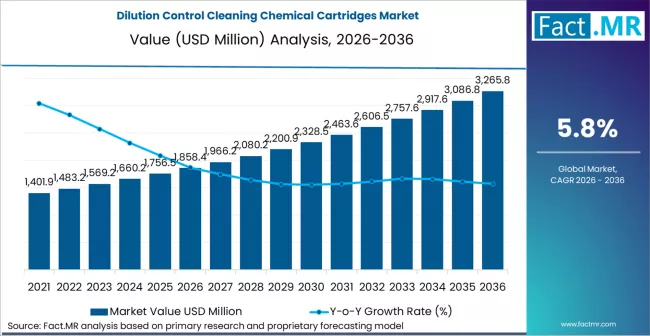
The market is shifting toward 'Precision Hygiene,' fueled by strategic mergers and advancements in technology. Industry leaders are focusing more on AI-driven metering and smart-dosage systems, moving away from traditional bulk chemical sales. By 2026, closed-loop cartridges are expected to become the global standard, enhancing user safety, minimizing chemical waste, and reducing plastic footprints by up to 90%.
Strategic moves, like Clorox's acquisition of GOJO Industries and Ecolab's launch of CIP IQ™ with AI-enhanced dosing systems, emphasize the shift toward more efficient and sustainable cleaning solutions. As Ecolab's spokesperson states, “Our technology is enabling customers to optimize chemical usage, driving both cost savings and sustainability goals.”
These changes align with increasing ESG compliance requirements and the industry's shift toward digitally optimized safety and efficiency, which is set to become standard by 2026.
Dilution Control Cleaning Chemical Cartridges Market
| Metric | Value |
|---|---|
| Estimated Value in (2026E) | USD 1,858.4 million |
| Forecast Value in (2036F) | USD 3,265.8 million |
| Forecast CAGR (2026 to 2036) | 5.8% |
Category
| Category | Segments |
|---|---|
| System Type | Closed-Loop Cartridge Systems; Open Dilution / Dispenser-Compatible Packs; Single-Use Pods / Capsules; Other Systems |
| Product Family | Restroom & Sanitizers; General-Purpose & Glass; Degreasers & Kitchen; Floor Care |
| End-Use Sector | Commercial Facilities; Industrial; Healthcare & Institutions; Hospitality & Foodservice |
| Contracting Model | Jan-San Distributor Programs; Direct Facility Contracts; OEM-Tied Programs |
| Region | North America; Europe; Asia Pacific; Latin America; Middle East & Africa |
Segmental Analysis
What Is the Impact of System Type on the Dilution Control Cleaning Chemical Cartridges Market?
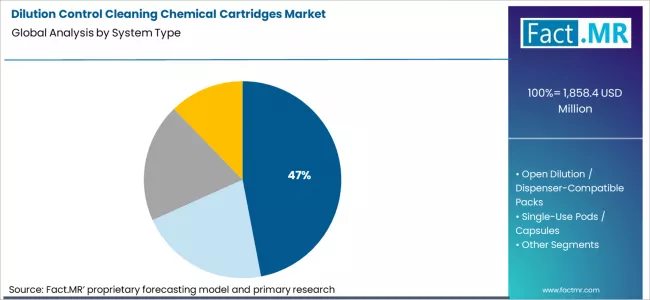
System type in the dilution control cleaning chemical cartridges market plays a crucial role in determining operational efficiency, product compatibility, and safety in chemical handling. Closed-loop cartridge systems hold the largest market share at 47.0%, thanks to their design, which prevents exposure to concentrated chemicals and ensures safer, more accurate dilution. These systems are commonly used in commercial and institutional environments like hospitals, schools, and large facilities, where accurate chemical mixing and contamination prevention are essential. The closed-loop design improves safety, consistency, reduces waste, and ensures compliance with regulatory standards. Their dominance stems from their reliability and the increasing demand for automated, safe, and efficient chemical dispensing solutions in high-demand commercial environments.
How Does Product Family Shape Demand in the Dilution Control Cleaning Chemical Cartridges Market?
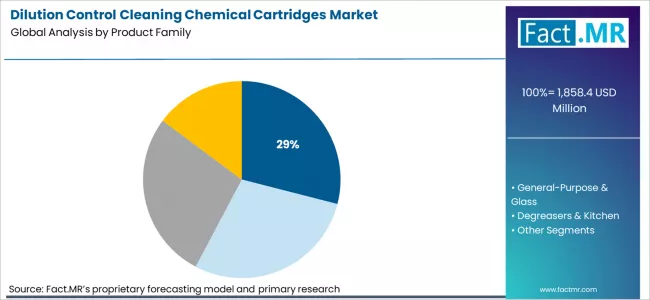
In the dilution control cleaning chemical cartridges market, product family plays a key role in meeting specific cleaning needs across diverse environments. Restroom & sanitizers account for a 29.0% share, driven by the high demand for effective disinfectants in high-traffic areas like commercial restrooms, healthcare facilities, and foodservice environments. These areas require products that ensure rapid microbial control while adhering to stringent sanitation standards. The continued emphasis on hygiene, particularly in light of heightened awareness of health and cleanliness, supports the demand for restroom-specific chemicals. Sanitizing solutions in these environments are expected to grow due to increasing hygiene standards, regulatory requirements, and consumer expectations for clean and safe public spaces.
What are the Drivers, Restraints, and Key Trends in the Dilution Control Cleaning Chemical Cartridges Market?
| Country | Driver | Restraint | Trend |
|---|---|---|---|
| USA | Widespread adoption in commercial cleaning for consistency and safety. | Higher upfront cost of dilution control systems. | Shift toward automated and IoT enabled dilution dispensing. |
| UK | Strong hygiene regulations in hospitality and healthcare sectors. | Budget constraints in smaller businesses limiting system upgrades. | Increasing preference for eco certified and biodegradable cartridges. |
| Germany | Industrial emphasis on workplace safety and standardization. | Complex compliance requirements for chemical handling systems. | Integration of smart monitoring for usage and inventory control. |
| China | Rapid expansion of commercial facilities driving demand for standardized cleaning. | Supply chain variability affecting cartridge availability and pricing. | Growth in locally manufactured dilution control solutions. |
| India | Rising focus on hygiene in retail, hospitality, and facilities management. | Limited awareness and adoption in small and mid sized enterprises. | Adoption of packaged dilution systems with training and support services. |
Analysis of the Dilution Control Cleaning Chemical Cartridges Market by Key Country
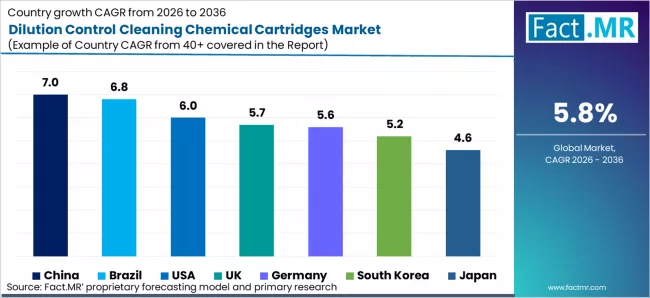
| Country | CAGR (%) |
|---|---|
| China | 7.0% |
| Brazil | 6.8% |
| USA | 6.0% |
| UK | 5.7% |
| Germany | 5.6% |
| South Korea | 5.2% |
| Japan | 4.6% |
The report covers an in-depth analysis of 40+ countries; top-performing countries are highlighted below.
What drives growth in China for dilution control cleaning chemical cartridges?
China is projected to grow at 7.0% CAGR, supported by rapid industrial expansion, modernization of facilities management, and increased regulatory emphasis on workplace safety and environmental protection. Chinese standards for occupational health and centralized cleaning operations in commercial and healthcare facilities have elevated the adoption of dilution control systems that deliver precise dosing and reduced chemical exposure. Domestic manufacturers are expanding production of cartridge compatible formulations tailored to automated dispensing platforms used in high volume applications.
“In high growth urban and industrial regions, facilities are specifying dilution control cartridges to ensure consistent cleaning outcomes while reducing operational risk,” explains Li Wei, Product Manager at a leading Chinese cleaning chemicals company.
Large commercial properties and institutional contracts increasingly mandate measured dosing to minimize chemical waste and support sustainability reporting.
What fuels the rapid rise in Brazil?
Brazil’s dilution control cleaning chemical cartridges market is expected to grow at 6.8% CAGR, driven by expanding hospitality and institutional sectors where standardized dosing improves efficiency and worker safety. Urban centers with high footfall in commercial spaces, healthcare facilities, and logistics hubs increasingly deploy cartridge based systems to cut down on over dilution or under dilution, which can compromise both hygiene and cost control. Brazilian cleaning service firms emphasize measurable outcomes and reduced chemical waste to satisfy both clients and environmental expectations.
“Cartridge dilution delivers reliable chemistry strength that helps us meet contractual cleaning standards without over using products,” says Carlos Oliveira, Operations Manager at a Brazilian facilities service company.
Market growth benefits from strong distribution networks and localized training on system operation.
How is the USA market evolving in the Dilution Control Cleaning Chemical Cartridges sector?
The USA market is forecast to grow at 6.0%, reflecting sustained adoption of dilution control systems that improve dosing accuracy, reduce chemical waste, and enhance worker safety across commercial, industrial, and institutional cleaning programs. Facilities managers increasingly specify cartridge based dilution systems to ensure consistent chemistry strength, reduce over use of concentrated products, and improve compliance with environmental health and safety standards. According to the Cleaning Products Industry Association, dilution control technology helps lower total cost of ownership by minimizing chemical consumption and spill related hazards.
“Cartridge based dilution has become a cornerstone of proactive sanitation practices because it standardizes dosing and reduces worker exposure to concentrated chemicals,” says Jennifer Brooks, Director of Environmental Health at a major U.S. facilities services provider.
Despite pressures to reduce procurement costs, demand continues as organizations prioritize wastewater reduction, regulatory compliance, and simplified training requirements associated with cartridge systems.
Why is the UK market critical for dilution control cleaning chemical cartridges?
The UK market is expanding at 5.7%, anchored in stringent hygiene standards across healthcare, transport, and education sectors where consistent chemical dosing is critical. Public health bodies and facility operators emphasize documented cleaning protocols to reduce infection risks and improve auditability. Cartridge based dilution systems are valued for reducing user error and ensuring repeatable cleaning performance across multiple sites.
“Standardizing chemical dilution with cartridge systems enhances accountability and reduces variability in cleaning outcomes, which is essential in regulated environments,” says Dr. Amelia Clarke, Head of Facilities Hygiene at a UK NHS trust.
Procurement tends to favor solutions that align with sustainability frameworks and reduce packaging waste through controlled chemical usage.
What is driving expansion in Germany?
Germany is projected to grow at 5.6% CAGR, supported by advanced industrial and commercial cleaning practices that emphasize precision, efficiency, and compliance. Leading facility operators adopt dilution control cartridges to standardize dosing, reduce chemical waste, and support stringent environmental and occupational safety policies. The German Institute for Standardization and related bodies recommend measured dosing to support predictable performance and minimize exposure risk.
“In our industrial cleaning programs, cartridge based dilution helps ensure consistency and reduces risk of worker exposure to concentrated chemicals,” explains Dr. Petra Müller, Head of Workplace Safety at a German industrial group.
Strong regulatory frameworks and corporate sustainability mandates reinforce adoption of these systems.
How is South Korea shaping demand for dilution control cleaning chemical cartridges?
South Korea’s market is growing at 5.2% CAGR, underpinned by increased adoption in high density commercial and institutional environments where precise dosing supports both cleanliness and reduced chemical footprint. Facility managers in sectors such as healthcare, hospitality, and transportation prioritize cartridge systems that limit exposure, streamline training, and improve operational consistency. Government campaigns on water and chemical use efficiency also encourage specifications favoring dilution control technology.
“In environments where cleaning quality and chemical control are paramount, cartridge dilution systems deliver measurable improvements in both safety and cost management,” says Min Jae Kim, Facility Operations Director at a South Korean cleaning services firm.
Export demand for South Korean cleaning solutions incorporating measured dosing further bolsters the segment.
What fuels the gradual rise in Japan?
Japan’s dilution control cleaning chemical cartridges market is forecast to grow at 4.6% CAGR, reflecting careful but steady uptake in facilities where precision and quality assurance are highly valued. Japanese institutions, particularly in healthcare, hospitality, and corporate campuses, emphasize stable dosing protocols and reduced chemical waste, aligning with national guidelines on occupational safety and environmental impact. Cartridge systems are appreciated for reducing training complexity and enhancing data traceability for audit purposes.
“In high standards cleaning environments, cartridge based dilution supports consistent, documented dosing that aligns with our rigorous quality expectations,” explains Hiroshi Tanaka, Technical Consultant at a Japanese facility services provider.
Conservative procurement cycles temper rapid expansion, yet ongoing emphasis on quality and sustainability sustains long term demand.
What Strategic Moves Are Defining Competitive Landscape?
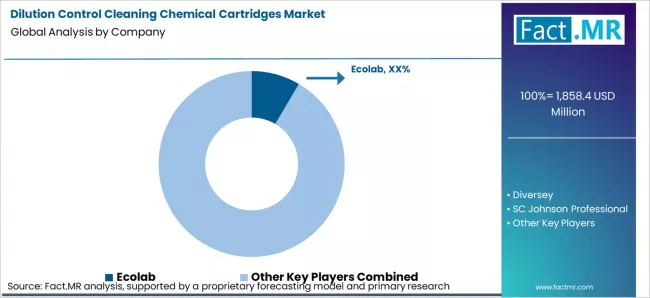
The dilution control cleaning chemical cartridges market is transitioning from a volume-based model to an intelligence-driven 'Outcome-as-a-Service' approach. From 2020 to 2024, the industry prioritized the adoption of closed-loop systems to reduce manual mixing errors and improve worker safety. Companies like Ecolab, Diversey, and 3M focused on deploying 'smart' dispensers that track usage rates and maintain consistent sanitation standards. Though this phase reduced chemical waste and lowered liability risks, it often left facility managers with isolated data that was hard to integrate into broader building systems.
Looking ahead to 2026 and beyond, the industry is shifting its focus toward autonomous process management and comprehensive resource optimization. Investment is growing in IoT-enabled cartridges that directly connect with robotic floor scrubbers and smart facility dashboards. Leadership's focus has shifted from cost per gallon to the accuracy of the 'Digital Hygiene Twin,' which offers real-time insights into cost-per-clean and carbon footprint metrics. Christophe Beck, CEO of Ecolab, stresses the importance of this digital shift for staying competitive in an ever-evolving industrial landscape.
"There are probably two types of companies: the ones who are saying, 'My God, this is a train that has left the station. I’d better get on that train as quickly as I can.' And you have a group saying, 'I’m going to take my time.' I’m afraid that latter group will not like where it ends up." - Christophe Beck, CEO of Ecolab
SC Johnson Professional and P&G Professional are using their scale to roll out ultra-concentrated, plastic-free cartridges that meet zero-waste goals. Specialists like Betco and Spartan Chemical are developing 'system-compatible' chemistries tailored for the sensitive sensors in autonomous cleaning fleets. This strategic shift helps manufacturers stay competitive as the market moves from reactive procurement to a more predictive, fully integrated asset management model.
Key Players in the Dilution Control Cleaning Chemical Cartridges Market
- Ecolab
- Diversey
- SC Johnson Professional
- Betco
- Spartan Chemical
- Zep
- 3M
- Solenis
- CloroxPro
- P&G Professional
Scope of the Report
| Items | Values |
|---|---|
| Quantitative Units | USD million |
| System Type | Closed-Loop Cartridge Systems; Open Dilution / Dispenser-Compatible Packs; Single-Use Pods / Capsules; Other Systems |
| Product Family | Restroom & Sanitizers; General-Purpose & Glass; Degreasers & Kitchen; Floor Care |
| End-Use Sector | Commercial Facilities; Industrial; Healthcare & Institutions; Hospitality & Foodservice |
| Contracting Model | Jan-San Distributor Programs; Direct Facility Contracts; OEM-Tied Programs |
| Regions Covered | Asia Pacific, Europe, North America, Latin America, Middle East & Africa |
| Countries Covered | China, Brazil, USA, UK, Germany, South Korea, Japan, and 40+ countries |
| Key Companies Profiled | Ecolab; Diversey; SC Johnson Professional; Betco; Spartan Chemical; Zep; 3M; Solenis; CloroxPro; P&G Professional |
| Additional Attributes | Dollar sales by system type, product family, and end-use sector; rising demand for closed-loop and single-use pod systems driving growth in healthcare and hospitality sectors; increasing preference for eco-friendly, concentrated cleaning solutions enhancing market opportunities; robust demand from commercial cleaning contracts, especially in large facilities, contributing to market expansion; adoption of dilution control systems tied to cost reduction and environmental benefits. |
Dilution Control Cleaning Chemical Cartridges Market Key Segment
-
System Type :
- Closed-Loop Cartridge Systems
- Open Dilution / Dispenser-Compatible Packs
- Single-Use Pods / Capsules
- Other Systems
-
Product Family :
- Restroom & Sanitizers
- General-Purpose & Glass
- Degreasers & Kitchen
- Floor Care
-
End-Use Sector :
- Commercial Facilities
- Industrial
- Healthcare & Institutions
- Hospitality & Foodservice
-
Contracting Model :
- Jan-San Distributor Programs
- Direct Facility Contracts
- OEM-Tied Programs
-
Region :
- North America
- USA
- Canada
- Mexico
- Europe
- Germany
- UK
- France
- Italy
- Spain
- Nordic Countries
- BENELUX
- Rest of Europe
- Asia Pacific
- China
- Japan
- South Korea
- India
- Australia
- Rest of Asia Pacific
- Latin America
- Brazil
- Argentina
- Rest of Latin America
- Middle East and Africa
- Kingdom of Saudi Arabia
- United Arab Emirates
- South Africa
- Rest of Middle East and Africa
- Other Regions
- Oceania
- Central Asia
- Other Markets
- North America
Bibliographies
- International Organization for Standardization. (2023). ISO 9001:2015-Quality management systems: Application in chemical dispensing and dilution systems. International Organization for Standardization.
- European Chemicals Agency. (2024). Guidance on safe use of detergents and disinfectants in professional cleaning systems. European Chemicals Agency.
- U.S. Environmental Protection Agency. (2023). Safer Choice program: Formulation and dispensing considerations for concentrated cleaning products. U.S. Environmental Protection Agency.
- Health and Safety Executive. (2023). Control of substances hazardous to health (COSHH): Safe dilution and dispensing of cleaning chemicals. Health and Safety Executive.
- Ecolab. (2024). Closed-loop dilution control systems: Safety, accuracy, and sustainability performance. Ecolab technical documentation.
Table of Content
- Executive Summary
- Global Market Outlook
- Demand to side Trends
- Supply to side Trends
- Technology Roadmap Analysis
- Analysis and Recommendations
- Market Overview
- Market Coverage / Taxonomy
- Market Definition / Scope / Limitations
- Research Methodology
- Chapter Orientation
- Analytical Lens and Working Hypotheses
- Market Structure, Signals, and Trend Drivers
- Benchmarking and Cross-market Comparability
- Market Sizing, Forecasting, and Opportunity Mapping
- Research Design and Evidence Framework
- Desk Research Programme (Secondary Evidence)
- Company Annual and Sustainability Reports
- Peer-reviewed Journals and Academic Literature
- Corporate Websites, Product Literature, and Technical Notes
- Earnings Decks and Investor Briefings
- Statutory Filings and Regulatory Disclosures
- Technical White Papers and Standards Notes
- Trade Journals, Industry Magazines, and Analyst Briefs
- Conference Proceedings, Webinars, and Seminar Materials
- Government Statistics Portals and Public Data Releases
- Press Releases and Reputable Media Coverage
- Specialist Newsletters and Curated Briefings
- Sector Databases and Reference Repositories
- FMR Internal Proprietary Databases and Historical Market Datasets
- Subscription Datasets and Paid Sources
- Social Channels, Communities, and Digital Listening Inputs
- Additional Desk Sources
- Expert Input and Fieldwork (Primary Evidence)
- Primary Modes
- Qualitative Interviews and Expert Elicitation
- Quantitative Surveys and Structured Data Capture
- Blended Approach
- Why Primary Evidence is Used
- Field Techniques
- Interviews
- Surveys
- Focus Groups
- Observational and In-context Research
- Social and Community Interactions
- Stakeholder Universe Engaged
- C-suite Leaders
- Board Members
- Presidents and Vice Presidents
- R&D and Innovation Heads
- Technical Specialists
- Domain Subject-matter Experts
- Scientists
- Physicians and Other Healthcare Professionals
- Governance, Ethics, and Data Stewardship
- Research Ethics
- Data Integrity and Handling
- Primary Modes
- Tooling, Models, and Reference Databases
- Desk Research Programme (Secondary Evidence)
- Data Engineering and Model Build
- Data Acquisition and Ingestion
- Cleaning, Normalisation, and Verification
- Synthesis, Triangulation, and Analysis
- Quality Assurance and Audit Trail
- Market Background
- Market Dynamics
- Drivers
- Restraints
- Opportunity
- Trends
- Scenario Forecast
- Demand in Optimistic Scenario
- Demand in Likely Scenario
- Demand in Conservative Scenario
- Opportunity Map Analysis
- Product Life Cycle Analysis
- Supply Chain Analysis
- Investment Feasibility Matrix
- Value Chain Analysis
- PESTLE and Porter’s Analysis
- Regulatory Landscape
- Regional Parent Market Outlook
- Production and Consumption Statistics
- Import and Export Statistics
- Market Dynamics
- Global Market Analysis 2021 to 2025 and Forecast, 2026 to 2036
- Historical Market Size Value (USD Million) Analysis, 2021 to 2025
- Current and Future Market Size Value (USD Million) Projections, 2026 to 2036
- Y to o to Y Growth Trend Analysis
- Absolute $ Opportunity Analysis
- Global Market Pricing Analysis 2021 to 2025 and Forecast 2026 to 2036
- Global Market Analysis 2021 to 2025 and Forecast 2026 to 2036, By System Type
- Introduction / Key Findings
- Historical Market Size Value (USD Million) Analysis By System Type, 2021 to 2025
- Current and Future Market Size Value (USD Million) Analysis and Forecast By System Type, 2026 to 2036
- Closed-Loop Cartridge Systems
- Open Dilution / Dispenser-Compatible Packs
- Single-Use Pods / Capsules
- Other Systems
- Closed-Loop Cartridge Systems
- Y to o to Y Growth Trend Analysis By System Type, 2021 to 2025
- Absolute $ Opportunity Analysis By System Type, 2026 to 2036
- Global Market Analysis 2021 to 2025 and Forecast 2026 to 2036, By Product Family
- Introduction / Key Findings
- Historical Market Size Value (USD Million) Analysis By Product Family, 2021 to 2025
- Current and Future Market Size Value (USD Million) Analysis and Forecast By Product Family, 2026 to 2036
- Restroom & Sanitizers
- General-Purpose & Glass
- Degreasers & Kitchen
- Floor Care
- Restroom & Sanitizers
- Y to o to Y Growth Trend Analysis By Product Family, 2021 to 2025
- Absolute $ Opportunity Analysis By Product Family, 2026 to 2036
- Global Market Analysis 2021 to 2025 and Forecast 2026 to 2036, By End-Use Sector
- Introduction / Key Findings
- Historical Market Size Value (USD Million) Analysis By End-Use Sector, 2021 to 2025
- Current and Future Market Size Value (USD Million) Analysis and Forecast By End-Use Sector, 2026 to 2036
- Commercial Facilities
- Industrial
- Healthcare & Institutions
- Hospitality & Foodservice
- Commercial Facilities
- Y to o to Y Growth Trend Analysis By End-Use Sector, 2021 to 2025
- Absolute $ Opportunity Analysis By End-Use Sector, 2026 to 2036
- Global Market Analysis 2021 to 2025 and Forecast 2026 to 2036, By Contracting Model
- Introduction / Key Findings
- Historical Market Size Value (USD Million) Analysis By Contracting Model, 2021 to 2025
- Current and Future Market Size Value (USD Million) Analysis and Forecast By Contracting Model, 2026 to 2036
- Jan-San Distributor Programs
- Direct Facility Contracts
- OEM-Tied Programs
- Jan-San Distributor Programs
- Y to o to Y Growth Trend Analysis By Contracting Model, 2021 to 2025
- Absolute $ Opportunity Analysis By Contracting Model, 2026 to 2036
- Global Market Analysis 2021 to 2025 and Forecast 2026 to 2036, By Region
- Introduction
- Historical Market Size Value (USD Million) Analysis By Region, 2021 to 2025
- Current Market Size Value (USD Million) Analysis and Forecast By Region, 2026 to 2036
- North America
- Latin America
- Western Europe
- Eastern Europe
- East Asia
- South Asia and Pacific
- Middle East & Africa
- Market Attractiveness Analysis By Region
- North America Market Analysis 2021 to 2025 and Forecast 2026 to 2036, By Country
- Historical Market Size Value (USD Million) Trend Analysis By Market Taxonomy, 2021 to 2025
- Market Size Value (USD Million) Forecast By Market Taxonomy, 2026 to 2036
- By Country
- USA
- Canada
- Mexico
- By System Type
- By Product Family
- By End-Use Sector
- By Contracting Model
- By Country
- Market Attractiveness Analysis
- By Country
- By System Type
- By Product Family
- By End-Use Sector
- By Contracting Model
- Key Takeaways
- Latin America Market Analysis 2021 to 2025 and Forecast 2026 to 2036, By Country
- Historical Market Size Value (USD Million) Trend Analysis By Market Taxonomy, 2021 to 2025
- Market Size Value (USD Million) Forecast By Market Taxonomy, 2026 to 2036
- By Country
- Brazil
- Chile
- Rest of Latin America
- By System Type
- By Product Family
- By End-Use Sector
- By Contracting Model
- By Country
- Market Attractiveness Analysis
- By Country
- By System Type
- By Product Family
- By End-Use Sector
- By Contracting Model
- Key Takeaways
- Western Europe Market Analysis 2021 to 2025 and Forecast 2026 to 2036, By Country
- Historical Market Size Value (USD Million) Trend Analysis By Market Taxonomy, 2021 to 2025
- Market Size Value (USD Million) Forecast By Market Taxonomy, 2026 to 2036
- By Country
- Germany
- UK
- Italy
- Spain
- France
- Nordic
- BENELUX
- Rest of Western Europe
- By System Type
- By Product Family
- By End-Use Sector
- By Contracting Model
- By Country
- Market Attractiveness Analysis
- By Country
- By System Type
- By Product Family
- By End-Use Sector
- By Contracting Model
- Key Takeaways
- Eastern Europe Market Analysis 2021 to 2025 and Forecast 2026 to 2036, By Country
- Historical Market Size Value (USD Million) Trend Analysis By Market Taxonomy, 2021 to 2025
- Market Size Value (USD Million) Forecast By Market Taxonomy, 2026 to 2036
- By Country
- Russia
- Poland
- Hungary
- Balkan & Baltic
- Rest of Eastern Europe
- By System Type
- By Product Family
- By End-Use Sector
- By Contracting Model
- By Country
- Market Attractiveness Analysis
- By Country
- By System Type
- By Product Family
- By End-Use Sector
- By Contracting Model
- Key Takeaways
- East Asia Market Analysis 2021 to 2025 and Forecast 2026 to 2036, By Country
- Historical Market Size Value (USD Million) Trend Analysis By Market Taxonomy, 2021 to 2025
- Market Size Value (USD Million) Forecast By Market Taxonomy, 2026 to 2036
- By Country
- China
- Japan
- South Korea
- By System Type
- By Product Family
- By End-Use Sector
- By Contracting Model
- By Country
- Market Attractiveness Analysis
- By Country
- By System Type
- By Product Family
- By End-Use Sector
- By Contracting Model
- Key Takeaways
- South Asia and Pacific Market Analysis 2021 to 2025 and Forecast 2026 to 2036, By Country
- Historical Market Size Value (USD Million) Trend Analysis By Market Taxonomy, 2021 to 2025
- Market Size Value (USD Million) Forecast By Market Taxonomy, 2026 to 2036
- By Country
- India
- ASEAN
- Australia & New Zealand
- Rest of South Asia and Pacific
- By System Type
- By Product Family
- By End-Use Sector
- By Contracting Model
- By Country
- Market Attractiveness Analysis
- By Country
- By System Type
- By Product Family
- By End-Use Sector
- By Contracting Model
- Key Takeaways
- Middle East & Africa Market Analysis 2021 to 2025 and Forecast 2026 to 2036, By Country
- Historical Market Size Value (USD Million) Trend Analysis By Market Taxonomy, 2021 to 2025
- Market Size Value (USD Million) Forecast By Market Taxonomy, 2026 to 2036
- By Country
- Kingdom of Saudi Arabia
- Other GCC Countries
- Turkiye
- South Africa
- Other African Union
- Rest of Middle East & Africa
- By System Type
- By Product Family
- By End-Use Sector
- By Contracting Model
- By Country
- Market Attractiveness Analysis
- By Country
- By System Type
- By Product Family
- By End-Use Sector
- By Contracting Model
- Key Takeaways
- Key Countries Market Analysis
- USA
- Pricing Analysis
- Market Share Analysis, 2025
- By System Type
- By Product Family
- By End-Use Sector
- By Contracting Model
- Canada
- Pricing Analysis
- Market Share Analysis, 2025
- By System Type
- By Product Family
- By End-Use Sector
- By Contracting Model
- Mexico
- Pricing Analysis
- Market Share Analysis, 2025
- By System Type
- By Product Family
- By End-Use Sector
- By Contracting Model
- Brazil
- Pricing Analysis
- Market Share Analysis, 2025
- By System Type
- By Product Family
- By End-Use Sector
- By Contracting Model
- Chile
- Pricing Analysis
- Market Share Analysis, 2025
- By System Type
- By Product Family
- By End-Use Sector
- By Contracting Model
- Germany
- Pricing Analysis
- Market Share Analysis, 2025
- By System Type
- By Product Family
- By End-Use Sector
- By Contracting Model
- UK
- Pricing Analysis
- Market Share Analysis, 2025
- By System Type
- By Product Family
- By End-Use Sector
- By Contracting Model
- Italy
- Pricing Analysis
- Market Share Analysis, 2025
- By System Type
- By Product Family
- By End-Use Sector
- By Contracting Model
- Spain
- Pricing Analysis
- Market Share Analysis, 2025
- By System Type
- By Product Family
- By End-Use Sector
- By Contracting Model
- France
- Pricing Analysis
- Market Share Analysis, 2025
- By System Type
- By Product Family
- By End-Use Sector
- By Contracting Model
- India
- Pricing Analysis
- Market Share Analysis, 2025
- By System Type
- By Product Family
- By End-Use Sector
- By Contracting Model
- ASEAN
- Pricing Analysis
- Market Share Analysis, 2025
- By System Type
- By Product Family
- By End-Use Sector
- By Contracting Model
- Australia & New Zealand
- Pricing Analysis
- Market Share Analysis, 2025
- By System Type
- By Product Family
- By End-Use Sector
- By Contracting Model
- China
- Pricing Analysis
- Market Share Analysis, 2025
- By System Type
- By Product Family
- By End-Use Sector
- By Contracting Model
- Japan
- Pricing Analysis
- Market Share Analysis, 2025
- By System Type
- By Product Family
- By End-Use Sector
- By Contracting Model
- South Korea
- Pricing Analysis
- Market Share Analysis, 2025
- By System Type
- By Product Family
- By End-Use Sector
- By Contracting Model
- Russia
- Pricing Analysis
- Market Share Analysis, 2025
- By System Type
- By Product Family
- By End-Use Sector
- By Contracting Model
- Poland
- Pricing Analysis
- Market Share Analysis, 2025
- By System Type
- By Product Family
- By End-Use Sector
- By Contracting Model
- Hungary
- Pricing Analysis
- Market Share Analysis, 2025
- By System Type
- By Product Family
- By End-Use Sector
- By Contracting Model
- Kingdom of Saudi Arabia
- Pricing Analysis
- Market Share Analysis, 2025
- By System Type
- By Product Family
- By End-Use Sector
- By Contracting Model
- Turkiye
- Pricing Analysis
- Market Share Analysis, 2025
- By System Type
- By Product Family
- By End-Use Sector
- By Contracting Model
- South Africa
- Pricing Analysis
- Market Share Analysis, 2025
- By System Type
- By Product Family
- By End-Use Sector
- By Contracting Model
- USA
- Market Structure Analysis
- Competition Dashboard
- Competition Benchmarking
- Market Share Analysis of Top Players
- By Regional
- By System Type
- By Product Family
- By End-Use Sector
- By Contracting Model
- Competition Analysis
- Competition Deep Dive
- Ecolab
- Overview
- Product Portfolio
- Profitability by Market Segments (Product/Age /Sales Channel/Region)
- Sales Footprint
- Strategy Overview
- Marketing Strategy
- Product Strategy
- Channel Strategy
- Diversey
- SC Johnson Professional
- Betco
- Spartan Chemical
- Zep
- 3M
- Solenis
- CloroxPro
- P&G Professional
- Ecolab
- Competition Deep Dive
- Assumptions & Acronyms Used
List Of Table
- Table 1: Global Market Value (USD Million) Forecast by Region, 2021 to 2036
- Table 2: Global Market Value (USD Million) Forecast by System Type, 2021 to 2036
- Table 3: Global Market Value (USD Million) Forecast by Product Family, 2021 to 2036
- Table 4: Global Market Value (USD Million) Forecast by End-Use Sector, 2021 to 2036
- Table 5: Global Market Value (USD Million) Forecast by Contracting Model, 2021 to 2036
- Table 6: North America Market Value (USD Million) Forecast by Country, 2021 to 2036
- Table 7: North America Market Value (USD Million) Forecast by System Type, 2021 to 2036
- Table 8: North America Market Value (USD Million) Forecast by Product Family, 2021 to 2036
- Table 9: North America Market Value (USD Million) Forecast by End-Use Sector, 2021 to 2036
- Table 10: North America Market Value (USD Million) Forecast by Contracting Model, 2021 to 2036
- Table 11: Latin America Market Value (USD Million) Forecast by Country, 2021 to 2036
- Table 12: Latin America Market Value (USD Million) Forecast by System Type, 2021 to 2036
- Table 13: Latin America Market Value (USD Million) Forecast by Product Family, 2021 to 2036
- Table 14: Latin America Market Value (USD Million) Forecast by End-Use Sector, 2021 to 2036
- Table 15: Latin America Market Value (USD Million) Forecast by Contracting Model, 2021 to 2036
- Table 16: Western Europe Market Value (USD Million) Forecast by Country, 2021 to 2036
- Table 17: Western Europe Market Value (USD Million) Forecast by System Type, 2021 to 2036
- Table 18: Western Europe Market Value (USD Million) Forecast by Product Family, 2021 to 2036
- Table 19: Western Europe Market Value (USD Million) Forecast by End-Use Sector, 2021 to 2036
- Table 20: Western Europe Market Value (USD Million) Forecast by Contracting Model, 2021 to 2036
- Table 21: Eastern Europe Market Value (USD Million) Forecast by Country, 2021 to 2036
- Table 22: Eastern Europe Market Value (USD Million) Forecast by System Type, 2021 to 2036
- Table 23: Eastern Europe Market Value (USD Million) Forecast by Product Family, 2021 to 2036
- Table 24: Eastern Europe Market Value (USD Million) Forecast by End-Use Sector, 2021 to 2036
- Table 25: Eastern Europe Market Value (USD Million) Forecast by Contracting Model, 2021 to 2036
- Table 26: East Asia Market Value (USD Million) Forecast by Country, 2021 to 2036
- Table 27: East Asia Market Value (USD Million) Forecast by System Type, 2021 to 2036
- Table 28: East Asia Market Value (USD Million) Forecast by Product Family, 2021 to 2036
- Table 29: East Asia Market Value (USD Million) Forecast by End-Use Sector, 2021 to 2036
- Table 30: East Asia Market Value (USD Million) Forecast by Contracting Model, 2021 to 2036
- Table 31: South Asia and Pacific Market Value (USD Million) Forecast by Country, 2021 to 2036
- Table 32: South Asia and Pacific Market Value (USD Million) Forecast by System Type, 2021 to 2036
- Table 33: South Asia and Pacific Market Value (USD Million) Forecast by Product Family, 2021 to 2036
- Table 34: South Asia and Pacific Market Value (USD Million) Forecast by End-Use Sector, 2021 to 2036
- Table 35: South Asia and Pacific Market Value (USD Million) Forecast by Contracting Model, 2021 to 2036
- Table 36: Middle East & Africa Market Value (USD Million) Forecast by Country, 2021 to 2036
- Table 37: Middle East & Africa Market Value (USD Million) Forecast by System Type, 2021 to 2036
- Table 38: Middle East & Africa Market Value (USD Million) Forecast by Product Family, 2021 to 2036
- Table 39: Middle East & Africa Market Value (USD Million) Forecast by End-Use Sector, 2021 to 2036
- Table 40: Middle East & Africa Market Value (USD Million) Forecast by Contracting Model, 2021 to 2036
List Of Figures
- Figure 1: Global Market Pricing Analysis
- Figure 2: Global Market Value (USD Million) Forecast 2021 to 2036
- Figure 3: Global Market Value Share and BPS Analysis by System Type, 2026 and 2036
- Figure 4: Global Market Y to o to Y Growth Comparison by System Type, 2026 to 2036
- Figure 5: Global Market Attractiveness Analysis by System Type
- Figure 6: Global Market Value Share and BPS Analysis by Product Family, 2026 and 2036
- Figure 7: Global Market Y to o to Y Growth Comparison by Product Family, 2026 to 2036
- Figure 8: Global Market Attractiveness Analysis by Product Family
- Figure 9: Global Market Value Share and BPS Analysis by End-Use Sector, 2026 and 2036
- Figure 10: Global Market Y to o to Y Growth Comparison by End-Use Sector, 2026 to 2036
- Figure 11: Global Market Attractiveness Analysis by End-Use Sector
- Figure 12: Global Market Value Share and BPS Analysis by Contracting Model, 2026 and 2036
- Figure 13: Global Market Y to o to Y Growth Comparison by Contracting Model, 2026 to 2036
- Figure 14: Global Market Attractiveness Analysis by Contracting Model
- Figure 15: Global Market Value (USD Million) Share and BPS Analysis by Region, 2026 and 2036
- Figure 16: Global Market Y to o to Y Growth Comparison by Region, 2026 to 2036
- Figure 17: Global Market Attractiveness Analysis by Region
- Figure 18: North America Market Incremental Dollar Opportunity, 2026 to 2036
- Figure 19: Latin America Market Incremental Dollar Opportunity, 2026 to 2036
- Figure 20: Western Europe Market Incremental Dollar Opportunity, 2026 to 2036
- Figure 21: Eastern Europe Market Incremental Dollar Opportunity, 2026 to 2036
- Figure 22: East Asia Market Incremental Dollar Opportunity, 2026 to 2036
- Figure 23: South Asia and Pacific Market Incremental Dollar Opportunity, 2026 to 2036
- Figure 24: Middle East & Africa Market Incremental Dollar Opportunity, 2026 to 2036
- Figure 25: North America Market Value Share and BPS Analysis by Country, 2026 and 2036
- Figure 26: North America Market Value Share and BPS Analysis by System Type, 2026 and 2036
- Figure 27: North America Market Y to o to Y Growth Comparison by System Type, 2026 to 2036
- Figure 28: North America Market Attractiveness Analysis by System Type
- Figure 29: North America Market Value Share and BPS Analysis by Product Family, 2026 and 2036
- Figure 30: North America Market Y to o to Y Growth Comparison by Product Family, 2026 to 2036
- Figure 31: North America Market Attractiveness Analysis by Product Family
- Figure 32: North America Market Value Share and BPS Analysis by End-Use Sector, 2026 and 2036
- Figure 33: North America Market Y to o to Y Growth Comparison by End-Use Sector, 2026 to 2036
- Figure 34: North America Market Attractiveness Analysis by End-Use Sector
- Figure 35: North America Market Value Share and BPS Analysis by Contracting Model, 2026 and 2036
- Figure 36: North America Market Y to o to Y Growth Comparison by Contracting Model, 2026 to 2036
- Figure 37: North America Market Attractiveness Analysis by Contracting Model
- Figure 38: Latin America Market Value Share and BPS Analysis by Country, 2026 and 2036
- Figure 39: Latin America Market Value Share and BPS Analysis by System Type, 2026 and 2036
- Figure 40: Latin America Market Y to o to Y Growth Comparison by System Type, 2026 to 2036
- Figure 41: Latin America Market Attractiveness Analysis by System Type
- Figure 42: Latin America Market Value Share and BPS Analysis by Product Family, 2026 and 2036
- Figure 43: Latin America Market Y to o to Y Growth Comparison by Product Family, 2026 to 2036
- Figure 44: Latin America Market Attractiveness Analysis by Product Family
- Figure 45: Latin America Market Value Share and BPS Analysis by End-Use Sector, 2026 and 2036
- Figure 46: Latin America Market Y to o to Y Growth Comparison by End-Use Sector, 2026 to 2036
- Figure 47: Latin America Market Attractiveness Analysis by End-Use Sector
- Figure 48: Latin America Market Value Share and BPS Analysis by Contracting Model, 2026 and 2036
- Figure 49: Latin America Market Y to o to Y Growth Comparison by Contracting Model, 2026 to 2036
- Figure 50: Latin America Market Attractiveness Analysis by Contracting Model
- Figure 51: Western Europe Market Value Share and BPS Analysis by Country, 2026 and 2036
- Figure 52: Western Europe Market Value Share and BPS Analysis by System Type, 2026 and 2036
- Figure 53: Western Europe Market Y to o to Y Growth Comparison by System Type, 2026 to 2036
- Figure 54: Western Europe Market Attractiveness Analysis by System Type
- Figure 55: Western Europe Market Value Share and BPS Analysis by Product Family, 2026 and 2036
- Figure 56: Western Europe Market Y to o to Y Growth Comparison by Product Family, 2026 to 2036
- Figure 57: Western Europe Market Attractiveness Analysis by Product Family
- Figure 58: Western Europe Market Value Share and BPS Analysis by End-Use Sector, 2026 and 2036
- Figure 59: Western Europe Market Y to o to Y Growth Comparison by End-Use Sector, 2026 to 2036
- Figure 60: Western Europe Market Attractiveness Analysis by End-Use Sector
- Figure 61: Western Europe Market Value Share and BPS Analysis by Contracting Model, 2026 and 2036
- Figure 62: Western Europe Market Y to o to Y Growth Comparison by Contracting Model, 2026 to 2036
- Figure 63: Western Europe Market Attractiveness Analysis by Contracting Model
- Figure 64: Eastern Europe Market Value Share and BPS Analysis by Country, 2026 and 2036
- Figure 65: Eastern Europe Market Value Share and BPS Analysis by System Type, 2026 and 2036
- Figure 66: Eastern Europe Market Y to o to Y Growth Comparison by System Type, 2026 to 2036
- Figure 67: Eastern Europe Market Attractiveness Analysis by System Type
- Figure 68: Eastern Europe Market Value Share and BPS Analysis by Product Family, 2026 and 2036
- Figure 69: Eastern Europe Market Y to o to Y Growth Comparison by Product Family, 2026 to 2036
- Figure 70: Eastern Europe Market Attractiveness Analysis by Product Family
- Figure 71: Eastern Europe Market Value Share and BPS Analysis by End-Use Sector, 2026 and 2036
- Figure 72: Eastern Europe Market Y to o to Y Growth Comparison by End-Use Sector, 2026 to 2036
- Figure 73: Eastern Europe Market Attractiveness Analysis by End-Use Sector
- Figure 74: Eastern Europe Market Value Share and BPS Analysis by Contracting Model, 2026 and 2036
- Figure 75: Eastern Europe Market Y to o to Y Growth Comparison by Contracting Model, 2026 to 2036
- Figure 76: Eastern Europe Market Attractiveness Analysis by Contracting Model
- Figure 77: East Asia Market Value Share and BPS Analysis by Country, 2026 and 2036
- Figure 78: East Asia Market Value Share and BPS Analysis by System Type, 2026 and 2036
- Figure 79: East Asia Market Y to o to Y Growth Comparison by System Type, 2026 to 2036
- Figure 80: East Asia Market Attractiveness Analysis by System Type
- Figure 81: East Asia Market Value Share and BPS Analysis by Product Family, 2026 and 2036
- Figure 82: East Asia Market Y to o to Y Growth Comparison by Product Family, 2026 to 2036
- Figure 83: East Asia Market Attractiveness Analysis by Product Family
- Figure 84: East Asia Market Value Share and BPS Analysis by End-Use Sector, 2026 and 2036
- Figure 85: East Asia Market Y to o to Y Growth Comparison by End-Use Sector, 2026 to 2036
- Figure 86: East Asia Market Attractiveness Analysis by End-Use Sector
- Figure 87: East Asia Market Value Share and BPS Analysis by Contracting Model, 2026 and 2036
- Figure 88: East Asia Market Y to o to Y Growth Comparison by Contracting Model, 2026 to 2036
- Figure 89: East Asia Market Attractiveness Analysis by Contracting Model
- Figure 90: South Asia and Pacific Market Value Share and BPS Analysis by Country, 2026 and 2036
- Figure 91: South Asia and Pacific Market Value Share and BPS Analysis by System Type, 2026 and 2036
- Figure 92: South Asia and Pacific Market Y to o to Y Growth Comparison by System Type, 2026 to 2036
- Figure 93: South Asia and Pacific Market Attractiveness Analysis by System Type
- Figure 94: South Asia and Pacific Market Value Share and BPS Analysis by Product Family, 2026 and 2036
- Figure 95: South Asia and Pacific Market Y to o to Y Growth Comparison by Product Family, 2026 to 2036
- Figure 96: South Asia and Pacific Market Attractiveness Analysis by Product Family
- Figure 97: South Asia and Pacific Market Value Share and BPS Analysis by End-Use Sector, 2026 and 2036
- Figure 98: South Asia and Pacific Market Y to o to Y Growth Comparison by End-Use Sector, 2026 to 2036
- Figure 99: South Asia and Pacific Market Attractiveness Analysis by End-Use Sector
- Figure 100: South Asia and Pacific Market Value Share and BPS Analysis by Contracting Model, 2026 and 2036
- Figure 101: South Asia and Pacific Market Y to o to Y Growth Comparison by Contracting Model, 2026 to 2036
- Figure 102: South Asia and Pacific Market Attractiveness Analysis by Contracting Model
- Figure 103: Middle East & Africa Market Value Share and BPS Analysis by Country, 2026 and 2036
- Figure 104: Middle East & Africa Market Value Share and BPS Analysis by System Type, 2026 and 2036
- Figure 105: Middle East & Africa Market Y to o to Y Growth Comparison by System Type, 2026 to 2036
- Figure 106: Middle East & Africa Market Attractiveness Analysis by System Type
- Figure 107: Middle East & Africa Market Value Share and BPS Analysis by Product Family, 2026 and 2036
- Figure 108: Middle East & Africa Market Y to o to Y Growth Comparison by Product Family, 2026 to 2036
- Figure 109: Middle East & Africa Market Attractiveness Analysis by Product Family
- Figure 110: Middle East & Africa Market Value Share and BPS Analysis by End-Use Sector, 2026 and 2036
- Figure 111: Middle East & Africa Market Y to o to Y Growth Comparison by End-Use Sector, 2026 to 2036
- Figure 112: Middle East & Africa Market Attractiveness Analysis by End-Use Sector
- Figure 113: Middle East & Africa Market Value Share and BPS Analysis by Contracting Model, 2026 and 2036
- Figure 114: Middle East & Africa Market Y to o to Y Growth Comparison by Contracting Model, 2026 to 2036
- Figure 115: Middle East & Africa Market Attractiveness Analysis by Contracting Model
- Figure 116: Global Market - Tier Structure Analysis
- Figure 117: Global Market - Company Share Analysis
- FAQs -
How big is the dilution control cleaning chemical cartridges market in 2026?
The global dilution control cleaning chemical cartridges market is estimated to be valued at USD 1,858.4 million in 2026.
What will be the size of dilution control cleaning chemical cartridges market in 2036?
The market size for the dilution control cleaning chemical cartridges market is projected to reach USD 3,265.8 million by 2036.
How much will be the dilution control cleaning chemical cartridges market growth between 2026 and 2036?
The dilution control cleaning chemical cartridges market is expected to grow at a 5.8% CAGR between 2026 and 2036.
What are the key product types in the dilution control cleaning chemical cartridges market?
The key product types in dilution control cleaning chemical cartridges market are closed-loop cartridge systems, open dilution / dispenser-compatible packs, single-use pods / capsules and other systems.
Which product family segment to contribute significant share in the dilution control cleaning chemical cartridges market in 2026?
In terms of product family, restroom & sanitizers segment to command 29.0% share in the dilution control cleaning chemical cartridges market in 2026.