- Market Value (2025): USD 5.95 Bn
- Estimated Value (2026): USD 6.26 Bn
- Forecast Value (2036): USD 10.5 Bn
- CAGR (2026-2036): 5.3%
What is the Diphtheria, Tetanus, and Pertussis (DTaP) Vaccine Market forecast to be worth by 2036?
USD 6.26 billion in 2026 to USD 10.5 billion by 2036 at a 5.3% CAGR.
- Fact.MR estimates the DTaP vaccine market at USD 5.95 billion for 2025, a base formed mostly by infant primary series and toddler boosters bought by public programmes.
- Value will move from USD 6.26 billion in 2026 to USD 10.5 billion by 2036, as booster doses for school children, teenagers and pregnant women take a larger slice of each schedule.
- Annual expansion of 5.3% CAGR from 2026 to 2036 reflects catch-up work after recent pertussis outbreaks and a steady move toward hexavalent presentations.
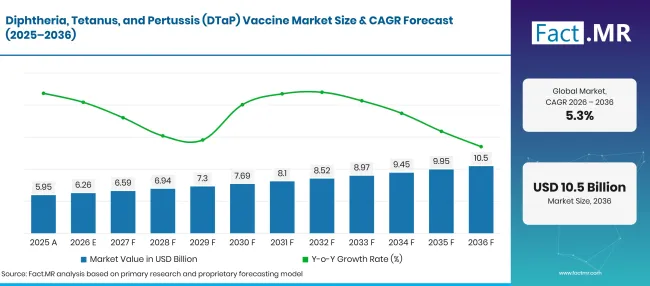
Diphtheria Tetanus And Pertussis Dtap Vaccine Market Forecast Global 1 | Source: Fact.MR
| Year | Basis | Market Value (USD billion) |
|---|---|---|
| 2025 | Actual | 5.95 |
| 2026 | Estimate | 6.26 |
| 2036 | Forecast | 10.5 |
| CAGR 2026 to 2036 | Forecast period | 5.3% |
Source: Fact.MR analysis. Updated Oct 26, 2026
What are the defining numbers behind Diphtheria, Tetanus, and Pertussis (DTaP) Vaccine Market growth?
USD 4.2 billion in added revenue will be generated between 2026 and 2036, led by booster and combination doses.
- Demand Drivers in the Market
- Whooping cough outbreaks have returned on a scale not seen in years. The Pan American Health Organization reported that 977,000 pertussis cases were recorded worldwide in 2024, up from 167,407 in 2023 [1]. Health ministries answered with catch-up rounds and tighter booster timing.
- Pertussis vaccine demand in Europe follows the infant burden. ECDC counted 209,674 pertussis cases across 29 EU/EEA countries in 2024, a notification rate of 54.9 per 100,000 population [2]. Vaccinating mothers during pregnancy is the main tool for shielding babies too young for their own primary series.
- Tetanus protection keeps adults in the dose count. ECDC reported 19 fatal tetanus cases in the EU/EEA in 2024, with adults aged 65 and above the most affected group [3]. Ten-yearly Td and Tdap boosters for older adults and wound care in emergency rooms support steady adult orders.
- Combination vaccines for infants cut the number of injections per visit. Parents and nurses prefer one shot that also covers polio, Hib and hepatitis B, so ministries upgrade presentations when tenders renew.
- Stockpiles and pooled purchases smooth national buying. Government agencies hold reserve doses for outbreaks, and their replenishment cycles shift orders between quarters without changing underlying demand.
- Key Segments Analyzed
- By Vaccine Type: Acellular will take 62.3% share in 2026, since every Tdap booster and most high-income infant schedules rely on purified pertussis antigens.
- By Age Group: Pediatric will command 71.8% share in 2026, reflecting up to six pertussis-containing doses given before a child leaves school.
- By Distribution Channel: Hospitals will capture 38.4% share in 2026 owing to birth-dose clinics, maternity wards and emergency tetanus care under one roof.
- By End-User: Public will account for 68.5% share in 2026 because national immunization programmes fund routine childhood doses free at the point of care.
- Analyst Opinion at Fact.MR
- Shambhu Nath Jha, Principal Consultant at Fact.MR, states, “Pertussis outbreaks after 2023 reminded every health ministry that protection from acellular vaccines fades, and the answer has been more boosters at more ages. The suppliers that gain will be those able to deliver liquid hexavalent infant products and adult Tdap at scale in the same year. Shrinking birth cohorts in Japan and Europe will cap infant volume, so booster uptake will decide how far revenue grows.”
- Strategic Implications
- DTaP manufacturers should plan pertussis antigen capacity for outbreak years, since booster recommendations tend to widen quickly once infant deaths are reported.
- Ministries of health should pair hexavalent switches with reminder systems for toddler and preschool boosters, where coverage drops most.
- Maternity services should offer pertussis vaccination at routine antenatal visits, so uptake does not depend on a separate appointment.
- Pharmacy chains should stock adult Tdap for wound care and travel clients who fall outside public schedules.
Germany will lead at 6.4% CAGR as low on-time series completion leaves room for catch-up doses. At 5.7%, the United Kingdom follows, with booster coverage gaps that the NHS is working to close. Brazil will grow at 5.3% while its health system responds to a pertussis resurgence among infants. For the United States, a 4.8% rate rests on a five-dose childhood series paid by public and private payers. Japan rounds off the list at 4.2%, where record-low births weigh against a broader combination schedule.
How does the Diphtheria, Tetanus, and Pertussis (DTaP) Vaccine Market break down by segment?
Acellular will lead Vaccine Type at 62.3%; Pediatric will head Age Group at 71.8%; Hospitals will rank first in Distribution Channel at 38.4%; Public will top End-User at 68.5%.
Which Vaccine Type dominates?
Acellular products represent 62.3% of 2026 revenue.
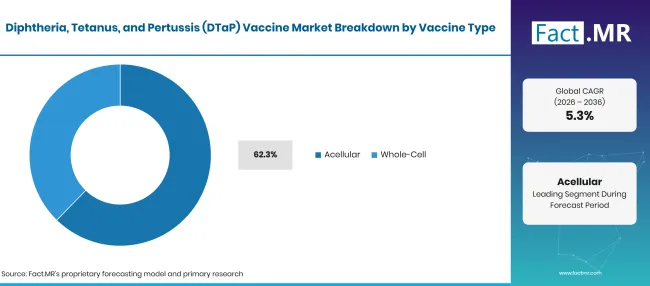
Diphtheria Tetanus And Pertussis Dtap Vaccine Market Breakdown Vaccine Type | Source: Fact.MR
| Vaccine Type | Share (2026) |
|---|---|
| Acellular (Leading segment) | 62.3% |
| Other segments combined | 37.7%* |
| Total | 100.0% |
Source: Fact.MR analysis. Updated Oct 26, 2026
Fewer fevers and local reactions led high-income countries to replace whole-cell pertussis in the 1990s and 2000s. Acellular products also carry a higher price per dose, so their weight in revenue exceeds their weight in volume. The U.S. label for Vaxelis, revised in April 2026, covers a three-dose series of a DTaP, polio, Hib and hepatitis B combination from 6 weeks through 4 years of age [4]. Whole-cell pertussis vaccines remain the base of pentavalent and hexavalent programmes in lower-income countries. They cost less to make and have a long record in national programmes, which keeps them in pooled tenders. Most whole-cell doses ship in multi-dose vials given with auto-disable syringes to prevent reuse.
What leads the Age Group segment?
Pediatric doses make up 71.8% of 2026 revenue.
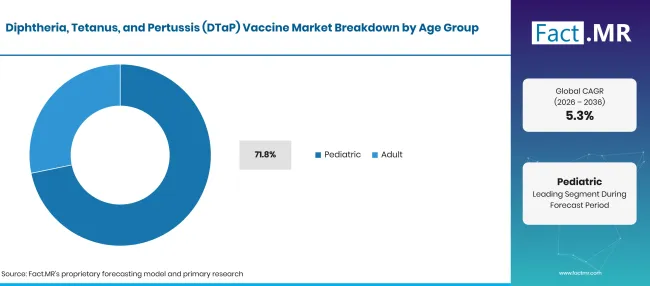
Diphtheria Tetanus And Pertussis Dtap Vaccine Market Breakdown Age Group | Source: Fact.MR
| Age Group | Share (2026) |
|---|---|
| Pediatric (Leading segment) | 71.8% |
| Other segments combined | 28.2%* |
| Total | 100.0% |
Source: Fact.MR analysis. Updated Oct 26, 2026
Children receive primary doses in the first months of life, a toddler booster and a preschool booster. Teenagers then receive Tdap. Each extra dose a country adds lifts pediatric demand even when birth numbers fall. Infants carry the heaviest disease burden, which keeps schedules focused on early protection. In 2024, ECDC recorded notification rates of 318.5 per 100,000 in infants under one year [2]. Adult demand rests on Tdap in pregnancy, ten-yearly boosters and wound care, and it overlaps with the wider adult vaccines business.
How does Distribution Channel shape demand?
Hospitals hold 38.4% of 2026 revenue.
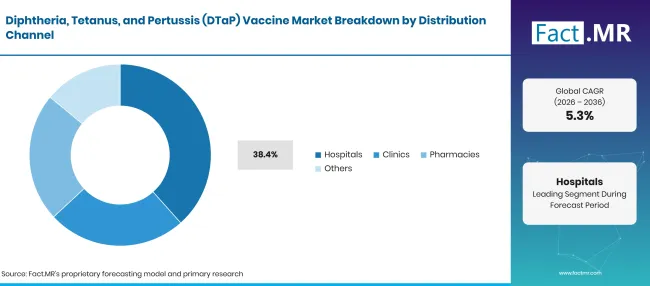
Diphtheria Tetanus And Pertussis Dtap Vaccine Market Breakdown Distribution Channel | Source: Fact.MR
| Distribution Channel | Share (2026) |
|---|---|
| Hospitals (Leading segment) | 38.4% |
| Other segments combined | 61.6%* |
| Total | 100.0% |
Source: Fact.MR analysis. Updated Oct 26, 2026
Many health systems give the first contact with a vaccinator in or near the maternity ward, and hospitals also handle tetanus prophylaxis after injury. Hospital pharmacies buy in bulk and often stock several DTaP and Tdap presentations at once. Clinics and pediatric practices give most scheduled toddler and preschool doses during check-ups. Pharmacies serve adults seeking Tdap before travel or a new grandchild. Prefilled syringes and other vaccine delivery devices shorten preparation time in every channel.
What supports Public within End-User?
Public buyers account for 68.5% of 2026 revenue.
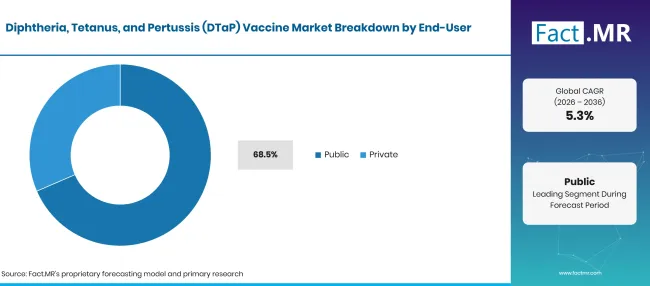
Diphtheria Tetanus And Pertussis Dtap Vaccine Market Breakdown End User | Source: Fact.MR
| End-User | Share (2026) |
|---|---|
| Public (Leading segment) | 68.5% |
| Other segments combined | 31.5%* |
| Total | 100.0% |
Source: Fact.MR analysis. Updated Oct 26, 2026
Governments write the schedule, fund the doses and choose the presentation, so public buyers control most of the volume. Contracts often run for several years and specify delivery windows by region. In the United States, CDC reported that pertussis cases have trended down since a peak in November 2024 but stayed above pre-pandemic levels in 2025 [5]. Private buyers include insurers, employers and households paying for travel, occupational or optional combination doses. Spending on meningococcal vaccines and other adolescent shots often shares the same private budget.
What is accelerating Diphtheria, Tetanus, and Pertussis (DTaP) Vaccine Market adoption, and what is holding it back?
Wider booster schedules, maternal pertussis programmes and hexavalent upgrades will lift demand through 2036. Falling birth cohorts, uneven booster uptake and parental hesitancy in some countries will slow volume growth.
Drivers Impact Analysis
| DRIVER | (~) % IMPACT ON CAGR | GEOGRAPHIC RELEVANCE | IMPACT TIMELINE |
|---|---|---|---|
| Booster doses added for toddlers, school children and teenagers | +1.5% | Western Europe, North America, East Asia | Medium term (2-4 years) |
| Public funding of infant primary series | +1.3% | Global | Short term (<= 2 years) |
| Pertussis vaccination during pregnancy | +1.0% | Western Europe, North America, Latin America | Short term (<= 2 years) |
| Shift from pentavalent to hexavalent presentations | +0.8% | Latin America, South Asia & Pacific, East Asia | Medium term (2-4 years) |
| Ten-yearly adult Td and Tdap boosters | +0.5% | North America, Western Europe | Long term (>= 4 years) |
Source: Fact.MR analysis. Updated Oct 26, 2026
Opportunity Impact Analysis
| OPPORTUNITY | (~) % IMPACT ON CAGR | GEOGRAPHIC RELEVANCE | IMPACT TIMELINE |
|---|---|---|---|
| Hexavalent combinations in schedules still using separate injections | +0.8% | East Asia, Latin America | Long term (>= 4 years) |
| Pharmacy-based Tdap for adults and new grandparents | +0.6% | North America, Western Europe | Medium term (2-4 years) |
| Catch-up campaigns after outbreak years | +0.5% | Latin America, Middle East & Africa | Short term (<= 2 years) |
Source: Fact.MR analysis. Updated Oct 26, 2026
Restraints Impact Analysis
| RESTRAINT | (~) % IMPACT ON CAGR | GEOGRAPHIC RELEVANCE | IMPACT TIMELINE |
|---|---|---|---|
| Shrinking birth cohorts in mature economies | -0.7% | East Asia, Western Europe | Long term (>= 4 years) |
| Low completion of preschool and adolescent boosters | -0.5% | Western Europe, North America | Medium term (2-4 years) |
| Vaccine hesitancy and non-medical exemptions | -0.4% | North America, Western Europe | Medium term (2-4 years) |
Source: Fact.MR analysis. Updated Oct 26, 2026
Which countries are scaling the Diphtheria, Tetanus, and Pertussis (DTaP) Vaccine Market through 2036?
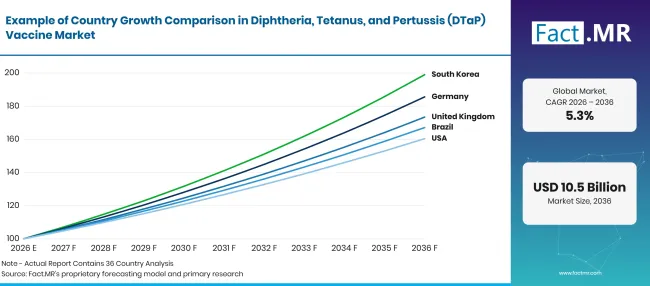
Diphtheria Tetanus And Pertussis Dtap Vaccine Market Growth Index | Source: Fact.MR
| Country | CAGR (2026 to 2036) |
|---|---|
| Germany | 6.4% |
| United Kingdom | 5.7% |
| Brazil | 5.3% |
| United States | 4.8% |
| Japan | 4.2% |
Source: Fact.MR analysis. Updated Oct 26, 2026
What supports Germany’s adoption?
6.4% CAGR, driven by catch-up of late infant doses and wider pertussis vaccination in pregnancy.
DTaP vaccination in Germany starts on time but often finishes late. The Robert Koch Institute reported that only 76% of children born in 2022 were fully vaccinated against diphtheria, tetanus and pertussis by 24 months of age [6]. Pertussis vaccination in pregnancy reached 51% for pregnancies that began in 2023 [6]. Pediatric practices bill these doses to statutory health insurers.
How is the United Kingdom scaling demand?
5.7% CAGR, helped by work to close gaps in infant and preschool coverage.
UKHSA’s quarterly COVER data for April to June 2026 put England’s 6-in-1 coverage at 12 months at 89.2% [7]. The DTaP/IPV preschool booster reached 81.1% of children at 5 years [7]. NHS practices buy these vaccines through central supply, so each gain in coverage converts directly into extra doses.
What is supporting Brazil’s adoption?
5.3% CAGR, as rising pertussis among babies pushes maternal and infant vaccination.
PAHO reported 2,682 confirmed pertussis cases in Brazil in 2025, including 12 deaths [8]. Infants carry much of that burden. In cases reported up to week 46 of 2025, 29.5% were children under one year, and 61% of those were under 6 months [9]. The Unified Health System buys pentavalent, DTP booster and dTpa doses centrally for free use.
How does the United States perform?
4.8% CAGR, backed by a five-dose childhood series funded by public and private payers.
CDC’s National Immunization Survey-Child found that 92.7% of children born in 2021 and 2022 had three or more DTaP doses by 24 months [10]. Only 80.7% had the fourth dose by that age [10]. Closing the gap on the fourth and fifth doses, plus Tdap at 11 to 12 years and in pregnancy, sustains orders through the Vaccines for Children program and private insurers.
How is Japan developing demand?
4.2% CAGR, reflecting fewer births set against a five-in-one infant combination.
Japan’s Ministry of Health, Labour and Welfare reported 671,236 births in 2025, down 14,937 from 2024, with a total fertility rate of 1.14 [11]. Each new cohort therefore buys fewer primary doses. The routine schedule uses DPT-IPV-Hib vaccines made by domestic producers, so price and schedule changes count for more than cohort size.
Who leads the Diphtheria, Tetanus, and Pertussis (DTaP) Vaccine Market?
Suppliers fall into three groups. Sanofi, GSK plc and Merck & Co., Inc. lead acellular sales in high-income markets with infant combinations and Tdap boosters such as Pentacel, Adacel, Infanrix, Pediarix and Boostrix. GSK said in October 2025 that favourable CDC stockpile movements helped year-to-date Infanrix and Pediarix sales, while stockpile timing weighed on Boostrix in the quarter [12].
Merck and Sanofi distribute the hexavalent Vaxelis in the United States [4]. Serum Institute of India, Biological E. Limited and Panacea Biotec supply whole-cell pentavalent and hexavalent vaccines to Indian and pooled tenders, and Serum Institute offers the hexavalent HEXASIIL. In Japan, BIKEN and KM Biologics produce DPT-IPV-Hib vaccines for the national schedule. BIKEN began a Phase III trial of a six-disease combination adding hepatitis B in October 2026 [13]. Combination breadth, prequalified capacity and steady delivery during outbreak years will separate winners in tenders.
Which companies are the key providers?
Key companies include Sanofi; GSK plc; Merck & Co., Inc.; Serum Institute of India Pvt. Ltd.; Biological E. Limited; Panacea Biotec Limited; BIKEN (The Research Foundation for Microbial Diseases of Osaka University); and KM Biologics Co., Ltd.
- Sanofi
- GSK plc
- Merck & Co., Inc.
- Serum Institute of India Pvt. Ltd.
- Biological E. Limited
- Panacea Biotec Limited
- BIKEN (The Research Foundation for Microbial Diseases of Osaka University)
- KM Biologics Co., Ltd.
Bibliography
- [1] Pan American Health Organization. (2025, December 9). PAHO renews call to close vaccination gaps amid whooping cough resurgence in the Americas.
- [2] European Centre for Disease Prevention and Control. (2026, April 20). Pertussis: Annual Epidemiological Report for 2024.
- [3] European Centre for Disease Prevention and Control. (2026, July 27). Tetanus: Annual Epidemiological Report 2024.
- [4] Merck Sharp & Dohme LLC and Sanofi Vaccines US Inc. (2026, April). VAXELIS (Diphtheria and Tetanus Toxoids and Acellular Pertussis, Inactivated Poliovirus, Haemophilus b Conjugate and Hepatitis B Vaccine) prescribing information.
- [5] Centers for Disease Control and Prevention. (2026, July 10). Pertussis Surveillance and Trends.
- [6] Robert Koch-Institut. (2025, December 11). Impfquoten in Deutschland [Immunization coverage in Germany], Epidemiologisches Bulletin 50/2025.
- [7] UK Health Security Agency. (2026, September 24). Quarterly vaccination coverage statistics for children aged up to 5 years in the UK (COVER programme): April to June 2026.
- [8] Pan American Health Organization. (2026, March 25). Epidemiological Update: Pertussis (Whooping Cough) in the Americas Region.
- [9] Pan American Health Organization. (2025, December 8). Epidemiological Update: Pertussis (Whooping Cough) in the Americas Region.
- [10] Centers for Disease Control and Prevention. (2026, March 26). Vaccination Coverage by Age 24 Months Among Children Born in 2021 and 2022: National Immunization Survey-Child, United States, 2022 to 2024.
- [11] Ministry of Health, Labour and Welfare, Japan. (2026, June).[Summary of 2025 preliminary annual vital statistics].
- [12] GSK plc. (2025, October 29). GSK delivers strong Q3 performance and upgrades 2025 guidance.
- [13] BIKEN. (2026, October 22). Initiation of Phase III Clinical Trial of a Combination Vaccine for Six Diseases (Pertussis, Diphtheria, Tetanus, Inactivated Polio, Hib, and Hepatitis B).
This Report Answers
- How much revenue do acellular and whole-cell pertussis combinations earn in infant and adult use through 2036?
- Which channel and payer type carry each leading subsegment, and why?
- Germany, the United Kingdom, Brazil, the United States and Japan are set side by side on coverage, outbreaks and birth trends.
- Profiles group DTaP and DTwP suppliers by pertussis technology and by the tenders they win.
- Booster ages, maternal doses and hexavalent switches are traced to show how doses per person change.
What does the Diphtheria, Tetanus, and Pertussis (DTaP) Vaccine Market cover?
Any vaccine that protects against diphtheria, tetanus and whooping cough in one product falls inside this market. That spans pediatric DTaP, whole-cell DTwP, adolescent and adult Tdap, and combinations that add polio, Hib or hepatitis B.
Revenue is tracked at manufacturer selling price for public and private buyers. Doses given in hospitals, clinics, pharmacies and outreach settings are all counted.
What is included in the scope?
Pentavalent and hexavalent products enter at full value, since the pertussis component fixes their place in the schedule. Tdap given in pregnancy or after an injury counts under the adult group.
Doses bought through national tenders, stockpile contracts and pooled procurement are included at contract price. Products from the wider vaccine market count only when they contain all three DTP antigens.
What is excluded from the scope?
Tetanus toxoid alone, Td and DT products lacking pertussis antigen are left out. Pertussis antibiotics and tetanus immune globulin are also excluded.
Adjuvant ingredients sold to vaccine makers belong to the vaccine adjuvants business and are not counted here. Administration fees, syringes and cold storage equipment also fall outside the revenue boundary.
How Was the Analysis Built?
The analysis draws on 120+ sources, 35+ company portfolios, 25+ countries, and more than 20 industry interviews.
- Primary Research: Primary research includes discussions with manufacturers, service providers, technology developers, distributors, end users, and subject-matter experts. These conversations examine purchasing priorities, product adoption, operational challenges, approval requirements, competitive positioning, and the factors that influence wider market acceptance.
- Desk Research: Desk research covers government statistics, regulatory publications, company filings, trade data, technical studies, industry associations, standards, public policy, and other authoritative sources. Every source used in the analysis is documented in the bibliography.
- Market Sizing and Forecasting: Market estimates combine historical performance, demand indicators, pricing and volume trends, segment shares, company participation, country-level growth, adoption patterns, investment activity, and barriers to market expansion.
- Data Validation and Update Cycle: Findings are validated by comparing primary interviews with public data, company activity, regulatory changes, trade patterns, and industry developments. Regular updates review new product launches, capacity changes, partnerships, approvals, and shifts in commercial adoption.
Segmentation
What is the report’s scope and coverage?
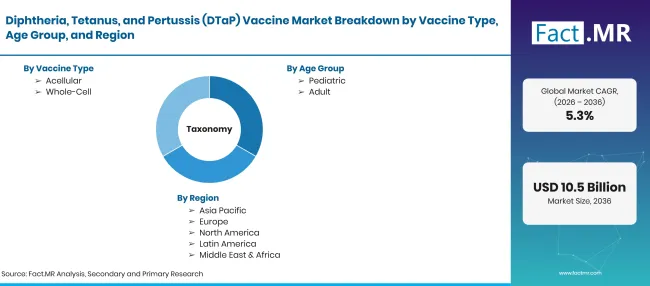
Diphtheria Tetanus And Pertussis Dtap Vaccine Market Taxonomy | Source: Fact.MR
| Attribute | Details |
|---|---|
| Quantitative Units | USD billion |
| Market Definition | Vaccines that combine diphtheria toxoid, tetanus toxoid and a pertussis antigen, including DTaP and DTwP products, Tdap boosters and pentavalent or hexavalent combinations built on them. |
| Vaccine Type | Acellular; Whole-Cell |
| Age Group | Pediatric; Adult |
| Distribution Channel | Hospitals; Clinics; Pharmacies; Others |
| End-User | Public; Private |
| Regions Covered | North America; Latin America; Western Europe; Eastern Europe; East Asia; South Asia & Pacific; Middle East & Africa |
| Countries Covered | Germany; United Kingdom; Brazil; United States; Japan |
| Companies Profiled | Sanofi; GSK plc; Merck & Co., Inc.; Serum Institute of India Pvt. Ltd.; Biological E. Limited; Panacea Biotec Limited; BIKEN (The Research Foundation for Microbial Diseases of Osaka University); KM Biologics Co., Ltd. |
| Forecast Period | 2026 to 2036 |
| Approach | Dose-based model built from birth cohorts, booster ages and pregnancy numbers; coverage by country; acellular and whole-cell price levels; channel mix; and supplier portfolio review. |
Source: Fact.MR analysis. Updated Oct 26, 2026
How is the market segmented?
-
By Vaccine Type
- Acellular
- Whole-Cell
-
By Age Group
- Pediatric
- Adult
-
By Distribution Channel
- Hospitals
- Clinics
- Pharmacies
- Others
-
By End-User
- Public
- Private
-
By Region
- North America
- Latin America
- Western Europe
- Eastern Europe
- East Asia
- South Asia & Pacific
- Middle East & Africa
Frequently Asked Questions
How big is the DTaP vaccine market in 2026?
What CAGR will the DTaP vaccine market record?
Which vaccine type leads the DTaP vaccine market?
Which age group generates most DTaP demand?
Which distribution channel leads DTaP vaccine sales?
Which end-user leads the DTaP vaccine market?
Which country will grow the most in the DTaP vaccine market?
Who supplies DTaP vaccines?
Who worked on this report


Preview the report firsthand - request a free sample
Free SampleGet the brochure for pricing and purchase details
Download PDF