Direct-to-Chip Cold Plate Market (2026 - 2036)
Direct-to-Chip Cold Plate Market Size and Share Forecast Outlook 2026 to 2036
Core Findings
Direct-to-Chip Cold Plate Market Forecast and Outlook 2026 to 2036
The direct-to-chip cold plate market is projected to grow at a CAGR of 7.0% from 2026 to 2036, expanding from USD 3.4 billion to USD 6.7 billion. Direct-to-chip cold plates have emerged from specialized cooling components into mission-critical infrastructure enabling modern AI and high-performance computing deployments. In hyperscale facilities, operators depend on precision-engineered cold plates delivering coolant directly to GPU surfaces handling thermal loads exceeding 1,000 watts. AI training clusters require liquid cooling solutions that remove heat at the source, maintaining processor junction temperatures within operational specifications.
Summary of Direct-to-Chip Cold Plate Market - Key Takeaways
- The market includes single-phase cold plates, two-phase systems, hybrid configurations, and manifolded multi-chip solutions designed for data center thermal management and high-performance computing applications.
- The defined scope covers revenue generated by cooling configuration, end application, material type, and distribution channel across global markets.
- The direct-to-chip cold plate market is projected to grow at a CAGR of 7.0% from 2026 to 2036, expanding from USD 3.4 billion to USD 6.7 billion based on Fact.MR analysis.
- Single-phase cooling configuration leads the market with a 45% share in 2025, supported by proven operational reliability and straightforward implementation architecture.
- Data centers account for 50% of total demand, driven by hyperscale operators deploying GPU clusters for AI training and inference workloads requiring liquid cooling.
- China records the fastest growth at 8.2% CAGR, supported by Internet Plus and Dual Carbon policies requiring PUE below 1.25 for new data center facilities.
- Competition is led by major players such as CoolIT, Asetek, Boyd, nVent, Parker Hannifin, Vertiv, Rittal, Mersen, Lytron, and Jabil Cooling.
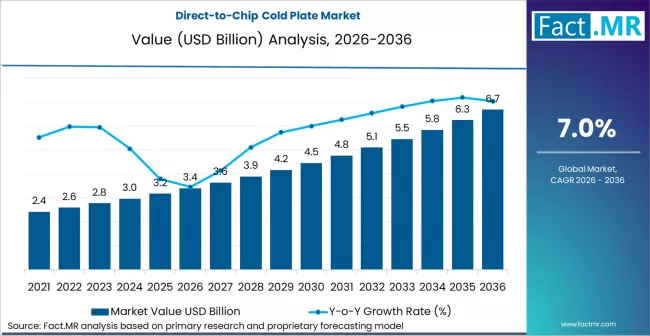
Beyond thermal capacity, efficiency is driving change. Modern facilities deploy integrated cooling systems that share coolant distribution infrastructure across multiple racks, reducing complexity and improving power usage effectiveness. These platforms synchronize with heat rejection equipment, meeting strict sustainability standards while maintaining computational performance. High-efficiency microchannel cold plates deliver superior heat transfer coefficients, enabling higher rack densities without proportional increases in cooling infrastructure investment.
Regulations are reshaping the industry, too. European dust safety mandates and post-Brexit UK HSE requirements push manufacturers toward integrated extraction solutions. As Thomas Mueller, Director of Professional Tools at Parker Hannifin, explains, craftspeople increasingly seek precision systems combining sawing, routing, and finishing tools in coordinated ecosystems that improve accuracy, reduce material waste, and meet stringent dust control standards across professional joinery applications.
Direct-to-Chip Cold Plate Market
| Metric | Value |
|---|---|
| Estimated Value in (2026) | USD 3.4 billion |
| Forecast Value in (2036) | USD 6.7 billion |
| Forecast CAGR 2026 to 2036 | 7.0% |
Category
| Category | Segments |
|---|---|
| Cooling Configuration | Single-Phase, Two-Phase, Hybrid w/ RDHx, Manifolded Multi-Chip |
| End Application | Data Centers, HPC, AI Servers, Telecom Racks |
| Material | Copper, Aluminum, Stainless/Composite |
| Distribution Channel | OEM Integrators, Retrofits, Design Firms |
| Region | North America; Europe; Asia Pacific; Latin America; Middle East & Africa |
Segmental Analysis
Why Does Single-Phase Cooling Lead the Market?
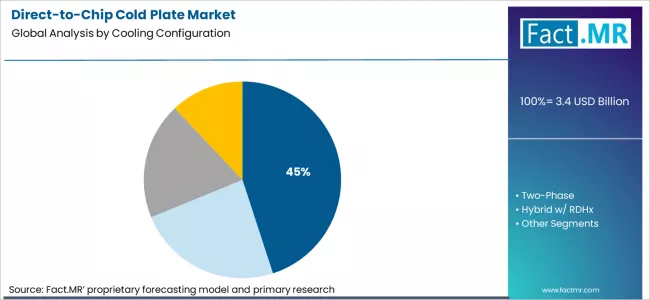
Single-phase cooling holds 45% of the global market share because it offers the best balance between performance, reliability, and operational simplicity. These systems circulate liquid coolant without phase change, making them easier to install and maintain compared to more complex two-phase designs. Data center operators prefer single-phase configurations because they integrate smoothly with existing facility water infrastructure and require less specialized maintenance expertise. They are also highly scalable. As processor power densities increase, single-phase cold plates provide consistent and predictable heat removal without introducing vapor management challenges. For operators seeking efficient thermal performance with lower technical risk, single-phase systems remain the most widely adopted configuration.
Why Do Data Centers Dominate End-Use Demand?
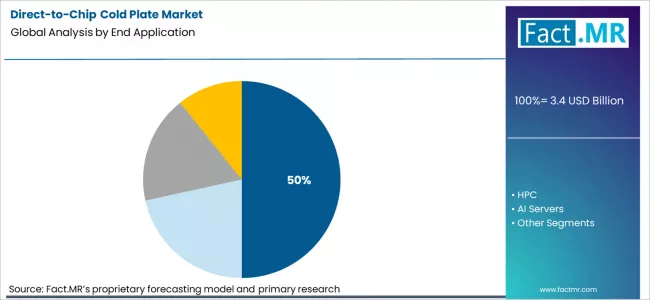
Data centers account for 50% of global market share because they face the highest and fastest-growing thermal loads. Hyperscale facilities and colocation providers operate thousands of servers running AI, cloud, and enterprise workloads that generate intense heat at the chip level. Direct-to-chip liquid cooling provides targeted thermal control that traditional air systems cannot match at high rack densities. Energy efficiency pressures also play a major role. Data center operators focus heavily on reducing power usage effectiveness (PUE), and liquid cooling significantly improves heat transfer efficiency. Given continuous cloud expansion and AI infrastructure scaling, data centers remain the largest and most influential segment in the market.
Drivers
- Drivers: Several key factors are shaping growth in the direct-to-chip cold plate market. Strong kitchen remodeling activity, particularly in the United States where renovation spending remains robust, is increasing demand for cordless high-torque screwdrivers and specialized cabinet fastening systems. Rising labor costs in developed markets are also pushing workshops and contractors to invest in automation and efficiency-enhancing tools that reduce installation time. Professional workshops must now comply with stricter dust control and workplace safety regulations, creating demand for integrated dust extraction systems that minimize exposure to wood and silica particles.
- Restraints: Despite strong professional demand, adoption can be limited by cost barriers. Professional-grade cordless tool platforms often require significant upfront investment in batteries and charging systems before the first tool is even purchased. Training requirements also add complexity, as workers must learn new equipment, digital systems, and updated safety protocols. Older workshops may struggle to integrate modern dust extraction systems with legacy ventilation infrastructure. In addition, the lack of battery standardization across brands forces professionals to maintain multiple incompatible platforms.
- Trend 1: Integrated systainer and tool ecosystem platforms The market is steadily moving toward fully integrated tool ecosystems. In Germany, Parker Hannifin introduced the TSC 55 KS plunge saw in March 2026 in response to efficiency and dust-control standards that emphasize clean, precise onsite work. These ecosystem platforms combine sawing, sanding, fastening, and dust extraction within coordinated systems stored in stackable Systainer cases for easy transport and organization.
- Trend 2: Smart measuring and AI-integrated layout tools Digitalization is reshaping installation practices. Smart measuring tools that connect directly to design software are becoming standard in professional cabinetry projects. In South Korea, technology-driven measuring devices and digital calipers now sync with CAD programs, enabling precise layouts for smart home-ready cabinetry. Laser distance meters with Bluetooth connectivity can scan rooms accurately and transmit measurements to tablets or smartphones, eliminating manual transcription errors.
Direct-to-Chip Cold Plate Market Analysis by Key Country
| Country | CAGR 2026 to 2036 |
|---|---|
| China | 8.2% |
| Brazil | 7.8% |
| Europe | 6.8% |
| United States | 6.7% |
| United Kingdom | 6.7% |
| Germany | 6.6% |
| South Korea | 6.2% |
| Japan | 5.5% |
What is accelerating China’s direct-to-chip liquid cooling market?
China is expanding at an 8.2% CAGR, supported by aggressive AI infrastructure deployment and national digital economy priorities. Government-backed data center expansion under “New Infrastructure” programs is driving rapid adoption of high-density liquid cooling systems. Domestic hyperscale operators are scaling AI clusters that require direct-to-chip cold plates to manage advanced GPU thermal loads. Local manufacturers are strengthening supply chains for copper cold plates and manifold systems to reduce reliance on imports. Energy efficiency mandates in major provinces are also encouraging liquid cooling to reduce power usage effectiveness (PUE) in large-scale facilities.
What is fueling Brazil’s steady growth in direct-to-chip cooling?
Brazil is growing at a 7.8% CAGR, supported by expanding cloud adoption and regional data center investments. São Paulo has emerged as a digital infrastructure hub serving Latin America. Rising power density in colocation facilities is pushing operators toward direct liquid cooling to maintain performance within constrained electrical and space limits. Regulatory focus on energy efficiency and grid reliability is encouraging investment in more thermally efficient server environments. As hyperscale players enter the region, adoption of chip-level cooling technologies is accelerating.
What factors are shaping growth in the United States market?
The United States is advancing at a 6.7% CAGR, largely driven by hyperscale AI deployments and semiconductor facility expansion under the CHIPS Act. Major cloud providers are building high-density AI clusters that require direct-to-chip cooling to manage extreme processor heat loads. Data center operators prioritize reducing PUE while supporting performance scaling. Federal and state-level incentives for energy-efficient infrastructure further encourage adoption. The strong presence of OEM integrators and cooling technology developers supports innovation and rapid commercialization.
What is influencing the United Kingdom’s direct-to-chip cooling development?
The United Kingdom is expanding at a 6.7% CAGR, supported by digital transformation initiatives and rising data center demand around London and regional hubs. Energy cost pressures and carbon reduction targets under the UK Net Zero strategy are encouraging liquid cooling adoption. Operators seek efficient solutions to comply with sustainability reporting requirements while maintaining high computational performance. Growth in fintech and AI research sectors also increases demand for HPC-ready cooling configurations.
How is Germany strengthening its position in this market?
Germany is recording a 6.6% CAGR, driven by industrial digitalization and strong HPC investment. Automotive engineering firms and research institutions are expanding AI and simulation capabilities that require high-performance computing clusters. National energy transition policies encourage efficiency improvements in data infrastructure. Precision engineering expertise supports domestic manufacturing of advanced cooling components. Sustainability compliance and Digital Product Passport initiatives reinforce demand for traceable, energy-efficient system designs.
What is supporting South Korea’s expansion in direct-to-chip cooling?
South Korea is growing at a 6.2% CAGR, propelled by semiconductor manufacturing dominance and AI data center development. Major technology companies are deploying advanced GPU clusters that require direct liquid cooling for stable operation. Government-backed smart infrastructure programs and energy efficiency goals support modernization of digital facilities. The country’s strong electronics ecosystem enables localized production of cold plates and manifold systems.
What factors are sustaining Japan’s direct-to-chip market growth?
Japan is advancing at a 5.5% CAGR, supported by steady HPC and semiconductor research investments. Energy efficiency priorities remain strong following national decarbonization commitments. Japanese data center operators are adopting liquid cooling to manage power-dense AI systems within space-constrained urban environments. Domestic engineering expertise contributes to precision cold plate manufacturing and hybrid cooling innovation. While overall expansion is moderate compared to faster-growing regions, demand for reliable, high-performance cooling systems remains consistent across research and enterprise computing sectors.
Competitive Landscape for Direct-to-Chip Cold Plate Market
The direct-to-chip cold plate market is highly competitive and largely driven by brands with deep roots in professional construction equipment. Companies such as CoolIT, nVent Tool, and Boyd leverage decades of experience in heavy-duty applications to serve cabinetry professionals. Their strengths lie in advanced brushless motor technology, high-capacity lithium-ion battery platforms, and precise speed control systems that ensure consistent results during cabinet installation and assembly. Vertical integration, from motor engineering to final tool production, allows these companies to maintain strong quality control and reliable warranty support.
European specialists such as Parker Hannifin and Vertiv focus heavily on engineering precision and dust-free operation. Their integrated dust extraction systems and organized Systainer storage platforms are designed to improve workflow efficiency and meet strict workplace safety standards. Meanwhile, Jabil Cooling Tool Company differentiates itself with cabinetry-focused jig systems and pocket hole solutions tailored to joinery accuracy.
As cordless technology becomes more standardized across the industry, competition is shifting beyond individual tools. Manufacturers are increasingly emphasizing ecosystem integration, shared battery platforms, digital connectivity, and specialized accessories. Professional workshops often commit to a single brand to standardize batteries and chargers, creating higher switching costs and reinforcing long-term brand loyalty once initial investments are made.
Recent Development
- In November 2025, Daikin Applied announced the acquisition of Chilldyne, a specialist in negative-pressure liquid cooling technology designed for chip-level and data center cooling. This deal adds direct-to-chip liquid cooling solutions to Daikin Applied’s portfolio, enhancing its ability to serve hyperscale and AI data center environments.
- In October 2025, Johnson Controls announced a multi-million-dollar strategic investment in Accelsius, a leader in two-phase direct-to-chip liquid cooling solutions for data centers. This backing supports scaled deployment of high-efficiency, two-phase cooling systems that help operators cut operational costs and energy use in power-dense HPC and AI workloads.
Key Market Players in Direct-to-Chip Cold Plate Market
- CoolIT
- Asetek
- Boyd
- nVent
- Parker Hannifin
- Vertiv
- Rittal
- Mersen
- Lytron
- Jabil Cooling
Scope of Report
| Items | Values |
|---|---|
| Quantitative Units (2026) | USD 3.4 Billion |
| Cooling Configuration | Single-Phase, Two-Phase, Hybrid w/ RDHx, Manifolded Multi-Chip |
| End Application | Data Centers, HPC, AI Servers, Telecom Racks |
| Material | Copper, Aluminum, Stainless/Composite |
| Distribution Channel | OEM Integrators, Retrofits, Design Firms |
| Regions Covered | North America, Europe, Asia Pacific, Latin America, Middle East & Africa |
| Countries Covered | U.S., China, Germany, UK, Japan, South Korea, Brazil, and other countries |
| Key Companies Profiled | CoolIT, Asetek, Boyd, nVent, Parker Hannifin, Vertiv, Rittal, Mersen, Lytron, Jabil Cooling |
| Additional Attributes | Dollar revenue in the direct-to-chip cold plate market is segmented by cooling configuration (single-phase, two-phase, hybrid with rear door heat exchanger, and manifolded multi-chip systems), by end application (data centers, high-performance computing, AI servers, and telecom racks), by material (copper, aluminum, and stainless steel/composite), by distribution channel (OEM integrators, retrofit installations, and design/engineering firms), and by region. |
Direct-to-Chip Cold Plate Market by Segments
-
Cooling Configuration :
- Single-Phase
- Two-Phase
- Hybrid w/ RDHx
- Manifolded Multi-Chip
-
End Application :
- Data Centers
- HPC
- AI Servers
- Telecom Racks
-
Material :
- Copper
- Aluminum
- Stainless/Composite
-
Distribution Channel :
- OEM Integrators
- Retrofits
- Design Firms
-
Region :
- Asia Pacific
- China
- Japan
- South Korea
- Rest of Asia Pacific
- North America
- United States
- Canada
- Mexico
- Europe
- Germany
- France
- UK
- Spain
- Rest of Europe
- Latin America
- Brazil
- Mexico
- Rest of Latin America
- Asia Pacific
Bibliography
- nVent Tool and Boyd USA. 2026. M18 and XGT precision product line expansion. Official company press releases and product documentation.
- Parker Hannifin GmbH. 2026. TSC 55 KS plunge saw launch and Bau-Effizienz standards compliance. Corporate innovation announcements and technical specifications.
- Boyd Corporation and KITZ. 2026. 40V max XGT woodworking units Universal Design initiative. Company product announcements and innovation reports.
- Trend Tool Technology and HSE UK. 2025-2026. Precision routing and dust safety equipment analysis. Regulatory guidance and industry compliance documentation.
- Health and Safety Executive UK. 2025-2026. Post-Brexit workplace dust control mandates. Official regulatory documentation and implementation frameworks.
Table of Content
- Executive Summary
- Global Market Outlook
- Demand to side Trends
- Supply to side Trends
- Technology Roadmap Analysis
- Analysis and Recommendations
- Market Overview
- Market Coverage / Taxonomy
- Market Definition / Scope / Limitations
- Research Methodology
- Chapter Orientation
- Analytical Lens and Working Hypotheses
- Market Structure, Signals, and Trend Drivers
- Benchmarking and Cross-market Comparability
- Market Sizing, Forecasting, and Opportunity Mapping
- Research Design and Evidence Framework
- Desk Research Programme (Secondary Evidence)
- Company Annual and Sustainability Reports
- Peer-reviewed Journals and Academic Literature
- Corporate Websites, Product Literature, and Technical Notes
- Earnings Decks and Investor Briefings
- Statutory Filings and Regulatory Disclosures
- Technical White Papers and Standards Notes
- Trade Journals, Industry Magazines, and Analyst Briefs
- Conference Proceedings, Webinars, and Seminar Materials
- Government Statistics Portals and Public Data Releases
- Press Releases and Reputable Media Coverage
- Specialist Newsletters and Curated Briefings
- Sector Databases and Reference Repositories
- FMR Internal Proprietary Databases and Historical Market Datasets
- Subscription Datasets and Paid Sources
- Social Channels, Communities, and Digital Listening Inputs
- Additional Desk Sources
- Expert Input and Fieldwork (Primary Evidence)
- Primary Modes
- Qualitative Interviews and Expert Elicitation
- Quantitative Surveys and Structured Data Capture
- Blended Approach
- Why Primary Evidence is Used
- Field Techniques
- Interviews
- Surveys
- Focus Groups
- Observational and In-context Research
- Social and Community Interactions
- Stakeholder Universe Engaged
- C-suite Leaders
- Board Members
- Presidents and Vice Presidents
- R&D and Innovation Heads
- Technical Specialists
- Domain Subject-matter Experts
- Scientists
- Physicians and Other Healthcare Professionals
- Governance, Ethics, and Data Stewardship
- Research Ethics
- Data Integrity and Handling
- Primary Modes
- Tooling, Models, and Reference Databases
- Desk Research Programme (Secondary Evidence)
- Data Engineering and Model Build
- Data Acquisition and Ingestion
- Cleaning, Normalisation, and Verification
- Synthesis, Triangulation, and Analysis
- Quality Assurance and Audit Trail
- Market Background
- Market Dynamics
- Drivers
- Restraints
- Opportunity
- Trends
- Scenario Forecast
- Demand in Optimistic Scenario
- Demand in Likely Scenario
- Demand in Conservative Scenario
- Opportunity Map Analysis
- Product Life Cycle Analysis
- Supply Chain Analysis
- Investment Feasibility Matrix
- Value Chain Analysis
- PESTLE and Porter’s Analysis
- Regulatory Landscape
- Regional Parent Market Outlook
- Production and Consumption Statistics
- Import and Export Statistics
- Market Dynamics
- Global Market Analysis 2021 to 2025 and Forecast, 2026 to 2036
- Historical Market Size Value (USD Million) Analysis, 2021 to 2025
- Current and Future Market Size Value (USD Million) Projections, 2026 to 2036
- Y to o to Y Growth Trend Analysis
- Absolute $ Opportunity Analysis
- Global Market Pricing Analysis 2021 to 2025 and Forecast 2026 to 2036
- Global Market Analysis 2021 to 2025 and Forecast 2026 to 2036, By Cooling Configuration
- Introduction / Key Findings
- Historical Market Size Value (USD Million) Analysis By Cooling Configuration, 2021 to 2025
- Current and Future Market Size Value (USD Million) Analysis and Forecast By Cooling Configuration, 2026 to 2036
- Single-Phase
- Two-Phase
- Hybrid w/ RDHx
- Manifolded Multi-Chip
- Single-Phase
- Y to o to Y Growth Trend Analysis By Cooling Configuration, 2021 to 2025
- Absolute $ Opportunity Analysis By Cooling Configuration, 2026 to 2036
- Global Market Analysis 2021 to 2025 and Forecast 2026 to 2036, By End Application
- Introduction / Key Findings
- Historical Market Size Value (USD Million) Analysis By End Application, 2021 to 2025
- Current and Future Market Size Value (USD Million) Analysis and Forecast By End Application, 2026 to 2036
- Data Centers
- HPC
- AI Servers
- Telecom Racks
- Data Centers
- Y to o to Y Growth Trend Analysis By End Application, 2021 to 2025
- Absolute $ Opportunity Analysis By End Application, 2026 to 2036
- Global Market Analysis 2021 to 2025 and Forecast 2026 to 2036, By Region
- Introduction
- Historical Market Size Value (USD Million) Analysis By Region, 2021 to 2025
- Current Market Size Value (USD Million) Analysis and Forecast By Region, 2026 to 2036
- North America
- Latin America
- Western Europe
- Eastern Europe
- East Asia
- South Asia and Pacific
- Middle East & Africa
- Market Attractiveness Analysis By Region
- North America Market Analysis 2021 to 2025 and Forecast 2026 to 2036, By Country
- Historical Market Size Value (USD Million) Trend Analysis By Market Taxonomy, 2021 to 2025
- Market Size Value (USD Million) Forecast By Market Taxonomy, 2026 to 2036
- By Country
- USA
- Canada
- Mexico
- By Cooling Configuration
- By End Application
- By Country
- Market Attractiveness Analysis
- By Country
- By Cooling Configuration
- By End Application
- Key Takeaways
- Latin America Market Analysis 2021 to 2025 and Forecast 2026 to 2036, By Country
- Historical Market Size Value (USD Million) Trend Analysis By Market Taxonomy, 2021 to 2025
- Market Size Value (USD Million) Forecast By Market Taxonomy, 2026 to 2036
- By Country
- Brazil
- Chile
- Rest of Latin America
- By Cooling Configuration
- By End Application
- By Country
- Market Attractiveness Analysis
- By Country
- By Cooling Configuration
- By End Application
- Key Takeaways
- Western Europe Market Analysis 2021 to 2025 and Forecast 2026 to 2036, By Country
- Historical Market Size Value (USD Million) Trend Analysis By Market Taxonomy, 2021 to 2025
- Market Size Value (USD Million) Forecast By Market Taxonomy, 2026 to 2036
- By Country
- Germany
- UK
- Italy
- Spain
- France
- Nordic
- BENELUX
- Rest of Western Europe
- By Cooling Configuration
- By End Application
- By Country
- Market Attractiveness Analysis
- By Country
- By Cooling Configuration
- By End Application
- Key Takeaways
- Eastern Europe Market Analysis 2021 to 2025 and Forecast 2026 to 2036, By Country
- Historical Market Size Value (USD Million) Trend Analysis By Market Taxonomy, 2021 to 2025
- Market Size Value (USD Million) Forecast By Market Taxonomy, 2026 to 2036
- By Country
- Russia
- Poland
- Hungary
- Balkan & Baltic
- Rest of Eastern Europe
- By Cooling Configuration
- By End Application
- By Country
- Market Attractiveness Analysis
- By Country
- By Cooling Configuration
- By End Application
- Key Takeaways
- East Asia Market Analysis 2021 to 2025 and Forecast 2026 to 2036, By Country
- Historical Market Size Value (USD Million) Trend Analysis By Market Taxonomy, 2021 to 2025
- Market Size Value (USD Million) Forecast By Market Taxonomy, 2026 to 2036
- By Country
- China
- Japan
- South Korea
- By Cooling Configuration
- By End Application
- By Country
- Market Attractiveness Analysis
- By Country
- By Cooling Configuration
- By End Application
- Key Takeaways
- South Asia and Pacific Market Analysis 2021 to 2025 and Forecast 2026 to 2036, By Country
- Historical Market Size Value (USD Million) Trend Analysis By Market Taxonomy, 2021 to 2025
- Market Size Value (USD Million) Forecast By Market Taxonomy, 2026 to 2036
- By Country
- India
- ASEAN
- Australia & New Zealand
- Rest of South Asia and Pacific
- By Cooling Configuration
- By End Application
- By Country
- Market Attractiveness Analysis
- By Country
- By Cooling Configuration
- By End Application
- Key Takeaways
- Middle East & Africa Market Analysis 2021 to 2025 and Forecast 2026 to 2036, By Country
- Historical Market Size Value (USD Million) Trend Analysis By Market Taxonomy, 2021 to 2025
- Market Size Value (USD Million) Forecast By Market Taxonomy, 2026 to 2036
- By Country
- Kingdom of Saudi Arabia
- Other GCC Countries
- Turkiye
- South Africa
- Other African Union
- Rest of Middle East & Africa
- By Cooling Configuration
- By End Application
- By Country
- Market Attractiveness Analysis
- By Country
- By Cooling Configuration
- By End Application
- Key Takeaways
- Key Countries Market Analysis
- USA
- Pricing Analysis
- Market Share Analysis, 2025
- By Cooling Configuration
- By End Application
- Canada
- Pricing Analysis
- Market Share Analysis, 2025
- By Cooling Configuration
- By End Application
- Mexico
- Pricing Analysis
- Market Share Analysis, 2025
- By Cooling Configuration
- By End Application
- Brazil
- Pricing Analysis
- Market Share Analysis, 2025
- By Cooling Configuration
- By End Application
- Chile
- Pricing Analysis
- Market Share Analysis, 2025
- By Cooling Configuration
- By End Application
- Germany
- Pricing Analysis
- Market Share Analysis, 2025
- By Cooling Configuration
- By End Application
- UK
- Pricing Analysis
- Market Share Analysis, 2025
- By Cooling Configuration
- By End Application
- Italy
- Pricing Analysis
- Market Share Analysis, 2025
- By Cooling Configuration
- By End Application
- Spain
- Pricing Analysis
- Market Share Analysis, 2025
- By Cooling Configuration
- By End Application
- France
- Pricing Analysis
- Market Share Analysis, 2025
- By Cooling Configuration
- By End Application
- India
- Pricing Analysis
- Market Share Analysis, 2025
- By Cooling Configuration
- By End Application
- ASEAN
- Pricing Analysis
- Market Share Analysis, 2025
- By Cooling Configuration
- By End Application
- Australia & New Zealand
- Pricing Analysis
- Market Share Analysis, 2025
- By Cooling Configuration
- By End Application
- China
- Pricing Analysis
- Market Share Analysis, 2025
- By Cooling Configuration
- By End Application
- Japan
- Pricing Analysis
- Market Share Analysis, 2025
- By Cooling Configuration
- By End Application
- South Korea
- Pricing Analysis
- Market Share Analysis, 2025
- By Cooling Configuration
- By End Application
- Russia
- Pricing Analysis
- Market Share Analysis, 2025
- By Cooling Configuration
- By End Application
- Poland
- Pricing Analysis
- Market Share Analysis, 2025
- By Cooling Configuration
- By End Application
- Hungary
- Pricing Analysis
- Market Share Analysis, 2025
- By Cooling Configuration
- By End Application
- Kingdom of Saudi Arabia
- Pricing Analysis
- Market Share Analysis, 2025
- By Cooling Configuration
- By End Application
- Turkiye
- Pricing Analysis
- Market Share Analysis, 2025
- By Cooling Configuration
- By End Application
- South Africa
- Pricing Analysis
- Market Share Analysis, 2025
- By Cooling Configuration
- By End Application
- USA
- Market Structure Analysis
- Competition Dashboard
- Competition Benchmarking
- Market Share Analysis of Top Players
- By Regional
- By Cooling Configuration
- By End Application
- Competition Analysis
- Competition Deep Dive
- CoolIT
- Overview
- Product Portfolio
- Profitability by Market Segments (Product/Age /Sales Channel/Region)
- Sales Footprint
- Strategy Overview
- Marketing Strategy
- Product Strategy
- Channel Strategy
- Asetek
- Boyd
- nVent
- Parker Hannifin
- Vertiv
- Rittal
- Mersen
- Lytron
- Jabil Cooling
- CoolIT
- Competition Deep Dive
- Assumptions & Acronyms Used
List Of Table
- Table 1: Global Market Value (USD Million) Forecast by Region, 2021 to 2036
- Table 2: Global Market Value (USD Million) Forecast by Cooling Configuration, 2021 to 2036
- Table 3: Global Market Value (USD Million) Forecast by End Application, 2021 to 2036
- Table 4: North America Market Value (USD Million) Forecast by Country, 2021 to 2036
- Table 5: North America Market Value (USD Million) Forecast by Cooling Configuration, 2021 to 2036
- Table 6: North America Market Value (USD Million) Forecast by End Application, 2021 to 2036
- Table 7: Latin America Market Value (USD Million) Forecast by Country, 2021 to 2036
- Table 8: Latin America Market Value (USD Million) Forecast by Cooling Configuration, 2021 to 2036
- Table 9: Latin America Market Value (USD Million) Forecast by End Application, 2021 to 2036
- Table 10: Western Europe Market Value (USD Million) Forecast by Country, 2021 to 2036
- Table 11: Western Europe Market Value (USD Million) Forecast by Cooling Configuration, 2021 to 2036
- Table 12: Western Europe Market Value (USD Million) Forecast by End Application, 2021 to 2036
- Table 13: Eastern Europe Market Value (USD Million) Forecast by Country, 2021 to 2036
- Table 14: Eastern Europe Market Value (USD Million) Forecast by Cooling Configuration, 2021 to 2036
- Table 15: Eastern Europe Market Value (USD Million) Forecast by End Application, 2021 to 2036
- Table 16: East Asia Market Value (USD Million) Forecast by Country, 2021 to 2036
- Table 17: East Asia Market Value (USD Million) Forecast by Cooling Configuration, 2021 to 2036
- Table 18: East Asia Market Value (USD Million) Forecast by End Application, 2021 to 2036
- Table 19: South Asia and Pacific Market Value (USD Million) Forecast by Country, 2021 to 2036
- Table 20: South Asia and Pacific Market Value (USD Million) Forecast by Cooling Configuration, 2021 to 2036
- Table 21: South Asia and Pacific Market Value (USD Million) Forecast by End Application, 2021 to 2036
- Table 22: Middle East & Africa Market Value (USD Million) Forecast by Country, 2021 to 2036
- Table 23: Middle East & Africa Market Value (USD Million) Forecast by Cooling Configuration, 2021 to 2036
- Table 24: Middle East & Africa Market Value (USD Million) Forecast by End Application, 2021 to 2036
List Of Figures
- Figure 1: Global Market Pricing Analysis
- Figure 2: Global Market Value (USD Million) Forecast 2021 to 2036
- Figure 3: Global Market Value Share and BPS Analysis by Cooling Configuration, 2026 and 2036
- Figure 4: Global Market Y to o to Y Growth Comparison by Cooling Configuration, 2026 to 2036
- Figure 5: Global Market Attractiveness Analysis by Cooling Configuration
- Figure 6: Global Market Value Share and BPS Analysis by End Application, 2026 and 2036
- Figure 7: Global Market Y to o to Y Growth Comparison by End Application, 2026 to 2036
- Figure 8: Global Market Attractiveness Analysis by End Application
- Figure 9: Global Market Value (USD Million) Share and BPS Analysis by Region, 2026 and 2036
- Figure 10: Global Market Y to o to Y Growth Comparison by Region, 2026 to 2036
- Figure 11: Global Market Attractiveness Analysis by Region
- Figure 12: North America Market Incremental Dollar Opportunity, 2026 to 2036
- Figure 13: Latin America Market Incremental Dollar Opportunity, 2026 to 2036
- Figure 14: Western Europe Market Incremental Dollar Opportunity, 2026 to 2036
- Figure 15: Eastern Europe Market Incremental Dollar Opportunity, 2026 to 2036
- Figure 16: East Asia Market Incremental Dollar Opportunity, 2026 to 2036
- Figure 17: South Asia and Pacific Market Incremental Dollar Opportunity, 2026 to 2036
- Figure 18: Middle East & Africa Market Incremental Dollar Opportunity, 2026 to 2036
- Figure 19: North America Market Value Share and BPS Analysis by Country, 2026 and 2036
- Figure 20: North America Market Value Share and BPS Analysis by Cooling Configuration, 2026 and 2036
- Figure 21: North America Market Y to o to Y Growth Comparison by Cooling Configuration, 2026 to 2036
- Figure 22: North America Market Attractiveness Analysis by Cooling Configuration
- Figure 23: North America Market Value Share and BPS Analysis by End Application, 2026 and 2036
- Figure 24: North America Market Y to o to Y Growth Comparison by End Application, 2026 to 2036
- Figure 25: North America Market Attractiveness Analysis by End Application
- Figure 26: Latin America Market Value Share and BPS Analysis by Country, 2026 and 2036
- Figure 27: Latin America Market Value Share and BPS Analysis by Cooling Configuration, 2026 and 2036
- Figure 28: Latin America Market Y to o to Y Growth Comparison by Cooling Configuration, 2026 to 2036
- Figure 29: Latin America Market Attractiveness Analysis by Cooling Configuration
- Figure 30: Latin America Market Value Share and BPS Analysis by End Application, 2026 and 2036
- Figure 31: Latin America Market Y to o to Y Growth Comparison by End Application, 2026 to 2036
- Figure 32: Latin America Market Attractiveness Analysis by End Application
- Figure 33: Western Europe Market Value Share and BPS Analysis by Country, 2026 and 2036
- Figure 34: Western Europe Market Value Share and BPS Analysis by Cooling Configuration, 2026 and 2036
- Figure 35: Western Europe Market Y to o to Y Growth Comparison by Cooling Configuration, 2026 to 2036
- Figure 36: Western Europe Market Attractiveness Analysis by Cooling Configuration
- Figure 37: Western Europe Market Value Share and BPS Analysis by End Application, 2026 and 2036
- Figure 38: Western Europe Market Y to o to Y Growth Comparison by End Application, 2026 to 2036
- Figure 39: Western Europe Market Attractiveness Analysis by End Application
- Figure 40: Eastern Europe Market Value Share and BPS Analysis by Country, 2026 and 2036
- Figure 41: Eastern Europe Market Value Share and BPS Analysis by Cooling Configuration, 2026 and 2036
- Figure 42: Eastern Europe Market Y to o to Y Growth Comparison by Cooling Configuration, 2026 to 2036
- Figure 43: Eastern Europe Market Attractiveness Analysis by Cooling Configuration
- Figure 44: Eastern Europe Market Value Share and BPS Analysis by End Application, 2026 and 2036
- Figure 45: Eastern Europe Market Y to o to Y Growth Comparison by End Application, 2026 to 2036
- Figure 46: Eastern Europe Market Attractiveness Analysis by End Application
- Figure 47: East Asia Market Value Share and BPS Analysis by Country, 2026 and 2036
- Figure 48: East Asia Market Value Share and BPS Analysis by Cooling Configuration, 2026 and 2036
- Figure 49: East Asia Market Y to o to Y Growth Comparison by Cooling Configuration, 2026 to 2036
- Figure 50: East Asia Market Attractiveness Analysis by Cooling Configuration
- Figure 51: East Asia Market Value Share and BPS Analysis by End Application, 2026 and 2036
- Figure 52: East Asia Market Y to o to Y Growth Comparison by End Application, 2026 to 2036
- Figure 53: East Asia Market Attractiveness Analysis by End Application
- Figure 54: South Asia and Pacific Market Value Share and BPS Analysis by Country, 2026 and 2036
- Figure 55: South Asia and Pacific Market Value Share and BPS Analysis by Cooling Configuration, 2026 and 2036
- Figure 56: South Asia and Pacific Market Y to o to Y Growth Comparison by Cooling Configuration, 2026 to 2036
- Figure 57: South Asia and Pacific Market Attractiveness Analysis by Cooling Configuration
- Figure 58: South Asia and Pacific Market Value Share and BPS Analysis by End Application, 2026 and 2036
- Figure 59: South Asia and Pacific Market Y to o to Y Growth Comparison by End Application, 2026 to 2036
- Figure 60: South Asia and Pacific Market Attractiveness Analysis by End Application
- Figure 61: Middle East & Africa Market Value Share and BPS Analysis by Country, 2026 and 2036
- Figure 62: Middle East & Africa Market Value Share and BPS Analysis by Cooling Configuration, 2026 and 2036
- Figure 63: Middle East & Africa Market Y to o to Y Growth Comparison by Cooling Configuration, 2026 to 2036
- Figure 64: Middle East & Africa Market Attractiveness Analysis by Cooling Configuration
- Figure 65: Middle East & Africa Market Value Share and BPS Analysis by End Application, 2026 and 2036
- Figure 66: Middle East & Africa Market Y to o to Y Growth Comparison by End Application, 2026 to 2036
- Figure 67: Middle East & Africa Market Attractiveness Analysis by End Application
- Figure 68: Global Market - Tier Structure Analysis
- Figure 69: Global Market - Company Share Analysis
- FAQs -
How big is the direct-to-chip cold plate market in 2026?
The global direct-to-chip cold plate market is estimated to be valued at USD 3.4 billion in 2026.
What will be the size of direct-to-chip cold plate market in 2036?
The market size for the direct-to-chip cold plate market is projected to reach USD 6.7 billion by 2036.
How much will be the direct-to-chip cold plate market growth between 2026 and 2036?
The direct-to-chip cold plate market is expected to grow at a 7.0% CAGR between 2026 and 2036.
What are the key product types in the direct-to-chip cold plate market?
The key product types in direct-to-chip cold plate market are single-phase, two-phase, hybrid w/ rdhx and manifolded multi-chip .
Which end application segment to contribute significant share in the direct-to-chip cold plate market in 2026?
In terms of end application, data centers segment to command 50.0% share in the direct-to-chip cold plate market in 2026.