- Base Value(2025): 3.9 Bn
- Estimated Value(2026): 4.5 Bn
- Forecast Value (2036): 17.8 Bn
- CAGR (2026 - 2036): 14.9%
Utility Analytics and Energy Analytics Market Forecast By Fact.MR
In 2025, the utility analytics and energy analytics market was valued at USD 3.9 billion. Based on FMR analysis, demand for utility and energy analytics solutions is estimated to grow to USD 4.5 billion in 2026 and USD 17.8 billion by 2036. Fact MR projects a CAGR of 14.9% during the forecast period.
The absolute dollar growth from 2026 to 2036 is USD 13.3 billion. This growth is driven by increasing adoption of smart grids, rising energy demand, and the need for improved operational efficiency and predictive maintenance in utilities. Analytics solutions enable real-time monitoring, energy optimization, and cost reduction, supporting broader digital transformation in the energy sector. However, challenges such as high implementation costs, data security concerns, and the need for skilled workforce may constrain growth in some regions.
India leads with a CAGR of 15.3%, driven by growing investments in smart grid infrastructure and renewable energy integration. China follows with 14.8%, supported by widespread adoption of energy monitoring and analytics in industrial and utility sectors. France grows at 13.6%, fueled by government initiatives and energy efficiency programs. The USA shows a CAGR of 12.6%, reflecting demand for advanced analytics in utility operations and energy management. Germany grows at 11.8%, driven by industrial energy efficiency initiatives and smart grid modernization.
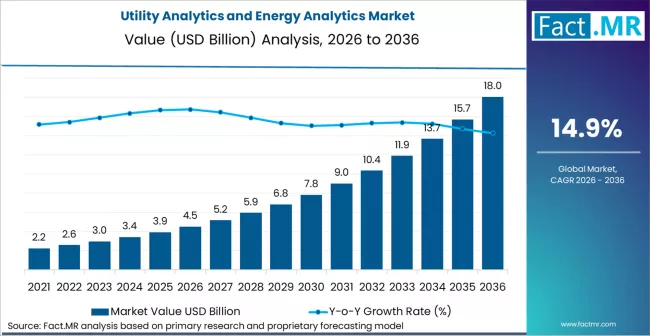
Utility Analytics And Energy Analytics Market Market Value Analysis | Source: Fact.MR
Utility Analytics and Energy Analytics Market
| Metric | Value |
|---|---|
| Estimated Value in (2026E) | USD 4.5 billion |
| Forecast Value in (2036F) | USD 17.8 billion |
| Forecast CAGR (2026 to 2036) | 14.9% |
Source: Fact.MR analysis. Updated Mar 12, 2026
Utility Analytics and Energy Analytics Market Definition
The Utility Analytics and Energy Analytics Market involves the provision and sale of software and services that analyse data from utility operations, energy assets, and consumption patterns to optimise performance, reduce costs, and support grid reliability and energy efficiency.
Market Inclusions
This report covers global and regional market sizes for utility and energy analytics over a defined forecast period, including analytics types (predictive, real‑time, prescriptive), deployment modes (cloud, on‑premises), application areas (grid management, demand forecasting, asset health, customer analytics), and end‑use segments (utilities, industrial, commercial energy users).
Market Exclusions
The scope excludes general IT analytics platforms not tailored to utility or energy workflows, hardware infrastructure not intrinsic to analytics functionality, and unrelated business intelligence tools not specific to energy data use cases.
Research Methodology
- Primary Research: Interviews were conducted with utility analysts, software developers, and energy management specialists.
- Desk Research: Data was sourced from industry reports, energy publications, and trade association statistics.
- Market‑Sizing and Forecasting: A hybrid model combining top‑down energy IT adoption forecasts with bottom‑up deployment and revenue data was used.
- Data Validation and Update Cycle: Findings were validated through expert review and aligned with recent adoption, production, and trade figures.
Summary of the Utility Analytics and Energy Analytics Market
- Market Definition
- The Utility Analytics and Energy Analytics Market involves global production, deployment, and trade of software, platforms, and services that analyze data from energy generation, distribution, and consumption. These solutions optimize operational efficiency, support predictive maintenance, and enable grid reliability and renewable energy integration. The market covers onshore and offshore wind applications, utilities, oil and gas, electricity, water, and waste management sectors.
- Demand Drivers
- Growing adoption of smart grids and renewable energy sources globally.
- Rising energy demand requiring predictive analytics for efficiency and reliability.
- Expansion of digital transformation initiatives in utility operations.
- Demand for real-time monitoring, cost reduction, and grid optimization.
- Government and regulatory programs promoting energy efficiency and smart infrastructure.
- Key Segments Analyzed
- Application: Onshore Wind Power Generation (60% share in 2026), Offshore Wind Power Generation.
- Deployment: Software (45% share in 2026), Hardware, Services.
- Type: Business Analytics, Big Data Platform, Optimization Services, Information Integration and Governance.
- Industry: Utilities, Energy, Oil & Gas, Electricity, Water, Waste & Recycle.
- Geography: North America, Europe, East Asia, South Asia; India shows the highest CAGR at 15.3%, followed by China (14.8%), France (13.6%), USA (12.6%), and Germany (11.8%).
- Analyst Opinion at Fact MR
- Shambhu Nath Jha, Principal Consultant, Fact MR, states, “The utility and energy analytics market is transitioning from conventional monitoring and reporting tools to advanced, predictive, and real-time analytics platforms. Operators deploying smart grids, renewable energy systems, and energy management solutions will capture value through operational efficiency, reduced downtime, and cost optimization. Providers offering integrated software, hardware, and service solutions across utility and renewable operations will gain structural advantage. Market growth is closely linked to smart grid adoption, renewable energy expansion, and regulatory compliance through 2036.”
- Strategic Implications/Executive Takeaways
- Expand software-based analytics solutions for predictive maintenance and energy optimization.
- Target high-growth regions such as India and China with smart grid and renewable energy initiatives.
- Integrate analytics platforms with renewable energy systems, grid management, and enterprise operational workflows.
- Align offerings with energy efficiency standards, regulatory reporting, and performance compliance.
- Offer scalable, cloud-enabled analytics solutions for both onshore and offshore energy applications.
- Leverage partnerships with utility providers, energy operators, and grid stakeholders to enhance adoption.
- Methodology
- Primary Research: Interviews with utility analysts, energy managers, and software providers.
- Desk Research: Data sourced from energy reports, industry publications, and trade associations.
- Market Sizing & Forecasting: Hybrid model combining top-down energy IT forecasts with bottom-up deployment and revenue data.
- Data Validation: Findings validated through expert review, adoption figures, and proprietary Fact MR forecasting models.
Segmental Analysis
Utility Analytics and Energy Analytics Market Analysis by Application
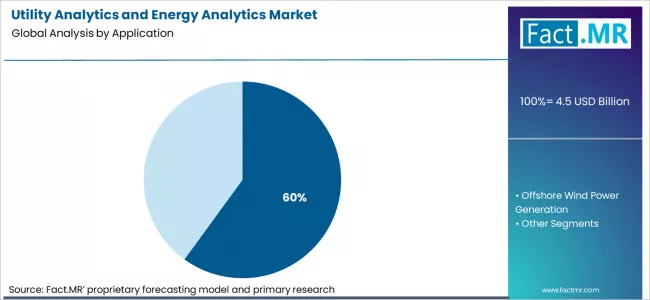
Utility Analytics And Energy Analytics Market Analysis By Application | Source: Fact.MR
Market Overview: Onshore wind power generation is expected to capture 60% of the market share by 2026. Utility and energy analytics are critical for optimizing the performance, efficiency, and maintenance of onshore wind farms. They enable operators to monitor turbine performance, predict failures, and maximize energy output.
Demand Drivers:
- Increasing Deployment of Onshore Wind Farms: Growth in renewable energy adoption globally drives the need for analytics to enhance operational efficiency and reliability.
- Performance Optimization: Analytics provide real-time insights into turbine operations, helping operators reduce downtime and increase power generation.
- Predictive Maintenance: Data-driven monitoring enables predictive maintenance, lowering costs and extending the lifespan of turbines in onshore wind projects.
Utility Analytics and Energy Analytics Market Analysis by Deployment
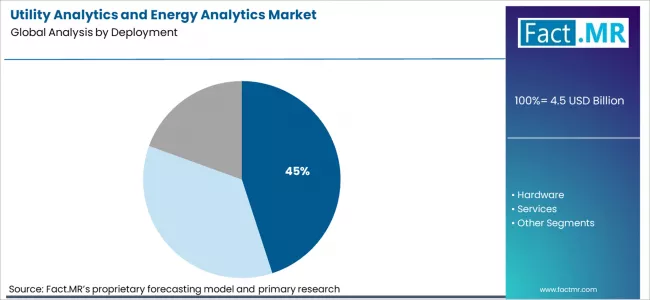
Utility Analytics And Energy Analytics Market Analysis By Deployment | Source: Fact.MR
Market Overview: Software solutions are projected to hold 45% of the market share by 2026. Software-based analytics platforms are widely used for monitoring, reporting, and optimizing energy generation and consumption, offering flexibility, scalability, and integration with existing energy management systems.
Demand Drivers:
- Advanced Data Processing: Software analytics can process large volumes of energy data, providing actionable insights for performance and operational improvements.
- Integration with Renewable Energy Systems: Software solutions integrate seamlessly with turbines, sensors, and grid systems, enabling real-time monitoring and control.
- Decision-Making Support: Energy analytics software supports informed decision-making for asset management, resource allocation, and cost optimization in renewable energy operations.
Utility Analytics and Energy Analytics Market Drivers, Restraints, and Opportunities
FMR analysts observe that the utility and energy analytics market is a growth‑aligned, digital‑transformation segment driven by escalating demand for data‑driven operational efficiency, grid reliability, and decarbonization insights. Historically, utilities managed systems with basic metering and siloed reporting; as smart grids, distributed energy resources, and regulatory performance targets evolved, structural demand emerged for advanced analytics that deliver real‑time forecasting, demand response optimization, and asset health insights. The 2026 valuation reflects this shift, with adoption tied to smart meter penetration, regulatory reporting requirements, and enterprise digitalization rather than legacy spreadsheet‑based analysis alone.
While traditional reporting tools remain in use for basic operations, advanced analytics platforms that leverage machine learning, big data, and predictive modeling are gaining share because they improve outage management, load forecasting, and energy efficiency. These higher‑value services often carry premium subscription or software‑as‑a‑service pricing, contributing to net market growth even as adoption scales with infrastructure modernizations. The market exists because utilities and energy stakeholders prioritize reliability, cost containment, and regulatory compliance in increasingly complex energy ecosystems.
- Grid Modernization Demand: Utilities adopt analytics to replace manual processes with predictive and real‑time insights that optimize grid performance and asset utilization.
- Regulatory & Reporting Standards: Energy efficiency, emissions reporting, and reliability mandates push uptake of certified analytics solutions that meet defined compliance and performance criteria.
- Regional Adoption Dynamics: In North America and Europe, strong smart grid investment and regulatory frameworks drive higher analytics uptake, while Asia‑Pacific shows rapid growth with expanding digital infrastructure.
Regional Analysis
The market analysis covers key global regions, including North America, Europe, East Asia, and South Asia. It is segmented geographically, with specific market dynamics for each region. The full report provides a detailed market attractiveness analysis.
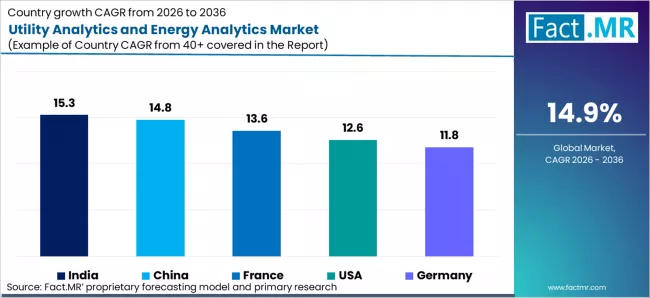
Utility Analytics And Energy Analytics Market Cagr Analysis By Country | Source: Fact.MR
| Country | CAGR (2026-2036) |
|---|---|
| USA | 12.6% |
| Germany | 11.8% |
| France | 13.6% |
| China | 14.8% |
| India | 15.3% |
Source: Fact.MR analysis. Updated Mar 12, 2026
Source: Fact MR (FMR) analysis, based on proprietary forecasting model and primary research
North America
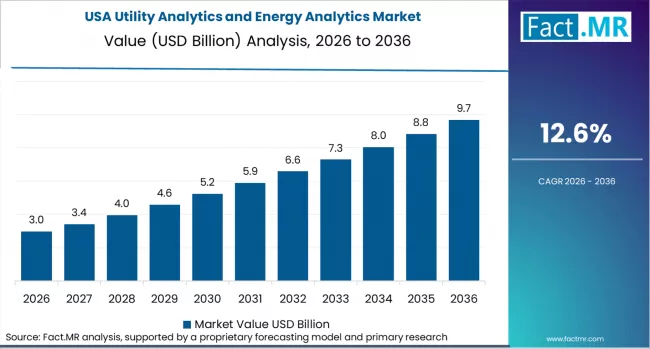
Utility Analytics And Energy Analytics Market Country Value Analysis | Source: Fact.MR
The USA is a major market, driven by smart grid implementation, renewable energy integration, and enterprise energy management solutions. Key players include Schneider Electric, Siemens, and IBM.
- USA: Demand for utility and energy analytics in the U.S. is projected to rise at 12.6% CAGR through 2036. Growth is supported by federal smart grid programs (05-2025) and Schneider Electric’s regional platform expansions (09-2025).
Europe
Germany and France are leading markets, supported by renewable energy adoption, energy efficiency regulations, and smart grid deployments.
- Germany: Demand for utility and energy analytics in Germany is projected to rise at 11.8% CAGR through 2036. Growth is supported by federal energy efficiency programs (04-2025) and Siemens’ regional analytics platform expansions (08-2025).
- France: Demand for utility and energy analytics in France is projected to rise at 13.6% CAGR through 2036. Growth is influenced by national renewable energy initiatives (03-2025) and Schneider Electric’s deployment of analytics solutions (07-2025).
East Asia
China is a key market, driven by smart grid expansion, renewable integration, and enterprise energy optimization.
- China: Demand for utility and energy analytics in China is projected to rise at 14.8% CAGR through 2036. Growth is supported by government smart energy projects (02-2025) and IBM’s regional analytics platform deployments (08-2025).
South Asia
India is a significant market, fueled by smart grid programs, renewable energy growth, and adoption of energy analytics solutions.
- India: Demand for utility and energy analytics in India is projected to rise at 15.3% CAGR through 2036. Growth is supported by government renewable energy initiatives (06-2025) and Siemens’ regional platform expansions (09-2025).
Fact MR's analysis of the utility analytics and energy analytics market in North America, Europe, East Asia, and South Asia consists of country-wise assessments that include the USA, Germany, France, China, and India. Readers can find detailed trends, regulatory updates, and company-specific investments shaping market growth in these countries.
What is the Competitive Structure and Buyer Behavior in the Utility Analytics and Energy Analytics Market?
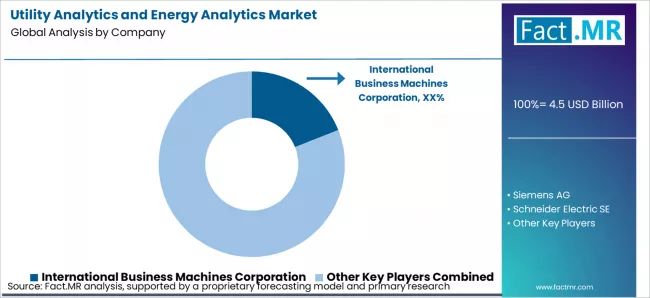
Utility Analytics And Energy Analytics Market Analysis By Company | Source: Fact.MR
The utility analytics and energy analytics market is moderately concentrated, with major global technology and industrial software providers such as International Business Machines Corporation (IBM), Siemens AG, Schneider Electric SE, General Electric Company, Oracle Corporation, SAP SE, and Microsoft Corporation holding substantial share alongside analytics‑focused firms including ABB Ltd, Hitachi Energy Ltd, SAS Institute Inc., Teradata Corporation, TIBCO Software Inc., Itron, Inc., AutoGrid Systems, Inc., and EnergyHub, Inc. The primary competitive variables are data processing performance, predictive analytics capability, integration with existing utility operational systems, real‑time insights, and scalability across enterprise and grid environments. Companies with broad analytics platforms, deep domain expertise in energy systems, and extensive integration and service networks hold structural advantages because they can deliver end‑to‑end solutions that span forecasting, optimisation, demand response, grid stability, and regulatory reporting.
Large utility and energy providers exert significant buyer leverage by qualifying multiple analytics suppliers, negotiating enterprise‑wide agreements based on performance outcomes and service levels, and standardising technical specifications tied to operational KPIs and compliance. To manage supplier dependency, these buyers often adopt multi‑vendor ecosystems, emphasise open architecture support, and require robust post‑deployment support and training, which limits individual suppliers’ pricing power. As a result, competition centres on delivering actionable analytics performance, integration ease with legacy systems, and strong service support rather than on price alone.
Key Players of the Utility Analytics and Energy Analytics Market
- International Business Machines Corporation
- Siemens AG
- Schneider Electric SE
- General Electric Company
- Oracle Corporation
- SAP SE
- ABB Ltd
- Hitachi Energy Ltd
- SAS Institute Inc.
- Microsoft Corporation
- Teradata Corporation
- TIBCO Software Inc.
- Itron, Inc.
- AutoGrid Systems, Inc.
- EnergyHub, Inc.
Report Scope
| Metric | Value |
|---|---|
| Quantitative Units | USD 4.5 billion (2026) to USD 17.8 billion (2036), at a CAGR of 14.9% |
| Market Definition | The utility and energy analytics market includes global production, deployment, and trade of analytics platforms and services for monitoring, optimizing, and integrating energy, utilities, and waste management operations. |
| Type Segmentation | Business Analytics, Big Data Platform, Optimization Services, Information Integration and Governance |
| Deployment Segmentation | Hardware, Software, Services |
| Application Coverage | Offshore Wind Power Generation, Onshore Wind Power Generation |
| Industry Coverage | Oil & Gas, Energy, Utilities, Electricity, Water, Waste and Recycle |
| Key Companies Profiled | International Business Machines Corporation, Siemens AG, Schneider Electric SE, General Electric Company, Oracle Corporation, SAP SE, ABB Ltd, Hitachi Energy Ltd, SAS Institute Inc., Microsoft Corporation, Teradata Corporation, TIBCO Software Inc., Itron, Inc., AutoGrid Systems, Inc., EnergyHub, Inc. |
| Forecast Period | 2026 to 2036 |
| Approach | Hybrid top-down and bottom-up modeling validated through interviews with utility and energy providers, supported by trade data benchmarking and platform capacity verification |
Source: Fact.MR analysis. Updated Mar 12, 2026
Bibliographies
- The Times of India. (2025, October). MSEDCL collaborates with GEAPP for grid modernisation. The Times of India.
- Business Insider. (2025, July). Utilities are tiptoeing into AI as climate change and data center growth add stress to the energy grid. Business Insider.
- T&D World. (2024, November/December). 2025: A year of AI-powered transformation for the utility experience. T&D World.
- Ahmed, K. A., & Gueniat, F. (2025). AI-enhanced IoT systems for predictive maintenance and affordability optimization in smart microgrids: A digital twin approach [arXiv preprint]. arXiv.
- Rashid, A., Biswas, P., Al Masum, A., Nasim, M. A., & Gupta, K. D. (2024). Power plays: Unleashing machine learning magic in smart grids [arXiv preprint]. arXiv.
This report addresses
- Market intelligence enabling evaluation of global utility and energy analytics solutions by deployment (hardware, software, services), type (business analytics, big data platforms, optimization services, information integration), applications (onshore/offshore wind power), and industry segments (utilities, energy, oil & gas, electricity, water, waste and recycling).
- Market volume (revenue) estimates and 10-year forecasts from 2026 to 2036, validated using smart grid adoption trends, renewable energy deployment, and enterprise analytics implementation.
- Growth opportunity mapping across software, hardware, and services deployment, with major markets including India, China, USA, France, and Germany.
- Segment and regional revenue forecasts for deployment types, applications, and industries, including predictive maintenance, energy optimization, and operational efficiency analytics.
- Competitive strategy analysis highlighting data processing performance, predictive capability, system integration, real-time monitoring, and scalability, with major players including International Business Machines Corporation (IBM), Siemens AG, Schneider Electric SE, General Electric Company, Oracle Corporation, SAP SE, ABB Ltd, Hitachi Energy Ltd, SAS Institute Inc., Microsoft Corporation, Teradata Corporation, TIBCO Software Inc., Itron, Inc., AutoGrid Systems, Inc., and EnergyHub, Inc.
- Adoption dynamics emphasizing utilities and energy stakeholders implementing analytics to support grid reliability, renewable integration, regulatory compliance, and cost optimization.
- Report delivery in PDF, Excel, PowerPoint, and interactive dashboard formats suitable for executive, operational, and strategic planning.
Segmentation
Utility Analytics and Energy Analytics Market Key Segments
-
Type
- Business Analytics
- Big Data Platform
- Optimization Services
- Information Integration and Governance
-
Deployment
- Hardware
- Software
- Services
-
Application
- Offshore Wind Power Generation
- Onshore Wind Power Generation
-
Industry
- Oil & Gas
- Energy
- Utilities
- Electricity
- Water
- Waste and Recycle
-
Region
- North America
- USA
- Canada
- Mexico
- Europe
- Germany
- UK
- France
- Italy
- Spain
- Nordic Countries
- BENELUX
- Rest of Europe
- Asia Pacific
- China
- Japan
- South Korea
- India
- Australia
- Rest of Asia Pacific
- Latin America
- Brazil
- Argentina
- Rest of Latin America
- Middle East and Africa
- Kingdom of Saudi Arabia
- United Arab Emirates
- South Africa
- Rest of Middle East and Africa
- Other Regions
- Oceania
- Central Asia
- Other Markets
- North America
Frequently Asked Questions
How large is the demand for Utility Analytics and Energy Analytics in the global market in 2026?
What will be the market size of Utility Analytics and Energy Analytics in the global market by 2036?
What is the expected demand growth for Utility Analytics and Energy Analytics in the global market between 2026 and 2036?
Which application segment is expected to dominate the market?
Which region is expected to show the highest growth rate for Utility Analytics and Energy Analytics?
How significant is the growth outlook for China in this market?
What is the growth outlook for the United States in the Utility Analytics and Energy Analytics market?
What is the growth forecast for Germany in the Utility Analytics and Energy Analytics market?
What is the growth forecast for France in the Utility Analytics and Energy Analytics market?
Which company is identified as a leading player in the Utility Analytics and Energy Analytics market?
What are Utility Analytics and Energy Analytics used for?
What does the Utility Analytics and Energy Analytics market include in this report?
How is the market forecast developed in this report?
What is meant by the Utility Analytics and Energy Analytics market in this report?
Who worked on this report


Preview the report firsthand - request a free sample
Free SampleGet the brochure for pricing and purchase details
Download PDF