- Base Value(2025): 0.5 Bn
- Forecast Value (2036): 1.1 Bn
- CAGR (2036): 6.2%
What is the disposable endoscope valves market forecast to be worth by 2036?
USD 0.6 billion in 2026 to USD 1.1 billion by 2036 at 6.2% CAGR.
- The Disposable Endoscope Valves Market was valued at USD 0.5 billion in 2025.
- The market is estimated at USD 0.6 billion in 2026. It is projected to reach USD 1.1 billion by 2036.
- The market is forecast to expand at 6.2% CAGR during the forecast period as infection control standards become stricter and demand for single-use endoscopy accessories continues rising.
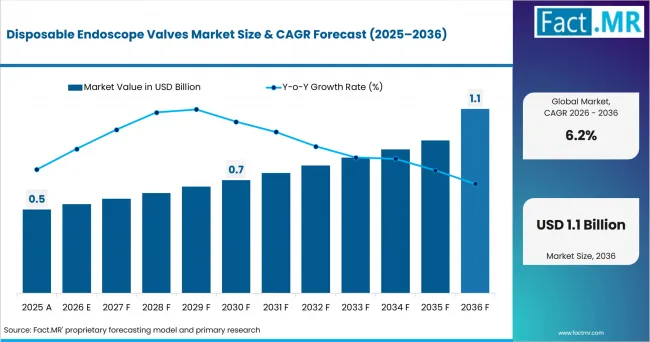
Disposable Endoscope Valves Market Market Value Analysis | Source: Fact.MR
What are the defining numbers behind disposable endoscope valve growth?
USD 0.5 billion absolute opportunity by 2036 led by the United States and Germany.
- Demand Drivers in the Market
- Infection prevention standards continue becoming stricter.
- Endoscopy procedure volumes continue increasing.
- Hospitals are adopting more single-use accessories.
- Healthcare facilities are reducing cross contamination risk.
- Key Segments Analyzed
- By Valve Type: Air/Water Valves are expected to hold 34.0% share in 2026 because they are required in most endoscopic procedures.
- By Endoscope Type: GI Endoscopes are projected to account for 41.0% share in 2026 because gastrointestinal procedures represent the largest procedure volume.
- By Use Setting: Hospitals are expected to hold 58.0% share in 2026 because they perform the highest number of endoscopic procedures.
- By Sterility: Sterile Single-Use is projected to account for 61.0% share in 2026 because infection prevention remains the highest priority.
- By Geography: The United States is projected to record 6.7% CAGR through 2036.
- Analyst Opinion at Fact.MR
- Shambhu Nath Jha, Senior Analyst at Fact.MR, states, "Disposable endoscope valves are becoming an important part of infection prevention strategies. Hospitals are increasing the use of sterile single-use accessories to improve patient safety and reduce reprocessing challenges. Continued growth in endoscopy procedures will support steady market expansion."
- Strategic Implications
- Expand production of sterile single-use valve systems.
- Develop valves with broader endoscope compatibility.
- Strengthen partnerships with hospitals and endoscopy centers.
- Invest in infection prevention technologies.
Disposable endoscope valves are sterile components used during endoscopic procedures to control air, water, suction and biopsy functions. They help reduce contamination risk while improving patient safety and operational efficiency.
The United States is projected to record 6.7% CAGR through 2036 because endoscopy procedure volumes continue increasing. Germany is expected to grow at 6.4% CAGR due to strong adoption of infection prevention products. Japan is forecast to expand at 6.2% CAGR as healthcare facilities increase single-use device adoption. China is projected to register 6.0% CAGR through 2036 because hospital infrastructure continues expanding. South Korea is expected to grow at 5.8% CAGR due to rising investment in advanced endoscopy services.
How does the disposable endoscope valves market break down by segment?
Air/Water Valves lead at 34.0%. Hospitals lead at 58.0%.
Which valve type accounts for the largest market share?
Air/Water Valves hold 34.0% share in 2026.
Air and water valves lead because they are used during almost every gastrointestinal endoscopy procedure. They support clear visualization by controlling irrigation and air flow. Hospitals prefer disposable air and water valves because they improve workflow efficiency. They also help reduce contamination risk between procedures. Demand remains strong across high-volume endoscopy units. Olympus received FDA 510(k) clearance for its EZ1500 gastrointestinal endoscopes featuring Extended Depth of Field technology. The launch supports the adoption of compatible disposable accessories including sterile valve systems used during endoscopic procedures.
Why do GI endoscopes generate the highest demand?
GI Endoscopes account for 41.0% share in 2026.
GI endoscopes account for the largest share because gastrointestinal disorders continue increasing worldwide. Screening programs also continue raising procedure volumes. Disposable valves help maintain sterile operating conditions. They also simplify equipment preparation before each procedure. Demand continues rising across diagnostic and therapeutic applications.
Which healthcare setting leads product adoption?
Hospitals hold 58.0% share in 2026.
Hospitals remain the largest users because they perform the highest number of endoscopic procedures. They also maintain strict infection prevention standards. Large healthcare facilities continue replacing reusable accessories with single-use products. This improves operational efficiency and patient safety.
Which sterility category remains the most widely adopted?
Sterile Single-Use leads with 61.0% share in 2026.
Sterile single-use products lead because they reduce the risk of cross contamination. Healthcare providers continue prioritizing patient safety during endoscopic procedures. These products also reduce cleaning requirements. They support faster procedure turnaround across busy endoscopy departments. Demand continues increasing across healthcare facilities.
What is fueling market expansion?
Infection prevention drives adoption while product costs remain a challenge.
The primary growth driver is stronger infection prevention requirements. Hospitals continue increasing the use of disposable accessories to improve patient safety. Endoscopy procedure volumes also continue growing. Screening programs and aging populations support higher procedure numbers. Healthcare facilities continue investing in sterile single-use products. Clinical guidelines also encourage infection control improvements.
The primary restraint is higher product cost. Disposable accessories increase procedure expenses compared with reusable products. Waste management is also a challenge because disposable accessories increase regulated medical waste. Environmental concerns continue influencing purchasing decisions.
Where are new growth opportunities emerging?
- Ambulatory Endoscopy Centers:
- Procedure volumes continue increasing outside hospitals. Single-use valves improve efficiency across outpatient facilities.
- Emergency Departments:
- Emergency endoscopy procedures require ready-to-use sterile accessories. Disposable valves reduce preparation time.
- Specialty Clinics:
- Specialty clinics continue expanding endoscopy services. Single-use products simplify daily operations.
- Advanced Endoscopy Procedures:
- Complex therapeutic procedures require dependable valve performance. Premium disposable products continue gaining demand.
Which countries are expanding the use of disposable endoscope valves?
United States 6.7%, Germany 6.4%, Japan 6.2%, China 6.0%, South Korea 5.8%.
Based on regional analysis, the disposable endoscope valves market is segmented into North America, Western Europe, Asia Pacific, Latin America, and Middle East and Africa.
| Country | CAGR (2026-2036) |
|---|---|
| United States | 6.7% |
| Germany | 6.4% |
| Japan | 6.2% |
| China | 6.0% |
| South Korea | 5.8% |
Source: Fact.MR analysis. Updated Jun 29, 2026
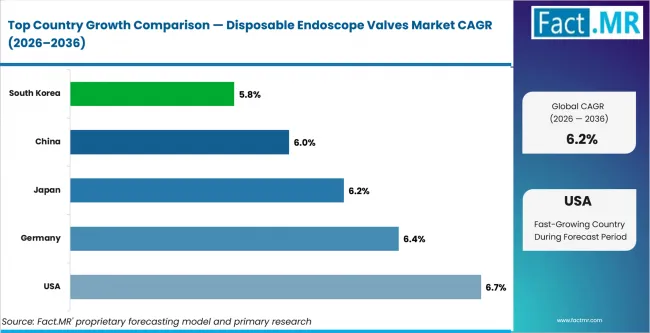
Disposable Endoscope Valves Market Cagr Analysis By Country | Source: Fact.MR
What supports growth in the United States?
6.7% CAGR, driven by higher endoscopy procedure volumes
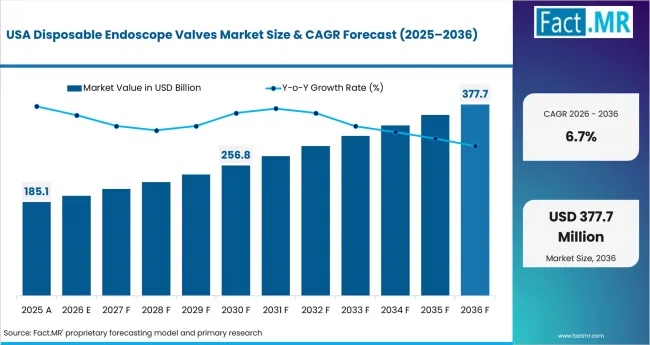
Disposable Endoscope Valves Market Country Value Analysis | Source: Fact.MR
The United States is projected to record 6.7% CAGR through 2036 because hospitals continue increasing endoscopic procedures. Healthcare providers are adopting disposable accessories to strengthen infection prevention. Demand also benefits from strict regulatory standards. Large healthcare networks continue replacing reusable components with sterile single-use products.
How is Germany strengthening infection prevention?
6.4% CAGR, supported by hospital safety standards
Germany is expected to post 6.4% CAGR through 2036 because hospitals continue improving infection control practices. Single-use accessories are becoming more common across endoscopy departments. Healthcare facilities are investing in sterile procedure kits. Rising awareness of patient safety also supports market expansion. Germany is a key European market for endoscopy products.
What is driving adoption in Japan?
6.2% CAGR, backed by an aging population
Japan is projected to register 6.2% CAGR through 2036 because demand for gastrointestinal screening continues increasing. Hospitals continue expanding the use of disposable endoscopy accessories. Healthcare providers also focus on reducing cross contamination. Procedure efficiency remains another important purchasing factor.
Why is China becoming a larger market?
6.0% CAGR, supported by healthcare expansion
China is forecast to advance at 6.0% CAGR through 2036 because hospital infrastructure continues expanding. More healthcare facilities are adopting advanced endoscopy devices. Demand for disposable valves is increasing as infection prevention standards improve. Growth in diagnostic procedures also supports market expansion. China is an important growth market in Asia.
How is South Korea expanding endoscopy services?
5.8% CAGR, due to healthcare investment
South Korea is expected to grow at 5.8% CAGR through 2036 because hospitals continue investing in advanced diagnostic technologies. Endoscopy procedure volumes continue increasing across major healthcare centers. Healthcare providers are adopting sterile disposable accessories to improve patient safety. Demand also benefits from continued investment in modern healthcare infrastructure.
Which manufacturers are driving innovation in the market?
Olympus, Boston Scientific, and Pentax Medical lead through endoscopy expertise and infection prevention technologies.
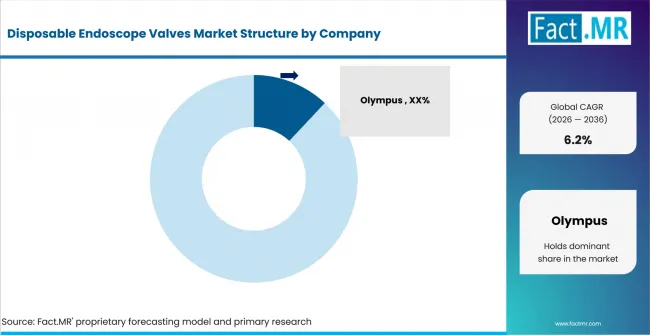
Disposable Endoscope Valves Market Analysis By Company | Source: Fact.MR
The competitive environment reflects the presence of several well-established medical device manufacturers alongside specialized endoscopy suppliers. Product differentiation is increasingly based on dependable clinical performance, ease of use and the ability to support strict infection control protocols. Companies are refining valve designs to make procedures more efficient while reducing the burden of reprocessing.
Demand continues to come primarily from hospitals where endoscopic procedures are performed at a large scale. Outpatient endoscopy centers are becoming another important customer group as minimally invasive procedures shift toward ambulatory care. The preference for disposable accessories is growing because healthcare providers want to reduce contamination risks and maintain consistent procedural quality. Gastrointestinal endoscopy represents the largest area of use due to the high number of routine screening and therapeutic procedures performed each year. Bronchoscopy, colonoscopy and ENT interventions also contribute to steady product demand as healthcare facilities continue expanding endoscopic services.
Olympus and Boston Scientific benefit from their broad endoscopy portfolios and established relationships with healthcare providers. Steris continue strengthening their presence by expanding disposable accessory offerings, improving compatibility across endoscope platforms and supporting hospitals with comprehensive clinical solutions. Future competition is expected to shift beyond product availability toward measurable clinical value. Suppliers that combine reliable performance, regulatory compliance and responsive technical support are likely to strengthen their position as healthcare providers place greater emphasis on patient safety and operational efficiency.
Who are the major companies operating in the Disposable Endoscope Valves Market?
Olympus, Boston Scientific, Pentax Medical
- Olympus
- Boston Scientific
- Pentax Medical
- FUJIFILM Healthcare
- CONMED
- Steris
Bibliography
- Olympus Corporation of the Americas. (2025, May 28). Olympus announces FDA clearance of its most advanced imaging endoscopes. Olympus.
- U.S. Food and Drug Administration. (2024, June 24). 510(k) premarket notification K233630: Ambu® aScope™ 5 Uretero and Ambu® aBox™ 2. FDA.
- Olympus America. (2026). Guardian™ Endoscope Single-Use Valve Set. Olympus America.
- Diversatek Healthcare. (2026). BullDog® disposable endoscope valves and accessories. Diversatek Healthcare.
- Boston Scientific. (2026). Orca™ sterile single-use air/water and suction valves. Boston Scientific.
- CONMED. (2024). Infection prevention: ClearGuard™ single-use biopsy valves. CONMED.
- STERIS. (2026). Biopsy valves and irrigation accessories. STERIS.
This Report Addresses
- Strategic analysis of disposable endoscope valve technologies.
- Segment assessment by valve type and endoscope type.
- Evaluation of healthcare settings and sterility preferences.
- Regional outlook covering the United States, Germany, Japan, China, and South Korea.
- Competitive assessment of major endoscopy device manufacturers.
- Analysis of infection prevention and procedure safety trends.
- Evaluation of hospital purchasing patterns and outpatient procedure growth.
- Primary interviews and supplier benchmarking supporting market estimates.
- Assessment of innovation in disposable endoscopy accessories.
- Analysis of future opportunities across diagnostic and therapeutic endoscopy.
How is the market defined?
Single-use valves designed for endoscopic procedures.
The market covers disposable valve systems used with flexible endoscopes to support sterile air, water, suction and biopsy functions during diagnostic and therapeutic procedures.
Which products are included?
Disposable valve systems and sterile accessory kits.
The scope includes air and water valves, suction valves, biopsy valves, irrigation valves and disposable valve kits.
What falls outside the scope?
Reusable endoscope valves and capital endoscopy equipment.
The scope excludes reusable valve components, complete endoscope systems, and endoscope reprocessing equipment.
What methodology supports this study?
100+ sources, 30+ company assessments, 25+ countries, and industry interviews.
- Primary Research: Interviews with endoscopy specialists, hospital procurement teams and medical device manufacturers.
- Desk Research: Analysis of endoscopy procedure volumes, infection prevention practices and healthcare investments.
- Market Sizing and Forecasting: Estimates based on procedure numbers, disposable accessory adoption and hospital purchasing trends.
- Data Validation and Update Cycle: Forecasts validated through company benchmarking and expert interviews.
Segmentation
What is the report's scope and coverage?
| Attribute | Details |
|---|---|
| Quantitative Units | USD Billion in 2026 to USD Billion by 2036 |
| Market Definition | Disposable valves designed for flexible endoscopes to improve infection prevention during diagnostic and therapeutic procedures |
| Valve Types Covered | Air/Water Valves, Suction Valves, Biopsy Valves, Irrigation Valves, Disposable Valve Kits |
| Endoscope Types Covered | GI Endoscopes, Bronchoscopes, Duodenoscopes, Colonoscopes, ENT Scopes |
| Use Settings Covered | Hospitals, Ambulatory Endoscopy Centers, Specialty Clinics, Emergency Departments, Procedure Rooms |
| Sterility Categories Covered | Sterile Single-Use, Non-Sterile Single-Use, Procedure Kits, Individually Packed, EO/Gamma Sterilized |
| Regions Covered | North America, Western Europe, Asia Pacific, Latin America, Middle East & Africa |
| Key Countries Covered | United States, Germany, Japan, China, South Korea |
| Companies Covered | Olympus, Boston Scientific, Pentax Medical, FUJIFILM Healthcare, CONMED, Steris |
| Forecast Period | 2026 to 2036 |
| Research Approach | Hybrid top-down and bottom-up methodology using endoscopy procedure volumes, infection prevention trends and hospital purchasing analysis |
Source: Fact.MR analysis. Updated Jun 29, 2026
How is the market classified?
-
By Valve Type:
- Air/Water Valves
- Suction Valves
- Biopsy Valves
- Irrigation Valves
- Disposable Valve Kits
-
By Endoscope Type:
- GI Endoscopes
- Bronchoscopes
- Duodenoscopes
- Colonoscopes
- ENT Scopes
-
By Use Setting:
- Hospitals
- Ambulatory Endoscopy Centers
- Specialty Clinics
- Emergency Departments
- Procedure Rooms
-
By Sterility:
- Sterile Single-Use
- Non-Sterile Single-Use
- Procedure Kits
- Individually Packed
- EO/Gamma Sterilized
-
Region:
- North America
- United States
- Canada
- Europe
- Germany
- United Kingdom
- France
- Italy
- Spain
- Asia Pacific
- China
- Japan
- South Korea
- India
- Singapore
- Latin America
- Brazil
- Mexico
- Argentina
- Middle East & Africa
- GCC Countries
- South Africa
- Israel
- North America
Frequently Asked Questions
Which valve type accounts for the largest market share?
Why do GI endoscopes generate the highest demand?
What factors are supporting market growth?
Which country is expected to record the fastest growth?
What remains the biggest challenge for manufacturers?
Which healthcare setting generates the highest demand?
Why are sterile single-use valves gaining wider acceptance?
How are outpatient facilities influencing demand?
What opportunities are emerging for suppliers?
Who worked on this report


Preview the report firsthand - request a free sample
Free SampleGet the brochure for pricing and purchase details
Download PDF