- Market Value (2025): USD 0.6 Bn
- Estimated Value (2026): USD 0.7 Bn
- Forecast Value (2036): USD 1.5 Bn
- CAGR (2026-2036): 7.9%
What is the disposable spirometry filters market forecast to be worth by 2036?
USD 0.7 billion in 2026 to USD 1.5 billion by 2036, at 7.9% CAGR.
- The disposable spirometry filters market crossed a valuation of USD 0.6 billion in 2025. Demand is expected to increase from USD 0.7 billion in 2026 to USD 1.5 billion by 2036. The market is forecast to record 7.9% CAGR from 2026 to 2036 as respiratory testing volumes recover and clinics standardize single-patient-use filter workflows.
- Disposable spirometry filters are single-use bacterial and viral filters placed between the patient and spirometer. The category connects with respiratory care devices because lung function testing depends on safe patient interfaces. The strongest adoption case comes from pulmonary function laboratories where multiple patients use the same testing equipment daily.
- Vitalograph stated in 2026 that its bacterial viral filter removes droplets, aerosols, bacteria and viruses from the airstream with >99.999% cross-contamination efficiency. This supports demand for high-efficiency single-use filters in spirometry and pulmonary function testing.
What are the defining numbers behind disposable spirometry filters market growth?
USD 0.84 billion absolute opportunity by 2036, led by the United States and Germany.
- Demand Drivers in the Market
- Key Segments Analyzed
- By Filter Type: Bacterial Viral Filters are expected to hold 58.0% share in 2026 because infection-control use dominates spirometry consumables.
- By Media Type: Electrostatic Hydrophobic Filter Media lead because they support microbial capture with low airflow resistance. The share is projected at 45.0% in 2026.
- By Application: Diagnostic Spirometry is likely to account for 52.0% share in 2026 because routine lung function testing drives repeat consumption.
- By End Use: Hospitals and Pulmonary Function Laboratories lead with 40.0% share in 2026 because they test multiple patients each day.
- By Sales Channel: Medical Supply Distributors are expected to hold 38.0% share in 2026 because clinics buy filters in recurring bulk packs.
- By Geography: The United States is projected to record 9.2% CAGR through 2036 as outpatient respiratory testing expands.
- Analyst Opinion at Fact.MR
- Shambhu Nath Jha, Senior Analyst at Fact.MR, states, “Disposable spirometry filters are becoming a standard consumable in safe lung function testing. We see clinics selecting filters that protect equipment while maintaining accurate flow measurement. Suppliers that combine high filtration performance with low resistance and broad spirometer compatibility will gain stronger access to pulmonary testing channels.”
- Strategic Implications
- Filter suppliers should publish resistance and dead-space data clearly.
- Spirometer makers should validate filter compatibility across device models.
- Clinics should standardize single-use filter protocols for every patient.
- Distributors should support bulk packs for high-volume respiratory screening programs.
ndd Medical states that its EasyOne Filter is placed at the end of the breathing mouthpiece to minimize resistance and dead space while supporting spirometry accuracy. This reinforces the need for filters that protect hygiene without disrupting test performance.
A 2024 study in the European Respiratory Journal Open Research reported that viral filters placed at the proximal end of spirometry and CPET circuits did not significantly alter test results. This supports clinical confidence in filter use during respiratory testing.
The United States is projected to record 9.2% CAGR through 2036 as outpatient pulmonary testing and occupational health screening expand. Germany is expected to post 8.7% CAGR through 2036 as pulmonary function laboratories prioritize validated filter use. The United Kingdom is likely to record 8.3% CAGR as primary care and respiratory clinics standardize hygiene consumables. Japan is forecast to advance at 7.9% CAGR as aging populations increase lung function testing. China is set to record 7.5% CAGR as hospitals and screening centers expand spirometry access.
How does the disposable spirometry filters market break down by segment?
Bacterial Viral Filters lead at 58.0%; Diagnostic Spirometry leads at 52.0%.
Which filter type dominates?
Bacterial Viral Filters hold 58.0% share in 2026.
Bacterial Viral Filters are expected to hold 58.0% share in 2026 because pulmonary function teams use them to reduce cross-contamination risk. These filters sit between the patient and the spirometer during breathing maneuvers. The format is suitable for inspiratory and expiratory testing. The segment is tied to infection-control supplies because respiratory testing exposes equipment to droplets and aerosols.
Which media type dominates?
Electrostatic Hydrophobic Filter Media account for 45.0% share in 2026.
Electrostatic Hydrophobic Filter Media lead because spirometry filters must capture particles while keeping breathing resistance low. The media type is projected to capture 45.0% share in 2026. GVS states that its Spiroguard electrostatic filters are designed for lung function testing and use hydrophobic filter media. This supports demand for filter media that can balance safety and flow performance.
Which application dominates?
Diagnostic Spirometry holds 52.0% share in 2026.
Diagnostic Spirometry leads because routine testing is the main recurring use for disposable filters. The application is likely to account for 52.0% share in 2026. Asthma, COPD and workplace screening programs all use spirometry to assess lung function. The segment is relevant to asthma treatment because spirometry supports diagnosis and monitoring in respiratory care.
Which end use dominates?
Hospitals and Pulmonary Function Laboratories lead with 40.0% share in 2026.
Hospitals and Pulmonary Function Laboratories lead because they perform repeated lung function tests across patient groups. The end use is expected to hold 40.0% share in 2026. Intersurgical states that Pulmo-Protect™ combines low resistance with high bacterial and viral efficiency and is designed to protect patients and equipment during lung function tests. High patient throughput makes single-use filtration a practical workflow requirement. Hospital supply channels matter because filters behave like routine clinical consumables.
Which sales channel dominates?
Medical Supply Distributors hold 38.0% share in 2026.
Medical Supply Distributors lead because spirometry filters are bought in repeated packs for clinics and labs. The sales channel is expected to hold 38.0% share in 2026. Distributor access helps small practices maintain stock without direct OEM contracts. OEM channels remain important when filters are device-specific. Medical device technology requirements are relevant because filter geometry must match spirometer interfaces.
What is accelerating disposable spirometry filter demand, and what is holding it back?
Respiratory testing hygiene drives demand; compatibility limits restrain adoption.
Respiratory testing hygiene is the main driver. Patients generate forceful airflow during spirometry, so clinics use filters to protect equipment and reduce cross-contamination risk. This supports routine filter use in pulmonary laboratories and occupational screening.
MIR positions disposable turbine and filter workflows around hygiene and reduced cleaning burden. This supports consumable formats that reduce staff handling after each test.
MGC Diagnostics states that preVent pulmonary function filters are tested for bacterial and viral effectiveness and are supplied for pulmonary function testing. This supports demand for validated filters in larger PFT systems.
The main restraint is compatibility. Not every filter fits every spirometer or flow sensor. Clinics must match filter size, resistance and dead space with the device and test protocol.
Where do the biggest disposable spirometry filter opportunities sit?
Pulmonary labs, occupational health screening and primary care spirometry.
- Pulmonary Laboratories: High patient volume creates recurring demand for validated BVF filters.
- Occupational Health Screening: Screening providers need bulk filter packs for workplace testing days.
- Primary Care Spirometry: Clinics can use filter-mouthpiece kits to standardize safe testing.
Which countries are scaling disposable spirometry filters fastest?
United States 9.2%, Germany 8.7%, United Kingdom 8.3%, Japan 7.9%, China 7.5%.
Based on regional analysis, the disposable spirometry filters market covers North America and Western Europe. Asia Pacific is also included. Latin America and Middle East and Africa complete the regional scope.
| Country | CAGR |
|---|---|
| United States | 9.2% |
| Germany | 8.7% |
| United Kingdom | 8.3% |
| Japan | 7.9% |
| China | 7.5% |
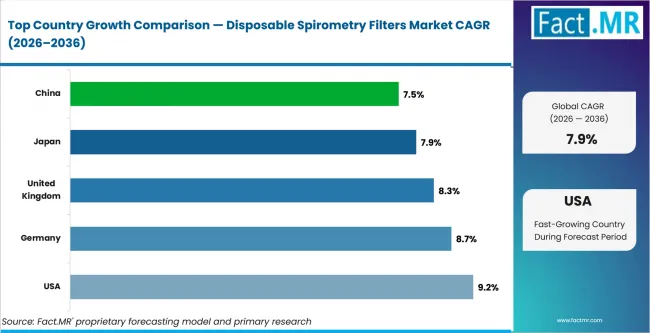
Disposable Spirometry Filters Market Cagr Analysis By Country | Source: Fact.MR
What is powering the United States lead?
9.2% CAGR, driven by MGC Diagnostics and outpatient pulmonary testing.
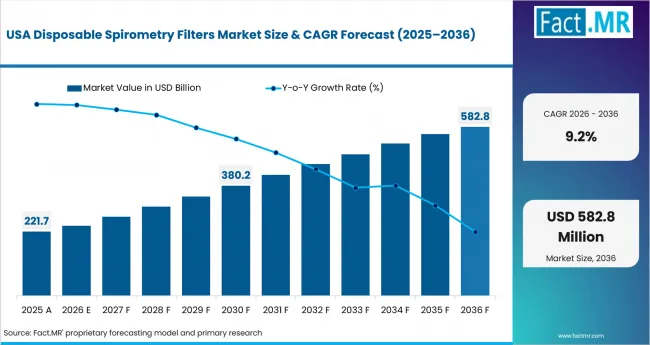
Disposable Spirometry Filters Market Country Value Analysis | Source: Fact.MR
The United States is projected to record 9.2% CAGR by 2036 as hospitals and outpatient practices increase lung function testing. MGC Diagnostics supports pulmonary function filter supply for clinical labs. ndd Medical also supports EasyOne filter workflows across spirometry platforms. Growth will favor filters with strong distributor access and device compatibility.
How is Germany scaling disposable spirometry filter demand?
8.7% CAGR, supported by pulmonary laboratories and validated filter use.
Germany is expected to post 8.7% CAGR through 2036 as pulmonary function laboratories prioritize safe multi-patient testing workflows. ndd Medical supports spirometry filter workflows, while established respiratory care channels support high-quality testing environments. Clinics need filters that preserve test accuracy and reduce contamination risk. Growth will favor low-resistance filters with clear technical documentation.
What supports the United Kingdom outlook?
8.3% CAGR, driven by Vitalograph and primary care respiratory testing.
The United Kingdom is likely to record 8.3% CAGR by 2036 as primary care and respiratory clinics standardize hygiene consumables. Vitalograph supports BVF use across lung function testing. Occupational health providers also need disposable filters for screening programs. Growth will favor filter-mouthpiece kits that simplify clinic workflow.
How is Japan scaling disposable spirometry filter adoption?
7.9% CAGR, backed by aging respiratory patients and clinic-based testing.
Japan is forecast to advance at 7.9% CAGR through 2036 as aging patients increase demand for lung function assessment. Clinics need disposable interfaces that reduce cleaning workload between tests. Device-specific filters help preserve measurement quality. Growth will favor compact filter formats and reliable supply.
What underpins China’s growth?
7.5% CAGR, driven by hospital spirometry expansion and local consumable supply.
China is set to record 7.5% CAGR by 2036 as hospitals and screening centers expand respiratory testing access. Local suppliers and imported filter brands support broader spirometry use. Clinics need affordable filters for high-volume patient flow. Growth will favor products with low airflow resistance and broad device fit.
Who leads the disposable spirometry filters market?
Vitalograph and ndd Medical Technologies lead through spirometer-linked filter portfolios.
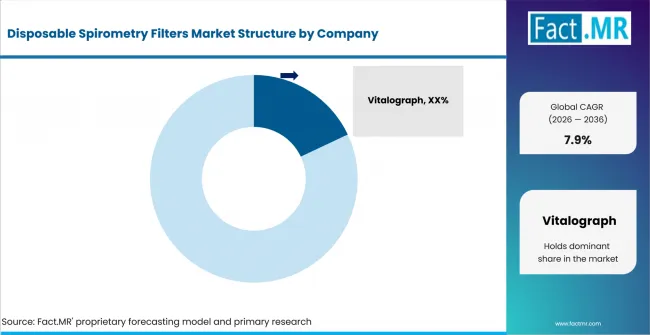
Disposable Spirometry Filters Market Analysis By Company | Source: Fact.MR
Disposable spirometry filters are supplied by spirometer OEMs and respiratory consumable manufacturers. Vitalograph leads through bacterial viral filters used across inspiratory and expiratory spirometry. ndd Medical Technologies supports EasyOne filters for its spirometry ecosystem.
MGC Diagnostics supports preVent filters for pulmonary function testing systems. GVS Group supplies electrostatic spirometry filters through its Spiroguard portfolio. Intersurgical competes through Pulmo-Protect lung function filters.
Competition through 2036 will depend on filter efficiency and device compatibility. Suppliers need low resistance, low dead space and clear performance data. The diagnostic testing link matters because filters must support accurate clinical measurement. The medical disposables layer is also relevant because single-use filters follow recurring consumable purchasing patterns.
Which companies are the key providers?
Vitalograph and ndd Medical Technologies are key providers. MIR and MGC Diagnostics are also profiled. GVS Group and Intersurgical complete the company set.
- Vitalograph
- ndd Medical Technologies
- MIR
- MGC Diagnostics
- GVS Group
- Intersurgical
Bibliography
- Vitalograph. (2026, May 14). Safeguarding respiratory testing: The essential role of bacterial viral filters. Vitalograph.
- ndd Medical Technologies. (2026). EasyOne Filter. ndd Medical Technologies.
- MIR – Medical International Research. (2026). FlowMIR®, disposable turbine flowmeter. MIR – Medical International Research. Retrieved July 4, 2026.
- Chang, S.-Y., Chiu, Y.-T., Liu, K.-C., Wei, M.-T., & Huang, S.-C. (2024, July 8). Impact of viral filters on accuracy of cardiopulmonary testing and spirometry. ERJ Open Research, 10(4), 01018-2023. doi: 10.1183/23120541.01018-2023.
- GVS Group. (2026). Electrostatic spirometry filters. GVS Group.
- Intersurgical. (2026). Pulmo-Protect™ lung function filter. Intersurgical.
- MGC Diagnostics. (2026). MGC Diagnostics patient testing supplies. MGC Diagnostics.
This Report Addresses
- Strategic intelligence on disposable spirometry filters across filter type and media type.
- Segment analysis covering Bacterial Viral Filters and Electrostatic Hydrophobic Filter Media.
- Regional outlook covering the United States, Germany, the United Kingdom, Japan, and China.
- Competitive analysis of Vitalograph, ndd Medical Technologies, MIR, MGC Diagnostics, GVS Group, and Intersurgical.
- Technology assessment covering filter efficiency, low resistance, dead space, and device compatibility.
- Use case assessment covering pulmonary labs, occupational health screening and primary care spirometry.
- Primary interviews, supplier checks and official source review support the forecast.
What does the disposable spirometry filters market cover?
Single-use bacterial and viral filters used during spirometry and lung function testing.
The disposable spirometry filters market covers filters used with spirometers, peak-flow testing systems and pulmonary function equipment. It includes bacterial viral filters, mouthpiece-integrated filters, pediatric filters and low-dead-space filters. The scope connects with clinical diagnostics because spirometry results support diagnosis and monitoring of respiratory diseases.
The market differs from ordinary disposable mouthpieces because filters provide a barrier against droplets and aerosols. A mouthpiece supports patient interface comfort. A filter also protects the device interior and reduces cross-contamination risk.
What is included in the scope?
BVF filters, spirometry mouthpiece filters and pulmonary function testing filters.
The scope includes single-use bacterial and viral filters used for inspiratory and expiratory spirometry. It covers filter-mouthpiece combinations and standalone filters used with compatible spirometers. The scope includes respiratory clinic use where spirometry is performed before or after therapy evaluation.
The scope includes filters sold to hospitals, clinics, occupational health providers and home-testing programs. It also covers filters supplied in kits with mouthpieces and nose clips. Bulk medical supply packs and OEM-compatible filters are included.
What is excluded from the scope?
Reusable mouthpieces and breathing circuit filters not used for spirometry.
The scope excludes reusable spirometry mouthpieces without disposable filter media. It excludes ventilator HME filters when they are not used for lung function testing. It excludes ordinary face masks and respiratory protective masks. It also excludes complete spirometers unless filter value is separately identifiable.
How was the analysis built?
100+ sources, 40+ company portfolios, 25+ countries, 20+ interviews.
- Primary Research: Primary research includes interviews with pulmonary function laboratory managers and respiratory therapists. It includes input from spirometer suppliers and medical consumable distributors.
- Desk Research: Desk research reviews official product pages and respiratory testing references. It covers bacterial viral filters, filter resistance, dead space and point-of-care diagnostics workflows used in decentralized spirometry.
- Market-Sizing and Forecasting: Forecasting uses spirometry test volumes and filter pull-through per patient session. Hospital testing recovery, occupational health screening and equipment installed base support the market assessment.
- Data Validation and Update Cycle: Forecasts are validated through supplier checks and distributor references. Product specifications and filter performance studies help confirm market direction.
What is the report’s scope and coverage?
| Attribute | Details |
|---|---|
| Quantitative Units | USD Billion in 2026 to USD Billion by 2036 at CAGR |
| Market Definition | Single-use bacterial and viral filters used during spirometry and lung function testing |
| Filter Type | Bacterial Viral Filters; Mouthpiece-Integrated Filters; Pediatric Spirometry Filters; Low-Dead-Space Filters; OEM-Specific Filter Kits |
| Media Type | Electrostatic Hydrophobic Filter Media; Pleated Filter Media; Low-Resistance Barrier Media; High-Efficiency Microbial Media; Eco-Material Filter Media |
| Application | Diagnostic Spirometry; Pulmonary Function Testing; Occupational Health Screening; Pre-Surgical Lung Assessment; Primary Care Respiratory Screening |
| End Use | Hospitals and Pulmonary Function Laboratories; Respiratory Clinics; Occupational Health Providers; Primary Care Clinics; Home Testing Programs |
| Sales Channel | Medical Supply Distributors; OEM Direct Supply; Hospital Procurement; Online Medical Supply; Clinic Subscription Replenishment |
| Regions Covered | North America; Western Europe; Asia Pacific; Latin America; Middle East and Africa |
| Countries Covered | United States; Germany; United Kingdom; Japan; China |
| Key Companies Profiled | Vitalograph; ndd Medical Technologies; MIR; MGC Diagnostics; GVS Group; Intersurgical |
| Forecast Period | 2026 to 2036 |
| Approach | Hybrid top-down and bottom-up approach using spirometry test volume, filter pull-through, device installed base and supplier validation |
How is the market segmented?
-
By Filter Type:
- Bacterial Viral Filters
- Mouthpiece-Integrated Filters
- Pediatric Spirometry Filters
- Low-Dead-Space Filters
- OEM-Specific Filter Kits
-
By Media Type:
- Electrostatic Hydrophobic Filter Media
- Pleated Filter Media
- Low-Resistance Barrier Media
- High-Efficiency Microbial Media
- Eco-Material Filter Media
-
By Application:
- Diagnostic Spirometry
- Pulmonary Function Testing
- Occupational Health Screening
- Pre-Surgical Lung Assessment
- Primary Care Respiratory Screening
-
By End Use:
- Hospitals and Pulmonary Function Laboratories
- Respiratory Clinics
- Occupational Health Providers
- Primary Care Clinics
- Home Testing Programs
-
By Sales Channel:
- Medical Supply Distributors
- OEM Direct Supply
- Hospital Procurement
- Online Medical Supply
- Clinic Subscription Replenishment
-
Region:
- North America
- United States
- Canada
- Europe
- Germany
- United Kingdom
- France
- Italy
- Netherlands
- Asia Pacific
- Japan
- China
- India
- South Korea
- Australia
- Latin America
- Brazil
- Mexico
- Argentina
- Middle East & Africa
- UAE
- Saudi Arabia
- South Africa
- Israel
- North America