- Base Value(2025): 5.1 Bn
- Forecast Value (2035): 14.2 Bn
- CAGR (2035): 12.8%
Smart Fixtures Market Outlook (2025 to 2035)
The global smart fixtures market is expected to reach USD 14.2 billion by 2035, up from USD 5.1 billion in 2025. During the forecast period (2025 – 2035), the industry is projected to expand at a CAGR of 10.8%.
The field of smart fixtures spans industrial test and assembly systems, retail displays, IoT sensors, and information analytics. Similar growth is driven by the adoption of Industry 4.0, manufacturing automation, and the increasing connected retail environment. East Asia predominates in industrial use applications, whereas North America is outstanding in retail innovation like electronic shelf labels and intelligent shelving.
2025-to-2035.webp "Us Smart Fixtures Market Value(usd Billion)2025 To 2035")
Us Smart Fixtures Market Value(usd Billion)2025 To 2035 | Source: Fact.MR
The drivers that influence market dynamics are operational efficiency, inventory accuracy and sustainability initiatives among others and the challenges are high start-up costs and complexities of integrating technology. The new potential is in predictive maintenance, which is supported by AI, building in modules and smart city implementations.
Quick Stats for Smart Fixtures Market
- Industry Value (2025): USD 5.1 Billion
- Projected Value (2035): USD 14.2 Billion
- Forecast CAGR (2025 to 2035): 10.8%
- Leading Segment (2025): Smart Plumbing Fixtures (39.2% Market Share)
- Fastest Growing Country (2025-2035): India (12.5% CAGR)
- Top Key Players: Teradyne Inc., Keysight Technologies Inc., National Instruments Corporation, Advantest Corporation, and Rohde & Schwarz GmbH & Co. KG
What are the drivers of the Smart Fixtures market?
The fast-growing implementation of Industry 4.0 in the manufacturing sector, which also focuses on automation, real-time data collection, and connected systems, is one of the most dominant forces behind the smart fixtures market. Monitoring and sensor-capacity smart industrial fixtures allow makers to specifically improve quality control, minimise downtime, and provide general production efficiency. The need to carry out predictive maintenance and traceable QA processes additionally helps enhance the solution in areas of automotive, electronics and aerospace industries.
The drive towards improved customer experiences and optimization in the retail business is gaining momentum in the integration of smart display fixtures, electronic shelf labels and RFID-enabled shelves. The retailers, with these technologies, can enhance the accuracy of inventories, save on labor costs, and allow dynamic pricing, in view of the increased demand for omnichannel shopping experiences. Smart fixtures also facilitate data-driven approaches to merchandising, enabling the store to react to layouts in an optimal way and promotions in real time.
What are the regional trends of the Smart Fixtures market?
North America smart fixtures are adopted by innovations in retailing and advanced manufacture. Major retailers are spending big on electronic shelf labels, RFID shelves and interactive display to stimulate interaction with the customer and improve inventory handling. Even growth in industrial smart fixtures also has the solid foundation of automation solution providers existing in the region, as well as the instituted adoption of Industry 4.0.
The East Asia region is overwhelming in the industrial category as it houses many manufacturing centers worldwide, especially in electronics and semiconductors. Countries like China, Japan, and South Korea are setting up automated assembly systems and sensorized test fixtures at an almost astounding rate in order to drive up the efficiency of production and quality control.
In the meantime, South Asia & Pacific are becoming a rapidly expanding market, including both retail modernization in India and Southeast Asia and increasing investments in automation of factories.
Western Europe is experiencing balanced development on the retail and industrial levels, with powerful regulatory drives in the direction of energy efficiency and sustainability.
Contrastingly, Latin America, Eastern Europe, and the Middle East and Africa have adoption rates at a more initial phase still yet offering a very high growth beyond as their networks and retail modernization projects increase.
What are the challenges and restraining factors of the Smart Fixtures market?
There are certain barriers associated with smart fixtures market with significant costs implications that may slow its adoption especially in more price-conscious markets. Initial cost in purchasing hardware, installation, and integration which is particularly cumbersome in industrial setting is a hindrance when making decisions. To smaller retailers and manufacturers, the monetary investment into upgrading to IoT-enabled sensor-based systems may be astronomical without having any unambiguous ROI visibility within a certain timeframe.
Market growth is hampered by interoperability and integration issues as well. The functionality of smart fixtures is dependent on interoperability at the hardware, software and connectivity protocols, but vendor ecosystems and omission of universal standards may cause difficulties on deployment. Smart fixtures intended to be integrated with the manufacturing execution systems (MES) or enterprise resource planning (ERP) tools in industrial applications may be subject to high customization, making the integration costly and time consuming.
The other issue is concerned with data security and privacy concerns. Since smart fixtures are accruing and transferring operational or consumer data, organizations have to face threats of unauthorized usage, data leakage, and regulation-compliance. This requires hard cybersecurity that further complicates implementation and further adds to expenses.
Country-Wise Insights
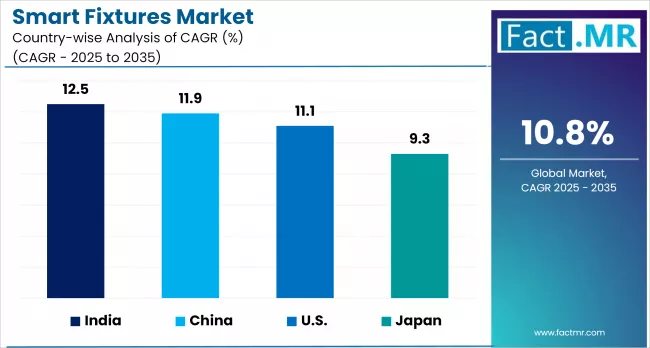
Smart Fixtures Market By Country | Source: Fact.MR
India is Accelerating Smart Fixtures Adoption through Automation and Smart Retail Transformation
The Indian smart fixtures industry is an industry that the Indian market is experiencing a spring in its growth given the concurrent growth of manufacturing automation and modernization of retailing. The government of India has realized the need to develop industry 4.0 through their projects of “Make in India” and “Digital India” and therefore, this presents an ideal environment to deploy test and assembly fixtures using Industry 4.0 capabilities enabled by IoT in automobile, electronics, and precision manufacturing segments.
At the same time, established retail chains and e-tailers are also making investments in electronic shelf labels, intelligent shelving and implementation of RFIDs in the display units to ensure increased accuracy of inventory, as well as increased customer connectivity.
Infrastructure preparedness of smart systems is being equally enhanced by urbanization and building to increase smart cities initiatives. Its manufacturing base is cheap, and with the growing number of technology partnerships with the world market players, the country is achieving faster access to the markets.
China is Driving Smart Fixture Innovation through Manufacturing Automation and Retail Digitalization.
China is gaining ground as the smart fixtures market leader because of its fast embrace of manufacturing automation and the use of digital retail technology. Smart shelves, electronic shelf labels, and RFID-based displays are used in the retail field by large chains to increase product accuracy and customer interaction. Domestic technology vendors and OEMs are operating at scale and driven through innovation that is producing cost effective and high-performance solutions that embrace domestic and international markets.
Also, the high level of electronics supply chain with excellent manufacturing capacity puts China on a competitive advantage of developing and fielding smart fixture system. The resulting duo-fold expansion into both industrial equipment and retail solutions also prompts China as a global reference point when it comes to making improvements in the field of smart fixtures, efficiency, scalability, and integration with smart infrastructures.
The United States Drives Innovation in IoT-Integrated Smart Fixtures
With the highly developed manufacturing abilities, the United States is becoming a leader in the implementation of IoT-connected smart fixtures that merge the present state-of-the-art manufacturing and innovative retail technologies. The use of smart fixtures in industrial applications allow U.S. manufacturers to be more precise during their assembly work, in automated testing and context planning where lifespan is being predicted, leading to maximized production and minimized downtime.
The digital infrastructure is robust in the country, which, combined with investments in the sphere of Industry 4.0, is the reason why fixtures can be easily integrated with enterprise systems with cloud-based analytics platforms.
2025-to-2035.webp "Us Smart Fixtures Market Country Value(usd Billion)2025 To 2035")
Us Smart Fixtures Market Country Value(usd Billion)2025 To 2035 | Source: Fact.MR
The U.S. companies are the first in the retail business to adopt smart shelving, an electronic shelf label and sensor-driven customer-facing screens in an effort to enhance more accurate inventory, facilitating operations and delivering a better store experience. The increased energy efficiency, sustainability and real time scope of operation is further increasing the adoption. The U.S., generating the next generation of smart fixture applications in both industrial and commercial settings, is being supported by competitive technology eco-system and targeted partnerships between the hardware suppliers, software developers and retailers.
Category-Wise Analysis
Smart Plumbing Fixtures are the Cornerstone of Intelligent Water Management
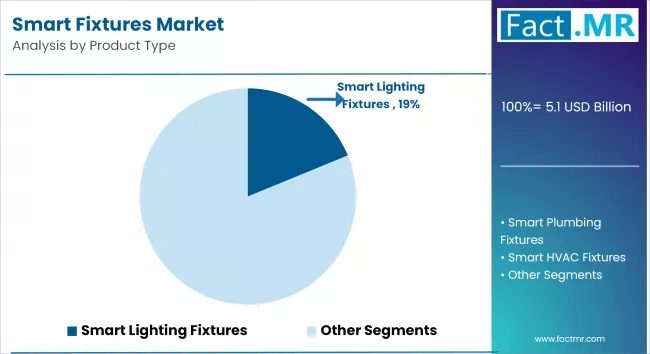
Smart Fixtures Market By Product Type | Source: Fact.MR
Smart plumbing fixtures segment is restructuring the approach of how residential, commercial, and industrial spaces should handle water consumption, hygiene and maintenance. These fixtures include sensor-based faucets, showers, intelligent leak detection systems which facilitate IoT, automation and analytics by optimizing the flow of water, avoiding waste, and improving convenience to the user. The increase in environmental awareness, tough water-saving policies, and the need to have solutions that are touchless in post-pandemic settings are fuelling the fastest adoption.
Smart plumbing fixtures are not only a luxury or convenient choice, but it is a point that should be considered as part of a sustainable infrastructure. They assist the property owners in reducing costs of operations and achieving sustainability goals through real-time monitoring of water usage, detection of anomalies, and real-time predictability maintenance of systems.
In addition, interoperability of them with smart home ecosystems and building management systems, which allows them to be centrally monitored and controlled, broadens their usefulness. With urbanization events occurring at the current pace, and concerns about water scarcity looming over everyone, the role of smart plumbing fixtures in the concept of intelligent water management will only become more important.
Smart Fixtures Are the Cornerstone of Next-Generation Commercial Spaces
Smart fixtures are also poised to become a vital operational excellence, customer-engagement, and brand-differentiator of the commercial segment of the industry. Such arrays, including intelligent display options, electronic shelf labels, and even shelving based on sensors, convert the conventional business world into data-connected and data-driven environments. Smart fixtures enable businesses to manage inventory, product visibility, and dynamic responses to consumer behaviour optimally by using IOT connectivity, automated control, and AI-based analytics.
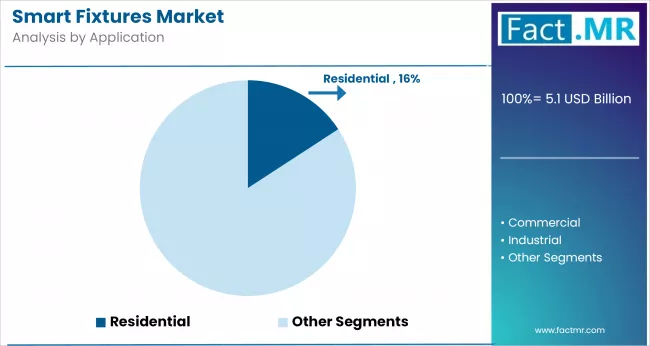
Smart Fixtures Market By Application | Source: Fact.MR
Retailers can enjoy real-time price changes, the implementation of energy efficient lighting, and space analysis; and hospitality and other public facilities gain presence through enhancing customer navigation and customization. The use of smart fixtures eliminates the bulk of manual work, error-prone situations, and sustainability, acting through minimizing waste and energy costs.
With the increase in competition in the commercial market, the companies that have already adopted the smart fixture technologies have made their operations less rigid and more responsive to customer satisfaction, as an early technology adopter it puts the innovations as a key investment towards a future-proof commercial infrastructure.
Competitive Analysis
Key players in the smart fixtures industry include Teradyne Inc., Keysight Technologies Inc., National Instruments Corporation, Advantest Corporation, Rohde & Schwarz GmbH & Co. KG, Chroma ATE Inc., Marvin Test Solutions Inc., Astronics Corporation, SPEA S.p.A., Cohu Inc., VusionGroup (formerly SES-imagotag), Kohler Co., The Sempre Group, Digi International, Inc., and Develco Products
The fierce competition is described in the smart fixtures market because of the fast progressive changes in technology and the growing popularity of integrated IoT solutions. Innovation in products is one of the main strategies pursued by the companies, with most of them adding features such as AI-based analytics, energy efficiencies, and greater connectivity as a way to differentiate themselves. Partnerships, mergers and acquisitions to increase geographic boundaries and product lines are the order of the day. Such heavy investment into R&D is also observed in the market in order to come up with modular and customer-based solutions that can be customized until they fit the requirements of a certain industry. Besides, the companies are improving after-sales services, software integrations, and cybersecurity capabilities to develop long-term clients and stay competitive.
Recent Development
- In May 2025, Plumber Bathware launched its Premium Thermostatic Shower Collection, enhancing plumbing fixtures with anti-scald technology, precise temperature control, and spa-like flow to ensure safety, comfort, and durability. Designed with premium brass and a heat-insulating polymer, the range redefined luxury in modern bathrooms while maintaining cool-touch surfaces.
- In February 2025, FGI Industries showcased breakthrough plumbing fixtures at KBIS 2025, unveiling innovations in Flush Guard™ Anti-Overflow Toilets, Craft + Main® vanities, Contrac® plumbing lines, and JETCOAT® Shower Walls. The company expanded its anti-overflow toilet range and introduced FLEX™ and REFLECTIONS™ shower wall collections, reinforcing its leadership in bathroom design.
Fact.MR has provided detailed information about the price points of key manufacturers of the Smart Fixtures Market positioned across regions, sales growth, production capacity, and speculative technological expansion, in the recently published report.
Methodology and Industry Tracking Approach
The global smart fixtures market report by Fact.MR uses data collected by referencing 1,200 stakeholders in 12 countries, the latter having a minimum sample of 75 observations. Among them 65 percent were end users such as commercial facility owners, retail chain operators, manufacturing plant managers, and OEM-procurement managers, and the rest 35 percent included supply chain architects, IoT system deployment consultants, and smart infrastructure policy designers.
The study was done between July 2024 and June 2025, and it cost over technology adoption readiness, interoperability standards and integration feasibility, ROI potential, and trends in cross-sector deployment. The calibration model used was balanced in a way that pertains to regional representation in North America, Europe, and Asia.
The work entailed more than 95 approved sources, such as smart retail implementation cases, industrial automation case studies, IoT standards documentation, network performance reports, and papers by providers of smart fixture solutions. With triangulation protocols, Fact.MR used multi-variable regression and scenario modeling to provide credible forecasts and strategic insights to stakeholders expecting to attain innovation, efficiency and stability in the smart fixtures ecosystem.
Segmentation
Segmentation of Smart Fixtures Market
-
By Product Type :
- Smart Lighting Fixtures
- Smart Plumbing Fixtures
- Smart HVAC Fixtures
- Smart Security Fixtures
-
By Connectivity :
- Wi-Fi
- Bluetooth
- Zigbee/Z-Wave
- Others
-
By Material :
- Metals
- Plastics
- Composite Materials
- Others
-
By Application :
- Residential
- Commercial
- Industrial
- Public Infrastructure
-
By Distribution Channel :
- Offline
- Online
-
By Region :
- North America
- Latin America
- Western Europe
- Eastern Europe
- East Asia
- South Asia & Pacific
- Middle East & Africa
Frequently Asked Questions
What was the Global Smart Fixtures Market Size Reported by Fact.MR for 2025?
Who are the Major Players Operating in the Smart Fixtures Market?
What is the Estimated Valuation of the Smart Fixtures Market in 2035?
What Value CAGR did the Smart Fixtures Market Exhibit Over the Last Five Years?
Who worked on this report


Preview the report firsthand - request a free sample
Free SampleGet the brochure for pricing and purchase details
Download PDF