- Market Value (2025): USD 2.6 Bn
- Estimated Value (2026): USD 2.9 Bn
- Forecast Value (2036): USD 8.0 Bn
- CAGR (2026-2036): 10.9%
What is the Dry Extrusion Proteins Market forecast to be worth by 2036?
USD 2.9 billion in 2026 to USD 8.0 billion by 2036 at a 10.9% CAGR.
- The Dry Extrusion Proteins Market reached USD 2.6 billion in 2025.
- Demand is projected to increase from USD 2.9 billion in 2026 to USD 8.0 billion by 2036.
- The market is forecast to record 10.9% CAGR from 2026 to 2036 as meat-alternative brands and snack makers expand texture-led protein formats.
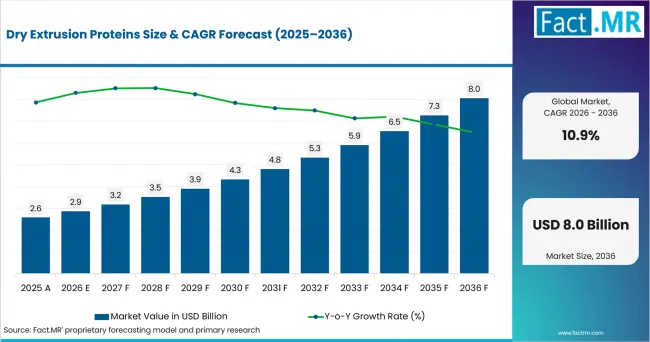
Dry Extrusion Proteins Value Analysis | Source: Fact.MR
What are the defining numbers behind Dry Extrusion Proteins Market growth?
An absolute opportunity of USD 5.1879 billion is expected between 2026 and 2036.
- Demand Drivers in the Market
- Meat-alternative brands need fibrous dry texturates that hydrate quickly and keep bite after cooking. Dry pieces help brands build familiar plant-based foods without changing every line process.
- Snack manufacturers need protein crisps and crumbles that keep expansion while lifting label protein claims. Cargill said in December 2025 that 57% of nutrition-label readers search for protein.
- U.S. ingredient makers benefit from soybean scale due to cost-aware soy texturate supply. USDA NASS estimated in June 2026 that U.S. soybean planted area was 85.4 million acres.
- Key Segments Analyzed
- By Protein Source: Pea is expected to hold 29.0% share in 2026 supported by neutral use in meat alternatives, snacks and bars.
- By Extrudate Type: TVP granules are projected to account for 34.0% share in 2026 owing to their use in mince, fillings and hybrid recipes.
- By Protein Level: 61-70% is anticipated to capture 31.0% share in 2026 supported by nutrition claims and manageable hydration behavior.
- By Application: Meat alternatives are estimated to represent 46.0% share in 2026 shaped by bite requirements in burgers, chunks and meal kits.
- Analyst Opinion at Fact.MR
- Shambhu Nath Jha, Principal Consultant at Fact.MR, states, “Dry extrusion proteins are gaining buyer attention because texture now decides repeat use in plant-based foods. Demand is expected to move toward suppliers that prove bite retention after hydration and cooking. Trial data, regional sourcing and recipe support are expected to shape supplier selection.”
- Strategic Implications
- Protein ingredient suppliers should publish hydration ratios, cooking behavior and texture retention data for every dry-extruded grade.
- Food brands should test granules and chunks in the final sauce matrix before scaling retail or foodservice recipes.
- Extrusion technology teams should document barrel settings and feed moisture ranges so plant trials move cleanly into commercial runs.
- Regional distributors should carry pea, soy and wheat bases where brands qualify multiple protein sources for cost control.
The Netherlands is projected to post 12.1% CAGR through 2036 supported by pulse processing policy. The UK is anticipated to advance at 11.6% CAGR due to prepared-food applications. The USA is forecast to record 11.3% CAGR attributable to soybean processing depth. Germany is estimated to hold 10.1% CAGR supported by meat-substitute output and dry texture demand. France is expected to reach 9.8% CAGR supported by legume-chain projects.
How does the Dry Extrusion Proteins Market break down by segment?
Pea leads Protein Source at 29.0%; meat alternatives lead Application at 46.0%.
Which Protein Source dominates?
Pea holds 29.0% share in 2026.
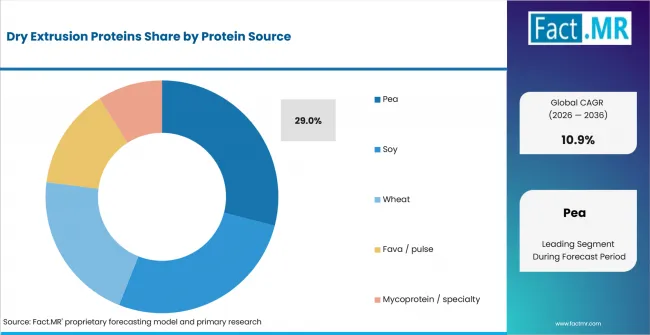
Dry Extrusion Proteins Analysis By Protein Source | Source: Fact.MR
Pea leads the source mix due to its flexible use in meat alternatives and snacks. Soy remains relevant where cost and extrusion know-how guide decisions. Wheat supports fibrous bite in chicken-style formats. Roquette launched NUTRALYS® Pea 850F in February 2026, positioning the pea protein isolate around improved sensory performance and cleaner, more neutral taste profiles.
What leads the Extrudate Type segment?
TVP granules account for 34.0% share in 2026.
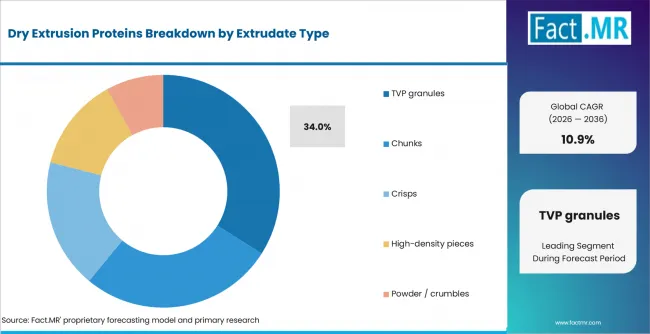
Dry Extrusion Proteins Analysis By Extrudate Type | Source: Fact.MR
TVP granules lead the type mix due to their role in mince, fillings and hybrid meat extenders. Chunks suit meal centers where visible bite is required. Crisps serve snack applications that need expansion and crunch. ADM’s May 2026 protein portfolio launch included European-sourced Arcon R soy protein concentrate, which supports dry extrusion among other applications, and Arcon T, a portfolio of textured soy protein concentrates.
How does Protein Level shape demand?
61-70% holds 31.0% share in 2026.
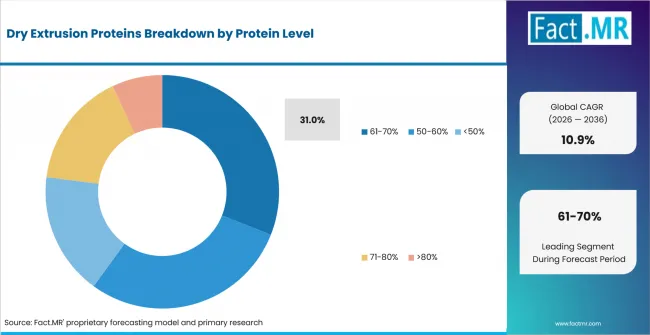
Dry Extrusion Proteins Analysis By Protein Level | Source: Fact.MR
The 61-70% range leads since it balances protein claims with manageable processing behavior. The 50-60% range suits lower-cost recipes where bite and yield guide formulation. Higher levels serve bars where label protein density carries value.
What supports Meat Alternatives within Application?
Meat alternatives represent 46.0% share in 2026.
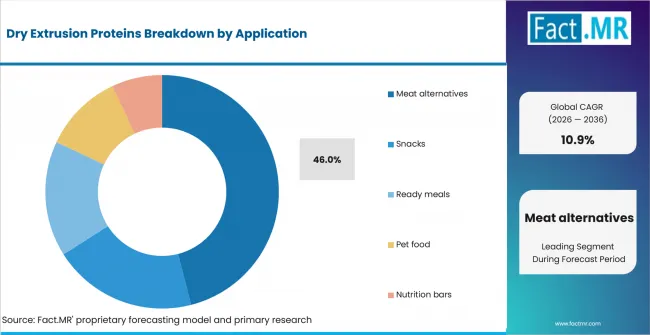
Dry Extrusion Proteins Analysis By Application | Source: Fact.MR
Meat alternatives represent the primary application due to bite mimicry and simpler process handling. Snacks follow where crisps and crumbles add protein to puffed formats. Ready meals use chunks that survive sauce contact. Food brands use dry pieces when meat-style texture must fit existing equipment.
What is accelerating Dry Extrusion Proteins Market adoption, and what is holding it back?
Texture-led formulation drives it; source-cost and sensory limits restrain it.
Drivers Impact Analysis
| DRIVER | (~) % IMPACT ON CAGR | GEOGRAPHIC RELEVANCE | IMPACT TIMELINE |
|---|---|---|---|
| Meat-alternative texture needs | +1.7% | North America, Europe | Short term (<= 2 years) |
| Snack protein fortification | +1.2% | Global | Medium term (2-4 years) |
| Ready-meal reformulation | +1.0% | Western Europe, North America | Medium term (2-4 years) |
| Regional soy and pea supply | +0.8% | USA, Europe | Long term (>= 4 years) |
| Pulse-processing policy support | +0.6% | Netherlands, France, UK | Long term (>= 4 years) |
Opportunity Impact Analysis
| OPPORTUNITY | (~) % IMPACT ON CAGR | GEOGRAPHIC RELEVANCE | IMPACT TIMELINE |
|---|---|---|---|
| Pea and wheat texture expansion | +1.1% | Europe, North America | Short term (<= 2 years) |
| High-protein snack crisps | +0.9% | Global | Medium term (2-4 years) |
| Fava and pulse diversification | +0.7% | Netherlands, Germany, France | Medium term (2-4 years) |
| Pet-food protein pieces | +0.5% | North America, Europe | Long term (>= 4 years) |
Restraints Impact Analysis
| RESTRAINT | (~) % IMPACT ON CAGR | GEOGRAPHIC RELEVANCE | IMPACT TIMELINE |
|---|---|---|---|
| Off-note masking needs | -0.7% | Global | Short term (<= 2 years) |
| Pulse crop volatility | -0.6% | UK, Netherlands, France | Medium term (2-4 years) |
| Soy price exposure | -0.4% | USA, Europe | Medium term (2-4 years) |
| Application scale-up failures | -0.3% | Global | Long term (>= 4 years) |
Which countries are scaling the Dry Extrusion Proteins Market through 2036?
- The country comparison spans 2.3 percentage points and forms three practical growth bands across the forecast period.
- The Netherlands remains 0.5 percentage point above the UK due to pulse-processing coordination and specialty ingredient capacity.
- The UK remains 0.3 percentage point above the USA due to prepared-food production and repeat dry-texturate applications.
- The USA remains 1.2 percentage points above Germany due to soybean processing depth and dry-extrusion know-how.
- Germany remains 0.3 percentage point above France through meat-substitute production and ready-meal use.
- France closes the displayed range supported by legume-chain projects and local textured protein processing.
Comparable CAGRs create different entry conditions due to crop availability, texturizing capacity and recipe localization. Full report coverage includes North America, Latin America, Western Europe, Eastern Europe, East Asia, South Asia & Pacific, Middle East & Africa.
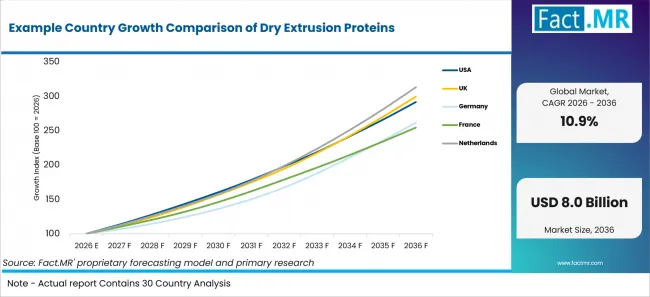
Example Country Growth Comparison Of Dry Extrusion Proteins | Source: Fact.MR
| Country | CAGR (2026-2036) |
|---|---|
| Netherlands | 12.1% |
| United Kingdom | 11.6% |
| United States | 11.3% |
| Germany | 10.1% |
| France | 9.8% |
What is powering the Netherlands' growth?
12.1% CAGR, supported by protein-crop coordination and food-use processing.
Dutch demand is shaped by chain coordination around protein-rich crops. The Netherlands is projected to record 12.1% CAGR through 2036 with local pulse work moving toward human-food processing. The Dutch indicator for protein-rich crops, covering oilseeds, pulses and fodder legumes, was provisionally reported at nearly 30,871 hectares in 2025.
How is the United Kingdom scaling demand?
11.6% CAGR, driven by prepared foods and domestic pulse supply.
Prepared-food manufacturers in the UK need dry pieces for chilled meals and snacks. The market is anticipated to post 11.6% CAGR through 2036 due to high-volume food manufacturing. Defra’s September 2026 update reported that production of peas harvested dry for human consumption was estimated at 96 thousand tonnes in 2025.
What supports the USA outlook?
11.3% CAGR, backed by soybean scale and pea-processing capacity.
U.S. adoption rests on crop scale and large ingredient processors serving soy and pea systems. The market is forecast to hold 11.3% CAGR through 2036 supported by domestic soybean processing for cost-aware dry texturates. PURIS described its Dawson site in March 2025 as the largest U.S. organic pea protein facility.
What is supporting Germany's adoption?
10.1% CAGR, supported by meat-substitute output and ready-meal production.
German demand is linked to prepared foods and meat-substitute manufacturing. The market is estimated to advance at 10.1% CAGR through 2036 where manufacturers refine dry pieces for chilled recipes. Destatis reported in January 2026 that Germany produced 1.7 million tonnes of ready meals in 2024.
How does France perform?
9.8% CAGR, led by legume-chain projects and local protein processing.
France has a policy-backed route for local legumes and textured protein processing. The market is expected to reach 9.8% CAGR through 2036 supported by public aid for transformation projects. France’s agriculture ministry said in July 2025 that the selected Texipro project aims to create an industrial unit for the first-stage processing of textured plant proteins supplied by local crops, particularly soybeans.
Who leads the Dry Extrusion Proteins Market?
Roquette and ADM have direct textured-protein offerings relevant to dry extrusion, while Cargill and Ingredion provide additional plant-protein and formulation solutions.
Roquette participates through NUTRALYS textured wheat and pea proteins, including NUTRALYS T PEA 700XC, a large-chunk textured pea protein suited to ready meals and other savory applications. ADM supports plant-protein applications through its established TVP portfolio, soy protein concentrates and pea ingredients, including recently introduced Arcon soy protein solutions.
Cargill supports plant-protein formulations through soy, pea and textured-protein solutions for meat-alternative and other food applications. In December 2025, Cargill described protein-fortified puffed-snack development in which a specific pea protein was paired with native starch to help achieve a crispy, expanded texture.
Which companies are the key providers?
Companies profiled include Roquette, ADM, Cargill, Ingredion, and PURIS.
- Roquette
- ADM
- Cargill
- Ingredion
- PURIS
Bibliography
- ADM. (2026, May 20). ADM advances protein innovation with new ingredient solutions.
- BENEO. (2025, December 2). BENEO helps producers improve nutritional profiles for weight management.
- Cargill. (2025, December 4). Protein boom: Why consumers want more protein—and how innovation is rising to meet the demand.
- Department for Environment, Food & Rural Affairs. (2026, September 3). Chapter 7: Crops. GOV.UK.
- De Staat van Landbouw, Voedsel, Visserij en Natuur. (2025, December 15). Oppervlakte eiwitrijke gewassen.
- Ingredion Incorporated. (2026, July 6). Ingredion to spotlight next-generation solutions for texture, clean labels and positive nutrition at IFT FIRST 2026.
- Ministère de l’Agriculture et de la Souveraineté alimentaire. (2025, July 2). Planification écologique : 11,7 millions d’euros d’aides en faveur de la souveraineté protéique en France.
- PURIS. (2026, May 27). Inside the largest U.S. pea processing plant.
- Roquette. (2025, June 17). NUTRALYS® portfolio: New textured wheat and pea proteins.
- Roquette. (2026, February 23). Launch of breakthrough clean-tasting pea protein isolate.
- Statistisches Bundesamt (Destatis). (2026a, May 18). Nach jahrelangem Anstieg: Fleischersatz-Produktion sinkt 2025 um 1,2 % gegenüber dem Vorjahr.
- Statistisches Bundesamt (Destatis). (2026b, January 14). Produktion von Fertiggerichten binnen fünf Jahren mengenmäßig um 25,6 % gestiegen.
- U.S. Department of Agriculture, National Agricultural Statistics Service. (2026, June 30). Corn planted acreage down 3% from 2025, soybean acreage up 5% from last year.
- Bukowski, M., & Swearingen, B. (2026, June 15). Oil crops outlook: June 2026 (OCS-26f). U.S. Department of Agriculture, Economic Research Service.
- Office for National Statistics. (2026, July 24). UK manufacturers’ sales by product: 2025.
- Zuijdgeest, S. (2025, August 28). Samen helpen wij de hele keten van eiwitrijke gewassen groeien: Van de ‘Bean’ naar de ‘Deal’ [Report]. Rijksoverheid.
This Report Answers
- The report explains where dry extrusion proteins are used across protein source and extrudate type. It covers protein level and application.
- Segment analysis identifies pea, TVP granules, 61-70% protein levels and meat alternatives as the 2026 share leaders.
- Country analysis examines the Netherlands, United Kingdom, United States, Germany and France across crop supply, processing capacity and policy support.
- Competitive analysis reviews Roquette, ADM, Cargill, Ingredion, and PURIS across textured proteins and application support.
- Application analysis assesses how bite, hydration and heat stability influence purchases by meat-alternative, snack, ready-meal and pet-food manufacturers.
What does the Dry Extrusion Proteins Market cover?
Pea, soy, wheat, fava and specialty protein texturates used for dry-format food applications.
The Dry Extrusion Proteins Market covers dry-extruded protein ingredients that deliver texture and protein density in finished foods. It includes plant protein ingredients extruded into granules, chunks, crisps or crumbles for shelf-stable handling.
The assessment differs from broader protein ingredients coverage since it focuses on texturized forms produced by dry extrusion. It links to downstream plant-based meat and snack use where dry pieces are hydrated or blended into final products.
What is included in the scope?
Dry-extruded protein ingredients used in meat alternatives, snacks, ready meals, pet food and nutrition bars.
The scope includes pea, soy, wheat, fava or specialty proteins processed into TVP granules, chunks, crisps, high-density pieces and powder or crumble formats. It covers dry-extruded inputs used in meat substitutes, protein snacks, ready meals, pet-food pieces and nutrition bars. It covers adjacent heat stable texturizing agents when dry-extruded protein is the functional base. The assessment includes textured soy proteins and United States textured soy protein activity where the use case is dry extrusion.
What is excluded from the scope?
Wet-extruded analogs and plain protein powders are outside the scope.
The scope excludes wet-extruded meat analogs sold as finished foods, plain isolates, concentrates and crop commodities traded before texturizing. It excludes non-GMO soy protein when sold only as a powder or isolate. It excludes fermented fava protein texturates unless the commercial form is dry-extruded and sold as a texturized ingredient. Broader protein texturizers and functional binders remain adjacent when sold separately from dry-extruded protein pieces.
How Was the Analysis Built?
The analysis draws on 120+ sources, 35+ company portfolios, 25+ countries, and more than 20 industry interviews.
- Primary Research: Primary research includes discussions with manufacturers, service providers, technology developers, distributors, end users, and subject-matter experts. These conversations examine purchasing priorities, product adoption, operational challenges, approval requirements, competitive positioning, and the factors that influence wider market acceptance.
- Desk Research: Desk research covers government statistics, regulatory publications, company filings, trade data, technical studies, industry associations, standards, public policy, and other authoritative sources. Every source used in the analysis is documented in the bibliography.
- Market Sizing and Forecasting: Market estimates combine historical performance, demand indicators, pricing and volume trends, segment shares, company participation, country-level growth, adoption patterns, investment activity, and barriers to market expansion.
- Data Validation and Update Cycle: Findings are validated by comparing primary interviews with public data, company activity, regulatory changes, trade patterns, and industry developments. Regular updates review new product launches, capacity changes, partnerships, approvals, and shifts in commercial adoption.
What is the report’s scope and coverage?
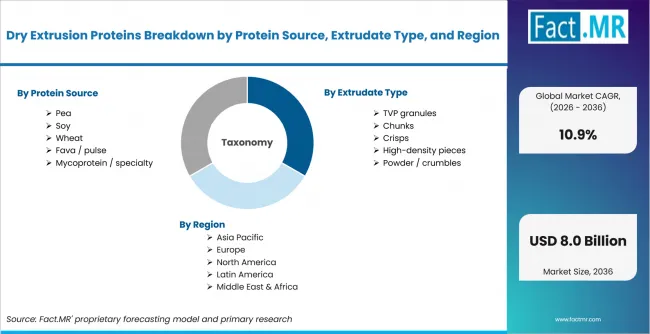
Dry Extrusion Proteins Breakdown By Protein Source, Extrudate Type, And Region | Source: Fact.MR
| Attribute | Details |
|---|---|
| Quantitative Units | USD billion in 2026 to USD billion by 2036 at a CAGR |
| Market Definition | Dry-extruded protein ingredients produced from plant or specialty protein bases to create granules, chunks, crisps, high-density pieces, powders and crumbles for food and pet-food formulation. |
| Protein Source | Pea; Soy; Wheat; Fava / pulse; Mycoprotein / specialty |
| Extrudate Type | TVP granules; Chunks; Crisps; High-density pieces; Powder / crumbles |
| Protein Level | 50-60%; 61-70%; 71-80%; <50%; >80% |
| Application | Meat alternatives; Snacks; Ready meals; Pet food; Nutrition bars |
| Regions Covered | North America; Latin America; Western Europe; Eastern Europe; East Asia; South Asia & Pacific; Middle East & Africa |
| Countries Covered | United States; United Kingdom; Germany; France; Netherlands |
| Key Companies Profiled | Roquette; ADM; Cargill; Ingredion; PURIS |
| Forecast Period | 2026 to 2036 |
| Approach | Hybrid top-down and bottom-up approach using crop availability, ingredient processing capacity, application mix, country-level adoption and provider portfolio review. |
How is the market segmented?
-
By Protein Source
- Pea
- Soy
- Wheat
- Fava / pulse
- Mycoprotein / specialty
-
By Extrudate Type
- TVP granules
- Chunks
- Crisps
- High-density pieces
- Powder / crumbles
-
By Protein Level
- 50-60%
- 61-70%
- 71-80%
- <50%
- >80%
-
By Application
- Meat alternatives
- Snacks
- Ready meals
- Pet food
- Nutrition bars
-
By Region
- North America
- Latin America
- Western Europe
- Eastern Europe
- East Asia
- South Asia & Pacific
- Middle East & Africa