- Market Value (2025): USD 316.2 Mn
- Estimated Value (2026): USD 336.1 Mn
- Forecast Value (2036): USD 621.4 Mn
- CAGR (2026-2036): 6.3%
E-Cloth Market Forecast and Outlook 2026 to 2036
The global E-Cloth market reached USD 316.2 million in 2025 and is valued at USD 336.1 million in 2026. Revenue is projected to increase to USD 621.4 million by 2036, reflecting a CAGR of 6.3% during the forecast period.
Demand for reusable cleaning textiles is linked to repeated wiping in homes and commercial premises. Household shoppers weigh the initial cost of a microfiber cloth against its care needs and repeated use. E-Cloth and Norwex explain how their cloths are used with water and how the fabric should be washed. Clearer instructions can support specialist cloth sales as shoppers compare performance across cleaning tasks.
Market Summary for the E-Cloth Market
- E-Cloth Market Value (2025): USD 316.2 million
- E-Cloth Market Value (2026): USD 336.1 million
- E-Cloth Market Forecast Value (2036): USD 621.4 million
- E-Cloth Market Forecast CAGR (2026-2036): 6.3%
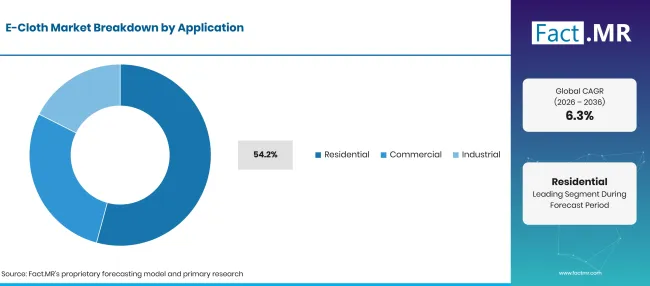
- Leading Application: Residential (54.2%)
- Key Market Participants: E-Cloth Ltd., Norwex, and Grove Collaborative
- Countries Covered: Germany, Brazil, USA, UK and Japan
Retail access is becoming more useful for reusable cleaning textiles as consumers look for clearer product comparisons. In August 2026, Germany's Federal Statistical Office reported that 85% of internet users aged 16 to 74 had purchased goods online during 2025. Well-labeled online ranges can reach shoppers who want to compare material, cleaning purpose and washing guidance before ordering.
E-Cloth Market
| Metric | Value |
|---|---|
| Estimated Value in (2026) | USD 336.1 million |
| Forecast Value in (2036) | USD 621.4 million |
| Forecast CAGR (2026 to 2036) | 6.3% |
Source: Fact.MR analysis. Updated Nov 17, 2026
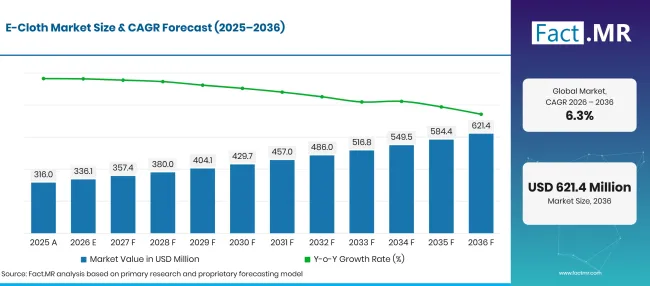
E Cloth Market Forecast Global | Source: Fact.MR
Category
| Category | Segments |
|---|---|
| Product Type | Kitchen Cloths, General Purpose Cloths, Glass & Polishing Cloths, Bathroom Cloths, Others |
| Application | Residential, Commercial, Industrial |
| Distribution Channel | Supermarkets/Hypermarkets, Online Retail, Specialty Stores, Others |
| Material Type | Microfiber, Cotton, Others |
| Region | Germany, Brazil, USA, UK, Japan |
Source: Fact.MR analysis. Updated Nov 17, 2026
Segmental Analysis
Why do kitchen cloths account for the largest product-type share in the E-Cloth Market?
E Cloth Market Breakdown Product Type | Source: Fact.MR
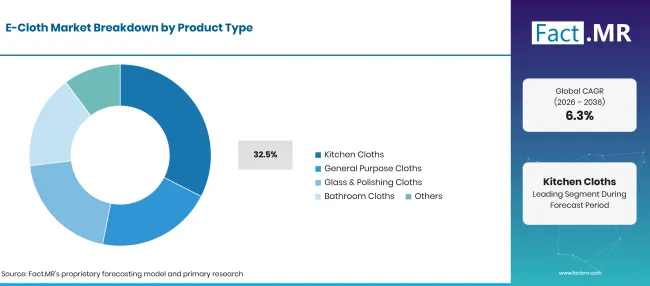
Kitchen cloths hold 32.5% of 2026 product-type revenue. Food preparation and routine counter wiping create regular opportunities for washable cloths in household kitchens. Customers compare surface compatibility and the ease of removing grease during repeated use. Clear kitchen-specific instructions can distinguish cloths sold for everyday wiping, while general-purpose and polishing versions address different household tasks. Adjacent product categories include surface cleaning products. A cloth chosen for food-preparation areas faces a different buying decision from one used only to polish a mirror. Retailers can explain those differences through room labels instead of long technical descriptions. The scope for a product set depends on whether each cloth has a clear purpose and whether customers want separate cloths for separate surfaces. This is why kitchen assortments are likely to remain an important part of specialist reusable-cleaning ranges.
How does residential cleaning shape E-Cloth Market applications?
E Cloth Market Breakdown Application | Source: Fact.MR
Residential customers are projected to account for 54.2% of E-Cloth market revenue in 2026. Cleaning surfaces after cooking or carrying out weekly home care creates repeated opportunities to use a washable cloth. Consumers choose between individual cloths and sets based on the rooms they clean. Household purchases will reflect the balance between upfront pack prices and the expected useful life of the fabric. For a household, the number of cleaning tasks can affect whether a single all-purpose cloth is enough. Families that separate kitchen wiping from bathroom cleaning may prefer packs containing more than one fabric type. At the same time, buyers need to understand washing frequency and proper drying before selecting a reusable product. Practical information on these points is expected to help maintain satisfaction after the first purchase.
Why do supermarkets and hypermarkets retain an important role in E-Cloth Market sales?
E Cloth Market Breakdown Distribution Channel | Source: Fact.MR
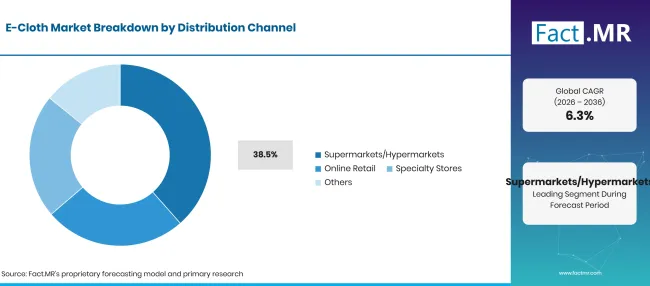
Supermarkets and hypermarkets lead with 38.5% share in 2026. Cleaning textiles are easy to compare during routine household shopping when customers can see pack sizes and price labels. Online outlets have a different role because they offer product details and care instructions. Specialist brands can benefit from consistent labeling across store shelves and digital listings, making repeat purchases easier after a customer chooses a suitable cloth. Adjacent product categories include consumer wet wipes. Shelf space matters for a small cleaning accessory because customers often decide during an existing shopping trip. A clear pack label can explain the cloth's intended use without requiring a separate product demonstration. Online pages have room for longer instructions and photographs, which can help with specialist glass or bathroom products. A consistent product name across both outlets also makes it easier for a shopper to find the same item again.
What makes microfiber the main material used in the E-Cloth Market?
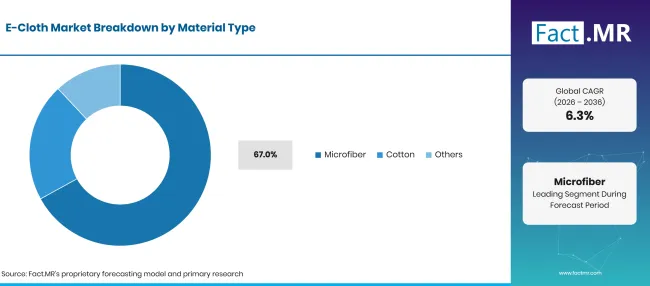
E Cloth Market Breakdown Material Type | Source: Fact.MR
Microfiber accounts for 67.0% of E-Cloth market revenue in 2026. Fine synthetic fibers provide a structure suited to repeated surface wiping when used and cared for correctly. Cotton cloths remain a familiar option for households that value a simple washing routine. Care instructions can influence microfiber replacement sales because cleaning performance depends partly on maintaining the cloth between uses. The distinction between microfiber and cotton is especially relevant when customers judge cloths by texture and cleaning routine. A microfiber cloth is commonly sold for a named surface or task, while cotton is familiar from everyday household use. Care guidance becomes part of the purchase decision because a customer needs to know how to wash the material after repeated wiping. Specialists are expected to compete on these clear practical differences instead of broad claims.
E-Cloth Market-Drivers, Restraints & Trends
- Drivers: Repeated cleaning of household surfaces is projected to support the use of washable cloths. In April 2026, Destatis published figures showing that Germany's real retail turnover rose 3.3% in 2025. Consumers generally know how to use ordinary fabric cloths, so specialist brands need simple language to explain the extra care involved in maintaining microfiber. Everyday examples such as wiping a kitchen counter or polishing a bathroom mirror make the comparison easier.
- Restraints: A reusable cloth requires proper washing and drying between uses. Norwex advises users to wash dirty microfiber and avoid fabric softeners or dryer sheets that coat the fibers. Shoppers who prefer low-effort disposable formats may regard this care routine as inconvenient. Brands need clear handling instructions and realistic descriptions of the cloth’s intended use, especially when products are promoted for kitchens and bathrooms.
- Trend: Online product education is becoming a useful part of the sales process. The UK Office for National Statistics reported that internet transactions accounted for 24.7% of household-goods store sales in 2025. This measure describes household-goods retailing across multiple product types. Detailed listings can explain washing advice and surface compatibility before a shopper orders a cloth. Stores providing simple demonstrations may complement this information and reduce confusion about intended applications.
E-Cloth Market by Analysis by Country
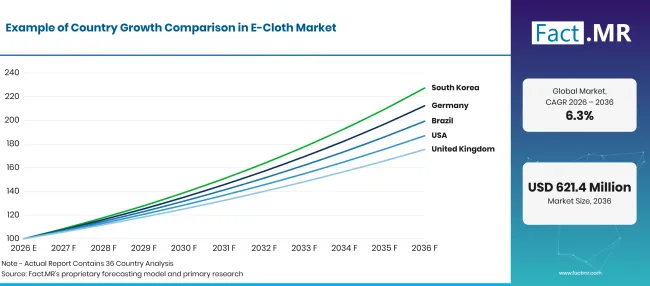
E Cloth Market Growth Index | Source: Fact.MR
| Country | CAGR (2026-2036) |
|---|---|
| Germany | 7.8% |
| Brazil | 7.1% |
| USA | 6.5% |
| UK | 5.8% |
| Japan | 5.1% |
Source: Fact.MR analysis. Updated Nov 17, 2026
What is supporting E-Cloth demand in Germany?
Germany's household retail network places washable cleaning cloths within an established range of home-care goods.
The E-Cloth market in Germany is projected to expand at a 7.8% CAGR from 2026 to 2036. Kitchen cloths fit frequent counter cleaning, while separate glass cloths appeal to customers seeking a clear finish on mirrors and windows. In May 2026, the Federal Statistical Office reported that the retail price index for miscellaneous-goods stores rose 2.3% in 2025. That price movement gives households a reason to compare the cost of a reusable cloth set with ordinary textiles and disposable wipes. Clear washing guidance and easy access through household retailers are projected to help specialist cloth brands explain their value.
How does Brazilian retail behavior influence E-Cloth sales?
Brazil's broad retail base creates several routes for washable household cleaning textiles, especially where shoppers prefer practical products for repeated kitchen use.
The E-Cloth market in Brazil is forecast to rise at a 7.1% CAGR between 2026 and 2036. In February 2026, the Brazilian Institute of Geography and Statistics reported that Brazil's total retail sales volume increased 1.6% in 2025. Stores that explain how to wash and reuse microfiber cloths are likely to make premium packs easier to compare with basic cotton alternatives. Online listings can describe the number of cloths in a pack and the surfaces each one is designed to clean.
What buying habits support E-Cloth Market growth in the USA?
United States consumers can find reusable cleaning cloths through supermarkets and online home-care stores, letting them to compare household sets before buying.
Sales in the US E-Cloth market are projected to grow at a 6.5% CAGR through 2036. In October 2026, the US Census Bureau reported that retail and food-service sales reached USD 745.0 billion in September 2026. A cloth's cleaning purpose and its care instructions are expected to shape the choice between specialized microfiber and ordinary household textiles. Kitchen products can be sold as daily-use items, while polishing cloths appeal to people cleaning glass or mirrors.
Why does the UK remain a relevant E-Cloth market?
UK households can buy cleaning cloths as part of their regular supermarket shopping or through online specialist retailers.
The UK E-Cloth market is anticipated to register a 5.8% CAGR during 2026 to 2036. In June 2026, the Office for National Statistics reported that average UK household spending across all categories reached GBP 676.60 per week in the financial year ending March 2025. Household budgets influence how shoppers compare the upfront price of microfiber cloths with lower-cost household textiles. Smaller product packs are likely to help consumers test a new cleaning format before purchasing a full set. Retailers can use simple care instructions to explain when a cloth needs washing and how it should be dried.
How are Japanese household cleaning routines shaping E-Cloth demand?
Japan's household cleaning market places value on compact storage and cloths that are simple to rinse after repeated use.
The E-Cloth market in Japan is estimated to grow at a 5.1% CAGR from 2026 to 2036. In February 2026, Japan's Statistics Bureau reported average monthly spending across all consumption categories of JPY 314,001 in 2025 for households with two or more people. Retailers are likely to benefit from clear distinctions between a general-purpose wiping cloth and one intended for glass polishing. Small packs may suit households looking for a limited number of cleaning accessories. Japanese-language care guidance can explain how to wash microfiber without fabric softener and how to dry the cloth after use.
Competitive Landscape for E-Cloth Market
Competition in reusable cleaning cloths is led by specialist fabric brands and wider household-supply sellers. E-Cloth markets purpose-made microfiber cloths for kitchen surfaces, glass and other home cleaning jobs. Norwex sells its EnviroCloth and separate window cloth formats, with instructions describing how to clean and care for them. These brands compete on the cloth’s intended use, textile features and information provided to consumers. Cloth supply should be distinguished from companies whose main offerings are bottled cleaning products or detergents. Specialist brands need to distinguish a cloth's cleaning use from its wider environmental claims. A shopper can assess its packaging and wash instructions before buying, but actual satisfaction depends on repeated use at home. The ability to buy a replacement cloth without purchasing a complete set can influence the customer relationship. Retailers serving several cleaning brands may emphasize product selection and convenience instead of fabric construction.
Grove Collaborative is a home-care retail platform and serves a different role from a specialist cloth producer. Other household cleaning brands offer adjacent products, but direct microfiber-cloth competition is most clearly represented by companies with documented reusable textile ranges. Fabric care instructions and task-specific packs are expected to influence how specialist brands compete for repeat household purchases. Household brands with cleaning sprays or concentrates belong to the surrounding home-care industry, but their participation in liquid cleaning products does not by itself establish a direct role in reusable microfiber textiles. The competitive discussion focuses on documented cloth ranges and the channels where buyers find them. A specialist fabric maker can explain its wash requirements in greater depth, while a retailer can help customers compare several household cleaning formats.
Recent Developments
- In October 2025, Norwex published its limited-edition EnviroCloth listing on its official Norway website. The reusable microfiber cloth is positioned for regular household wiping and includes instructions for continued use and washing.
- In 2026, E-Cloth continued to publish cleaning and fabric-care guidance for its reusable microfiber cloth range. The guidance explains how cloths are used for different household surfaces and how the fabric can be washed for repeated use.
Key Players in E-Cloth Market
Key companies profiled include E-Cloth Ltd.; Norwex; and Grove Collaborative.
- E-Cloth Ltd.
- Norwex
- Grove Collaborative
Bibliography
- Brazilian Institute of Geography and Statistics. (2026, February 13). Vendas no varejo fecham 2025 com alta de 1,6%. agenciadenoticias.ibge.gov.br
- Federal Statistical Office of Germany. (2026, April 28). Data by topic: Industry, trade and services. destatis.de
- Federal Statistical Office of Germany. (2026, August 25). Onlineshopping weit verbreitet 2025. destatis.de
- Federal Statistical Office of Germany. (2026, September). Einzelhandelsumsatz im August 2026 real um 1,3 % höher als im Vormonat. destatis.de
- Federal Statistical Office of Germany. (2026, May 12). Retail price index.
Official Destatis source - Instituto Brasileiro de Geografia e Estatística. (2026, September 15). Pesquisa Mensal de Comércio: July 2026. ibge.gov.br
- Norwex. (2025, October). EnviroCloth™ LE. Norwex Norway. Norwex Norge AS
- Office for National Statistics. (2026, June 11). Family spending in the UK: April 2024 to March 2025. Office for National Statistics
- Office for National Statistics. (2026, August 21). Internet sales as a percentage of total retail sales (ratio) (%). Office for National Statistics
- Office for National Statistics. (2026, October 23). RSI: Internet: Household goods stores: All Bus: SA: proportion of retail. Office for National Statistics
- Statistics Bureau of Japan. (2026, February 6). Family Income and Expenditure Survey: 2025 yearly average. Statistics Bureau of Japan
- U.S. Census Bureau. (2026, August 18). Quarterly retail e-commerce sales: Second quarter 2026. Census.gov
- U.S. Census Bureau. (2026, October 15). Advance monthly sales for retail and food services, September 2026. Census.gov
Segmentation
Scope of Report
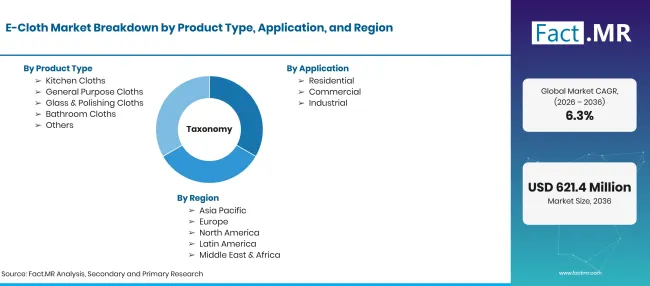
E Cloth Market Taxonomy | Source: Fact.MR
| Items | Values |
|---|---|
| Quantitative Units (2026) | USD 336.1 Million |
| Product Type | Kitchen Cloths, General Purpose Cloths, Glass & Polishing Cloths, Bathroom Cloths, Others |
| Application | Residential, Commercial, Industrial |
| Distribution Channel | Supermarkets/Hypermarkets, Online Retail, Specialty Stores, Others |
| Material Type | Microfiber, Cotton, Others |
| Regions Covered | North America, Latin America, Europe, Asia Pacific, Middle East & Africa |
| Countries Covered | Germany, Brazil, USA, UK, Japan and other countries |
| Key Companies Profiled | E-Cloth Ltd., Norwex, Grove Collaborative |
| Additional Attributes | Revenue by cloth type, application, channel, material and geography; household purchasing patterns and reusable cleaning use cases. |
Source: Fact.MR analysis. Updated Nov 17, 2026
E-Cloth Market by Segments
-
Product Type
- Kitchen Cloths
- General Purpose Cloths
- Glass & Polishing Cloths
- Bathroom Cloths
- Others
-
Application
- Residential
- Commercial
- Industrial
-
Distribution Channel
- Supermarkets/Hypermarkets
- Online Retail
- Specialty Stores
- Others
-
Material Type
- Microfiber
- Cotton
- Others
-
Region:
- North America
- Europe
- Asia Pacific
- Latin America
- Middle East & Africa
Frequently Asked Questions
How big is the global E-Cloth Market in 2026?
What is the E-Cloth Market forecast for 2036?
What CAGR is forecast for the E-Cloth Market?
Which product type holds the largest E-Cloth Market share?
Which application leads the E-Cloth Market?
Which material accounts for the main share?
Which distribution channel has the largest share?
Which country has the highest forecast CAGR?
Who worked on this report


Preview the report firsthand - request a free sample
Free SampleGet the brochure for pricing and purchase details
Download PDF