- Forecast Value (2036): 0.86 Bn
- CAGR (2036): 12.3%
What is the lyophilized assay beads market forecast to be worth by 2036?
USD 0.27 billion in 2026 to USD 0.86 billion by 2036, at 12.3% CAGR.
- The lyophilized assay beads market reached approximately USD 0.24 billion in 2025.
- Demand is expected to increase from USD 0.27 billion in 2026 to USD 0.86 billion by 2036.
- The market is forecast to record 12.3% CAGR from 2026 to 2036 as molecular diagnostics and point-of-care platforms use dry reagent formats to improve stability and workflow consistency.
- Lyophilized assay beads are single-dose freeze-dried reagent spheres used in molecular assays and cartridge-based diagnostic systems. The category connects with molecular diagnostics because dry reagents help diagnostic developers simplify PCR and isothermal test formats.
- The strongest adoption case comes from point-of-care testing where liquid reagent storage can create logistics pressure. Cytiva and Argonaut Manufacturing Services announced in 2025 that they would expand reagent stabilization and lyophilization services for diagnostic assay developers in the EU and US.
- This shows how contract manufacturing capacity is becoming important for lyophilized assay formats.
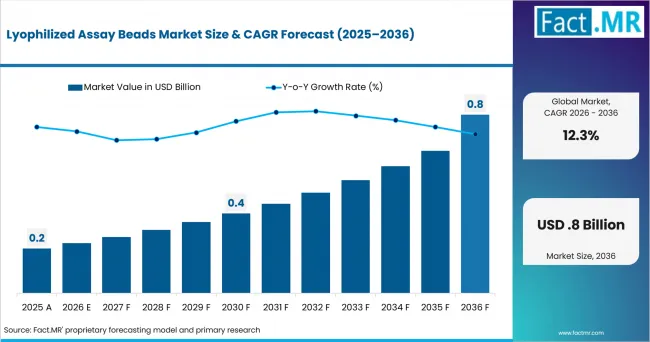
Lyophilized Assay Beads Market Market Value Analysis | Source: Fact.MR
What are the defining numbers behind lyophilized assay beads market growth?
USD 0.59 billion absolute opportunity by 2036, led by the United States and Germany.
- Demand Drivers in the Market
- Diagnostic developers need dry reagents that reduce cold-chain dependence.
- Point-of-care device teams need pre-dosed beads for cartridge assembly.
- CDMOs need scalable bead manufacturing for regulated IVD programs.
- Assay teams need rapid rehydration and consistent reaction performance.
- Key Segments Analyzed
- By Bead Format: Single-Dose PCR and qPCR Beads are expected to hold 39.0% share in 2026 because molecular assays are the main commercial use.
- By Assay Type: Molecular Diagnostic Assays lead because nucleic acid tests benefit from stabilized enzyme mixes. The share is projected at 46.0% in 2026.
- By Reagent Composition: Enzyme and Buffer Beads are likely to account for 37.0% share in 2026 because amplification workflows need stable polymerase chemistry.
- By End Use: IVD Kit Manufacturers lead with 42.0% share in 2026 because kit developers control reagent format decisions.
- By Packaging Format: Cartridge-Ready Beads are expected to hold 34.0% share in 2026 because point-of-care systems need device-compatible dosing.
- By Geography: The United States is projected to record 14.4% CAGR through 2036 as dry reagent diagnostics adoption expands.
- Analyst Opinion at Fact.MR
- Shambhu Nath Jha, Senior Analyst at Fact.MR, states, “Lyophilized assay beads are becoming a practical bridge between laboratory-grade reagents and field-ready diagnostics. Suppliers that combine formulation skill with scalable bead manufacturing will gain stronger access to IVD development programs.”
- Strategic Implications
- Reagent suppliers should offer bead development with assay performance support.
- IVD developers should qualify bead stability before cartridge design lock.
- CDMOs can differentiate through dose uniformity and controlled humidity handling.
- Point-of-care platforms should design cartridges around bead placement and rehydration flow.
DCN Dx stated in 2025 that its custom lyophilized beads are designed to eliminate cold-chain logistics and integrate into microfluidics, cartridges or PCR tubes. This reinforces the point-of-care use case because device developers need stable reagents that fit compact formats.
The United States is projected to record 14.4% CAGR through 2036 as molecular diagnostic developers and CDMOs scale dry reagent kits. Germany is expected to post 13.2% CAGR through 2036 as IVD manufacturers adopt stable cartridge-ready reagents. The United Kingdom is likely to record 12.8% CAGR as Biofortuna and New England Biolabs / NEB Lyophilization Sciences support assay stabilization. China is forecast to advance at 12.1% CAGR as local diagnostic manufacturers expand molecular testing capacity. Japan is set to record 11.6% CAGR as compact diagnostic platforms use dry reagent formats.
How does the lyophilized assay beads market break down by segment?
Single-Dose PCR and qPCR Beads lead at 39.0%; Molecular Diagnostic Assays lead at 46.0%.
Which bead format dominates?
Single-Dose PCR and qPCR Beads hold 39.0% share in 2026.
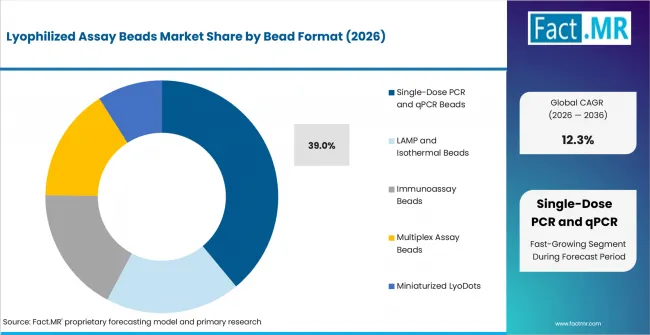
Lyophilized Assay Beads Market Analysis By Bead Format | Source: Fact.MR
Single-Dose PCR and qPCR Beads are expected to hold 39.0% share in 2026 because molecular assay developers need stable amplification reagents in one reaction unit. The format helps reduce pipetting steps and supports consistent dosing. It also fits PCR tubes and compact cartridges. The segment connects with PCR reagents because bead performance depends on stable enzymes and optimized buffers.
Which assay type dominates?
Molecular Diagnostic Assays account for 46.0% share in 2026.
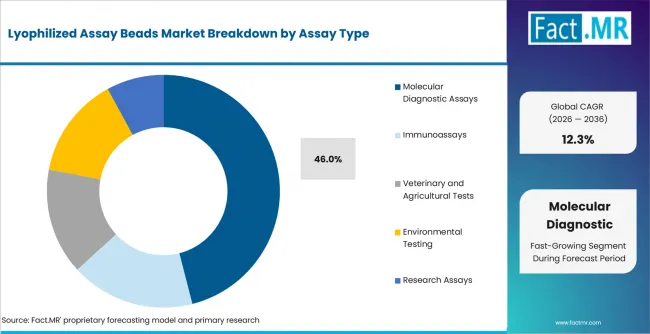
Lyophilized Assay Beads Market Analysis By Assay Type | Source: Fact.MR
Molecular Diagnostic Assays lead because amplification chemistry is sensitive to temperature and handling variation. The assay type is projected to capture 46.0% share in 2026. Lyophilized beads help stabilize assay components and simplify workflow design. NEB stated in 2025 that lyophilized beads are used in rapid point-of-care tests for respiratory viruses and sexually transmitted diseases. This supports molecular diagnostic demand.
Which reagent composition dominates?
Enzyme and Buffer Beads hold 37.0% share in 2026.
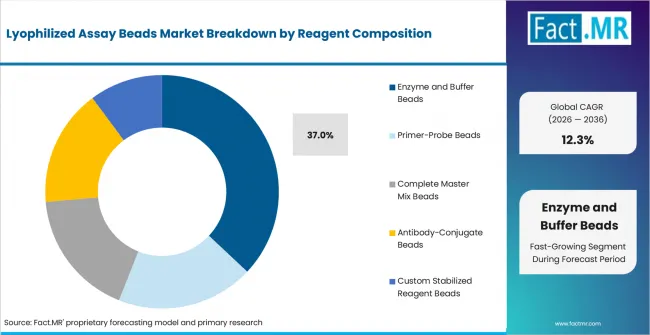
Lyophilized Assay Beads Market Analysis By Reagent Composition | Source: Fact.MR
Enzyme and Buffer Beads lead because amplification tests need polymerases, salts and stabilizers in the correct reaction balance. The composition is likely to account for 37.0% share in 2026. Developers value beads that rehydrate quickly without reducing assay sensitivity.
Which end use dominates?
IVD Kit Manufacturers lead with 42.0% share in 2026.
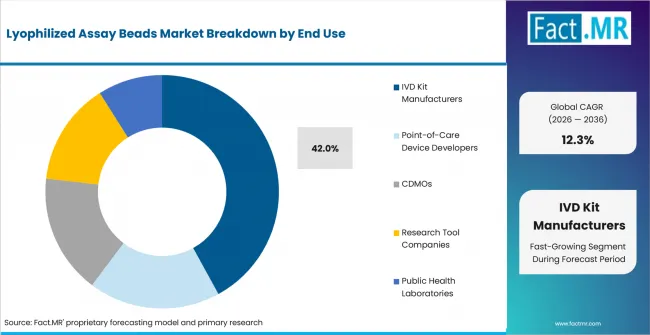
Lyophilized Assay Beads Market Analysis By End Use | Source: Fact.MR
IVD Kit Manufacturers lead because they decide whether the assay ships as liquid reagent or dry format. The end use is expected to hold 42.0% share in 2026. Beads help kit companies reduce user preparation and storage complexity. CDMOs follow because many kit developers outsource bead development and manufacturing. Diagnostic testing benefits because dry reagents can support broader test deployment.
Which packaging format dominates?
Cartridge-Ready Beads hold 34.0% share in 2026.
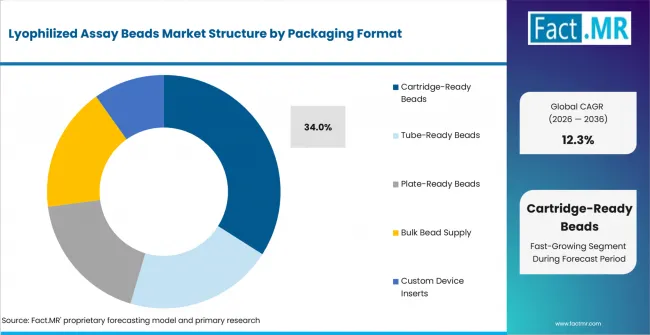
Lyophilized Assay Beads Market Analysis By Packaging Format | Source: Fact.MR
Cartridge-Ready Beads lead because point-of-care devices need a stable dose placed directly inside the test path. The packaging format is expected to hold 34.0% share in 2026. Beads can be sub-assembled into cartridges after lyophilization. This avoids drying the entire cartridge and improves manufacturing efficiency. The format connects with microfluidics because bead rehydration must work inside small fluid paths.
What is accelerating lyophilized assay beads demand, and what is holding it back?
Point-of-care diagnostics drive demand; formulation transfer risk restrains adoption.
Point-of-care diagnostics are the main driver. Developers need reagents that survive storage and rehydrate inside small devices. Lyophilized beads help reduce liquid handling and make assays easier to run outside central labs.
Promega states that its lyophilized bead format contains PCR reagents in one bead and supports ambient shipping and storage. [6] This supports OEM assay workflows where shipping and preparation steps must be simplified.
Biofortuna stated that its lyo bead production process creates custom lyophilized reagent beads with precise material volume per reaction. This supports bead adoption where dose consistency is central to assay performance.
The main restraint is formulation transfer risk. A liquid assay may not perform the same way after bead lyophilization. Developers need excipient optimization, stability testing and rehydration studies before commercial launch.
Where do the biggest lyophilized assay bead opportunities sit?
Point-of-care cartridges, multiplex PCR kits and field testing.
- Point-of-Care Cartridges: Device makers can place stable reagent doses directly into disposable test cartridges.
- Multiplex PCR Kits: Kit developers can simplify multi-target reactions with pre-dosed amplification beads.
- Field Testing: Environmental and veterinary tests can reduce cold-chain dependence through dry reagent formats.
Which countries are scaling lyophilized assay beads fastest?
United States 14.4%, Germany 13.2%, United Kingdom 12.8%, China 12.1%, Japan 11.6%.
Based on regional analysis, the lyophilized assay beads market is segmented into North America, Western Europe, Asia Pacific, Latin America, and Middle East and Africa.
| Country | CAGR |
|---|---|
| United States | 14.4% |
| Germany | 13.2% |
| United Kingdom | 12.8% |
| China | 12.1% |
| Japan | 11.6% |
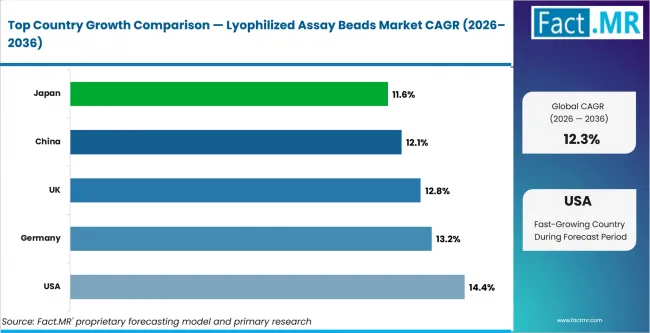
Lyophilized Assay Beads Market Cagr Analysis By Country | Source: Fact.MR
What is powering the United States lead?
14.4% CAGR, driven by Argonaut Manufacturing Services and point-of-care assay outsourcing.
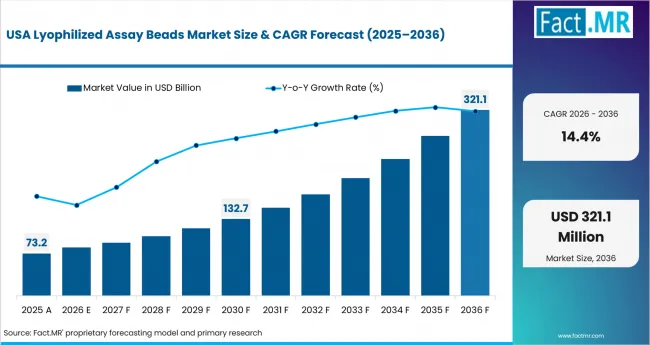
Lyophilized Assay Beads Market Country Value Analysis | Source: Fact.MR
The United States is projected to record 14.4% CAGR through 2036 as diagnostic developers outsource bead formulation and manufacturing. Argonaut supports reagent lyophilization and LyoDots for diagnostic devices. DCN Dx supports custom lyophilized beads for molecular and immunoassay formats. Growth will favor suppliers that can support regulated IVD transfer.
How is Germany scaling lyophilized assay bead demand?
13.2% CAGR, supported by IVD manufacturing and molecular assay stabilization.
Germany is expected to post 13.2% CAGR by 2036 as diagnostic manufacturers use stable dry reagents in cartridge-based systems. Molecular testing and applied diagnostics create demand for robust bead formats. Suppliers with strong quality systems will gain preference. Growth will favor validated bead production and formulation support.
What supports the United Kingdom outlook?
12.8% CAGR, driven by Biofortuna and New England Biolabs / NEB Lyophilization Sciences capability.
The United Kingdom is likely to record 12.8% CAGR through 2036 as specialist lyophilization capacity supports IVD development. Biofortuna manufactures custom lyo beads for diagnostic applications. New England Biolabs / NEB Lyophilization Sciences supports lyophilized molecular biology reagent formats. Growth will favor companies with scale-up experience and controlled humidity handling.
What underpins China’s growth?
12.1% CAGR, backed by domestic diagnostic kit production and point-of-care expansion.
China is forecast to advance at 12.1% CAGR by 2036 as local diagnostic manufacturers expand molecular test formats. Beads can reduce cold-chain dependence and simplify user workflows. Point-of-care platforms create new demand for cartridge-ready reagents. Growth will favor suppliers that can support cost-sensitive scale-up.
How is Japan scaling lyophilized assay bead adoption?
11.6% CAGR, due to compact diagnostic platforms and quality-focused manufacturing.
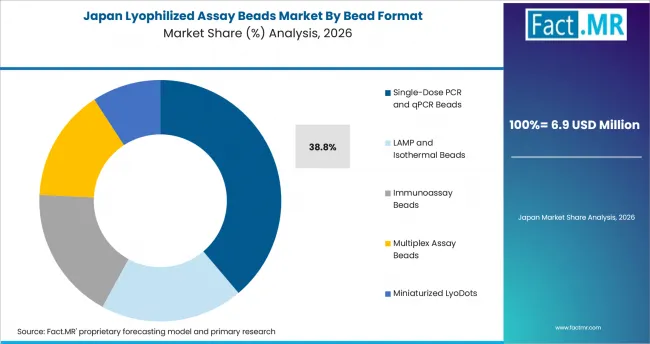
Lyophilized Assay Beads Market Japan Market Share Analysis By Bead Format | Source: Fact.MR
Japan is set to record 11.6% CAGR through 2036 as diagnostic companies adopt dry reagents for compact systems. Bead formats fit small instruments and controlled assay cartridges. Manufacturers need stable performance across storage periods. Growth will favor suppliers with strong quality documentation and assay transfer support.
Who leads the lyophilized assay beads market?
Biofortuna and Argonaut Manufacturing Services lead through custom lyo bead development and diagnostic manufacturing.
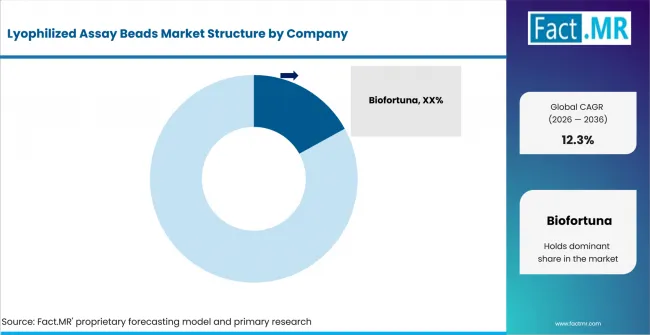
Lyophilized Assay Beads Market Analysis By Company | Source: Fact.MR
Lyophilized assay beads are supplied by specialist reagent stabilization firms and molecular reagent manufacturers. Biofortuna leads through custom lyo bead development for IVD and point-of-care assays. Argonaut Manufacturing Services supports LyoDots and reagent lyophilization for diagnostic device developers.
DCN Dx competes through custom lyophilized beads for molecular and immunoassay diagnostics. New England Biolabs / NEB Lyophilization Sciences supports lyophilized molecular biology reagents and custom development. Promega supports custom lyophilized PCR assay beads for OEM and clinical assay development.
Competition through 2036 will depend on formulation transfer and manufacturing scale. Suppliers need humidity-controlled production and dose consistency. The IVD raw materials link matters because enzyme quality and excipient selection shape bead stability. Lab automation also matters as bead handling becomes more automated in kit assembly.
Which companies are the key providers?
Biofortuna and Argonaut Manufacturing Services are key providers. DCN Dx and New England Biolabs / NEB Lyophilization Sciences are also profiled.
- Biofortuna
- Argonaut Manufacturing Services
- DCN Dx
- New England Biolabs / NEB Lyophilization Sciences
- Promega
Bibliography
- [1] Biofortuna. (2025, March 6). Additional Lyo bead automation ramps up manufacturing capacity to over half a million tests per day. Biofortuna.
- [2] Argonaut Manufacturing Services. (2025, August 6). Cytiva and Argonaut collaborate to expand reagent lyophilization services to support diagnostic assay developers in the EU and US. Argonaut Manufacturing Services.
- [3] DCN Dx. (2025, July 21). Lyophilized beads for immunoassay and molecular diagnostics. DCN Dx.
- [4] Gibson, J. (2025, June 22). How lyophilized beads are changing diagnostics and research. New England Biolabs.
- [5] Meridian Bioscience. (2024, June 26). Meridian Bioscience unveils industry-first lyophilized library prep kit for next-generation sequencing, eliminating the need for cold-chain shipping and storage. Meridian Bioscience.
- [6] Promega Corporation. (2025). Fit-for-purpose lyophilized PCR amplification assays. Promega Corporation.
This Report Addresses
- Strategic intelligence on lyophilized assay beads across bead format and assay type.
- Segment analysis covering Single-Dose PCR and qPCR Beads and Molecular Diagnostic Assays.
- Regional outlook covering the United States, Germany, the United Kingdom, China and Japan.
- Competitive analysis of Biofortuna, Argonaut Manufacturing Services, DCN Dx, New England Biolabs / NEB Lyophilization Sciences, and Promega.
- Technology assessment covering assay stabilization, bead rehydration, dry reagent dosing and cartridge compatibility.
- Use case assessment covering point-of-care cartridges, multiplex PCR kits and field testing.
- Primary interviews, provider checks and official source review support the forecast.
What does the lyophilized assay beads market cover?
Single-dose freeze-dried reagent beads used in diagnostic and research assays.
The lyophilized assay beads market covers dry bead formats that contain enzymes or assay reagents in a pre-dosed unit. It includes PCR beads and immunoassay reagent beads. The scope connects with point-of-care diagnostics because dry beads help simplify tests used near patients or outside central labs.
The market differs from general lyophilized reagents because bead geometry and dose uniformity matter. Each bead must rehydrate quickly and deliver consistent reaction performance. Bead handling also needs to match cartridge assembly and automated filling workflows.
What is included in the scope?
Custom lyo beads and ready-to-use assay bead formats.
The scope includes custom lyophilized beads used in IVD assay development and commercial diagnostic kits. It covers single-dose PCR beads and isothermal amplification beads. The scope includes clinical diagnostics applications when beads are used to stabilize reagents for regulated test workflows.
What is excluded from the scope?
Ordinary liquid master mixes and freeze-dried cakes.
The scope excludes liquid PCR mixes and liquid immunoassay reagents. It excludes lyophilized cakes when the format is not a bead or sphere. It excludes general freeze-drying equipment unless sold with bead manufacturing services. It also excludes magnetic beads used for sample cleanup unless they are part of a lyophilized assay bead format.
How was the analysis built?
100+ sources, 40+ company portfolios, 25+ countries, 20+ interviews.
- Primary Research: Primary research includes interviews with diagnostic assay developers and reagent manufacturing heads. It includes input from CDMOs and point-of-care device engineers.
- Desk Research: Desk research reviews official supplier sources and lyophilized bead technology references. It covers PCR bead formats and immunoassay use in rapid testing.
- Market-Sizing and Forecasting: Forecasting uses IVD assay development activity and bead manufacturing capacity signals. Point-of-care platform adoption and reagent outsourcing support the market assessment.
- Data Validation and Update Cycle: Forecasts are validated through supplier checks and diagnostic platform references. Capacity updates and custom lyophilization service launches help confirm market direction.
What is the report’s scope and coverage?
Lyophilized Assay Beads Market Breakdown By Bead Format, , And Region | Source: Fact.MR
| Attribute | Details |
|---|---|
| Quantitative Units | USD Billion in 2026 to USD Billion by 2036 at CAGR |
| Market Definition | Single-dose freeze-dried reagent beads used in diagnostic and research assays |
| Bead Format | Single-Dose PCR and qPCR Beads; LAMP and Isothermal Beads; Immunoassay Beads; Multiplex Assay Beads; Miniaturized LyoDots |
| Assay Type | Molecular Diagnostic Assays; Immunoassays; Veterinary and Agricultural Tests; Environmental Testing; Research Assays |
| Reagent Composition | Enzyme and Buffer Beads; Primer-Probe Beads; Complete Master Mix Beads; Antibody-Conjugate Beads; Custom Stabilized Reagent Beads |
| End Use | IVD Kit Manufacturers; Point-of-Care Device Developers; CDMOs; Research Tool Companies; Public Health Laboratories |
| Packaging Format | Cartridge-Ready Beads; Tube-Ready Beads; Plate-Ready Beads; Bulk Bead Supply; Custom Device Inserts |
| Regions Covered | North America; Western Europe; Asia Pacific; Latin America; Middle East and Africa |
| Countries Covered | United States; Germany; United Kingdom; China; Japan |
| Key Companies Profiled | Biofortuna; Argonaut Manufacturing Services; DCN Dx; New England Biolabs / NEB Lyophilization Sciences; Promega |
| Forecast Period | 2026 to 2036 |
| Approach | Hybrid top-down and bottom-up approach using diagnostic kit demand, point-of-care platform adoption, bead manufacturing capacity and supplier validation |
How is the market segmented?
-
By Bead Format:
- Single-Dose PCR and qPCR Beads
- LAMP and Isothermal Beads
- Immunoassay Beads
- Multiplex Assay Beads
- Miniaturized LyoDots
-
By Assay Type:
- Molecular Diagnostic Assays
- Immunoassays
- Veterinary and Agricultural Tests
- Environmental Testing
- Research Assays
-
By Reagent Composition:
- Enzyme and Buffer Beads
- Primer-Probe Beads
- Complete Master Mix Beads
- Antibody-Conjugate Beads
- Custom Stabilized Reagent Beads
-
By End Use:
- IVD Kit Manufacturers
- Point-of-Care Device Developers
- CDMOs
- Research Tool Companies
- Public Health Laboratories
-
By Packaging Format:
- Cartridge-Ready Beads
- Tube-Ready Beads
- Plate-Ready Beads
- Bulk Bead Supply
- Custom Device Inserts
-
Region:
- North America
- United States
- Canada
- Europe
- Germany
- United Kingdom
- France
- Switzerland
- Netherlands
- Asia Pacific
- China
- Japan
- South Korea
- Singapore
- India
- Latin America
- Brazil
- Mexico
- Argentina
- Middle East & Africa
- UAE
- Saudi Arabia
- South Africa
- Israel
- North America