- Base Value(2026): 1.1 Bn
- Estimated Value(2026): 1.1 Bn
- Forecast Value (2036): 3.5 Bn
- CAGR (2026 - 2036): 12.3%
Dye-Free and Label-Free Packaging for PCR Optimization Market Forecast and Outlook 2026 to 2036
The dye-free and label-free packaging for PCR optimization market is expected to reach USD 1.1 billion in 2026, growing to USD 3.5 billion by 2036, with a CAGR of 12.3%.
Key Takeaways from Dye-Free and Label-Free Packaging for PCR Optimization Market
- Dye-Free and Label-Free Packaging for PCR Optimization Market Value (2026): USD 1.1 billion
- Dye-Free and Label-Free Packaging for PCR Optimization Market Forecast Value (2036): USD 3.5 billion
- Dye-Free and Label-Free Packaging for PCR Optimization Market Forecast CAGR (2026-2036): 12.3%
- Leading Segment in Dye-Free and Label-Free Packaging for PCR Optimization Market: Natural PE, PP, PET (57%)
- Key Growth Region in Dye-Free and Label-Free Packaging for PCR Optimization Market: Asia Pacific
- Key Players in Dye-Free and Label-Free Packaging for PCR Optimization Market: ALPLA, Plastipak, Zijiang Enterprise, Manjushree Technopack, Greiner Packaging, Berry Global
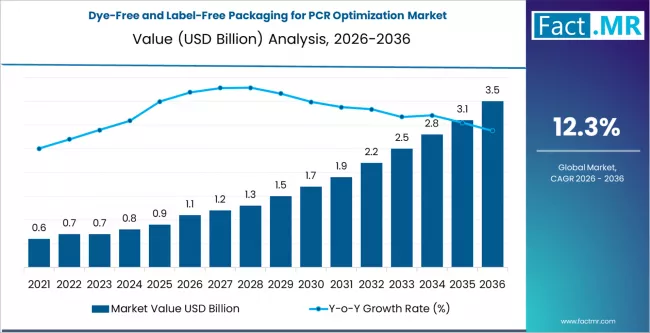
Dye Free And Label Free Packaging For Pcr Optimization Market Market Value Analysis | Source: Fact.MR
Regional demand concentration plays a significant role in shaping market dynamics, with certain regions showing a higher propensity for adopting sustainable packaging solutions. Uneven adoption patterns are influenced by varying levels of environmental regulations and consumer demand for eco-friendly alternatives, leading to significant geographical disparities.
For instance, markets in Europe and North America tend to exhibit higher adoption rates, driven by stringent regulations and increased consumer awareness. In contrast, regions with lower regulatory pressure may experience slower growth. Geographic cost advantages further influence the adoption curve, with regions possessing more established recycling infrastructure or lower production costs benefiting from faster market penetration. These regional factors create an uneven, yet strategically important, landscape for vendors to navigate.
Dye-Free and Label-Free Packaging for PCR Optimization Market
| Metric | Value |
|---|---|
| Estimated Value in (2026E) | USD 1.1 billion |
| Forecast Value in (2036F) | USD 3.5 billion |
| Forecast CAGR (2026 to 2036) | 12.3% |
Source: Fact.MR analysis. Updated Jan 17, 2026
Category
| Category | Segments |
|---|---|
| End-use | FMCG packaging; Consumer goods packaging; Premium packaging; Industrial packaging; Sustainable packaging |
| Packaging Type | Dye-free packaging; Label-free packaging; Mono-material packaging; Minimalist packaging |
| Material Strategy | PCR plastics; Bio-based materials; Recycled PET (rPET); Polyolefins; Others |
| Technology | Resin formulation optimization; Surface treatment technology; High-clarity PCR plastics; Eco-friendly labeling systems |
| Region | North America; Europe; Asia Pacific; Latin America; Middle East & Africa |
Source: Fact.MR analysis. Updated Jan 17, 2026
Segmental Analysis
What Is the Impact of Material on the Dye-Free and Label-Free Packaging for PCR Optimization Market?
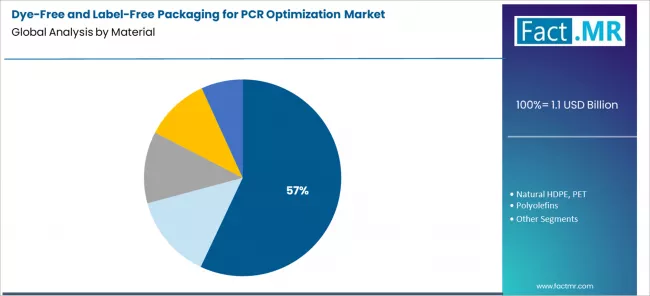
Dye Free And Label Free Packaging For Pcr Optimization Market Analysis By Material | Source: Fact.MR
In the dye-free and label-free packaging for PCR optimization market, material selection is key to both sustainability and performance. Natural PE, PP, and PET lead the market with a 57% share, as these materials offer the necessary strength and versatility for various packaging applications while being compatible with PCR optimization efforts. The use of these materials ensures that packaging is both effective in protecting contents and recyclable, helping to meet environmental sustainability goals. As demand for eco-friendly packaging increases, natural PE, PP, and PET will remain central to the market, offering practical solutions for reducing the environmental impact of packaging.
How Does End-Use Influence the Dye-Free and Label-Free Packaging for PCR Optimization Market?
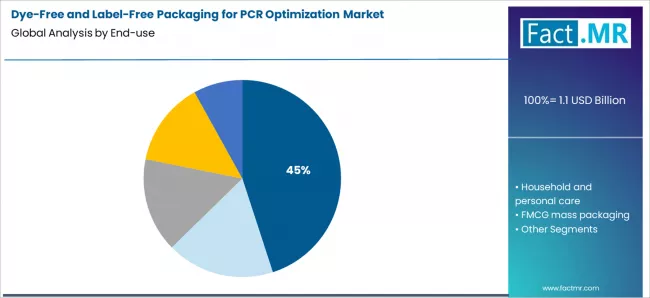
Dye Free And Label Free Packaging For Pcr Optimization Market Analysis By End Use | Source: Fact.MR
End-use plays a significant role in shaping the demand for dye-free and label-free packaging solutions, with food and beverage packaging holding a 45% share. This sector prioritizes sustainability without compromising on functionality, making dye-free and label-free solutions ideal for food and beverage products. By eliminating dyes and labels, these packaging solutions are easier to recycle and contribute to the circular economy. As consumer preference for environmentally responsible packaging grows, food and beverage packaging will continue to drive the adoption of PCR-optimized, dye-free, and label-free solutions, ensuring that packaging meets both ecological and practical requirements.
What are the Principal Drivers, Constraints, and Evolving Dynamics of the Dye Free and Label Free Packaging for PCR Optimization Market?
Demand for dye free and label free packaging designed to optimize post consumer recycled (PCR) content has been influenced by efforts to improve recyclability and reduce contamination in recycling systems. Brand owners and packaging converters specify products without added colorants or adhesive labels that complicate sorting and lower the quality of recycled streams. Performance requirements for clarity, material integrity, and run ability on filling lines shape selection of PCR resins and design practices.
Variability in feedstock quality remains a challenge where residual dyes or labels persist in collected PCR input streams, affecting final resin consistency. Some converters adjust processing parameters to mitigate appearance and performance issues without relying on labels or pigments. Limited availability of validated PCR grades that meet aesthetic and functional criteria in dye free and label free formats has slowed adoption in certain segments. Work to improve sorting technologies that separate labels and to define material specifications that support label free design is under way. Collaboration among resin suppliers, recyclers, and brand technical teams aims to expand material options that balance recyclability and package performance.
Analysis of the Dye-Free and Label-Free Packaging for PCR Optimization Market by Key Country
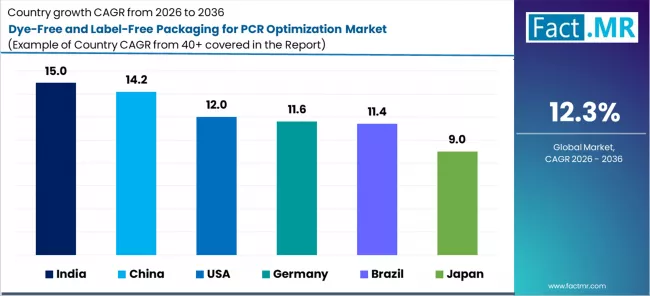
Dye Free And Label Free Packaging For Pcr Optimization Market Cagr Analysis By Country | Source: Fact.MR
| Country | CAGR 2026 to 2036 |
|---|---|
| Germany | 11.6% |
| USA | 12% |
| China | 14.2% |
| India | 15% |
| Brazil | 11.4% |
| Japan | 9% |
Source: Fact.MR analysis. Updated Jan 17, 2026
The report covers an in-depth analysis of 40+ countries; top-performing countries are highlighted below.
What is the Growth Outlook for Dye-Free and Label-Free Packaging for PCR Optimization in Germany?
Germany’s dye-free and label-free packaging for PCR optimization market is projected to grow at a CAGR of 11.6% from 2026 to 2036. As Germany’s packaging industry continues to emphasize sustainability and waste reduction, the demand for dye-free and label-free packaging solutions is increasing. These packaging innovations help optimize PCR processes by reducing contaminants and enhancing recyclability. With strong environmental regulations and growing consumer demand for eco-friendly products, Germany’s market for dye-free and label-free packaging is expected to expand steadily.
How is the Dye-Free and Label-Free Packaging for PCR Optimization Market Performing in the USA?
The USA’s dye-free and label-free packaging for PCR optimization market is expected to grow at a CAGR of 12% from 2026 to 2036. The USA’s packaging industry is under increasing pressure to adopt sustainable and recyclable packaging solutions. Dye-free and label-free packaging not only meet these demands but also optimize PCR processes by minimizing waste and reducing contamination. As the USA continues to prioritize sustainability and circular economy principles, the market for these packaging solutions will grow, supported by regulatory incentives and consumer preferences for eco-friendly options.
What is the Market Outlook for Dye-Free and Label-Free Packaging for PCR Optimization in China?
China is projected to experience significant growth in the dye-free and label-free packaging for PCR optimization market, with a projected CAGR of 14.2% from 2026 to 2036. As China continues to expand its packaging industry and address environmental challenges, the adoption of dye-free and label-free packaging solutions is becoming more widespread. These solutions align with China’s focus on sustainability and improving the efficiency of recycling systems. The demand for such packaging will be driven by government regulations promoting plastic waste reduction and consumer preference for more sustainable packaging options.
What is the Growth Potential for Dye-Free and Label-Free Packaging for PCR Optimization in India?
India’s dye-free and label-free packaging for PCR optimization market is forecast to grow at a CAGR of 15% from 2026 to 2036. With the growing focus on sustainability in India’s packaging industry, the demand for packaging solutions that enhance recyclability and reduce environmental impact is increasing. Dye-free and label-free packaging technologies are seen as a key part of optimizing PCR processes and meeting sustainability targets. As government initiatives to reduce plastic waste and increase recycling capabilities gain momentum, India’s market for these packaging solutions is poised for rapid growth.
What is the Demand for Dye-Free and Label-Free Packaging for PCR Optimization in Brazil?
Brazil’s dye-free and label-free packaging for PCR optimization market is set to grow at a CAGR of 11.4% from 2026 to 2036. As Brazil’s packaging industry transitions toward more sustainable solutions, there is increasing demand for packaging that is both recyclable and free of unnecessary additives like dyes and labels. Dye-free and label-free packaging solutions help optimize PCR processes by reducing contamination and waste. As environmental regulations tighten and consumer demand for eco-friendly products rises, Brazil’s market for these packaging solutions is expected to expand steadily.
What is the Market Expansion Outlook for Dye-Free and Label-Free Packaging for PCR Optimization in Japan?
Japan’s dye-free and label-free packaging for PCR optimization market is projected to grow at a CAGR of 9% from 2026 to 2036. Japan’s packaging industry has long prioritized sustainability and innovation, and the adoption of dye-free and label-free packaging solutions is becoming more common. These solutions offer a sustainable approach to reducing waste and improving recyclability in the packaging sector. While Japan’s growth rate may be more modest compared to other regions, the country’s focus on reducing plastic waste and meeting high environmental standards will support continued market demand for dye-free and label-free packaging.
How is Competition Structured in the Dye Free and Label Free Packaging for PCR Optimization Market?
Competition in the dye free and label free packaging for PCR optimization market is shaped by material performance, surface clarity, and process compatibility with high post consumer recycled content. ALPLA and Plastipak compete with broad packaging portfolios that integrate PCR grade resins without added dyes or labels to simplify sorting and recycling. Their offerings focus on clear polymer substrates that support automated sorting systems and maintain mechanical integrity. Greiner Packaging and Berry Global emphasize solutions that balance recyclability with production efficiency, optimizing wall thickness and finish to meet food and consumer goods requirements.
Zijiang Enterprise and Manjushree Technopack position their products with cost competitive, label free bottle and container designs tailored to regional markets. Competitive differentiation arises from proven recyclability outcomes, ease of molding without colorants, and compatibility with downstream sorting technologies. Buyers assess suppliers based on certified PCR content, documented performance in decontamination and remelting processes, and the ability to deliver consistent dimensions and surface quality at scale.
Key Players of the Dye-Free and Label-Free Packaging for PCR Optimization Market
- ALPLA
- Plastipak
- Zijiang Enterprise
- Manjushree Technopack
- Greiner Packaging
- Berry Global
Bibliographies
- ALPLA. (2026). ALPLA: Sustainable and dye-free packaging solutions for PCR optimization. ALPLA.
- Plastipak. (2026). Plastipak: Innovations in label-free and dye-free packaging solutions. Plastipak.
- Greiner Packaging. (2026). Greiner Packaging: Label-free and sustainable packaging innovations for PCR optimization. Greiner Packaging.
- European Commission. (2023).Packaging and Packaging Waste Regulation (PPWR): Design requirements for recyclability, colour usage, and label compatibility. Publications Office of the European Union.
- Organisation for Economic Co-operation and Development. (2023).Design for recycling: Reducing additives and material complexity in plastic packaging. OECD Publishing.
Segmentation
Scope of the Report
| Items | Values |
|---|---|
| Quantitative Units (2026) | USD Billion |
| End-use | Food and beverage packaging, Household and personal care, FMCG mass packaging, FMCG and dairy, Beverage packaging |
| Packaging | Unpigmented containers, Label-free bottles, Clear and natural packaging, Label-free bottles, Others |
| Material | Natural PE, PP, PET, Natural HDPE, PET, Polyolefins, Natural PE, Others |
| Technology | Mold-in embossing and digital marking, Laser marking and embossing, High-speed embossing, Simplified decoration, Others |
| Regions Covered | North America, Europe, Asia Pacific, Latin America, Middle East & Africa |
| Countries Covered | United States, Canada, Mexico, Brazil, Germany, United Kingdom, France, Italy, Spain, China, Japan, South Korea, India, Australia & New Zealand |
| Key Companies Profiled | ALPLA, Plastipak, Zijiang Enterprise, Manjushree Technopack, Greiner Packaging, Berry Global |
| Additional Attributes | Dollar revenue by end-use, packaging, material, and technology; regional demand trends, competitive landscape, technological advancements in dye-free and label-free packaging for PCR optimization, and innovations in simplified decoration techniques |
Source: Fact.MR analysis. Updated Jan 17, 2026
Dye-Free and Label-Free Packaging for PCR Optimization Market Key Segments
-
End-use :
- Food and beverage packaging
- Household and personal care
- FMCG mass packaging
- FMCG and dairy
- Beverage packaging
-
Packaging :
- Unpigmented containers
- Label-free bottles
- Clear and natural packaging
- Label-free bottles
- Others
-
Material :
- Natural PE, PP, PET
- Natural HDPE, PET
- Polyolefins
- Natural PE
- Others
-
Technology :
- Mold-in embossing and digital marking
- Laser marking and embossing
- High-speed embossing
- Simplified decoration
- Others
-
Region :
- North America
- U.S.
- Canada
- Mexico
- Europe
- Germany
- UK
- France
- Italy
- Spain
- Nordic Countries
- BENELUX
- Rest of Europe
- Asia Pacific
- China
- Japan
- South Korea
- India
- Australia
- Rest of Asia Pacific
- Latin America
- Brazil
- Argentina
- Rest of Latin America
- Middle East and Africa
- Kingdom of Saudi Arabia
- United Arab Emirates
- South Africa
- Rest of Middle East and Africa
- Other Regions
- Oceania
- Central Asia
- Other Markets
- North America
Frequently Asked Questions
How big is the dye-free and label-free packaging for pcr optimization market in 2026?
What will be the size of dye-free and label-free packaging for pcr optimization market in 2036?
How much will be the dye-free and label-free packaging for pcr optimization market growth between 2026 and 2036?
What are the key product types in the dye-free and label-free packaging for pcr optimization market?
Which packaging segment to contribute significant share in the dye-free and label-free packaging for pcr optimization market in 2026?
Who worked on this report


Preview the report firsthand - request a free sample
Free SampleGet the brochure for pricing and purchase details
Download PDF