- Market Value (2025): USD 8.0 Bn
- Estimated Value (2026): USD 8.7 Bn
- Forecast Value (2036): USD 20.9 Bn
- CAGR (2026-2036): 9.1%
What is the E-Commerce Prep and Compliance Packaging Services Market forecast to be worth by 2036?
USD 8.7 billion in 2026 to USD 20.9 billion by 2036 at a 9.1% CAGR.
- The e-commerce prep and compliance packaging services market reached an estimated USD 8.0 billion in 2025, calculated from the 2026 value and stated 9.1% CAGR.
- Demand is projected to increase from USD 8.7 billion in 2026 to USD 20.9 billion by 2036.
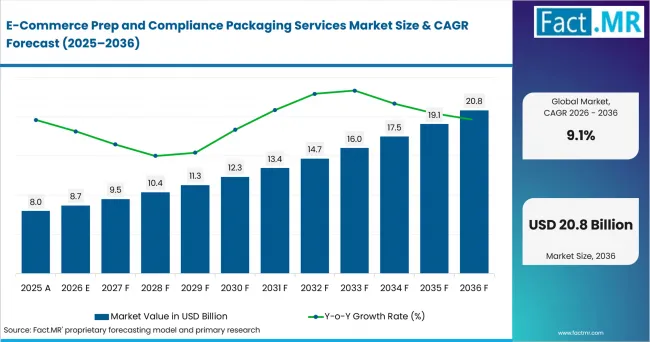
E Commerce Prep And Compliance Packaging Services Market Value Analysis | Source: Fact.MR
What are the defining numbers behind E-Commerce Prep and Compliance Packaging Services Market growth?
An absolute opportunity of USD 12.2 billion is expected between 2026 and 2036.
- Demand Drivers in the Market
- Rising e-commerce order volumes are increasing the number of products that must be labelled and prepared before entering marketplace fulfilment networks. U.S. retail e-commerce sales reached USD 326.7 billion in the first quarter of 2026 and increased 9.7% from the previous year. Higher parcel throughput expands demand for outsourced services that can prepare inventory in bulk while maintaining consistent packaging and shipment data.
- Marketplace sellers face detailed requirements related to barcodes and product preparation. These requirements can vary according to the product type and fulfilment route. Non-compliant inventory may require correction before it can be received or processed, encouraging sellers to outsource inspection and labelling to specialist providers. The value of prep services therefore comes from reducing inbound errors and preventing avoidable delays at fulfilment centres.
- Packaging regulation is becoming a stronger operational consideration, particularly for sellers shipping into several jurisdictions. The EU Packaging and Packaging Waste Regulation entered into force in February 2025 and will generally apply from August 2026. It introduces sustainability and labelling requirements across the packaging life cycle, increasing the need for businesses to review packaging formats and documentation before products are dispatched.
- Pressure to reduce unnecessary packaging is also changing how sellers select box sizes and protective materials. The EU generated 83.4 million tonnes of packaging waste in 2022, equivalent to 186.5 kg per person, while plastic packaging waste reached 35.3 kg per person in 2023. These volumes are strengthening regulatory and customer pressure for packaging that protects products without excessive material use, creating demand for providers that can combine marketplace compliance with right-sized packaging.
- Cross-border e-commerce adds customs and handling requirements beyond ordinary domestic fulfilment. Sellers may need product identification and shipping documents to remain consistent across the parcel and digital records. OECD research notes that the growth of cross-border parcel trade has increased the number of actors involved across the delivery chain, which raises the importance of accurate preparation before goods enter international logistics networks.
- Key Segments Analyzed
- FBA Preparation Services account for 38.0% of the Service Category segment in 2026, supported by demand for labelling, bundling and shipment preparation aligned with fulfilment-centre requirements.
- Order Preparation holds 41.0% of the Order Fulfilment Stage segment in 2026 because inspection and compliant packing must be completed before inventory can enter downstream fulfilment operations.
- Retail & E-commerce represents 44.0% of the End-use Industry segment in 2026, reflecting the high volume of parcels requiring standardized packaging and marketplace-ready documentation.
- Online Sellers account for 40.0% of the Client Type segment in 2026 as many merchants outsource preparation work that would otherwise require dedicated labour, space and compliance expertise.
- Amazon FBA Compliance holds 42.0% of the Packaging Compliance Standard segment in 2026 due to the scale of seller participation and the need to meet specific preparation, barcode and inbound-shipment rules.
- Analyst Opinion at Fact.MR
- Shambhu Nath Jha, Principal Consultant at Fact.MR, states, “E-Commerce Prep and Compliance Packaging Services companies need to show how the product fits each use case rather than compete on generic claims. Leading positioning supports premium demand, but repeat sales are expected to depend on consistent quality, clear documentation and a measurable outcome.”
- Strategic Implications
- Brand owners should position offerings by application fit rather than generic capability claims. Clearer articulation of the specific use case and the supporting evidence is expected to shorten the buying decision and strengthen pricing power.
- Suppliers can strengthen retention by documenting specification, compliance and performance in simple customer-facing materials. Transparent documentation reduces evaluation friction and supports repeat purchasing, particularly in compliance-heavy regions.
- Distributors should plan channel strategies around the leading segment and the fastest-growing use cases. Aligning inventory, pricing and promotion with the share leaders is expected to improve margin capture.
- Pricing strategy should reflect the value of documented outcomes rather than raw capacity. Differentiating on reliability, compliance and committed service levels is expected to protect margins against lower-cost substitutes.
How does the E-Commerce Prep and Compliance Packaging Services Market break down by segment?
FBA Preparation Services leads Service Category with 38.0% share in 2026
Why does FBA Preparation Services lead Service Category?
FBA Preparation Services are projected to account for a 38.0% share in 2026.
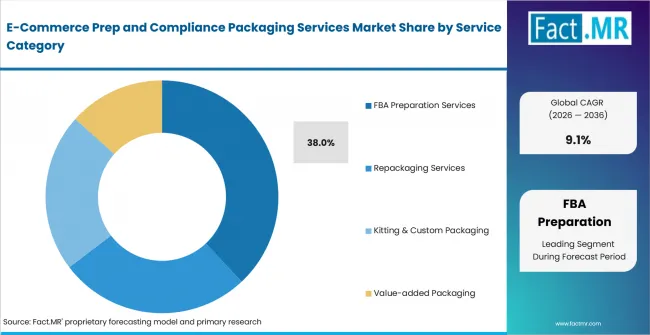
E Commerce Prep And Compliance Packaging Services Market Analysis By Service Category | Source: Fact.MR
The segment leads because products sent into fulfilment centres must arrive in a condition that supports automated receiving and downstream order processing. Depending on the product, preparation may involve barcode placement, poly bagging, bundling or protective packaging. Amazon requires each unit to carry an accessible scannable barcode or label, making accurate preparation essential before inventory enters the fulfilment network.
Outsourcing this work is particularly relevant for sellers managing several SKUs or sourcing inventory from multiple suppliers. A preparation provider can standardize labelling and packaging before consolidating goods for shipment, reducing the risk of rejected or delayed inventory. The continuing expansion of online retail strengthens this use case. U.S. e-commerce sales reached USD 326.7 billion in the first quarter of 2026 and grew 9.7% from a year earlier, increasing the volume of inventory moving through marketplace fulfilment systems.
Why does Order Preparation lead Order Fulfillment Stage?
Order Preparation is projected to account for a 41.0% share in 2026.
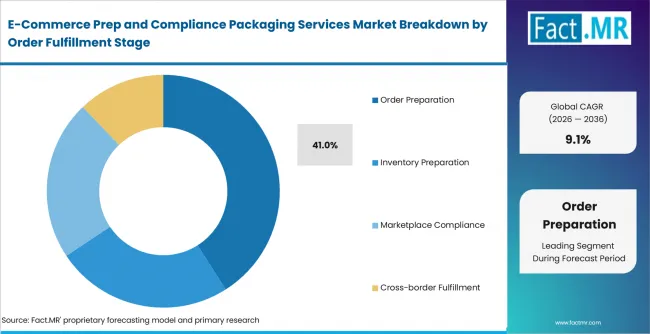
E Commerce Prep And Compliance Packaging Services Market Analysis By Order Fulfillment Stage | Source: Fact.MR
Order Preparation leads because labelling, product inspection and compliant packing must be completed before inventory can move efficiently into storage or fulfilment. Errors at this stage can affect every subsequent activity, including receiving, inventory identification and customer shipment.
For example, a product with an unreadable barcode may require relabelling before it can be entered into the warehouse system. Bundled products must also be secured and identified as a single sellable unit. Completing these tasks before dispatch reduces corrective handling later in the process, where delays can be more expensive and harder to control.
Why does Retail & E-commerce lead End-use Industry?
Retail & E-commerce is projected to account for a 44.0% share in 2026.
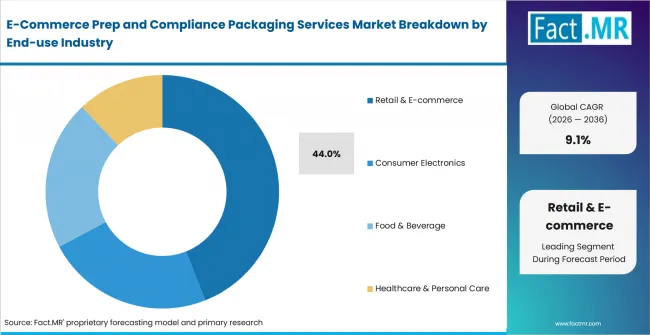
E Commerce Prep And Compliance Packaging Services Market Analysis By End Use Industry | Source: Fact.MR
The sector leads because online retail produces large volumes of individually packed goods that must meet platform and carrier requirements before fulfilment. Unlike pallet-based business shipments, e-commerce orders frequently involve varied SKUs and small parcels, creating repeated demand for inspection and compliant preparation.
U.S. retail e-commerce represented 16.8% of total retail sales during the first quarter of 2026, showing the commercial scale of goods moving through digital channels. OECD research also identifies warehousing, fulfilment and delivery as core parts of e-commerce logistics, with value-added services forming part of the operating model.
Why do Online Sellers lead Client Type?
Online Sellers are projected to account for a 40.0% share in 2026.
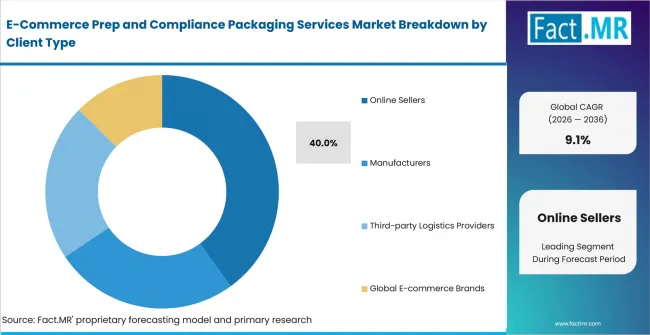
E Commerce Prep And Compliance Packaging Services Market Analysis By Client Type | Source: Fact.MR
Online Sellers lead because many merchants lack dedicated packaging facilities or staff trained in marketplace-specific requirements. Outsourcing allows them to convert fixed expenditure on labour and warehouse space into a service cost linked more closely to shipment volume.
The need is greater for sellers importing goods or purchasing from several manufacturers, since products may arrive with inconsistent labels or packaging. Preparation providers inspect and standardize these units before they are sent to fulfilment centres. OECD evidence from Vietnam illustrates the mixed logistics structure used in e-commerce: 10% of surveyed platforms outsourced logistics completely, while 45% combined internal operations with third-party logistics services.
Why does Amazon FBA Compliance lead Packaging Compliance Standard?
Amazon FBA Compliance is projected to account for a 42.0% share in 2026.
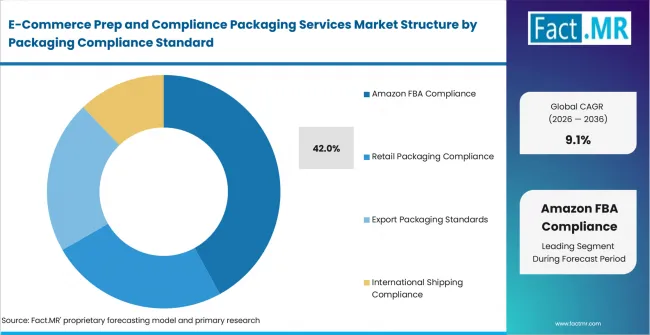
E Commerce Prep And Compliance Packaging Services Market Analysis By Packaging Compliance Standard | Source: Fact.MR
The segment leads because FBA inventory must comply with defined product-packaging and shipment-identification requirements before it can be received efficiently. Amazon states that units require an exterior scannable barcode or label, while shipment boxes and pallets are subject to separate identification requirements.
Compliance therefore extends beyond ordinary protective packaging. Sellers must ensure that product identifiers remain readable and that bundled or bagged items are prepared correctly. These requirements create recurring demand for specialist providers that can apply consistent procedures across large SKU portfolios. Wider packaging regulation adds another layer of complexity: the EU Packaging and Packaging Waste Regulation entered into force in February 2025 and generally applies from August 2026, introducing sustainability and labelling requirements across the packaging life cycle.
What is accelerating E-Commerce Prep and Compliance Packaging Services Market adoption, and what is holding it back?
Drivers Impact Analysis
| DRIVER | (~) % IMPACT ON CAGR | Global | Short term (<= 2 years) |
|---|---|---|---|
| Adoption and integration | +1.6% | Global | Short term (<= 2 years) |
| DRIVER | (~) % IMPACT ON CAGR | USA; Germany; UK | Short term (<= 2 years) |
| Regulatory and compliance support | +1.4% | USA; Germany; UK | Short term (<= 2 years) |
| DRIVER | (~) % IMPACT ON CAGR | Global | Medium term (2-4 years) |
| Channel and access expansion | +1.1% | Global | Medium term (2-4 years) |
| DRIVER | (~) % IMPACT ON CAGR | USA; UK; Canada | Medium term (2-4 years) |
| Clear specification and documentation | +0.9% | USA; UK; Canada | Medium term (2-4 years) |
| DRIVER | (~) % IMPACT ON CAGR | Global | Long term (>= 4 years) |
| Cost and efficiency gains | +0.6% | Global | Long term (>= 4 years) |
Source: Fact.MR analysis. Updated Aug 6, 2026
Opportunity Impact Analysis
| OPPORTUNITY | (~) % IMPACT ON CAGR | Global | Medium term (2-4 years) |
|---|---|---|---|
| Emerging application expansion | +1.0% | Global | Medium term (2-4 years) |
| OPPORTUNITY | (~) % IMPACT ON CAGR | USA; UK; Germany | Medium term (2-4 years) |
| Premium and specialist positioning | +0.8% | USA; UK; Germany | Medium term (2-4 years) |
| OPPORTUNITY | (~) % IMPACT ON CAGR | Global | Long term (>= 4 years) |
| Channel and partner expansion | +0.7% | Global | Long term (>= 4 years) |
| OPPORTUNITY | (~) % IMPACT ON CAGR | USA; Canada; Singapore | Long term (>= 4 years) |
| Standards and compliance alignment | +0.5% | USA; Canada; Singapore | Long term (>= 4 years) |
Source: Fact.MR analysis. Updated Aug 6, 2026
Restraints Impact Analysis
| RESTRAINT | (~) % IMPACT ON CAGR | Global | Short term (<= 2 years) |
|---|---|---|---|
| Cost and complexity | -1.1% | Global | Short term (<= 2 years) |
| RESTRAINT | (~) % IMPACT ON CAGR | USA; UK; Germany | Short term (<= 2 years) |
| Specification and compliance checks | -0.9% | USA; UK; Germany | Short term (<= 2 years) |
| RESTRAINT | (~) % IMPACT ON CAGR | Import-dependent markets | Medium term (2-4 years) |
| Substitution by lower-cost alternatives | -0.7% | Import-dependent markets | Medium term (2-4 years) |
| RESTRAINT | (~) % IMPACT ON CAGR | Global | Long term (>= 4 years) |
| Supply chain and pricing pressure | -0.5% | Global | Long term (>= 4 years) |
Source: Fact.MR analysis. Updated Aug 6, 2026
Which countries are scaling the E-Commerce Prep and Compliance Packaging Services Market fastest?
- USA: USPS handled approximately 108.7 billion mailpieces and packages during fiscal 2025, showing the scale of goods moving through national delivery infrastructure. Large shipment volumes increase demand for barcode verification, repackaging and fulfilment-centre preparation that can prevent receiving delays.
- UK: The Extended Producer Responsibility framework requires affected businesses to report packaging data and contribute toward household packaging waste-management costs. Online marketplaces that facilitate sales by overseas businesses also have defined responsibilities, increasing the need for packaging documentation and compliance support before products enter UK fulfilment channels.
- Germany: Online retail turnover is particularly significant in categories such as clothing, computers and software, with clothing alone generating nearly 10 billion through online trade in the referenced Destatis data. High volumes across varied product formats create demand for standardized labelling, protective packing and marketplace-ready shipment preparation.
- Canada: Statistics Canada reported that Canadian e-commerce sales totalled 45.1 billion in 2023, while employment in local messenger and delivery activities increased alongside parcel demand. This supports outsourced preparation services for sellers that need consistent packaging without maintaining dedicated fulfilment labour.
- Japan: Cross-border purchases from Japanese sellers by Chinese consumers reached 2.64 trillion in 2024, increasing 8.5% from the previous year. The expansion of cross-border commerce raises the importance of customs-ready packaging, accurate product identification and documentation aligned with destination-market rules.
- Australia: Continued digital purchasing increases the number of mixed-SKU parcels requiring inspection and standardized preparation before entering domestic or international delivery networks.
- Singapore: All commercial goods imported through postal or courier channels are subject to customs and tax procedures, with permit and documentation requirements depending on the shipment. Singapore’s TradeNet system processes import, export and transhipment permit applications electronically, creating demand for packaging and shipment preparation that keeps physical labels consistent with customs records.
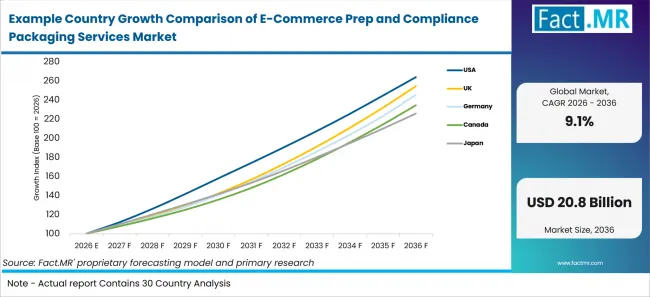
Example Country Growth Comparison Of E Commerce Prep And Compliance Packaging Services Market | Source: Fact.MR
| Country | CAGR (2026-2036) |
|---|---|
| USA | 10.2% |
| UK | 9.8% |
| Germany | 9.4% |
| Canada | 8.9% |
| Japan | 8.5% |
| Australia | 8.1% |
| Singapore | 7.6% |
Source: Fact.MR analysis. Updated Aug 6, 2026
What is driving USA’s growth through 2036?
The USA is forecast to expand at a 10.2% CAGR from 2026 to 2036.
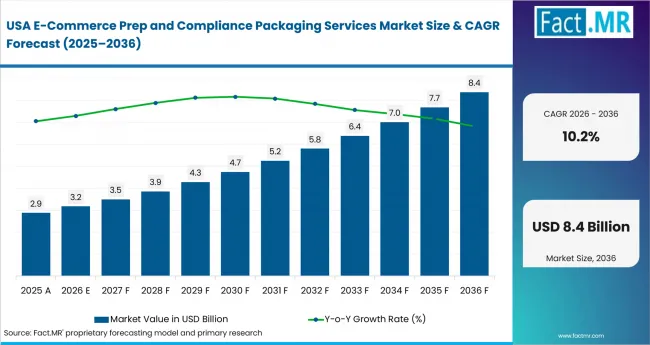
E Commerce Prep And Compliance Packaging Services Market Country Value Analysis | Source: Fact.MR
Growth is supported by the scale of marketplace fulfilment and the need to prepare products for different regulatory categories before distribution. For example, U.S. rules require certain regulated products to carry prescribed information on the label or immediate container, making accurate labelling part of market access rather than a cosmetic packaging step. This creates demand for providers that can combine barcode application with inspection and category-specific compliance checks.
What is driving the UK’s growth through 2036?
The UK is forecast to expand at a 9.8% CAGR from 2026 to 2036.
Extended Producer Responsibility is increasing the packaging-data obligations attached to marketplace sales. Online marketplaces facilitating sales by overseas businesses may have to report packaging supplied into the UK, which raises the value of service providers that can document materials and prepare inventory consistently before fulfilment.
What is driving Germany’s growth through 2036?
Germany is forecast to expand at a 9.4% CAGR from 2026 to 2036.
Germany combines a developed online retail environment with stringent packaging-waste controls. The country generated 18.8 million tonnes of packaging waste in 2020, while marketplace operators have faced increasing responsibility for checking whether sellers comply with packaging-registration obligations. These conditions support demand for preparation partners that can manage packaging formats and compliance records before goods enter distribution.
What is driving Canada’s growth through 2036?
Canada is forecast to expand at an 8.9% CAGR from 2026 to 2036.
Growth is supported by detailed packaging and labelling requirements across consumer categories. Canada’s Consumer Packaging and Labelling Act governs information presented on prepackaged products, while proposed plastic-packaging rules cover recycled content and claims related to recyclability or compostability. Sellers serving several categories may therefore require specialist preparation that checks labels and packaging claims before dispatch.
What is driving Japan’s growth through 2036?
Japan is forecast to expand at an 8.5% CAGR from 2026 to 2036.
Japan’s domestic business-to-consumer e-commerce market reached 26.1 trillion in 2024, while consumer-to-consumer e-commerce reached 2.53 trillion. The size of these channels increases the flow of varied products through fulfilment networks and supports demand for inspection and repackaging services that maintain accuracy across high-SKU inventories.
What is driving Australia’s growth through 2036?
Australia is forecast to expand at an 8.1% CAGR from 2026 to 2036.
Packaging regulation is moving toward stricter circular-economy outcomes, with government reforms intended to improve packaging design and recovery while reducing waste. Australia’s national targets call for all packaging to be reusable, recyclable or compostable and for higher recycled content, increasing demand for preparation providers that can help sellers choose compliant materials without weakening shipment protection.
What is driving Singapore’s growth through 2036?
Singapore is forecast to expand at a 7.6% CAGR from 2026 to 2036.
Singapore’s role in regional trade creates demand for accurate preparation of imported and re-exported parcels. Customs procedures require businesses to determine classification and permit obligations while retaining consistent shipment records, making labelling and customs-ready packaging important for sellers moving goods through the country to multiple destination markets
Who leads the E-Commerce Prep and Compliance Packaging Services Market?
DHL Supply Chain leads the market, supported by its large contract-logistics network and ability to combine warehousing with fulfilment, packaging and value-added services. GXO Logistics, Kuehne+Nagel, DB Schenker, DSV and CEVA Logistics also compete through multinational warehouse networks and established relationships with retailers.
Nippon Express, C.H. Robinson, GEODIS and Ryder strengthen the competitive field through combinations of distribution, freight management and contract logistics. Specialist preparation providers also remain relevant where marketplace sellers need SKU-level inspection, barcode application or product-specific repackaging without purchasing a broader logistics contract.
Competition depends on the provider’s ability to prepare varied inventories accurately and at scale. Important capabilities include marketplace-specific labelling, inventory inspection, bundling and customs-ready packaging. Geographic warehouse coverage also matters because sellers can reduce handling time when preparation takes place close to fulfilment centres or import gateways.
The commercial opportunity is supported by the wider expansion of online selling. Eurostat reported that 23.8% of EU enterprises conducted online sales in 2023, compared with 17.2% in 2013. UN Trade and Development also estimated that 2.3 billion people shopped online in 2021, increasing the flow of goods through fulfilment and parcel networks. These trends broaden the customer base for logistics companies that can add preparation and compliance services to conventional warehousing.
The market remains fragmented because large logistics groups generally focus on enterprise-scale contracts, while smaller preparation firms serve marketplace merchants and emerging brands. Providers able to combine global logistics coverage with detailed marketplace compliance are positioned more strongly for multinational accounts.
Which companies are the key providers?
Key companies include DHL Supply Chain; GXO Logistics, Inc.; Kuehne + Nagel International AG; DB Schenker; DSV A/S; CEVA Logistics; Nippon Express Holdings, Inc.; C.H. Robinson Worldwide, Inc.; GEODIS; and Ryder System, Inc.
- DHL Supply Chain
- GXO Logistics, Inc.
- Kuehne + Nagel International AG
- DB Schenker
- DSV A/S
- CEVA Logistics
- Nippon Express Holdings, Inc.
- C.H. Robinson Worldwide, Inc.
- GEODIS
- Ryder System, Inc.
Bibliography
- Australian Bureau of Statistics. (2023). Digital activity in the Australian economy, 2021–22. Australian Government.
- Australian Government, Department of Climate Change, Energy, the Environment and Water. (2026). Packaging and the circular economy.
- Canada Border Services Agency. (2026). Importing commercial goods into Canada: Documentation and customs requirements.
- Canadian Food Inspection Agency. (2026). Consumer Packaging and Labelling Act and Regulations. Government of Canada.
- Department for Environment, Food & Rural Affairs. (2026). Extended producer responsibility for packaging: Who is affected and what to do. UK Government.
- Department for Environment, Food & Rural Affairs. (2026). Packaging data: What to collect for extended producer responsibility. UK Government.
- Eurostat. (2025). EU enterprises’ online sales reach new heights in 2023. European Commission.
- Eurostat. (2026). E-commerce statistics. European Commission.
- European Parliament and Council of the European Union. (2025). Regulation (EU) 2025/40 on packaging and packaging waste. Official Journal of the European Union.
- Federal Environment Agency. (2023). Packaging waste and implementation of European packaging requirements. Government of Germany.
- Japan Ministry of Economy, Trade and Industry. (2025). Results of the FY2024 E-Commerce Market Survey. Government of Japan.
- OECD. (2021). Trade in the Time of Parcels. OECD Publishing.
- OECD. (2021). Competitive Neutrality Reviews: Small-Package Delivery Services in ASEAN. OECD Publishing.
- Singapore Customs. (2026). Importing by postal or courier service. Government of Singapore.
- Singapore Customs. (2026). Export procedures overview. Government of Singapore.
- U.S. Census Bureau. (2026). Quarterly Retail E-Commerce Sales: First Quarter 2026. U.S. Department of Commerce.
- U.S. Environmental Protection Agency. (2026). Packaging, labelling and establishment compliance requirements.
- United Nations Conference on Trade and Development. (2024). Digital Economy Report and global e-commerce statistics. United Nations.
This Report Answers
- The report provides strategic intelligence on the E-Commerce Prep and Compliance Packaging Services Market across the covered segments that shape product positioning.
- Segment analysis covers the leading segments and their share within the 2026 market.
- Country outlook evaluates the highest-growth markets and the wider regional comparison.
- Competitive analysis profiles the named providers in the e-commerce prep and compliance packaging services space.
- Application assessment covers the covered use cases with attention to channel access and product fit.
What does the E-Commerce Prep and Compliance Packaging Services Market cover?
E-Commerce Prep and Compliance Packaging Services products are sold across the covered segments and applications.
The E-Commerce Prep and Compliance Packaging Services Market covers products identified by the covered segments and sold in the assessed formats for the leading applications. The assessment includes the leading segments, the segment share leaders and the countries that drive the fastest growth. Other uses are included when the product is sold within the assessed scope.
What is included in the scope?
E-Commerce Prep and Compliance Packaging Services is assessed across the covered segments and regions with company coverage tied to named providers.
The scope includes the covered segments and regions. Coverage spans the leading segments and the application base that drives demand. The country view includes the listed countries and their projected growth, while the regional view covers North America, Latin America, Europe, East Asia, South Asia and Pacific, and the Middle East and Africa. Company coverage includes the named providers listed in the competitive section.
What is excluded from the scope?
Products outside the assessed segments and applications are outside this market.
The scope excludes products that do not sit within the covered segments. General alternatives and adjacent categories are outside the scope unless sold within the assessed definition. Related services and supporting equipment that are not directly tied to the covered product are excluded, keeping the market sizing consistent with the stated definition.
How Was the Analysis Built?
The analysis draws on 120+ sources and 35+ company portfolios. It covers 25+ countries and more than 20 industry interviews.
- Primary Research: Primary research includes discussions with manufacturers and service providers. It covers distributors, end users and subject-matter experts. These conversations examine purchasing priorities and channel requirements.
- Desk Research: Desk research covers official statistics and regulatory publications. It reviews company literature, trade data and standards. Every source used in the analysis is documented in the bibliography.
- Market Sizing and Forecasting: Market estimates combine historical performance with demand indicators. The model reviews pricing trends, segment shares and country-level growth. Barriers to market expansion are tested before the forecast is finalized.
- Data Validation and Update Cycle: Findings are validated by comparing interviews with public data and company activity. Regular updates review launches, sourcing shifts and changes in customer adoption.
Segmentation
What is the report's scope and coverage?
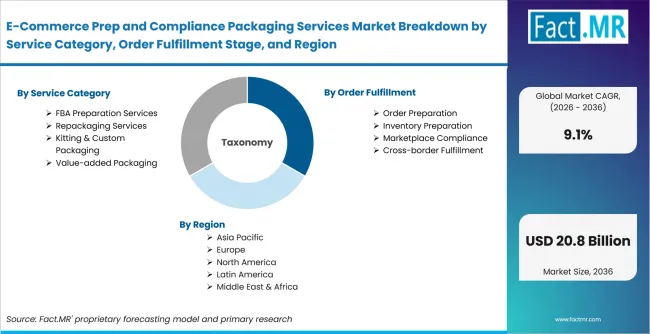
E Commerce Prep And Compliance Packaging Services Market Breakdown By Service Category, Order Fulfillment Stage, And Region | Source: Fact.MR
| Attribute | Details |
|---|---|
| Quantitative Units | USD billion in 2026 to USD billion by 2036 at a CAGR |
| Market Definition | E-Commerce Prep and Compliance Packaging Services products sold across the covered segments and applications |
| Segments Covered | Service Category; Order Fulfillment Stage; End-use Industry; Client Type; Packaging Compliance Standard |
| Regions Covered | North America; Latin America; Europe; East Asia; South Asia and Pacific; Middle East and Africa |
| Countries Covered | USA; UK; Germany; Canada; Japan; Australia; Singapore |
| Key Companies Profiled | DHL Supply Chain; GXO Logistics, Inc.; Kuehne + Nagel International AG; DB Schenker; DSV A/S; and others |
| Forecast Period | 2026 to 2036 |
| Approach | Hybrid top-down and bottom-up approach using segment demand; share; country growth; channel visibility; pricing; and company portfolio review |
Source: Fact.MR analysis. Updated Aug 6, 2026
How is the market segmented?
-
By Service Category
- FBA Preparation Services
- Labeling & Barcode Services
- Poly Bagging & Bundling
- Repackaging Services
- Carton Reconfiguration
- Protective Repackaging
- Kitting & Custom Packaging
- Promotional Kitting
- Custom Packaging
- Value-added Packaging
- Gift Wrapping
- Seasonal Packaging
- FBA Preparation Services
-
By Order Fulfillment Stage
- Order Preparation
- SKU Labeling
- Product Bundling
- Inventory Preparation
- Inventory Inspection
- Defect Screening
- Marketplace Compliance
- Compliance Verification
- Return Processing
- Cross-border Fulfillment
- Customs-ready Packaging
- Export Documentation
- Order Preparation
-
By End-use Industry
- Retail & E-commerce
- Online Marketplaces
- Direct-to-Consumer Brands
- Consumer Electronics
- Consumer Goods
- Household Products
- Food & Beverage
- Packaged Foods
- Beverages
- Healthcare & Personal Care
- Personal Care Products
- Healthcare Products
- Retail & E-commerce
-
By Client Type
- Online Sellers
- Marketplace Merchants
- Brand Owners
- Manufacturers
- Distributors
- Importers
- Third-party Logistics Providers
- Fulfillment Centers
- Contract Packaging Companies
- Global E-commerce Brands
- Cross-border Sellers
- Global Retailers
- Online Sellers
-
By Packaging Compliance Standard
- Amazon FBA Compliance
- FNSKU Labeling Standards
- Barcode Verification
- Retail Packaging Compliance
- Carton Label Compliance
- Shipment Documentation
- Export Packaging Standards
- Quality Inspection Protocols
- Seller Performance Standards
- International Shipping Compliance
- Customs Packaging Requirements
- Multi-market Compliance
- Amazon FBA Compliance
-
By Region
- North America
- Latin America
- Western Europe
- Eastern Europe
- East Asia
- South Asia and Pacific
- Middle East & Africa
Frequently Asked Questions
Which Service Category leads the market?
Which Order Fulfillment Stage leads the market?
Which End-use Industry leads the market?
Which Client Type leads the market?
Which Packaging Compliance Standard leads the market?
Which country records the highest listed CAGR?
What is the primary driver in this market?
What is the main restraint?
Which companies are included in the market assessment?
Who worked on this report


Preview the report firsthand - request a free sample
Free SampleGet the brochure for pricing and purchase details
Download PDF