- Base Value(2025): 1.8 Bn
- Estimated Value(2026): 1.8 Bn
- Forecast Value (2036): 3.1 Bn
- CAGR (2026 - 2036): 5.3%
ECG Cable and ECG Lead Wires Market Analysis and Forecast by Fact.MR
The global market for ecg cable and ecg lead wires is estimated to be around USD 1.8 billion in 2026 and has been forecast to expand at a CAGR of 5.3% to end up at USD 3.1 billion by 2036. The ECG Cable and ECG Lead Wires segment is led by ECG Cables, which is anticipated to account for 51.0% of the product segment in 2026, while Cardiac Monitoring is expected to remain the leading application with around 56.0% share. The market was valued at USD 1.8 billion in 2025 and is poised for steady growth driven by evolving industry dynamics and regional demand patterns.
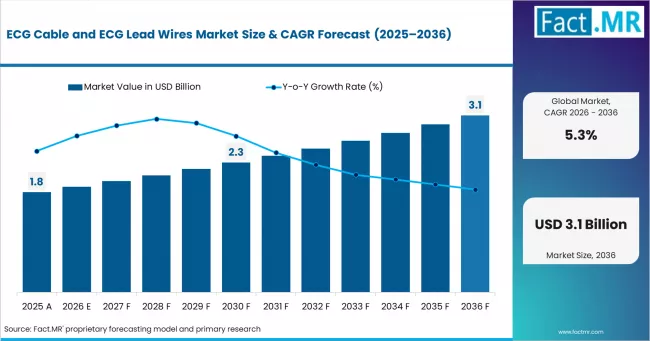
Ecg Cable And Ecg Lead Wires Market Market Value Analysis | Source: Fact.MR
Summary of ECG Cable and ECG Lead Wires Market
- Market Snapshot
- In 2025, the global ECG Cable and ECG Lead Wires Market was valued at approximately USD 1.8 billion.
- The market is estimated to reach USD 1.8 billion in 2026 and is projected to attain USD 3.1 billion by 2036
- The ecg cable and ecg lead wires market is likely to expand at a CAGR of 5.3% during the forecast period.
- The market is anticipated to create an absolute dollar opportunity of USD 1.3 billion between 2026 and 2036.
- ECG Cables account for 51.0% of market share in 2026.
- China (7.16%) and India (6.62%) are the key growth markets during the forecast period
- Demand and Growth Drivers
- Demand is shaped by the rising incidence of cardiovascular disease, which remains the leading cause of death globally and drives sustained hospital and ambulatory ECG volume.
- Growth reflects the replacement cycle economics of ECG cables and lead wires, where wear, cleaning-related degradation, and infection-control protocols drive predictable reorder patterns.
- Adoption is increasing due to the shift toward single-patient-use disposable lead wires in hospital settings, reducing cross-contamination risk and lifting unit volumes despite higher per-unit pricing.
- Product and Segment View
- ECG cables lead the product segment with a 51% share in 2026, supported by their use across bedside monitors, diagnostic ECG systems, and telemetry platforms.
- Cardiac monitoring accounts for 56% of the application segment, reflecting the embedded role of ECG tracking across ICU, operating room, and general ward settings.
- Hospitals hold 63% of end-use demand, while ambulatory and home care channels are growing faster as remote cardiac monitoring expands.
- Geography and Competitive Outlook
- North America remains the largest regional market, anchored by the US where hospital monitor density, cardiac procedure volumes, and infection control standards drive steady demand.
- Asia Pacific is the fastest-growing region, led by China and India as hospital infrastructure expands and cardiac diagnostics penetrate secondary and tertiary care settings.
- The competitive field is led by Cardinal Health, 3M Company, Medtronic plc, Koninklijke Philips N.V., and General Electric Company, with depth in sterile cable kit supply and hospital procurement relationships defining positioning.
- Analyst Opinion
- The ECG cable and lead wire market is a quiet but structurally attractive consumables category inside cardiac care. Growth is not about breakthrough technology. It is about three things: cardiovascular disease volume, infection-control-driven shifts toward disposables, and the replacement cycle economics that keep hospital orders flowing. The commercial lever that matters is hospital contracting depth combined with reliable sterile cable kit supply, because procurement groups are consolidating around fewer vendors who can guarantee quality and availability. Players that combine broad hospital access with disposable lead wire capacity and thermoplastic elastomer expertise will capture disproportionate share of incremental demand, while fragmented regional players will continue to lose ground to integrated suppliers.
Why is ECG Cable and ECG Lead Wires Market Growing?
- Growth reflects the rising global burden of cardiovascular disease, which is sustaining ECG monitoring volumes across all care settings.
- Demand is shaped by infection-control protocols that are accelerating the shift from reusable to single-patient-use disposable lead wires in hospital and critical care environments.
- Adoption is increasing due to the expansion of cardiac diagnostic capacity in emerging markets, where hospital bed additions directly translate into ECG cable and lead wire demand.
The demand base rests on cardiovascular epidemiology. With ischemic heart disease, arrhythmias, and heart failure populations all rising, ECG remains the most-used cardiac diagnostic tool globally. Every hospital monitor, operating room setup, and emergency department bay requires functional ECG cables and lead wires, which creates an embedded consumables demand pattern.
Infection control is the second structural driver. Reusable ECG lead wires carry measurable contamination risk, and hospital-acquired infection reduction programs have pushed procurement toward disposable single-patient-use alternatives. Disposables carry higher per-unit pricing and lift total category revenue because each hospital admission consumes a fresh set rather than one set serving many patients.
The third driver is emerging market expansion. Hospital capacity growth in China, India, and Brazil adds new monitor installations, each of which requires cable and lead wire consumables, keeping global demand on a steady growth path.
Segment-wise Analysis of ECG Cable and ECG Lead Wires Market
- ECG cables lead the product segment with a 51% share in 2026, supported by their central role across bedside monitors, diagnostic ECG systems, and telemetry platforms.
- Cardiac monitoring captures 56% of the application segment, reflecting its position as the primary clinical use case across ICU, operating room, and general ward deployments.
- Hospitals hold 63% of end-use demand, while ambulatory surgical centers and home care are growing faster as cardiac diagnostics decentralize.
The segmentation view is heavily concentrated, with one dominant sub-segment in each category. This concentration reduces product complexity for manufacturers but sharpens competition on price, quality, and distribution depth. Growth over the forecast period is expected to tilt toward disposable lead wire formats and toward ambulatory end-use channels, where infection control and remote monitoring trends intersect.
Why Do ECG Cables Lead the Product Segment?
ECG cables lead the product segment because they are the indispensable interface between patient and monitor across every cardiac care setting. Bedside monitors, diagnostic ECG systems, stress test equipment, and telemetry platforms all require cables that carry clinical-grade signal. The 5-lead and 12-lead configurations dominate hospital use, while 3-lead formats serve ambulatory and emergency applications. Cable durability, signal fidelity, and connector compatibility define purchasing decisions.
The leadership of this segment is reinforced by replacement cycle economics. Cables degrade through repeated use, cleaning, and handling, which produces a predictable reorder pattern for hospital procurement. Thermoplastic elastomer construction has become the preferred material because it balances flexibility, durability, and cleanability, and suppliers with material expertise in this area hold structural cost and performance advantages.
Why Does Cardiac Monitoring Dominate the Application Segment?
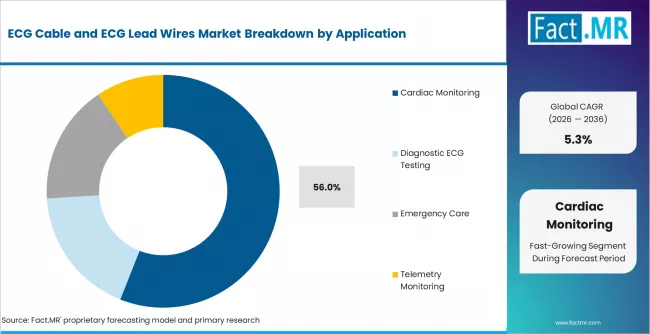
Ecg Cable And Ecg Lead Wires Market Analysis By Application | Source: Fact.MR
Cardiac monitoring dominates the application view because continuous ECG tracking is clinical standard across ICU, operating room, telemetry unit, and general ward settings. Every admitted patient with cardiovascular symptoms, post-surgical status, or chronic cardiac condition requires some level of ECG monitoring, which produces the largest volume of cable and lead wire consumption in the market. Critical care monitoring alone drives a disproportionate share of disposable lead wire demand.
Growth within cardiac monitoring is being lifted by telemetry expansion and by remote cardiac tracking programs that extend monitoring beyond the bedside. Hospital wards are deploying wireless telemetry more broadly for ambulating cardiac patients, and home-based cardiac monitoring is also creating incremental demand for compatible cable and lead wire sets.
Key Growth Drivers, Constraints, and Market Scope
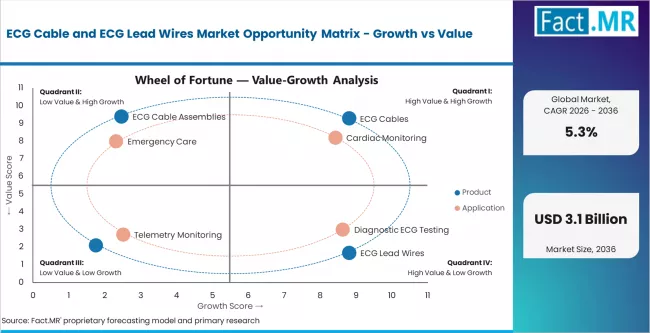
Ecg Cable And Ecg Lead Wires Market Opportunity Matrix Growth Vs Value | Source: Fact.MR
- Cardiovascular disease volume and hospital monitor installed base are the structural demand foundations.
- The shift to single-patient-use disposable lead wires is the most important compositional shift in the category.
- Pricing pressure from low-cost regional manufacturers remains the primary competitive constraint.
The market scope is shaped by steady, consumables-driven demand with limited technology disruption risk. Competitive advantage sits in distribution, sterile kit supply, and material quality rather than in product innovation. Suppliers that can defend hospital contracts while scaling disposable lead wire capacity will outperform.
Growth Drivers
The primary driver is cardiovascular disease prevalence, which sustains ECG monitoring volumes across every major care setting. A second driver is the disposable lead wire substitution trend, pushed by infection-control programs and Joint Commission requirements around cleaning and reprocessing. A third driver is hospital capacity expansion in emerging markets, where each new bed and each new cardiac care installation adds to the cable and lead wire consumables base. These three forces combine to deliver a stable mid-single-digit growth trajectory with limited cyclical exposure.
Constraints
The leading constraint is pricing pressure from low-cost manufacturers, particularly those based in China and India, who have gained share in the basic reusable cable segment. A second constraint is the higher cost of disposable lead wires, which can limit substitution in budget-constrained hospital systems and public health networks. A third constraint is commoditization risk at the low end of the product range, where differentiation is minimal and purchasing decisions default to price. These pressures compress margins for suppliers that cannot differentiate through quality, sterile kit supply, or contracted hospital relationships.
Opportunities
The strongest opportunity lies in disposable and single-patient-use lead wire portfolios, where infection control tailwinds and higher per-unit pricing combine to lift revenue. A second opportunity is premium sterile cable kit supply for operating room and ICU use, where hospital procurement groups value packaging quality and sterility assurance. A third opportunity is emerging market penetration through partnerships with local hospital chains, which can provide scale without the cost base of direct distribution. Suppliers that execute across these three opportunities will defend share against commodity pressure.
Regional Outlook Across Key Markets
.webp "Top Country Growth Comparison Ecg Cable And Ecg Lead Wires Market Cagr (2026 2036)")
Top Country Growth Comparison Ecg Cable And Ecg Lead Wires Market Cagr (2026 2036) | Source: Fact.MR
- China leads country-level growth at 7.16% CAGR, supported by hospital infrastructure expansion, rising cardiac procedure volumes, and domestic cable manufacturing scale.
- India follows at 6.62%, driven by corporate hospital chain expansion, rising cardiovascular disease prevalence, and growing private healthcare capacity.
- European demand is led by Germany at 6.09% and the UK at 4.5%, with both countries benefitting from infection-control policy enforcement and gradual shifts toward disposable lead wire formats.
- North America remains the largest regional pool by absolute value, with the US at 5.04% supported by replacement cycle demand, high monitor density, and Joint Commission-aligned procurement standards.
Country CAGR Table
| Country | CAGR (%) |
|---|---|
| China | 7.16% |
| India | 6.62% |
| Germany | 6.09% |
| Brazil | 5.57% |
| USA | 5.04% |
| UK | 4.50% |
| Japan | 3.98% |
Source: Fact.MR analysis. Updated Apr 24, 2026
Source: Fact.MR analysis, based on proprietary forecasting model and primary research.
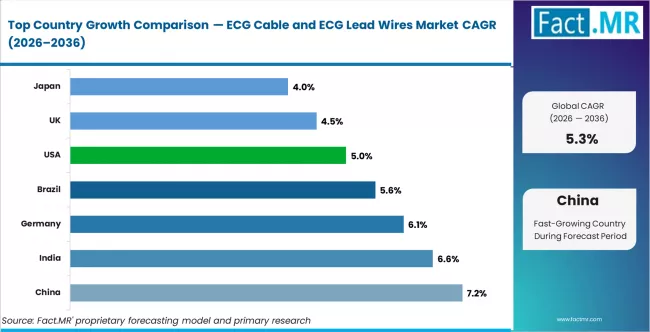
Ecg Cable And Ecg Lead Wires Market Cagr Analysis By Country | Source: Fact.MR
Country-level dynamics split into three clusters. Asia Pacific leads on growth rate, supported by hospital capacity expansion and domestic manufacturing scale. Europe grows at steady mid-single-digit rates driven by infection-control policy and disposable lead wire adoption. North America remains the largest dollar market, anchored by US hospital density and replacement cycle demand across a deep installed base of cardiac monitors.
United States
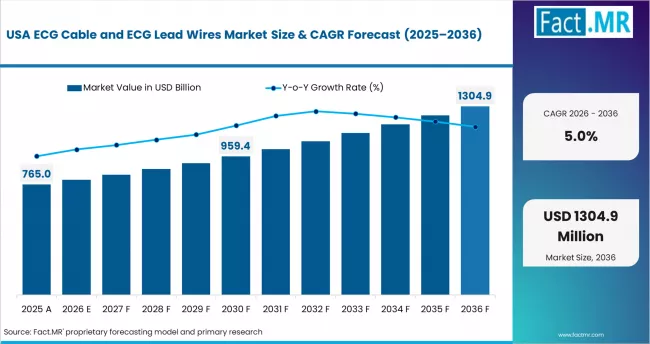
Ecg Cable And Ecg Lead Wires Market Country Value Analysis | Source: Fact.MR
The United States anchors global demand through its deep installed base of hospital cardiac monitors, strict Joint Commission infection-control standards, and well-organized group purchasing organization (GPO) procurement networks. Growth is supported by persistent cardiovascular disease incidence, by the replacement cycle of cables and lead wires across hospitals, and by the steady shift toward disposable single-patient-use lead wire formats. Scale suppliers hold structural advantages through GPO relationships and through private-label supply arrangements with hospital systems.
- GPO consolidation concentrates cable and lead wire contracts with a narrow set of qualified suppliers.
- Joint Commission infection-control standards favor disposable lead wire adoption.
- Replacement cycle demand across a large monitor installed base sustains baseline volume.
Canada
Canada represents a steady mid-single-digit growth market shaped by provincial health system procurement and by a gradual shift toward disposable ECG lead wires in acute care. Cross-border supply from US manufacturers fills most hospital demand, while domestic distribution partners handle provincial tender execution. The market is stable rather than dynamic, driven by replacement cycles and predictable hospital monitor installations.
- Provincial health agency procurement concentrates contracts with scaled suppliers.
- Cross-border US sourcing sustains product availability across the country.
- Disposable lead wire adoption is advancing gradually in acute care settings.
United Kingdom
The United Kingdom market is shaped by NHS hospital procurement frameworks and by infection-control guidance from the Health and Safety Executive. Central supply contracts concentrate demand with a small set of approved vendors, while disposable lead wire adoption has progressed steadily across acute trusts. Private hospital networks contribute additional demand in higher-margin product tiers.
- NHS central supply frameworks consolidate cable and lead wire procurement.
- Infection-control guidance supports disposable lead wire substitution.
- Private hospital networks add premium product demand beyond NHS tender volumes.
Germany
Germany leads European growth on the strength of hospital density, statutory health insurance funding for cardiac monitoring, and strict medical device regulatory oversight from BfArM. Infection-control standards from the Robert Koch Institute have accelerated the shift toward disposable lead wire formats, while large hospital groups have consolidated procurement with scaled suppliers. Domestic manufacturing capacity and strong distribution networks support steady volume growth.
- Robert Koch Institute infection-control standards favor disposable lead wire adoption.
- Statutory health insurance funding underpins stable hospital cardiac monitoring spend.
- Hospital group procurement consolidation concentrates cable demand with scaled suppliers.
China
China is the fastest-growing country in the forecast, driven by rapid hospital infrastructure expansion, rising cardiac procedure volumes, and a large domestic cable and lead wire manufacturing base. Tier-1 and tier-2 hospitals are adding cardiac monitoring capacity at scale, while domestic manufacturers such as Mindray supply both the local market and export channels. Pricing competition is intense at the mid-range, while premium segments remain dominated by international brands.
- Hospital infrastructure expansion in tier-1 and tier-2 cities drives monitor and consumables volume.
- Domestic manufacturing capacity supports both local supply and export growth.
- Rising cardiac procedure volumes anchor sustained cable and lead wire demand.
India
India is growing on the strength of corporate hospital chain expansion, rising cardiovascular disease burden, and increasing private healthcare capacity in tier-1 and tier-2 cities. Apollo, Fortis, Max, and other large hospital groups are adding cardiac monitoring capacity, which directly drives cable and lead wire consumables demand. Domestic manufacturers serve the mid-range, while international brands dominate premium tiers.
- Corporate hospital chains drive concentrated cable and lead wire procurement.
- Rising cardiovascular disease prevalence sustains cardiac monitoring volume growth.
- Domestic manufacturing scale supports mid-range product supply at competitive prices.
Competitive Benchmarking and Company Positioning
- Cardinal Health leads with an estimated 28% share, supported by its deep US hospital contracting footprint and integrated medical products portfolio.
- 3M Company, Medtronic plc, Koninklijke Philips N.V., and General Electric Company compete through hospital monitor ecosystem integration and branded cable and lead wire portfolios.
- Regional specialists such as Welch Allyn, Curbell Medical Products, and SCHILLER AG maintain strong positions in specific geographies and product tiers.
The competitive field is moderately concentrated at the top, with Cardinal Health holding a leading share anchored by its private-label hospital supply business and GPO contracting depth. 3M Company, Medtronic plc, Koninklijke Philips N.V., and General Electric Company compete on the strength of integrated cardiac monitoring ecosystems, where cables and lead wires are sold alongside or specified for parent monitor platforms. This ecosystem lock-in creates structural stickiness that protects against pure commodity pricing pressure.
The second tier of the market is occupied by specialist suppliers such as Welch Allyn, Mindray, Curbell Medical Products, CONMED Corporation, and SCHILLER AG, along with Boston Scientific Corporation and OSI Systems in specific monitor-adjacent categories. These players compete through regional strength, product specialization, and cost advantage in mid-range segments.
Strategic priorities across the field include expanding disposable lead wire capacity, deepening hospital contracting relationships through GPO and tender wins, and investing in sterile cable kit production. Suppliers that can defend monitor ecosystem ties while growing disposable product share will capture the largest portion of forecast period growth.
Competitive Analysis
Competitive positioning rests on three levers: hospital contracting depth, monitor ecosystem alignment, and disposable product capacity. Cardinal Health leads on contracting depth, supported by its medical products distribution network and private-label capability. 3M Company, Medtronic plc, Koninklijke Philips N.V., and General Electric Company compete through monitor ecosystem alignment, selling cables and lead wires into installed bases of their own or compatible platforms.
Second-tier competitors maintain relevance by focusing on product niches such as disposable lead wires, snap connectors, or specialty sterile kits. Smaller regional manufacturers compete on price in commoditized categories but lack contracting depth or monitor ecosystem alignment to scale into premium segments.
Benchmarking Table
| Company | Scale Reach | Hospital Contracting | Disposable Capacity | Monitor Ecosystem |
|---|---|---|---|---|
| Cardinal Health | Global | Strong | High | Broad |
| 3M Company | Global | Strong | Medium-High | Compatible |
| Medtronic plc | Global | Strong | Medium-High | Strong |
| Koninklijke Philips N.V. | Global | Strong | Medium-High | Strong |
| General Electric Company | Global | Strong | Medium | Strong |
| Welch Allyn | Global | Medium | Medium | Niche |
| Mindray Medical International | Global | Medium | Medium | Strong (Asia) |
Source: Fact.MR analysis. Updated Apr 24, 2026
Recent Developments
- In 2025, Cardinal Health expanded its disposable lead wire portfolio through extended private-label supply agreements with large US hospital systems.
- In 2025, Koninklijke Philips N.V. strengthened its connected cardiac monitoring ecosystem, reinforcing cable and lead wire compatibility with its next-generation patient monitors.
- In 2026, General Electric Company advanced its telemetry cable and lead wire offering, aligning with upgraded wireless hospital monitoring platforms.
Leading Companies Shaping ECG Cable and ECG Lead Wires Market
-
Major Players
- Cardinal Health
- 3M Company
- Boston Scientific Corporation
- Medtronic plc
- Koninklijke Philips N.V.
- Welch Allyn
- Mindray Medical International Limited
- General Electric Company
-
Emerging Players
- Curbell Medical Products
- Becton, Dickinson and Company
- CONMED Corporation
- Toshiba Corporation
- OSI Systems
- SCHILLER AG
- Nihon Kohden Corporation
- Spacelabs Healthcare
Sources and Research References
- United States Food and Drug Administration (FDA) - 510(k) Clearance Database for ECG Cables and Lead Wires
- Joint Commission - Hospital Accreditation Standards on Infection Control and Medical Device Reprocessing
- World Health Organization (WHO) - Global Cardiovascular Disease Burden Reports
- American Heart Association - Heart Disease and Stroke Statistics Annual Report
- Cardinal Health - Annual Report and Medical Products Segment Disclosures
- Koninklijke Philips N.V. - Annual Report and Patient Monitoring Product Disclosures
- Primary interviews with hospital biomedical engineering leads, cardiology procurement managers, and cable and lead wire manufacturers
This bibliography is provided for reader reference and is not exhaustive. The full report contains the complete reference list and detailed citations.
Key Questions This Report Addresses
- What is the current and future size of the ECG cable and ECG lead wires market?
- How fast is the market expected to grow between 2026 and 2036?
- Which product segment is likely to lead the market by 2026?
- Which application segment will account for the highest demand by 2026?
- How is the shift toward disposable lead wires reshaping demand?
- Why are China and India emerging as the fastest-growing markets?
- Which countries are projected to show the fastest growth through 2036?
- Who are the key companies active in the ECG cable and ECG lead wires market?
- How does Fact.MR estimate and validate the market forecast?
ECG Cable and ECG Lead Wires Market Definition
The ECG cable and ECG lead wires market covers the passive signal transmission components that connect a patient to electrocardiograph monitoring equipment. This includes patient cables, lead wire sets, connectors, and accessories used across 3-lead, 5-lead, and 12-lead ECG configurations in hospital, clinical, ambulatory, and home care settings.
ECG Cable and ECG Lead Wires Market Inclusions
The scope includes ECG cables across 3-lead, 5-lead, and 12-lead formats, disposable and reusable lead wires, cable assemblies, and accessories such as snap connectors and adapters. It covers applications across cardiac monitoring, diagnostic ECG testing, emergency care, and telemetry monitoring. Coverage spans hospitals, ambulatory surgical centers, diagnostic centers, home healthcare, and specialty clinics from 2026 to 2036.
ECG Cable and ECG Lead Wires Market Exclusions
The scope excludes the parent ECG monitoring equipment itself, cardiac electrodes and adhesive patches, Holter monitor hardware, and implantable cardiac rhythm devices. It also excludes full patient monitoring systems sold as finished hardware, non-ECG cables such as pulse oximetry or blood pressure cuff cables, and general-purpose medical wire and cable manufacturing unrelated to ECG signal transmission.
ECG Cable and ECG Lead Wires Market Research Methodology
- Primary Research: Interviews with cable manufacturers, hospital biomedical engineering leads, cardiology department procurement managers, and distributor contacts to validate demand patterns, replacement cycles, and pricing dynamics.
- Desk Research: Review of FDA 510(k) clearances, hospital infection-control policy updates, and published financial disclosures of listed cable and medical device companies.
- Market Sizing: Demand-side model built on hospital bed count, ECG monitor installed base, cardiac procedure volumes, and cable replacement cycle inputs, triangulated with top-down shipment data.
- Data Validation: Cross-validation across primary interviews, regulatory filings, and hospital procurement benchmarks, with sensitivity checks on disposable lead wire adoption rates and infection-control policy shifts.
Segmentation
Scope of Analysis
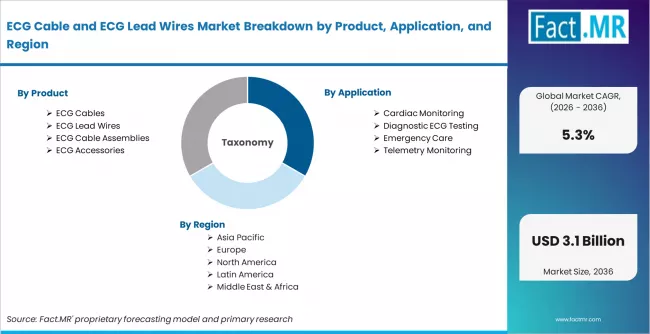
Ecg Cable And Ecg Lead Wires Market Breakdown By Product, Application, And Region | Source: Fact.MR
| Parameter | Details |
|---|---|
| Quantitative Units | USD 1.84 billion to USD 3.09 billion, at a CAGR of 5.3% |
| Market Definition | The ECG cable and ECG lead wires market covers passive signal transmission components connecting patients to electrocardiograph monitoring equipment, including 3-lead, 5-lead, and 12-lead configurations in disposable and reusable formats. |
| Regions Covered | North America, Latin America, Europe, East Asia, South Asia and Pacific, Middle East and Africa |
| Countries Covered | USA, Canada, UK, Germany, China, India, Brazil, Japan, 30 plus countries |
| Key Companies | Cardinal Health, 3M Company, Boston Scientific Corporation, Medtronic plc, Koninklijke Philips N.V., Welch Allyn, Mindray Medical International Limited, General Electric Company |
| Forecast Period | 2026 to 2036 |
| Approach | Hybrid demand-side and top-down methodology built on hospital monitor installed base, cardiac procedure volumes, cable replacement cycle inputs, and primary interviews across manufacturers, hospital biomedical engineering, and cardiology procurement teams |
Source: Fact.MR analysis. Updated Apr 24, 2026
Market Segmentation Analysis
-
ECG Cable and ECG Lead Wires Market Market Segmented by Product:
- ECG Cables
- 3-Lead ECG Cables
- 5-Lead ECG Cable Systems
- 12-Lead ECG Cable Systems
- 3-Lead ECG Cables
- ECG Lead Wires
- Disposable Lead Wires
- Reusable Lead Wire Sets
- Disposable Lead Wires
- ECG Cable Assemblies
- Patient Monitoring Cable Sets
- Multi-Connector ECG Systems
- Patient Monitoring Cable Sets
- ECG Accessories
- Snap Connectors & Adapters
- Lead Wire Clips & Plugs
- Snap Connectors & Adapters
- ECG Cables
-
ECG Cable and ECG Lead Wires Market Market Segmented by Application:
- Cardiac Monitoring
- Continuous ECG Monitoring
- ICU Patient Monitoring
- Continuous ECG Monitoring
- Diagnostic ECG Testing
- Resting ECG Procedures
- Stress Test Monitoring
- Resting ECG Procedures
- Emergency Care
- Critical Care Cardiac Support
- ER Cardiac Assessment
- Critical Care Cardiac Support
- Telemetry Monitoring
- Remote Cardiac Tracking
- Hospital Ward Monitoring
- Remote Cardiac Tracking
- Cardiac Monitoring
-
ECG Cable and ECG Lead Wires Market Market Segmented by End Use:
- Hospitals
- ICU & Emergency Units
- Cardiology Departments
- Ambulatory Surgical Centers
- Day Care Cardiac Units
- Outpatient Monitoring Clinics
- Day Care Cardiac Units
- Diagnostic Centers
- Cardiac Diagnostic Labs
- ECG Testing Facilities
- Cardiac Diagnostic Labs
- Home Healthcare
- Remote Patient Monitoring
- Chronic Cardiac Patients
- Remote Patient Monitoring
- ICU & Emergency Units
- Hospitals
-
ECG Cable and ECG Lead Wires Market Market Segmented by Technology:
- Wired ECG Connectivity
- Multi-Lead Signal Transmission
- High-Fidelity ECG Signal Transfer
- Multi-Lead Signal Transmission
- Shielded Cable Technology
- Noise Reduction Systems
- Signal Interference Protection
- Noise Reduction Systems
- Disposable Lead Wire Technology
- Single-Use ECG Systems
- Infection-Control Lead Sets
- Single-Use ECG Systems
- Wireless ECG Integration
- Hybrid Monitoring Systems
- Bluetooth Enabled ECG Modules
- Hybrid Monitoring Systems
- Wired ECG Connectivity
-
ECG Cable and ECG Lead Wires Market Market Segmented by Distribution Channel:
- Direct Sales
- Hospital Procurement Contracts
- Medical Device Tenders
- Hospital Procurement Contracts
- Specialty Medical Distributors
- Cardiac Equipment Suppliers
- Regional Healthcare Vendors
- Cardiac Equipment Suppliers
- Online Medical Supply
- B2B Healthcare Platforms
- Digital Procurement Portals
- B2B Healthcare Platforms
- Direct Sales
-
ECG Cable and ECG Lead Wires Market Market Segmented by Packaging:
- Sterile Cable Kits
- Single Patient Use Packs
- Pre-Assembled ECG Kits
- Single Patient Use Packs
- Medical Device Boxes
- Hospital Grade Packaging
- Bulk Clinical Supply Boxes
- Hospital Grade Packaging
- Blister Packaging
- Individual Lead Wire Packs
- Protected Connector Kits
- Individual Lead Wire Packs
- Sterile Cable Kits
-
ECG Cable and ECG Lead Wires Market Market by Region:
- North America
- USA
- Canada
- Mexico
- Latin America
- Brazil
- Chile
- Rest of Latin America
- Western Europe
- Germany
- UK
- Italy
- Spain
- France
- Nordic
- BENELUX
- Rest of Western Europe
- Eastern Europe
- Russia
- Poland
- Hungary
- Balkan & Baltic
- Rest of Eastern Europe
- East Asia
- China
- Japan
- South Korea
- South Asia and Pacific
- India
- ASEAN
- Australia & New Zealand
- Rest of South Asia and Pacific
- Middle East & Africa
- Kingdom of Saudi Arabia
- Other GCC Countries
- Turkiye
- South Africa
- Other African Union
- Rest of Middle East & Africa
- North America
Frequently Asked Questions
How big is the ECG cable and ECG lead wires market in 2026?
What will be the size of the ECG cable and ECG lead wires market in 2036?
How much will the ECG cable and ECG lead wires market grow between 2026 and 2036?
Which product segment is expected to lead the market in 2026?
Which country is the fastest-growing market?
Why is India a key growth market?
What does the ECG cable and ECG lead wires market cover?
How is the market forecast estimated and validated?
Who worked on this report


Preview the report firsthand - request a free sample
Free SampleGet the brochure for pricing and purchase details
Download PDF