- Base Value(2026): 1.15 Bn
- Estimated Value(2026): 1.2 Bn
- Forecast Value (2036): 2.3 Bn
- CAGR (2026 - 2036): 7.1%
Eco-Modulation Optimized Rigid Plastic Packaging Market Forecast and Outlook 2026 to 2036
The global eco-modulation optimized rigid plastic packaging market is valued at USD 1.15 billion in 2026 and is set to reach USD 2.28 billion by 2036, recording a compound annual growth rate (CAGR) of 7.1% between 2026 and 2036. In 2026, the food & beverage application segment is projected to hold a 45% share, while bottles & jars account for 40% by packaging format.
Key Takeaways from the Eco-Modulation Optimized Rigid Plastic Packaging Market Report
- Market Value of the Eco-Modulation Optimized Rigid Plastic Packaging Market (2026): USD 1.15 Billion
- Market Forecast Value of the Eco-Modulation Optimized Rigid Plastic Packaging Market (2036): USD 2.28 Billion
- Forecast CAGR of the Eco-Modulation Optimized Rigid Plastic Packaging Market (2026-2036): 7.1%
- Leading Application Segment of the Eco-Modulation Optimized Rigid Plastic Packaging Market: Food & Beverage (45%)
- Leading Packaging Format of the Eco-Modulation Optimized Rigid Plastic Packaging Market: Bottles & Jars (40%)
- Key Growth Regions of the Eco-Modulation Optimized Rigid Plastic Packaging Market: North America, Europe, Asia Pacific, Latin America, MEA
- Key Players of the Eco-Modulation Optimized Rigid Plastic Packaging Market: Amcor plc., RPC/ALPLA, Indorama Ventures, UFlex, Braskem, Toyo Seikan, Plastipak, Berry Global

Eco Modulation Optimized Rigid Plastic Packaging Market Market Value Analysis | Source: Fact.MR
Market expansion is fundamentally driven by the global proliferation of Extended Producer Responsibility (EPR) schemes that impose variable fees, based on packaging recyclability and environmental impact. This financial mechanism is compelling brands to redesign packaging to avoid penalties and secure lower fees. Optimization focuses on enhancing recyclability, integrating recycled content, and reducing material use without compromising functionality, directly aligning corporate cost management with circular economy goals.
Advanced material science and precision manufacturing will define growth over the forecast period. Innovations in polymer blends with eco-modulation additives improve performance while maintaining mono-material structures for easier recycling. Technologies like co-extrusion with recycled cores and advanced lightweighting through structural simulation allow for high-performance packaging that scores favorably under evolving eco-modulation criteria. This trend is transforming rigid plastic design from a purely marketing and functional exercise into a complex calculation of material science, regulatory compliance, and end-of-life economics.
Eco-Modulation Optimized Rigid Plastic Packaging Market
| Metric | Value |
|---|---|
| Estimated Value in (2026E) | USD 1.15 Billion |
| Forecast Value in (2036F) | USD 2.28 Billion |
| Forecast CAGR (2026 to 2036) | 7.1% |
Category
| Category | Segments |
|---|---|
| End-use/Application | Food & Beverage, Personal Care, Household Chemicals, Dairy & Beverages, Retail & Bulk, Others |
| Packaging Format/Type | Bottles & Jars, Clamshells & Trays, Rigid Containers, Drinkable Yogurt Bottles, Pails & Cans, Others |
| Material | PP / PET with Eco-modulation Additives, High-recyclability Blends, rPET / rPP Content Solutions, Bio-blend Polymers, HDPE with Reformulation, Others |
| Technology | Lightweighting & Material Substitution, Injection Stretch Blow Moulding Optimisation, Co-extrusion with Recycled Content, Design for Recycling, Structural Design & Wall Thinning, Others |
| Region | North America, Europe, Asia Pacific, Latin America, MEA |
Segmental Analysis
How do EPR Fee Structures Drive Adoption in the Food & Beverage Sector?
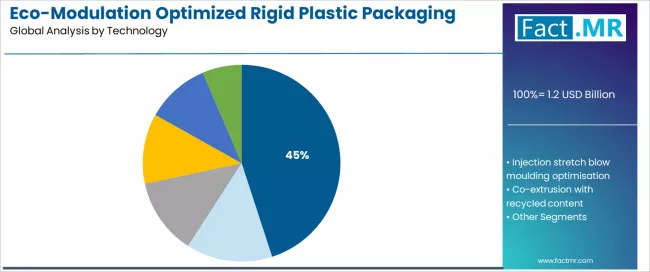
Eco Modulation Optimized Rigid Plastic Packaging Market Analysis By Technology | Source: Fact.MR
The food & beverage segment commands a 45% market share in 2026, as it faces the most immediate financial pressure from high-volume plastic usage under stringent EPR laws. Eco-modulation fees directly impact the bottom line for bottled water, dairy, sauces, and snacks. Brands are proactively redesigning packaging to incorporate high percentages of recycled PET or PP, eliminate problematic colors and labels, and adopt mono-material structures to achieve the highest recyclability grades and lowest fees.
This segment’s optimization is critical for maintaining product safety and shelf life while meeting these new parameters. The shift is not merely cosmetic; it requires re-engineering barrier properties, improving light-weighting through advanced moulding, and securing reliable supplies of food-grade recycled resin. Success in this segment means balancing compliance, cost, and consumer acceptance.
- Supermarket chains are setting stringent packaging sustainability requirements for their private-label products, cascading demand for optimized solutions down the supply chain.
- The high visibility of beverage bottles in public recycling streams makes them a primary target for regulators, accelerating innovation in bottle design and material composition.
Why are Bottles & Jars the Primary Focus for Optimization?
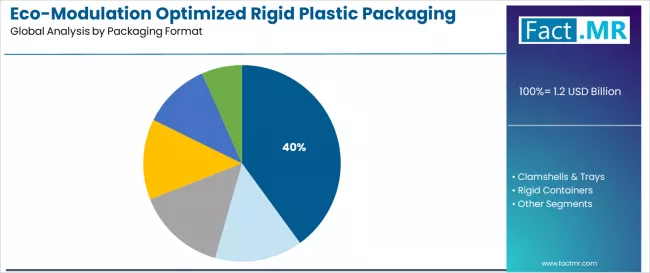
Eco Modulation Optimized Rigid Plastic Packaging Market Analysis By Packaging Format | Source: Fact.MR
Bottles and jars are projected to hold a 40% share by packaging format in 2026. This dominance is because they represent the highest volume application of rigid plastics with clearly established, but often complex, recycling pathways. Their cylindrical shape and material purity (when designed correctly) make them highly valuable in the recycling stream. Optimization efforts concentrate on removing silicone valves, PVC labels, and adhesives that contaminate the PET or HDPE recycle stream.
The format benefits from mature technologies like injection stretch blow moulding, which can be finely tuned for lightweighting—removing micrograms of material per unit—resulting in massive overall resin savings and lower eco-modulation fees across billions of units. The design focus is on achieving maximum performance with minimal, recyclable material.
- Standardization of bottle neck finishes and material types across competitors is emerging as a collective strategy to improve sorting efficiency and recyclate quality, benefiting all players.
- The development of enhanced barrier layers that are compatible with recycling processes is a key innovation area for jars requiring product protection.
What are the Drivers, Restraints, and Trends in the Eco-Modulation Optimized Rigid Plastic Packaging Market?
The market is singularly driven by legislation mandating eco-modulated EPR fees, creating a direct financial incentive for packaging optimization. Brand sustainability commitments and consumer sentiment provide secondary support. Key restraints include the higher cost of recycled food-grade resins, technical limitations in maintaining performance with reduced material, and the complexity of redesigning global packaging portfolios.
The market is trending towards digital product passports (DPPs) that provide detailed packaging composition data to regulators and recyclers, and towards advanced polymer sorting and decontamination technologies that enable higher-value recycled content, thus closing the loop.
Analysis of the Eco-Modulation Optimized Rigid Plastic Packaging Market by Key Countries
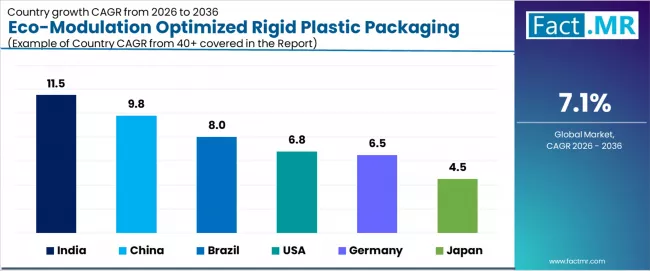
Eco Modulation Optimized Rigid Plastic Packaging Market Cagr Analysis By Country | Source: Fact.MR
| Country | CAGR (2026-2036) |
|---|---|
| India | 11.5% |
| China | 9.8% |
| USA | 6.8% |
| Brazil | 8.0% |
| Germany | 6.5% |
| Japan | 4.5% |
How is India's New EPR Framework Accelerating Market Transformation?
The market in India is projected to grow at a leading CAGR of 11.5% through 2036. This rapid growth is directly fueled by the implementation of stringent, newly enforced EPR rules that mandate recycled content and impose fees based on recyclability. The household chemicals and dairy sectors are leading adopters, seeking rPP and rPET content solutions. Domestic resin producers and packaging converters are investing heavily in washing and extrusion capabilities to meet the sudden surge in demand for compliant, recycled-content packaging.
- The large informal recycling sector presents both a challenge for formal data collection and an opportunity for rapid scaling of collection infrastructure to feed new recycling plants.
- Cost-competitive optimization is paramount, driving innovation in local material blends and lightweight designs suitable for the domestic market.
What Role Does China's Dual Carbon Strategy Play in Shaping Demand?
Demand for eco-modulation optimized rigid plastic packaging in China is forecast to grow at a CAGR of 9.8%. While national EPR is developing, the overarching Dual Carbon strategy (peak carbon, carbon neutrality) and corporate sustainability targets are powerful drivers. The personal care and electronics sectors are actively redesigning clamshells and trays using high-recyclability blends to reduce their carbon footprint. China's massive plastic production capacity is pivoting to develop and supply these new optimized materials and advanced, resource-efficient moulding technologies.
- Export-oriented manufacturers are proactively adopting designs that comply with European and North American EPR standards to maintain market access.
- Investments in chemical recycling plants aim to produce high-quality recyclate suitable for food-contact applications, a key for future optimization.
How do State-Level Regulations and Brand Initiatives Drive the US Market?
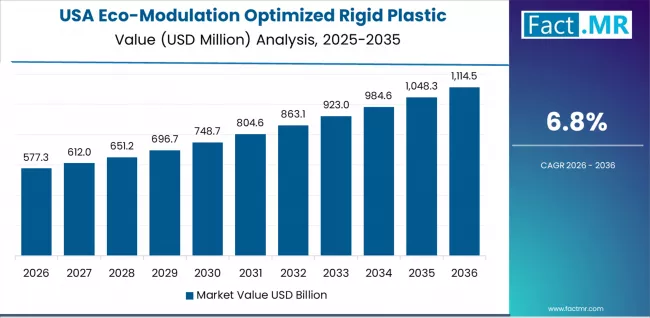
Eco Modulation Optimized Rigid Plastic Packaging Market Country Value Analysis | Source: Fact.MR
The market in the USA is set to grow at a CAGR of 6.8%. In the absence of federal EPR, state-level regulations in California, Oregon, Maine, and others are creating a complex patchwork that de facto drives national packaging changes. Major brand owners and retailers are implementing lightweighting and material substitution strategies at scale to pre-emptively comply and manage costs. The focus is on optimizing ubiquitous PET beverage bottles and HDPE containers through design for recycling (DfR) principles and integrating post-consumer resin (PCR).
- Voluntary commitments from large coalitions of brands to use significant PCR content are creating strong market pull for optimized packaging solutions.
- Innovation focuses on overcoming the technical challenges of incorporating higher levels of PCR while maintaining clarity, strength, and shelf life.
Why does Mature EU Legislation and Engineering Precision Define the German Market?
The market in Germany is expected to grow at a CAGR of 6.5%. As a leader under the EU's PPWR (Packaging and Packaging Waste Regulation) framework, Germany's eco-modulation fees are among the world's most sophisticated and costly. German engineering is applied to precision lightweighting, optimizing injection stretch blow moulding cycles, and developing co-extrusion technologies that place recycled content only in the middle layers of food packaging. The emphasis is on achieving technical excellence that delivers the best possible score in a rigorous regulatory environment.
- The well-established Der Grüne Punkt (Green Dot) system provides extensive data on packaging flows, enabling precise fee modulation and targeted design improvements.
- Collaboration between chemical companies, packaging manufacturers, and food brands is deep, focusing on closed-loop systems for specific polymer streams.
How is the Latin American Leadership in Bio-Polymers Influencing the Brazilian Market?
The market in Brazil is projected to grow at a CAGR of 8.0%. Brazil's strength in sugarcane-based bio-polymers creates a unique optimization path. For dairy and beverage applications, brands are exploring rigid packaging incorporating bio-blend polymers that can offer favorable eco-modulation outcomes due to their renewable carbon content. Simultaneously, design for recycling initiatives aim to improve the yieldfrom traditional PET and HDPE streams. The regional leadership in bio-materials offers an alternative optimization route alongside mechanical recycling.
- Local resin producers like Braskem are central to innovation, developing new polymer grades tailored for both recyclability and bio-content.
- The growing formalization of waste picker cooperatives is improving the quality and quantity of collected material, enabling more reliable recycled content supply.
What drives Japan's Focus on High-Efficiency Recycling and Premium Formats?
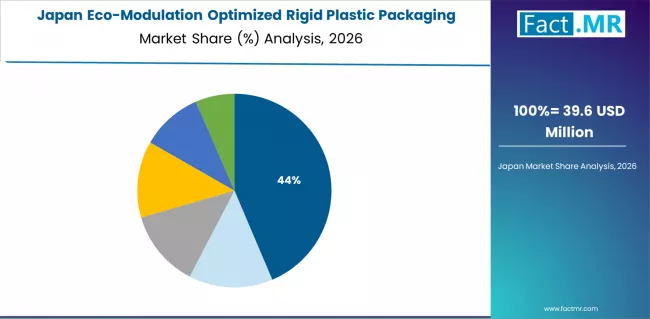
Eco Modulation Optimized Rigid Plastic Packaging Market Japan Market Share Analysis By End Use | Source: Fact.MR
The market in Japan is projected to grow at a CAGR of 4.5%. Japan's optimization efforts are characterized by an extreme focus on collection purity and high-efficiency mechanical recycling. Technologies for structural design and wall thinning are advanced, minimizing material use without sacrificing the premium feel required for retail and bulk food packaging. The optimization challenge lies in maintaining the impeccable clarity and haptics expected by consumers while integrating recycled content and ensuring compatibility with the country's meticulous sorting and washing processes.
- The long-standing container and packaging recycling law has created a mature but costly system, making further optimization through lightweighting a continuous priority to reduce fee burdens.
- Innovation in decontamination and super-cleaning technologies for recycled flake is critical to achieving food-contact approval for rPET and rPP in a risk-averse market.
Competitive Landscape of the Eco-Modulation Optimized Rigid Plastic Packaging Market
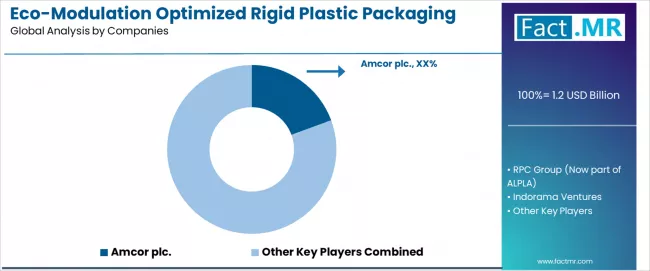
Eco Modulation Optimized Rigid Plastic Packaging Market Analysis By Company | Source: Fact.MR
The competitive landscape is being reshaped as resin producers, packaging converters, and brand owners form unprecedented vertical collaborations. Competition centers on access to reliable supplies of food-grade recycled resin, proprietary polymer formulation expertise like eco-modulation additives, and advanced manufacturing technologies that enable lightweighting and recycled content integration.
Major players are investing in recycling infrastructure to secure material feedstock. Success hinges on the ability to provide brands with comprehensive, data-backed solutions that demonstrably lower their EPR fee liability and meet ambitious recycled content targets, transitioning from a supplier to a strategic compliance and sustainability partner.
Key Players in the Eco-Modulation Optimized Rigid Plastic Packaging Market
- Amcor plc.
- RPC Group (Now part of ALPLA)
- Indorama Ventures
- UFlex Limited
- Braskem
- Toyo Seikan Group Holdings, Ltd.
- Plastipak Holdings, Inc.
- Berry Global, Inc.
Segmentation
Scope of the Report
| Items | Values |
|---|---|
| Quantitative Units (2026) | USD 1.15 Billion |
| End-use/Application | Food & Beverage, Personal Care, Household Chemicals, Dairy & Beverages, Retail & Bulk, Others |
| Packaging Format/Type | Bottles & Jars, Clamshells & Trays, Rigid Containers, Drinkable Yogurt Bottles, Pails & Cans, Others |
| Material | PP / PET with Eco-modulation Additives, High-recyclability Blends, rPET / rPP Content Solutions, Bio-blend Polymers, HDPE with Reformulation, Others |
| Technology | Lightweighting & Material Substitution, Injection Stretch Blow Moulding Optimisation, Co-extrusion with Recycled Content, Design for Recycling, Structural Design & Wall Thinning, Others |
| Regions Covered | North America, Europe, Asia Pacific, Latin America, MEA |
| Key Companies Profiled | Amcor plc., RPC / ALPLA, Indorama Ventures, UFlex, Braskem, Toyo Seikan, Plastipak, Berry Global, and other leading players |
| Additional Attributes | Market share analysis, analysis of eco-modulation fee structures by region, cost-benefit analysis of packaging redesign, insights into recycling infrastructure development and PCR supply dynamics. |
Eco-Modulation Optimized Rigid Plastic Packaging Market by Segments
-
By End-use/Application :
- Food & Beverage
- Personal Care
- Household Chemicals
- Dairy & Beverages
- Retail & Bulk
- Others
-
By Packaging Format/Type :
- Bottles & Jars
- Clamshells & Trays
- Rigid Containers
- Drinkable Yogurt Bottles
- Pails & Cans
- Others
-
By Material :
- PP/PET with Eco-modulation Additives
- High-recyclability Blends
- rPET/rPP Content Solutions
- Bio-blend Polymers
- HDPE with Reformulation
- Others
-
By Technology :
- Lightweighting & Material Substitution
- Injection Stretch Blow Moulding Optimisation
- Co-extrusion with Recycled Content
- Design for Recycling
- Structural Design & Wall Thinning
- Others
-
By Region :
-
North America
- USA
- Canada
- Mexico
-
Europe
- Germany
- UK
- France
- Italy
- Spain
- Nordic Countries
- BENELUX
- Rest of Europe
-
Asia Pacific
- China
- India
- Japan
- South Korea
- Australia
- Rest of Asia Pacific
-
Latin America
- Brazil
- Argentina
- Rest of Latin America
-
MEA
- Saudi Arabia
- UAE
- South Africa
- Rest of MEA
-
Frequently Asked Questions
How big is the eco-modulation optimized rigid plastic packaging market in 2026?
What will be the size of eco-modulation optimized rigid plastic packaging market in 2036?
How much will be the eco-modulation optimized rigid plastic packaging market growth between 2026 and 2036?
What are the key product types in the eco-modulation optimized rigid plastic packaging market?
Which packaging format/type segment to contribute significant share in the eco-modulation optimized rigid plastic packaging market in 2026?
Who worked on this report


Preview the report firsthand - request a free sample
Free SampleGet the brochure for pricing and purchase details
Download PDF