- Estimated Value(2026): 37.6 Bn
- Forecast Value (2036): 248.8 Bn
- CAGR (2026 - 2036): 20.8%
Edge Security Market Forecast and Outlook 2026 to 2036
In 2025, the edge security market surpassed a valuation of USD 31.2 billion. Based on Fact.MR analysis, demand for edge security is estimated to grow to USD 37.6 billion in 2026 and USD 248.8 billion by 2036. Fact.MR projects a CAGR of 20.8% during the forecast period.
The edge security market is expected to create an absolute dollar opportunity of about USD 211.2 billion between 2026 and 2036. Market growth is fueled by expanding 5G infrastructure, increasing deployment of IoT devices, and stronger cybersecurity regulations across critical infrastructure industries. These trends are encouraging enterprises and government agencies to adopt specialized edge security solutions. Market expansion is moderated by certain challenges. Many organizations face a shortage of skilled professionals in edge security architecture, and integration across diverse edge hardware environments can be complex. These issues tend to slow deployment, particularly among mid-sized enterprises.
Matthew Prince, CEO of Cloudflare said, "Securing the Internet against future threats shouldn't be a complex burden... By bringing this protection to our entire SASE platform, we’re making post-quantum security the default no hardware upgrades, no complex configurations, and no added cost."
Country growth reflects 5G rollout, IoT security regulations, and critical infrastructure cybersecurity mandates. Korea leads with 25.0% CAGR due to strong 5G adoption and industrial IoT security rules. Japan follows at 24.9% supported by stricter critical infrastructure cybersecurity programmes. The United States grows at 24.1% driven by federal cybersecurity mandates and infrastructure protection policies. China records 23.5% due to data security laws and large scale smart city deployments. The United Kingdom advances at 23.1% through IoT security regulations and national cybersecurity standards.
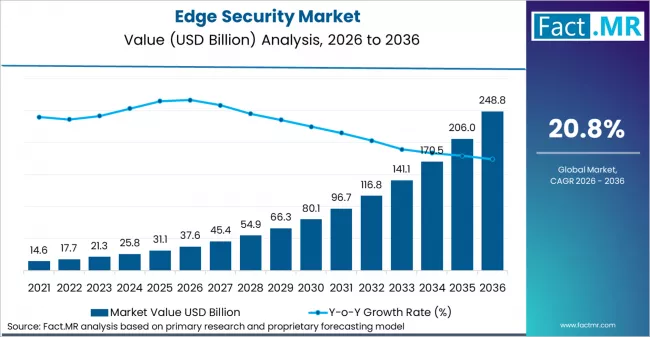
Edge Security Market Market Value Analysis | Source: Fact.MR
| Metric | Value |
|---|---|
| Estimated Value in 2026 | USD 37.6 billion |
| Forecast Value in 2036 | USD 248.8 billion |
| Forecast CAGR (2026 to 2036) | 20.8% |
Source: Fact.MR analysis. Updated Mar 5, 2026
Market Definition
The edge security market includes solutions and services that protect data, applications, and network traffic at distributed network edges such as IoT devices, industrial systems, 5G infrastructure, and enterprise branches.
Market Inclusions
Includes global and regional forecasts from 2026 to 2036 by component and deployment mode. Covers solutions and services across cloud and on premise architectures including zero trust access, SASE platforms, IoT gateways, OT edge security, and managed services.
Market Exclusions
Excludes core data centre security, endpoint security tools not used at network edges, and general cloud security platforms without edge capabilities. Traditional firewall or VPN tools without edge functionality are also excluded.
Research Methodology
- Primary Research: Interviews were conducted with enterprise security architects, telecom security teams, government CISOs, IoT vendors, and edge hardware integrators across major regions.
- Desk Research; Sources included CISA publications, NCSC guidance, ENISA reports, national cybersecurity strategies, OEM investor presentations, 5G rollout records, and IoT security regulations.
- Market Sizing and Forecasting; A hybrid model combined edge device estimates with average contract values by component and deployment type, incorporating regulatory timelines and enterprise adoption trends.
- Data Validation and Update Cycle: Results were validated using vendor revenues, cybersecurity spending data, enterprise procurement announcements, and regional IoT deployment statistics.
Summary
- Market Definition
- Edge security includes solutions and managed services protecting IoT devices, industrial systems, and distributed network nodes across enterprise, telecom, and government environments.
- Demand Drivers
- Rapid growth of IoT devices across industry and smart city deployments is expanding network attack surfaces and increasing demand for edge security platforms.
- Cybersecurity regulations such as CISA directives, EU NIS2, and the UK PSTI Act require critical infrastructure operators to deploy verifiable edge security controls.
- Adoption of hybrid cloud and distributed work environments is driving demand for zero trust and SASE security platforms across enterprise networks.
- Key Segments Analyzed
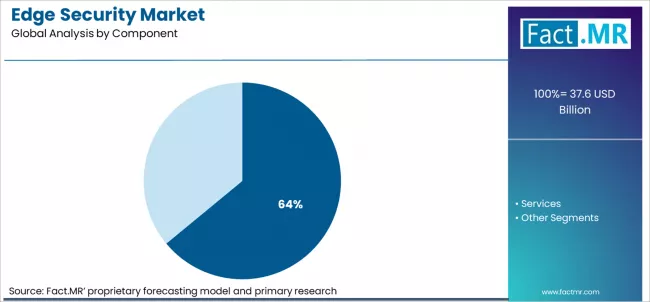
- By Component: Solutions account for about 64 percent share in 2026 due to high contract value of edge security software, gateways, and SASE platforms.
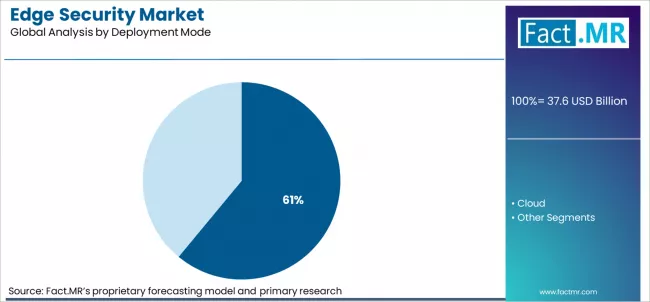
- By Deployment Mode: On premise deployments hold about 61 percent share in 2026 due to compliance requirements in regulated industries and critical infrastructure.
- By Geography: Asia Pacific leads growth with Korea recording the highest CAGR of 25.0 percent supported by strong 5G rollout and industrial IoT security mandates.
- Analyst Opinion at FACT.MR
- Shambhu Nath Jha, Principal Consultant at Fact.MR, opines, “Regulatory mandates, 5G expansion, and zero trust adoption are driving rapid growth in edge security. The USD 211.2 billion opportunity will concentrate in OT security, managed SASE services, and government critical infrastructure programmes.”
- Strategic Implications
- Vendors should develop OT focused edge security platforms to meet regulatory requirements in manufacturing, energy, and utilities.
- Managed security providers should build edge security operations centres that support IoT monitoring and compliance reporting.
- Security vendors should partner with telecom operators deploying private 5G networks to integrate edge security solutions for enterprise customers.
- Methodology
- Market sizing combined connected device estimates with average security contract values by deployment mode and component type.
- Regulatory mandates, IoT security standards, and 5G rollout schedules were benchmarked using government cybersecurity publications and telecom operator reports.
- Regional forecasts used cybersecurity spending data, IoT deployment statistics, and interviews with enterprise CISOs and OT security managers.
Segmental Analysis
Edge Security Market Analysis by Component
Edge Security Market Analysis By Component | Source: Fact.MR
Based on FACT.MR’s report, solutions are expected to hold about 64% share in 2026. High contract value for security platforms and gateways drives this segment, as enterprises prioritise zero trust architecture, IoT device visibility, and OT protocol support.
- Palo Alto Networks SASE Platform Expansion: In 2025, Palo Alto Networks expanded its Prisma SASE platform with AI powered IoT security and OT protocol inspection for critical infrastructure and manufacturing sectors. [5]
- Cisco Edge Security Platform Launch: In 2025, Cisco launched enhanced edge security features within its Security Cloud platform integrating AI threat detection across Catalyst and Meraki network infrastructure. [6]
- Managed Edge Security Service Adoption Trend: In 2024, enterprise demand for managed detection and response services with edge and IoT monitoring increased. MSSP providers including Secure works and Arctic Wolf expanded their service offerings. [7]
Edge Security Market Analysis by Deployment Mode
Edge Security Market Analysis By Deployment Mode | Source: Fact.MR
Based on FACT.MR’s report, on premise deployment is expected to hold about 61% share in 2026. Critical infrastructure, defence, and financial institutions require local data control and support for proprietary industrial protocols.
- Fortinet OT Security Appliance Investment: In 2025, Fortinet expanded its FortiGate rugged security appliances designed for industrial OT environments such as utilities, water systems, and oil and gas facilities. [8]
- Microsoft Azure Edge Security Cloud Platform Growth: In 2025, Microsoft reported increased adoption of Azure Arc based edge security allowing cloud policy management with on premise data processing for regulated industries. [9]
- 5G Private Network Edge Security Procurement Trend: In 2024, Nokia and Ericsson reported increased demand for integrated edge security within private 5G networks used by manufacturing customers. [10]
Drivers, Restraints, and Opportunities
FACT.MR analysts observe that the edge security market has evolved from a niche segment of network security into a core enterprise requirement. Market growth to USD 31.2 billion in 2025 reflects the rapid expansion of IoT devices, 5G networks, and hybrid cloud systems that extend enterprise networks beyond traditional security perimeters. New cybersecurity regulations in major economies are turning edge security investment into a compliance requirement.
The market faces a balance between urgent regulatory compliance and the complexity of integrating edge security with legacy infrastructure. Cloud delivered SASE platforms are expanding quickly in enterprise IT environments. In contrast, industrial OT sectors continue to rely on on premise security due to data sovereignty and protocol compatibility requirements.
- EU NIS2 Directive Critical Infrastructure Mandate: The EU NIS2 Directive requires essential service operators to implement cybersecurity risk management including protection of network edge systems. ENISA guidance published in 2024 highlights edge security as a mandatory control, driving procurement across EU member states. [2]
- Korea K Cyber Security Framework IoT Mandate: Korea updated its K Cyber Security Framework in 2025 to require security certification for IoT devices used in critical infrastructure and smart factories. Major companies such as Samsung Electronics and LG Electronics have introduced edge security requirements for industrial IoT platforms. [3]
- U.S. CISA Zero Trust Edge Security Mandate: CISA Directive 25 01 issued in 2025 requires federal agencies to adopt zero trust security including edge enforcement points for connected systems. Vendors including Palo Alto Networks, Zscaler, and Cisco reported increased federal contract demand following the mandate. [4]
Regional Analysis
The edge security market is analysed across Asia Pacific, Europe, North America, Latin America, and Middle East and Africa, covering 40+ countries with distinct demand profiles shaped by 5G deployment maturity, IoT regulation stringency, critical infrastructure cyber mandate intensity, and enterprise security budget allocation patterns. The full report offers market attractiveness analysis based on regulatory enforcement timelines and enterprise adoption rates.
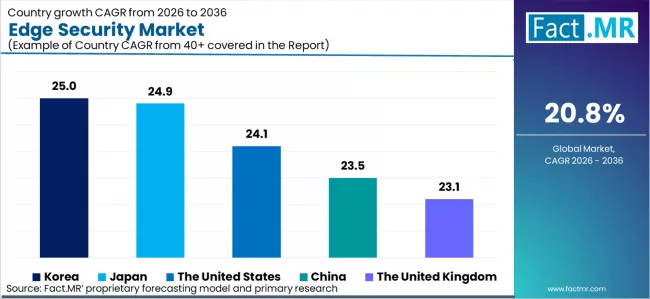
Edge Security Market Cagr Analysis By Country | Source: Fact.MR
| Country | CAGR (2026-2036) |
|---|---|
| Korea | 25.0% |
| Japan | 24.9% |
| The United States | 24.1% |
| China | 23.5% |
| The United Kingdom | 23.1% |
Source: Fact.MR analysis. Updated Mar 5, 2026
Source: Fact.MR (FACT.MR) analysis, based on proprietary forecasting model and primary research
Asia Pacific Edge Security Market Analysis
Asia Pacific is the fastest growing region for edge security due to large scale 5G deployment, rapid IoT adoption, and strong cybersecurity regulations. Countries in the region are investing heavily in smart manufacturing, critical infrastructure security, and connected device protection.
- South Korea: Demand for edge security in Korea is projected to grow at a 25.0% CAGR through 2036. Updated K Cyber Security Framework rules introduced mandatory security certification for IoT devices in critical infrastructure and smart factories. Companies such as Samsung Electronics increased edge security integration across industrial IoT platforms, while national certification programs expanded testing for connected devices.
- Japan: Demand for edge security in Japan is projected to grow at a 24.9% CAGR through 2036. The updated Critical Information Infrastructure Protection Programme expanded cybersecurity requirements across sectors including logistics and healthcare. NTT Security expanded managed edge security services to support critical infrastructure operators adopting new compliance frameworks.
- China: Demand for edge security in China is projected to grow at a 23.5% CAGR through 2036. Regulations under the Data Security Law and MLPS 2.0 require security controls for smart city and industrial IoT systems. Companies such as Huawei reported increased demand for edge security appliances across smart city and enterprise infrastructure deployments.
FACT.MR's Asia Pacific analysis of the edge security market covers China, Japan, South Korea, India, Australia and New Zealand, ASEAN, and Rest of Asia Pacific. Readers can find country CAGR forecasts, IoT security regulation timelines, 5G network security trends, and compliance investment benchmarks.
Europe Edge Security Market Analysis
Europe is a key regulatory hub for edge security driven by the NIS2 Directive and the EU Cyber Resilience Act. These policies are shaping enterprise and vendor investment in IoT and edge security compliance across the region.
- United Kingdom: Demand for edge security in the United Kingdom is projected to grow at a 23.1% CAGR through 2036. The Product Security and Telecommunications Infrastructure Act introduced mandatory security standards for connected devices from 2024. Enterprises must also meet Cyber Essentials Plus certification that now includes edge device security checks.
- Germany: Demand for edge security in Germany is projected to grow at around 22.5% CAGR through 2036. Updated cybersecurity guidance from the Federal Office for Information Security expanded security requirements for industrial control systems. Companies such as Siemens and SAP are integrating edge security features within industrial and enterprise platforms to support compliance.
FACT.MR's European analysis of the edge security market covers Germany, France, the United Kingdom, Italy, Spain, the Netherlands, the Nordics, and Rest of Europe. Readers can find NIS2 compliance investment timelines, EU product security certification schedules, and country growth forecasts.
North America Edge Security Market Analysis
North America is the largest revenue market for edge security due to strong enterprise IoT adoption, federal cybersecurity mandates, and the presence of major technology vendors.
- United States: Demand for edge security in the United States is projected to grow at a 24.1% CAGR through 2036. Federal directives such as CISA Binding Operational Directive 25 01 require zero trust architecture and edge security controls for government systems. Increased cybersecurity spending across energy, transport, and utilities sectors is driving enterprise adoption of edge security platforms.
FACT.MR's North American analysis of the edge security market covers the United States, Canada, and Mexico. Readers can find federal cybersecurity mandate timelines, IoT security investment trends, and market forecasts by deployment model.
Latin America Edge Security Market Analysis
Latin America is an emerging market for edge security supported by expanding industrial IoT deployments and growing government cybersecurity programmes.
- Brazil: Demand for edge security in Brazil is projected to grow at a 19.5% CAGR through 2036. Brazil’s National Cyber Security Strategy expanded requirements for cybersecurity in critical infrastructure and industrial IoT systems. Companies such as Embraer and Petrobras have begun integrating edge security within connected manufacturing and energy operations.
FACT.MR's Latin American analysis of the edge security market covers Brazil, Chile, Ecuador, and Rest of Latin America. Readers can find national cybersecurity strategy timelines, IoT security adoption trends, and country level growth forecasts.
Competitive Aligners for Market Players
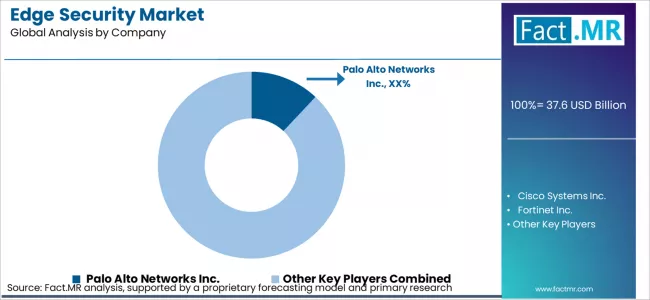
Edge Security Market Analysis By Company | Source: Fact.MR
The global edge security market is moderately concentrated among large platform vendors, while managed service providers compete in the services segment through regional coverage and industry specialization. Companies such as Palo Alto Networks, Cisco Systems, Fortinet, Zscaler, and Microsoft hold significant shares of solution revenue. Their strength comes from integrated security platforms that combine edge security with broader enterprise network protection. Enterprise customers prefer platforms that manage IoT, OT, branch networks, and cloud systems through a single control interface, which strengthens long term vendor relationships.
Leading vendors maintain advantages through advanced threat detection technologies, industrial protocol support, and government security certifications required for critical infrastructure projects. Palo Alto Networks uses its Cortex AI platform for threat intelligence and automation. Fortinet delivers integrated protection through its FortiOS ecosystem across hardware and virtual appliances. Zscaler provides cloud based zero trust access through its Zero Trust Exchange platform. Microsoft benefits from strong enterprise adoption through Azure Arc and Defender for IoT integrated with Microsoft cloud services.
Large organizations often reduce the number of security vendors they use. This platform consolidation increases reliance on established providers and creates strong barriers for new entrants. Competitive opportunities are therefore strongest in new deployments and emerging edge infrastructure projects.
Recent Developments
- In January 2025, Palo Alto Networks announced general availability of Prisma SASE 3.0 with enhanced IoT security and OT protocol inspection capabilities, targeting critical infrastructure and industrial manufacturing customers fulfilling NIS2 and CISA zero-trust compliance requirements across on premise and cloud-managed edge deployments.
- In February 2025, Fortinet Inc. disclosed commercial launch of its FortiGate 90G rugged edge security appliance series for harsh industrial environments, certified for IEC 62443 OT security compliance, targeting energy, water, and manufacturing operators requiring on premise edge security in space and temperature-constrained deployment conditions.
Key Players
- Palo Alto Networks Inc.
- Cisco Systems Inc.
- Fortinet Inc.
- Zscaler Inc.
- Microsoft Corporation
- Check Point Software Technologies Ltd.
- CrowdStrike Holdings Inc.
- Juniper Networks Inc.
- Trend Micro Incorporated
- Broadcom Inc. (Symantec)
Bibliography
- [1] Palo Alto Networks Inc. (2025). Q2 FY2025 Earnings Call Transcript: Platformisation and Federal Mandate Demand Commentary. February 2025. investors.paloaltonetworks.com
- [2] European Union Agency for Cybersecurity (ENISA). (2024). NIS2 Directive Technical Implementation Guidance: Edge Node and OT Security Control Requirements. November 2024. enisa.europa.eu
- [3] Ministry of Science and ICT, Republic of Korea. (2025). K-Cyber Security Framework Update: Mandatory Edge Device Security Certification for IoT in Critical Infrastructure and Smart Factories. January 2025. msit.go.kr
- [4] U.S. Cybersecurity and Infrastructure Security Agency (CISA). (2025). Binding Operational Directive 25-01: Implementing Zero Trust Architecture Requirements for Federal Civilian Agencies. January 2025. cisa.gov
- [5] Palo Alto Networks Inc. (2025). Press Release: Prisma SASE 3.0 with Enhanced IoT Security and OT Protocol Inspection Capabilities. February 2025. paloaltonetworks.com
- [6] Cisco Systems Inc. (2025). Press Release: Cisco Security Cloud Edge Security Capabilities with AI Threat Detection for Distributed Enterprise Edge Nodes. January 2025. cisco.com
- [7] Gartner Inc. (2024). Market Guide for Managed Detection and Response Services: Edge and IoT Visibility Expansion Trend. August 2024. gartner.com
- [8] Fortinet Inc. (2025). Press Release: FortiGate Rugged 90G Series Launch for Industrial OT Edge Security with IEC 62443 Certification. February 2025. fortinet.com
- [9] Microsoft Corporation. (2025). Azure Arc and Defender for IoT: Hybrid Edge Security Deployment Growth Disclosure. January 2025. azure.microsoft.com
- [10] Nokia Corporation / Ericsson AB. (2024). Annual Reports FY2024: 5G Private Network Security Service Integration and On-Premise Edge Security Bundling Trend. nokia.com; ericsson.com
This Report Addresses
- Strategic intelligence on zero trust edge security adoption, OT and ICS protection investment, SASE managed services, 5G private network security trends, and regulatory compliance demand.
- Market forecast from USD 37.6 billion in 2026 to USD 248.8 billion by 2036 at 20.8% CAGR, segmented by component, deployment mode, and region.
- Growth opportunities in U.S. federal zero trust programmes, EU NIS2 compliance, Korea IoT security certification, Japan CIPP requirements, and industrial OT security investment.
- Regional outlook with country CAGR for Korea 25.0%, Japan 24.9%, United States 24.1%, China 23.5%, and United Kingdom 23.1%.
- Competitive analysis of Palo Alto Networks, Cisco, Fortinet, Zscaler, and Microsoft covering platform capabilities, OT certification, government security qualification, and telecom partnerships.
- Technology tracking including Prisma SASE IoT expansion, FortiGate industrial appliances, Zscaler 5G integration, Microsoft Defender for IoT, and AI based threat detection platforms.
- Regulatory analysis covering EU NIS2 Directive, EU Cyber Resilience Act, CISA BOD 25 01 mandate, UK PSTI Act, Korea IoT security framework, and Japan CIPP obligations.
- Report delivered in Excel datasets, PowerPoint summary, and detailed PDF supported by regulatory records, vendor disclosures, and primary research.
Segmentation
Scope of Report
| Items | Values |
|---|---|
| Quantitative Units | USD 37.6 billion (2026) to USD 248.8 billion (2036), at a CAGR of 20.8% |
| Market Definition | Edge security includes solutions and services that protect data, applications, and network traffic at distributed edges such as IoT devices, industrial systems, 5G nodes, and enterprise branches across enterprise, telecom, government, and industrial sectors. |
| Component Segmentation | Solution (64%), Services |
| Deployment Mode Segmentation | Cloud, On-Premise (61%) |
| Application Coverage | Critical infrastructure OT and ICS protection, enterprise IoT security gateways, 5G private network security, zero trust access for branches and remote users, government edge security, smart city and industrial IoT protection, and SASE based edge policy enforcement. |
| Regions Covered | Asia Pacific, Europe, North America, Latin America, Middle East and Africa |
| Countries Covered | China, Japan, South Korea, India, Australia and New Zealand, ASEAN, Rest of Asia Pacific, Germany, United Kingdom, France, Italy, Spain, Netherlands, Nordics, Rest of Europe, United States, Canada, Mexico, Brazil, Chile, Ecuador, Rest of Latin America, Kingdom of Saudi Arabia, United Arab Emirates, South Africa, Turkey, Rest of Middle East and Africa |
| Key Companies Profiled | Palo Alto Networks Inc., Cisco Systems Inc., Fortinet Inc., Zscaler Inc., Microsoft Corporation, Check Point Software Technologies Ltd., CrowdStrike Holdings Inc., Juniper Networks Inc., Trend Micro Incorporated, Broadcom Inc. (Symantec) |
| Forecast Period | 2026 to 2036 |
| Approach | A hybrid top down and bottom up model was used. Top down inputs included connected device estimates, cybersecurity spending, and 5G rollout plans. Bottom up analysis used contract values by deployment type, service pricing, platform adoption rates, and compliance cost data from industry interviews. |
Source: Fact.MR analysis. Updated Mar 5, 2026
Edge Security Market by Segment
-
By Component
- Solution
- Services
-
By Deployment Mode
- Cloud
- On-Premise
-
By Region
- North America
- United States
- Canada
- Mexico
- Europe
- Germany
- United Kingdom
- France
- Italy
- Spain
- Netherlands
- Nordics
- Rest of Europe
- Asia Pacific
- China
- Japan
- South Korea
- India
- Australia and New Zealand
- ASEAN
- Rest of Asia Pacific
- Latin America
- Brazil
- Chile
- Ecuador
- Rest of Latin America
- Middle East and Africa
- Kingdom of Saudi Arabia
- United Arab Emirates
- South Africa
- Turkey
- Rest of Middle East and Africa
- North America
Frequently Asked Questions
How large is the edge security market in 2025?
What will the market size be in 2026?
What is the projected market size by 2036?
What is the expected CAGR from 2026 to 2036?
Which component segment is poised to lead the market?
Which deployment mode holds the largest share?
Which country shows the fastest growth rate?
How fast is the market expected to expand in Japan?
What is the forecast CAGR for the United States?
What growth rate is expected for China?
What are the main growth drivers of the market?
Which distribution channel dominates the market?
Who worked on this report


Preview the report firsthand - request a free sample
Free SampleGet the brochure for pricing and purchase details
Download PDF