- Base Value(2025): 7.3 Bn
- Forecast Value (2035): 44.9 Bn
- CAGR (2035): 20.7%
Neuromorphic Edge Analytics Market Outlook 2025 to 2035
The global neuromorphic edge analytics market is expected to reach USD 44.9 billion by 2035, up from USD 7.3 billion in 2025. During the forecast period 2025 to 2035, the industry is projected to expand at a CAGR of 19.9%.
The neuromorphic edge analytics market will be experiencing robust growth as industries will be requiring data processing that is intelligent and energy efficient and with low latency close to the source. The increasing use of networked sensors, autonomous robots, and high-tech robotics is driving companies towards computing infrastructures that are capable of interpreting and responding real-time without connecting to the cloud network. This development will likely transform the way real time insights are being created and utilized in daily operations.
Quick Stats for Neuromorphic Edge Analytics Market
- Industry Value (2025): USD 7.3 Million
- Projected Value (2035): USD 44.9 Million
- Forecast CAGR (2025 to 2035): 19.9%
- Leading Segment (2025): Hardware (60.8% Market Share)
- Fastest Growing Country (2025-2035): United States (22% CAGR)
- Top Key Players: Intel, IBM, BrainChip, SynSense, Innatera, GrAI Matter Labs, Prophesee, iniVation, and Sony

Neuromorphic Edge Analytics Market Market Value Analysis | Source: Fact.MR
Even the rapid innovation in neuromorphic hardware and chip design has supported the development of the industry. Bramble-like structures that can compute in parallel, event-based, are providing the scalability never seen before to real-time analytics. The developments are making devices learn, adapt, and respond quicker and limiting power consumption by a large margin, which gives hardware manufacturers a key point in the creation of the future-scape of the market.
The market is, however, hampered by barriers such as lack of programming skills and expensive hardware integration. Compatibility with any existing AI frameworks and the creation of clear software standards are still some issues to be managed. But the continuous growth in the AI and collaboration with the technological industries and open-source platforms are likely to reduce the obstacles that will impede the market in the coming year.
What are the drivers of the neuromorphic edge analytics market?
The neuromorphic edge analytics marketplace is being driven by a fast process of integrating artificial intelligence into edge devices, which can interpret data faster and at the edges, in industrial, automotive, healthcare, and defense fields. The United States, China, Japan, Germany, and the United Kingdom are some of the countries that are on the path to adopt edge intelligence with a heavy focus on the neuromorphic hardware, sensor fusion systems and adaptive computing structures. These countries have solid semiconductor research and development as well as robust digital infrastructure that helps to accelerate the implementation of brain-inspired analytics at scale.
Soaring demand, growing need of ultra-low latency, energy efficient processing demands is a significant growth driver as organizations move to decentralized computing architectures. Neuromorphic edge enables make real-time inference and make decisions without relying on clouds, which solve operational issues in autonomous mobility, smart manufacturing, and predictive healthcare monitoring. Their capability to learn and adapt continuously increases the reliability of the processes and lessens the energy usage by a great margin, which would ultimately qualify them in the next-generation intelligent network.
Intense international regulations on data privacy, cybersecurity, and AI ethics are pursuing the demand of safe and certified neuromorphic systems. Transparency and algorithmic accountability are being required by regulators in Asia, North America and Europe, and this will lead to the use of compliant edge solutions.
What are the regional trends of the neuromorphic edge analytics market?
Regional diversification in terms of the neuromorphic edge analytics has been on a good note with Asia Pacific turning out to be the major focal point of technological innovation and adoption. The leadership of the region is based on the fact that artificial intelligence is strongly supported by the government, industries are becoming more digital, and the infrastructures that are connected are growing fast.
China is developing the mass deployment of neuromorphic-level with national smart manufacturing and autonomous mobility plans, paying attention to the introduction of event-based chips in robotics, transportation, and urban surveillance. Japan is still increasing at a rapid pace in commercial application under good AI and semiconductor policies with focus in autonomous vehicle, robotics in healthcare, and energy-efficient electronics.
Europe is also one of the key hubs of sustainable and compliant neuromorphic edge analytics. Germany, France, and the United Kingdom are some of the nations that are focusing on certified and energy-efficient systems in line with the EU emissions and digital sovereignty agenda.
North America, particularly USA dominated the market due to the advance adaptation of AI across technological industries and continuous investment in semiconductor industries. The market is gaining momentum through high venture capital investment, an established ecosystem of AI software and fast adoption in defense and healthcare analytics.
What are the challenges and restraining factors of the neuromorphic edge analytics market?
Combination of technical and structural issues prevails in the Neuromorphic Edge Analytics Market and holds it back on large-scale deployment. Such demands increase expenses and restrict competition of smaller manufacturers.
The neuromorphic systems require a lot of certification and compliance testing in order to develop and validate them. In the U.S., Japan, South Korea, and the EU, cybersecurity validation, AI governance procedures, and performance verification processes increase commercialization cycles by a substantial amount of time and costs. With regulators increasing the rigors of the algorithmic transparency, businesses must invest larger R&D funds in certification, which acts as a hindrance to large-scale implementation in cost-sensitive environments.
Poor scalability and production capacity are also a lot of concern. Both the production of event-driven processors and the hardware of spiking neural networks are hideous manufacturing processes that are available to only a small number of semiconductor companies. This limits availability of supply and increases the overall deployment cost of large scale industrial and automotive usage. There is also the deficiency of experienced engineers that have been well trained in the field of neuromorphic programming therefore limiting innovation and slowing system optimization.
Country-Wise Insights
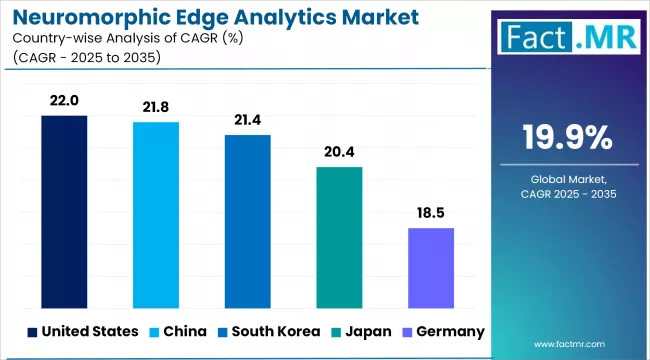
Neuromorphic Edge Analytics Market Cagr Analysis By Country | Source: Fact.MR
Expanding AI Infrastructure and Edge Innovation Accelerate Market Growth in Japan
The semiconductor R&D, robotics, and AI-driven manufacturers are the factors that are speeding up the market in Japan. The next-generation computing and automation programs implemented by the government are contributing to uptake in automotive, electronics and healthcare industries. Early applications of neuromorphic processors in real-time interpretation of data and the use of intelligent control systems are being advanced by public-private collaborations.
Collaboration with the universities, government laboratories, and technology giants ensures uniform innovation and commercialization. The proactive regulatory nature of Japan in the field of AI ethics, data security and hardware certification increases the level of investor confidence and scalability of the market. Together these developments make Japan a strong competitor in the market
Rising Semiconductor Investments and Smart Manufacturing Push Neuromorphic Advancements in the United States
Neruromorphic edge analytics is highest in the world around the United States with unprecedented investment in massive semiconductor schemes and the fast pace of development of smart manufacturing and defense uses. The strategic emphasis on AI sovereignty and chip self-sufficiency is giving the country a sustainable ability to use neuromorphic structures in mass applications in industrial automation, transportation, and national security infrastructure.

Neuromorphic Edge Analytics Market Country Value Analysis | Source: Fact.MR
There is a rapid adoption of edge computing by industries seeking to have faster and localized intelligence to autonomous systems and real-time analytics. The capability of neuromorphic processors to replicate neural behavior means that they can make high efficiency, on-board decisions, which would be perfect in mission-critical scenarios such as logistics, aerospace, and predictive maintenance. The performance, cybersecurity and scalability orientation of the U.S market means that neuromorphic edge analytics will continue to feature prominently in the digital transformation agenda of the U.S market in the coming years.
Category-Wise Analysis
Dominance of Hardware Segment Driven by Demand for Adaptive and Energy-Efficient Processors

Neuromorphic Edge Analytics Market Analysis By Component | Source: Fact.MR
The most powerful segment of the neuromorphic edge analytics market is the hardware part, and it is largely driven by the increased level of demand on the more advanced energy efficient processors that can have the capacity to serve real-time analytics. The neuromorphic chip reduces the dependency on cloud infrastructure by replicating the functions of biological neuron. This capability is based on hardware-based ability that is becoming vital in industries such as automotive, industrial automation, and defense, where milliseconds count in the performance results.
The ever-increasing interest in energy-efficient power consumption and enhanced accuracy in dynamic conditions has turned neuromorphic hardware into the support of future AI-driven ecosystem. The cost effectiveness and scalability of neuromorphic processors are also improving with more investments by semiconductor leaders. The efficiency of neuromorphic devices will be further improved in the next few years owing to the development of acquisition technology of fabrication, stacking of 3D chips and heterogeneous integration.
Automotive & Transportation Segment Leads with Strong Integration of Edge AI and Neuromorphic Intelligence

Neuromorphic Edge Analytics Market Analysis By End Use Industry | Source: Fact.MR
The automotive and transportation sector remains the leader on the market of neuromorphic edge analytics because the edge AI in autonomous vehicles, electric mobility, and smart transportation infrastructure is rapidly adopted. Incorporation of neuromorphic processors helps vehicles to analyze, control and perceive their environment in a real-time and implement adaptive control that is independent of centralized servers. This creates safer, quicker and more fuel-efficient driving systems that re-invent the contemporary mobility experience.
With the advent of software-defined vehicles as a new standard, edge-based neuromorphic analytics is offering unprecedented flexibilities in the continuous updates, system adaptation, and optimization of energy. The unstructured sensory real-time nature of the technology with minimal latency to process data facilitates next-generation autonomous navigation and vehicle-to-everything (V2X) communications.
Competitive Analysis
Key players in the neuromorphic edge analytics market are Intel, IBM, BrainChip, SynSense, Innatera, GrAI Matter Labs, Prophesee, iniVation, Sony, Applied Brain Research, Numenta, Mythic AI, Syntiant, Samsung Electronics, and Qualcomm
The market competition in neuromorphic edge analytics is growing as the companies are working on creating better architectures, encryption systems, and adaptive learning algorithms that characterize the speed, security, and intelligent capability of the edge computing systems. Those companies that have invested into scalable neuromorphic hardware, integrated AI frameworks and real time edge optimization are realizing long term differentiation by having a better performance stability and processing efficiency.
The partnerships are a top priority among leading players excepting to pursue partnerships with OEMs, industrial automation companies, and AI platform providers to gain early adoption benefits. The availability of intellectual property in neuromorphic processors, in spiking neural network architecture and in hybrid AI-edge integration, is now a major competitive positioning factor.
Strategic alliance between different firms such as semiconductors industry, Technological industries such as AI developers, and research institutions, together all these make a competitive landscape for the market. These partnerships strengthen and help in deployment of application-specific intelligence across multiple industries.
Recent Development
- The company BraincChio, in 2025, Unveiled the Akida Pico processor, a highly energy-efficient (~1 mW) neuromorphic microprocessor specifically designed for edge devices. The chip makes it possible for devices to have continuous intelligent sensing and immediate data processing in wearable gadgets, IoT sensors, and smart consumer electronics.
- In the year 2024, the company named Intel, developed Hala Point, constituting billions of neurons around 1.1 bnusing Loihi 2 chips and it is considered as the word largest neuromorphic computing system.
Fact.MR has provided detailed information about the price points of key manufacturers of Neuromorphic Edge Analytics Market positioned across regions, sales growth, production capacity, and speculative technological expansion, in the recently published report.
Methodology and Industry Tracking Approach
The 2025 neuromorphic edge analytics market report by Fact.MR is based on insights collected from 1,200 stakeholders across 12 countries, with a minimum of 75 respondents per country. Among the participants, 65% were end users including biopolymer converters, specialty chemical formulators, and FMCG sustainability teams while the remaining 35% included sourcing managers, R&D directors, environmental compliance leads, and bioeconomy consultants.
Data collection was conducted between July 2024 and June 2025, focusing on parameters such as monomer purity, conversion yield, cost per ton, end-use compatibility, feedstock availability, and regulatory alignment. A regionally weighted calibration model ensured balanced representation across North America, Europe, and Asia-Pacific.
The study triangulated over 95 validated sources, including patent databases, sustainability disclosures, process modeling datasets, and annual reports from monomer and biopolymer producers.
Fact.MR applied rigorous analytical tools such as multi-variable regression and scenario modeling to ensure data robustness. With continuous monitoring of the glass adhesives space since 2018, this report offers a comprehensive roadmap for firms seeking competitive advantage, innovation, and sustainable growth within the sector.
Segmentation
Segmentation of Neuromorphic Edge Analytics Market
-
By Component :
- Hardware
- Software
- Services
-
By Hardware Type :
- Neuromorphic Chips
- Sensors
- Processors
- Memory & Storage Modules
-
By Vehicle Category :
- Passenger Cars
- Light Commercial Vehicles (LCVs)
- Heavy Commercial Vehicles (HCVs)
- Power Sports Vehicles
- Off-Highway Vehicles
-
By Deployment Type :
- Edge Devices
- Edge Servers
- Gateways
-
By Technology :
- Spiking Neural Networks (SNNs)
- Non-Spiking Neural Networks
- Hybrid Neuromorphic Systems
-
By End-Use Industry :
- Automotive & Transportation
- Consumer Electronics
- Healthcare & Wearables
- Industrial & Manufacturing
- Aerospace & Defense
- Smart Cities & Infrastructure
- Robotics & Drones
-
By Application :
- Image & Signal Processing
- Predictive Maintenance
- Real-Time Monitoring
- Pattern Recognition
- Decision Support Systems
-
By Region :
- North America
- Latin America
- Western Europe
- Eastern Europe
- East Asia
- South Asia & Pacific
- Middle East & Africa
Frequently Asked Questions
What was the Global Neuromorphic Edge Analytics Market Size Reported by Fact.MR for 2025?
Who are the Major Players Operating in the Neuromorphic Edge Analytics Market?
What is the Estimated Valuation of the Neuromorphic Edge Analytics Market in 2035?
What Value CAGR did the Neuromorphic Edge Analytics Market Exhibit Over the Last Five Years?
Who worked on this report


Preview the report firsthand - request a free sample
Free SampleGet the brochure for pricing and purchase details
Download PDF