- Market Value (2025): USD 90.1 Mn
- Estimated Value (2026): USD 96.2 Mn
- Forecast Value (2036): USD 186.8 Mn
- CAGR (2026-2036): 6.9%
What is the Egg Phosphatidylcholine Market forecast to be worth by 2036?
USD 96.2 million in 2026 to USD 186.8 million by 2036 at a 6.9% CAGR.
- As per Fact.MR analysis, the Egg Phosphatidylcholine Market crossed a valuation of USD 90.1 million in 2025.
- Demand is projected to reach from USD 96.2 million in 2026 to USD 186.8 million by 2036 as producers of dietary supplements and drug formulations seek consistent egg-derived phospholipid inputs.
- The 2026 to 2036 outlook carries a 6.9% CAGR, while purchase decisions remain closely tied to grade, traceability, stability and intended application.
| Year | Basis | Market Value (USD million) |
|---|---|---|
| 2025 | Actual | 90.1 |
| 2026 | Estimate | 96.2 |
| 2036 | Forecast | 186.8 |
| CAGR 2026 to 2036 | Forecast period | 6.9% |
Source: Fact.MR analysis. Updated Nov 11, 2026
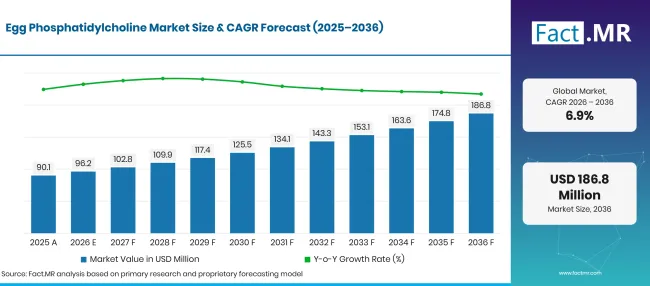
Egg Phosphatidylcholine Market Forecast Global | Source: Fact.MR
What are the defining numbers behind Egg Phosphatidylcholine Market growth?
The market adds USD 90.6 million in forecast value between 2026 and 2036.
- Demand Drivers in the Market
- Egg yolk availability is relevant to input sourcing, although shell-egg output is not the same as extractable phosphatidylcholine supply.
- Lipid researchers and medicine developers value reproducible material behavior when building membrane systems.
- Egg yolk sourcing depends on the wider food supply chain. In March 2026, IBGE reported that Brazil produced 4.95 billion dozen eggs during 2025, an increase of 5.7%.
- Key Segments Analyzed
- By Product Type: Liquid is expected to account for 57.3% of the market in 2026. Its handling in blending and emulsion processing suits manufacturers that incorporate phospholipid ingredients into liquid systems.
- By Application: Dietary Supplements represent 35.2% of 2026 demand. Brands evaluate dosage form and the permitted ingredient claims before deciding whether an egg-derived phospholipid suits their formula.
- By Sales Channel: Online Retail leads with 34.1% of 2026 value. Digital ordering supports repeat purchases and product comparison, although technical pharmaceutical purchasing follows a different approval process.
- By End-User: Individual Consumers represent 63.2% of market value in 2026, reflecting the downstream consumer side of supplement and other finished-product sales.
- Analyst Opinion at Fact.MR
- Shambhu Nath Jha, Principal Consultant at Fact.MR, states, “Egg phosphatidylcholine buyers compare purity, batch consistency and intended use before approving a grade. Pharmaceutical formulators place greater weight on composition and qualification records, while supplement brands also consider labeling and ingredient origin. Suppliers with clear specifications, reliable testing and stable delivery are better positioned to secure repeat orders.”
- Strategic Implications
- Ingredient processors should distinguish crude egg lecithin from concentrated phosphatidylcholine. Clear grade descriptions and composition data help prevent unsuitable substitutions in regulated formulations.
- Pharmaceutical purchasing teams should compare supplier testing protocols and intended-use documentation before beginning qualification. Switching materials after development can create additional testing work.
- Supplement manufacturers should check local labeling and allergen requirements before selecting egg-derived ingredients. A product that can be used in one jurisdiction is not automatically cleared for another.
- Distributors should separate research-only material from grades intended for food or pharmaceutical production.
Brazil is forecast at 7.8% CAGR through 2036, while Japan follows at 7.4%. Germany is projected at 6.9%. The UK is estimated at 5.4%, and the USA at 5.0%.
How does the Egg Phosphatidylcholine Market break down by segment?
Liquid leads Product Type at 57.3%; Dietary Supplements lead Application at 35.2%; Online Retail leads Sales Channel at 34.1%; Individual Consumers lead End-User at 63.2%.
Which Product Type dominates?
Liquid accounts for 57.3% of 2026 market value.
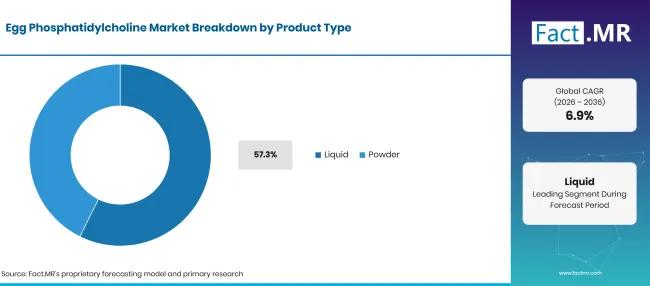
Egg Phosphatidylcholine Market Breakdown Product Type | Source: Fact.MR
| Product Type | Share (2026) |
|---|---|
| Liquid (Leading segment) | 57.3% |
| Other segments combined | 42.7% |
| Total | 100.0% |
Source: Fact.MR analysis. Updated Nov 11, 2026
Liquid egg phosphatidylcholine can enter formulations where a premixed ingredient is convenient. The form reduces one preparation step for teams already working with fluid emulsions, although concentration and stability must still be checked. Powdered products suit buyers who need to control handling and storage during formulation. Neither form is interchangeable without a grade review.
What leads the Application segment?
Dietary Supplements contribute 35.2% of 2026 demand.
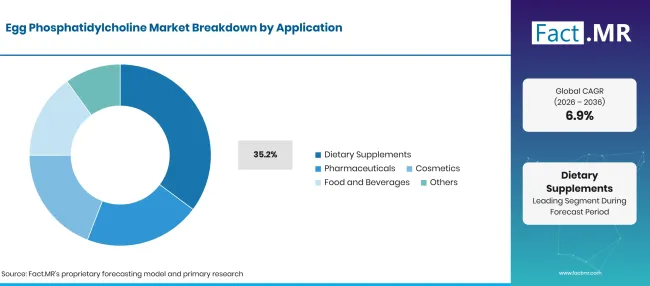
Egg Phosphatidylcholine Market Breakdown Application | Source: Fact.MR
| Application | Share (2026) |
|---|---|
| Dietary Supplements (Leading segment) | 35.2% |
| Other segments combined | 64.8% |
| Total | 100.0% |
Source: Fact.MR analysis. Updated Nov 11, 2026
Dietary supplement formulas provide one route for egg-derived phosphatidylcholine. Ingredient purchasers examine label wording and the suitability of egg-origin materials for their target customers. Pharmaceutical uses demand a different approval standard, especially for emulsions used in parenteral delivery. Lipoid identifies purified egg phospholipids as constituents of fat emulsions for parenteral nutrition and drug-containing pharmaceutical formulations.
How does Sales Channel shape demand?
Online Retail leads with 34.1% of the market in 2026.
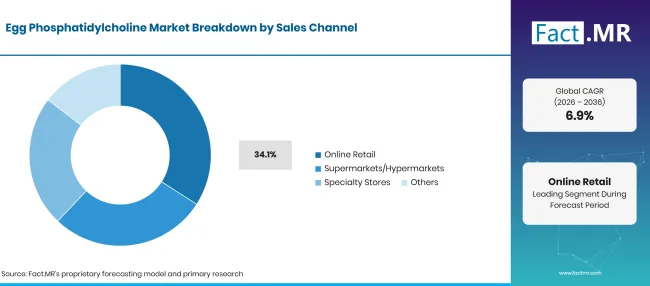
Egg Phosphatidylcholine Market Breakdown Sales Channel | Source: Fact.MR
| Sales Channel | Share (2026) |
|---|---|
| Online Retail (Leading segment) | 34.1% |
| Other segments combined | 65.9% |
| Total | 100.0% |
Source: Fact.MR analysis. Updated Nov 11, 2026
Online retail supports consumer access to finished phospholipid supplements and product information. It should not be confused with the contract supply of qualified ingredients to drug manufacturers. Eurostat reported that 78% of EU internet users bought or ordered goods or services online in 2025.
What shapes the End-User segment?
Individual Consumers represent 63.2% of 2026 sales.
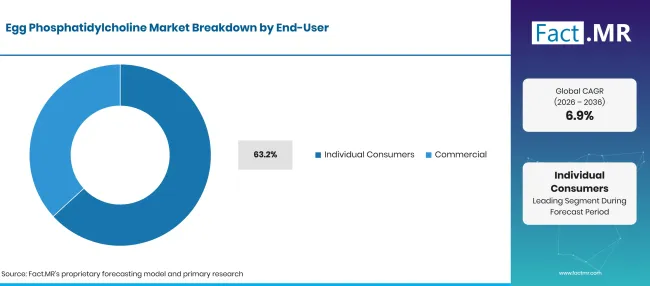
Egg Phosphatidylcholine Market Breakdown End User | Source: Fact.MR
| End-User | Share (2026) |
|---|---|
| Individual Consumers (Leading segment) | 63.2% |
| Other segments combined | 36.8% |
| Total | 100.0% |
Source: Fact.MR analysis. Updated Nov 11, 2026
Individual consumers buy finished products that contain egg phosphatidylcholine, often with only limited visibility into ingredient grades. Commercial end users purchase the material for manufacturing and review technical data more closely. Higher-purity material is usually evaluated against precise functional needs, while mass retail depends on a clear product label and convenient availability.
What is accelerating Egg Phosphatidylcholine Market adoption, and what is holding it back?
Demand depends on ingredient composition and product suitability. Buying decisions reflect egg input costs and labeling rules. Specialist grades create opportunities for formulation teams, while technical testing shapes supplier choice.
Drivers Impact Analysis
| Driver | (~) % IMPACT ON CAGR | Geographic Relevance | Impact Timeline |
|---|---|---|---|
| Pharmaceutical use of defined egg PC grades | +1.2% | Europe, North America | Medium term |
| Supplement formulation and ingredient disclosure | +0.9% | Global | Medium term |
| Raw material access and egg-yolk processing | +0.7% | Brazil, Europe, Asia | Long term |
| Research and lipid membrane applications | +0.5% | Japan, USA, Europe | Medium term |
| Repeat purchasing through digital retail | +0.3% | North America, Europe | Short term |
Source: Fact.MR analysis. Updated Nov 11, 2026
Opportunity Impact Analysis
| Opportunity | (~) % IMPACT ON CAGR | Geographic Relevance | Impact Timeline |
|---|---|---|---|
| Higher-purity formulation grades | +0.7% | North America, Europe | Long term |
| Clearer allergen and origin communication | +0.5% | Global | Short term |
| Qualified contract supply for specialized uses | +0.4% | Europe, Japan, USA | Medium term |
| Catalog and technical-support expansion | +0.2% | Global | Medium term |
Source: Fact.MR analysis. Updated Nov 11, 2026
Restraints Impact Analysis
| Restraint | (~) % IMPACT ON CAGR | Geographic Relevance | Impact Timeline |
|---|---|---|---|
| Variation in egg feedstock costs | -0.7% | Global | Short term |
| Batch testing and qualification effort | -0.6% | USA, Europe, Japan | Long term |
| Egg allergen and labeling controls | -0.4% | Global | Medium term |
| Competition from other phospholipid sources | -0.3% | Global | Long term |
Source: Fact.MR analysis. Updated Nov 11, 2026
Which countries are scaling the Egg Phosphatidylcholine Market through 2036?
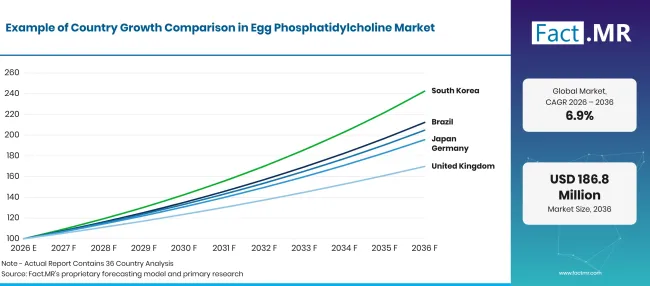
Egg Phosphatidylcholine Market Growth Index | Source: Fact.MR
| Country | CAGR (2026 to 2036) |
|---|---|
| Brazil | 7.8% |
| Japan | 7.4% |
| Germany | 6.9% |
| UK | 5.4% |
| USA | 5.0% |
Source: Fact.MR analysis. Updated Nov 11, 2026
How does Brazil perform?
7.8% CAGR, with ingredient sourcing and supplement compliance shaping demand.
Brazil’s egg-processing industry offers a local base for sourcing yolk-derived ingredients, while specialty phosphatidylcholine still requires controlled extraction and purity testing. Anvisa’s supplement rules influence the wording used on consumer labels and the evidence needed for product claims.
How is Japan developing demand?
7.4% CAGR, shaped by careful grade selection and specialized end uses.
Japanese formulators tend to match phospholipid grade to the precise purpose of each product, especially when research or drug development calls for controlled composition. Japan’s Ministry of Agriculture reported 2,480,663 tonnes of domestic egg production for 2024 in its April 2025 statistical release.
What supports Germany’s adoption?
6.9% CAGR, linked to pharmaceutical-grade supply and documented composition.
Germany’s pharmaceutical ingredient base provides a practical setting for high-purity egg phosphatidylcholine, especially where producers need documented composition for formulation work. Destatis reported in March 2026 that German operations with at least 3,000 laying-hen places produced around 13.7 billion eggs in 2025. A separate Destatis release in March 2026 recorded 5.4 billion imported eggs during 2025, illustrating the role of cross-border egg supply.
How is the UK developing demand?
5.4% CAGR, with input pricing and specialized formulation purchasing in focus.
The UK market serves both supplement brands and specialist formulation teams, creating different requirements for egg-derived phosphatidylcholine. The Department for Environment, Food and Rural Affairs published updated egg-sector statistics in October 2026 covering production and prices through the third quarter of 2026. Online sales support access to finished supplements, whereas direct ingredient sales depend on technical specifications and batch documents.
What is supporting USA adoption?
5.0% CAGR, led by specialized ingredient demand and technical purchasing.
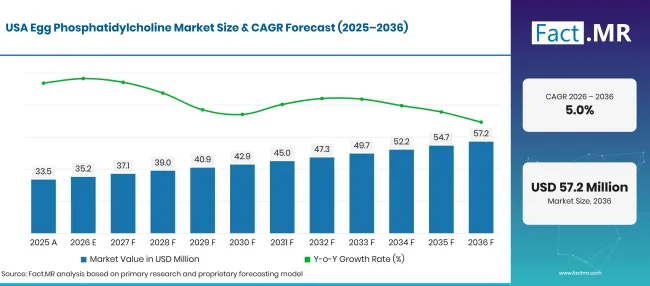
Egg Phosphatidylcholine Market Forecast Usa 1 | Source: Fact.MR
US demand draws on pharmaceutical development and specialist research as well as consumer supplement products. The US Department of Agriculture reported in 2026 that the value of egg production reached USD 31.5 billion in 2025. Egg-origin labeling and the handling needs of high-purity ingredients influence buying decisions. USDA also show 105 billion eggs were produced in 2025, indicating the scale of the broader supply chain.
Who leads the Egg Phosphatidylcholine Market?
The Egg Phosphatidylcholine Market includes specialist phospholipid manufacturers alongside wider lecithin and food-ingredient businesses. Their positions differ according to the purity they offer and the applications their products are designed to serve.
Lipoid GmbH has a clearly identified portfolio of egg-derived phospholipids. Its official product list includes LIPOID E 80, which contains 80% phosphatidylcholine, and LIPOID E PC S, specified at a minimum of 96% phosphatidylcholine. The distinction is commercially useful because manufacturers can choose materials according to the intended level of purification.
Avanti Polar Lipids, part of Croda International, serves research and pharmaceutical development customers with specialist lipids. Its egg phosphatidylcholine catalogue gives laboratory teams access to defined materials for membrane and formulation work. Kewpie Corporation brings experience with egg-derived ingredients and egg processing. American Lecithin Company and Lecico GmbH operate in the broader lecithin supply field, while Cargill Incorporated has wider emulsifier activities.
Which companies are the key providers?
Key companies include Lipoid GmbH; Kewpie Corporation; American Lecithin Company; Cargill, Incorporated; VAV Life Sciences Pvt. Ltd.; Avanti Polar Lipids / Croda International Plc; Phospholipid GmbH; Lecico GmbH.
- Lipoid GmbH
- Kewpie Corporation
- American Lecithin Company
- Cargill, Incorporated
- VAV Life Sciences Pvt. Ltd.
- Avanti Polar Lipids / Croda International Plc
- Phospholipid GmbH
- Lecico GmbH
Bibliography
- Agência Nacional de Vigilância Sanitária. (n.d.). Lembre-se de ler o rótulo com atenção.
- Avanti Research. (n.d.). Phosphatidylcholine.
- Department for Environment, Food & Rural Affairs. (2026, October 29). Quarterly UK statistics about eggs – statistics notice: Data to Q3 2026.
- Eurostat. (2026, June 2). E-commerce statistics for individuals.
- Instituto Brasileiro de Geografia e Estatística. (2026, March 18). Em 2025, Brasil registra a maior produção de leite, couro e ovos da história; abate de bovinos, frangos e suínos também é recorde..
- Lipoid GmbH. (n.d.). Egg phospholipids..
- Ministry of Agriculture, Forestry and Fisheries, Japan. (2025, April 30). 2024 egg production and distribution statistics.
- Statistisches Bundesamt (Destatis). (2026, March 13). Eierproduktion 2025 leicht gestiegen..
- Statistisches Bundesamt (Destatis). (2026, March 31). 69 % der importierten Eier 2025 stammen aus den Niederlanden.
- U.S. Department of Agriculture, Economic Research Service. (2026, September 4). Poultry & Eggs – Sector at a Glance.
- U.S. Department of Agriculture, National Agricultural Statistics Service. (2026, February 17). Chickens and Eggs Annual Summary.
This Report Answers
- The analysis explains how liquid and powder egg phosphatidylcholine grades fit different handling and formulation needs.
- The application review separates dietary supplement demand from pharmaceutical use and other ingredient functions.
- Sales channels distinguish consumer retail from ingredient supply.
- Country analysis covers Brazil, Japan, Germany, the UK and USA.
- Competitive analysis distinguishes egg phosphatidylcholine from lecithin.
What does the Egg Phosphatidylcholine Market cover?
The report covers egg-derived phosphatidylcholine used as a formulated ingredient and in specified applications. It distinguishes egg-origin material from soy and sunflower phosphatidylcholine.
What is included in the scope?
Included products are egg phosphatidylcholine grades used in dietary supplements and pharmaceutical formulations, together with relevant cosmetics and food uses.
Sales through retail channels and commercial purchasing routes are assessed under their stated categories.
What is excluded from the scope?
Ordinary shell eggs and egg products sold only as food are not counted.
Plant-derived phosphatidylcholine, unrelated lipid materials and other finished products without egg phosphatidylcholine fall outside the defined market.
How Was the Analysis Built?
The analysis draws on 120+ sources, 35+ company portfolios, 25+ countries, and more than 20 industry interviews.
- Primary Research: Primary research includes discussions with manufacturers, service providers, technology developers, distributors, end users, and subject-matter experts. These conversations examine purchasing priorities, product adoption, operational challenges, approval requirements, competitive positioning, and the factors that influence wider market acceptance.
- Desk Research: Desk research covers government statistics, regulatory publications, company filings, trade data, technical studies, industry associations, standards, public policy, and other authoritative sources. Every source used in the analysis is documented in the bibliography.
- Market Sizing and Forecasting: Market estimates combine historical performance, demand indicators, pricing and volume trends, segment shares, company participation, country-level growth, adoption patterns, investment activity, and barriers to market expansion.
- Data Validation and Update Cycle: Findings are validated by comparing primary interviews with public data, company activity, regulatory changes, trade patterns, and industry developments. Regular updates review new product launches, capacity changes, partnerships, approvals, and shifts in commercial adoption.
Segmentation
What is the report’s scope and coverage?
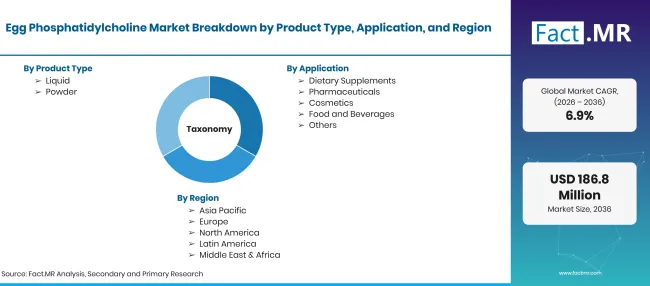
Egg Phosphatidylcholine Market Taxonomy | Source: Fact.MR
| Attribute | Details |
|---|---|
| Quantitative Units | USD million |
| Market Definition | Purified phosphatidylcholine and egg phospholipid fractions sold for use in specified formulations and finished products. |
| Product Type | Liquid; Powder |
| Application | Dietary Supplements; Pharmaceuticals; Cosmetics; Food and Beverages; Others |
| Sales Channel | Online Retail; Supermarkets/Hypermarkets; Specialty Stores; Others |
| End-User | Individual Consumers; Commercial |
| Regions Covered | North America; Latin America; Western Europe; Eastern Europe; East Asia; South Asia & Pacific; Middle East & Africa |
| Countries Covered | Brazil; Japan; Germany; UK; USA |
| Companies Profiled | Lipoid GmbH; Kewpie Corporation; American Lecithin Company; Cargill, Incorporated; VAV Life Sciences Pvt. Ltd.; Avanti Polar Lipids / Croda International Plc; Phospholipid GmbH; Lecico GmbH |
| Forecast Period | 2026 to 2036 |
| Approach | Review of ingredient portfolios, official egg supply statistics, segment figures and country growth outlooks. |
Source: Fact.MR analysis. Updated Nov 11, 2026
How is the market segmented?
-
By Product Type
- Liquid
- Powder
-
By Application
- Dietary Supplements
- Pharmaceuticals
- Cosmetics
- Food and Beverages
- Others
-
By Sales Channel
- Online Retail
- Supermarkets/Hypermarkets
- Specialty Stores
- Others
-
By End-User
- Individual Consumers
- Commercial
-
By Region
- North America
- Latin America
- Western Europe
- Eastern Europe
- East Asia
- South Asia & Pacific
- Middle East & Africa
Frequently Asked Questions
How big is the egg phosphatidylcholine market in 2026?
What is the CAGR of the egg phosphatidylcholine market from 2026 to 2036?
Which product type leads the egg phosphatidylcholine market?
Which end-user group leads the egg phosphatidylcholine market?
Which companies sell documented egg phosphatidylcholine products?
Who worked on this report


Preview the report firsthand - request a free sample
Free SampleGet the brochure for pricing and purchase details
Download PDF