- Market Value (2025): USD 342.8 Mn
- Estimated Value (2026): USD 358.2 Mn
- Forecast Value (2036): USD 556.3 Mn
- CAGR (2026-2036):4.5%
What is the Tert-Butylamine Market forecast to be worth by 2036?
USD 358.2 million in 2026 to USD 556.3 million by 2036 at a 4.5% CAGR.
- As per Fact.MR analysis, the tert-butylamine market was valued at USD 342.8 million in 2025, with demand linked to industrial chemical production and specified intermediate synthesis routes.
- Revenue is projected to reach from USD 358.2 million in 2026 to USD 556.3 million by 2036 as chemical manufacturers continue using this amine in specified synthesis routes.
- The forecast indicates a 4.5% CAGR from 2026 to 2036; supply qualification and customer batch approval remain important commercial conditions.
| Year | Basis | Market Value (USD million) |
|---|---|---|
| 2025 | Actual | 342.8 |
| 2026 | Estimate | 358.2 |
| 2036 | Forecast | 556.3 |
| CAGR 2026 to 2036 | Forecast period | 4.5% |
Source: Fact.MR analysis. Updated Nov 11, 2026
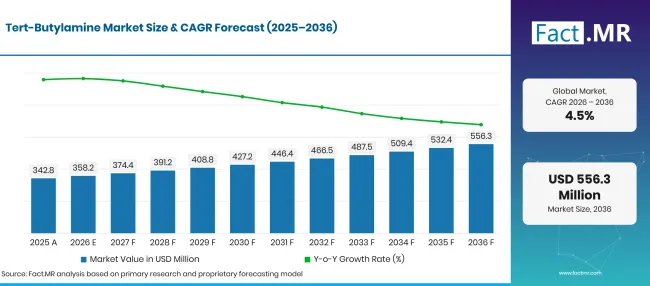
Tert Butylamine Market Forecast Global | Source: Fact.MR
What are the defining numbers behind Tert-Butylamine Market growth?
USD 198.1 million of additional market value by 2036; industrial grade and agrochemicals account for the principal segment positions.
- Demand Drivers in the Market
- Agrochemical intermediate producers use tert-butylamine in selected active-ingredient synthesis routes. BASF identifies terbutylazine manufacture as one application of this amine.
- Pharmaceutical synthesis teams need chemical building blocks with controlled impurity profiles. Tert-butylamine can serve that role in selected reaction sequences.
- Brazilian crop-protection formulation activity creates demand for industrial intermediates used in applicable synthesis pathways.
- Chemical plants seek dependable access to amine inputs because interrupted deliveries can stop a downstream manufacturing campaign.
- Key Segments Analyzed
- By Grade: Industrial Grade is projected to account for 52.3% in 2026, reflecting its use in manufacturing chemical intermediates and rubber accelerators.
- By Application: Agrochemicals lead with 38.5% in 2026, linked to specified crop-protection synthesis routes.
- By End-User Industry: Agriculture represents 39.2% in 2026, as crop-protection supply chains purchase chemical ingredients through industrial manufacturers.
- Analyst Opinion at Fact.MR
- Shambhu Nath Jha, Principal Consultant at Fact.MR, states, “Tert-butylamine is a specification-driven intermediate, so commercial success depends on supplying the right grade for an established synthesis route rather than competing only on volume. Industrial users value dependable deliveries and repeatable assay, while laboratory buyers place greater weight on pack size and documentation. Suppliers that reduce qualification effort can strengthen repeat purchasing.”
- Strategic Implications
- Bulk producers should distinguish stable industrial shipments from small packaged reagent sales. The required quality records and unit economics differ between these channels.
- Rubber chemical manufacturers should test alternate amine supply under their own accelerator process conditions before changing an approved source.
- Agrochemical intermediate producers should track active-ingredient approval changes and match inventory planning to confirmed synthesis requirements.
- Laboratory distributors should maintain clear hazard information and lot-specific documents so research buyers can compare grades before ordering.
Germany is forecast at a 4.8% CAGR through 2036 on its established chemical manufacturing base. Brazil follows at 4.4% as crop-protection manufacturers review synthesis inputs. The USA is projected at 4.0%, supported by a broad chemical production network.
How does the Tert-Butylamine Market break down by segment?
Industrial Grade holds 52.3%; Agrochemicals hold 38.5%; Agriculture holds 39.2% of 2026 market value.
Which Grade dominates?
Industrial Grade accounts for 52.3% of 2026 demand.
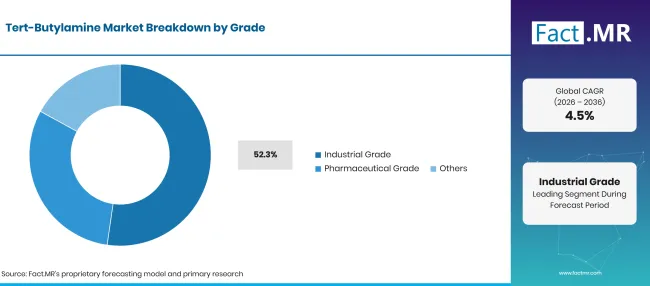
Tert Butylamine Market Breakdown Grade | Source: Fact.MR
| Grade | Share (2026) |
|---|---|
| Industrial Grade (Leading segment) | 52.3% |
| Other segments combined | 47.7% |
| Total | 100.0% |
Source: Fact.MR analysis. Updated Nov 11, 2026
Industrial material is purchased for repeated synthesis campaigns where orders cost per batch and stable assay shape. Tert-butylamine is handled as a flammable amine, so shipping arrangements and plant safety procedures are part of the commercial discussion. Pharmaceutical Grade serves work requiring more demanding specification controls.
What leads the Application segment?
Agrochemicals represent 38.5% of 2026 market value.
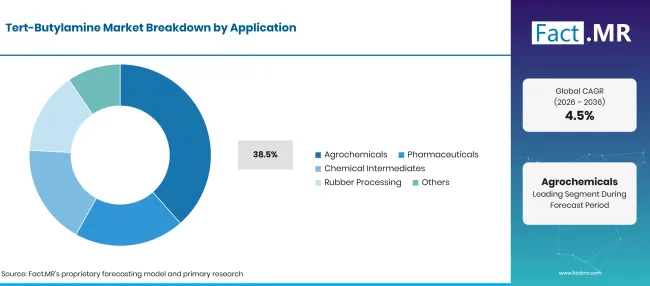
Tert Butylamine Market Breakdown Application | Source: Fact.MR
| Application | Share (2026) |
|---|---|
| Agrochemicals (Leading segment) | 38.5% |
| Other segments combined | 61.5% |
| Total | 100.0% |
Source: Fact.MR analysis. Updated Nov 11, 2026
Agricultural chemical synthesis is one clear industrial use of tert-butylamine. BASF identifies terbutylazine manufacture as a relevant application. Pharmaceutical production uses the compound as a building block in selected routes. Chemical intermediates cover further synthesis work while rubber processing includes TBBS accelerator chemistry.
How does End-User Industry shape sales?
Agriculture accounts for 39.2% of 2026 market value.
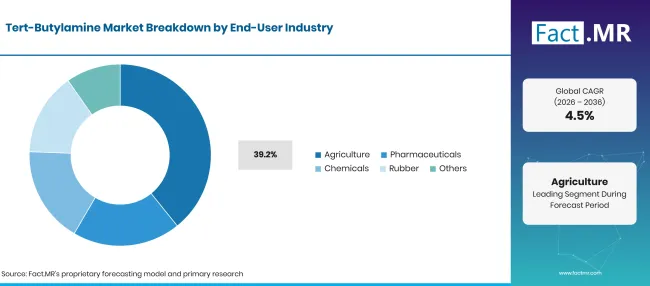
Tert Butylamine Market Breakdown End User Industry | Source: Fact.MR
| End-User Industry | Share (2026) |
|---|---|
| Agriculture (Leading segment) | 39.2% |
| Other segments combined | 60.8% |
| Total | 100.0% |
Source: Fact.MR analysis. Updated Nov 11, 2026
The agriculture category covers chemical manufacturers supplying crop-protection value chains. The end user is normally a chemical plant rather than a farm purchasing tert-butylamine directly. Chemicals companies use the material for broader intermediate work, and rubber suppliers purchase it for accelerator manufacture. Pharmaceutical customers need clearer documentation about lot identity and testing.
Which countries are scaling the Tert-Butylamine Market through 2036?
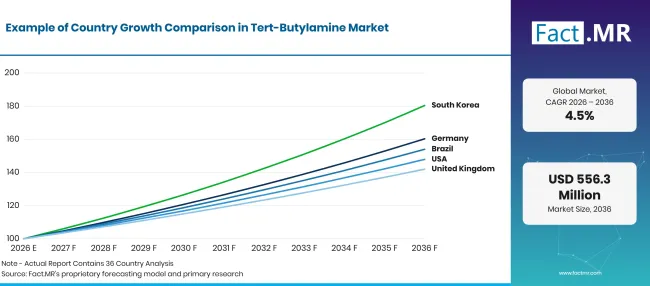
Tert Butylamine Market Growth Index | Source: Fact.MR
| Country | CAGR (2026 to 2036) |
|---|---|
| Germany | 4.8% |
| Brazil | 4.4% |
| USA | 4.0% |
| UK | 3.6% |
| Japan | 3.2% |
Source: Fact.MR analysis. Updated Nov 11, 2026
Why is Germany a key market for tert-butylamine?
4.8% CAGR, tied to chemical intermediates and rubber accelerators.
Germany’s chemical producers evaluate tert-butylamine against the requirements of established manufacturing routes. The country is forecast to achieve a 4.8% CAGR through 2036 as industrial customers retain qualified amine inputs. The German Environment Agency reported approximately EUR 95 billion in basic chemical industry revenue for 2025. Eurostat recorded a 14% German share of EU pesticide sales volume in 2024 in its May 2026 publication.
How is agrochemical synthesis shaping Brazil’s tert-butylamine demand?
4.4% CAGR, led by agrochemical synthesis.
Brazilian agrochemical producers form a relevant downstream customer group for tert-butylamine used in specified synthesis routes. National market revenue is projected to rise at a 4.4% CAGR through 2036. Brazil’s Ministry of Agriculture and Livestock reported 912 pesticide and bioinput registrations in 2025, including 323 technical products for industrial use and 162 bioinputs. This activity describes the wider crop-protection product base and makes route-specific ingredient screening relevant to chemical suppliers. IBGE reported a 6.2% month-on-month decrease in Brazilian chemical production during December 2025 in its February 2026 release.
What is driving tert-butylamine consumption in the USA?
4.0% CAGR, supported by industrial and laboratory uses.
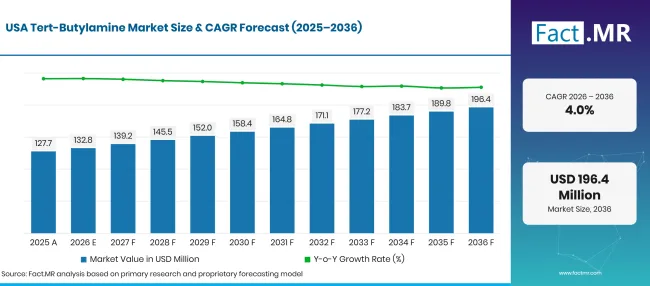
Tert Butylamine Market Forecast Usa | Source: Fact.MR
American laboratory distributors and industrial chemical plants serve different tert-butylamine purchasing needs. The USA is projected to expand at a 4.0% CAGR through 2036. The U.S. Census Bureau reported USD 918.2 billion in chemical manufacturing shipments for 2024 in a September 2026 release. Rubber accelerator producers are expected to assess incoming material against process requirements and existing quality records. The Environmental Protection Agency recorded 220 low-volume exemption grants in fiscal year 2025.
How are specialty chemical applications influencing UK demand?
3.6% CAGR, tied to specialty chemical processing.
UK chemical processors assess tert-butylamine orders against their manufacturing schedules and availability from distributors. The country is projected to achieve a 3.6% CAGR through 2036. The Office for National Statistics reported a 1.5% annual decline in UK chemicals manufacturing output for 2025 in its October 2026 index release. Pharmaceutical intermediates remain an application where purity standards affect supplier selection.
Where is Japan seeing demand for tert-butylamine?
3.2% CAGR, linked to reagent sales and controlled synthesis.
Japanese customers buying tert-butylamine for laboratory synthesis place value on clear specifications and consistent chemical identification. Fact.MR forecasts that Japan is projected to post a 3.2% CAGR through 2036. The Ministry of Economy, Trade and Industry published its 2025 Current Survey of Production yearbook in June 2026. Industrial manufacturers compare material assays before agreeing to a chemical grade for repeat use.
Who leads the Tert-Butylamine Market?
Competition in tert-butylamine depends on the form in which the chemical reaches the customer. Industrial users purchase material for specified production routes, while laboratories require smaller packs with clear specifications and supporting documents.
BASF SE has direct product coverage for tert-butylamine under CAS 75-64-9. Its product information describes the chemical as an input for rubber vulcanization accelerators and identifies uses in agricultural and pharmaceutical synthesis. BASF also offers an associated mass-balance product variant.
Industrial-grade buyers are expected to place weight on repeatable material quality and reliable deliveries. In rubber production chains, tert-butylamine is an upstream ingredient for TBBS accelerator manufacture. In selected agricultural chemical routes, it is an input to intermediate manufacture rather than the final crop-protection product. Suppliers serving these customers are assessed for the chemical itself and their ability to deliver a suitable grade in agreed quantities.
Laboratory chemical distributors compete through product identification and accessible pack sizes. Tokyo Chemical Industry Co., Ltd. Offers tert-butylamine as product B0709 and lists a gas-chromatography purity specification above 98%. Merck KGaA offers tert-butylamine for synthesis under catalog number 8.01546 and identifies an assay of at least 99%. Thermo Fisher Scientific Inc. Supplies tert-butylamine through its laboratory chemical portfolio. Such suppliers are expected to serve testing activity before or alongside selected commercial manufacturing routes.
Which companies are the key providers?
Key companies include BASF SE; Thermo Fisher Scientific Inc.; Tokyo Chemical Industry Co., Ltd.; Merck KGaA; Shandong Yanggu Huatai Chemical Co., Ltd.; Zibo Luhua Hongjin New Material Co., Ltd.; Kanto Chemical Co., Inc.; Junsei Chemical Co., Ltd.; Nacalai Tesque, Inc.; Shandong Xianglong New Materials Corp.
- BASF SE
- Thermo Fisher Scientific Inc.
- Tokyo Chemical Industry Co., Ltd.
- Merck KGaA
- Shandong Yanggu Huatai Chemical Co., Ltd.
- Zibo Luhua Hongjin New Material Co., Ltd.
- Kanto Chemical Co., Inc.
- Junsei Chemical Co., Ltd.
- Nacalai Tesque, Inc.
- Shandong Xianglong New Materials Corp.
Bibliography
- Eurostat. (2026, May 13). Sales of pesticides in the EU rebounded by 8% in 2024.
- Instituto Brasileiro de Geografia e Estatística. (2026, February 3). Produção industrial recua 1,2% em dezembro.
- Ministry of Agriculture and Livestock, Brazil. (2026, May 27). Mapa divulga balanço anual de registros de agrotóxicos e bioinsumos em 2025.
- Ministry of Economy, Trade and Industry, Japan. (2026, June 30). Current Survey of Production: 2025 Yearbook.
- Office for National Statistics. (2026, October 15). 20: Manufacture of Chemicals and Chemical Products: CVM: annual & monthly growth.
- Umweltbundesamt. (2026, October 23). Strukturdaten: Chemikalien und chemisch-pharmazeutische Industrie.
- U.S. Census Bureau. (2026, September 3). Census Bureau releases new Annual Integrated Economic Survey data.
- U.S. Environmental Protection Agency. (n.d.). Statistics for the New Chemicals Program under TSCA.
This Report Answers
- The report explains market valuations and forecast growth.
- Segment analysis compares industrial and pharmaceutical grades using their main process applications.
- Application assessment examines agrochemical synthesis and TBBS rubber accelerator production.
- Country analysis covers Germany, Brazil, USA, UK and Japan with individual growth forecasts.
- Competitive coverage distinguishes direct industrial chemical production from packaged laboratory reagent sales.
What does the Tert-Butylamine Market cover?
The market covers the sale of tert-butylamine as a distinct chemical product. It includes industrial supply used for chemical synthesis and packaged grades sold for laboratory work. Revenues are assigned to tert-butylamine itself instead of the value of the final pesticide or rubber accelerator made from it.
The chemical is identified by CAS number 75-64-9 and is also called 2-amino-2-methylpropane. Product grades are assessed by customer specification and intended use. Its applications can cross end-user categories, so purchases are classified by the purpose of the original chemical sale.
What is included in the scope?
Industrial grade includes production-scale material used in approved manufacturing routes. Pharmaceutical grade covers products sold to meet more specific quality needs in pharmaceutical synthesis. Other grades include additional commercial specifications that fall outside these two groups.
Manufacturers and distributors are assessed by their role in the chain. Larger drum shipments and smaller packaged reagent quantities are both relevant where the chemical supplied is tert-butylamine. The channel distinction affects typical order size and the documentation a customer expects.
What is excluded from the scope?
The market excludes sales of finished pesticides and pharmaceutical medicines. Finished rubber accelerators are excluded as end products even if tert-butylamine serves as a raw material during their manufacture. Other amines are excluded because they are separate chemical substances.
How Was the Analysis Built?
The analysis draws on 120+ sources, 35+ company portfolios, 25+ countries, and more than 20 industry interviews.
- Primary Research: Primary research includes discussions with manufacturers, service providers, technology developers, distributors, end users, and subject-matter experts. These conversations examine purchasing priorities, product adoption, operational challenges, approval requirements, competitive positioning, and the factors that influence wider market acceptance.
- Desk Research: Desk research covers government statistics, regulatory publications, company filings, trade data, technical studies, industry associations, standards, public policy, and other authoritative sources. Every source used in the analysis is documented in the bibliography.
- Market Sizing and Forecasting: Market estimates combine historical performance, demand indicators, pricing and volume trends, segment shares, company participation, country-level growth, adoption patterns, investment activity, and barriers to market expansion.
- Data Validation and Update Cycle: Findings are validated by comparing primary interviews with public data, company activity, regulatory changes, trade patterns, and industry developments. Regular updates review new product launches, capacity changes, partnerships, approvals, and shifts in commercial adoption.
What is accelerating Tert-Butylamine Market adoption, and what is holding it back?
Established intermediate synthesis supports purchases; chemical qualification and handling obligations constrain supplier changes. Drivers Impact Analysis
| DRIVERS | (~) % IMPACT ON CAGR | GEOGRAPHIC RELEVANCE | IMPACT TIMELINE |
|---|---|---|---|
| Agrochemical synthesis in approved product routes | +1.2% | Europe, Latin America | Medium term (2–4 years) |
| TBBS rubber accelerator manufacturing | +0.9% | East Asia, Europe | Short term (≤ 2 years) |
| Repeat purchasing from chemical intermediate plants | +0.7% | Global | Short term (≤ 2 years) |
| Specialty synthesis requiring specified amine inputs | +0.5% | North America, Europe | Medium term (2–4 years) |
Source: Fact.MR analysis. Updated Nov 11, 2026
Opportunity Impact Analysis
| OPPORTUNITY | (~) % IMPACT ON CAGR | GEOGRAPHIC RELEVANCE | IMPACT TIMELINE |
|---|---|---|---|
| Longer industrial supply arrangements | +0.6% | Europe, East Asia | Medium term (2–4 years) |
| Higher-purity laboratory and synthesis packs | +0.4% | North America, East Asia | Medium term (2–4 years) |
| Broader distribution and batch traceability | +0.3% | Global | Long term (≥ 4 years) |
Source: Fact.MR analysis. Updated Nov 11, 2026
Restraints Impact Analysis
| RESTRAINTS | (~) % IMPACT ON CAGR | GEOGRAPHIC RELEVANCE | IMPACT TIMELINE |
|---|---|---|---|
| Feedstock and operating-cost changes | -0.6% | Global | Short term (≤ 2 years) |
| Hazardous chemical handling requirements | -0.5% | Global | Short term (≤ 2 years) |
| Downstream validation before supplier replacement | -0.4% | Europe, North America, Japan | Medium term (2–4 years) |
Source: Fact.MR analysis. Updated Nov 11, 2026
Segmentation
What is the report’s scope and coverage?
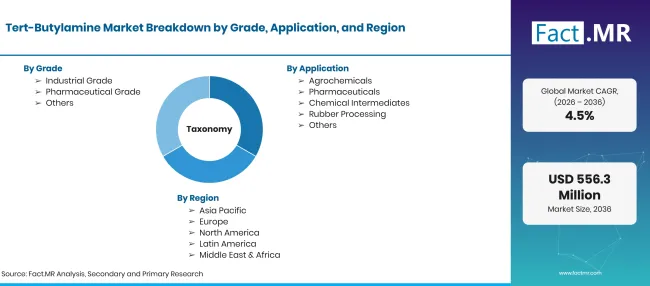
Tert Butylamine Market Taxonomy | Source: Fact.MR
| Attribute | Details |
|---|---|
| Quantitative Units | USD million |
| Market Definition | Tert-butylamine (CAS 75-64-9) sold as an intermediate for rubber accelerators, selected agrochemical and pharmaceutical synthesis, and laboratory chemical applications. |
| Grade | Industrial Grade; Pharmaceutical Grade; Others |
| Application | Agrochemicals; Pharmaceuticals; Chemical Intermediates; Rubber Processing; Others |
| End-User Industry | Agriculture; Pharmaceuticals; Chemicals; Rubber; Others |
| Regions Covered | North America; Latin America; Western Europe; Eastern Europe; East Asia; South Asia & Pacific; Middle East & Africa |
| Countries Covered | Germany; Brazil; USA; UK; Japan |
| Companies Profiled | BASF SE; Thermo Fisher Scientific Inc.; Tokyo Chemical Industry Co., Ltd.; Merck KGaA; Shandong Yanggu Huatai Chemical Co., Ltd.; Zibo Luhua Hongjin New Material Co., Ltd.; Kanto Chemical Co., Inc.; Junsei Chemical Co., Ltd.; Nacalai Tesque, Inc.; Shandong Xianglong New Materials Corp. |
| Forecast Period | 2026 to 2036 |
| Approach | Market value assessment with fixed segment and country forecasts, end-use mapping, official industry data and supplier product-catalog review. |
Source: Fact.MR analysis. Updated Nov 11, 2026
How is the market segmented?
-
By Grade
- Industrial Grade
- Pharmaceutical Grade
- Others
-
By Application
- Agrochemicals
- Pharmaceuticals
- Chemical Intermediates
- Rubber Processing
- Others
-
By End-User Industry
- Agriculture
- Pharmaceuticals
- Chemicals
- Rubber
- Others
-
By Region
- North America
- Latin America
- Western Europe
- Eastern Europe
- East Asia
- South Asia & Pacific
- Middle East & Africa
Frequently Asked Questions
How big is the Tert-Butylamine Market in 2026?
What is the CAGR of the Tert-Butylamine Market from 2026 to 2036?
Which grade leads the Tert-Butylamine Market?
Which application leads the Tert-Butylamine Market?
Who are the leading companies in the Tert-Butylamine Market?
Who worked on this report


Preview the report firsthand - request a free sample
Free SampleGet the brochure for pricing and purchase details
Download PDF