Elastic Palletizing Bands Market (2026 - 2036)
Elastic Palletizing Bands Market Size and Share Forecast Outlook 2026 to 2036
Core Findings
Elastic Palletizing Bands Market Forecast and Outlook 2026 to 2036
The period opens with the elastic palletizing bands market at USD 860.0 million in 2026 and closes near USD 2,971.0 million by 2036, which reflects a 13.20% CAGR.
Elastic Palletizing Bands Market Key Takeaways
- Elastic Palletizing Bands Market Value (2026): USD 860.0 million
- Elastic Palletizing Bands Market Forecast Value (2036): USD 2,971.0 million
- Elastic Palletizing Bands Market Forecast CAGR 2026 to 2036: 13.2%
- Leading Load Class in Elastic Palletizing Bands Market: Light loads (less than 300 kg)
- Key Growth Regions in Elastic Palletizing Bands Market: Asia Pacific, North America, Europe, Latin America, Middle East & Africa
- Top Players in Elastic Palletizing Bands Market: Signode Industrial Group, Avery Dennison Corporation, Bandall B.V., ATS-Tanner AG
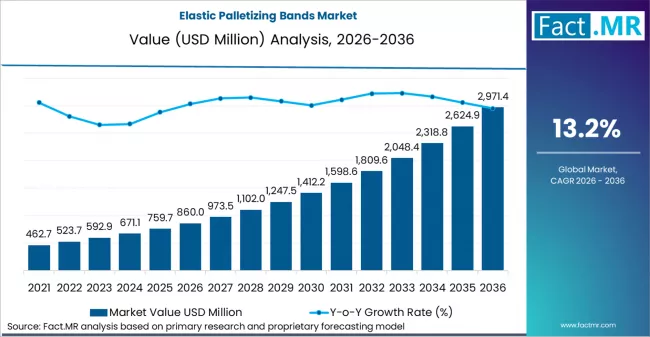
This category serves warehouse and distribution operations that need fast, repeatable load securing without the waste and handling issues linked to stretch film. Bands are selected for tension stability, recovery after repeated use, and consistent grip across mixed carton sizes.
Operations teams favor solutions that reduce wrapping time and simplify pallet breakdown at receiving points. Once a band type is approved, it often becomes a standard item across multiple facilities since work instructions, training, and storage systems align around it. Buying decisions focus on durability per cycle, failure rates, and ease of handling rather than on unit price alone. Growth follows automation projects, higher throughput requirements, and wider use in closed-loop logistics systems.
Elastic Palletizing Bands Market
| Metric | Value |
|---|---|
| Market Value (2026) | USD 860 million |
| Forecast Value (2036) | USD 2,971 million |
| Forecast CAGR 2026 to 2036 | 13.2% |
Category
| Category | Segments |
|---|---|
| Load Class | Light loads (less than 300 kg); Medium loads (300-700 kg); Heavy loads (more than 700 kg); Export pallets |
| Band Width Class | Narrow (less than 50 mm); Medium (50-100 mm); Wide (more than 100 mm) |
| Polymer Type | LDPE; HDPE; PP blends |
| Region | North America; Europe; Asia Pacific; Latin America; Middle East & Africa |
Segmental Analysis
Why Do Light Load Applications Generate The Highest Demand For Elastic Palletizing Bands?
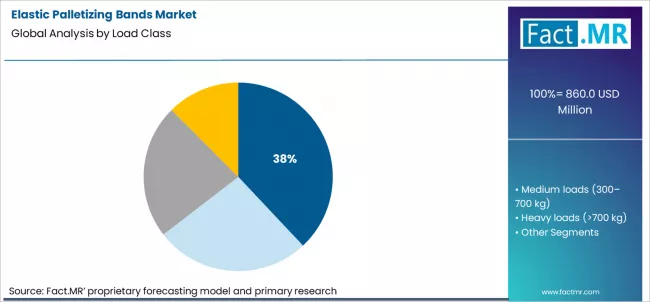
Light loads under 300 kg account for 38% of usage in the elastic palletizing bands market. These shipments appear in high frequency distribution flows such as retail replenishment, parcel logistics, and mixed SKU pallets. Warehouse operations in these channels focus on speed of unitization and rapid breakdown at destination. Elastic bands fit this workflow since application and removal require minimal handling steps. Damage risk in this load class centers on shifting cartons rather than structural collapse, which suits elastic restraint. Inventory planners also stock more bands for light pallets due to higher pallet counts per day. Medium and heavy loads move in lower unit volumes. The sheer number of light pallets in circulation keeps this class as the main demand anchor.
What Band Width Category Is Used Most Often Across Day to Day Pallet Securing Tasks?
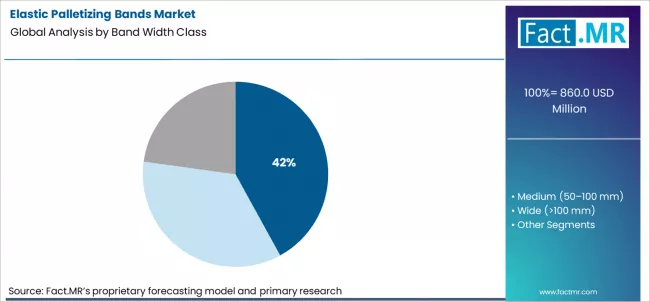
Narrow bands below 50 mm represent 42% of band width class usage in this market. This width suits cartons, trays, and bundled packs that do not require wide contact surfaces for load stability. Operators favor narrow bands since they are easier to stretch, place, and remove during fast paced handling. Storage and dispensing systems in warehouses are also designed around smaller roll sizes. Band consumption in light and mixed loads further supports this preference. Medium and wide bands serve heavier or irregular stacks. Most routine palletizing work still relies on narrow widths that match the scale and handling style of everyday shipments.
What are the Drivers, Restraints, and Key Trends of the Elastic Palletizing Bands Market?
- Drivers: Requirements for secure, adaptable load stabilization during pallet transport and the need to replace rigid strapping solutions with flexible alternatives are supporting use of elastic palletizing bands in warehousing, logistics, and distribution operations.
- Restraint: Price competition from conventional strapping and banding materials, along with limited awareness of elastic band advantages among some logistics planners, restrict broader adoption in cost-sensitive supply chains.
- Trend 1: Product improvements are focused on enhanced tensile strength and consistent elasticity to handle diverse load sizes and weights.
- Trend 2: Expanded availability of pre-cut and color-coded band lengths that facilitate faster application and load identification in multi-SKU operations.
Analysis of the Elastic Palletizing Bands Market by Key Country
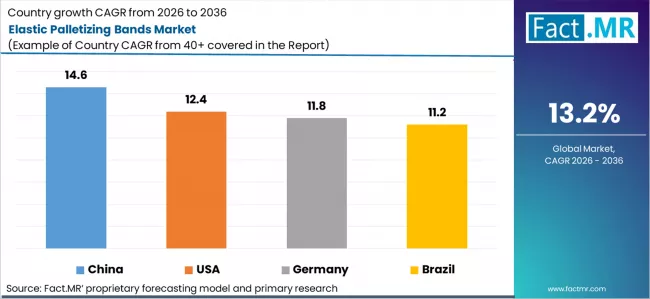
| Country | CAGR 2026 to 2036 |
|---|---|
| USA | 12.4% |
| Germany | 11.8% |
| China | 14.6% |
| Brazil | 11.2% |
The report covers an in-depth analysis of 40+ countries; top-performing countries are highlighted below.
How Are Warehouse Automation and Reusable Packaging Programs in USA Shaping Elastic Palletizing Bands?
Growth in USA runs at about 12.4% per year through 2036. Demand is shaped by higher use of returnable packaging, mixed load palletization, and automation friendly load securing methods. Buyers focus on elasticity, recovery strength, and compatibility with conveyor and robotic handling systems. Purchasing decisions emphasize total cost of use rather than unit price alone. Conversions usually begin in high throughput distribution centers and retail logistics hubs. Distribution relies on industrial packaging suppliers and logistics equipment vendors. Volume growth tracks expansion of e-commerce fulfillment and regional distribution networks rather than changes in shipping regulations.
Why Do Sustainability and Efficiency Targets in Germany Influence Elastic Palletizing Bands?
Growth in Germany runs at about 11.8% per year through 2036. Demand follows strong focus on waste reduction, reusable transport packaging, and standardized logistics processes. Buyers emphasize durability, consistent tension, and long service life. Packaging engineers evaluate performance under repeated cycles and varying load profiles. Purchasing decisions remain conservative and specification driven. Conversions proceed gradually because logistics systems are already optimized. Distribution stays concentrated among industrial packaging and materials handling suppliers. Volume growth tracks warehouse modernization and automation projects rather than rapid changes in shipping practices or short term cost driven substitution.
What Is Driving Faster Adoption of Elastic Palletizing Bands in China?
Growth in China runs at about 14.6% per year through 2036. Demand rises from rapid expansion of automated warehouses, e-commerce logistics, and regional distribution hubs. Operators prioritize speed of application, load stability, and compatibility with automated handling equipment. Product formats favor bands that can be integrated into semi-automatic and fully automatic palletizing lines. Purchasing aligns with large scale logistics infrastructure investments. Local production capacity influences supplier choice. Volume increases follow commissioning of new logistics parks and fulfillment centers. Market development remains tied to logistics modernization rather than manual warehouse operations.
How Are Distribution Network Expansions in Brazil Shaping Elastic Palletizing Bands?
Growth in Brazil runs at about 11.2% per year through 2036. Demand is driven by expansion of organized retail distribution, food and beverage logistics, and regional warehousing. Buyers focus on cost balance, basic performance, and availability. Many operators shift from single use wrapping methods to reusable band systems to reduce material waste. Purchasing decisions emphasize distributor reach and after sales support. Conversions often begin in large distribution centers before spreading to smaller sites. Volume growth tracks network expansion and professionalization of logistics operations rather than changes in packaging regulations or export requirements.
How Do Line Throughput and Load Stability Requirements Shape Competition in the Elastic Palletizing Bands Market?
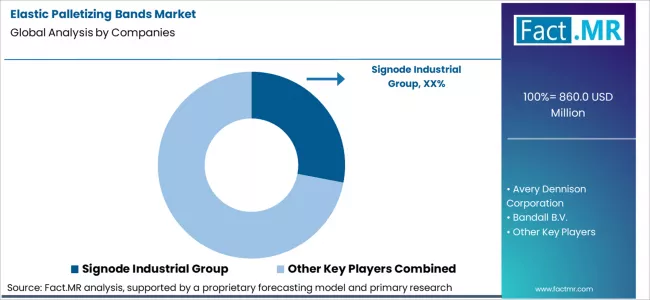
Access to palletizing programs is decided by line speed targets, load geometry, and downstream handling rules before any supplier is considered. Operations teams first define cycle times, band tension ranges, and compatibility with stretch or shrink alternatives. Signode, Bandall, ATS Tanner, and Avery Dennison compete by fitting equipment and consumables into existing pallet cells with minimal changeover.
Engineering groups compare solutions using wrap consistency, recovery behavior after transport, and uptime under continuous duty. Procurement also weighs service coverage, spare parts availability, and training support for maintenance crews. Once a banding system is validated on a line, volumes follow throughput growth and site replication. Supplier changes usually appear after automation upgrades, packaging standard revisions, or consolidation of pallet formats across networks.
Key Players in Elastic Palletizing Bands Market
- Signode Industrial Group
- Avery Dennison Corporation
- Bandall B.V.
- ATS-Tanner AG
Scope of the Report
| Items | Values |
|---|---|
| Quantitative Units (2026) | USD million |
| Load Class | Light loads (<300 kg), medium loads (300-700 kg), heavy loads (>700 kg), export pallets |
| Band Width Class | Narrow (<50 mm), medium (50-100 mm), wide (>100 mm) |
| Polymer Type | LDPE, HDPE, PP blends |
| Regions Covered | Asia Pacific, Europe, North America, Latin America, Middle East & Africa |
| Countries Covered | United States, Canada, Mexico, Germany, United Kingdom, France, Italy, Spain, Nordics, BENELUX, China, Japan, South Korea, India, Australia & New Zealand, ASEAN, Brazil, Chile, Saudi Arabia, Turkey, South Africa, and other regional markets |
| Key Companies Profiled | Signode Industrial Group, Avery Dennison Corporation, Bandall B.V., ATS-Tanner AG |
| Additional Attributes | Dollar sales by load class, band width, and polymer type; performance factors include elasticity, recovery strength, and cycle durability; demand driven by warehouse automation, reusable packaging, and high-throughput distribution operations |
Elastic Palletizing Bands Market Segmentation
-
Load Class :
- Light loads (<300 kg)
- Medium loads (300-700 kg)
- Heavy loads (>700 kg)
- Export pallets
-
Band Width Class :
- Narrow (<50 mm)
- Medium (50-100 mm)
- Wide (>100 mm)
-
Polymer Type :
- LDPE
- HDPE
- PP blends
-
Region :
- Asia Pacific
- China
- Japan
- South Korea
- India
- Australia & New Zealand
- ASEAN
- Rest of Asia Pacific
- Europe
- Germany
- United Kingdom
- France
- Italy
- Spain
- Nordic
- BENELUX
- Rest of Europe
- North America
- United States
- Canada
- Mexico
- Latin America
- Brazil
- Chile
- Rest of Latin America
- Middle East & Africa
- Kingdom of Saudi Arabia
- Other GCC Countries
- Turkey
- South Africa
- Other African Union
- Rest of Middle East & Africa
- Asia Pacific
References
- European Committee for Standardization. (2023). EN 12195-1: Load restraint on road vehicles - Safety - Part 1: Calculation of securing forces. CEN.
- European Commission. (2024). Proposal for a regulation of the European Parliament and of the Council on packaging and packaging waste and repealing Directive 94/62/EC. European Commission.
- European Commission, Joint Research Centre. (2023). The future of packaging in a circular economy: Material use, reuse systems and waste prevention. Publications Office of the European Union.
- International Organization for Standardization. (2023). ISO 8611: Pallets for materials handling - Flat pallets - Testing methods. ISO.
- International Organization for Standardization. (2023). ISO 2248: Packaging - Complete, filled transport packages - Vertical impact test by dropping. ISO.
Table of Content
- Executive Summary
- Global Market Outlook
- Demand to side Trends
- Supply to side Trends
- Technology Roadmap Analysis
- Analysis and Recommendations
- Market Overview
- Market Coverage / Taxonomy
- Market Definition / Scope / Limitations
- Market Background
- Market Dynamics
- Drivers
- Restraints
- Opportunity
- Trends
- Scenario Forecast
- Demand in Optimistic Scenario
- Demand in Likely Scenario
- Demand in Conservative Scenario
- Opportunity Map Analysis
- Product Life Cycle Analysis
- Supply Chain Analysis
- Investment Feasibility Matrix
- Value Chain Analysis
- PESTLE and Porter’s Analysis
- Regulatory Landscape
- Regional Parent Market Outlook
- Production and Consumption Statistics
- Import and Export Statistics
- Market Dynamics
- Global Market Analysis 2021 to 2025 and Forecast, 2026 to 2036
- Historical Market Size Value (USD Million) Analysis, 2021 to 2025
- Current and Future Market Size Value (USD Million) Projections, 2026 to 2036
- Y to o to Y Growth Trend Analysis
- Absolute $ Opportunity Analysis
- Global Market Pricing Analysis 2021 to 2025 and Forecast 2026 to 2036
- Global Market Analysis 2021 to 2025 and Forecast 2026 to 2036, By Load Class
- Introduction / Key Findings
- Historical Market Size Value (USD Million) Analysis By Load Class, 2021 to 2025
- Current and Future Market Size Value (USD Million) Analysis and Forecast By Load Class, 2026 to 2036
- Light loads (<300 kg)
- Medium loads (300-700 kg)
- Heavy loads (>700 kg)
- Export pallets
- Light loads (<300 kg)
- Y to o to Y Growth Trend Analysis By Load Class, 2021 to 2025
- Absolute $ Opportunity Analysis By Load Class, 2026 to 2036
- Global Market Analysis 2021 to 2025 and Forecast 2026 to 2036, By Band Width Class
- Introduction / Key Findings
- Historical Market Size Value (USD Million) Analysis By Band Width Class, 2021 to 2025
- Current and Future Market Size Value (USD Million) Analysis and Forecast By Band Width Class, 2026 to 2036
- Narrow (<50 mm)
- Medium (50-100 mm)
- Wide (>100 mm)
- Narrow (<50 mm)
- Y to o to Y Growth Trend Analysis By Band Width Class, 2021 to 2025
- Absolute $ Opportunity Analysis By Band Width Class, 2026 to 2036
- Global Market Analysis 2021 to 2025 and Forecast 2026 to 2036, By Polymer Type
- Introduction / Key Findings
- Historical Market Size Value (USD Million) Analysis By Polymer Type, 2021 to 2025
- Current and Future Market Size Value (USD Million) Analysis and Forecast By Polymer Type, 2026 to 2036
- LDPE
- HDPE
- PP blends
- LDPE
- Y to o to Y Growth Trend Analysis By Polymer Type, 2021 to 2025
- Absolute $ Opportunity Analysis By Polymer Type, 2026 to 2036
- Global Market Analysis 2021 to 2025 and Forecast 2026 to 2036, By Region
- Introduction
- Historical Market Size Value (USD Million) Analysis By Region, 2021 to 2025
- Current Market Size Value (USD Million) Analysis and Forecast By Region, 2026 to 2036
- North America
- Latin America
- Western Europe
- Eastern Europe
- East Asia
- South Asia and Pacific
- Middle East & Africa
- Market Attractiveness Analysis By Region
- North America Market Analysis 2021 to 2025 and Forecast 2026 to 2036, By Country
- Historical Market Size Value (USD Million) Trend Analysis By Market Taxonomy, 2021 to 2025
- Market Size Value (USD Million) Forecast By Market Taxonomy, 2026 to 2036
- By Country
- USA
- Canada
- Mexico
- By Load Class
- By Band Width Class
- By Polymer Type
- By Country
- Market Attractiveness Analysis
- By Country
- By Load Class
- By Band Width Class
- By Polymer Type
- Key Takeaways
- Latin America Market Analysis 2021 to 2025 and Forecast 2026 to 2036, By Country
- Historical Market Size Value (USD Million) Trend Analysis By Market Taxonomy, 2021 to 2025
- Market Size Value (USD Million) Forecast By Market Taxonomy, 2026 to 2036
- By Country
- Brazil
- Chile
- Rest of Latin America
- By Load Class
- By Band Width Class
- By Polymer Type
- By Country
- Market Attractiveness Analysis
- By Country
- By Load Class
- By Band Width Class
- By Polymer Type
- Key Takeaways
- Western Europe Market Analysis 2021 to 2025 and Forecast 2026 to 2036, By Country
- Historical Market Size Value (USD Million) Trend Analysis By Market Taxonomy, 2021 to 2025
- Market Size Value (USD Million) Forecast By Market Taxonomy, 2026 to 2036
- By Country
- Germany
- UK
- Italy
- Spain
- France
- Nordic
- BENELUX
- Rest of Western Europe
- By Load Class
- By Band Width Class
- By Polymer Type
- By Country
- Market Attractiveness Analysis
- By Country
- By Load Class
- By Band Width Class
- By Polymer Type
- Key Takeaways
- Eastern Europe Market Analysis 2021 to 2025 and Forecast 2026 to 2036, By Country
- Historical Market Size Value (USD Million) Trend Analysis By Market Taxonomy, 2021 to 2025
- Market Size Value (USD Million) Forecast By Market Taxonomy, 2026 to 2036
- By Country
- Russia
- Poland
- Hungary
- Balkan & Baltic
- Rest of Eastern Europe
- By Load Class
- By Band Width Class
- By Polymer Type
- By Country
- Market Attractiveness Analysis
- By Country
- By Load Class
- By Band Width Class
- By Polymer Type
- Key Takeaways
- East Asia Market Analysis 2021 to 2025 and Forecast 2026 to 2036, By Country
- Historical Market Size Value (USD Million) Trend Analysis By Market Taxonomy, 2021 to 2025
- Market Size Value (USD Million) Forecast By Market Taxonomy, 2026 to 2036
- By Country
- China
- Japan
- South Korea
- By Load Class
- By Band Width Class
- By Polymer Type
- By Country
- Market Attractiveness Analysis
- By Country
- By Load Class
- By Band Width Class
- By Polymer Type
- Key Takeaways
- South Asia and Pacific Market Analysis 2021 to 2025 and Forecast 2026 to 2036, By Country
- Historical Market Size Value (USD Million) Trend Analysis By Market Taxonomy, 2021 to 2025
- Market Size Value (USD Million) Forecast By Market Taxonomy, 2026 to 2036
- By Country
- India
- ASEAN
- Australia & New Zealand
- Rest of South Asia and Pacific
- By Load Class
- By Band Width Class
- By Polymer Type
- By Country
- Market Attractiveness Analysis
- By Country
- By Load Class
- By Band Width Class
- By Polymer Type
- Key Takeaways
- Middle East & Africa Market Analysis 2021 to 2025 and Forecast 2026 to 2036, By Country
- Historical Market Size Value (USD Million) Trend Analysis By Market Taxonomy, 2021 to 2025
- Market Size Value (USD Million) Forecast By Market Taxonomy, 2026 to 2036
- By Country
- Kingdom of Saudi Arabia
- Other GCC Countries
- Turkiye
- South Africa
- Other African Union
- Rest of Middle East & Africa
- By Load Class
- By Band Width Class
- By Polymer Type
- By Country
- Market Attractiveness Analysis
- By Country
- By Load Class
- By Band Width Class
- By Polymer Type
- Key Takeaways
- Key Countries Market Analysis
- USA
- Pricing Analysis
- Market Share Analysis, 2025
- By Load Class
- By Band Width Class
- By Polymer Type
- Canada
- Pricing Analysis
- Market Share Analysis, 2025
- By Load Class
- By Band Width Class
- By Polymer Type
- Mexico
- Pricing Analysis
- Market Share Analysis, 2025
- By Load Class
- By Band Width Class
- By Polymer Type
- Brazil
- Pricing Analysis
- Market Share Analysis, 2025
- By Load Class
- By Band Width Class
- By Polymer Type
- Chile
- Pricing Analysis
- Market Share Analysis, 2025
- By Load Class
- By Band Width Class
- By Polymer Type
- Germany
- Pricing Analysis
- Market Share Analysis, 2025
- By Load Class
- By Band Width Class
- By Polymer Type
- UK
- Pricing Analysis
- Market Share Analysis, 2025
- By Load Class
- By Band Width Class
- By Polymer Type
- Italy
- Pricing Analysis
- Market Share Analysis, 2025
- By Load Class
- By Band Width Class
- By Polymer Type
- Spain
- Pricing Analysis
- Market Share Analysis, 2025
- By Load Class
- By Band Width Class
- By Polymer Type
- France
- Pricing Analysis
- Market Share Analysis, 2025
- By Load Class
- By Band Width Class
- By Polymer Type
- India
- Pricing Analysis
- Market Share Analysis, 2025
- By Load Class
- By Band Width Class
- By Polymer Type
- ASEAN
- Pricing Analysis
- Market Share Analysis, 2025
- By Load Class
- By Band Width Class
- By Polymer Type
- Australia & New Zealand
- Pricing Analysis
- Market Share Analysis, 2025
- By Load Class
- By Band Width Class
- By Polymer Type
- China
- Pricing Analysis
- Market Share Analysis, 2025
- By Load Class
- By Band Width Class
- By Polymer Type
- Japan
- Pricing Analysis
- Market Share Analysis, 2025
- By Load Class
- By Band Width Class
- By Polymer Type
- South Korea
- Pricing Analysis
- Market Share Analysis, 2025
- By Load Class
- By Band Width Class
- By Polymer Type
- Russia
- Pricing Analysis
- Market Share Analysis, 2025
- By Load Class
- By Band Width Class
- By Polymer Type
- Poland
- Pricing Analysis
- Market Share Analysis, 2025
- By Load Class
- By Band Width Class
- By Polymer Type
- Hungary
- Pricing Analysis
- Market Share Analysis, 2025
- By Load Class
- By Band Width Class
- By Polymer Type
- Kingdom of Saudi Arabia
- Pricing Analysis
- Market Share Analysis, 2025
- By Load Class
- By Band Width Class
- By Polymer Type
- Turkiye
- Pricing Analysis
- Market Share Analysis, 2025
- By Load Class
- By Band Width Class
- By Polymer Type
- South Africa
- Pricing Analysis
- Market Share Analysis, 2025
- By Load Class
- By Band Width Class
- By Polymer Type
- USA
- Market Structure Analysis
- Competition Dashboard
- Competition Benchmarking
- Market Share Analysis of Top Players
- By Regional
- By Load Class
- By Band Width Class
- By Polymer Type
- Competition Analysis
- Competition Deep Dive
- Signode Industrial Group
- Overview
- Product Portfolio
- Profitability by Market Segments (Product/Age /Sales Channel/Region)
- Sales Footprint
- Strategy Overview
- Marketing Strategy
- Product Strategy
- Channel Strategy
- Avery Dennison Corporation
- Bandall B.V.
- ATS-Tanner AG
- Signode Industrial Group
- Competition Deep Dive
- Assumptions & Acronyms Used
- Research Methodology
List Of Table
- Table 1: Global Market Value (USD Million) Forecast by Region, 2021 to 2036
- Table 2: Global Market Value (USD Million) Forecast by Load Class, 2021 to 2036
- Table 3: Global Market Value (USD Million) Forecast by Band Width Class, 2021 to 2036
- Table 4: Global Market Value (USD Million) Forecast by Polymer Type, 2021 to 2036
- Table 5: North America Market Value (USD Million) Forecast by Country, 2021 to 2036
- Table 6: North America Market Value (USD Million) Forecast by Load Class, 2021 to 2036
- Table 7: North America Market Value (USD Million) Forecast by Band Width Class, 2021 to 2036
- Table 8: North America Market Value (USD Million) Forecast by Polymer Type, 2021 to 2036
- Table 9: Latin America Market Value (USD Million) Forecast by Country, 2021 to 2036
- Table 10: Latin America Market Value (USD Million) Forecast by Load Class, 2021 to 2036
- Table 11: Latin America Market Value (USD Million) Forecast by Band Width Class, 2021 to 2036
- Table 12: Latin America Market Value (USD Million) Forecast by Polymer Type, 2021 to 2036
- Table 13: Western Europe Market Value (USD Million) Forecast by Country, 2021 to 2036
- Table 14: Western Europe Market Value (USD Million) Forecast by Load Class, 2021 to 2036
- Table 15: Western Europe Market Value (USD Million) Forecast by Band Width Class, 2021 to 2036
- Table 16: Western Europe Market Value (USD Million) Forecast by Polymer Type, 2021 to 2036
- Table 17: Eastern Europe Market Value (USD Million) Forecast by Country, 2021 to 2036
- Table 18: Eastern Europe Market Value (USD Million) Forecast by Load Class, 2021 to 2036
- Table 19: Eastern Europe Market Value (USD Million) Forecast by Band Width Class, 2021 to 2036
- Table 20: Eastern Europe Market Value (USD Million) Forecast by Polymer Type, 2021 to 2036
- Table 21: East Asia Market Value (USD Million) Forecast by Country, 2021 to 2036
- Table 22: East Asia Market Value (USD Million) Forecast by Load Class, 2021 to 2036
- Table 23: East Asia Market Value (USD Million) Forecast by Band Width Class, 2021 to 2036
- Table 24: East Asia Market Value (USD Million) Forecast by Polymer Type, 2021 to 2036
- Table 25: South Asia and Pacific Market Value (USD Million) Forecast by Country, 2021 to 2036
- Table 26: South Asia and Pacific Market Value (USD Million) Forecast by Load Class, 2021 to 2036
- Table 27: South Asia and Pacific Market Value (USD Million) Forecast by Band Width Class, 2021 to 2036
- Table 28: South Asia and Pacific Market Value (USD Million) Forecast by Polymer Type, 2021 to 2036
- Table 29: Middle East & Africa Market Value (USD Million) Forecast by Country, 2021 to 2036
- Table 30: Middle East & Africa Market Value (USD Million) Forecast by Load Class, 2021 to 2036
- Table 31: Middle East & Africa Market Value (USD Million) Forecast by Band Width Class, 2021 to 2036
- Table 32: Middle East & Africa Market Value (USD Million) Forecast by Polymer Type, 2021 to 2036
List Of Figures
- Figure 1: Global Market Pricing Analysis
- Figure 2: Global Market Value (USD Million) Forecast 2021 to 2036
- Figure 3: Global Market Value Share and BPS Analysis by Load Class, 2026 and 2036
- Figure 4: Global Market Y to o to Y Growth Comparison by Load Class, 2026 to 2036
- Figure 5: Global Market Attractiveness Analysis by Load Class
- Figure 6: Global Market Value Share and BPS Analysis by Band Width Class, 2026 and 2036
- Figure 7: Global Market Y to o to Y Growth Comparison by Band Width Class, 2026 to 2036
- Figure 8: Global Market Attractiveness Analysis by Band Width Class
- Figure 9: Global Market Value Share and BPS Analysis by Polymer Type, 2026 and 2036
- Figure 10: Global Market Y to o to Y Growth Comparison by Polymer Type, 2026 to 2036
- Figure 11: Global Market Attractiveness Analysis by Polymer Type
- Figure 12: Global Market Value (USD Million) Share and BPS Analysis by Region, 2026 and 2036
- Figure 13: Global Market Y to o to Y Growth Comparison by Region, 2026 to 2036
- Figure 14: Global Market Attractiveness Analysis by Region
- Figure 15: North America Market Incremental Dollar Opportunity, 2026 to 2036
- Figure 16: Latin America Market Incremental Dollar Opportunity, 2026 to 2036
- Figure 17: Western Europe Market Incremental Dollar Opportunity, 2026 to 2036
- Figure 18: Eastern Europe Market Incremental Dollar Opportunity, 2026 to 2036
- Figure 19: East Asia Market Incremental Dollar Opportunity, 2026 to 2036
- Figure 20: South Asia and Pacific Market Incremental Dollar Opportunity, 2026 to 2036
- Figure 21: Middle East & Africa Market Incremental Dollar Opportunity, 2026 to 2036
- Figure 22: North America Market Value Share and BPS Analysis by Country, 2026 and 2036
- Figure 23: North America Market Value Share and BPS Analysis by Load Class, 2026 and 2036
- Figure 24: North America Market Y to o to Y Growth Comparison by Load Class, 2026 to 2036
- Figure 25: North America Market Attractiveness Analysis by Load Class
- Figure 26: North America Market Value Share and BPS Analysis by Band Width Class, 2026 and 2036
- Figure 27: North America Market Y to o to Y Growth Comparison by Band Width Class, 2026 to 2036
- Figure 28: North America Market Attractiveness Analysis by Band Width Class
- Figure 29: North America Market Value Share and BPS Analysis by Polymer Type, 2026 and 2036
- Figure 30: North America Market Y to o to Y Growth Comparison by Polymer Type, 2026 to 2036
- Figure 31: North America Market Attractiveness Analysis by Polymer Type
- Figure 32: Latin America Market Value Share and BPS Analysis by Country, 2026 and 2036
- Figure 33: Latin America Market Value Share and BPS Analysis by Load Class, 2026 and 2036
- Figure 34: Latin America Market Y to o to Y Growth Comparison by Load Class, 2026 to 2036
- Figure 35: Latin America Market Attractiveness Analysis by Load Class
- Figure 36: Latin America Market Value Share and BPS Analysis by Band Width Class, 2026 and 2036
- Figure 37: Latin America Market Y to o to Y Growth Comparison by Band Width Class, 2026 to 2036
- Figure 38: Latin America Market Attractiveness Analysis by Band Width Class
- Figure 39: Latin America Market Value Share and BPS Analysis by Polymer Type, 2026 and 2036
- Figure 40: Latin America Market Y to o to Y Growth Comparison by Polymer Type, 2026 to 2036
- Figure 41: Latin America Market Attractiveness Analysis by Polymer Type
- Figure 42: Western Europe Market Value Share and BPS Analysis by Country, 2026 and 2036
- Figure 43: Western Europe Market Value Share and BPS Analysis by Load Class, 2026 and 2036
- Figure 44: Western Europe Market Y to o to Y Growth Comparison by Load Class, 2026 to 2036
- Figure 45: Western Europe Market Attractiveness Analysis by Load Class
- Figure 46: Western Europe Market Value Share and BPS Analysis by Band Width Class, 2026 and 2036
- Figure 47: Western Europe Market Y to o to Y Growth Comparison by Band Width Class, 2026 to 2036
- Figure 48: Western Europe Market Attractiveness Analysis by Band Width Class
- Figure 49: Western Europe Market Value Share and BPS Analysis by Polymer Type, 2026 and 2036
- Figure 50: Western Europe Market Y to o to Y Growth Comparison by Polymer Type, 2026 to 2036
- Figure 51: Western Europe Market Attractiveness Analysis by Polymer Type
- Figure 52: Eastern Europe Market Value Share and BPS Analysis by Country, 2026 and 2036
- Figure 53: Eastern Europe Market Value Share and BPS Analysis by Load Class, 2026 and 2036
- Figure 54: Eastern Europe Market Y to o to Y Growth Comparison by Load Class, 2026 to 2036
- Figure 55: Eastern Europe Market Attractiveness Analysis by Load Class
- Figure 56: Eastern Europe Market Value Share and BPS Analysis by Band Width Class, 2026 and 2036
- Figure 57: Eastern Europe Market Y to o to Y Growth Comparison by Band Width Class, 2026 to 2036
- Figure 58: Eastern Europe Market Attractiveness Analysis by Band Width Class
- Figure 59: Eastern Europe Market Value Share and BPS Analysis by Polymer Type, 2026 and 2036
- Figure 60: Eastern Europe Market Y to o to Y Growth Comparison by Polymer Type, 2026 to 2036
- Figure 61: Eastern Europe Market Attractiveness Analysis by Polymer Type
- Figure 62: East Asia Market Value Share and BPS Analysis by Country, 2026 and 2036
- Figure 63: East Asia Market Value Share and BPS Analysis by Load Class, 2026 and 2036
- Figure 64: East Asia Market Y to o to Y Growth Comparison by Load Class, 2026 to 2036
- Figure 65: East Asia Market Attractiveness Analysis by Load Class
- Figure 66: East Asia Market Value Share and BPS Analysis by Band Width Class, 2026 and 2036
- Figure 67: East Asia Market Y to o to Y Growth Comparison by Band Width Class, 2026 to 2036
- Figure 68: East Asia Market Attractiveness Analysis by Band Width Class
- Figure 69: East Asia Market Value Share and BPS Analysis by Polymer Type, 2026 and 2036
- Figure 70: East Asia Market Y to o to Y Growth Comparison by Polymer Type, 2026 to 2036
- Figure 71: East Asia Market Attractiveness Analysis by Polymer Type
- Figure 72: South Asia and Pacific Market Value Share and BPS Analysis by Country, 2026 and 2036
- Figure 73: South Asia and Pacific Market Value Share and BPS Analysis by Load Class, 2026 and 2036
- Figure 74: South Asia and Pacific Market Y to o to Y Growth Comparison by Load Class, 2026 to 2036
- Figure 75: South Asia and Pacific Market Attractiveness Analysis by Load Class
- Figure 76: South Asia and Pacific Market Value Share and BPS Analysis by Band Width Class, 2026 and 2036
- Figure 77: South Asia and Pacific Market Y to o to Y Growth Comparison by Band Width Class, 2026 to 2036
- Figure 78: South Asia and Pacific Market Attractiveness Analysis by Band Width Class
- Figure 79: South Asia and Pacific Market Value Share and BPS Analysis by Polymer Type, 2026 and 2036
- Figure 80: South Asia and Pacific Market Y to o to Y Growth Comparison by Polymer Type, 2026 to 2036
- Figure 81: South Asia and Pacific Market Attractiveness Analysis by Polymer Type
- Figure 82: Middle East & Africa Market Value Share and BPS Analysis by Country, 2026 and 2036
- Figure 83: Middle East & Africa Market Value Share and BPS Analysis by Load Class, 2026 and 2036
- Figure 84: Middle East & Africa Market Y to o to Y Growth Comparison by Load Class, 2026 to 2036
- Figure 85: Middle East & Africa Market Attractiveness Analysis by Load Class
- Figure 86: Middle East & Africa Market Value Share and BPS Analysis by Band Width Class, 2026 and 2036
- Figure 87: Middle East & Africa Market Y to o to Y Growth Comparison by Band Width Class, 2026 to 2036
- Figure 88: Middle East & Africa Market Attractiveness Analysis by Band Width Class
- Figure 89: Middle East & Africa Market Value Share and BPS Analysis by Polymer Type, 2026 and 2036
- Figure 90: Middle East & Africa Market Y to o to Y Growth Comparison by Polymer Type, 2026 to 2036
- Figure 91: Middle East & Africa Market Attractiveness Analysis by Polymer Type
- Figure 92: Global Market - Tier Structure Analysis
- Figure 93: Global Market - Company Share Analysis
- FAQs -
How big is the elastic palletizing bands market in 2026?
The global elastic palletizing bands market is estimated to be valued at USD 860.0 million in 2026.
What will be the size of elastic palletizing bands market in 2036?
The market size for the elastic palletizing bands market is projected to reach USD 2,971.4 million by 2036.
How much will be the elastic palletizing bands market growth between 2026 and 2036?
The elastic palletizing bands market is expected to grow at a 13.2% CAGR between 2026 and 2036.
What are the key product types in the elastic palletizing bands market?
The key product types in elastic palletizing bands market are light loads (<300 kg), medium loads (300–700 kg), heavy loads (>700 kg) and export pallets.
Which band width class segment to contribute significant share in the elastic palletizing bands market in 2026?
In terms of band width class, narrow (<50 mm) segment to command 42.0% share in the elastic palletizing bands market in 2026.