- Market Value (2025): USD 116.9 Mn
- Estimated Value (2026): USD 135 Mn
- Forecast Value (2036): USD 570 Mn
- CAGR (2026-2036): 15.5%
What is the electric belt loader batteries market forecast to be worth by 2036?
USD 135 million in 2026 to USD 570 million by 2036, at 15.5% CAGR.
- The electric belt loader batteries market reached USD 116.9 million in 2025. Market value is projected to increase to USD 135 million in 2026 to USD 570 million by 2036.
- The market is forecast to expand at a 15.5% CAGR during the forecast period as airports continue replacing conventional belt loaders with battery-powered equipment.
- Electric belt loader batteries supply power for vehicles used to load passenger baggage and air cargo. Battery performance directly influences equipment uptime and maintenance schedules.
- Modern lithium batteries also reduce charging frequency and improve fleet productivity.
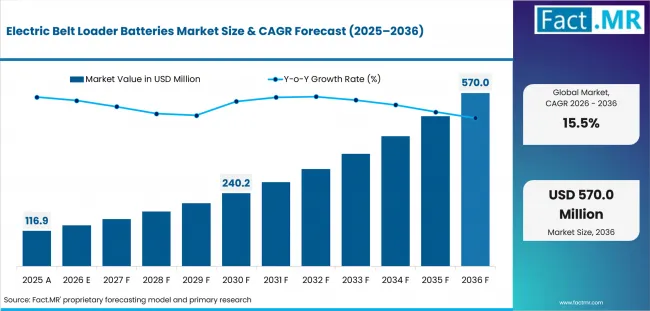
Electric Belt Loader Batteries Market Market Value Analysis | Source: Fact.MR
What are the defining numbers behind electric belt loader batteries market growth?
USD 435 million absolute opportunity by 2036, supported by airport fleet electrification and lithium battery adoption.
- Demand Drivers in the Market
- Airports continue replacing diesel belt loaders with electric equipment.
- Lithium battery adoption improves operating time and fleet productivity.
- Ground handlers seek lower maintenance costs across airport fleets.
- Airline sustainability programs support investment in electric ground operations.
- Key Segments Analyzed
- By Battery Chemistry: Lithium-ion batteries are expected to account for 42.0% share in 2026 because they provide higher energy density and longer operating life.
- By Belt Loader Type: Self-propelled belt loaders are projected to hold 39.0% share in 2026 as they remain the most widely deployed airport configuration.
- By Sales Channel: OEM installed batteries are forecast to represent 46.0% share in 2026 because airports increasingly purchase factory equipped electric vehicles.
- By Buyer Type: Ground handlers are expected to capture 36.0% share in 2026 as they manage large electric airport fleets across daily operations.
- By Geography: The United States is projected to record 16.0% CAGR through 2036 as airport electrification continues accelerating.
- Analyst Opinion at Fact.MR
- Shambhu Nath Jha, Senior Analyst at Fact.MR, states, "Electric belt loader batteries are becoming a strategic investment for airport operators seeking higher fleet utilization and lower operating costs. Companies that improve battery durability and charging efficiency are expected to strengthen their competitive position."
- Strategic Implications
- Battery suppliers should improve compatibility across multiple belt loader platforms.
- Airport operators should include battery replacement planning within fleet electrification strategies.
- GSE manufacturers should standardize battery designs to simplify maintenance.
Demand continues rising because airport operators seek cleaner ground handling operations with lower operating costs. Airlines and ground handlers are investing in electric fleets that deliver reliable daily performance. Battery technology improvements also support longer service life and higher energy efficiency.
The United States is projected to record 16.0% CAGR through 2036 because airport electrification continues expanding. Germany is expected to achieve 15.7% CAGR through low emission airport programs. China is likely to register 15.3% CAGR through airport infrastructure investment. Japan is forecast to grow at 15.0% CAGR through fleet modernization. India is anticipated to record 14.6% CAGR as electric airport equipment adoption continues increasing.
How does the electric belt loader batteries market break down by segment?
Lithium ion batteries lead at 42.0%. Self-propelled belt loaders lead at 39.0%.
Which battery chemistry dominates?
Lithium ion batteries hold 42.0% share in 2026.
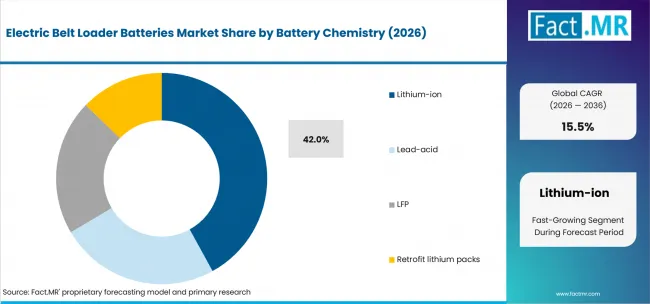
Electric Belt Loader Batteries Market Analysis By Battery Chemistry | Source: Fact.MR
Lithium-ion batteries are expected to account for 42.0% share in 2026 because they provide longer operating time and faster charging than conventional batteries. Airports also benefit from lower maintenance needs. LFP batteries gain attention through improved safety and long cycle life. Retrofit lithium packs support fleet upgrades. Lead acid batteries continue serving older equipment. Mallaghan officially launched the SkyBelt, a fully electric belt loader developed with Delta Air Lines. The battery-powered belt loader began deployment at major U.S. airports including Seattle-Tacoma, Los Angeles, and LaGuardia, with orders extending into 2025.
Which belt loader type dominates?
Self-propelled belt loaders lead with 39.0% share in 2026.
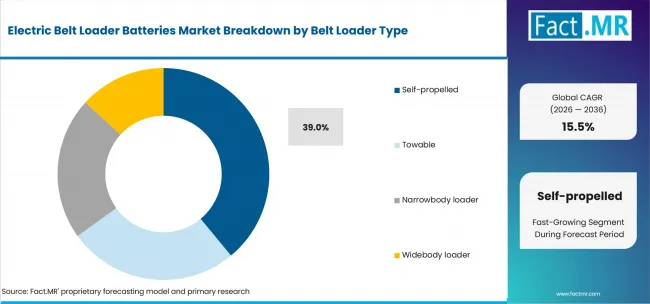
Electric Belt Loader Batteries Market Analysis By Belt Loader Type | Source: Fact.MR
Self-propelled belt loaders are projected to capture 39.0% share in 2026 because they improve operating efficiency across busy airport aprons. Operators also value better vehicle mobility. Towable loaders remain suitable for smaller airports. Narrowbody loaders support domestic aircraft. Widebody loaders strengthen demand across international terminals. ANA Motor Service (ANAMS) announced it had converted a retired diesel airport belt loader into an electric vehicle using an in-house battery, motor, and electric drivetrain. The project demonstrates battery electrification of existing airport belt loaders.
Which sales channel dominates?
OEM installed batteries hold 46.0% share in 2026.
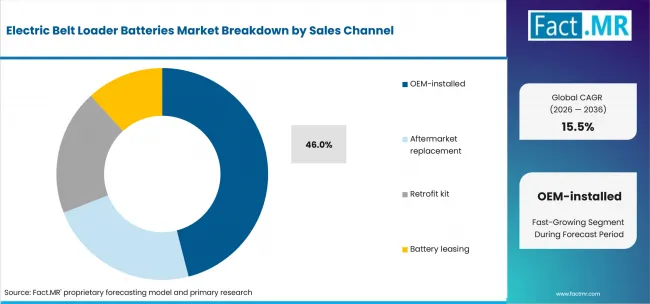
Electric Belt Loader Batteries Market Analysis By Sales Channel | Source: Fact.MR
OEM installed batteries remain the largest sales channel because airports increasingly purchase factory equipped electric belt loaders. The segment is expected to account for 46.0% share in 2026. Aftermarket replacement supports battery renewal. Retrofit kits extend equipment life. Battery leasing improves financial flexibility for fleet operators. Japan Airlines (JAL) announced that it would begin operating EINSA electric belt loaders at Tokyo Haneda Airport from December 17, becoming the first Japanese airline to deploy electric belt loaders in regular service. The electric belt loaders operate using rechargeable battery systems.
Which airport type dominates?
Hub airports lead with 43.0% share in 2026.
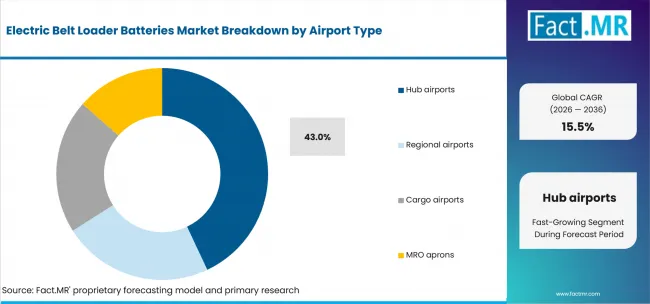
Electric Belt Loader Batteries Market Analysis By Airport Type | Source: Fact.MR
Hub airports are expected to account for 43.0% share in 2026 because they operate large electric ground support fleets throughout the day. Higher aircraft movements create greater battery demand. Regional airports continue electrification projects. Cargo airports strengthen battery replacement demand. MRO aprons support specialized service equipment. Green Cubes Technology introduced a new LiFePO₄ lithium-ion battery designed specifically for airport Ground Support Equipment, including belt loaders, baggage tractors, aircraft tugs, and cargo loaders.
Which buyer type dominates?
Ground handlers lead with 36.0% share in 2026.
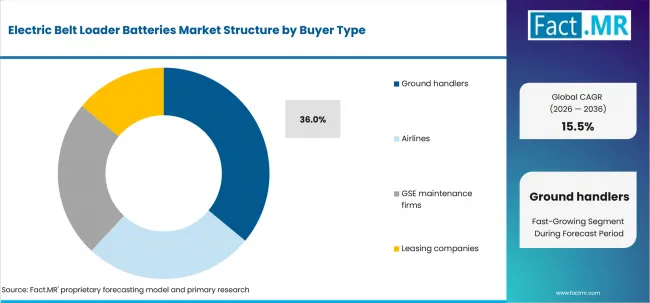
Electric Belt Loader Batteries Market Analysis By Buyer Type | Source: Fact.MR
Ground handlers remain the largest customer group because they operate extensive belt loader fleets across passenger and cargo terminals. The segment is expected to account for 36.0% share in 2026. Airlines continue investing in cleaner airport operations. GSE maintenance firms support battery replacement services. Leasing companies expand electric equipment portfolios. Electrovaya launched multiple lithium-ion battery system products specifically designed for airport Ground Support Equipment (GSE). The battery systems support a wide range of electrified airport vehicles, including belt loaders, baggage tractors, cargo loaders, and airplane tuggers.
What is accelerating electric belt loader battery adoption, and what is holding it back?
Airport electrification supports growth while battery replacement costs remain a challenge.
Drivers Impact Analysis
| DRIVER | (~) % IMPACT ON CAGR | GEOGRAPHIC RELEVANCE | IMPACT TIMELINE |
|---|---|---|---|
| Airport fleet electrification | +1.2% | Global | Medium term (2-4 years) |
| Rising lithium battery adoption | +1.0% | North America, Europe | Medium term (2-4 years) |
| Lower operating costs for electric GSE | +0.8% | Global | Long term (≥4 years) |
| Expansion of airport sustainability programs | +0.6% | Europe, Asia Pacific | Medium term (2-4 years) |
| Growth of battery monitoring systems | +0.4% | Global | Short term (≤2 years) |
Source: Fact.MR analysis. Updated Jul 6, 2026
Airport fleet electrification
Airports continue replacing diesel belt loaders with electric models. Battery demand increases as fleet conversion expands.
Lithium battery adoption
Lithium batteries improve operating time and charging efficiency. Fleet operators also reduce maintenance requirements.
Lower operating costs
Electric belt loaders reduce fuel expenses and routine servicing. Battery-powered equipment supports long term cost savings.
Airport sustainability programs
Many airports continue reducing carbon emissions through electric ground operations. Battery demand grows alongside these programs.
Battery monitoring systems
Digital battery monitoring improves maintenance planning and extends battery service life. Fleet operators benefit from better asset management.
Opportunity Impact Analysis
| OPPORTUNITY | (~) % IMPACT ON CAGR | GEOGRAPHIC RELEVANCE | IMPACT TIMELINE |
|---|---|---|---|
| Battery leasing services | +0.8% | Global | Medium term (2-4 years) |
| Second life battery programs | +0.6% | Europe, North America | Long term (≥4 years) |
| Airport expansion projects | +0.5% | Asia Pacific, Middle East | Medium term (2-4 years) |
| Standardized battery platforms | +0.4% | Global | Long term (≥4 years) |
Source: Fact.MR analysis. Updated Jul 6, 2026
Battery leasing services
Leasing reduces upfront investment for airport operators. Flexible contracts also simplify battery replacement planning.
Second life battery programs
Used batteries can support less demanding energy applications after vehicle service. This improves overall asset value.
Airport expansion projects
New airport terminals increasingly include electric ground support equipment from the planning stage. Battery demand rises with fleet deployment.
Standardized battery platforms
Common battery designs improve compatibility across multiple equipment models. Operators also simplify maintenance and spare inventory.
Restraints Impact Analysis
| RESTRAINT | (~) % IMPACT ON CAGR | GEOGRAPHIC RELEVANCE | IMPACT TIMELINE |
|---|---|---|---|
| High battery replacement costs | -0.7% | Global | Medium term (2-4 years) |
| Limited charging infrastructure | -0.5% | Emerging airports | Medium term (2-4 years) |
| Battery compatibility issues | -0.4% | Mixed equipment fleets | Short term (≤2 years) |
| Supply chain pressure for battery materials | -0.3% | Global | Long term (≥4 years) |
Source: Fact.MR analysis. Updated Jul 6, 2026
High battery replacement costs
Large battery packs require significant investment during replacement cycles. Budget limitations may delay fleet upgrades.
Limited charging infrastructure
Some airports continue expanding charging capacity for electric GSE. Infrastructure limitations can slow fleet adoption.
Battery compatibility issues
Different equipment manufacturers often use different battery formats. This reduces flexibility across mixed airport fleets.
Supply chain pressure
Demand for battery materials continues increasing across many industries. Material availability may influence battery production costs.
Which countries are scaling electric belt loader battery adoption fastest?
United States 16.0%; Germany 15.7%; China 15.3%; Japan 15.0%; India 14.6%.
Based on regional analysis, the electric belt loader batteries market is segmented into North America, Europe, East Asia, South Asia, Middle East and Africa and Latin America.
| Country | CAGR |
|---|---|
| United States | 16.0% |
| Germany | 15.7% |
| China | 15.3% |
| Japan | 15.0% |
| India | 14.6% |
Source: Fact.MR analysis. Updated Jul 6, 2026
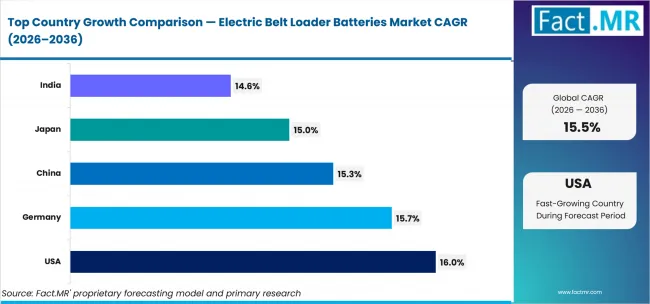
Electric Belt Loader Batteries Market Cagr Analysis By Country | Source: Fact.MR
What supports market growth in the United States?
16.0% CAGR, driven by airport electrification and fleet replacement.
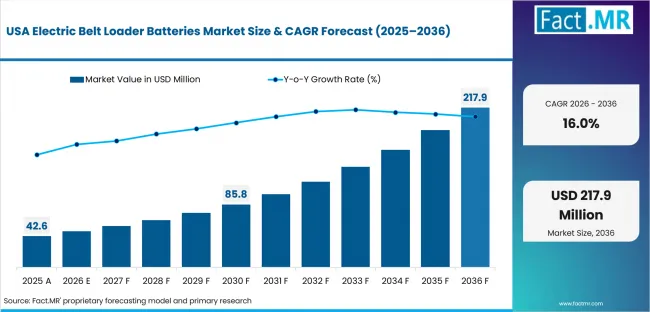
Electric Belt Loader Batteries Market Country Value Analysis | Source: Fact.MR
The United States is projected to record 16.0% CAGR from 2026 to 2036 as airports continue replacing diesel belt loaders with electric models. Ground handling companies are investing in lithium battery systems that improve fleet availability. Airport sustainability targets also encourage wider adoption of electric ground equipment.
Why is Germany strengthening battery demand?
15.7% CAGR, supported by low emission airport operations.
Germany is expected to achieve 15.7% CAGR through 2036 because airport operators continue modernizing ground fleets with electric equipment. Demand for lithium batteries increases as operators seek longer operating time and lower maintenance costs. Fleet replacement programs also support market expansion.
What is driving growth across China?
15.3% CAGR, backed by airport infrastructure investment.
China is forecast to expand at 15.3% CAGR by 2036 as airport construction and terminal upgrades continue supporting electric ground support equipment. Higher aircraft traffic increases battery demand across baggage handling operations. Domestic manufacturing also strengthens equipment availability.
Why is Japan creating new opportunities?
15.0% CAGR, backed by efficient airport operations.
Japan is likely to register 15.0% CAGR through 2036 because airport operators continue improving operational efficiency through electric support vehicles. Battery technology upgrades reduce downtime while supporting dependable daily service. Modern fleet management also strengthens battery replacement demand.
How is India expanding future demand?
14.6% CAGR, supported by airport modernization.
India is expected to record 14.6% CAGR by 2036 as commercial airports continue investing in electric ground handling equipment. Higher passenger traffic increases equipment utilization across major terminals. Continued airport expansion is expected to strengthen long term battery demand.
Who leads the electric belt loader batteries market?
Battery performance and airport equipment expertise shape competitive positioning.
The market includes airport ground support equipment manufacturers and lithium battery suppliers. TLD continues expanding its electric belt loader portfolio through reliable battery-powered equipment designed for commercial airport fleets. Charlatte strengthens its position through electric airport vehicles that improve operational efficiency across passenger terminals.
Textron GSE develops electric ground support equipment that supports airport fleet modernization. Mallaghan continues expanding its electric belt loader range for airlines and ground handling companies. Flux Power strengthens competition through lithium battery systems that improve operating time and battery reliability.
Competition increasingly depends on battery life, charging performance and equipment compatibility. Airport operators prefer suppliers that reduce maintenance while improving fleet availability. Companies offering dependable battery technology with responsive service support are expected to strengthen their market position.
Which companies are the key providers?
TLD and Charlatte are leading providers. Textron GSE remains established participants. Mallaghan and Flux Power complete the competitive landscape.
- TLD
- Charlatte
- Textron GSE
- Mallaghan
- Flux Power
Bibliography
- Mallaghan. (2025, August 28). Double award win for Mallaghan as SkyBelt takes top honor. Mallaghan.
- ANA Holdings Inc. (2024, July 26). Upcycling of old work vehicles: Reducing CO₂ emissions by converting airport belt loaders to EVs. ANA Holdings Inc.
- Green Cubes Technology. (2024, September 12). Green Cubes Technology unveils new Li-ion battery for ground support equipment. Green Cubes Technology.
- Electrovaya Inc. (2025, July 29). Electrovaya launches battery system products for airport ground support equipment (GSE) with first delivery in August to a major OEM supplier. Electrovaya Inc.
- TLD. (2026). NBL-E electric belt loader. TLD.
- Charlatte America. (2026). CBL150E electric intermediate beltloader. Charlatte America.
- Textron GSE. (2026). Belt loaders. Textron GSE.
- Flux Power. (2026). Lithium-ion batteries for airport GSE. Flux Power.
This Report Addresses
- Strategic assessment of batteries used in electric airport belt loaders.
- Segment evaluation covering Lithium-ion Batteries and Self-propelled Belt Loaders.
- Country outlook for the United States, Germany, China, Japan and India.
- Competitive review of TLD, Charlatte, Textron GSE, Mallaghan, and Flux Power.
- Technology assessment covering lithium-ion batteries, LFP batteries, retrofit battery packs and battery monitoring systems.
- Operational assessment covering hub airports, cargo airports, regional airports, MRO aprons and electric baggage handling operations.
- Market estimates supported by airport electrification analysis, battery replacement trends and primary industry interviews.
What does the electric belt loader batteries market cover?
Battery systems developed for electric airport belt loaders.
The market includes lead-acid batteries, lithium-ion batteries, LFP batteries, and retrofit lithium battery packs designed for electric belt loaders. These batteries improve operating efficiency while supporting airport decarbonization initiatives.
The assessment focuses only on batteries used in electric belt loaders. Conventional engine powered belt loaders and general airport charging equipment remain outside the market scope.
What is included in the scope?
Battery solutions supporting electric baggage handling equipment.
The study covers OEM installed batteries, aftermarket replacement batteries, retrofit battery kits and battery leasing programs. It also evaluates applications across self-propelled belt loaders, towable units, narrowbody loaders and widebody loaders.
The market includes deployment across hub airports, regional airports, cargo airports and MRO aprons. Products supplied to ground handlers, airlines, GSE maintenance firms and leasing companies are included.
What is excluded from the scope?
Airport batteries outside electric belt loader applications are excluded.
The assessment excludes aircraft batteries, airport energy storage systems, battery chargers sold independently and batteries used in unrelated ground support equipment. Passenger electric vehicles are also excluded.
How was the analysis built?
112+ sources, 43+ company portfolios, 31+ countries, 25+ interviews.
- Primary Research: Airport operators, GSE manufacturers, battery suppliers and fleet managers contributed commercial and technical insights. Maintenance specialists also supported market validation.
- Desk Research: The study reviewed airport electrification projects, battery technology developments, manufacturer portfolios and aviation sustainability programs. Public procurement announcements strengthened market assessment.
- Market Sizing and Forecasting: Forecasts were prepared using electric belt loader deployment, battery replacement cycles, airport fleet investment and battery technology adoption across major aviation markets.
- Data Validation and Update Cycle: Forecasts were verified through supplier interviews, airport fleet monitoring and expert assessment. Equipment procurement activity and battery replacement trends supported the final market estimates.
Segmentation
What is the report's scope and coverage?
| Attribute | Details |
|---|---|
| Quantitative Units | USD Million in 2026 to USD Million by 2036 at CAGR |
| Market Definition | Battery systems designed for electric airport belt loaders |
| Battery Chemistry | Lead-acid; lithium-ion; LFP; retrofit lithium packs |
| Belt Loader Type | Self-propelled; towable; narrowbody loader; widebody loader |
| Sales Channel | OEM-installed; aftermarket replacement; retrofit kit; battery leasing |
| Airport Type | Hub airports; regional airports; cargo airports; MRO aprons |
| Buyer Type | Ground handlers; airlines; GSE maintenance firms; leasing companies |
| Regions Covered | North America; Europe; East Asia; South Asia; Middle East and Africa; Latin America |
| Countries Covered | United States; Germany; China; Japan; India |
| Key Companies Profiled | TLD; Charlatte; Textron GSE; Mallaghan; Flux Power |
| Forecast Period | 2026 to 2036 |
| Approach | Hybrid top down and bottom up approach using airport electrification, battery replacement cycles, fleet expansion and expert validation |
Source: Fact.MR analysis. Updated Jul 6, 2026
How is the market segmented?
-
By Battery Chemistry:
- Lead-acid
- Lithium-ion
- LFP
- Retrofit lithium packs
-
By Belt Loader Type:
- Self-propelled
- Towable
- Narrowbody loader
- Widebody loader
-
By Sales Channel:
- OEM-installed
- Aftermarket replacement
- Retrofit kit
- Battery leasing
-
By Airport Type:
- Hub airports
- Regional airports
- Cargo airports
- MRO aprons
-
By Buyer Type:
- Ground handlers
- Airlines
- GSE maintenance firms
- Leasing companies
-
Region:
- North America
- United States
- Canada
- Europe
- Germany
- United Kingdom
- France
- Italy
- Spain
- Asia Pacific
- China
- Japan
- South Korea
- India
- Singapore
- Latin America
- Brazil
- Mexico
- Argentina
- Middle East & Africa
- GCC Countries
- South Africa
- Israel
- North America
Frequently Asked Questions
Which battery chemistry leads the Electric Belt Loader Batteries Market?
Which belt loader type leads the Electric Belt Loader Batteries Market?
Which sales channel leads the Electric Belt Loader Batteries Market?
Which airport type leads the Electric Belt Loader Batteries Market?
Which buyer type leads the Electric Belt Loader Batteries Market?
Which region leads the Electric Belt Loader Batteries Market?
Which country expands fastest in the Electric Belt Loader Batteries Market?
Who worked on this report


Preview the report firsthand - request a free sample
Free SampleGet the brochure for pricing and purchase details
Download PDF