- Market Value (2025): USD 16.8 Bn
- Estimated Value (2026): USD 18.9 Bn
- Forecast Value (2036): USD 62.5 Bn
- CAGR (2026-2036): 12.7%
What is the Electric Commercial Vehicle Battery Pack Market forecast to be worth by 2036?
USD 16.8 billion to USD 62.5 billion by 2036 at a 12.7% CAGR.
- The electric commercial vehicle battery pack market reached USD 16.8 billion in 2025.
- Demand is projected to increase from USD 18.9 billion in 2026 to USD 62.5 billion by 2036.12.7% CAGR
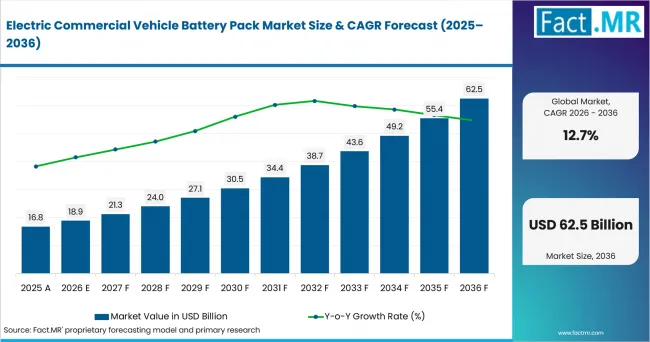
Electric Commercial Vehicle Battery Pack Market Value Analysis | Source: Fact.MR
What are the defining numbers behind Electric Commercial Vehicle Battery Pack Market growth?
An absolute opportunity of USD 43.5 billion is expected between 2026 and 2036.
- Demand Drivers in the Market
- Electric bus and truck adoption is increasing the volume of battery capacity required by commercial fleets. Global electric bus sales exceeded 70,000 units in 2024, rising 30% from the previous year, while electric truck sales surpassed 400,000 units in 2025 and represented 9% of worldwide truck sales. Each vehicle requires a substantially larger battery pack than a passenger car, making commercial fleet electrification a direct demand driver for pack manufacturers.
- Public procurement rules are accelerating the replacement of diesel city buses. EU standards require 90% of newly sold city buses to be zero-emission by 2030 and 100% by 2035. Clean-vehicle procurement targets also require public authorities to purchase defined shares of clean and zero-emission buses, creating longer-term visibility for battery suppliers and vehicle manufacturers.
- LFP chemistry is gaining adoption because commercial fleets place strong emphasis on cost, safety and operating life. LFP represented more than 55% of EV battery deployment worldwide in 2025. The chemistry avoids nickel and cobalt, has lower flammability and typically offers longer cycle life, making it suitable for buses and delivery vehicles that undergo frequent charging.
- Fleet operators evaluate battery packs against route length, charging time and passenger or cargo capacity. Battery-electric bus deployment therefore requires coordination between the storage system, vehicle configuration and charging infrastructure. Packs that can be adapted to different duty cycles help manufacturers serve city buses, delivery vans and heavy trucks without redesigning the full vehicle platform.
- Safety and durability requirements are increasing the technical value of engineered battery packs. Commercial EV packs operate at high voltages and must withstand vibration, temperature changes and collision exposure. U.S. Department of Energy guidance notes that EV packs are tested against conditions including overcharging, short circuits, fire and water immersion, supporting demand for integrated thermal management and battery monitoring.
- Key Segments Analyzed
- Lithium Iron Phosphate Battery Packs account for 46.0% of the Battery Chemistry segment in 2026, supported by lower material costs, long cycle life and suitability for frequently operated fleet vehicles.
- Electric Buses hold 41.0% of the Vehicle Category segment in 2026 as public transport authorities increasingly replace diesel fleets with zero-emission alternatives.
- Public Transportation represents 44.0% of the End-use Sector segment in 2026, reflecting policy-led procurement and predictable route structures that support planned charging.
- Commercial Vehicle OEMs account for 42.0% of the Customer Type segment in 2026 because battery packs must be integrated with vehicle structure, thermal systems and power-management controls during platform development.
- Modular Battery Packs hold 39.0% of the Battery Architecture segment in 2026 as manufacturers can adjust installed capacity for different vehicle sizes and operating ranges.
- Analyst Opinion at Fact.MR
- Shambhu Nath Jha, Senior Consultant at Fact.MR, states, “Demand will increasingly favour battery packs designed around commercial duty cycles rather than adapted from passenger vehicles. Fleet operators assess acquisition cost alongside usable range, charging availability and expected battery life. Suppliers that combine safe pack architecture with modular capacity and dependable service support are likely to secure stronger OEM relationships as the market expands from USD 18.9 billion in 2026 to USD 62.4 billion by 2036.”
- Strategic Implications
- Brand owners should position offerings by application fit rather than generic capability claims. Clearer articulation of the specific use case and the supporting evidence is expected to shorten the buying decision and strengthen pricing power.
- Suppliers can strengthen retention by documenting specification, compliance and performance in simple customer-facing materials. Transparent documentation reduces evaluation friction and supports repeat purchasing, particularly in compliance-heavy regions.
- Distributors should plan channel strategies around the leading segment and the fastest-growing use cases. Aligning inventory, pricing and promotion with the share leaders is expected to improve margin capture.
- Pricing strategy should reflect the value of documented outcomes rather than raw capacity. Differentiating on reliability, compliance and committed service levels is expected to protect margins against lower-cost substitutes.
How does the Electric Commercial Vehicle Battery Pack Market break down by segment?
The market is segmented by Battery Chemistry, Vehicle Category, End-use Sector, Customer Type and Battery Architecture.
Why does Lithium Iron Phosphate Battery Pack lead Battery Chemistry?
Lithium Iron Phosphate Battery Packs are projected to account for a 46.0% share in 2026.
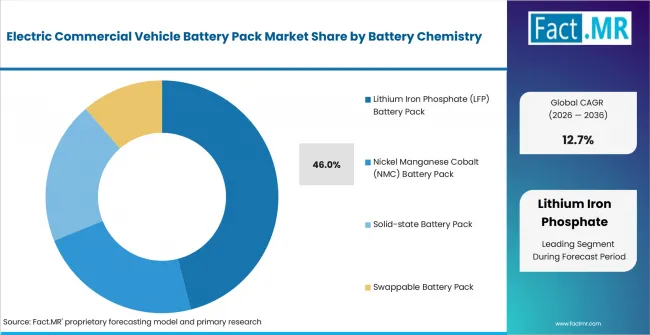
Electric Commercial Vehicle Battery Pack Market Analysis By Battery Chemistry | Source: Fact.MR
LFP leads because commercial fleets place a high value on battery life, safety and cost per operating kilometre. Buses and delivery vehicles may complete intensive daily duty cycles, making resistance to repeated charging more important than maximizing energy density alone. LFP chemistry also avoids nickel and cobalt, reducing exposure to some higher-cost battery materials.
The IEA reported that global EV battery deployment reached 1.2 TWh in 2025, nearly 30% above 2024. LFP accounted for more than half of EV battery deployment during the year, reflecting its growing use in cost-sensitive vehicle applications.
Why do Electric Buses lead Vehicle Category?
Electric Buses are projected to account for a 41.0% share in 2026.
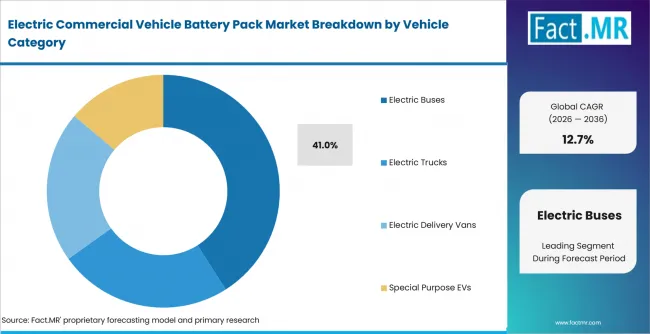
Electric Commercial Vehicle Battery Pack Market Analysis By Vehicle Category | Source: Fact.MR
Electric buses lead because they operate on planned routes and return to depots where charging can be scheduled. This makes route energy requirements easier to estimate than for commercial vehicles that travel across changing locations. Transit authorities also purchase buses in fleets, creating concentrated battery-pack demand when a depot begins electrification.
More than 70,000 electric buses were sold worldwide in 2024. Sales outside China were almost three times their 2020 level, showing that adoption is extending into a broader group of public-transport markets.
Why does Public Transportation lead End-use Sector?
Public Transportation is projected to account for a 44.0% share in 2026.
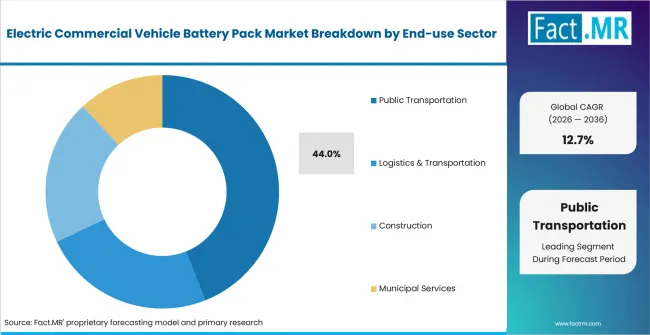
Electric Commercial Vehicle Battery Pack Market Analysis By End Use Sector | Source: Fact.MR
Public transportation leads because bus procurement is strongly influenced by government emissions targets and public purchasing programmes. Transit fleets also operate vehicles for long periods, allowing authorities to assess battery investment against lifetime fuel and maintenance costs.
The EU Clean Vehicles Directive sets national procurement targets for clean vehicles across public purchases and service contracts. By creating minimum demand through public tenders, the policy gives bus manufacturers and battery suppliers greater visibility into future fleet orders.
Why do Commercial Vehicle OEMs lead Customer Type?
Commercial Vehicle OEMs are projected to account for a 42.0% share in 2026.
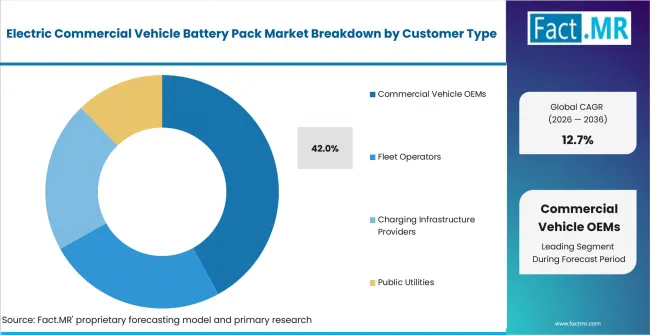
Electric Commercial Vehicle Battery Pack Market Analysis By Customer Type | Source: Fact.MR
Commercial Vehicle OEMs lead because the battery pack must be engineered as part of the vehicle rather than selected as a separate component after assembly. Pack dimensions affect chassis layout and passenger or cargo capacity. Voltage must also align with the drivetrain and charging architecture.
OEMs therefore coordinate cell selection with thermal management, structural protection and battery-management software. U.S. Department of Energy research notes that commercial vehicles may use battery voltages around 700 volts, with higher-voltage architectures being considered to improve charging speed and efficiency.
Why does Modular Battery Pack lead Battery Architecture?
Modular Battery Packs are projected to account for a 39.0% share in 2026.
Electric Commercial Vehicle Battery Pack Market Analysis By Battery Chemistry | Source: Fact.MR
Modular architecture leads because commercial vehicles have widely different energy requirements. A city bus and a long-haul truck cannot use the same pack capacity, while even buses may require different configurations depending on route length and charging frequency.
Standardized modules allow manufacturers to vary total capacity without redesigning the complete pack for every model. They can also simplify maintenance by allowing technicians to diagnose or replace sections of the system. Department of Energy-supported commercial-vehicle research has identified modular pack sizing as a way to match battery capacity with customer duty cycles.
What is accelerating Electric Commercial Vehicle Battery Pack Market adoption, and what is holding it back?
Drivers Impact Analysis
| Driver | (~) % Impact on CAGR | Geographic Relevance | Impact Timeline |
|---|---|---|---|
| Adoption and integration | +1.6% | Global | Short term (≤ 2 years) |
| Regulatory and compliance support | +1.4% | USA, Germany and UK | Short term (≤ 2 years) |
| Channel and access expansion | +1.1% | Global | Medium term (2–4 years) |
| Clear specification and documentation | +0.9% | USA, UK and Canada | Medium term (2–4 years) |
| Cost and efficiency gains | +0.6% | Global | Long term (≥ 4 years) |
Source: Fact.MR analysis. Updated Aug 6, 2026
Opportunity Impact Analysis
| Opportunity | (~) % Impact on CAGR | Geographic Relevance | Impact Timeline |
|---|---|---|---|
| Emerging application expansion | +1.0% | Global | Medium term (2–4 years) |
| Premium and specialist positioning | +0.8% | USA, UK and Germany | Medium term (2–4 years) |
| Channel and partner expansion | +0.7% | Global | Long term (≥ 4 years) |
| Standards and compliance alignment | +0.5% | USA, Canada and Singapore | Long term (≥ 4 years) |
Source: Fact.MR analysis. Updated Aug 6, 2026
Restraints Impact Analysis
| Restraint | (~) % Impact on CAGR | Geographic Relevance | Impact Timeline |
|---|---|---|---|
| Cost and complexity | -1.1% | Global | Short term (≤ 2 years) |
| Specification and compliance checks | -0.9% | USA, UK and Germany | Short term (≤ 2 years) |
| Substitution by lower-cost alternatives | -0.7% | Import-dependent markets | Medium term (2–4 years) |
| Supply chain and pricing pressure | -0.5% | Global | Long term (≥ 4 years) |
Source: Fact.MR analysis. Updated Aug 6, 2026
Which countries are scaling the Electric Commercial Vehicle Battery Pack Market fastest?
- China: China produces nearly 75% of the world’s electric cars, giving it the largest manufacturing ecosystem for battery cells, pack components and vehicle integration. This industrial scale supports lower production costs and faster deployment of battery packs across buses, delivery vehicles and other commercial fleets.
- USA: The U.S. Department of Energy announced USD 68 million for projects developing heavy-duty EV charging sites near ports and distribution hubs. Infrastructure investment at freight-intensive locations supports demand for high-capacity battery packs designed for commercial duty cycles.
- Germany: Germany benefits from EU procurement rules that require public authorities to purchase defined shares of clean buses and trucks. These tenders provide a recurring demand base for battery suppliers serving municipal transport and public-service fleets.
- South Korea: South Korea’s established battery-manufacturing base supports domestic access to cells and pack engineering capabilities. Its automotive and electronics industries provide a foundation for integrating battery systems into buses and commercial vehicle platforms.
- Japan: Japan has begun demonstrations that combine commercial electric vehicles with energy-management systems using vehicle and travel data. Such programmes support battery packs optimized around route planning, charging availability and fleet operations.
- India: The PM-eBus Sewa scheme targets the deployment of 10,000 electric buses across 115 cities and 26 states and union territories. This creates a direct procurement pipeline for large-format battery packs and associated charging infrastructure.
- France: France benefits from EU clean-vehicle procurement requirements and mandatory infrastructure targets for alternative-fuel vehicles. These measures support the gradual electrification of municipal bus fleets and commercial road transport.
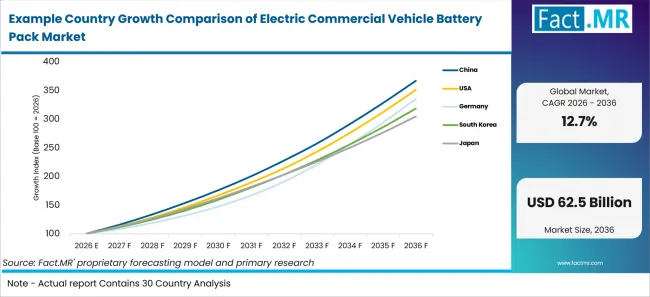
Example Country Growth Comparison Of Electric Commercial Vehicle Battery Pack Market | Source: Fact.MR
| Country | CAGR (2026-2036) |
|---|---|
| China | 13.9% |
| USA | 13.4% |
| Germany | 12.9% |
| South Korea | 12.3% |
| Japan | 11.8% |
| India | 11.2% |
| France | 10.7% |
Source: Fact.MR analysis. Updated Aug 6, 2026
What is driving China’s growth through 2036?
China is forecast to expand at a 13.9% CAGR from 2026 to 2036.
China combines large commercial EV demand with a highly integrated domestic battery supply chain. One in four trucks sold in China during 2025 was electric, while battery-swapping models accounted for around 15% of electric truck sales. Local access to cells and vehicle platforms allows pack manufacturers to scale production around bus and truck duty cycles more quickly.
What is driving USA’s growth through 2036?
The USA is forecast to expand at a 13.4% CAGR from 2026 to 2036.
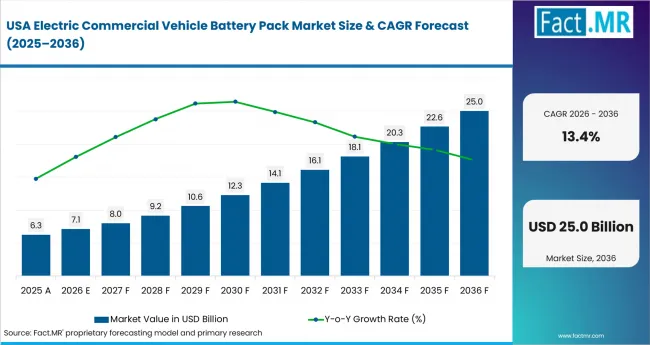
Electric Commercial Vehicle Battery Pack Market Country Value Analysis | Source: Fact.MR
Federal programmes are supporting battery development for heavy-duty vehicles and the charging infrastructure required to operate them. The U.S. Department of Energy made up to USD 88 million available for vehicle technology research, including improved batteries for light- and heavy-duty applications. This support reduces development risk for packs designed around higher power, longer range and demanding commercial use.
What is driving Germany’s growth through 2036?
Germany is forecast to expand at a 12.9% CAGR from 2026 to 2036.
Germany is extending charging planning beyond passenger cars to buses and heavy commercial vehicles. Its Charging Infrastructure Master Plan 2030 covers depot charging, electric HGV facilities and charging for buses and coaches. Better infrastructure visibility gives vehicle manufacturers and fleet operators greater confidence when selecting battery capacity and pack architecture.
What is driving South Korea’s growth through 2036?
South Korea is forecast to expand at a 12.3% CAGR from 2026 to 2036.
Growth is supported by the country’s established battery-cell manufacturing capabilities and its concentration of vehicle and electronics engineering expertise. Domestic suppliers can combine cell development with pack controls and thermal systems, supporting closer cooperation with commercial vehicle manufacturers.
South Korean companies also have experience supplying batteries to global vehicle programmes. This gives them a base from which to develop commercial packs with higher durability and charging requirements than typical passenger-vehicle systems.
What is driving Japan’s growth through 2036?
Japan is forecast to expand at an 11.8% CAGR from 2026 to 2036.
Japan is strengthening the battery and critical-minerals supply chain while expanding charging infrastructure for electric vehicles. Government planning has also set a long-term objective of reducing in-vehicle battery-pack costs to JPY 10,000 per kWh or less, approximately USD 68 per kWh, which would improve the economics of commercial fleet electrification.
What is driving India’s growth through 2036?
India is forecast to expand at an 11.2% CAGR from 2026 to 2036.
Government-backed bus procurement is creating a direct market for large commercial battery packs. The PM e-Drive framework has an outlay of INR 34.35 billion, approximately USD 392 million, and aims to support more than 38,000 electric buses. This scale can encourage domestic pack assembly and longer-term supply agreements between battery companies and bus manufacturers.
What is driving France’s growth through 2036?
France is forecast to expand at a 10.7% CAGR from 2026 to 2036.
France is prioritizing battery-electric technology for urban and short-distance commercial vehicles, where predictable routes make charging easier to plan. National decarbonization work identifies battery-electric vehicles as particularly suitable for lower-tonnage operations and large urban areas because they reduce local emissions and noise.
Who leads the Electric Commercial Vehicle Battery Pack Market?
Contemporary Amperex Technology Co., Limited is positioned as the leading supplier due to its scale in cell production and deep integration with commercial vehicle manufacturers. The IEA reports that CATL supplied around 80% of the batteries used in China’s electric trucks in 2025, demonstrating its strong position in the world’s largest electric-truck market.
BYD combines battery production with commercial vehicle manufacturing, allowing it to coordinate cell chemistry and vehicle design internally. LG Energy Solution, Samsung SDI, Panasonic Energy and SK On compete through cell technology and international manufacturing relationships.
CALB, EVE Energy, Gotion High-Tech and SVOLT add further capacity in China’s battery ecosystem. Their position is strengthened by growing demand for LFP packs and battery systems tailored to buses, trucks and delivery vehicles.
Competition depends on pack cost and cycle life. Safety performance and integration with commercial vehicle platforms also influence supplier selection. Battery producers that can supply cells while supporting thermal management and pack-level engineering are more likely to secure long-term OEM contracts.
Which companies are the key providers?
- Contemporary Amperex Technology Co., Limited
- BYD Company Limited
- LG Energy Solution, Ltd.
- Samsung SDI Co., Ltd.
- Panasonic Energy Co., Ltd.
- SK On Co., Ltd.
- CALB Co., Ltd.
- EVE Energy Co., Ltd.
- Gotion High-Tech Co., Ltd.
- SVOLT Energy Technology Co., Ltd.
Bibliography
- Federal Ministry of Transport, Germany. (2025). Federal Government Charging Infrastructure Master Plan 2030.
- Government of India, Press Information Bureau. (2026). Implementation Status of the National Electric Mobility Mission and Electric Bus Support Schemes.
- International Energy Agency. (2026). Electric Vehicle Batteries. In Global EV Outlook 2026.
- International Energy Agency. (2026). Manufacturing and Trade. In Global EV Outlook 2026.
- International Energy Agency. (2026). Trends in Other Electric Vehicle Modes. In Global EV Outlook 2026.
- Japan Ministry of Economy, Trade and Industry. (2025). Conference on the Battery and Critical Minerals Ecosystem.
- Japan Ministry of Economy, Trade and Industry. (2022). Technology Roadmap for Transition Finance in the Automobile Sector.
- Ministry for Ecological Transition, France. (2023). Roadmap for Decarbonising the Heavy-Vehicle Sector.
- U.S. Department of Energy. (2025). Fiscal Year 2025 Vehicle Technologies Office Program-Wide Funding Opportunity.
This Report Answers
- The report provides strategic intelligence on the Electric Commercial Vehicle Battery Pack Market across the covered segments that shape product positioning.
- Segment analysis covers the leading segments and their share within the 2026 market.
- Country outlook evaluates the highest-growth markets and the wider regional comparison.
- Competitive analysis profiles the named providers in the electric commercial vehicle battery pack space.
- Application assessment covers the covered use cases with attention to channel access and product fit.
What does the Electric Commercial Vehicle Battery Pack Market cover?
The Electric Commercial Vehicle Battery Pack Market covers rechargeable battery packs engineered for electric buses, trucks, delivery vans and other commercial vehicles. The assessment examines battery chemistry, vehicle category, end-use sector, customer type and pack architecture across major regional markets.
What is included in the scope?
The scope includes complete battery packs supplied for battery-electric commercial vehicles and related fleet applications. It covers LFP, NMC, solid-state and swappable battery configurations, together with modular pack designs and integrated battery enclosures.
The analysis includes demand from commercial vehicle manufacturers, fleet operators and public transport authorities. Regional coverage spans North America, Latin America, Europe, East Asia, South Asia and Pacific, and the Middle East and Africa.
What is excluded from the scope?
The scope excludes individual battery cells sold without pack-level integration, passenger-car battery packs and batteries used exclusively for stationary energy storage. Charging stations, electric motors, power converters and standalone battery-management systems are excluded unless supplied as an integral part of the commercial vehicle battery pack.
Conventional lead-acid starter batteries and replacement batteries for internal-combustion vehicles also fall outside the market definition.
How Was the Analysis Built?
The analysis draws on more than 120 sources, over 35 company portfolios and more than 20 industry interviews across at least 25 countries.
- Primary Research: Interviews with battery manufacturers, commercial vehicle OEMs, fleet operators and technology suppliers examine pack selection, vehicle integration and purchasing priorities.
- Desk Research: The review covers government policy, vehicle-registration data, battery production, company disclosures and technical standards. Sources used in the analysis are recorded in the bibliography.
- Market Sizing and Forecasting: Estimates combine commercial EV production, average pack capacity, battery pricing, chemistry mix and country-level adoption. The model also considers charging infrastructure and fleet procurement programmes.
- Data Validation and Update Cycle: Findings are cross-checked against company activity, public data and industry interviews. Updates account for changes in battery prices, vehicle launches, production capacity and fleet-electrification policy.
Segmentation
What is the report's scope and coverage?
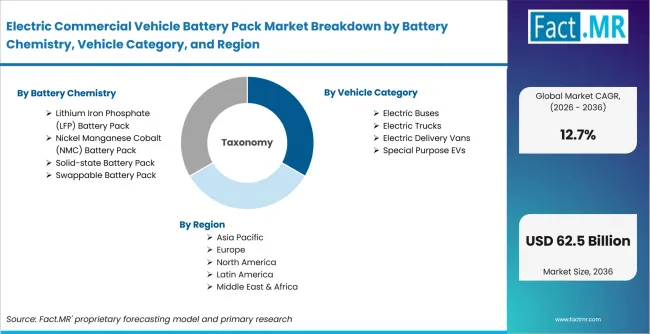
Electric Commercial Vehicle Battery Pack Market Breakdown By Battery Chemistry, Vehicle Category, And Region | Source: Fact.MR
| Attribute | Details |
|---|---|
| Quantitative Units | USD billion in 2026 to USD billion by 2036 at a CAGR |
| Market Definition | Electric Commercial Vehicle Battery Pack products sold across the covered segments and applications |
| Segments Covered | Battery Chemistry; Vehicle Category; End-use Sector; Customer Type; Battery Architecture |
| Regions Covered | North America; Latin America; Europe; East Asia; South Asia and Pacific; Middle East and Africa |
| Countries Covered | China; USA; Germany; South Korea; Japan; India; France |
| Key Companies Profiled | Contemporary Amperex Technology Co., Limited (CATL); BYD Company Limited; LG Energy Solution, Ltd.; Samsung SDI Co., Ltd.; Panasonic Energy Co., Ltd.; and others |
| Forecast Period | 2026 to 2036 |
| Approach | Hybrid top-down and bottom-up approach using segment demand; share; country growth; channel visibility; pricing; and company portfolio review |
Source: Fact.MR analysis. Updated Aug 6, 2026
How is the market segmented?
-
By Battery Chemistry:
- Lithium Iron Phosphate (LFP) Battery Pack
- Prismatic LFP Cells
- Blade Battery Pack
- Nickel Manganese Cobalt (NMC) Battery Pack
- High-Nickel NMC Pack
- NMC Battery Module
- Solid-state Battery Pack
- Sulfide Solid-state Cells
- Oxide Solid-state Cells
- Swappable Battery Pack
- Standardized Battery Pack
- Robotic Swap-compatible Pack
- Lithium Iron Phosphate (LFP) Battery Pack
-
By Vehicle Category:
- Electric Buses
- City Transit Buses
- Intercity Electric Buses
- Electric Trucks
- Light Commercial Vehicles
- Heavy-duty Trucks
- Electric Delivery Vans
- Last-mile Delivery Vans
- Cargo Vans
- Special Purpose EVs
- Electric Garbage Trucks
- Electric Utility Vehicles
- Electric Buses
-
By End-use Sector:
- Public Transportation
- Municipal Transit Authorities
- Public Fleet Operators
- Logistics & Transportation
- E-commerce Logistics
- Cold Chain Logistics
- Construction
- Mining & Construction
- Waste Management
- Municipal Services
- City Administration
- Airport Operations
- Public Transportation
-
By Customer Type:
- Commercial Vehicle OEMs
- Bus Manufacturers
- Truck Manufacturers
- Fleet Operators
- Commercial Fleet Owners
- Leasing Companies
- Charging Infrastructure Providers
- Utility Companies
- Government Agencies
- Public Utilities
- Municipal Corporations
- Airport Authorities
- Commercial Vehicle OEMs
-
By Battery Architecture:
- Modular Battery Pack
- Cell-to-Pack (CTP) Technology
- High-energy Battery Module
- Thermal Management System
- Liquid Cooling Architecture
- Smart Battery Management System
- Integrated Battery Enclosure
- Integrated Cooling Plate
- High-voltage Architecture
- Battery Swapping System
- Quick-release Pack Design
- Removable Battery Module
- Modular Battery Pack
-
By Region:
- North America
- Latin America
- Western Europe
- Eastern Europe
- East Asia
- South Asia and Pacific
- Middle East & Africa
Frequently Asked Questions
Which Battery Chemistry leads the market?
Which Vehicle Category leads the market?
Which End-use Sector leads the market?
Which Customer Type leads the market?
Which Battery Architecture leads the market?
Which country records the highest listed CAGR?
What is the primary driver in this market?
What is the main restraint?
Which companies are included in the market assessment?
Who worked on this report


Preview the report firsthand - request a free sample
Free SampleGet the brochure for pricing and purchase details
Download PDF