- Market Value (2025): USD 2.9 Bn
- Estimated Value (2026): USD 3.2 Bn
- Forecast Value (2036): USD 7.1 Bn
- CAGR (2026-2036): 8.4%
What is the Electronic Circuit Protectors Market forecast to be worth by 2036?
USD 3.2 billion in 2026 to USD 7.1 billion by 2036 at an 8.4% CAGR.
- The Electronic Circuit Protectors Market reached approximately USD 2.9 billion in 2025.
- Demand is projected to increase from USD 3.2 billion in 2026 to USD 7.1 billion by 2036.
- The market is forecast to record an 8.4% CAGR from 2026 to 2036 as circuit protection moves closer to the load and adds reset, diagnostics and programmable fault response.
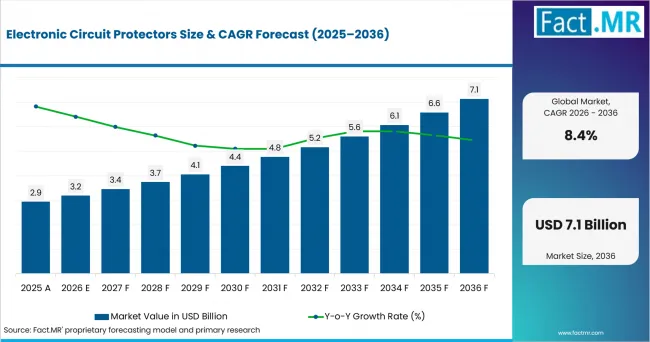
Electronic Circuit Protectors Value Analysis | Source: Fact.MR
What are the defining numbers behind Electronic Circuit Protectors Market growth?
The market is expected to create an absolute opportunity of approximately USD 3.9 billion between 2026 and 2036.
- Demand Drivers in the Market
- Integrated solid-state protection is reducing the number of discrete components required around low-voltage power rails. UL Solutions identifies solid-state overcurrent protectors as load-side protection for power supplies and batteries, while current eFuse designs combine current limiting with overvoltage and inrush protection. This makes protection easier to place directly on compact boards.
- Rising power density in computing equipment increases the value of fast fault isolation at the board and rack level. Lawrence Berkeley National Laboratory's 2026 update estimates that U.S. data centers could account for 11.8% of national electricity use by 2030. Higher-power server and backplane designs increase the need for protection within DC power distribution, where electronic protectors can interrupt a local fault before it pulls down a wider power path.
- Vehicle electrification expands the number of protected electrical rails and power-distribution nodes. The IEA reported more than 20 million electric-car sales in 2025. Protection demand therefore extends from conventional 12 V circuits into 24 V and 48 V auxiliary architectures, with a direct connection to automotive power electronics where current monitoring and selective isolation protect downstream converters and control modules.
- Updated protection standards increase qualification requirements for transient and surge devices. IEC 61643-01:2024 covers surge protective devices connected to circuits up to 1,000 V AC or 1,500 V DC, while IEC 61643-21:2025 addresses telecommunications and signalling networks, including powered lines such as Power over Ethernet. Standards-driven testing makes verified protection performance a purchasing requirement for equipment makers.
- Key Segments Analyzed
- By Protection Type: eFuse / electronic fuse accounts for 31.0% share in 2026 because integrated devices combine fault interruption with programmable current limiting and reset functions.
- By Voltage Domain: 12-48 VDC represents 29.0% share in 2026, supported by industrial control rails and vehicle auxiliary electrical systems that require selective low-voltage protection.
- By Application: Industrial controls hold 26.0% share in 2026 as sensors, PLC I/O, actuators and control-power branches require fault isolation without shutting down the complete machine.
- By Integration: PCB module accounts for 35.0% share in 2026 because board-mounted protection reduces wiring and allows protection to be specified close to sensitive loads.
- Analyst Opinion at Fact.MR
- Shambhu Nath Jha, Principal Consultant, Fact.MR, states, "Electronic circuit protection is moving from a sacrificial component toward an active power-management function. Buyers increasingly want a protector that can limit current, report a fault and restore service without replacing hardware. That shift favors suppliers that can combine predictable trip behavior with compact integration and standards-based qualification."
- Strategic Implications
- Semiconductor protection suppliers should prioritize programmable thresholds and fault telemetry in low-voltage products because board designers increasingly use protection as an active part of power-path control.
- Industrial protection vendors should make selective tripping and channel status easier to commission on 24 V and 48 V control networks. Eaton and Phoenix Contact both position electronic circuit protection around overload handling in DC control circuits, where upstream power supplies may otherwise fold back before a conventional breaker trips.
- At higher current, suppliers have to keep on-resistance and thermal dissipation low enough that the protector does not create excessive voltage loss or board heat. This is especially relevant in vehicle and data-center power paths where protection speed has to coexist with continuous-current efficiency.
- Product teams should plan certification during device design. UL 2367 recognition and IEC 62368-related certification are used on current eFuse products, while IEC 61643 requirements shape surge-device qualification. Pre-qualified components can shorten equipment-level validation for OEMs.
How does the Electronic Circuit Protectors Market break down by segment?
The market is segmented by Protection Type, Voltage Domain, Application and Integration.
Why does eFuse / electronic fuse lead Protection Type?
eFuse / electronic fuse accounts for 31.0% of Protection Type in 2026.
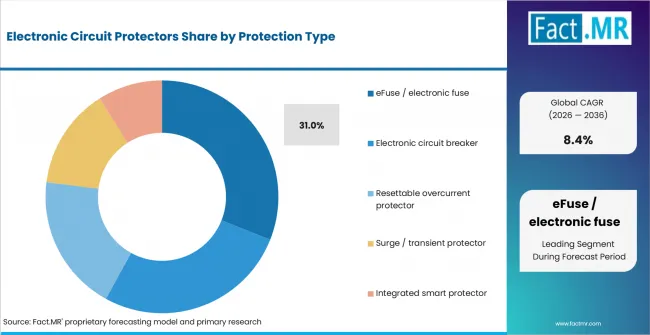
Electronic Circuit Protectors Analysis By Protection Type | Source: Fact.MR
eFuses fit power-entry and load-switch positions where current limiting, inrush control and reset behavior need to sit in one IC or module. Texas Instruments describes eFuses as integrated protection for overcurrent, short-circuit, overvoltage, reverse-current and inrush events, with adjustable thresholds and diagnostics available in current product families. STMicroelectronics similarly positions eFuses as compact integrated replacements for conventional fuses or resettable polymeric devices.
For board designers, consolidation is the practical advantage. One managed power-path device can replace several discrete protection elements, then use latch-off, auto-retry or circuit-breaker behavior according to the load. UL Solutions also recognizes solid-state overcurrent protectors as IC or modular devices used on the load side of power supplies and batteries.
Why does 12-48 VDC lead Voltage Domain?
12-48 VDC accounts for 29.0% of Voltage Domain in 2026.
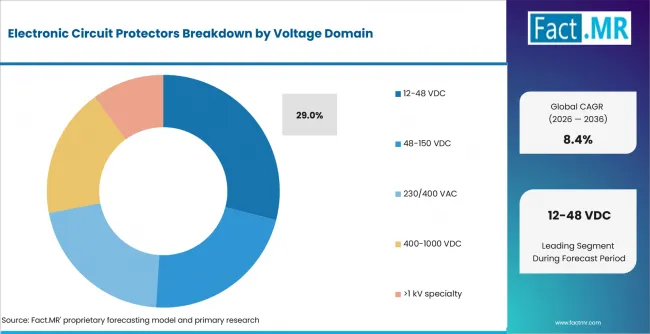
Electronic Circuit Protectors Analysis By Voltage Domain | Source: Fact.MR
The voltage band aligns with two recurring protection environments. Industrial machinery commonly distributes 24 VDC to control electronics, while vehicle architectures use 12 V and increasingly 48 V auxiliary rails. Phoenix Contact offers electronic circuit breakers for 12 V and 24 V DC loads, and Eaton's PXS24 platform is designed specifically for 24 VDC control circuits. STMicroelectronics also markets intelligent fuse protection for 12 V, 24 V and 48 V automotive applications. Related automotive electronics expansion increases the number of electronically protected nodes per platform.
Buyers in this band are sensitive to voltage drop and nuisance trips because the protected load may be a controller, sensor bank or communications module. Electronic protectors can monitor current more precisely than simple thermal devices and isolate a single branch before a power supply collapses across multiple loads.
Why do Industrial controls lead Application?
Industrial controls account for 26.0% of Application in 2026.
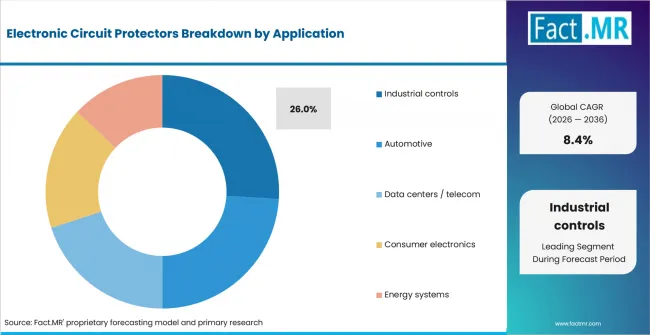
Electronic Circuit Protectors Analysis By Application | Source: Fact.MR
Industrial control cabinets contain many low-voltage branches feeding PLC I/O, sensors, actuators and communications equipment. A short circuit in one branch can pull down a shared DC supply unless the branch is isolated quickly. This makes electronic protection a practical complement to industrial automation where uptime depends on containing local electrical faults.
Electronic breakers also support maintenance workflows because status outputs can identify the affected channel and allow controlled reset. This gives maintenance teams shorter troubleshooting time and selective shutdown alongside the core protection function.
Why does PCB module lead Integration?
PCB module accounts for 35.0% of Integration in 2026.
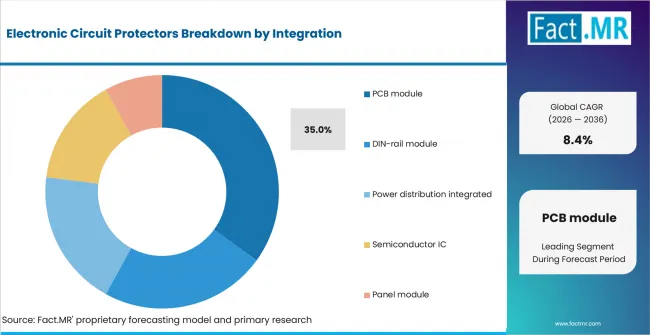
Electronic Circuit Protectors Analysis By Integration | Source: Fact.MR
PCB integration places protection close to semiconductor loads and avoids extra panel wiring. UL Solutions notes that solid-state overcurrent protectors may be integrated circuits intended for printed wiring boards, while Mersen offers direct-mount semiconductor fuses designed to reduce clips and fuseholders. This integration path also follows the broader move toward higher electronic content described in the automotive semiconductor supply chain.
PCB modules also fit high-volume assembly because protection can be installed through standard board-production processes. Equipment makers gain a repeatable electrical layout and can coordinate the protector directly with the downstream semiconductor or connector.
What is accelerating Electronic Circuit Protectors Market adoption, and what is holding it back?
Higher circuit power density is increasing the consequence of a local fault. Low-voltage DC distribution is also spreading across control equipment and electronic platforms. In selected designs, resettable devices with diagnostics are replacing passive protection because operators can isolate the affected branch and restore service without replacing a fuse.
Qualification effort remains a constraint, along with higher unit cost than a simple passive fuse. At higher current, voltage drop and thermal losses can limit where an electronic protector is practical, and designers still have to coordinate it with upstream protection. Surge devices must also meet application-specific test requirements under standards such as IEC 61643. In higher-voltage systems, electronic protectors compete with conventional fuses and surge arresters that already have established qualification practices.
Drivers Impact Analysis
| DRIVER | (~) % IMPACT ON CAGR | GEOGRAPHIC RELEVANCE | IMPACT TIMELINE |
|---|---|---|---|
| Integrated eFuse replacement of discrete protection | +1.6% | North America, Europe, East Asia | Short term (<= 2 years) |
| 24 V and 48 V control-rail protection | +1.3% | Europe, USA, Japan | Medium term (2-4 years) |
| Higher power density in data-center and telecom equipment | +1.1% | USA, UK, South Korea | Medium term (2-4 years) |
| Standards-driven surge and transient qualification | +0.8% | Global | Long term (>= 4 years) |
Opportunity Impact Analysis
| OPPORTUNITY | (~) % IMPACT ON CAGR | GEOGRAPHIC RELEVANCE | IMPACT TIMELINE |
|---|---|---|---|
| 48 V eFuse and hot-swap protection for compute power paths | +0.9% | USA, UK, East Asia | Short term (<= 2 years) |
| Resettable multi-channel protection for control cabinets | +0.7% | Germany, Japan, USA | Medium term (2-4 years) |
| PCB protection with current monitoring and fault telemetry | +0.6% | Global electronics manufacturing | Medium term (2-4 years) |
Restraints Impact Analysis
| RESTRAINT | (~) % IMPACT ON CAGR | GEOGRAPHIC RELEVANCE | IMPACT TIMELINE |
|---|---|---|---|
| Higher unit cost versus passive fuses in simple circuits | -0.5% | Global | Short term (<= 2 years) |
| Thermal and voltage-drop limits at higher continuous current | -0.4% | Data centers, automotive, industrial | Medium term (2-4 years) |
| Coordination and certification effort across protection layers | -0.3% | North America, Europe, East Asia | Long term (>= 4 years) |
Which countries are scaling the Electronic Circuit Protectors Market through 2036?
- USA: Data-center power growth and higher electronic content in vehicles are increasing the number of protected DC rails, backplanes and distribution nodes. Faster fault isolation becomes more valuable as equipment power rises.
- Germany: Dense factory automation and continued renewable-power buildout support electronic protection in industrial controls, power conversion and distributed energy equipment.
- Japan: Semiconductor policy, power-device investment and recurring machinery demand support board-level protectors used in industrial equipment, automotive systems and electronic production.
- South Korea: Semiconductor-cluster infrastructure and advanced packaging investment create demand for protection inside production equipment, power distribution and high-density electronics.
- UK: AI Growth Zones are intended to unlock data-center infrastructure with significant power capacity, supporting demand for electronic protection in compute, telecom and facility-level DC systems.
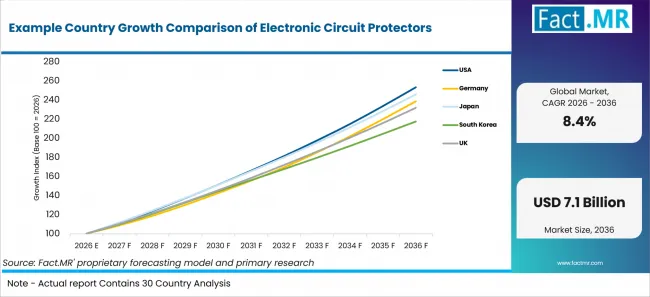
Example Country Growth Comparison Of Electronic Circuit Protectors | Source: Fact.MR
Country CAGR (2026-2036)
| Country | CAGR (2026-2036) |
|---|---|
| USA | 9.8% |
| Germany | 9.1% |
| Japan | 9.4% |
| South Korea | 8.1% |
| UK | 8.8% |
What is driving USA's growth through 2036?
The USA is forecast to grow at a 9.8% CAGR from 2026 to 2036.
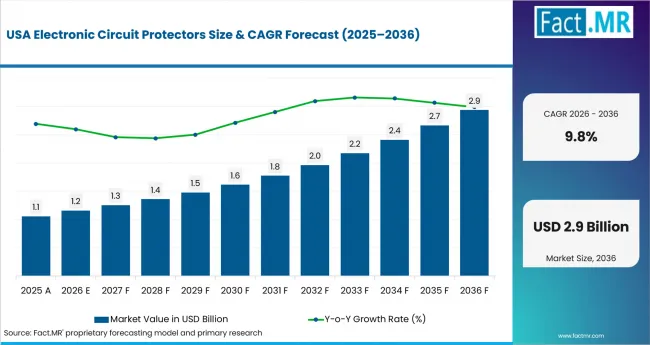
Electronic Circuit Protectors Country Value Analysis | Source: Fact.MR
The U.S. growth mechanism is closely tied to power density in data centers and electronic content in connected equipment. Lawrence Berkeley National Laboratory's 2026 data-center update estimates a reference case of 649 TWh of U.S. data-center electricity use in 2030, with data centers accounting for about 11.8% of national electricity use. Higher rack power increases the consequence of faults at server, backplane and power-distribution levels.
Higher rack power makes fast current limiting and selective fault isolation more valuable at the server, backplane and power-distribution levels. Domestic industrial investment and vehicle electrification create an additional demand path through control systems and protected low-voltage vehicle rails.
What is driving Germany's growth through 2036?
Germany's market is expected to expand at a 9.1% CAGR through 2036.
Germany combines automated manufacturing with rapid change in electrical infrastructure. Germany Trade & Invest reports 278,881 operational industrial robots in the country in 2024 and 449 robots per 10,000 manufacturing employees. These installations depend on distributed control power, sensors and drive electronics that require selective branch protection.
The Bundesnetzagentur reported that renewable installed capacity increased by nearly 21 GW in 2025 to just under 210 GW, including 117 GW of solar. More power-electronic conversion and distributed DC equipment increases the need for overcurrent and transient protection across industrial and energy systems.
What is driving Japan's growth through 2036?
Japan is forecast at a 9.4% CAGR over 2026-2036.
Japan's demand is linked to manufacturing equipment and semiconductor investment. METI's semiconductor strategy emphasizes domestic production infrastructure for specialty semiconductors used in industrial applications and continued development of power-semiconductor technologies. Circuit-protection suppliers benefit because these devices are used around power conversion, control electronics and protected board-level loads.
The Cabinet Office reported that machinery orders received by 280 manufacturers increased 11.3% quarter-on-quarter in April-June 2026. Machinery investment creates recurring demand for 24 VDC electronic breakers, PCB protectors and surge protection inside automated production equipment.
What is driving South Korea's growth through 2036?
South Korea's market is expected to grow at an 8.1% CAGR from 2026 to 2036.
South Korea's semiconductor buildout is creating a concentrated electronics and power-infrastructure demand base. The Ministry of Trade, Industry and Resources announced agreements for power and water infrastructure supporting the Yongin Semiconductor Cluster, with commercial operation scheduled to begin in 2027. The same ecosystem requires protection across fab tools, auxiliary power systems and high-density electronic equipment.
The ministry also opened 2026 infrastructure programs for advanced semiconductor packaging. Packaging and test environments place more protection directly on boards and equipment power rails, supporting compact modules with fast overcurrent response and current monitoring.
What is driving UK's growth through 2036?
The UK is forecast to register an 8.8% CAGR from 2026 to 2036.
UK demand is supported by planned AI data-center infrastructure and the associated power systems. The Department for Science, Innovation and Technology requires AI Growth Zone applicants to demonstrate access to at least 500 MW of power capacity by 2030. This scale of compute infrastructure increases demand for protected DC distribution, telecom equipment and power-conversion systems.
Electronic protection is useful where operators need fault isolation without replacing passive fuses across large numbers of power branches. The same requirement supports higher-value protectors with diagnostics and reset capability in server, network and facility control equipment.
Who Leads the Electronic Circuit Protectors Market?
Key players in the Electronic Circuit Protectors Market include Littelfuse, Eaton, Mersen, Phoenix Contact, Sensata Technologies and STMicroelectronics. Their product positions span semiconductor eFuses and PCB protection, DIN-rail electronic breakers, semiconductor fuses and protection used around electrified power systems.
Littelfuse and STMicroelectronics compete through integrated eFuse portfolios that combine overcurrent protection with additional power-path functions. Phoenix Contact and Eaton focus strongly on electronic protection for low-voltage industrial control circuits, where selective interruption and channel status affect machine availability.
Mersen brings semiconductor-protection and direct-mount fuse capability across PCB and power-electronics applications. Sensata combines circuit-breaker experience with protection for vehicle and electrified systems; its 2026 Active + Passive PyroFuse announcement targets fault isolation in high-voltage vehicle, charging and industrial electrification architectures.
Which companies are the key providers?
The key providers are Littelfuse, Eaton, Mersen, Phoenix Contact, Sensata Technologies and STMicroelectronics.
- Littelfuse
- Eaton
- Mersen
- Phoenix Contact
- Sensata Technologies
- STMicroelectronics
Bibliography
- UL Solutions. (n.d.). Solid State Overcurrent Protection Devices Certification. UL Solutions.
- International Electrotechnical Commission. (2024). IEC 61643-01:2024 Low-voltage surge protective devices - Part 01: General requirements and test methods. IEC.
- International Electrotechnical Commission. (2025). IEC 61643-21:2025 Low voltage surge protective devices - Part 21: Telecommunications and signalling networks. IEC.
- Texas Instruments. (n.d.). eFuses (integrated hot swaps). Texas Instruments.
- Phoenix Contact. (n.d.). Electronic circuit breakers. Phoenix Contact.
- Eaton. (n.d.). PXS24 xEffect Electronic Protection Module. Eaton.
- STMicroelectronics. (n.d.). eFuses (electronic fuses). STMicroelectronics.
- Lawrence Berkeley National Laboratory. (2026). United States Data Center Energy Usage Report: 2025 Update. U.S. Department of Energy.
- International Energy Agency. (2026). Global EV Outlook 2026. IEA.
- Germany Trade & Invest. (2026). Robotics Industry in Germany. Federal Ministry for Economic Affairs and Energy.
- Bundesnetzagentur. (2026). Growth in renewable energy in 2025. Federal Network Agency.
- Ministry of Economy, Trade and Industry, Japan. (2026). Semiconductor and Digital Industry Strategy, June 2026 revision. Government of Japan.
- Economic and Social Research Institute, Cabinet Office, Japan. (2026). Machinery Orders in June 2026 and Forecast for July-September 2026. Government of Japan.
- Ministry of Trade, Industry and Energy, Republic of Korea. (2024). Public and private sectors join hands in establishing the Yongin Semiconductor Cluster. Government of the Republic of Korea.
- Ministry of Trade, Industry and Resources, Republic of Korea. (2026). Advanced semiconductor packaging infrastructure program for 2026. Government of the Republic of Korea.
- Department for Science, Innovation and Technology. (2025). AI Growth Zones: open for applications. UK Government.
- Mersen. (n.d.). PCS Midget Fast-Acting semiconductor direct-mount fuses. Mersen.
- Sensata Technologies. (2026). Sensata Technologies introduces Active + Passive PyroFuse for high-voltage electrified systems. Sensata Technologies.
This Report Answers
- How electronic protection is moving from passive interruption toward resettable and diagnostic protection functions.
- Which protection type, voltage domain, application and integration format account for the leading 2026 shares.
- Why industrial control, automotive, data-center and energy applications create different requirements for trip speed, reset behavior and voltage handling.
- How demand mechanisms differ across USA, Germany, Japan, South Korea and UK.
- How supplier competition differs between IC/PCB protection and DIN-rail or higher-current protection.
What does the Electronic Circuit Protectors Market cover?
The Electronic Circuit Protectors Market covers products whose commercial function is to protect electronic circuits or connected loads from overcurrent, short circuit, transient overvoltage, reverse-current events or related electrical faults. Revenue is counted when the protection function is sold as a device, module or integrated electronic component.
The market includes products used in industrial controls, automotive electrical systems, data centers and telecom equipment, consumer electronics and energy systems. The analysis follows protection type, voltage domain and physical integration into the final electrical architecture.
What is included in the scope?
Included products are eFuses and electronic fuses, electronic circuit breakers, resettable overcurrent protectors, surge and transient protectors, and integrated smart protectors. The scope includes PCB modules, DIN-rail modules, protection integrated into power distribution, semiconductor IC implementations and panel modules.
Voltage coverage includes 12-48 VDC, 48-150 VDC, 230/400 VAC, 400-1000 VDC and specialty protection above 1 kV where the product is used to protect electronic or power-electronic circuitry.
What is excluded from the scope?
The scope excludes general-purpose utility and building switchgear when its primary commercial role is branch, feeder or transmission protection. Conventional passive fuses used only for general wiring protection are outside the market unless they are specifically packaged for semiconductor or board-level circuit protection.
Standalone surge arresters for transmission and distribution networks, raw semiconductor devices without a protection function, and software-only monitoring platforms are excluded. Adjacent power-management devices are included only when circuit protection is an integrated commercial function of the product.
How Was the Analysis Built?
- Primary Research: Interviews and technical discussions focus on circuit-protection manufacturers, semiconductor suppliers, electrical distributors, panel builders, automation integrators, automotive electrical-architecture teams, data-center power engineers and equipment OEMs. Research tests how trip behavior, reset capability, voltage range and integration influence purchase decisions.
- Desk Research: The analysis uses safety standards, regulatory material, government manufacturing and infrastructure data, official industrial statistics, product certifications, company technical literature and first-party development announcements relevant to electronic circuit protection.
- Market Sizing and Forecasting: Market sizing uses product revenue and unit-demand indicators across protection type, voltage domain, application and integration. Forecasting considers protected load growth, electronic content, voltage migration, replacement cycles, average selling price, adoption of integrated protection and the share of systems moving from passive to resettable electronic protection.
- Data Validation and Update Cycle: The update cycle tracks product launches, safety-standard revisions, country infrastructure activity, electronics manufacturing investment and changes in vehicle or data-center power architecture. Competitive analysis reflects current company status and active product availability.
What is the report's scope and coverage?
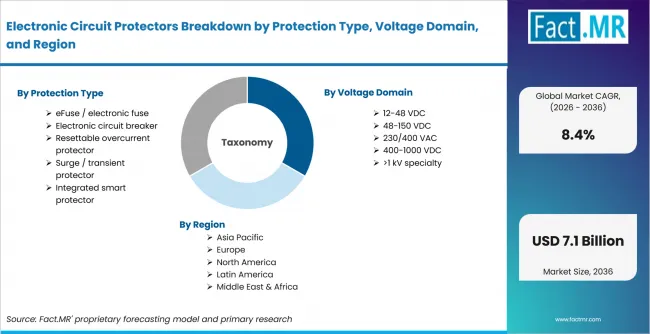
Electronic Circuit Protectors Breakdown By Protection Type, Voltage Domain, And Region | Source: Fact.MR
| Attribute | Details |
|---|---|
| Quantitative Units | USD Billion |
| Market Definition | Electronic devices and modules that protect circuits or connected loads from abnormal current or voltage conditions. |
| Protection Type | eFuse / electronic fuse; Electronic circuit breaker; Resettable overcurrent protector; Surge / transient protector; Integrated smart protector |
| Voltage Domain | 12-48 VDC; 48-150 VDC; 230/400 VAC; 400-1000 VDC; >1 kV specialty |
| Application | Industrial controls; Automotive; Data centers / telecom; Consumer electronics; Energy systems |
| Integration | PCB module; DIN-rail module; Power distribution integrated; Semiconductor IC; Panel module |
| Country Analysis | USA; Germany; Japan; South Korea; UK |
| Key Companies | Littelfuse; Eaton; Mersen; Phoenix Contact; Sensata Technologies; STMicroelectronics |
| Forecast Period | 2026-2036 |
| Base Year | 2026 |
| Market Value, 2026 | USD 3.2 billion |
| Market Value, 2036 | USD 7.1 billion |
| CAGR, 2026-2036 | 8.4% |
| Absolute Opportunity | Approximately USD 3.9 billion |
| Approach | Demand-side and supplier-side triangulation using unit deployment, voltage mix, integration format, price/mix and replacement cycles. |
How is the market segmented?
-
By Protection Type
- eFuse / electronic fuse
- Electronic circuit breaker
- Resettable overcurrent protector
- Surge / transient protector
- Integrated smart protector
-
By Voltage Domain
- 12-48 VDC
- 48-150 VDC
- 230/400 VAC
- 400-1000 VDC
- >1 kV specialty
-
By Application
- Industrial controls
- Automotive
- Data centers / telecom
- Consumer electronics
- Energy systems
-
By Integration
- PCB module
- DIN-rail module
- Power distribution integrated
- Semiconductor IC
- Panel module
-
By Region
- North America
- Latin America
- Western Europe
- Eastern Europe
- East Asia
- South Asia and Pacific
- Middle East & Africa