- Base Value(2025): 15.3 Bn
- Estimated Value(2026): 16.9 Bn
- Forecast Value (2036): 46.3 Bn
- CAGR (2026 - 2036): 10.6%
Electronic Toll Collection Market Forecast By Fact.MR
In 2025, the electronic toll collection market was valued at USD 15.3 billion. Based on FMR analysis, demand for electronic toll collection solutions is estimated to grow to USD 16.9 billion in 2026 and USD 46.3 billion by 2036. Fact MR projects a CAGR of 10.6% during the forecast period.
The absolute dollar growth from 2026 to 2036 is USD 29.4 billion. This growth is driven by the increasing adoption of smart transportation systems, rising vehicle ownership, and government initiatives to improve traffic management and reduce congestion. Electronic toll collection systems provide faster, more efficient tolling, reduce operational costs, and support automated infrastructure. However, challenges such as high installation costs, system integration complexities, and data security concerns may affect growth in certain regions.
China leads with a CAGR of 10%, driven by large-scale infrastructure development and adoption of smart toll systems. South Korea follows with 7.6%, supported by growing urban mobility and automated tolling initiatives. The UK grows at 7.4%, reflecting investments in intelligent transportation and congestion management. The USA shows growth at 6.6%, driven by highway modernization and toll automation projects. Germany grows at 6%, supported by steady adoption of electronic tolling across its national and regional road networks.
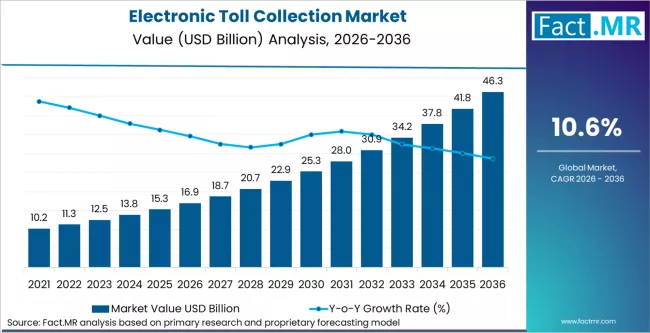
Electronic Toll Collection Market Market Value Analysis | Source: Fact.MR
Electronic Toll Collection Market
| Metric | Value |
|---|---|
| Estimated Value in (2026E) | USD 16.9 billion |
| Forecast Value in (2036F) | USD 46.3 billion |
| Forecast CAGR (2026 to 2036) | 10.6% |
Source: Fact.MR analysis. Updated Mar 10, 2026
Electronic Toll Collection Market Definition
The Electronic Toll Collection Market involves the development, deployment, and sale of systems that automate toll payments on highways, bridges, and tunnels by enabling vehicles to transmit payment information electronically without stopping.
Market Inclusions
This report covers global and regional market sizes for electronic toll collection systems over a defined forecast period, including technology types (RFID tags, DSRC, ANPR/camera‑based), deployment models (open road tolling, barrier tolling), and end users (government transport agencies, toll operators, public‑private partnerships).
Market Exclusions
The scope excludes manual toll collection services, unrelated traffic management systems not tied to tolling, and physical toll booth hardware not integrated with electronic payment infrastructure.
Research Methodology
- Primary Research: Interviews were conducted with transportation planners, system integrators, and tollway operators.
- Desk Research: Data was sourced from industry reports, government publications, and trade association statistics.
- Market‑Sizing and Forecasting; A hybrid model combining top‑down infrastructure investment forecasts with bottom‑up deployment and revenue data was used.
- Data Validation and Update Cycle: Findings were validated through expert review and aligned with recent adoption and operational data.
Summary of the Electronic Toll Collection (ETC) Market
- Market Definition
- The Electronic Toll Collection (ETC) Market includes systems and components enabling automated toll collection on highways, bridges, and urban roads. It uses vehicle-mounted transponders, antennae, and sensors to process tolls electronically, reducing congestion, improving traffic flow, and enabling seamless payments.
- Demand Drivers
- Expansion of smart transportation systems and highway modernization programs.
- Rising vehicle ownership and increasing urban mobility requirements.
- Government initiatives promoting cashless tolling and congestion management.
- Faster vehicle processing and reduced operational costs through automation.
- Integration with smart city infrastructure and interoperable tolling networks.
- Key Segments Analyzed
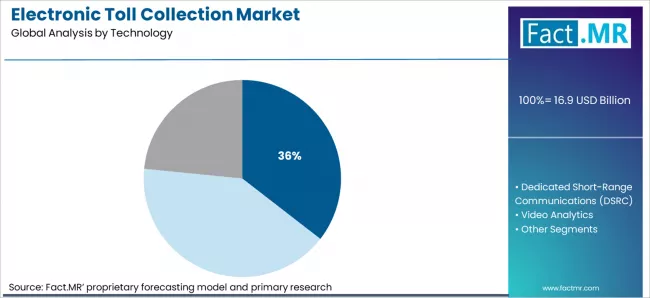
- Technology: Radio-Frequency Identification (RFID) leads with 35.5% share in 2026, followed by DSRC, Video Analytics, and GNSS.
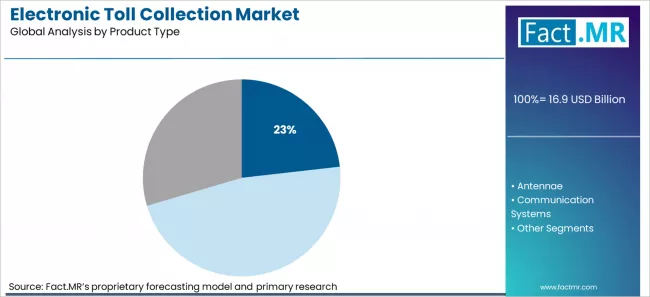
- Product Type: Transponders hold 23.2% of the market in 2026, complemented by antennae, communication systems, treadles, and inductive loops.
- Application Type: Highways, Urban Roads, Bridges.
- Geography: East Asia, South Korea, North America, Europe; China leads at 10% CAGR, South Korea 7.6%, UK 7.4%, USA 6.6%, Germany 6%.
- Analyst Opinion at Fact MR
- Shambhu Nath Jha, Principal Consultant, Fact MR, opines, 'In this updated edition of the Electronic Toll Collection Market report, industry participants will observe that value creation is shifting from basic toll automation toward fully integrated, interoperable smart transportation ecosystems. ETC systems are no longer limited to vehicle identification; they now support traffic management, congestion pricing, and real-time digital payments. Providers investing in cross-network transponder interoperability, AI-enhanced vehicle recognition, and scalable system architectures will capture premium adoption in urban and highway infrastructure. The convergence of accuracy, speed, and digital integration defines the competitive landscape through 2036.'
- Strategic Implications/Executive Takeaways
- Prioritize RFID-based solutions for high-speed tolling and urban highway integration.
- Expand adoption of interoperable transponders across multiple toll networks.
- Target high-growth regions such as China and South Korea with localized deployment strategies.
- Integrate AI and video analytics for automated vehicle identification and fraud detection.
- Focus on urban congestion management, smart highway modernization, and public-private partnerships.
- Align solutions with government regulations, security standards, and infrastructure modernization plans.
- Methodology
- Primary Research: Interviews with transportation planners, system integrators, and tollway operators.
- Desk Research: Data sourced from industry reports, government publications, and trade association statistics.
- Market Sizing & Forecasting: Hybrid model combining top-down infrastructure investment forecasts with bottom-up deployment and revenue data.
- Data Validation: Findings validated through expert review and aligned with recent adoption and operational data using proprietary Fact MR forecasting models.
Segmental Analysis
Electronic Toll Collection Market Analysis by Technology
Electronic Toll Collection Market Analysis By Technology | Source: Fact.MR
Market Overview: Radio-Frequency Identification (RFID) technology is expected to capture 35.5% of the market share by 2026. RFID-based systems are widely used for electronic toll collection due to their ability to quickly and accurately identify vehicles, enabling seamless toll processing and reduced congestion at toll plazas.
Demand Drivers:
- Faster Vehicle Processing: RFID technology allows high-speed identification of vehicles, minimizing delays at toll booths and improving traffic flow.
- Reliable and Accurate Data Capture: RFID ensures precise vehicle identification and toll calculation, enhancing operational efficiency for toll authorities.
- Growing Implementation in Smart Transportation: Adoption of RFID-based electronic toll collection aligns with smart city initiatives and the modernization of transportation infrastructure globally.
Electronic Toll Collection Market Analysis by Product Type
Electronic Toll Collection Market Analysis By Product Type | Source: Fact.MR
Market Overview: Transponders are projected to hold 23.2% of the market share by 2026. Transponders are the primary vehicle-mounted devices used in electronic toll collection systems, transmitting data to tolling infrastructure to enable automatic payment and vehicle identification.
Demand Drivers:
- Convenience for Drivers: Transponders allow drivers to pass through tolls without stopping, providing a seamless and efficient tolling experience.
- Wide Adoption by Toll Authorities: Toll operators prefer transponder-based systems for reliability and ease of integration with existing infrastructure.
- Integration with Multiple Tolling Systems: Modern transponders can work across regions and toll networks, supporting interoperability and boosting market adoption.
Electronic Toll Collection Market Drivers, Restraints, and Opportunities
FMR analysts observe that the electronic toll collection (ETC) market is a growth‑aligned, infrastructure modernization segment propelled by widespread deployment of cashless, automated tolling to improve traffic flow and reduce congestion on highways and bridges. Historically, manual toll booths dominated; as road networks expanded and smart city initiatives matured, structural demand emerged for ETC systems that use RFID, DSRC, or ANPR technologies to enable seamless payments and reduce delays. The 2026 valuation reflects this shift, with adoption tied to government transport policy, congestion management goals, and digital payment integration rather than legacy tolling models.
While traditional cash and token‑based tolling still persists in some regions, advanced ETC solutions with account‑based and interoperable payment capabilities are gaining share. These higher‑value systems command premium implementation and service fees, contributing to net market growth even as overall toll transactions scale with vehicle use and infrastructure expansion. The market exists because governments and operators increasingly view automated tolling as essential for efficient, safe, and user‑friendly transportation networks.
- Smart Transport Demand: Road authorities adopt ETC systems to replace manual tolling and improve traffic throughput, driver convenience, and operational efficiency.
- Regulatory & Policy Standards: Government policies on cashless payments and congestion pricing push adoption of certified ETC solutions that meet interoperability and security criteria.
- Regional Infrastructure Dynamics: In North America and Europe, extensive highway networks and smart mobility programs drive higher ETC uptake, while Asia‑Pacific shows rapid growth with expanding road infrastructure and tolling modernization.
Regional Analysis
The market analysis covers key global regions, including East Asia, South Korea, North America, and Europe. It is segmented geographically, with specific market dynamics for each region. The full report provides a detailed market attractiveness analysis.
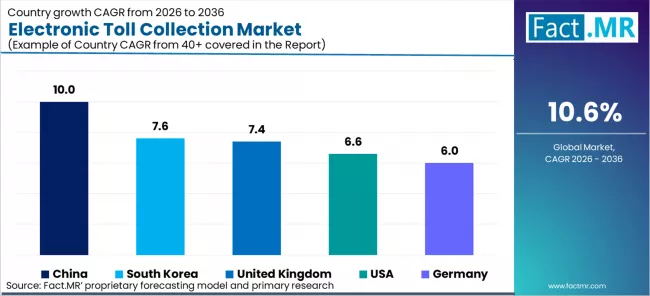
Electronic Toll Collection Market Cagr Analysis By Country | Source: Fact.MR
| Country | CAGR (2026-2036) |
|---|---|
| China | 10.0% |
| South Korea | 7.6% |
| United Kingdom | 7.4% |
| USA | 6.6% |
| Germany | 6.0% |
Source: Fact.MR analysis. Updated Mar 10, 2026
Source: Fact MR (FMR) analysis, based on proprietary forecasting model and primary research
East Asia
China is a leading market, supported by government highway modernization, toll automation projects, and smart city initiatives. Key players include ZTE Corporation, Huawei Technologies, and China Electronic Toll Collection Co.
- China: Demand for electronic toll collection systems in China is projected to rise at 10.0% CAGR through 2036. Growth is supported by government highway automation programs (03-2025) and Huawei Technologies’ regional deployment expansion (08-2025).
South Korea
The country is a major market, driven by highway modernization, urban toll systems, and smart transport initiatives.
- South Korea: Demand for electronic toll collection systems in South Korea is projected to rise at 7.6% CAGR through 2036. Growth is influenced by government smart transport projects (02-2025) and ZTE Corporation’s regional system deployment expansions (07-2025).
North America
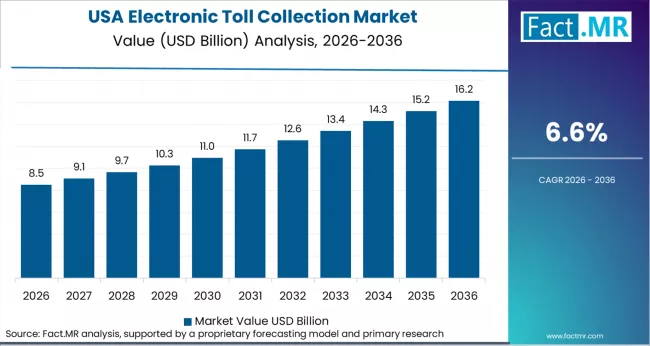
Electronic Toll Collection Market Country Value Analysis | Source: Fact.MR
The USA is a significant market, driven by interstate highway modernization, toll infrastructure upgrades, and adoption of automated tolling systems.
- USA: Demand for electronic toll collection systems in the U.S. is projected to rise at 6.6% CAGR through 2036. Growth is supported by federal highway infrastructure programs (05-2025) and TransCore’s expansion of tolling technology deployment (08-2025).
Europe
The United Kingdom and Germany are key markets, supported by government highway modernization, smart transport programs, and urban toll systems.
- United Kingdom: Demand for electronic toll collection systems in the UK is projected to rise at 7.4% CAGR through 2036. Growth is supported by Department for Transport smart road initiatives (04-2025) and Thales Group’s regional system expansions (09-2025).
- Germany: Demand for electronic toll collection systems in Germany is projected to rise at 6.0% CAGR through 2036. Growth is influenced by federal highway modernization programs (03-2025) and Siemens AG’s tolling infrastructure deployments (08-2025).
Fact MR's analysis of the electronic toll collection market in East Asia, South Korea, North America, and Europe consists of country-wise assessments that include China, South Korea, the United Kingdom, the USA, and Germany. Readers can find detailed trends, regulatory updates, and company-specific investments shaping market growth in these countries.
What is the Competitive Structure and Buyer Behavior in the Electronic Toll Collection Market?
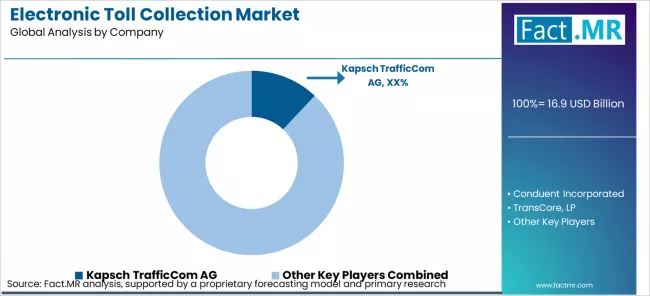
Electronic Toll Collection Market Analysis By Company | Source: Fact.MR
The electronic toll collection market is moderately concentrated, with established transport technology and systems integrators such as Kapsch TrafficCom AG, Conduent Incorporated, TransCore, LP, Thales Group, Cubic Corporation, Siemens Mobility GmbH, Egis Group, Neology, Inc., Raytheon Technologies Corporation, and Verra Mobility Corporation capturing a substantial share of global deployments. The primary competitive variables are system reliability, interoperability with national and regional tolling standards, accuracy of vehicle identification, ease of integration with traffic management infrastructure, and robustness against fraud and environmental conditions. Companies with broad solution portfolios, strong engineering capabilities, global deployment experience, and established service networks hold structural advantages because they can support complex installations, manage long‑term maintenance, and align with regulatory frameworks across jurisdictions.
Large government transportation agencies, toll authorities, and infrastructure concessionaires wield significant buyer leverage by qualifying multiple system providers, negotiating long‑term performance and service agreements, and standardising technical specifications tied to compliance and fiscal accountability. To manage supplier dependency, these buyers often adopt multi‑vendor strategies, emphasise open standards, and require rigorous interoperability testing prior to procurement, which limits individual suppliers’ pricing power. As a result, competition centres on delivering proven performance, system reliability, integration support, and long‑term service assurance rather than on price alone.
Key Players of the Electronic Toll Collection Market
- Kapsch TrafficCom AG
- Conduent Incorporated
- TransCore, LP
- Thales Group
- Cubic Corporation
- Siemens Mobility GmbH
- Egis Group
- Neology, Inc.
- Raytheon Technologies Corporation
- Verra Mobility Corporation
Report Scope
| Metric | Value |
|---|---|
| Quantitative Units | USD 16.9 billion (2026) to USD 46.3 billion (2036), at a CAGR of 10.6% |
| Market Definition | The Electronic Toll Collection (ETC) Market includes systems and components enabling automated toll collection, reducing congestion and facilitating seamless vehicle passage using transponders, antennae, and sensors. |
| Product Type | Transponders, Antennae, Communication Systems, Treadles, Inductive Loops |
| Technology | Radio-Frequency Identification (RFID), Dedicated Short-Range Communications (DSRC), Video Analytics, Global Navigation Satellite System (GNSS) |
| Application Type | Highways, Urban Roads, Bridges |
| Regions Covered | North America, Latin America, Western Europe, Eastern Europe, East Asia, South Asia & Pacific, Middle East & Africa |
| Countries Covered | United States, Canada, Mexico, Brazil, Germany, France, United Kingdom, Italy, Spain, China, India, Japan, South Korea, Australia & New Zealand, GCC Countries, South Africa |
| Key Companies Profiled | Kapsch TrafficCom AG, Conduent Incorporated, TransCore, LP, Thales Group, Cubic Corporation, Siemens Mobility GmbH, Egis Group, Neology, Inc., Raytheon Technologies Corporation, Verra Mobility Corporation |
| Forecast Period | 2026 to 2036 |
| Approach | Market sizing and growth projections based on historical adoption of ETC systems, traffic volume, regional infrastructure expansion, and vendor revenue data validated through industry sources and expert interviews. |
Source: Fact.MR analysis. Updated Mar 10, 2026
Bibliographies
- International Transport Forum. (2023). Road pricing and electronic toll collection technologies in modern transportation systems. International Transport Forum.
- World Bank. (2023). Electronic toll collection and road user charging systems for sustainable transport infrastructure. World Bank.
- European Commission. (2024). European electronic toll service and interoperable road charging systems. European Commission.
- U.S. Department of Transportation. (2023). Intelligent transportation systems and electronic toll collection deployment in highway networks. U.S. Department of Transportation.
- Kapsch TrafficCom AG. (2024). Annual report: Intelligent transportation systems and electronic tolling technologies. Kapsch TrafficCom AG.
- Siemens Mobility GmbH. (2024). Integrated mobility report: Digital infrastructure and intelligent road systems. Siemens Mobility GmbH.
- Cubic Corporation. (2024). Annual report: Transportation systems and smart mobility infrastructure. Cubic Corporation.
This report addresses
- Market intelligence enabling a detailed assessment of leading countries, technology types, product categories, and application segments in the Electronic Toll Collection Market globally.
- Market volume (revenue) estimates and 10-year revenue forecasts from 2026 to 2036, validated through toll system deployment data, vehicle counts, and infrastructure expansion trends.
- Growth opportunity mapping across technology types (RFID, DSRC, Video Analytics, GNSS), product types (Transponders, Antennae, Communication Systems, Treadles, Inductive Loops), applications (Highways, Urban Roads, Bridges), and regions.
- Segment and regional revenue forecasts by technology, product, application, and geography, covering 40+ countries.
- Competition strategy analysis focusing on system reliability, interoperability, ease of integration, traffic throughput, and security compliance, including major players Kapsch TrafficCom AG, Conduent Incorporated, TransCore, LP, Thales Group, Cubic Corporation, Siemens Mobility GmbH, Egis Group, Neology, Inc., Raytheon Technologies Corporation, and Verra Mobility Corporation.
- Product, technology, and regulatory tracking aligned with intelligent transportation systems (ITS), smart city frameworks, and electronic payment compliance standards.
- Adoption dynamics emphasizing RFID-based identification, DSRC implementation, automated tolling, and integrated smart transport networks.
- Report delivery in PDF, Excel, PowerPoint, and interactive dashboard formats for executive, operational, and strategic planning use.
Segmentation
Electronic Toll Collection Market Key Segments
-
Product Type
- Transponders
- Antennae
- Communication Systems
- Treadles
- Inductive Loops
-
Technology
- Radio-Frequency Identification (RFID)
- Dedicated Short-Range Communications (DSRC)
- Video Analytics
- Global Navigation Satellite System (GNSS)
-
Application Type
- Highways
- Urban
- Bridges
-
Region
- North America
- USA
- Canada
- Mexico
- Europe
- Germany
- UK
- France
- Italy
- Spain
- Nordic Countries
- BENELUX
- Rest of Europe
- Asia Pacific
- China
- Japan
- South Korea
- India
- Australia
- Rest of Asia Pacific
- Latin America
- Brazil
- Argentina
- Rest of Latin America
- Middle East and Africa
- Kingdom of Saudi Arabia
- United Arab Emirates
- South Africa
- Rest of Middle East and Africa
- Other Regions
- Oceania
- Central Asia
- Other Markets
- North America
Frequently Asked Questions
How large is the demand for Electronic Toll Collection in the global market in 2026?
What will be the market size of Electronic Toll Collection in the global market by 2036?
What is the expected demand growth for Electronic Toll Collection in the global market between 2026 and 2036?
Which technology type is expected to dominate the market?
Which region is expected to show the highest growth rate for Electronic Toll Collection?
How significant is the growth outlook for South Korea in this market?
What is the growth outlook for the United Kingdom in the Electronic Toll Collection market?
What is the growth forecast for the United States in the Electronic Toll Collection market?
What is the growth forecast for Germany in the Electronic Toll Collection market?
Which company is identified as a leading player in the Electronic Toll Collection market?
What is Electronic Toll Collection used for?
What does the Electronic Toll Collection market include in this report?
How is the market forecast developed in this report?
What is meant by the Electronic Toll Collection market in this report?
Who worked on this report


Preview the report firsthand - request a free sample
Free SampleGet the brochure for pricing and purchase details
Download PDF