- Market Value (2025): USD 33.9 Bn
- Estimated Value (2026): USD 36.8 Bn
- Forecast Value (2036): USD 82.5 Bn
- CAGR (2026-2036): 8.4%
What is the Electronic Manufacturing Services for Communication Equipment Market forecast to be worth by 2036?
USD 36.8 billion in 2026 to USD 82.5 billion by 2036 at an 8.4% CAGR.
- The market was valued at approximately USD 33.9 billion in 2025, calculated from the 2026 value and the stated CAGR.
- Demand is projected to increase from USD 36.8 billion in 2026 to USD 82.5 billion by 2036.
- The market is forecast to record an 8.4% CAGR from 2026 to 2036 and create an absolute opportunity of USD 45.7 billion.
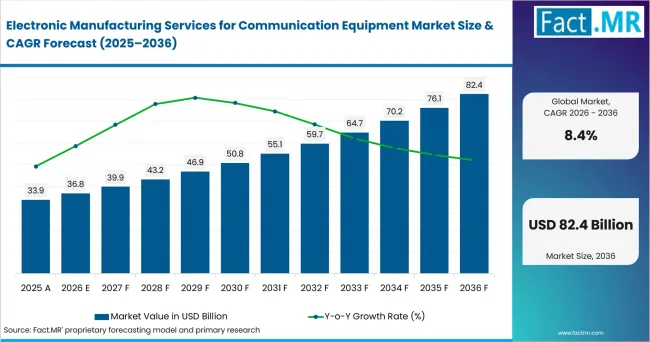
Electronic Manufacturing Services For Communication Equipment Market Value Analysis | Source: Fact.MR
What are the defining numbers behind Electronic Manufacturing Services for Communication Equipment Market growth?
An absolute opportunity of USD 45.7 billion is expected between 2026 and 2036.
- Demand Drivers in the Market
- 5G network expansion is increasing demand for outsourced production of radio units, baseband equipment, routers and optical transport systems. The International Telecommunication Union estimates that 5G covered 55% of the global population in 2025 and accounted for about 3 billion mobile-broadband subscriptions. Network-equipment OEMs must therefore scale complex electronics without carrying the full fixed cost of assembly lines, automated optical inspection and radio-frequency testing.
- Communication equipment is becoming more component-dense as manufacturers add massive MIMO radios, high-speed optical interfaces and advanced power-management systems. These products require multilayer printed circuit boards, precise surface-mount assembly and controlled testing. EMS providers with high-volume SMT capability help OEMs manage shorter product cycles while maintaining yield and traceability.
- Broadband infrastructure programmes are creating a longer pipeline of access and transport equipment. The U.S. Broadband Equity, Access and Deployment programme provides USD 42.45 billion for high-speed broadband deployment. Procurement linked to fibre, fixed-wireless and network-access projects supports demand for contract manufacturing of routers, switches, optical equipment and wireless base stations.
- OEMs are diversifying production across several manufacturing regions to reduce exposure to component shortages, trade restrictions and logistics disruption. The OECD describes semiconductor production as a globally distributed value chain with concentrated inputs and potential bottlenecks. Communication-equipment companies increasingly use EMS partners with facilities in Asia, North America and Europe so production can be shifted between qualified sites.
- Testing and lifecycle support are becoming part of the manufacturing decision. Network hardware must meet electrical-safety, electromagnetic-compatibility and telecommunications standards before deployment. Buyers favour EMS providers that can combine assembly with functional testing, repair and refurbishment because this reduces hand-offs and gives the OEM one traceable manufacturing record.
- Key Segments Analyzed
- Box Build Assembly accounts for 38.0% of Service Type in 2026 because network-equipment OEMs increasingly outsource complete enclosure assembly, cabling, power integration and final testing.
- 5G Network Equipment holds 42.0% of Communication Equipment in 2026 as continued radio-access and core-network deployment requires high-volume production of complex electronic systems.
- Telecommunications represents 45.0% of End-use Industry in 2026 due to recurring investment in mobile, fixed-broadband and optical-network infrastructure.
- Network Equipment OEMs account for 41.0% of Customer Category in 2026 because they use EMS partners to convert product designs into scalable, compliant manufacturing programmes.
- High-volume SMT Assembly holds 39.0% of Manufacturing Capability in 2026 as communication equipment depends on dense PCB assemblies produced with automated placement and inspection.
- Analyst Opinion at Fact.MR
- Shambhu Nath Jha, Senior Consultant at Fact.MR, states, “Communication-equipment OEMs are outsourcing a larger share of assembly and testing as 5G radios, optical systems and network platforms become more complex. Supplier selection will depend on process yield, component traceability, test coverage and the ability to transfer production between qualified sites. EMS providers that combine box-build capability with high-volume SMT and lifecycle support are better positioned to secure multi-year programmes as the market expands from USD 36.8 billion in 2026 to USD 82.5 billion by 2036.”
- Strategic Implications
- EMS providers should organize commercial proposals around communication-equipment platforms such as radio access, optical networking, satellite systems and consumer devices. Buyers need evidence that the manufacturing line can meet the required board density, test coverage and production volume.
- Suppliers should strengthen component traceability and multi-site qualification. A production programme that can move between approved facilities gives OEMs more protection against semiconductor shortages, logistics disruption and regional trade restrictions.
- Network-equipment OEMs should involve manufacturing partners earlier in design-for-manufacturability reviews. Early collaboration can reduce board rework, simplify test access and improve yield before the product enters high-volume production.
- Pricing should reflect the full manufacturing package, including engineering support, tooling, test development, repair and obsolescence management. Capacity-only comparisons can understate the cost of quality failures or delayed network deployment.
How does the Electronic Manufacturing Services for Communication Equipment Market break down by segment?
The market is segmented by Service Type, Communication Equipment, End-use Industry, Customer Category and Manufacturing Capability.
Why does Box Build Assembly lead Service Type?
Box Build Assembly is projected to account for a 38.0% share in 2026.
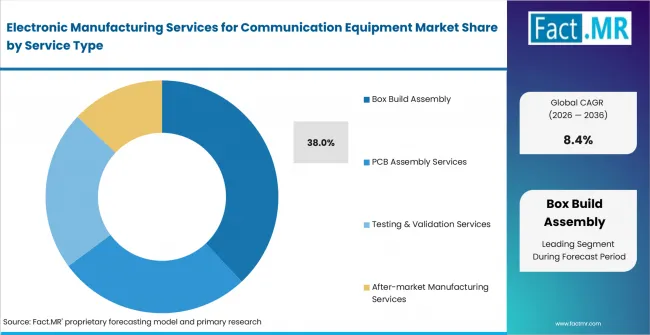
Electronic Manufacturing Services For Communication Equipment Market Analysis By Service Type | Source: Fact.MR
Box build assembly combines PCB assemblies with enclosures, power supplies, cabling, thermal components and final system testing. Communication-equipment OEMs use this service when they want a finished radio, router or optical unit delivered from one manufacturing partner rather than coordinating several component suppliers.
The model reduces assembly hand-offs and allows the EMS provider to test the complete system in its operating configuration. This is important for network equipment because failures may originate from connectors, power distribution, cooling or firmware interaction rather than the PCB alone. Buyers therefore place more value on suppliers that can manage system integration and final acceptance testing.
Why does 5G Network Equipment lead Communication Equipment?
5G Network Equipment is projected to account for a 42.0% share in 2026.
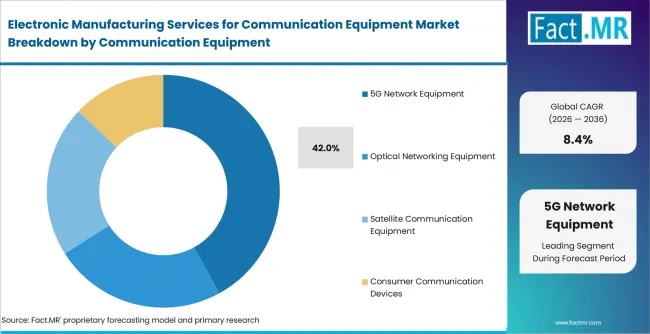
Electronic Manufacturing Services For Communication Equipment Market Analysis By Communication Equipment | Source: Fact.MR
5G equipment leads because radio-access networks require large volumes of radios, antennas, baseband systems and transport hardware. The ITU estimated that 5G reached 55% of the world’s population in 2025, while the number of 5G subscriptions approached 3 billion.
The equipment is technically demanding. Massive MIMO radios contain dense RF and digital electronics, while baseband and transport platforms require high-speed processing and optical connectivity. OEMs use EMS partners to scale these products across several regions while maintaining process control and functional-test coverage.
Why does Telecommunications lead End-use Industry?
Telecommunications is projected to account for a 45.0% share in 2026.
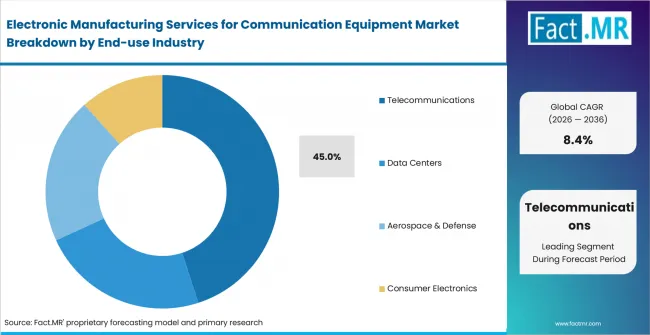
Electronic Manufacturing Services For Communication Equipment Market Analysis By End Use Industry | Source: Fact.MR
Telecommunications leads because mobile and fixed-network operators continually expand capacity, replace ageing equipment and introduce new radio or optical technologies. Each investment cycle creates orders for base stations, routers, switches, transmission systems and customer-premises equipment.
Operator procurement also favours repeatable production and long-term support. Equipment may remain in service for many years, requiring spare assemblies, repair and controlled component substitutions. EMS providers with lifecycle-management capability can therefore support both initial network deployment and the installed base.
Why do Network Equipment OEMs lead Customer Category?
Network Equipment OEMs are projected to account for a 41.0% share in 2026.
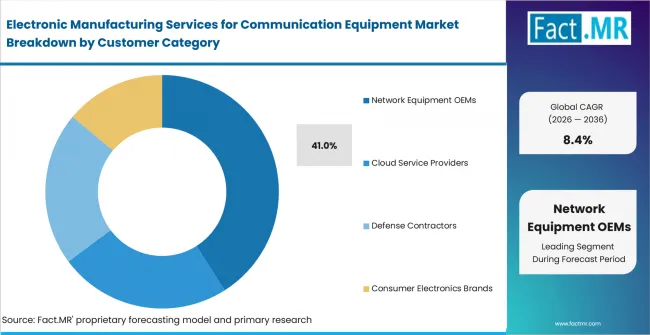
Electronic Manufacturing Services For Communication Equipment Market Analysis By Customer Category | Source: Fact.MR
Network-equipment OEMs lead because they retain control of product architecture and software while outsourcing capital-intensive manufacturing activities. This model allows engineering teams to focus on radio performance, networking functions and platform development without building every assembly and test line internally.
OEMs also need production flexibility as demand moves between countries or network generations. Multi-site EMS providers can qualify common processes, procure components at scale and transfer production between plants, reducing the time required to respond to regional orders.
Why does High-volume SMT Assembly lead Manufacturing Capability?
High-volume SMT Assembly is projected to account for a 39.0% share in 2026.
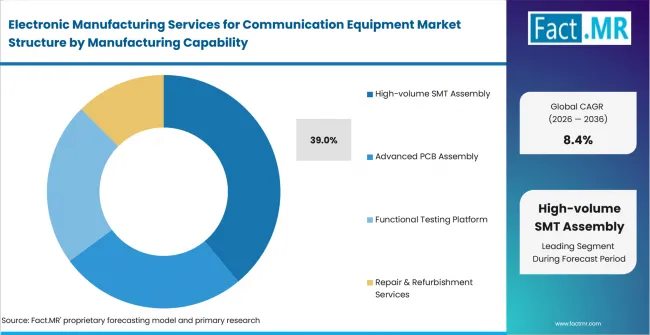
Electronic Manufacturing Services For Communication Equipment Market Analysis By Manufacturing Capability | Source: Fact.MR
High-volume SMT assembly leads because communication equipment contains densely populated PCBs with processors, memory, RF components and power-management devices. Automated placement and reflow lines are required to produce these boards at consistent speed and quality.
Scale improves purchasing leverage and supports investment in solder-paste inspection, automated optical inspection and in-circuit testing. These controls help EMS providers identify defects before boards reach final box-build assembly, lowering rework cost and improving delivery reliability for OEM customers.
What is accelerating Electronic Manufacturing Services for Communication Equipment Market adoption, and what is holding it back?
Drivers Impact Analysis
| Factor | (~) % Impact on CAGR | Geographic Relevance | Impact Timeline |
|---|---|---|---|
| 5G and broadband equipment outsourcing | +1.6% | Global | Short term (<= 2 years) |
| Telecom manufacturing and compliance support | +1.4% | USA; Germany; UK | Short term (<= 2 years) |
| Expansion of regional EMS capacity | +1.1% | Global | Medium term (2-4 years) |
| Traceability and test documentation | +0.9% | USA; UK; Canada | Medium term (2-4 years) |
| Scale-based procurement and production efficiency | +0.6% | Global | Long term (>= 4 years) |
Source: Fact.MR analysis. Updated Aug 7, 2026
Opportunity Impact Analysis
| Factor | (~) % Impact on CAGR | Geographic Relevance | Impact Timeline |
|---|---|---|---|
| 5G-Advanced, optical and satellite equipment | +1.0% | Global | Medium term (2-4 years) |
| High-reliability specialist manufacturing | +0.8% | USA; UK; Germany | Medium term (2-4 years) |
| Multi-site OEM manufacturing partnerships | +0.7% | Global | Long term (>= 4 years) |
| Standards-aligned testing and lifecycle services | +0.5% | USA; Canada; Singapore | Long term (>= 4 years) |
Source: Fact.MR analysis. Updated Aug 7, 2026
Restraints Impact Analysis
| Factor | (~) % Impact on CAGR | Geographic Relevance | Impact Timeline |
|---|---|---|---|
| Capital cost and manufacturing complexity | -1.1% | Global | Short term (<= 2 years) |
| Qualification and compliance checks | -0.9% | USA; UK; Germany | Short term (<= 2 years) |
| Competition from lower-cost assembly locations | -0.7% | Import-dependent markets | Medium term (2-4 years) |
| Component availability and pricing pressure | -0.5% | Global | Long term (>= 4 years) |
Source: Fact.MR analysis. Updated Aug 7, 2026
Which countries are scaling the Electronic Manufacturing Services for Communication Equipment Market fastest?
- USA: Broadband investment and domestic supply-chain priorities support local and regional manufacturing. The USD 42.45 billion BEAD programme covers high-speed broadband deployment and includes network-access, transport and wireless equipment.
- Vietnam: Vietnam is gaining share in electronics assembly as OEMs diversify production. Official trade-promotion data indicate that computers, electronics and components generated nearly USD 165 billion of exports in 2025, supporting a larger supplier and manufacturing base.
- Mexico: Mexico benefits from proximity to the United States and established electronics manufacturing clusters. Communication-equipment OEMs can use Mexican EMS capacity to shorten logistics routes and support North American product configuration or repair.
- India: India is building domestic telecom-equipment capacity through the Production Linked Incentive scheme. Department of Telecommunications documents cover telecom and networking products and encourage design-led manufacturing, creating opportunities for EMS providers serving local OEMs.
- Malaysia: Malaysia’s established electrical and electronics ecosystem supports advanced assembly and testing. Electronic components accounted for 59% of E&E investment in 2025, largely driven by foreign investment, strengthening the supplier base available to communication-equipment programmes.
- Germany: Germany’s dense industrial base and continued 5G rollout support demand for high-reliability manufacturing. The Bundesnetzagentur reported 5G coverage from at least one operator across more than 93.85% of the country in 2025.
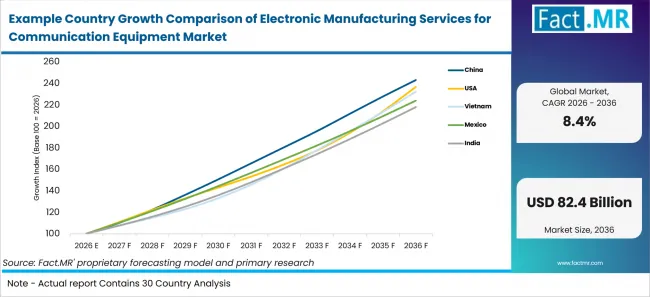
Example Country Growth Comparison Of Electronic Manufacturing Services For Communication Equipment Market | Source: Fact.MR
| Country | CAGR (2026-2036) |
|---|---|
| USA | 9.0% |
| Vietnam | 8.8% |
| Mexico | 8.4% |
| India | 8.1% |
| Malaysia | 7.8% |
| Germany | 7.5% |
Source: Fact.MR analysis. Updated Aug 7, 2026
What is driving China's growth through 2036?
China is forecast to expand at a 9.3% CAGR from 2026 to 2036.
China combines large domestic demand with a mature electronics manufacturing network. By the end of 2025, the country had 4.838 million 5G base stations and 1.204 billion 5G subscriptions. Continued deployment of 5G-Advanced, optical transport and industrial connectivity gives EMS providers recurring production programmes across radio, switching and access equipment.
The country also offers close access to component suppliers, tooling and high-volume SMT capacity. This reduces production lead times for OEMs, although customers increasingly qualify additional sites outside China to improve supply-chain resilience.
What is driving USA's growth through 2036?
USA is forecast to expand at a 9.0% CAGR from 2026 to 2036.
The USA is expanding broadband infrastructure while placing greater emphasis on secure and resilient supply chains. The BEAD programme provides USD 42.45 billion for high-speed broadband access, supporting procurement of fibre, fixed-wireless, routing and network-access equipment.
Demand favours EMS providers with North American manufacturing, engineering support and product traceability. OEMs may retain complex or security-sensitive programmes closer to end customers while using international plants for higher-volume assemblies.
What is driving Vietnam's growth through 2036?
Vietnam is forecast to expand at a 8.8% CAGR from 2026 to 2036.
Vietnam is scaling as an export-oriented electronics manufacturing location. Computers, electronics and components generated nearly USD 165 billion in exports during 2025, indicating a large operating base for assembly, components and logistics.
Communication-equipment OEMs use Vietnam to diversify production while retaining access to Asian component supply chains. Growth will depend on deeper local sourcing, engineering capability and the ability of EMS facilities to support advanced testing rather than assembly alone.
What is driving Mexico's growth through 2036?
Mexico is forecast to expand at a 8.4% CAGR from 2026 to 2036.
Mexico’s position within North American manufacturing networks supports communication-equipment production for the USA and Canada. Shorter transport routes make the country suitable for configure-to-order systems, repair programmes and products that require regular engineering changes.
Demand is also supported by established electronics clusters and cross-border supply chains. EMS providers that combine Mexican production with design and component-management teams in the USA can offer OEMs a regional manufacturing model with lower logistics exposure.
What is driving India's growth through 2036?
India is forecast to expand at a 8.1% CAGR from 2026 to 2036.
India is promoting local production of telecom and networking equipment through its Production Linked Incentive scheme. The programme includes telecom products and design-led manufacturing, encouraging domestic and global companies to expand local output.
This creates opportunities for EMS providers that can support radio units, routers, optical equipment and related PCB assemblies. Local demand from network rollout can provide scale, while export growth will depend on component localization and internationally accepted quality systems.
What is driving Malaysia's growth through 2036?
Malaysia is forecast to expand at a 7.8% CAGR from 2026 to 2036.
Malaysia benefits from a long-established electrical and electronics industry centred on Penang and other manufacturing regions. Electronic components represented 59% of E&E investment in 2025, strengthening access to semiconductor packaging, testing and precision manufacturing capabilities.
The country is suited to communication equipment requiring controlled processes and strong supplier coordination. EMS providers can serve regional OEM programmes while using Malaysia’s logistics links to source components across East and Southeast Asia.
What is driving Germany's growth through 2036?
Germany is forecast to expand at a 7.5% CAGR from 2026 to 2036.
Germany’s growth is supported by industrial electronics capability and continued investment in mobile infrastructure. In 2025, 5G coverage from at least one network operator was available across more than 93.85% of the country.
Demand favours EMS providers able to meet European quality, traceability and environmental requirements. Germany is more likely to support lower-volume, high-complexity production, prototype industrialization and lifecycle services than labour-intensive commodity assembly.
Who leads the Electronic Manufacturing Services for Communication Equipment Market?
Foxconn Technology Group is positioned as the leading provider because of its global manufacturing scale, electronics supply-chain reach and ability to support complete system assembly. Its position is strongest where communication-device and network-equipment programmes require high-volume PCB assembly, enclosure integration and international production coverage.
Flex, Jabil, Sanmina, Celestica, Benchmark Electronics and Plexus compete through engineering support, regulated manufacturing, test development and multi-region production. Pegatron, New Kinpo Group and Universal Scientific Industrial add scale in electronics assembly and component integration.
Competition is shaped by manufacturing yield, RF and functional-test capability, component procurement and the ability to qualify the same product at several sites. Communication-equipment OEMs also assess cybersecurity controls, product traceability, repair turnaround and obsolescence management because network platforms may remain in service for many years.
The market includes large global EMS groups and smaller regional specialists. Large providers are better placed to manage multinational product transfers and component purchasing, while specialist manufacturers can compete in low-volume, high-complexity systems or programmes requiring close engineering interaction.
Which companies are the key providers?
Key companies include Foxconn Technology Group; Flex Ltd.; Jabil Inc.; Benchmark Electronics, Inc.; Sanmina Corporation; Celestica Inc.; Pegatron Corporation; New Kinpo Group; Universal Scientific Industrial Co., Ltd.; and Plexus Corp.
- Foxconn Technology Group
- Flex Ltd.
- Jabil Inc.
- Benchmark Electronics, Inc.
- Sanmina Corporation
- Celestica Inc.
- Pegatron Corporation
- New Kinpo Group
- Universal Scientific Industrial Co., Ltd.
- Plexus Corp.
Bibliography
- Bundesnetzagentur. (2025). Mobile Network Measurement Week Across Germany.
- Government of China, Ministry of Industry and Information Technology. (2026). China’s 5G Base Stations Top 4.83 Million by End of 2025.
- Government of India, Department of Telecommunications. (2025). Production Linked Incentive Scheme Guidelines for Telecom and Networking Products.
- International Telecommunication Union. (2025). Measuring Digital Development: Facts and Figures 2025.
- Malaysian Investment Development Authority. (2026). Electrical and Electronics Industry.
- National Telecommunications and Information Administration. (2025). Broadband Equity, Access and Deployment Program.
- OECD. (2025). Mapping the Semiconductor Value Chain. OECD Publishing.
- Vietnam Ministry of Industry and Trade. (2025). Viet Nam’s Supporting Industry for Electronics Needs More Support.
- Vietnam Trade Promotion Agency. (2026). Electronics Drive Vietnam’s Trade Growth as Exports Hit Record in 2025.
This Report Answers
- The report evaluates demand for electronic manufacturing services used in communication equipment across service types, equipment categories and customer groups.
- Segment analysis identifies the leading categories and their shares within the 2026 market.
- Country analysis compares growth across China, the USA, Vietnam, Mexico, India, Malaysia and Germany.
- Competitive analysis reviews global EMS providers serving network equipment and communication-device programmes.
- The scope distinguishes complete outsourced manufacturing services from component supply and unrelated electronics production.
What does the Electronic Manufacturing Services for Communication Equipment Market cover?
The market covers outsourced manufacturing services used to produce communication equipment. These services include PCB assembly, box-build integration, testing, validation, repair and refurbishment for 5G network equipment, optical systems, satellite communication equipment and consumer communication devices.
The assessment measures service revenue generated by EMS providers and contract manufacturers. It evaluates demand from network-equipment OEMs, cloud service providers, defence contractors and consumer communication brands across the listed regions.
What is included in the scope?
The scope includes contract manufacturing of communication-equipment PCB assemblies and finished systems. Box-build work may include enclosure assembly, cabling, power integration, firmware loading and final functional testing. Testing services are included when they form part of an outsourced manufacturing programme.
After-market manufacturing services include repair, refurbishment, spare-unit production and controlled replacement of obsolete components. The assessment covers high-volume SMT, advanced PCB assembly and functional-test platforms used for the stated communication-equipment categories.
What is excluded from the scope?
The scope excludes semiconductor fabrication, standalone component distribution and raw-material supply when these activities are not part of an EMS contract. Telecommunications services, network operation and infrastructure construction are outside the market.
Consumer electronics manufacturing is included only for communication devices within the supplied taxonomy. General computing equipment, unrelated industrial electronics and software-only network products are excluded. Original equipment manufactured entirely within an OEM-owned plant is not counted as outsourced EMS revenue.
How Was the Analysis Built?
The analysis draws on more than 120 sources, over 35 company portfolios and more than 20 industry interviews across at least 25 countries.
- Primary Research: Interviews with EMS executives, network-equipment OEMs, component procurement managers, manufacturing engineers and telecommunications buyers examined outsourcing criteria, test requirements, production transfers and supplier qualification.
- Desk Research: The review covered telecom infrastructure statistics, broadband programmes, electronics manufacturing policy, company disclosures, trade data and technical standards. External sources used in the article are listed in the bibliography.
- Market Sizing and Forecasting: Estimates combine communication-equipment production, the share of manufacturing outsourced to EMS providers, service mix, average manufacturing value, regional production capacity and country-level demand. Segment shares and company portfolios are used to test the resulting totals.
- Data Validation and Update Cycle: Interview findings are cross-checked against public infrastructure data, company manufacturing footprints and electronics trade indicators. Updates account for 5G deployment, broadband investment, component availability and shifts in OEM sourcing.
Segmentation
What is the report's scope and coverage?
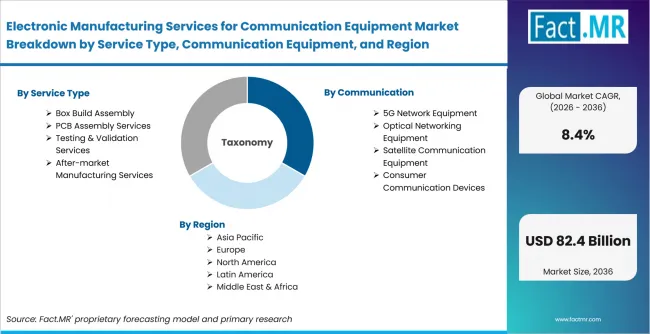
Electronic Manufacturing Services For Communication Equipment Market Breakdown By Service Type, Communication Equipment, And Region | Source: Fact.MR
| Attribute | Details |
|---|---|
| Quantitative Units | USD billion |
| Market Definition | Outsourced engineering, assembly, testing and lifecycle manufacturing services for communication equipment |
| Segments Covered | Service Type; Communication Equipment; End-use Industry; Customer Category; Manufacturing Capability |
| Regions Covered | North America; Latin America; Europe; East Asia; South Asia and Pacific; Middle East and Africa |
| Countries Covered | China; USA; Vietnam; Mexico; India; Malaysia; Germany |
| Key Companies Profiled | Foxconn Technology Group; Flex Ltd.; Jabil Inc.; Benchmark Electronics, Inc.; Sanmina Corporation; and others |
| Forecast Period | 2026 to 2036 |
| Approach | Hybrid top-down and bottom-up approach using equipment production, outsourced manufacturing penetration, service pricing, segment shares, country growth and company portfolio review |
Source: Fact.MR analysis. Updated Aug 7, 2026
How is the market segmented?
-
By Service Type
- Box Build Assembly
- System Integration
- Rack-level Integration
- PCB Assembly Services
- High-density PCB Assembly
- Rigid-flex PCB Assembly
- Testing & Validation Services
- RF Functional Testing
- Environmental Testing
- After-market Manufacturing Services
- Device Refurbishment
- Spare Parts Management
- Box Build Assembly
-
By Communication Equipment
- 5G Network Equipment
- Base Stations
- Small Cell Equipment
- Optical Networking Equipment
- Optical Transceivers
- Routers & Switches
- Satellite Communication Equipment
- SATCOM Terminals
- Ground Stations
- Consumer Communication Devices
- Home Networking Devices
- Wi-Fi Gateways
- 5G Network Equipment
-
By End-use Industry
- Telecommunications
- Wireless Infrastructure
- Data Communications
- Data Centers
- Enterprise Networking
- Industrial Communications
- Aerospace & Defense
- Defense Communications
- Government Communications
- Consumer Electronics
- Smart Home Communications
- Broadband Equipment
- Telecommunications
-
By Customer Category
- Network Equipment OEMs
- Telecom Operators
- System Integrators
- Cloud Service Providers
- Data Center Operators
- Industrial OEMs
- Defense Contractors
- Aerospace Manufacturers
- Public Sector Organizations
- Consumer Electronics Brands
- Distributors
- Service Providers
- Network Equipment OEMs
-
By Manufacturing Capability
- High-volume SMT Assembly
- Automated SMT Lines
- Multi-line PCB Assembly
- Advanced PCB Assembly
- AOI & X-ray Inspection
- Precision Component Placement
- Functional Testing Platform
- In-circuit Testing
- Burn-in Testing
- Repair & Refurbishment Services
- Component-level Repair
- Lifecycle Management
- High-volume SMT Assembly
-
By Region
- North America
- Latin America
- Western Europe
- Eastern Europe
- East Asia
- South Asia and Pacific
- Middle East & Africa
Frequently Asked Questions
Which Service Type leads the market?
Which Communication Equipment leads the market?
Which End-use Industry leads the market?
Which Customer Category leads the market?
Which Manufacturing Capability leads the market?
Which country records the highest listed CAGR?
What is the primary driver in this market?
What is the main restraint?
Which companies are included in the market assessment?
Who worked on this report


Preview the report firsthand - request a free sample
Free SampleGet the brochure for pricing and purchase details
Download PDF