Electronic Cartography Market (2026 - 2036)

Electronic Cartography Market is segmented by Component (Navigation Charts and Navigation System), End User (Commercial and Defense), and Region. Forecast for 2026 to 2036.

Core Findings

    Electronic Cartography Market Forecast By Fact.MR

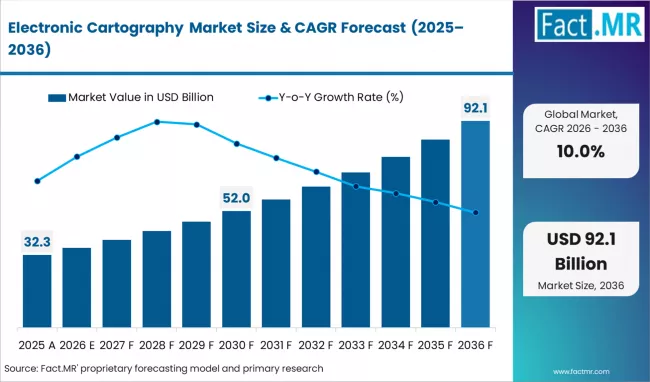
    In 2025, the electronic cartography market was valued at USD 32.3 billion. Based on Fact MR analysis, demand for electronic cartography is estimated to grow to USD 35.5 billion in 2026 and USD 53.6 billion by 2036. FMR projects a CAGR of 10.0% during the forecast period.

    The absolute dollar growth from 2026 to 2036 is USD 18.1 billion. This expansion reflects steady growth in digital mapping systems rather than a structural shift in geospatial technologies. Electronic cartography solutions are widely used across navigation systems, geographic information systems, transportation planning, and defense applications. Demand continues to rise with increased use of location based services, digital navigation platforms, and mapping integration in mobile and automotive systems. Growth remains influenced by data acquisition costs, satellite imaging expenses, and regulatory restrictions related to geospatial data usage.
    Electronic Cartography Market Market Value Analysis

    Electronic Cartography Market

    Metric Details
    Industry Size (2026E) USD 35.5 billion
    Industry Value (2036F) USD 53.6 billion
    CAGR (2026 to 2036) 10%

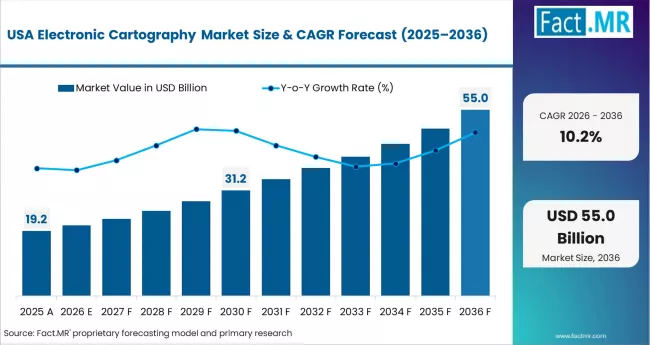
    India leads with a projected CAGR of 11.4%, supported by expanding use of digital mapping in transportation, logistics, and urban planning applications. China follows with a CAGR of 10.9%, driven by large scale deployment of navigation systems and location based services. The United States records a CAGR of 10.2%, supported by demand across automotive navigation, defense, and enterprise mapping applications. Japan shows a CAGR of 10.1%, reflecting steady adoption of digital cartography in transportation and infrastructure systems. Australia records the slowest growth at 9.9%, reflecting a smaller geospatial services market and mature adoption levels. Mature markets generate a significant share of replacement demand as mapping systems are updated with higher resolution data and improved navigation capabilities.

    Summary of the Electronic Cartography Market

    • Market Definition
      • The market includes digital mapping systems and software used to create, store, and display geographic and navigational data in electronic formats. These systems convert spatial data into interactive maps used across navigation platforms, geographic information systems, and transportation networks. Electronic cartography supports real time mapping, route planning, and geospatial analysis across commercial and defense applications.
    • Demand Drivers
      • Increasing use of location based services across mobile, automotive, and logistics platforms
      • Rising demand for real time navigation and route optimization in transportation and supply chain operations
      • Expansion of digital mapping integration in smart infrastructure and urban planning systems
      • Growing reliance on geospatial data for defense, aviation, and maritime navigation applications
    • Key Segments Analyzed
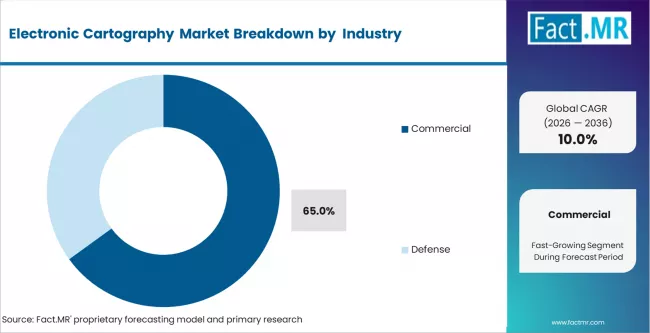
      • End User: Commercial segment leads with around 65% share in 2026 driven by logistics and navigation applications
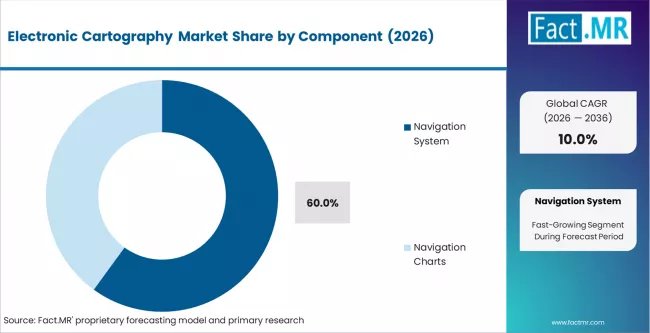
      • Component: Navigation systems dominate with about 60% share supported by real time mapping capabilities
      • Application: Transportation, aviation, and GIS systems show steady adoption of digital cartography solutions
      • Geography: Asia Pacific leads in growth, while North America maintains strong demand through advanced mapping platforms
    • Analyst Opinion at Fact MR
      • Shambhu Nath Jha, Principal Consultant, Fact MR, opines, "In this updated edition of the Electronic Cartography Market report, industry participants will observe that demand is driven by steady expansion of digital mapping applications across navigation, logistics, and geospatial analytics. Electronic cartography systems are evolving toward real time, data integrated platforms that support continuous updates and advanced spatial analysis. Providers that enhance data accuracy, system integration, and real time processing capabilities will maintain competitive positioning as geospatial applications expand through 2036."
    • Strategic Implications/Executive Takeaways
      • Invest in real time mapping platforms integrating dynamic data sources and continuous updates
      • Strengthen geospatial data accuracy and interoperability across mapping and navigation systems
      • Expand application capabilities across transportation, logistics, and defense sectors
      • Focus on integration with mobile platforms, automotive systems, and enterprise GIS solutions
    • Methodology
      • Primary interviews conducted with geospatial software providers, mapping specialists, and navigation system developers
      • Desk research based on geospatial industry publications, company reports, regulatory filings, and geographic data sources
      • Market sizing derived using a hybrid approach combining bottom up software revenue analysis with top down demand assessment
      • Data validation performed through cross verification with industry datasets and internal peer review aligned with Fact MR standards

    Segmental Analysis

    Electronic Cartography Market Analysis by Component
    Electronic Cartography Market Analysis By Component

    • Market Overview: Navigation systems are projected to account for around 60% share of the electronic cartography market by 2026. These systems integrate digital maps, positioning technologies, and route optimization algorithms to provide real time navigation support. Electronic cartography is widely used in applications such as automotive navigation, aviation systems, marine navigation, and mobile mapping platforms. Navigation systems rely on accurate geospatial data and mapping software to deliver route guidance, traffic updates, and location based services. The increasing use of digital navigation tools across transportation and logistics operations continues to support demand within this segment.
    • Demand Drivers:
      • Real Time Navigation Solutions: Navigation systems provide route guidance, traffic updates, and location tracking for users across different transportation modes.
      • Integration with Positioning Technologies: Electronic cartography systems integrate with GPS and other positioning technologies to deliver accurate navigation data.
      • Transportation and Logistics Applications: Businesses and consumers rely on navigation systems to support travel planning, fleet management, and route optimization.

    Electronic Cartography Market Analysis by End User
    Electronic Cartography Market Analysis By End Use

    • Market Overview: Commercial end users are expected to represent approximately 65% share of the electronic cartography market in 2026. Commercial organizations deploy electronic cartography solutions in industries such as transportation, logistics, aviation, maritime, and tourism. These systems support route planning, asset tracking, navigation, and operational management. Businesses rely on digital mapping solutions to improve efficiency, reduce operational costs, and enhance service delivery. The adoption of electronic cartography in commercial operations continues to grow due to the need for accurate and real time geospatial information.
    • Demand Drivers:
      • Fleet and Logistics Management: Commercial organizations use electronic cartography systems to manage transportation routes and track assets.
      • Aviation and Maritime Navigation: Navigation systems support safe and efficient operations in aviation and maritime industries.
      • Operational Efficiency Improvements: Businesses deploy digital mapping solutions to optimize routes and improve service delivery across commercial operations.

    Electronic Cartography Market Drivers, Restraints, and Opportunities
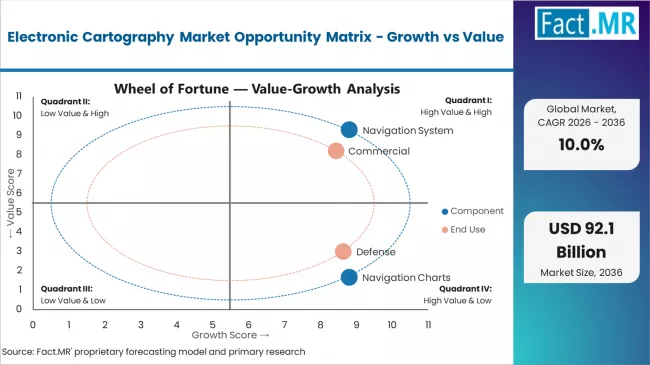
    Electronic Cartography Market Opportunity Matrix Growth Vs Value

    Fact MR analysis indicates that the electronic cartography market developed from traditional mapmaking processes that transitioned into digital geographic information systems used for navigation and spatial analysis. Early digital mapping solutions were deployed in maritime navigation, aviation systems, and government surveying applications where accurate geographic data was critical. The current market valuation reflects widespread use of electronic maps across automotive navigation, mobile applications, logistics systems, and urban planning tools. Demand persists because digital cartography enables real-time location tracking, route optimization, and geospatial analysis across multiple industries.

    A structural shift is occurring as static digital maps transition toward dynamic, continuously updated mapping platforms integrated with real-time data sources. Conventional electronic maps remain widely used in systems where periodic updates are sufficient for navigation and planning purposes. Advanced cartographic platforms integrate satellite imagery, sensor data, and user-generated inputs to provide real-time mapping updates and predictive routing capabilities. These platforms require higher development and data management costs due to continuous data acquisition and processing. Even with moderate growth in map usage, higher pricing associated with dynamic mapping services supports steady market value expansion.

    • Real Time Mapping Systems: Navigation and logistics platforms deploy electronic cartography solutions that provide real-time location tracking, traffic updates, and route optimization.
    • Geospatial Data Standards: Frameworks such as ISO 19115 geographic information metadata standards and Open Geospatial Consortium (OGC) specifications influence data interoperability and mapping accuracy.
    • North America Navigation Platforms: The United States hosts major digital mapping and navigation service providers that develop electronic cartography solutions for automotive, logistics, and mobile applications.

    Regional Analysis

    The electronic cartography market is assessed across North America, Europe, Asia Pacific, Latin America, and Middle East & Africa, segmented by country-level geospatial data adoption, navigation systems, and mapping technologies. Regional demand reflects digital mapping integration, government geospatial programs, and enterprise location intelligence usage. The full report offers market attractiveness analysis.

    Top Country Growth Comparison Electronic Cartography Market Cagr (2026 2036)

    Country CAGR (2026-2036)
    USA 10.2%
    China 10.9%
    Japan 10.1%
    India 11.4%
    Australia 9.9%

    Source: Fact MR analysis, based on proprietary forecasting model and primary research
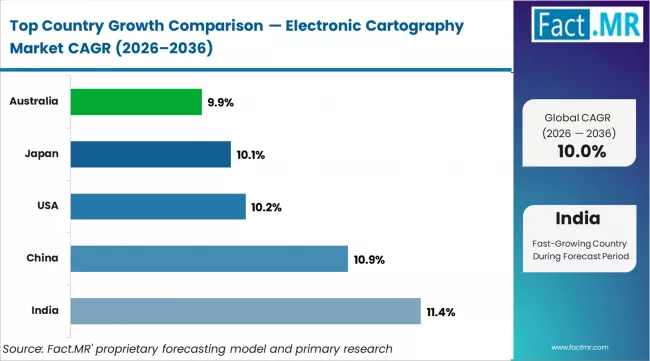
    Electronic Cartography Market Cagr Analysis By Country

    North America

    Electronic Cartography Market Country Value Analysis

    North America functions as the digital mapping and geospatial analytics innovation hub, supported by strong technology ecosystems and navigation platform development. Google LLC maintains leadership in digital mapping services. Esri strengthens GIS platform capabilities. Trimble Inc. supports geospatial data solutions.

    • USA: Demand for electronic cartography in USA is projected to rise at 10.2% CAGR through 2036. Growth is supported by the National Spatial Data Infrastructure initiative (U.S. Geological Survey, ongoing), promoting geospatial data integration. Esri expanded GIS and mapping platforms (March 2023), supporting enterprise adoption.

    Asia Pacific
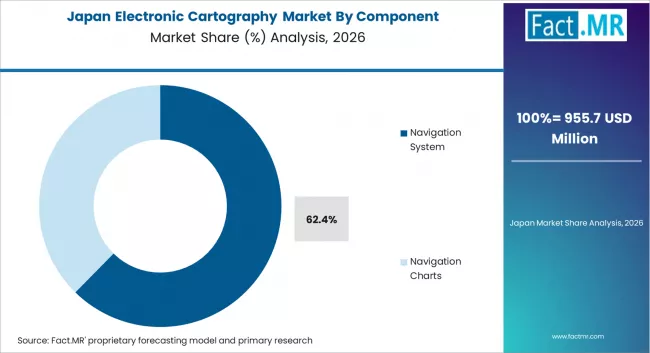
    Electronic Cartography Market Japan Market Share Analysis By Component

    Asia Pacific serves as the high-growth geospatial data and digital mapping market, supported by government-backed mapping initiatives and mobile navigation demand. Alibaba Group Holding Limited integrates mapping into digital ecosystems. Zenrin Co., Ltd. advances detailed cartographic data. MapmyIndia strengthens domestic geospatial services.

    • China: Demand for electronic cartography in China is projected to rise at 10.9% CAGR through 2036. The National Geospatial Information policy (State Council, updated 2021) supports mapping infrastructure. Alibaba Group Holding Limited expanded mapping and location-based services (April 2023), supporting adoption.
    • Japan: Demand for electronic cartography in Japan is projected to rise at 10.1% CAGR through 2036. The Society 5.0 initiative (Cabinet Office, updated 2021) promotes geospatial integration. Zenrin Co., Ltd. expanded digital mapping databases (January 2023), supporting market growth.
    • India: Demand for electronic cartography in India is projected to rise at 11.4% CAGR through 2036. The National Geospatial Policy (Government of India, February 2022) supports private sector participation. MapmyIndia expanded digital mapping and navigation platforms (May 2023), supporting domestic demand.
    • Australia: Demand for electronic cartography in Australia is projected to rise at 9.9% CAGR through 2036. The National Digital Twin initiative (Geoscience Australia, ongoing) supports geospatial data integration. Esri expanded mapping solutions in Australia (March 2023), supporting adoption.

    Fact MR's analysis of electronic cartography market in global regions consists of country-wise assessment that includes USA, China, Japan, India, and Australia. Readers can find geospatial data trends, mapping technology developments, regulatory frameworks, and competitive positioning across key markets.

    Competitive Structure and Buyer Dynamics in the Electronic Cartography Market
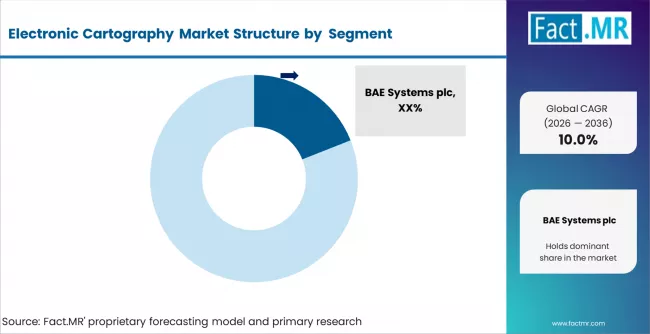
    Electronic Cartography Market Analysis By Company

    The competitive structure of the Electronic Cartography Market is moderately concentrated, with a mix of geospatial technology firms, defense contractors, and navigation solution providers controlling a significant share of high value applications. Companies such as Esri, Inc., Hexagon AB, TomTom N.V., Garmin Ltd., and Maxar Technologies Inc. maintain strong positions through mapping platforms, geospatial analytics, and navigation data services. Defense and aerospace focused players including BAE Systems plc, RTX Corporation, Thales Group, and Honeywell International Inc. contribute through specialized cartographic systems used in military and aviation applications. Additional participants such as Fugro N.V. provide geodata acquisition and surveying services that support mapping accuracy. Competition is primarily influenced by data accuracy, update frequency, geospatial analytics capability, and integration with navigation and mission critical systems.

    Several companies maintain structural advantages through ownership of large geospatial datasets and advanced mapping technologies. Firms such as Esri, Inc. and Hexagon AB benefit from widely adopted geospatial software platforms and strong enterprise integration capabilities. Garmin Ltd. and TomTom N.V. maintain advantages through consumer navigation ecosystems and continuously updated mapping databases. Maxar Technologies Inc. and Fugro N.V. leverage satellite imagery and geospatial data acquisition capabilities to support high precision mapping. Government agencies, defense organizations, and commercial enterprises often adopt multi vendor strategies to reduce dependence on a single mapping provider and ensure data redundancy. Procurement decisions evaluate vendors based on data accuracy, system compatibility, and long term reliability. This purchasing behavior moderates supplier pricing leverage, while providers with proprietary datasets and advanced analytics capabilities retain stronger negotiating influence.

    Key Players of the Electronic Cartography Market

    • BAE Systems plc
    • RTX Corporation (formerly Raytheon Technologies Corporation)
    • Esri, Inc. (Environmental Systems Research Institute)
    • Fugro N.V.
    • Hexagon AB
    • Garmin Ltd.
    • Garmin Ltd. (Navionics brand)
    • Maxar Technologies Inc.
    • TomTom N.V.
    • Honeywell International Inc. (Honeywell Aerospace division)
    • Thales Group (Thales S.A.)

    Report Scope
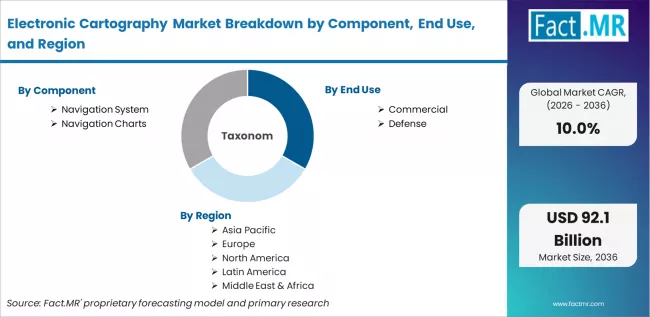
    Electronic Cartography Market Breakdown By Component, End Use, And Region

    Metric Value
    Quantitative Units USD 35.5 billion (2026) to USD 53.6 billion (2036), at a CAGR of 10%
    Market Definition The electronic cartography market includes digital mapping systems and navigation solutions that provide geospatial data, electronic navigation charts, and real time positioning information for maritime, aviation, and land based navigation across commercial and defense applications.
    Component Segmentation Navigation Charts, Navigation System
    End User Segmentation Commercial, Defense
    Regions Covered North America, Latin America, Europe, East Asia, South Asia, Oceania, Middle East and Africa
    Countries Covered United States, Canada, Mexico, Brazil, Germany, United Kingdom, France, Italy, Spain, China, India, Japan, South Korea, Australia, and 40+ countries
    Key Companies Profiled BAE Systems plc, RTX Corporation, Esri, Inc., Fugro N.V., Hexagon AB, Garmin Ltd., Maxar Technologies Inc., TomTom N.V., Honeywell International Inc., Thales Group
    Forecast Period 2026 to 2036
    Approach Hybrid top-down and bottom-up market modeling supported by geospatial data usage trends, navigation system deployment analysis, satellite imagery demand assessment, and validation through interviews with mapping technology providers, defense organizations, and commercial navigation service users.

    Electronic Cartography Market Key Segments

    • Component :

      • Navigation Charts
      • Navigation System
    • End User :

      • Commercial
      • Defense
    • Region :

      • North America
        • USA
        • Canada
        • Mexico
      • Europe
        • Germany
        • UK
        • France
        • Italy
        • Spain
        • Nordic Countries
        • BENELUX
        • Rest of Europe
      • Asia Pacific
        • China
        • Japan
        • South Korea
        • India
        • Australia
        • Rest of Asia Pacific
      • Latin America
        • Brazil
        • Argentina
        • Rest of Latin America
      • Middle East and Africa
        • Kingdom of Saudi Arabia
        • United Arab Emirates
        • South Africa
        • Rest of Middle East and Africa
      • Other Regions
        • Oceania
        • Central Asia
        • Other Markets

    Bibliographies

    • [1] Esri, Inc. (2023, March). What's new in the ArcGIS Solutions March 2023 release.
    • [2] Press Information Bureau, Government of India. (2025, February). India's National Geospatial Policy 2022.
    • [3] MapmyIndia. (2025, August). Department of Posts partners with MapmyIndia to advance DIGIPIN application.
    • [4] U.S. Geological Survey. (2024, September). The vision for National Spatial Data Infrastructure, and how drones will play a big role.
    • [5] Esri Canada. (2023, May). Getting Technical- March 2023.
    • [6] Drishti IAS. (2023, January). National Geospatial Policy 2022.
    • [7] MapmyIndia. (2023, April). Submission of Press Release-MapmyIndia 23 April 2023.
    • [8] Open Geospatial Consortium. (2025, July). National Spatial Data Infrastructure Modernization Project.

    This Report Addresses

    • Market size estimation and revenue forecasts for the Electronic Cartography Market from 2026 to 2036, supported by geospatial data usage trends and digital mapping adoption benchmarks.
    • Growth opportunity mapping across navigation charts and navigation systems, reflecting demand for real time mapping, route optimization, and location based services.
    • Segment and regional revenue forecasts covering components, end users, and key markets including India, China, United States, Japan, and Australia.
    • Competition strategy assessment of leading companies such as Esri, Inc., Hexagon AB, Garmin Ltd., TomTom N.V., and Maxar Technologies Inc., including data accuracy and platform integration benchmarking.
    • Regulatory impact analysis covering geospatial data standards, mapping regulations, and data privacy frameworks influencing electronic cartography deployment and usage.
    • Market report delivery in PDF, Excel, PPT, and interactive dashboard formats designed for navigation planning, geospatial analysis, and operational decision support.
    • Supply chain vulnerability assessments examining satellite data acquisition costs, mapping data update requirements, and regulatory restrictions on geospatial information impacting market growth.

    Electronic Cartography Market Definition

    The Electronic Cartography Market includes digital mapping systems and software used to create, store, and display geographic and navigational information in electronic formats. These systems convert geographic data into interactive maps that can be used on computers, navigation devices, and mobile platforms. Electronic cartography is widely used in marine navigation, aviation, transportation planning, and geographic information systems. The primary function of electronic cartography is to provide accurate, real time mapping and spatial data visualization for navigation, route planning, and geographic analysis.

    Electronic Cartography Market Inclusions

    This report covers global and regional market sizes for electronic cartography solutions with forecast analysis for the study period. The market is segmented by component including mapping software, digital chart systems, and related services. Application segments include marine navigation, aviation mapping, transportation planning, and geographic information systems. End users include maritime operators, aviation authorities, transportation agencies, and government organizations. The report also evaluates pricing models, software adoption trends, and selected trade flow analysis across major geospatial technology markets.

    Electronic Cartography Market Exclusions

    The report excludes traditional paper maps and printed cartographic materials. Satellite hardware and remote sensing equipment used to collect geographic data are not included. The scope also excludes general navigation devices such as GPS units unless focused on mapping software. Standalone geographic data collection services without mapping software integration are outside the defined market scope, as the analysis focuses strictly on electronic mapping systems and platforms.

    Electronic Cartography Market Research Methodology

    • Primary Research: Interviews were conducted with geospatial software providers, mapping specialists, navigation system developers, and government agencies.
    • Desk Research: Public information was collected from geospatial industry publications, company reports, regulatory filings, and geographic data repositories.
    • Market-Sizing and Forecasting: A hybrid model combining bottom up software revenue analysis with top down demand assessment across navigation and mapping sectors was applied.
    • Data Validation and Update Cycle: Findings were cross verified using multiple industry data sources and expert inputs, with periodic updates conducted as new geospatial data becomes available.

    Table of Content

    1. Executive Summary
      • Global Market Outlook
      • Demand to side Trends
      • Supply to side Trends
      • Technology Roadmap Analysis
      • Analysis and Recommendations
    2. Market Overview
      • Market Coverage / Taxonomy
      • Market Definition / Scope / Limitations
    3. Research Methodology
      • Chapter Orientation
      • Analytical Lens and Working Hypotheses
        • Market Structure, Signals, and Trend Drivers
        • Benchmarking and Cross-market Comparability
        • Market Sizing, Forecasting, and Opportunity Mapping
      • Research Design and Evidence Framework
        • Desk Research Programme (Secondary Evidence)
          • Company Annual and Sustainability Reports
          • Peer-reviewed Journals and Academic Literature
          • Corporate Websites, Product Literature, and Technical Notes
          • Earnings Decks and Investor Briefings
          • Statutory Filings and Regulatory Disclosures
          • Technical White Papers and Standards Notes
          • Trade Journals, Industry Magazines, and Analyst Briefs
          • Conference Proceedings, Webinars, and Seminar Materials
          • Government Statistics Portals and Public Data Releases
          • Press Releases and Reputable Media Coverage
          • Specialist Newsletters and Curated Briefings
          • Sector Databases and Reference Repositories
          • Fact.MR Internal Proprietary Databases and Historical Market Datasets
          • Subscription Datasets and Paid Sources
          • Social Channels, Communities, and Digital Listening Inputs
          • Additional Desk Sources
        • Expert Input and Fieldwork (Primary Evidence)
          • Primary Modes
            • Qualitative Interviews and Expert Elicitation
            • Quantitative Surveys and Structured Data Capture
            • Blended Approach
          • Why Primary Evidence is Used
          • Field Techniques
            • Interviews
            • Surveys
            • Focus Groups
            • Observational and In-context Research
            • Social and Community Interactions
          • Stakeholder Universe Engaged
            • C-suite Leaders
            • Board Members
            • Presidents and Vice Presidents
            • R&D and Innovation Heads
            • Technical Specialists
            • Domain Subject-matter Experts
            • Scientists
            • Physicians and Other Healthcare Professionals
          • Governance, Ethics, and Data Stewardship
            • Research Ethics
            • Data Integrity and Handling
        • Tooling, Models, and Reference Databases
      • Data Engineering and Model Build
        • Data Acquisition and Ingestion
        • Cleaning, Normalisation, and Verification
        • Synthesis, Triangulation, and Analysis
      • Quality Assurance and Audit Trail
    4. Market Background
      • Market Dynamics
        • Drivers
        • Restraints
        • Opportunity
        • Trends
      • Scenario Forecast
        • Demand in Optimistic Scenario
        • Demand in Likely Scenario
        • Demand in Conservative Scenario
      • Opportunity Map Analysis
      • Product Life Cycle Analysis
      • Supply Chain Analysis
      • Investment Feasibility Matrix
      • Value Chain Analysis
      • PESTLE and Porter’s Analysis
      • Regulatory Landscape
      • Regional Parent Market Outlook
      • Production and Consumption Statistics
      • Import and Export Statistics
    5. Global Market Analysis 2021 to 2025 and Forecast, 2026 to 2036
      • Historical Market Size Value (USD Million) Analysis, 2021 to 2025
      • Current and Future Market Size Value (USD Million) Projections, 2026 to 2036
        • Y to o to Y Growth Trend Analysis
        • Absolute $ Opportunity Analysis
    6. Global Market Pricing Analysis 2021 to 2025 and Forecast 2026 to 2036
    7. Global Market Analysis 2021 to 2025 and Forecast 2026 to 2036, By Component
      • Introduction / Key Findings
      • Historical Market Size Value (USD Million) Analysis By Component, 2021 to 2025
      • Current and Future Market Size Value (USD Million) Analysis and Forecast By Component, 2026 to 2036
        • Navigation System
        • Navigation Charts
      • Y to o to Y Growth Trend Analysis By Component, 2021 to 2025
      • Absolute $ Opportunity Analysis By Component, 2026 to 2036
    8. Global Market Analysis 2021 to 2025 and Forecast 2026 to 2036, By End Use
      • Introduction / Key Findings
      • Historical Market Size Value (USD Million) Analysis By End Use, 2021 to 2025
      • Current and Future Market Size Value (USD Million) Analysis and Forecast By End Use, 2026 to 2036
        • Commercial
        • Defense
      • Y to o to Y Growth Trend Analysis By End Use, 2021 to 2025
      • Absolute $ Opportunity Analysis By End Use, 2026 to 2036
    9. Global Market Analysis 2021 to 2025 and Forecast 2026 to 2036, By Region
      • Introduction
      • Historical Market Size Value (USD Million) Analysis By Region, 2021 to 2025
      • Current Market Size Value (USD Million) Analysis and Forecast By Region, 2026 to 2036
        • North America
        • Latin America
        • Western Europe
        • Eastern Europe
        • East Asia
        • South Asia and Pacific
        • Middle East & Africa
      • Market Attractiveness Analysis By Region
    10. North America Market Analysis 2021 to 2025 and Forecast 2026 to 2036, By Country
      • Historical Market Size Value (USD Million) Trend Analysis By Market Taxonomy, 2021 to 2025
      • Market Size Value (USD Million) Forecast By Market Taxonomy, 2026 to 2036
        • By Country
          • USA
          • Canada
          • Mexico
        • By Component
        • By End Use
      • Market Attractiveness Analysis
        • By Country
        • By Component
        • By End Use
      • Key Takeaways
    11. Latin America Market Analysis 2021 to 2025 and Forecast 2026 to 2036, By Country
      • Historical Market Size Value (USD Million) Trend Analysis By Market Taxonomy, 2021 to 2025
      • Market Size Value (USD Million) Forecast By Market Taxonomy, 2026 to 2036
        • By Country
          • Brazil
          • Chile
          • Rest of Latin America
        • By Component
        • By End Use
      • Market Attractiveness Analysis
        • By Country
        • By Component
        • By End Use
      • Key Takeaways
    12. Western Europe Market Analysis 2021 to 2025 and Forecast 2026 to 2036, By Country
      • Historical Market Size Value (USD Million) Trend Analysis By Market Taxonomy, 2021 to 2025
      • Market Size Value (USD Million) Forecast By Market Taxonomy, 2026 to 2036
        • By Country
          • Germany
          • UK
          • Italy
          • Spain
          • France
          • Nordic
          • BENELUX
          • Rest of Western Europe
        • By Component
        • By End Use
      • Market Attractiveness Analysis
        • By Country
        • By Component
        • By End Use
      • Key Takeaways
    13. Eastern Europe Market Analysis 2021 to 2025 and Forecast 2026 to 2036, By Country
      • Historical Market Size Value (USD Million) Trend Analysis By Market Taxonomy, 2021 to 2025
      • Market Size Value (USD Million) Forecast By Market Taxonomy, 2026 to 2036
        • By Country
          • Russia
          • Poland
          • Hungary
          • Balkan & Baltic
          • Rest of Eastern Europe
        • By Component
        • By End Use
      • Market Attractiveness Analysis
        • By Country
        • By Component
        • By End Use
      • Key Takeaways
    14. East Asia Market Analysis 2021 to 2025 and Forecast 2026 to 2036, By Country
      • Historical Market Size Value (USD Million) Trend Analysis By Market Taxonomy, 2021 to 2025
      • Market Size Value (USD Million) Forecast By Market Taxonomy, 2026 to 2036
        • By Country
          • China
          • Japan
          • South Korea
        • By Component
        • By End Use
      • Market Attractiveness Analysis
        • By Country
        • By Component
        • By End Use
      • Key Takeaways
    15. South Asia and Pacific Market Analysis 2021 to 2025 and Forecast 2026 to 2036, By Country
      • Historical Market Size Value (USD Million) Trend Analysis By Market Taxonomy, 2021 to 2025
      • Market Size Value (USD Million) Forecast By Market Taxonomy, 2026 to 2036
        • By Country
          • India
          • ASEAN
          • Australia & New Zealand
          • Rest of South Asia and Pacific
        • By Component
        • By End Use
      • Market Attractiveness Analysis
        • By Country
        • By Component
        • By End Use
      • Key Takeaways
    16. Middle East & Africa Market Analysis 2021 to 2025 and Forecast 2026 to 2036, By Country
      • Historical Market Size Value (USD Million) Trend Analysis By Market Taxonomy, 2021 to 2025
      • Market Size Value (USD Million) Forecast By Market Taxonomy, 2026 to 2036
        • By Country
          • Kingdom of Saudi Arabia
          • Other GCC Countries
          • Turkiye
          • South Africa
          • Other African Union
          • Rest of Middle East & Africa
        • By Component
        • By End Use
      • Market Attractiveness Analysis
        • By Country
        • By Component
        • By End Use
      • Key Takeaways
    17. Key Countries Market Analysis
      • USA
        • Pricing Analysis
        • Market Share Analysis, 2025
          • By Component
          • By End Use
      • Canada
        • Pricing Analysis
        • Market Share Analysis, 2025
          • By Component
          • By End Use
      • Mexico
        • Pricing Analysis
        • Market Share Analysis, 2025
          • By Component
          • By End Use
      • Brazil
        • Pricing Analysis
        • Market Share Analysis, 2025
          • By Component
          • By End Use
      • Chile
        • Pricing Analysis
        • Market Share Analysis, 2025
          • By Component
          • By End Use
      • Germany
        • Pricing Analysis
        • Market Share Analysis, 2025
          • By Component
          • By End Use
      • UK
        • Pricing Analysis
        • Market Share Analysis, 2025
          • By Component
          • By End Use
      • Italy
        • Pricing Analysis
        • Market Share Analysis, 2025
          • By Component
          • By End Use
      • Spain
        • Pricing Analysis
        • Market Share Analysis, 2025
          • By Component
          • By End Use
      • France
        • Pricing Analysis
        • Market Share Analysis, 2025
          • By Component
          • By End Use
      • India
        • Pricing Analysis
        • Market Share Analysis, 2025
          • By Component
          • By End Use
      • ASEAN
        • Pricing Analysis
        • Market Share Analysis, 2025
          • By Component
          • By End Use
      • Australia & New Zealand
        • Pricing Analysis
        • Market Share Analysis, 2025
          • By Component
          • By End Use
      • China
        • Pricing Analysis
        • Market Share Analysis, 2025
          • By Component
          • By End Use
      • Japan
        • Pricing Analysis
        • Market Share Analysis, 2025
          • By Component
          • By End Use
      • South Korea
        • Pricing Analysis
        • Market Share Analysis, 2025
          • By Component
          • By End Use
      • Russia
        • Pricing Analysis
        • Market Share Analysis, 2025
          • By Component
          • By End Use
      • Poland
        • Pricing Analysis
        • Market Share Analysis, 2025
          • By Component
          • By End Use
      • Hungary
        • Pricing Analysis
        • Market Share Analysis, 2025
          • By Component
          • By End Use
      • Kingdom of Saudi Arabia
        • Pricing Analysis
        • Market Share Analysis, 2025
          • By Component
          • By End Use
      • Turkiye
        • Pricing Analysis
        • Market Share Analysis, 2025
          • By Component
          • By End Use
      • South Africa
        • Pricing Analysis
        • Market Share Analysis, 2025
          • By Component
          • By End Use
    18. Market Structure Analysis
      • Competition Dashboard
      • Competition Benchmarking
      • Market Share Analysis of Top Players
        • By Regional
        • By Component
        • By End Use
    19. Competition Analysis
      • Competition Deep Dive
        • BAE Systems plc
          • Overview
          • Product Portfolio
          • Profitability by Market Segments (Product/Age /Sales Channel/Region)
          • Sales Footprint
          • Strategy Overview
            • Marketing Strategy
            • Product Strategy
            • Channel Strategy
        • RTX Corporation (formerly Raytheon Technologies Corporation)
        • Esri, Inc. (Environmental Systems Research Institute)
        • Fugro N.V.
        • Hexagon AB
        • Garmin Ltd.
        • Garmin Ltd. (Navionics brand)
        • Maxar Technologies Inc.
        • TomTom N.V.
        • Honeywell International Inc. (Honeywell Aerospace division)
        • Thales Group (Thales S.A.)
    20. Assumptions & Acronyms Used

    List Of Table

    • Table 1: Global Market Value (USD Million) Forecast by Region, 2021 to 2036
    • Table 2: Global Market Value (USD Million) Forecast by Component, 2021 to 2036
    • Table 3: Global Market Value (USD Million) Forecast by End Use, 2021 to 2036
    • Table 4: North America Market Value (USD Million) Forecast by Country, 2021 to 2036
    • Table 5: North America Market Value (USD Million) Forecast by Component, 2021 to 2036
    • Table 6: North America Market Value (USD Million) Forecast by End Use, 2021 to 2036
    • Table 7: Latin America Market Value (USD Million) Forecast by Country, 2021 to 2036
    • Table 8: Latin America Market Value (USD Million) Forecast by Component, 2021 to 2036
    • Table 9: Latin America Market Value (USD Million) Forecast by End Use, 2021 to 2036
    • Table 10: Western Europe Market Value (USD Million) Forecast by Country, 2021 to 2036
    • Table 11: Western Europe Market Value (USD Million) Forecast by Component, 2021 to 2036
    • Table 12: Western Europe Market Value (USD Million) Forecast by End Use, 2021 to 2036
    • Table 13: Eastern Europe Market Value (USD Million) Forecast by Country, 2021 to 2036
    • Table 14: Eastern Europe Market Value (USD Million) Forecast by Component, 2021 to 2036
    • Table 15: Eastern Europe Market Value (USD Million) Forecast by End Use, 2021 to 2036
    • Table 16: East Asia Market Value (USD Million) Forecast by Country, 2021 to 2036
    • Table 17: East Asia Market Value (USD Million) Forecast by Component, 2021 to 2036
    • Table 18: East Asia Market Value (USD Million) Forecast by End Use, 2021 to 2036
    • Table 19: South Asia and Pacific Market Value (USD Million) Forecast by Country, 2021 to 2036
    • Table 20: South Asia and Pacific Market Value (USD Million) Forecast by Component, 2021 to 2036
    • Table 21: South Asia and Pacific Market Value (USD Million) Forecast by End Use, 2021 to 2036
    • Table 22: Middle East & Africa Market Value (USD Million) Forecast by Country, 2021 to 2036
    • Table 23: Middle East & Africa Market Value (USD Million) Forecast by Component, 2021 to 2036
    • Table 24: Middle East & Africa Market Value (USD Million) Forecast by End Use, 2021 to 2036

    List Of Figures

    • Figure 1: Global Market Pricing Analysis
    • Figure 2: Global Market Value (USD Million) Forecast 2021 to 2036
    • Figure 3: Global Market Value Share and BPS Analysis by Component, 2026 and 2036
    • Figure 4: Global Market Y-o-Y Growth Comparison by Component, 2026 to 2036
    • Figure 5: Global Market Attractiveness Analysis by Component
    • Figure 6: Global Market Value Share and BPS Analysis by End Use, 2026 and 2036
    • Figure 7: Global Market Y-o-Y Growth Comparison by End Use, 2026 to 2036
    • Figure 8: Global Market Attractiveness Analysis by End Use
    • Figure 9: Global Market Value (USD Million) Share and BPS Analysis by Region, 2026 and 2036
    • Figure 10: Global Market Y-o-Y Growth Comparison by Region, 2026 to 2036
    • Figure 11: Global Market Attractiveness Analysis by Region
    • Figure 12: North America Market Incremental Dollar Opportunity, 2026 to 2036
    • Figure 13: Latin America Market Incremental Dollar Opportunity, 2026 to 2036
    • Figure 14: Western Europe Market Incremental Dollar Opportunity, 2026 to 2036
    • Figure 15: Eastern Europe Market Incremental Dollar Opportunity, 2026 to 2036
    • Figure 16: East Asia Market Incremental Dollar Opportunity, 2026 to 2036
    • Figure 17: South Asia and Pacific Market Incremental Dollar Opportunity, 2026 to 2036
    • Figure 18: Middle East & Africa Market Incremental Dollar Opportunity, 2026 to 2036
    • Figure 19: North America Market Value Share and BPS Analysis by Country, 2026 and 2036
    • Figure 20: North America Market Value Share and BPS Analysis by Component, 2026 and 2036
    • Figure 21: North America Market Y-o-Y Growth Comparison by Component, 2026 to 2036
    • Figure 22: North America Market Attractiveness Analysis by Component
    • Figure 23: North America Market Value Share and BPS Analysis by End Use, 2026 and 2036
    • Figure 24: North America Market Y-o-Y Growth Comparison by End Use, 2026 to 2036
    • Figure 25: North America Market Attractiveness Analysis by End Use
    • Figure 26: Latin America Market Value Share and BPS Analysis by Country, 2026 and 2036
    • Figure 27: Latin America Market Value Share and BPS Analysis by Component, 2026 and 2036
    • Figure 28: Latin America Market Y-o-Y Growth Comparison by Component, 2026 to 2036
    • Figure 29: Latin America Market Attractiveness Analysis by Component
    • Figure 30: Latin America Market Value Share and BPS Analysis by End Use, 2026 and 2036
    • Figure 31: Latin America Market Y-o-Y Growth Comparison by End Use, 2026 to 2036
    • Figure 32: Latin America Market Attractiveness Analysis by End Use
    • Figure 33: Western Europe Market Value Share and BPS Analysis by Country, 2026 and 2036
    • Figure 34: Western Europe Market Value Share and BPS Analysis by Component, 2026 and 2036
    • Figure 35: Western Europe Market Y-o-Y Growth Comparison by Component, 2026 to 2036
    • Figure 36: Western Europe Market Attractiveness Analysis by Component
    • Figure 37: Western Europe Market Value Share and BPS Analysis by End Use, 2026 and 2036
    • Figure 38: Western Europe Market Y-o-Y Growth Comparison by End Use, 2026 to 2036
    • Figure 39: Western Europe Market Attractiveness Analysis by End Use
    • Figure 40: Eastern Europe Market Value Share and BPS Analysis by Country, 2026 and 2036
    • Figure 41: Eastern Europe Market Value Share and BPS Analysis by Component, 2026 and 2036
    • Figure 42: Eastern Europe Market Y-o-Y Growth Comparison by Component, 2026 to 2036
    • Figure 43: Eastern Europe Market Attractiveness Analysis by Component
    • Figure 44: Eastern Europe Market Value Share and BPS Analysis by End Use, 2026 and 2036
    • Figure 45: Eastern Europe Market Y-o-Y Growth Comparison by End Use, 2026 to 2036
    • Figure 46: Eastern Europe Market Attractiveness Analysis by End Use
    • Figure 47: East Asia Market Value Share and BPS Analysis by Country, 2026 and 2036
    • Figure 48: East Asia Market Value Share and BPS Analysis by Component, 2026 and 2036
    • Figure 49: East Asia Market Y-o-Y Growth Comparison by Component, 2026 to 2036
    • Figure 50: East Asia Market Attractiveness Analysis by Component
    • Figure 51: East Asia Market Value Share and BPS Analysis by End Use, 2026 and 2036
    • Figure 52: East Asia Market Y-o-Y Growth Comparison by End Use, 2026 to 2036
    • Figure 53: East Asia Market Attractiveness Analysis by End Use
    • Figure 54: South Asia and Pacific Market Value Share and BPS Analysis by Country, 2026 and 2036
    • Figure 55: South Asia and Pacific Market Value Share and BPS Analysis by Component, 2026 and 2036
    • Figure 56: South Asia and Pacific Market Y-o-Y Growth Comparison by Component, 2026 to 2036
    • Figure 57: South Asia and Pacific Market Attractiveness Analysis by Component
    • Figure 58: South Asia and Pacific Market Value Share and BPS Analysis by End Use, 2026 and 2036
    • Figure 59: South Asia and Pacific Market Y-o-Y Growth Comparison by End Use, 2026 to 2036
    • Figure 60: South Asia and Pacific Market Attractiveness Analysis by End Use
    • Figure 61: Middle East & Africa Market Value Share and BPS Analysis by Country, 2026 and 2036
    • Figure 62: Middle East & Africa Market Value Share and BPS Analysis by Component, 2026 and 2036
    • Figure 63: Middle East & Africa Market Y-o-Y Growth Comparison by Component, 2026 to 2036
    • Figure 64: Middle East & Africa Market Attractiveness Analysis by Component
    • Figure 65: Middle East & Africa Market Value Share and BPS Analysis by End Use, 2026 and 2036
    • Figure 66: Middle East & Africa Market Y-o-Y Growth Comparison by End Use, 2026 to 2036
    • Figure 67: Middle East & Africa Market Attractiveness Analysis by End Use
    • Figure 68: Global Market - Tier Structure Analysis
    • Figure 69: Global Market - Company Share Analysis

    - Frequently Asked Questions -

    How large is the demand for Electronic Cartography in the global market in 2026?

    Demand for Electronic Cartography in the global market is estimated to be valued at USD 35.5 billion in 2026.

    What will be the market size of Electronic Cartography in the global market by 2036?

    Market size for Electronic Cartography is projected to reach USD 53.6 billion by 2036.

    What is the expected demand growth for Electronic Cartography in the global market between 2026 and 2036?

    Demand for Electronic Cartography in the global market is expected to grow at a CAGR of 10% during 2026 to 2036.

    Which End User Segment is poised to lead global demand by 2026?

    Commercial applications are expected to remain the dominant end user segment, accounting for approximately 65% of the global market share in 2026.

    Which Company is Identified as a Leading Participant in the Electronic Cartography Market?

    Esri, Inc. is identified as a leading participant in the electronic cartography market due to its strong geographic information system and mapping solutions.

    What is Driving Electronic Cartography Demand in the United States?

    Demand growth in the United States is supported by increasing use of digital mapping systems in navigation, logistics, and urban planning.

    What is the United States Growth Outlook in this Report?

    The United States electronic cartography market is projected to expand at a CAGR of 10.2% during 2026 to 2036.

    Why is China an Important Market for Electronic Cartography?

    China represents a significant market due to expanding digital infrastructure and increasing adoption of mapping technologies in transportation and smart city projects.

    What is the China Growth Outlook in this Report?

    The China electronic cartography market is projected to expand at a CAGR of 10.9% during 2026 to 2036.

    Why is Japan an Important Market for Electronic Cartography?

    Japan represents an important market due to advanced navigation systems and strong adoption of geographic information technologies.

    What is the Japan Growth Outlook in this Report?

    The Japan electronic cartography market is projected to expand at a CAGR of 10.1% during 2026 to 2036.

    What Factors Support Electronic Cartography Demand in India?

    India demand growth is associated with increasing infrastructure development and adoption of digital mapping for transportation and logistics.

    What is the India Growth Outlook in this Report?

    The India electronic cartography market is projected to expand at a CAGR of 11.4% during 2026 to 2036.

    Why is Australia Included in the Electronic Cartography Market Outlook?

    Australia represents a relevant market due to growing use of mapping technologies in resource management and geographic analysis.

    What is the Australia Growth Outlook in this Report?

    The Australia electronic cartography market is projected to expand at a CAGR of 9.9% during 2026 to 2036.

    The Australia electronic cartography market is projected to expand at a CAGR of 9.9% during 2026 to 2036.

    xElectronic cartography refers to the creation and use of digital maps and geographic data for navigation, analysis, and spatial planning.

    What does Electronic Cartography Market Mean in this Report?

    Electronic cartography market refers to global development, deployment, and adoption of digital mapping and geographic information systems.

    What is Included in the Scope of this Electronic Cartography Market Report?

    The scope includes electronic cartography solutions categorized by end user and their use across commercial, government, and industrial applications.

    What is Excluded from the Scope of this Report?

    Traditional paper based mapping and unrelated geographic tools are excluded unless integrated with digital cartography systems.

    What does Market Forecast Mean on this Page?

    Market forecast represents a projection of future demand based on digital mapping adoption and geographic data usage trends.

    How is the Electronic Cartography Market Forecast Developed in this Report?

    Forecast analysis is developed using geospatial data usage statistics, mapping technology adoption trends, and infrastructure development data across regions.

    Electronic Cartography Market