- Base Value(2025): 4.2 Bn
- Estimated Value(2026): 4.6 Bn
- Forecast Value (2036): 11.1 Bn
- CAGR (2026 - 2036): 9.2%
In-Cabin Occupant Detection Sensor Platforms Market Forecast and Outlook by Fact.MR
In 2025, the in-cabin occupant detection sensor platforms market was valued at USD 4.2 billion. Based on Fact.MR estimates, demand is estimated to grow to USD 4.6 billion in 2026 and USD 11.1 billion by 2036. Fact.MR projects a CAGR of 9.2% during the forecast period.
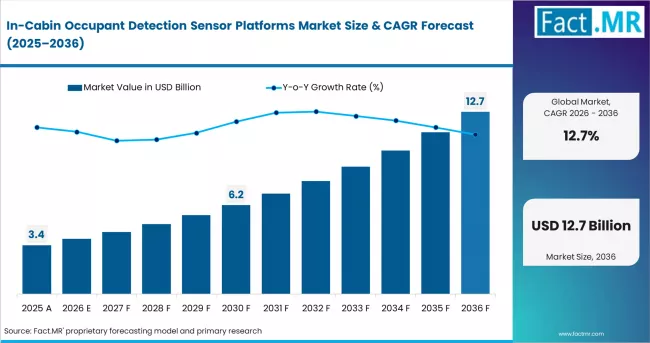
In Cabin Occupant Detection Sensor Platforms Market Value Analysis | Source: Fact.MR
Summary of In-Cabin Occupant Detection Sensor Platforms Market
- Market Definition
- The market includes in-cabin sensing platforms used to detect occupants, classify their position, and support child presence and occupant protection functions. [1]
- Demand Drivers
- Child presence and life presence detection are becoming more important as vehicle safety expectations expand beyond crash events.
- Occupant detection now supports more than seat occupancy, including posture, location, and adaptive restraint decisions.
- Euro NCAP’s 2026 direction puts stronger focus on occupant presence and occupant classification inside the cabin.
- Key Segments Analyzed
- By Platform Type: Interior radar occupant detection systems are estimated to lead with approximately 35% share in 2026, supported by life-presence detection and hidden integration potential.
- By Function Type: Child presence detection is expected to hold approximately 31% share in 2026, driven by stronger safety focus and protocol attention.
- By Vehicle Class: Passenger cars are projected to account for approximately 39% share in 2026, supported by wider premium-safety feature migration.
- By Geography: India leads growth at 10.3% CAGR through 2036, supported by rising premium safety-feature fitment.
- These share values are model-based estimates rather than figures directly published in the cited sources.
- Analyst Opinion at FACT.MR
- Shambhu Nath Jha, Senior Analyst at Fact.MR, opines, market as an interior safety intelligence category rather than a niche cabin sensor segment. Buyers are not only paying for occupancy detection. They are paying for a sensing layer that supports child safety, adaptive restraint logic, and broader in-cabin awareness.
- Strategic Implications
- Invest in occupant detection platforms that combine child presence sensing with adaptive restraint and posture awareness.
- Build technical sales capability around direct life-presence detection, interior radar integration, and occupant classification rather than sensor modality alone.
- Position combined radar-camera cabin platforms where OEMs want stronger interior safety value from one architecture. [3]
| Metric | Value |
|---|---|
| Estimated Value in 2026 | USD 4.6 billion |
| Forecast Value in 2036 | USD 11.1 billion |
| Forecast CAGR (2026 to 2036) | 9.2% |
Source: Fact.MR analysis. Updated Apr 24, 2026
The market is projected to generate USD 6.5 billion in absolute opportunity between 2026 and 2036. Growth is being supported by rising in-cabin safety requirements, stronger attention to child presence detection, and broader OEM demand for smarter occupant classification and adaptive restraint control. Valeo states that its interior radar-based occupant monitoring system can detect the presence of living beings in the car, including newborns and children up to six years old. [2]
India is projected to lead with a CAGR of 10.3% through 2036, driven by rising premium safety-feature migration and stronger fitment of in-cabin sensing in passenger vehicles. China follows at 9.8%, supported by high smart-vehicle volume and quicker rollout of interior radar and camera sensing. The United States is expected to grow at 9.3%, underpinned by stronger child safety awareness and wider interior monitoring deployment. Germany records 8.7%, backed by premium OEM integration and safety-test pressure. South Korea grows at 8.3%, supported by strong cabin electronics capability.
Segmental Analysis
In-Cabin Occupant Detection Sensor Platforms Market Analysis by Platform Type
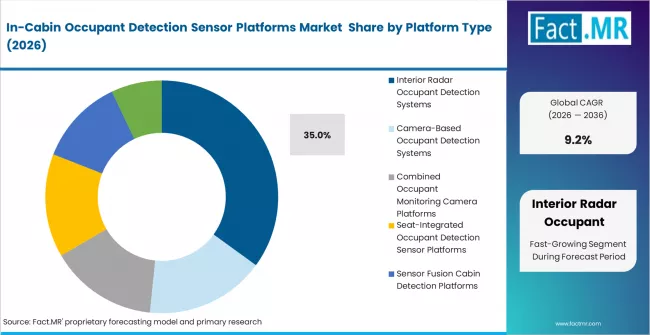
In Cabin Occupant Detection Sensor Platforms Market Analysis By Platform Type | Source: Fact.MR
Interior radar occupant detection systems are estimated to hold 35% share in 2026. Their lead is driven by the growing preference for radar-based sensing that enables direct life-presence detection without relying on continuous visible-light monitoring inside the cabin. This makes radar particularly effective in low-light conditions, occluded seating positions, and privacy-sensitive use cases. Valeo highlights that its interior radar occupant monitoring system can detect newborns and children up to six years old, reinforcing the technology’s relevance for child presence detection and safety compliance. As in-cabin sensing expands, radar-based solutions are gaining traction for their reliability, passive operation, and ability to support safety-critical applications.
- Interior radar leads because it supports direct life-presence detection and discreet integration.
- Camera-based occupant detection remains attractive where occupant posture and seat-position awareness are important.
- Fusion cabin platforms gain relevance where one system is expected to support multiple interior safety functions.
In-Cabin Occupant Detection Sensor Platforms Market Analysis by Function Type
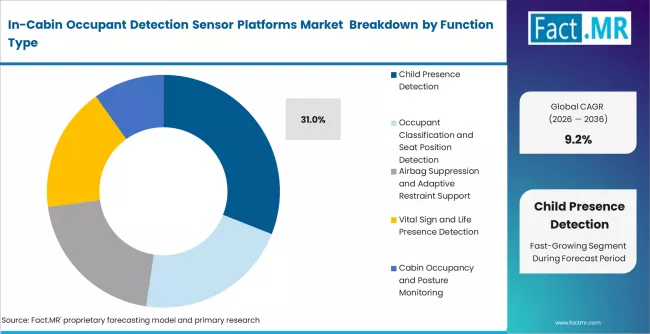
In Cabin Occupant Detection Sensor Platforms Market Analysis By Function Type | Source: Fact.MR
Child presence detection is expected to hold approximately 31% share in 2026, driven by its clear safety relevance and regulatory attention. The segment leads because hot-car child fatality risk has made CPD one of the most visible and urgent use cases for in-cabin sensing systems. Safety initiatives from National Highway Traffic Safety Administration, including its 2025 heatstroke awareness campaign, reinforce the importance of detecting unattended children in vehicles. At the same time, Euro NCAP protocols are increasing focus on occupant monitoring, further supporting adoption. As a result, CPD is becoming a core application within interior sensing systems, combining regulatory pressure with strong consumer and OEM safety priorities. [4]
- Child presence detection leads because it is the clearest safety use case tied to in-cabin life-presence detection.
- Occupant classification and adaptive restraint support remain important where airbag logic and seat-position interpretation matter.
- Vital sign and life-presence detection gain relevance where OEMs want higher-value interior safety differentiation.
In-Cabin Occupant Detection Sensor Platforms Market Analysis by Vehicle Class
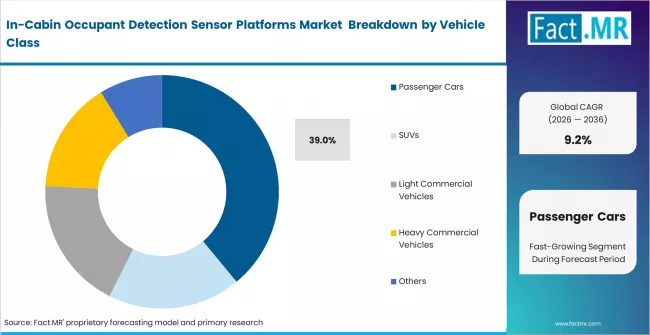
In Cabin Occupant Detection Sensor Platforms Market Analysis By Vehicle | Source: Fact.MR
Passenger cars are projected to account for approximately 39% share in 2026. Their lead is driven by the combination of high production volumes and rapid migration of child presence detection and occupant monitoring features from premium trims into mainstream vehicle programs. As safety and convenience features scale across segments, passenger vehicles provide the largest platform for widespread adoption. Valeo and Bosch both position interior sensing systems as broad safety solutions rather than niche applications, reinforcing their integration across high-volume passenger vehicle platforms.
- Passenger cars lead because they provide the broadest future volume base for occupant detection scaling.
- SUVs remain attractive where family-vehicle positioning raises the value of child presence detection.
- Light commercial vehicles gain traction where long occupancy hours and fleet safety requirements create additional value.
Drivers, Restraints, and Opportunities
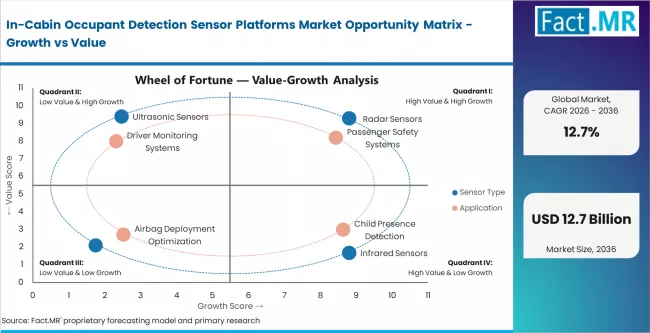
In Cabin Occupant Detection Sensor Platforms Market Opportunity Matrix Growth Vs Value | Source: Fact.MR
The market is being shaped by the need to improve interior safety intelligence beyond traditional crash sensing alone. Structural demand is anchored in child presence detection, occupant classification, and adaptive restraint support. Bosch explicitly links occupant monitoring data to improved seat belt reminder and automatic airbag suppression logic.
The main restraint is cost, validation burden, and architecture choice. OEMs still need to decide whether to use radar, cameras, seat-integrated sensing, or combined architectures depending on cabin layout and cost targets. Child presence and occupant presence systems must also prove reliable detection across real cabin conditions. This means suppliers still need to prove value in false-negative control, seat coverage, and real-world robustness.
- Child presence detection remains the clearest opportunity where OEMs want stronger family and safety positioning.
- Radar-based life-presence systems create stronger value where discreet cabin integration is preferred.
- Combined occupant detection and adaptive restraint platforms offer higher-value opportunity than simple seat-occupancy logic.
Regional Analysis
The market is assessed across North America, Europe, Asia Pacific, Latin America, and Middle East and Africa, covering 40+ countries with demand profiles shaped by child safety emphasis, premium vehicle mix, interior sensing supplier strength, and OEM safety strategy. The country growth rates below are model-based estimates.
.webp "Top Country Growth Comparison In Cabin Occupant Detection Sensor Platforms Market Cagr (2026 2036)")
Top Country Growth Comparison In Cabin Occupant Detection Sensor Platforms Market Cagr (2026 2036) | Source: Fact.MR
| Country | CAGR (2026 to 2036) |
|---|---|
| India | 10.3% |
| China | 9.8% |
| United States | 9.3% |
| Germany | 8.7% |
| South Korea | 8.3% |
Source: Fact.MR analysis. Updated Apr 24, 2026
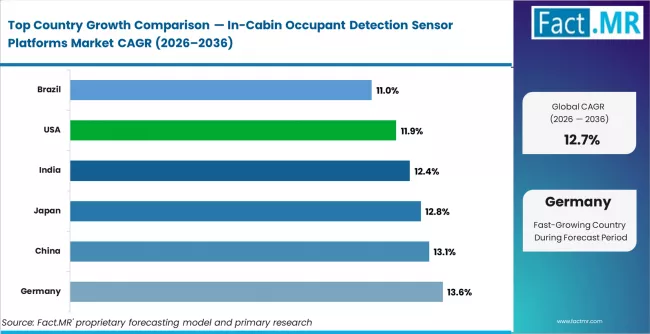
In Cabin Occupant Detection Sensor Platforms Market Cagr Analysis By Country | Source: Fact.MR
North America In-Cabin Occupant Detection Sensor Platforms Market Analysis
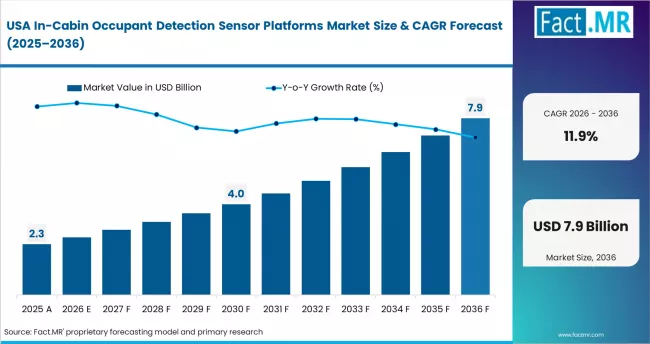
In Cabin Occupant Detection Sensor Platforms Market Country Value Analysis | Source: Fact.MR
North America remains an important commercial region because it combines stronger child safety awareness, premium SUV and passenger-car demand, and increasing interest in cabin intelligence for safety. NHTSA’s 2025 heatstroke campaign and related reporting reinforce the relevance of left-behind-child detection in the region.
- United States: Stronger child safety awareness and wider interior sensing adoption support growth. The market is projected to expand at a CAGR of 9.3% through 2036, driven by increasing integration of occupant detection and monitoring systems across vehicle segments.
Europe In-Cabin Occupant Detection Sensor Platforms Market Analysis
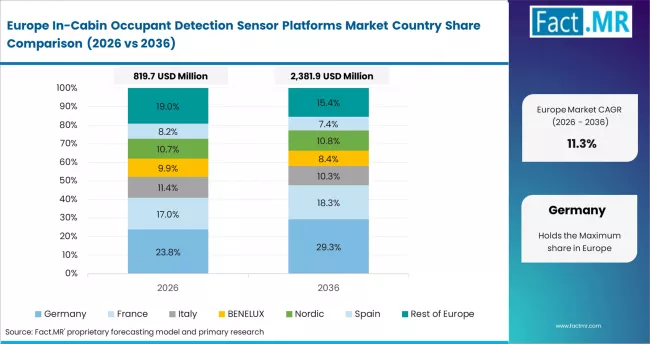
In Cabin Occupant Detection Sensor Platforms Market Europe Country Market Share Analysis, 2026 & 2036 | Source: Fact.MR
Europe remains a technically managed and regulation-driven region where adoption is closely tied to safety assessment frameworks, premium OEM integration, and structured occupant monitoring requirements.
- Germany: Strong automotive engineering capability and premium vehicle production support demand. The market is projected to grow at a CAGR of 8.7% through 2036, driven by increasing integration of occupant detection and classification systems. OEMs are focusing on enhancing in-cabin safety, meeting regulatory expectations, and improving occupant monitoring accuracy across advanced vehicle platforms.
Asia Pacific and Latin America In-Cabin Occupant Detection Sensor Platforms Market Analysis
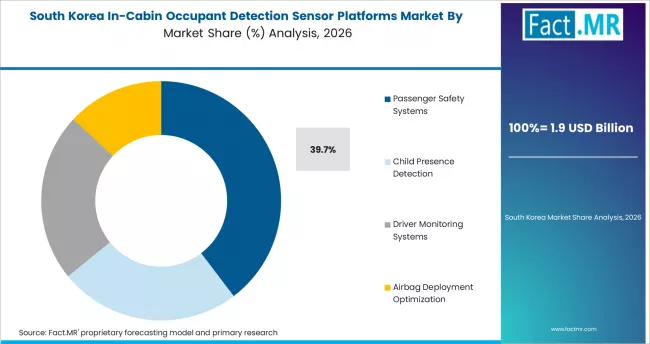
In Cabin Occupant Detection Sensor Platforms Market South Korea Market Share Analysis By Application | Source: Fact.MR
Asia Pacific offers the strongest long-term expansion potential because it combines high vehicle production, rising smart-cabin adoption, and stronger supplier capability in cabin radar and interior sensing. Bosch and Valeo both position interior sensing as a broader platform for occupant safety.
- India: Rising premium safety-feature migration and stronger cabin electronics adoption support demand. The market is projected to grow at a CAGR of 10.3% through 2036, driven by increasing awareness of in-cabin safety and feature-rich vehicle offerings.
- China: High smart-vehicle volumes and rapid rollout of interior radar and camera systems continue to support growth. The market is projected to grow at a CAGR of 9.8% through 2036, with strong integration across domestic vehicle production.
- South Korea: Strong interior electronics ecosystems support steady growth. The market is projected to grow at a CAGR of 8.3% through 2036, backed by advanced automotive electronics capabilities.
Competitive Aligners for Market Players
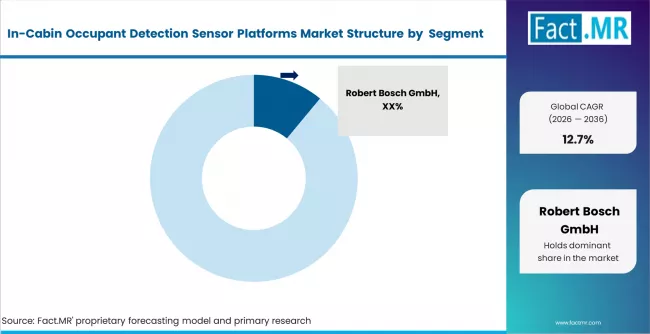
In Cabin Occupant Detection Sensor Platforms Market Analysis By Company | Source: Fact.MR
The market is moderately concentrated at the interior sensing and integrated cabin-platform level, while broader vehicle deployment remains OEM-controlled. Competitive strength comes from the ability to combine life-presence detection, occupant classification, adaptive restraint support, and compact cabin integration. Suppliers need more than a cabin sensor claim. They need a clear explanation of how the system improves child safety, airbag logic, and broader occupant awareness in production vehicles.
Competitive advantage is defined by direct sensing capability, hidden integration, fusion-readiness, low false-alarm performance, and ability to support both occupant monitoring and child presence functions. This competitive framing is an analytical view derived from current supplier disclosures rather than a published market-share table.
Representative Players
- Bosch
- Valeo
- Magna
- Smart Eye
- Seeing Machines
- Cipia
- Continental
- Denso
- FORVIA
This player set is indicative rather than a verified global share ranking. It reflects visible participation in interior sensing, child presence detection, and occupant monitoring categories.
Bibliography
- [1] Bosch. Interior sensing solutions describing occupant monitoring camera and cabin sensing radar support for occupant position recognition and passive safety enhancement.
- [2] Valeo. Interior radar-based occupant monitoring system describing detection of living beings including newborns and children up to six years old.
- [3] Valeo. Ultra-wideband occupancy monitoring system materials describing top-of-cabin detection of living beings.
- [4] NHTSA. 2025 heatstroke campaign materials on children left behind in vehicles.
This Report Addresses
- Strategic intelligence on in-cabin occupant detection platform demand across child presence detection, occupant classification, and adaptive restraint architectures.
- Market forecast from USD 4.6 billion in 2026 to USD 11.1 billion by 2036 at a CAGR of 9.2%.
- Growth opportunity mapping across interior radar occupant detection, camera-based cabin sensing, sensor-and-ECU assemblies, and fusion-based occupant monitoring platforms.
- Segment analysis by platform type, function type, vehicle class, integration type, and end use.
- Regional outlook covering North America, Europe, Asia Pacific, Latin America, and Middle East and Africa.
- Competitive analysis of major suppliers serving child presence detection, occupant monitoring, and adaptive restraint support integration.
- In-cabin safety analysis covering life-presence detection, occupant classification, seat-position awareness, and family-vehicle safety logic.
- Market interpretation built around child safety demand, interior sensing expansion, and broader OEM interest in intelligent cabin protection systems.
Market Definition
The market covers in-cabin sensor platforms used to detect, classify, and monitor vehicle occupants for safety, restraint adaptation, life-presence detection, and occupant-state awareness. It includes cabin radar systems, occupant monitoring cameras, combined camera-radar platforms, seat-related sensing platforms, and related integrated cabin detection architectures.
In-Cabin Occupant Detection Sensor Platforms Market Inclusions
Covers global and regional forecasts from 2026 to 2036. Includes child presence detection systems, occupant classification platforms, adaptive restraint support sensing, vital sign and life presence detection, and combined cabin monitoring platforms sold for OEM interior safety integration.
In-Cabin Occupant Detection Sensor Platforms Market Exclusions
Excludes cabin cameras used only for infotainment or conferencing, exterior ADAS cameras, rearview cameras, and seat sensors used only for simple seatbelt reminders unless occupant detection remains the core function. It also excludes driver monitoring systems where occupant detection is not part of the main product role.
In-Cabin Occupant Detection Sensor Platforms Market Research Methodology
- Primary Research
- Interviews with interior sensing engineers, passive safety specialists, occupant monitoring suppliers, OEM sourcing teams, and cabin-electronics planners.
- Desk Research
- Uses current Bosch and Valeo interior sensing materials, Euro NCAP occupant monitoring references, and NHTSA child heatstroke campaign materials.
- Market-Sizing and Forecasting
- Hybrid model using child presence detection relevance, adaptive restraint demand, interior radar and camera fitment growth, OEM integration rates, and safety-test influence.
- Data Validation and Update Cycle
- Validated using supplier product disclosures, safety protocol updates, and recurring checks on occupant monitoring, child presence detection, and adaptive restraint direction.
Segmentation
Scope of Report
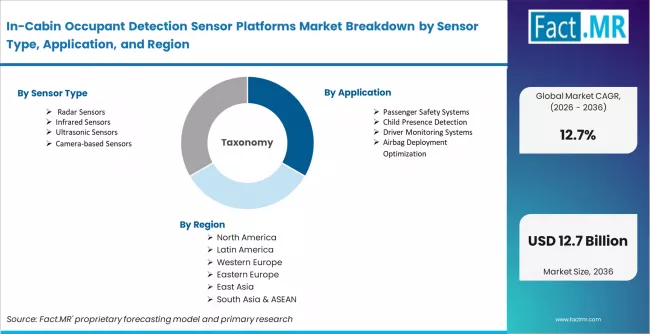
In Cabin Occupant Detection Sensor Platforms Market Breakdown By Sensor Type Application And Region | Source: Fact.MR
| Attribute | Details |
|---|---|
| Quantitative Units | USD 4.6 billion (2026) to USD 11.1 billion (2036), at a CAGR of 9.2% |
| Market Definition | In-cabin sensor platforms used to detect, classify, and monitor vehicle occupants for child presence, occupant protection, and adaptive restraint functions |
| Platform Type Segmentation | Interior Radar Occupant Detection Systems, Camera-Based Occupant Detection Systems, Combined Occupant Monitoring Camera Platforms, Seat-Integrated Occupant Detection Sensor Platforms, Sensor Fusion Cabin Detection Platforms, Others |
| Function Type Segmentation | Child Presence Detection, Occupant Classification and Seat Position Detection, Airbag Suppression and Adaptive Restraint Support, Vital Sign and Life Presence Detection, Cabin Occupancy and Posture Monitoring, Others |
| Vehicle Class Segmentation | Passenger Cars, SUVs, Light Commercial Vehicles, Heavy Commercial Vehicles, Others |
| Regions Covered | North America, Europe, Asia Pacific, Latin America, Middle East and Africa |
| Countries Covered | United States, Germany, China, India, South Korea, Japan, and 40+ countries |
| Forecast Period | 2026 to 2036 |
| Approach | Hybrid top-down and bottom-up model using child presence relevance, occupant classification demand, interior sensing fitment growth, and primary interviews with OEM, supplier, and interior-safety specialists |
Source: Fact.MR analysis. Updated Apr 24, 2026
In-Cabin Occupant Detection Sensor Platforms Market by Segments
-
By Platform Type:
- Interior Radar Occupant Detection Systems
- Camera-Based Occupant Detection Systems
- Combined Occupant Monitoring Camera Platforms
- Seat-Integrated Occupant Detection Sensor Platforms
- Sensor Fusion Cabin Detection Platforms
- Others
-
By Function Type:
- Child Presence Detection
- Occupant Classification and Seat Position Detection
- Airbag Suppression and Adaptive Restraint Support
- Vital Sign and Life Presence Detection
- Cabin Occupancy and Posture Monitoring
- Others
-
By Vehicle Class:
- Passenger Cars
- SUVs
- Light Commercial Vehicles
- Heavy Commercial Vehicles
- Others
-
By Region:
- North America
- United States
- Canada
- Mexico
- Latin America
- Brazil
- Argentina
- Chile
- Rest of Latin America
- Western Europe
- Germany
- France
- United Kingdom
- Italy
- Spain
- Nordic Countries
- BENELUX
- Rest of Western Europe
- Eastern Europe
- Russia
- Poland
- Hungary
- Balkan and Baltic
- Rest of Eastern Europe
- East Asia
- China
- Japan
- South Korea
- South Asia and Pacific
- India
- ASEAN
- Australia and New Zealand
- Rest of South Asia and Pacific
- Middle East and Africa
- Kingdom of Saudi Arabia
- Other GCC Countries
- Turkey
- South Africa
- Rest of Middle East and Africa
- North America
Frequently Asked Questions
How large is the global in-cabin occupant detection sensor platforms market in 2025?
What will the market size be in 2026?
What is the projected market size by 2036?
What is the expected CAGR from 2026 to 2036?
Which platform type is poised to lead the market?
Which function segment holds the largest share?
Which vehicle class is expected to remain strongest?
Which country shows the fastest growth?
What is driving demand for in-cabin occupant detection sensor platforms?
What is the key challenge in this market?
Who worked on this report


Preview the report firsthand - request a free sample
Free SampleGet the brochure for pricing and purchase details
Download PDF