- Market Value (2025): USD 6.8 Bn
- Estimated Value (2026): USD 7.09 Bn
- Forecast Value (2036): USD 10.8 Bn
- CAGR (2026-2036): 4.3%
What is the Localization Software Market forecast to be worth by 2036?
USD 7.1 billion in 2026 to USD 10.8 billion by 2036 at a 4.3% CAGR.
- At USD 6.8 billion in 2025, the localization software market already served enterprises, software developers and multilingual content teams across every major region.
- By 2036 the market will reach USD 10.8 billion, up from USD 7.09 billion in 2026, as companies move more of their web, app and support content into managed translation workflows.
- A 4.3% CAGR reflects a buyer base that renews subscriptions steadily and adds languages as it enters new markets, with AI features lifting the value of each seat.
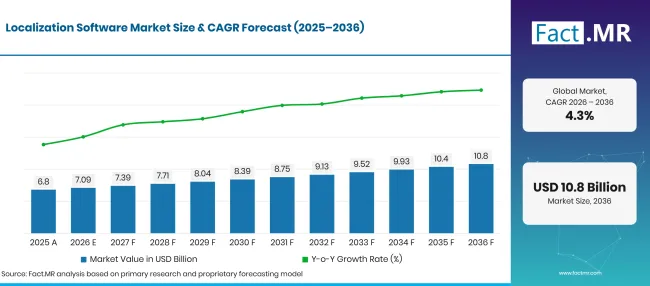
Localization Software Market Forecast Global | Source: Fact.MR
| Year | Basis | Market Value (USD billion) |
|---|---|---|
| 2025 | Actual | 6.8 |
| 2026 | Estimate | 7.09 |
| 2036 | Forecast | 10.8 |
| CAGR 2026 to 2036 | Forecast period | 4.3% |
Source: Fact.MR analysis. Updated Nov 9, 2026
What are the defining numbers behind Localization Software Market growth?
The 2026 to 2036 period will add USD 3.7 billion in new value, most of it from cloud subscriptions sold to large enterprises in software and telecom.
- Demand Drivers in the Market
- Public institutions now run machine translation at very high volume. The European Commission’s eTranslation service processed more than 890 million pages in 2025, up from 764 million in 2024 [1]. That scale shows how far automated translation has moved into routine content work.
- Online retail keeps widening the amount of product, payment and service text that needs a local version. US e-commerce sales accounted for 17.1% of total retail sales in the second quarter of 2026 [2]. Sellers that reach foreign shoppers need listings, checkout pages and support replies in each target language.
- Mobile app and SaaS release cycles have shortened to weeks or days. Each release carries new interface strings, help pages and in-app messages, so teams want continuous localization tied directly to their build pipeline.
- AI translation now handles the first draft of repetitive content at low cost. Human linguists still review tone, legal wording and brand terms, which keeps demand high for platforms that combine machine output with structured review.
- Key Segments Analyzed
- By Deployment Type: Cloud-based will hold 63.4% share in 2026, since shared translation memories and browser-based review suit teams spread across several countries.
- By Enterprise Size: Large Enterprises will account for 65.3% of 2026 revenue, reflecting the number of brands, regions and product lines they must keep consistent in every language.
- By End-User Industry: IT and Telecommunications will capture 22.8% of 2026 demand, given frequent software updates and global app launches that each require new strings.
- Analyst Opinion at Fact.MR
- Shambhu Nath Jha, Principal Consultant at Fact.MR, states, “Localization software will turn into a standing line item for any business that ships digital products across borders. AI agents will take over first-pass translation and quality checks, while human review will concentrate on brand voice and regulated text. Vendors that plug directly into code, content and design tools will win the renewals, because buyers will measure them on release speed.”
- Strategic Implications
- Software vendors should invest in connectors for Git, headless CMS platforms and design tools, since integration depth now decides platform choice.
- Language service providers should package human review on top of AI output and price it by quality tier for regulated or brand-critical content.
- Enterprise buyers should consolidate scattered regional tools into one platform with shared terminology to cut duplicate spend.
- Investors should favor platforms with high net revenue retention in software and telecom accounts, where content volumes rise with every product release.
Germany leads the country set at 5.0%, helped by export-heavy manufacturers that publish technical documentation in many languages and a heavily funded national digital roadmap. Brazil follows at 4.5%, where a large online population and Portuguese-only audiences push foreign software firms to localize. The United States records 4.1%; its base is already mature, so growth comes mostly from new AI features and language additions. The United Kingdom, at 3.7%, relies on services exports for demand, while Japan trails at 3.2% as companies weigh localization spend against labor shortages and long software procurement cycles.
How does the Localization Software Market break down by segment?
Cloud-based will lead Deployment Type at 63.4%; Large Enterprises will head Enterprise Size at 65.3%; IT and Telecommunications will hold End-User Industry at 22.8% in 2026.
Which Deployment Type leads?
Cloud-based takes 63.4% of 2026 sales.
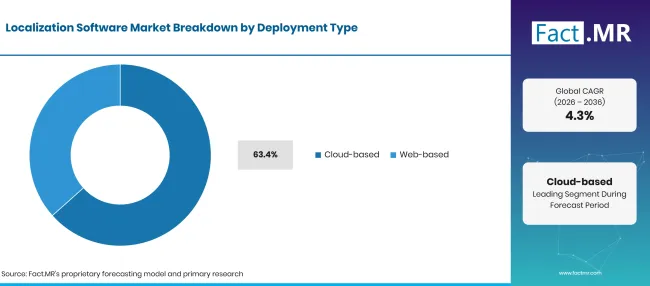
Localization Software Market Breakdown Deployment Type | Source: Fact.MR
| Deployment Type | Share (2026) |
|---|---|
| Cloud-based (Leading segment) | 63.4% |
| Other segments combined | 36.6%* |
| Total | 100.0% |
Source: Fact.MR analysis. Updated Nov 9, 2026
Localization teams rarely work in one office. Project managers, in-house reviewers and external translators need the same translation memory at the same moment, and cloud platforms deliver that without local installs. Subscription pricing also lets companies add seats during a launch and remove them afterward. Many vendors build on the same cloud computing infrastructure that hosts their customers’ apps, which simplifies data residency choices. Web-based tools keep a role for smaller teams and for organizations with strict hosting rules. Public bodies show how API-linked language services spread: the European Commission added WebText and Accessible Text in 2025, both available through a web interface or an API connection to other systems [3]. Private platforms follow the same pattern of browser access plus programmatic links.
What supports Large Enterprises within Enterprise Size?
Large Enterprises account for 65.3% of 2026 revenue.
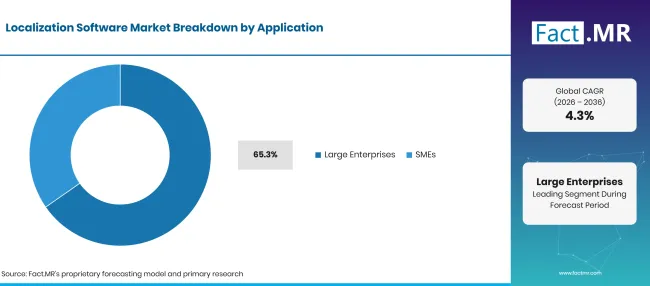
Localization Software Market Breakdown Application | Source: Fact.MR
| Enterprise Size | Share (2026) |
|---|---|
| Large Enterprises (Leading segment) | 65.3% |
| Other segments combined | 34.7%* |
| Total | 100.0% |
Source: Fact.MR analysis. Updated Nov 9, 2026
Multinational companies publish websites, product documentation and customer emails in dozens of markets at once. A single wrong term in a contract or safety notice can cause legal and reputational trouble, so these firms pay for terminology control, approval workflows and audit trails. Localization budgets are often funded through wider digital transformation programs, which helps large buyers justify enterprise licenses. SMEs also use localization platforms, mostly through self-service cloud plans. Smaller content volumes and tighter budgets limit their uptake of advanced features such as custom AI models, single sign-on and dedicated account support. Vendors increasingly target this group with usage-based pricing and ready-made integrations for common web builders.
How does End-User Industry shape demand?
IT and Telecommunications represents 22.8% of 2026 demand.
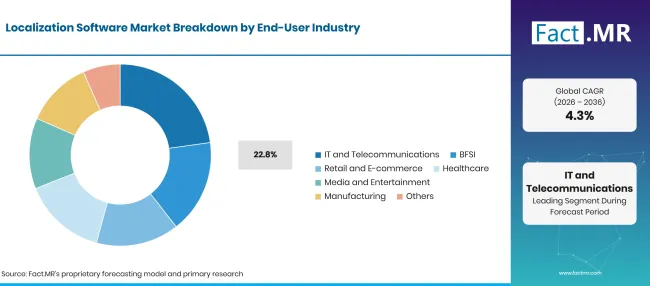
Localization Software Market Breakdown End User Industry | Source: Fact.MR
| End-User Industry | Share (2026) |
|---|---|
| IT and Telecommunications (Leading segment) | 22.8% |
| Other segments combined | 77.2%* |
| Total | 100.0% |
Source: Fact.MR analysis. Updated Nov 9, 2026
Software companies, telecom operators and digital service firms push new interface text, release notes and support articles every week. Translation must run inside the developer workflow, so these buyers value API access, string-level version control and automatic pull requests. Advances in natural language processing have also made machine output good enough for large volumes of interface text. UK exports of telecommunication, computer and information services rose by GBP 7.5 billion in 2025, a sign of how much digital service work now crosses borders [4]. BFSI, retail and e-commerce, healthcare, media and entertainment and manufacturing complete the end-user mix. Banks and insurers focus on regulated disclosures, retailers on product catalogs, and manufacturers on manuals and spare-parts data. Media firms add subtitling and dubbing needs, which pulls video tools into localization suites.
What is accelerating Localization Software Market adoption, and what is holding it back?
Growth comes from rising multilingual content volumes, cloud delivery and AI translation that cuts the cost of each new language. Buyers also want one platform for web, app and support content. Adoption slows where implementation costs are high, where legacy content systems resist integration, and where data privacy rules restrict which AI engines may process customer text.
Drivers Impact Analysis
| DRIVER | (~) % IMPACT ON CAGR | GEOGRAPHIC RELEVANCE | IMPACT TIMELINE |
|---|---|---|---|
| Increasing international expansion of digital businesses and multilingual content requirements | +1.5% | Global | Long term (>=4 years) |
| Growing adoption of cloud-based localization and translation management platforms | +1.2% | North America, Western Europe, East Asia | Medium term (2-4 years) |
| Rising software, mobile application and SaaS product localization requirements | +1.0% | Global | Medium term (2-4 years) |
| Integration of AI-assisted translation and automated localization workflows | +0.8% | North America, Western Europe, East Asia | Short term (<=2 years) |
Source: Fact.MR analysis. Updated Nov 9, 2026
Opportunity Impact Analysis
| OPPORTUNITY | (~) % IMPACT ON CAGR | GEOGRAPHIC RELEVANCE | IMPACT TIMELINE |
|---|---|---|---|
| AI-powered localization platforms with contextual translation and automated quality assurance | +0.5% | Global | Medium term (2-4 years) |
| Affordable cloud-based localization subscriptions for SMEs entering international markets | +0.3% | Latin America, Asia-Pacific, Middle East | Long term (>=4 years) |
| Integration of localization platforms with DevOps, CI/CD and enterprise content management systems | +0.3% | North America, Western Europe, East Asia | Medium term (2-4 years) |
| Expansion of localization support for emerging regional languages and digital markets | +0.2% | Asia-Pacific, Latin America, Middle East | Long term (>=4 years) |
Source: Fact.MR analysis. Updated Nov 9, 2026
Restraints Impact Analysis
| RESTRAINT | (~) % IMPACT ON CAGR | GEOGRAPHIC RELEVANCE | IMPACT TIMELINE |
|---|---|---|---|
| High subscription, implementation and integration costs for enterprise localization platforms | -0.6% | Global | Short term (<=2 years) |
| Linguistic accuracy challenges and human review requirements for automated translations | -0.4% | Global | Medium term (2-4 years) |
| Data security, privacy and regulatory compliance requirements across international markets | -0.3% | North America, Western Europe, East Asia | Medium term (2-4 years) |
| Integration complexity with legacy software and existing enterprise content systems | -0.2% | Global | Long term (>=4 years) |
Source: Fact.MR analysis. Updated Nov 9, 2026
Which countries are scaling the Localization Software Market through 2036?
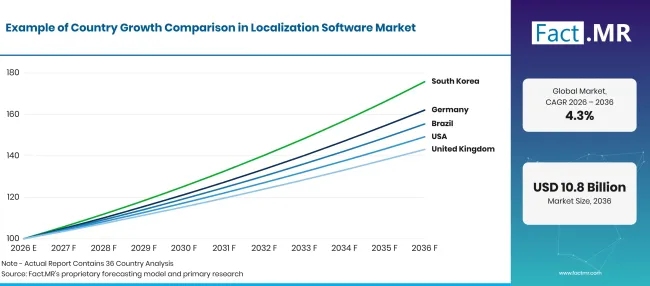
Localization Software Market Growth Index | Source: Fact.MR
| Country | CAGR (2026 to 2036) |
|---|---|
| Germany | 5.0% |
| Brazil | 4.5% |
| United States | 4.1% |
| United Kingdom | 3.7% |
| Japan | 3.2% |
Source: Fact.MR analysis. Updated Nov 9, 2026
What supports adoption in Germany?
5.0% CAGR, driven by export manufacturing and a funded national digital roadmap.
German machine builders, automakers and chemical firms ship manuals, safety sheets and software screens to customers worldwide, and each document needs accurate technical terminology. Public support adds momentum. Germany’s 2026 Digital Decade roadmap lists 50 measures with a total budget of EUR 102.1 billion, and the country counted 74 unicorns in 2025 [5]. Young scale-ups of that kind often localize from launch to reach other EU markets.
How is Brazil developing demand?
4.5% CAGR, backed by a large online population that expects Portuguese content.
Brazil’s national statistics agency reported that 90.5% of people aged 10 and older used the internet in 2025, or 168.7 million users [6]. Few of them browse in English, so foreign software firms, marketplaces and fintech apps must offer Portuguese interfaces to compete. Cloud subscriptions let local teams manage that work without building in-house translation systems.
What is shaping the United States’ adoption?
4.1% CAGR, helped by a deep base of SaaS firms and large services exports.
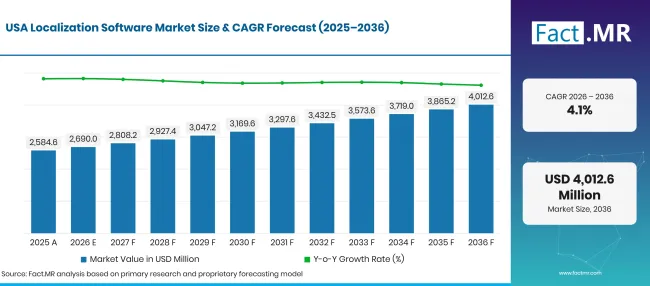
Localization Software Market Forecast Usa | Source: Fact.MR
US technology companies, SaaS developers and multinationals run some of the biggest localization programs in the world, often tied to weekly product releases. Integration with content management systems and developer tools carries the most weight in purchase decisions. US exports of services reached USD 1,234.9 billion in 2025, up USD 82.1 billion from 2024, showing the scale of business sold to foreign customers [7].
What supports adoption in the United Kingdom?
3.7% CAGR, reflecting a services economy that sells heavily abroad.
Software firms, banks and retailers in the United Kingdom serve customers across Europe, North America and Asia. They need localized websites, contracts and help content, usually managed through shared terminology and centralized review. Total UK services exports rose from GBP 487.2 billion in 2024 to GBP 522.8 billion in 2025 [4]. That export base keeps steady demand for translation management tools.
How does Japan perform?
3.2% CAGR, as firms pair localization with automation to offset labor shortages.
Japanese manufacturers and game studios prepare interfaces, manuals and marketing for overseas buyers, while foreign vendors localize into Japanese to enter the domestic market. Workforce pressure shapes buying choices. The Digital Agency’s FY2026 priority plan warns of a shortage of about 3.4 million AI and robotics personnel by 2040 [8]. Companies therefore lean on AI translation with lean review teams, though long procurement cycles slow new platform contracts.
Who leads the Localization Software Market?
The market splits into three groups. Enterprise translation management suites from Phrase, RWS and Smartling compete on workflow depth, security and AI that fits regulated content. Phrase widened its platform in June 2025 with Phrase Studio for audio and video localization and an agentic content system for translation and post-editing [9].
RWS brought its Trados app into the Microsoft Marketplace in November 2025, so users can reach approved terminology inside Copilot and Teams [10]. Smartling reported in January 2026 that enterprise customers moved AI translation from testing to production during 2025 [11]. A second group, led by Lokalise, Crowdin, Transifex and POEditor, wins developer teams with Git syncs, SDKs and continuous localization; Crowdin added native AI quality checks in February 2025 [12]. Smartcat and BLEND form a third group that blends AI translation software with access to human linguists. Ease of integration and the quality of AI output will separate winners from the rest.
Which companies are the key providers?
Key companies include Phrase, RWS, Smartling, Lokalise, Crowdin, Transifex, POEditor, Smartcat and BLEND.
- Phrase
- RWS
- Smartling
- Lokalise
- Crowdin
- Transifex
- POEditor
- Smartcat
- BLEND
Bibliography
- [1] Directorate-General for Translation, European Commission. (2026, August 12). DG Translation in figures.
- [2] U.S. Census Bureau. (2026, August 18). Quarterly Retail E-Commerce Sales.
- [3] Directorate-General for Translation, European Commission. (2025, March 24). New AI services to simplify your texts.
- [4] Office for National Statistics. (2026, October 30). UK Balance of Payments, The Pink Book: 2026.
- [5] European Commission. (2026, August 24). Germany’s 2026 Digital Decade Country Report.
- [6] Brazilian Institute of Geography and Statistics. (2026, July 2). Proportion of Internet users in Brazil exceeded 90% of population aged 10 or over, in 2025.
- [7] U.S. Bureau of Economic Analysis. (2026, February 19). U.S. International Trade in Goods and Services, December and Annual 2025.
- [8] Digital Agency, Government of Japan. (2026). FY2026 Priority Plan for the Advancement of a Digital Society: Overview (Provisional Translation).
- [9] Phrase. (2025, June 11). Phrase Unveils Its Most Powerful Release Yet with Multimedia Localization, Agentic AI, and Enhanced Developer Experience.
- [10] RWS (Trados). (2025, November 20). Say hello to Trados in the Microsoft universe!.
- [11] Smartling. (2026, January 29). Smartling Reports 218% Growth in AI Translation in 2025.
- [12] Crowdin. (2025, February 28). What’s New at Crowdin: February 2025.
This Report Answers
- How is revenue split between cloud-based and web-based localization software?
- Why do large enterprises spend more on localization, and which features justify their licenses?
- What makes IT and telecom firms the core buyers of continuous localization tools?
- In what ways are AI translation agents changing vendor competition and pricing?
- Which of the five profiled countries offers the quickest growth, and what explains the gaps between them?
- What restraints, from integration costs to data privacy rules, could slow adoption through 2036?
What does the Localization Software Market cover?
This study tracks software that helps organizations translate, adapt and maintain digital content in many languages. Revenue comes from subscriptions and enterprise licenses for translation management systems, software string management and multilingual content workflow tools. Adjacent translation software used by individual translators is relevant context but is not the core of this market.
Value is counted at the vendor level across large enterprises and SMEs. End-user coverage spans IT and telecommunications, BFSI, retail and e-commerce, healthcare, media and entertainment, manufacturing and other industries. Translation memory, terminology control, machine translation integration and automated quality checks count as part of the platform when sold within it.
What is included in the scope?
Cloud-based and web-based localization platforms and translation management systems.
Software localization tools for apps, websites and games, including Git, API and SDK connectors. Course and training content localized through platform workflows, such as material for e-learning apps. Built-in translation memory, glossaries, AI translation and quality assurance modules sold on subscription or enterprise license.
What is excluded from the scope?
Standalone human translation, interpretation and linguistic consulting fees.
General word processors and standalone machine translation engines without workflow or project management. Content writing, publishing services and language training. Hosting and operations fees billed separately through cloud managed services contracts.
How Was the Analysis Built?
The analysis draws on 120+ sources, 35+ company portfolios, 25+ countries, and more than 20 industry interviews.
- Primary Research: Primary research includes discussions with manufacturers, service providers, technology developers, distributors, end users, and subject-matter experts. These conversations examine purchasing priorities, product adoption, operational challenges, approval requirements, competitive positioning, and the factors that influence wider market acceptance.
- Desk Research: Desk research covers government statistics, regulatory publications, company filings, trade data, technical studies, industry associations, standards, public policy, and other authoritative sources. Every source used in the analysis is documented in the bibliography.
- Market Sizing and Forecasting: Market estimates combine historical performance, demand indicators, pricing and volume trends, segment shares, company participation, country-level growth, adoption patterns, investment activity, and barriers to market expansion.
- Data Validation and Update Cycle: Findings are validated by comparing primary interviews with public data, company activity, regulatory changes, trade patterns, and industry developments. Regular updates review new product launches, capacity changes, partnerships, approvals, and shifts in commercial adoption.
Segmentation
What is the report’s scope and coverage?
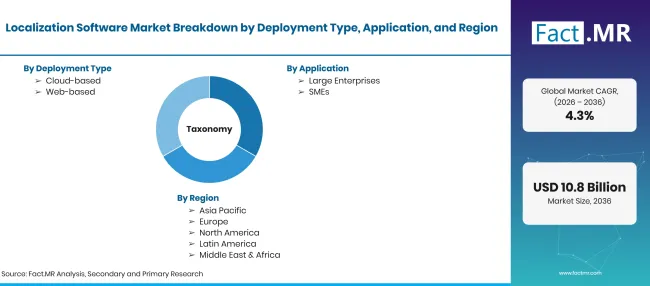
Localization Software Market Taxonomy | Source: Fact.MR
| Attribute | Details |
|---|---|
| Quantitative Units | USD billion |
| Market Definition | Software used to translate, adapt, manage and deliver digital content across languages and regional markets, including translation management systems, software localization tools and multilingual content workflows. |
| Deployment Type | Cloud-based; Web-based |
| Enterprise Size | Large Enterprises; SMEs |
| End-User Industry | IT and Telecommunications; BFSI; Retail and E-commerce; Healthcare; Media and Entertainment; Manufacturing; Others |
| Regions Covered | North America; Latin America; Western Europe; Eastern Europe; East Asia; South Asia & Pacific; Middle East & Africa |
| Countries Covered | Germany; Brazil; United States; United Kingdom; Japan |
| Companies Profiled | Phrase; RWS; Smartling; Lokalise; Crowdin; Transifex; POEditor; Smartcat; BLEND |
| Forecast Period | 2026 to 2036 |
| Approach | Hybrid top-down and bottom-up model built on enterprise localization spend, cloud subscription uptake, multilingual software release volumes and country digital indicators. |
Source: Fact.MR analysis. Updated Nov 9, 2026
How is the market segmented?
-
By Deployment Type
- Cloud-based
- Web-based
-
By Enterprise Size
- Large Enterprises
- SMEs
-
By End-User Industry
- IT and Telecommunications
- BFSI
- Retail and E-commerce
- Healthcare
- Media and Entertainment
- Manufacturing
- Others
-
By Region
- North America
- Latin America
- Western Europe
- Eastern Europe
- East Asia
- South Asia & Pacific
- Middle East & Africa
Frequently Asked Questions
How large is the localization software market in 2026?
What growth rate will the localization software market record?
Which deployment type leads?
Which enterprise size leads?
Which end-user industry leads?
Which country will grow quickest?
Who are the main companies?
What holds the market back?
Who worked on this report


Preview the report firsthand - request a free sample
Free SampleGet the brochure for pricing and purchase details
Download PDF