- Market Value (2025): USD 148.7 Mn
- Estimated Value (2026): USD 160.0 Mn
- Forecast Value (2036): USD 332.9 Mn
- CAGR (2026-2036): 7.6%
Encapsulated Choline Systems Market Forecast and Outlook 2026 to 2036
As per the Fact.MR analysis, the encapsulated choline systems market surpassed a value of USD 148.7 million in 2025 and is projected to grow from USD 160.0 million in 2026 to USD 332.9 million by 2036. Demand for encapsulated choline systems is likely to grow at a CAGR of 7.6% over the forecast period.
Demand for encapsulated choline systems is rising as infant formula, prenatal, cognitive and medical nutrition products add choline, a nutrient needed for brain development, liver function and cell membranes. Encapsulation masks choline's fishy odor, controls moisture uptake and protects it in mixtures. For example, EU rules for infant formula under Delegated Regulation (EU) 2016/127 set minimum choline levels, making it a standard ingredient. Similar requirements are projected to drive sales of encapsulated choline systems through 2036.
Key Takeaways from the Encapsulated Choline Systems Market
- Encapsulated Choline Systems Market Value (2025): USD 148.7 million
- Encapsulated Choline Systems Market Value (2026): USD 160.0 million
- Encapsulated Choline Systems Market Forecast Value (2036): USD 332.9 million
- Encapsulated Choline Systems Market Forecast CAGR (2026-2036): 7.6%
- Leading Choline active: Citicoline (32.4%)
- Key Market Participants: DSM-Firmenich, Lonza, Balchem, Kerry Group, Glanbia Nutritionals, IFF
- Key Growth Regions: United States, China, France, Germany, Japan
The American Medical Association recommended in 2017 that prenatal vitamins contain adequate choline, and many prenatal brands have since added it. Demand for encapsulated choline systems is growing as prenatal and maternal nutrition brands reformulate. Suppliers such as Balchem, with its VitaCholine range, are offering choline forms for these products. Similar recommendations are projected to drive sales of encapsulated choline systems in North America and beyond.
Encapsulated Choline Systems Market
| Metric | Value |
|---|---|
| Estimated Value in (2026) | USD 160.0 million |
| Forecast Value in (2036) | USD 332.9 million |
| Forecast CAGR (2026 to 2036) | 7.6% |
Source: Fact.MR analysis. Updated Nov 18, 2026
Source: Fact.MR analysis.
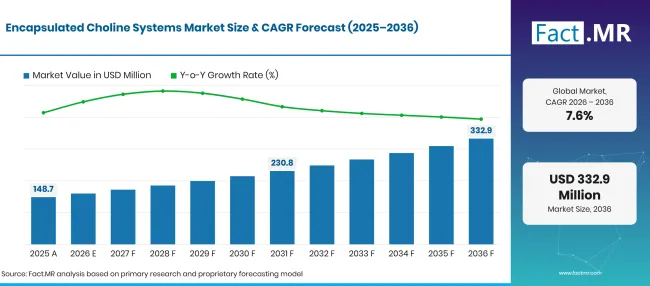
Encapsulated Choline Systems Forecast Global | Source: Fact.MR
Category
| Category | Segments |
|---|---|
| Choline active | Choline bitartrate, Choline chloride, Citicoline, Alpha-GPC, Phosphatidylcholine |
| Commercial form | Powder, Capsule / tablet, Liquid, Microcapsule, Ready-to-use blend |
| End application | Clinical nutrition, Supplements, Functional foods, Infant / pediatric, Specialized medical |
| Sales channel | Ingredient OEM, Medical nutrition brand, Hospital procurement, Pharmacy, Direct consumer |
| Region | United States; China; France; Germany; Japan |
Source: Fact.MR analysis. Updated Nov 18, 2026
Source: Fact.MR analysis.
Segmental Analysis
Why does Citicoline lead active demand in the Encapsulated Choline Systems Market?
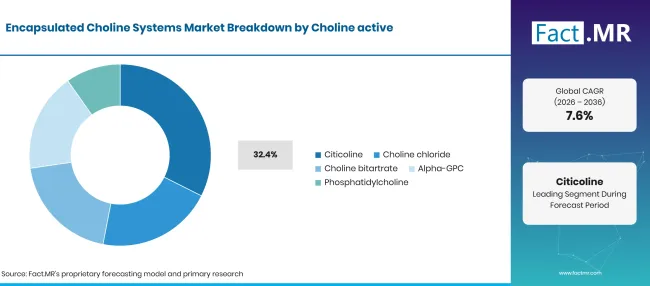
Encapsulated Choline Systems Breakdown Choline Active | Source: Fact.MR
Demand for Citicoline leads with 32.4% of 2026 revenue, about USD 51.8 million, as supplement manufacturers use it in products positioned for cognitive health and neurological support. Branded ingredients such as Cognizin from Kyowa Hakko help suppliers differentiate citicoline-based formulations through ingredient recognition and established formulation use. Phosphatidylcholine and choline bitartrate also serve nutrition and supplement applications, but citicoline benefits from its positioning in the cognitive-support category. The U.S. National Institutes of Health identifies choline as essential for neurotransmitter production and nervous-system function, reinforcing the broader nutritional relevance of choline ingredients.
What is driving liquid-form demand in the Encapsulated Choline Systems Market?
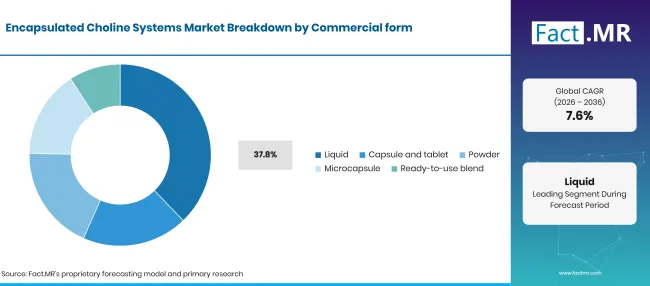
Encapsulated Choline Systems Breakdown Commercial Form | Source: Fact.MR
Sales of liquid systems account for 37.8% of 2026 revenue, about USD 60.5 million, as infant formula, pediatric drops and liquid nutrition products require ingredients that disperse consistently and remain stable during processing and storage. Liquid emulsions and encapsulated suspensions can also simplify incorporation into ready-to-use nutrition formats. The U.S. Dietary Guidelines Advisory Committee’s federal intake analysis reports that infants aged 6–11 months consume an average of 140–142 mg of choline daily from infant milk and complementary foods, demonstrating the importance of choline-containing nutrition during early development. This supports the underlying application demand for choline ingredients, rather than proving a preference for encapsulated liquid formats specifically.
How does infant / pediatric nutrition drive end-application demand in the Encapsulated Choline Systems Market?
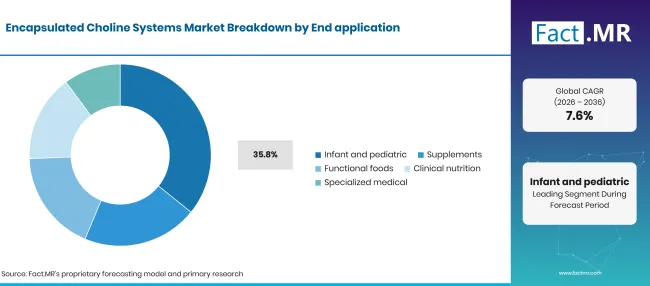
Encapsulated Choline Systems Breakdown End Application | Source: Fact.MR
Demand for the infant and pediatric nutrition represents 35.8% of 2026 revenue, about USD 57.3 million, as infant formula, toddler nutrition and pediatric supplements require choline to support normal growth and brain development. The U.S. CDC reported 3.61 million births in 2025 in its October 2026 report, indicating the scale of the infant population served by formula and early-life nutrition suppliers. In addition, the U.S. FDA announced a proposed update to infant-formula nutrient requirements in October 2026, with choline included in its planned evidence-review process. These developments keep infant nutrition formulation and nutrient compliance relevant for ingredient suppliers serving formula manufacturers.
Why does Pharmacy lead sales-channel demand in the Encapsulated Choline Systems Market?
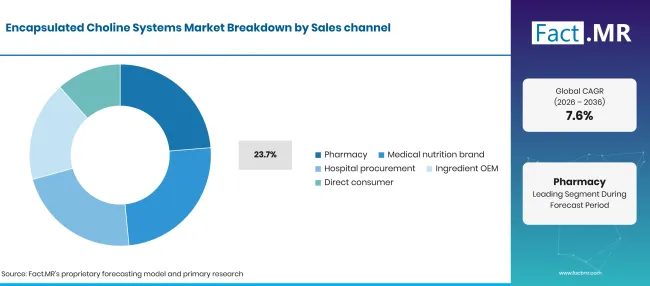
Encapsulated Choline Systems Breakdown Sales Channel | Source: Fact.MR
Pharmacies account for 23.7% of 2026 revenue, about USD 37.9 million, as consumers purchase prenatal supplements, pediatric nutrition products and cognitive-health formulations through established pharmacy networks. U.S. Census Bureau data show that pharmacy and drug-store sales reached approximately USD 32.7 billion in August 2026 on a seasonally adjusted basis. Although this figure covers the broader pharmacy retail category rather than choline products alone, it illustrates the scale of the channel available to supplement brands. Pharmacy distribution also gives manufacturers access to consumers seeking pharmacist guidance when selecting nutritional supplements.
Encapsulated Choline Systems Market-Drivers, Restraints & Trends
Drivers: Inadequate choline intake -:
Demand for encapsulated choline systems is rising as surveys show most adults and pregnant women do not reach recommended choline intakes. Suppliers are educating brands and consumers. The U.S. Dietary Guidelines Advisory Committee’s scientific report found that only 12% of people aged one year and older had choline intakes above the Adequate Intake (AI). Among adults aged 19–30, only 8% of men and 6% of women exceeded the AI. This points to a broad intake gap that ingredient suppliers can address through food fortification and supplement formulations.
Restraints: Consumer awareness and formulation challenges -:
Sales of encapsulated choline systems is limited by low consumer awareness of choline compared with other vitamins and by odor and stability challenges. Similar barriers are projected to slow adoption in some products. Suppliers must improve sensory performance. The CDC’s May 2026 report found that 60.2% of U.S. adults used at least one dietary supplement during August 2021–August 2023. The NIH also notes that fewer than half of prenatal supplements contain choline, and products that do often provide relatively small amounts. This suggests an opportunity for better consumer education and formulation, while odor and stability remain technical challenges for suppliers.
Opportunity: Prenatal Choline
Demand for choline in prenatal vitamins is rising. Suppliers are offering compact forms. The prenatal nutrition segment offers an opportunity because choline requirements increase during pregnancy, yet many prenatal formulations do not provide meaningful amounts. NIH guidance sets the pregnancy AI at 450 mg per day and reports that an analysis of 188 prenatal supplements found only 40% contained choline, with a median of just 25 mg per serving. This gap creates scope for suppliers to develop concentrated, compact and easy-to-incorporate choline ingredients for prenatal products.
Trend: Cognitive Health Supplements
Sales of citicoline and alpha-GPC in cognitive products is rising. Suppliers are offering branded forms. Interest in cognitive-health formulations is developing alongside broader supplement use, particularly among older consumers. The CDC’s May 2026 report found that 75.9% of U.S. adults aged 60 and older used at least one dietary supplement during August 2021–August 2023, compared with 46.3% of adults aged 20–39. This provides a sizeable supplement-consuming audience for products marketed around healthy ageing and cognitive wellness.
Encapsulated Choline Systems Market by Analysis by Key Country
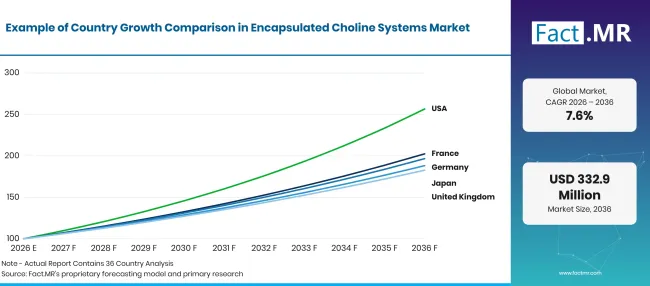
Encapsulated Choline Systems Growth Index | Source: Fact.MR
| Country | CAGR (2026-2036) |
|---|---|
| United States | 9.9% |
| China | 9.2% |
| France | 7.1% |
| Germany | 7.0% |
| Japan | 6.5% |
Source: Fact.MR analysis. Updated Nov 18, 2026
Source: Fact.MR analysis.
Why is the United States the fastest-growing market for encapsulated choline systems?
Demand in the United States is estimated to record a 9.9% CAGR, the fastest among the five key countries, as prenatal brands add choline and cognitive supplements grow.
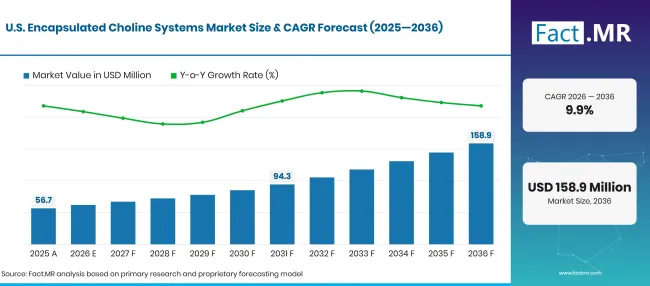
Encapsulated Choline Systems Forecast Usa | Source: Fact.MR
Balchem is US-based. The NIH Office of Dietary Supplements reports that most pregnant women do not meet recommended choline intake and that fewer than half of prenatal supplements sold in the country contain choline. This creates room for brands to expand choline-containing formulations. Balchem's U.S. presence also supports domestic ingredient supply and customer access.
What is driving encapsulated choline system demand in China?
Sales in China are projected to grow at a 9.2% CAGR as premium infant formula and cognitive supplements grow, and national formula standards from 2023 set choline levels.
Infant formula makers such as Feihe and Yili include choline in premium products. China's National Bureau of Statistics reported 7.92 million births in 2025 in its February 2026 statistical communiqué, indicating a substantial infant-nutrition consumer base despite demographic contraction. Infant formula quality oversight also remains stringent, with the government reporting a 99.88% food-safety sampling pass rate for infant formula powder in 2024. Choline-containing formulations offer manufacturers a way to meet nutritional specifications and differentiate premium products.
Which Factors are shaping encapsulated choline system demand in France?
Demand in France is estimated to capture a 7.1% CAGR as infant formula producers meet EU Delegated Regulation 2016/127, which sets choline levels. Lactalis and Danone make formula for export.
Commission Delegated Regulation (EU) 2016/127 specifies choline content in infant formula at 25–50 mg per 100 kcal and requires its declaration on product labels. INSEE reported 643,905 births in France in 2025, according to figures published in July 2026. Although births declined 2.3% year over year, regulatory compliance continues to create a defined formulation requirement for infant nutrition suppliers.
What is shaping encapsulated choline system demand in Germany?
Sales in Germany is projected to grow at a 7.0% CAGR as pharmacies sell cognitive and prenatal supplements, and prenatal brands such as Femibion sell widely.
EFSA has set adequate intakes for choline in pregnancy and lactation, which supplement brands cite on labels. In February 2026, Germany's Federal Institute for Risk Assessment advised expectant mothers to pay particular attention to selected micronutrients and explained when supplementation may be appropriate. Destatis reported 654,241 births in 2025, the lowest post-war total, in figures released in July 2026. Suppliers therefore need to target formulation quality and specialist nutrition channels rather than rely on rising birth volumes.
Why is encapsulated choline system growth slower in Japan?
Demand in Japan is estimated to record a 6.5% CAGR, the slowest among the five key countries, as births fell to a record low of 686,061 in 2024.
Kyowa Hakko Bio develops citicoline locally. The Ministry of Health, Labour and Welfare reported 671,270 births in 2025, the lowest figure on record, in its September 2026 release. This demographic pressure may constrain formula-related choline demand, although adult nutrition and cognitive-health applications provide other sales opportunities. Kyowa Hakko Bio's citicoline activities also reflect Japan's established interest in choline-related ingredients.
Competitive Landscape for Encapsulated Choline Systems Market
Competition in the encapsulated choline systems market is concentrated among specialized animal-nutrition ingredient manufacturers and broader nutrition suppliers. Balchem competes through ReaShure and ReaShure-XC, which use proprietary encapsulation technology to protect choline from rumen degradation and improve intestinal delivery. Kemin differentiates its portfolio with CholiGEM, a concentrated encapsulated choline product containing 60% choline chloride and its proprietary C3 technology. Vetagro offers Ruprocol, a microencapsulated rumen-protected choline source designed to support liver function, metabolic health and reproductive performance in dairy cows. Yahe Nutritive participates through CholiTarget, targeting rumen-bypass delivery for ruminant nutrition. Glanbia operates across nutrition ingredients and supplement formulation, with a broader portfolio that includes choline-related nutritional applications. Buyers assess choline concentration, rumen protection, intestinal bioavailability, processing stability, formulation flexibility and cost effectiveness.
From 2024 onward, competition has increasingly focused on improving nutrient concentration, delivery efficiency and product performance. Kemin's CholiGEM emphasizes 60% choline chloride concentration, while Balchem's ReaShure-XC focuses on higher nutrient payload and feed stability. Vetagro highlights microencapsulation performance under pelleting and mechanical stress. These differences give feed manufacturers options to optimize dairy transition-cow diets. Yahe Nutritive adds competition through its rumen-protected choline offerings, while Glanbia's broader ingredient capabilities support formulation opportunities in human nutrition. Suppliers that demonstrate reliable nutrient release, consistent quality and measurable animal-performance benefits are better positioned to secure feed-industry demand.
Recent Developments
- In October 2026, Vetagro inaugurated its first 40,000-square-foot U.S. manufacturing facility in Maryland, expanding production and distribution capacity for its animal-nutrition portfolio.
- In April 2026, Yahe established a rumen-to-small-intestine evaluation system using duodenal fistula technology to assess rumen-protected products, including CholiTarget.
- In September 2026, Balchem reported research showing that its choline-enriched Optifolin+ ingredient increased cellular methylation capacity, supporting further development of human nutrition formulations.
Key Players in Encapsulated Choline Systems Market
- Balchem
- Kemin
- Vetagro
- Glanbia
- Yahe Nutritive
Bibliography
- Balchem Corporation. (2025). Annual report 2024.
- Bundesinstitut für Risikobewertung. (2026, February). Folsäure und Co.: Müssen Schwangere ihre Nahrung ergänzen? [Folic acid and other nutrients: Do pregnant women need to supplement their diet?].
- Centers for Disease Control and Prevention. (2026, October). Births in the United States, 2025.
- Destatis. (2026, July). Births in 2025. Federal Statistical Office of Germany.
- European Commission. (2016). Commission Delegated Regulation (EU) 2016/127 of 25 September 2015 supplementing Regulation (EU) No 609/2013 as regards the specific compositional and information requirements for infant formula and follow-on formula and as regards requirements on information relating to infant and young child feeding (consolidated version, January 1, 2026). EUR-Lex.
- Food and Drug Administration. (2026, October 29). Infant formula nutrient requirements: Proposed rule.
- Institut national de la statistique et des études économiques. (2026). Births in 2025. INSEE.
- Ministry of Health, Labour and Welfare. (2026, September). 2025 vital statistics: Final data. Government of Japan.
- National Bureau of Statistics of China. (2026, February 28). Statistical communiqué of the People's Republic of China on the 2025 national economic and social development.
- National Institutes of Health, Office of Dietary Supplements. (n.d.). Choline: Fact sheet for health professionals.
- National Institutes of Health, Office of Dietary Supplements. (n.d.). Dietary supplements and life stages: Pregnancy.
- U.S. Department of Agriculture, Dietary Guidelines Advisory Committee. (2024). Current intakes of nutrients and dietary components.
Segmentation
Scope of Report
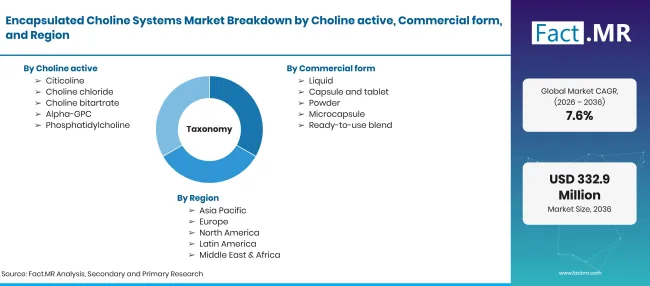
Encapsulated Choline Systems Taxonomy | Source: Fact.MR
| Items | Values |
|---|---|
| Quantitative Units (2026) | USD 160.0 Million |
| Choline active | Choline bitartrate, Choline chloride, Citicoline, Alpha-GPC, Phosphatidylcholine |
| Commercial form | Powder, Capsule / tablet, Liquid, Microcapsule, Ready-to-use blend |
| End application | Clinical nutrition, Supplements, Functional foods, Infant / pediatric, Specialized medical |
| Sales channel | Ingredient OEM, Medical nutrition brand, Hospital procurement, Pharmacy, Direct consumer |
| Regions Covered | North America, Latin America, Europe, East Asia, South Asia and Pacific, Middle East & Africa |
| Countries Covered | United States, China, France, Germany, Japan, and other countries |
| Key Companies Profiled | Balchem ; Kemin ; Vetagro ; Glanbia ; Yahe Nutritive |
| Additional Attributes | Dollar revenue in the Encapsulated Choline Systems Market is segmented by choline active (choline bitartrate, choline chloride, citicoline, alpha-gpc, phosphatidylcholine); commercial form (powder, capsule / tablet, liquid, microcapsule, ready-to-use blend); end application (clinical nutrition, supplements, functional foods, infant / pediatric, specialized medical); sales channel (ingredient oem, medical nutrition brand, hospital procurement, pharmacy, direct consumer) and region. |
Source: Fact.MR analysis. Updated Nov 18, 2026
Encapsulated Choline Systems Market by Segments
-
Choline active
- Choline bitartrate
- Choline chloride
- Citicoline
- Alpha-GPC
- Phosphatidylcholine
-
Commercial form
- Powder
- Capsule / tablet
- Liquid
- Microcapsule
- Ready-to-use blend
-
End application
- Clinical nutrition
- Supplements
- Functional foods
- Infant / pediatric
- Specialized medical
-
Sales channel
- Ingredient OEM
- Medical nutrition brand
- Hospital procurement
- Pharmacy
- Direct consumer
-
Region:
- North America
- United States
- Canada
- Mexico
- Europe
- Germany
- United Kingdom
- France
- Italy
- Spain
- Rest of Europe
- Asia Pacific
- China
- India
- Japan
- South Korea
- Australia
- Rest of Asia Pacific
- Latin America
- Brazil
- Mexico
- Argentina
- Rest of Latin America
- Middle East & Africa
- GCC Countries
- South Africa
- Rest of Middle East & Africa
- North America
Frequently Asked Questions
How big is the global Encapsulated Choline Systems Market in 2026?
What will be the size of the Encapsulated Choline Systems Market by 2036?
How fast will the Encapsulated Choline Systems Market grow during the forecast period?
Which choline active segment holds the largest share of the Encapsulated Choline Systems Market?
Who worked on this report


Preview the report firsthand - request a free sample
Free SampleGet the brochure for pricing and purchase details
Download PDF