
- Market Value (2025): USD 227.4 Mn
- Estimated Value (2026): USD 220.0 Mn
- Forecast Value (2036): USD 541.0 Mn
- CAGR (2026-2036): 8.2%
Energy-Efficient Cocoa Roasters Market Forecast and Outlook 2026 to 2036
The energy-efficient cocoa roasters market reached a derived estimate of USD 227.4 million in 2025. The market is anticipated to increase from USD 220.0 million in 2026 to USD 397.7 million by 2036, expanding at a CAGR of 6.1% during the forecast period.
Rising energy bills and tighter processing margins are encouraging cocoa processors to invest in roasters that use less fuel without compromising roast quality. The International Cocoa Organization reported in November 2025 that high input costs had constrained processing margins. Responding to this pressure, Bühler introduced its Lucent cocoa roaster on July 7, 2026, featuring heat recovery and predictive controls that cut energy use by at least 20% while increasing throughput by up to 20%. Such equipment improvements are strengthening the case for energy-efficient roasting.
Key Takeaways from the Energy-Efficient Cocoa Roasters Market
- Sales of energy-efficient cocoa roasters stood at USD 227.4 million in 2025
- Energy-Efficient Cocoa Roasters Market Value (2026): USD 220.0 million
- Energy-Efficient Cocoa Roasters Market Forecast Value (2036): USD 541.0 million
- Energy-Efficient Cocoa Roasters Market Forecast CAGR (2026-2036):8.2%
- Leading Product Type: Hybrid energy-recovery roasting (24.6%)
- Key Market Participants: Bühler, Royal Duyvis Wiener, NETZSCH, Caotech, Probat, JAF Inox
- Key Growth Regions: Indonesia, Côte d’Ivoire, Netherlands, Switzerland, Germany
Côte d’Ivoire’s push to expand local cocoa processing is creating fresh opportunities for roasting equipment manufacturers. On September 1, 2026, the Coffee and Cocoa Council announced that installed processing capacity would rise from 1.155 million tonnes to 1.344 million tonnes in the 2026/27 season as new factories enter operation. New grinding lines are giving processors an opportunity to install energy-saving roasters from the outset. Equipment manufacturers offering integrated roasting and alkalizing systems are likely to gain traction across West Africa and Southeast Asia.
Energy-Efficient Cocoa Roasters Market
| Metric | Value |
|---|---|
| Estimated Value (2025) | USD 227.4 million (Derived estimate) |
| Market Value (2026) | USD 220.0 million |
| Forecast Value (2036) | USD 541.0 million |
| Forecast CAGR (2026 to 2036) | 8.2% |
Source: Fact.MR analysis. Updated Nov 26, 2026
Category
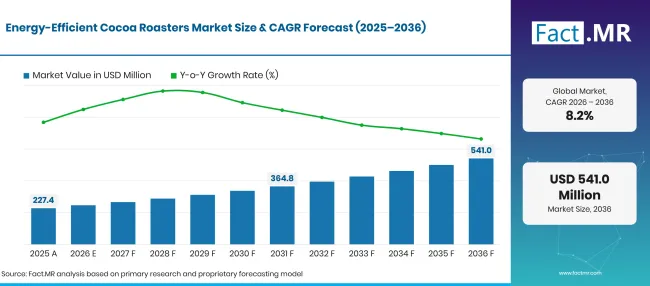
Energy Efficient Cocoa Roasters Forecast Global | Source: Fact.MR
| Category | Segments |
|---|---|
| Product Type | Hybrid energy-recovery roasting, Drum roasting, Infrared-assisted roasting, Fluidized-bed roasting, Continuous belt roasting |
| Operating Mode | Modular inline, Continuous, Batch, Semi-continuous, Turnkey integrated |
| Capacity Tier | Custom high-capacity, Pilot and laboratory, High throughput, Medium throughput, Small commercial |
| Customer Industry | Confectionery manufacturers, Compound coating producers, Craft chocolate makers, Industrial chocolate makers, Cocoa grinders |
| Region | Indonesia; Côte d’Ivoire; Netherlands; Switzerland; Germany |
Source: Fact.MR analysis. Updated Nov 26, 2026
Segmental Analysis
Why does hybrid energy-recovery roasting lead product demand in the Energy-Efficient Cocoa Roasters Market?
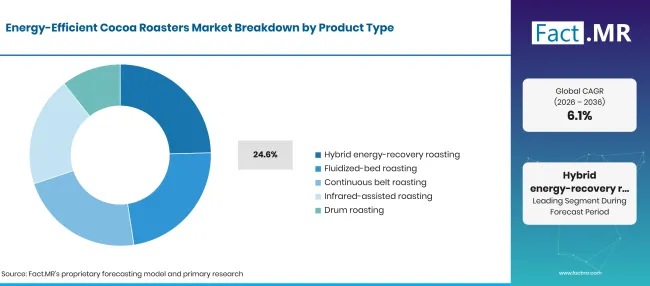
Energy Efficient Cocoa Roasters Breakdown Product Type | Source: Fact.MR
Hybrid energy-recovery systems hold a 24.6% share in 2026, equivalent to USD 54.1 million. Their appeal lies in recovering heat from exhaust streams and reusing it during bean or nib roasting, lowering fuel consumption without major changes to roast characteristics. Conventional drum roasters remain relevant for smaller processors, while infrared-assisted models are gaining attention for faster and more controlled heating. In July 2026, Bühler introduced its Lucent cocoa roaster with at least 20% lower energy use per batch than its previous Tornado model.
How is modular inline operation leading demand in the Energy-Efficient Cocoa Roasters Market?
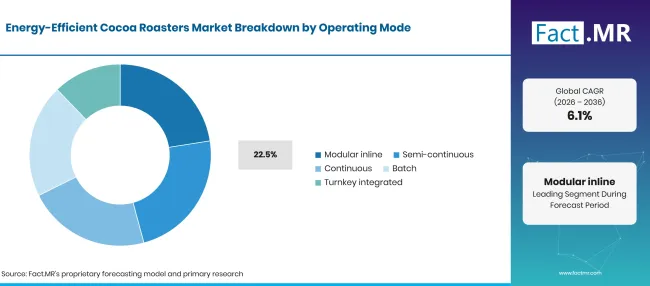
Energy Efficient Cocoa Roasters Breakdown Operating Mode | Source: Fact.MR
Modular inline systems capture 22.5% of 2026 revenue, equivalent to USD 49.5 million. Cocoa processors prefer layouts that connect roasting with cleaning, winnowing and grinding without requiring a complete factory redesign. This arrangement also allows capacity additions in manageable stages. Batch-operated roasters remain relevant for specialty chocolate makers, while continuous systems attract large plants seeking consistent output. Côte d’Ivoire's September 2026 plan to raise installed cocoa processing capacity from 1.155 million to 1.344 million tonnes creates further opportunities for integrated roasting installations.
Why does custom high-capacity equipment lead demand in the Energy-Efficient Cocoa Roasters Market?
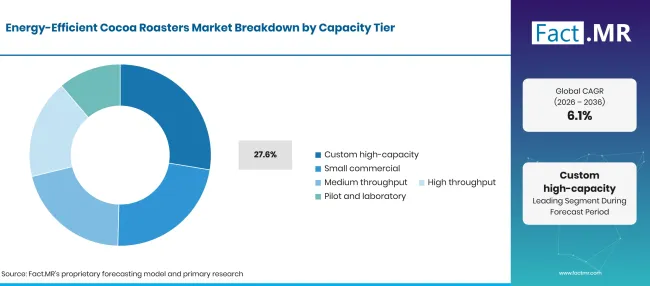
Energy Efficient Cocoa Roasters Breakdown Capacity Tier | Source: Fact.MR
Custom high-capacity roasters lead with a 27.6% share in 2026, worth USD 60.7 million. Large cocoa processors favour equipment engineered around their throughput targets, available utilities and roasting requirements. Standard-capacity machines are also gaining traction among smaller grinding facilities seeking affordable upgrades. In February 2026, Barry Callebaut announced a €250 million investment programme for its Wieze chocolate factory and another €125 million plan for Halle, reinforcing investment in large-scale processing infrastructure.
How are confectionery manufacturers leading customer demand in the Energy-Efficient Cocoa Roasters Market?
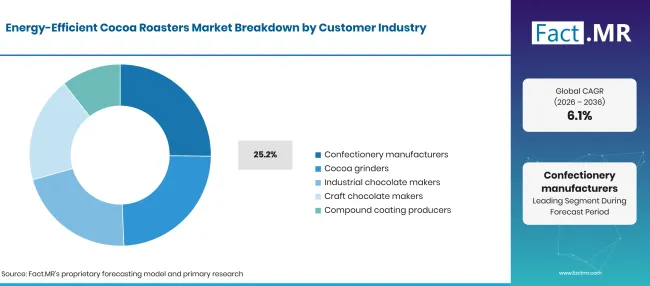
Energy Efficient Cocoa Roasters Breakdown Customer Industry | Source: Fact.MR
Confectionery manufacturers generate 25.2% of market revenue in 2026, equivalent to USD 55.4 million. Chocolate makers are upgrading roasting operations to maintain signature flavour profiles while reducing factory energy consumption. Cocoa grinding companies are also investing in efficient roasting equipment as local processing expands. Ferrero's 2025 Sustainability Report recorded a 7.2% reduction in Scope 1 and 2 emissions year-on-year, alongside 24 manufacturing plants operating on 100% renewable grid electricity. Such factory-level environmental targets are strengthening interest in energy-saving roasting technology.
Energy-Efficient Cocoa Roasters Market-Drivers, Restraints & Trends
Cocoa Grinding Recovery Encourages Equipment Replacement:
Improving cocoa processing activity is giving roaster manufacturers a stronger sales opportunity as grinders revisit equipment upgrades postponed during the price surge. European Cocoa Association figures released on October 15, 2026, showed third-quarter European grinding rising 3.2% year-on-year to 348,215 tonnes. Higher plant utilization improves the commercial case for replacing fuel-intensive roasting systems with equipment that lowers operating expenses.
Restraints
Unpredictable Bean Prices Tighten Investment Budgets: Volatile cocoa prices leave processors with less room for expensive machinery upgrades, particularly when margins are already under pressure. Barry Callebaut's November 4, 2026 results highlighted this uncertainty, with its 2026/27 outlook based on cocoa bean prices of GBP 4,000 per tonne, compared with roughly GBP 3,000 assumed in July. Long installation periods and uncertain payback further discourage smaller grinders from committing capital.
Trends and Opportunities: Industrial Electrification Opens New Investment Opportunities
Rising interest in industrial electrification is creating room for lower-emission cocoa processing infrastructure. A European Parliament study published on October 22, 2026, identified electricity costs and grid access as major barriers to industrial electrification. This creates an opportunity for cocoa processors to explore electric process heating and recoverable thermal energy as part of factory modernisation. Wider access to renewable electricity could strengthen this transition over the coming years.
Trend:Growing Cocoa Processing at Origin Expands Market Potential:
Cocoa-producing countries are increasingly moving beyond bean exports towards domestic grinding and value-added production. Indonesia's Ministry of Industry reported in November 2026 that national cocoa grinding reached 307,882 tonnes during January to September, while third-quarter cocoa liquor sales jumped 91.3%. Further investment in local processing infrastructure creates opportunities for roasting equipment adoption as manufacturers expand capacity closer to cocoa-growing regions.
Energy-Efficient Cocoa Roasters Market by Analysis by Key Country
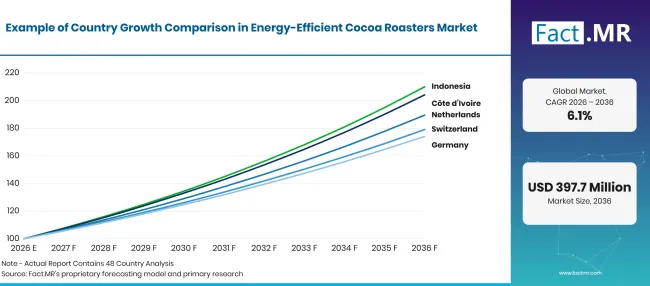
Energy Efficient Cocoa Roasters Growth Index | Source: Fact.MR
| Country | CAGR (2026-2036) |
|---|---|
| Indonesia | 7.7% |
| Côte d’Ivoire | 7.4% |
| Netherlands | 6.6% |
| Switzerland | 6.0% |
| Germany | 5.7% |
Source: Fact.MR analysis. Updated Nov 26, 2026
What is driving energy-efficient cocoa roasters demand in Indonesia?
Indonesia's expanding cocoa processing industry is creating a strong opening for energy-efficient roasting equipment.
The Ministry of Industry reported that domestic cocoa grinding reached 422,176 tonnes in 2025, marking 4.43% growth. Rising local processing activity and efforts to increase exports of cocoa butter, liquor and powder are encouraging manufacturers to upgrade roasting infrastructure. Investments in factory efficiency and higher processing capacity are likely to strengthen equipment sales over the forecast period.
How is new grinding capacity supporting energy-efficient cocoa roasters sales in Côte d’Ivoire?
Local value addition is becoming a major investment priority in Côte d’Ivoire.
The FAO reported in December 2025 that the country aims to process 80% of its cocoa beans domestically by 2030, with existing primary processing capacity nearing 1 million tonnes during the 2024/25 season. New grinding facilities are creating opportunities for modern roasting installations. Rising investment in domestic chocolate production and processing infrastructure is likely to accelerate purchases of energy-saving machinery.
What is shaping energy-efficient cocoa roasters demand in the Netherlands?
Amsterdam's position as a major international cocoa trading hub gives the Netherlands a substantial base for industrial roasting equipment sales.
Statistics Netherlands reported in April 2026 that Dutch exports of cocoa beans and cocoa products reached EUR 13.3 billion in 2025. Large processing operations across Amsterdam and the Zaanstreek region are encouraging investment in efficient production facilities. Reducing thermal energy consumption and maintaining high processing throughput are important factors shaping equipment replacement decisions.
How is a cautious recovery shaping energy-efficient cocoa roasters sales in Switzerland?
Premium chocolate production keeps Switzerland relevant for advanced cocoa roasting equipment.
According to Chocosuisse, Swiss chocolate manufacturers generated CHF 2.467 billion in revenue during 2025, up 11.8% year-on-year, despite a 7.9% decline in sales volume. Maintaining product consistency while controlling factory operating expenses is encouraging manufacturers to consider efficient roasting systems. Equipment upgrades are also gaining relevance as producers serve export markets that require consistent flavour and quality standards.
Why is growth slower for energy-efficient cocoa roasters in Germany?
Germany's large confectionery manufacturing base creates a substantial replacement market for energy-efficient cocoa roasters.
The Federal Ministry of Agriculture reported that German cocoa bean grinding declined 10.1% to 358,000 tonnes in 2025. Despite this setback, the country's extensive chocolate manufacturing industry continues to require reliable cocoa processing infrastructure. Energy expenses and pressure to improve factory efficiency are encouraging producers to examine modern roasting systems when replacing older equipment.
Competitive Landscape for Energy-Efficient Cocoa Roasters Market
Competition in the energy-efficient cocoa roasters market centres on roasting performance, complete processing capabilities and after-sales support. Bühler strengthened its offering in July 2026 with Lucent, an industrial cocoa nib roaster featuring heat recovery and predictive controls. It uses at least 20% less energy per tonne than its predecessor while delivering up to 20% higher throughput. PROBAT offers batch and continuous roasting systems alongside grinding and refining equipment, while Royal Duyvis Wiener provides turnkey cocoa and chocolate processing lines. NETZSCH, Caotech and JAF Inox add grinding, refining and plant engineering capabilities. Competition increasingly favours manufacturers that combine lower energy consumption with precise flavour control, dependable servicing and retrofit support.
Recent Developments
- On July 7, 2026, Bühler launched its Lucent industrial cocoa nib roaster, which uses at least 20% less energy per tonne and delivers up to 20% higher throughput than its previous Tornado model.
- On March 17, 2026, Royal Duyvis Wiener, under the PROBAT Group, announced the redesigned HPB Hydraulic Press Butter for cocoa and nut processing, featuring a smaller footprint, faster pressing cycles and improved operating safety.
- On March 4, 2026, NETZSCH inaugurated a new production facility in Goa, India, expanding its manufacturing presence and industrial capabilities in the country.
- On January 27, 2026, PROBAT integrated MacIntyre Chocolate Systems into its corporate brand portfolio to strengthen its chocolate processing equipment and turnkey solutions business.
- On May 22, 2026, NETZSCH announced a strategic partnership with Dutch Structuring Technologies at interpack 2026 to develop integrated processing solutions for structured protein products.
Key Players in Energy-Efficient Cocoa Roasters Market
Key companies operating in the market include Bühler, Royal Duyvis Wiener, NETZSCH, Caotech, Probat, and JAF Inox.
- Bühler
- Royal Duyvis Wiener
- NETZSCH
- Caotech
- Probat
- JAF Inox
Bibliography
- Agence Ivoirienne de Presse. (2026, September 1). Côte d’Ivoire-AIP: La capacité de transformation du cacao devrait atteindre 1,344 million de tonnes en 2026-2027 (Conseil du café-cacao).
- ANTARA News. (2026, November 2). Indonesia taps trade pacts to boost processed cocoa exports.
- Barry Callebaut Group. (2026, November 4). Barry Callebaut Group full-year results, fiscal year 2025/26.
- BMEL-Statistik. (n.d.). Kakao Versorgungsbilanzen [Cocoa supply balances].
- Chocosuisse. (2026, March 20). Swiss chocolate in 2025: Sales declining, revenue continues to rise.
- European Cocoa Association. (2026, October 15). Grind stats: Q3 2026 European cocoa grind statistics.
- European Commission. (2026, July 17). Electrification.
- Food and Agriculture Organization of the United Nations. (2025, December 11). A look at financing opportunities for primary cocoa processing in Côte d’Ivoire.
- Ferrero. (2025). Sustainability report 2025.
- International Cocoa Organization. (2025, November). November 2025 quarterly bulletin of cocoa statistics.
- Lamongan Regency Department of Cooperatives, Industry and Trade. (2026). Indonesia strengthens its position as a global cocoa grinding hub.
- Statistics Netherlands. (2026, April 3). The Netherlands is the world’s leading exporter of cocoa products.
Segmentation
Scope of Report
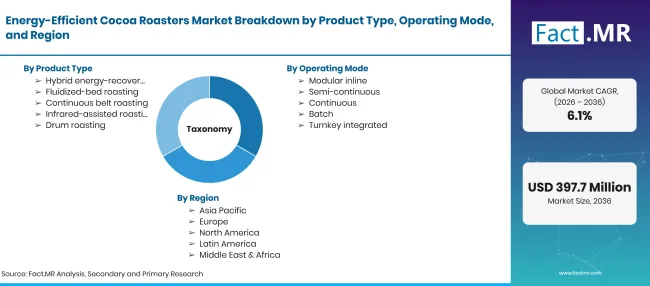
Energy Efficient Cocoa Roasters Taxonomy | Source: Fact.MR
| Items | Values |
|---|---|
| Quantitative Units (2026) | USD 220.0 Million |
| Product Type | Hybrid energy-recovery roasting, Drum roasting, Infrared-assisted roasting, Fluidized-bed roasting, Continuous belt roasting |
| Operating Mode | Modular inline, Continuous, Batch, Semi-continuous, Turnkey integrated |
| Capacity Tier | Custom high-capacity, Pilot and laboratory, High throughput, Medium throughput, Small commercial |
| Customer Industry | Confectionery manufacturers, Compound coating producers, Craft chocolate makers, Industrial chocolate makers, Cocoa grinders |
| Regions Covered | North America, Latin America, Europe, East Asia, South Asia and Pacific, Middle East & Africa |
| Countries Covered | Indonesia, Côte d’Ivoire, Netherlands, Switzerland, Germany, and other countries |
| Key Companies Profiled | Bühler, Royal Duyvis Wiener, NETZSCH, Caotech, Probat, JAF Inox |
| Additional Attributes | Dollar revenue in the Energy-Efficient Cocoa Roasters Market is segmented by product type (hybrid energy-recovery, drum, infrared-assisted, fluidized-bed, continuous belt roasting), operating mode, capacity tier, customer industry and region. |
Source: Fact.MR analysis. Updated Nov 26, 2026
Energy-Efficient Cocoa Roasters Market by Segments
-
Product Type
- Hybrid energy-recovery roasting
- Drum roasting
- Infrared-assisted roasting
- Fluidized-bed roasting
- Continuous belt roasting
-
Operating Mode
- Modular inline
- Continuous
- Batch
- Semi-continuous
- Turnkey integrated
-
Capacity Tier
- Custom high-capacity
- Pilot and laboratory
- High throughput
- Medium throughput
- Small commercial
-
Customer Industry
- Confectionery manufacturers
- Compound coating producers
- Craft chocolate makers
- Industrial chocolate makers
- Cocoa grinders
-
Region:
- North America
- United States
- Canada
- Mexico
- Europe
- Germany
- United Kingdom
- France
- Italy
- Spain
- Rest of Europe
- Asia Pacific
- China
- India
- Japan
- South Korea
- Australia
- Rest of Asia Pacific
- Latin America
- Brazil
- Mexico
- Argentina
- Rest of Latin America
- Middle East & Africa
- GCC Countries
- South Africa
- Rest of Middle East & Africa
- North America
Table of Contents
Key Takeaways
- Market Size and CAGR
- Top Growth Driver
- Fastest Growing Segment
- Leading Region
- Key Companies
- Emerging Opportunities

