
- Market Value (2025): USD 42.2 Mn
- Estimated Value (2026): USD 45.0 Mn
- Forecast Value (2036): USD 85.3 Mn
- CAGR (2026-2036): 6.6%
Metal-Detectable Flight Systems Market Forecast and Outlook 2026 to 2036
The metal-detectable flight systems market reached a derived estimate of USD 42.2 million in 2025. The market is expected to expand from USD 45.0 million in 2026 to USD 85.3 million by 2036, advancing at a CAGR of 6.6% during the forecast period.
Food processors are paying closer attention to conveyor components that could become foreign-body hazards if damaged during production. Metal-detectable flights, scrapers and paddles help operators identify broken fragments through existing inspection systems without giving up the lightweight properties of plastic. In September 2025, BRCGS released an updated Foreign Body Control guideline covering metal detection, X-ray inspection and equipment selection. This renewed focus on contamination prevention is likely to encourage food manufacturers to adopt detectable conveyor components over the coming years.
Key Takeaways from the Metal-Detectable Flight Systems Market
- Sales of metal-detectable flight systems stood at USD 42.2 million in 2025
- Metal-Detectable Flight Systems Market Value (2026): USD 45.0 million
- Metal-Detectable Flight Systems Market Forecast Value (2036): USD 85.3 million
- Metal-Detectable Flight Systems Market Forecast CAGR (2026-2036): 6.6%
- Leading Metal-detectable flight material: Metal-loaded polymer (31.0%)
- Key Market Participants: GEA, JBT Marel, Heat and Control, Bühler, Baker Perkins, tna solutions
- Key Growth Regions: China, United States, Italy, Germany, Japan
US food safety rules are putting greater focus on preventing physical contamination during food processing. Under the FDA’s FSMA Preventive Controls rule, facilities must assess foreseeable hazards, including hard plastic and metal fragments, and document the effectiveness of relevant controls. The 2025 edition of 21 CFR Part 117 continues to require verification and recordkeeping for preventive controls. This is encouraging processors to consider metal-detectable conveyor flights and documented detection performance when upgrading production lines, particularly those serving US markets.
Metal-Detectable Flight Systems Market
| Metric | Value |
|---|---|
| Estimated Value (2025) | USD 42.2 million |
| Estimated Value (2026) | USD 45.0 million |
| Forecast Value (2036) | USD 85.3 million |
| Forecast CAGR (2026 to 2036) | 6.6% |
Source: Fact.MR analysis. Updated Nov 25, 2026
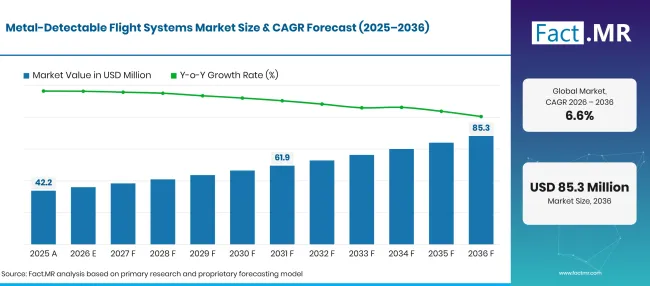
Metal Detectable Flight Systems Forecast Global | Source: Fact.MR
Category
| Category | Segments |
|---|---|
| Metal-detectable flight material | Metal-loaded polymer, Stainless steel, Metal-detectable composite, Embedded tracer polymer, Hybrid detectable |
| Processing scale | Pilot / lab, Small commercial, Mid-scale, High-throughput, Ultra-high-throughput |
| Operating configuration | Batch, Semi-continuous, Continuous, Modular skid, Integrated line |
| Food / process application | Bakery / wafers, Confectionery / cocoa, Snacks / seasoning, Brewing / grains, Other food / industrial |
| Region | China; United States; Italy; Germany; Japan |
Source: Fact.MR analysis. Updated Nov 25, 2026
Segmental Analysis
Why does Metal-loaded polymer lead material demand in the Metal-Detectable Flight Systems Market?
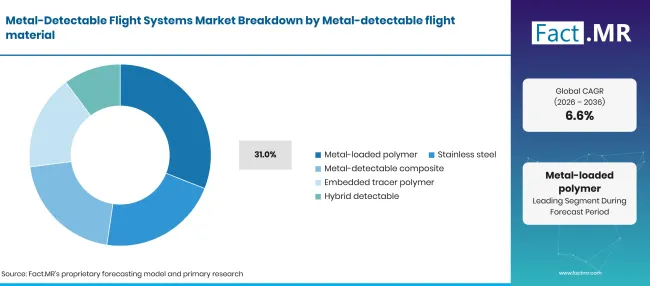
Metal Detectable Flight Systems Breakdown Metal Detectable Flight Material | Source: Fact.MR
Metal-loaded polymer is gaining preference because processors want detectable conveyor components without the extra weight and noise associated with metal parts. Its mouldability also allows manufacturers to produce different flight shapes for existing conveyor designs. Stainless steel flights remain relevant in high-temperature and demanding processing environments, while composite materials attract buyers seeking a balance between strength and weight. The 2025 edition of FDA's 21 CFR Part 117 reinforces the importance of cleanable, durable and suitable food-contact equipment, adding to interest in specialised polymer grades.
Why does the Pilot / lab segment lead scale demand in the Metal-Detectable Flight Systems Market?
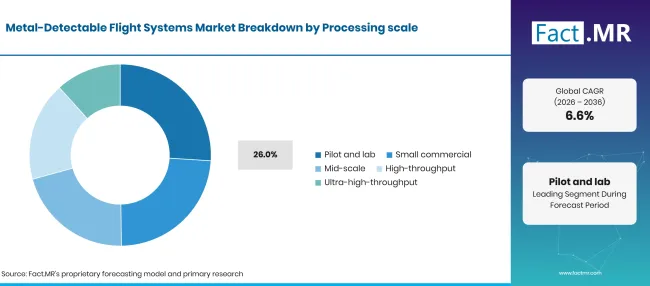
Metal Detectable Flight Systems Breakdown Processing Scale | Source: Fact.MR
Pilot and laboratory installations give processors room to test flight materials before introducing them across full production lines. Detection sensitivity, product characteristics and conveyor compatibility all require practical checks. BRCGS released its Foreign Body Control guideline on 22 September 2025, highlighting equipment selection, installation, validation and testing. This focus makes small-scale trials an important purchase stage. High-throughput installations are also gaining traction as established plants replace components across larger conveyor networks.
Why does Continuous operation lead configuration demand in the Metal-Detectable Flight Systems Market?
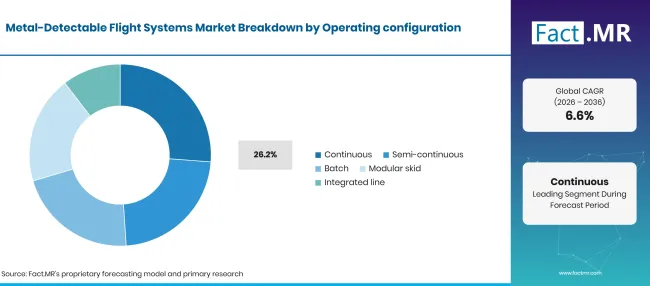
Metal Detectable Flight Systems Breakdown Operating Configuration | Source: Fact.MR
Round-the-clock processing puts conveyor flights through repeated movement, cleaning and product contact, making component durability a major purchasing consideration. Continuous lines also leave less room for unexpected stoppages caused by damaged parts. The FDA's 2025 inspection manual specifically highlights conveyor belt condition, residue accumulation and hard-to-reach equipment areas during food facility inspections. Semi-continuous systems are gaining interest as smaller processors upgrade production capacity, while intermittent configurations suit batch-based operations with frequent product changes.
Why does Other food / industrial lead application demand in the Metal-Detectable Flight Systems Market?
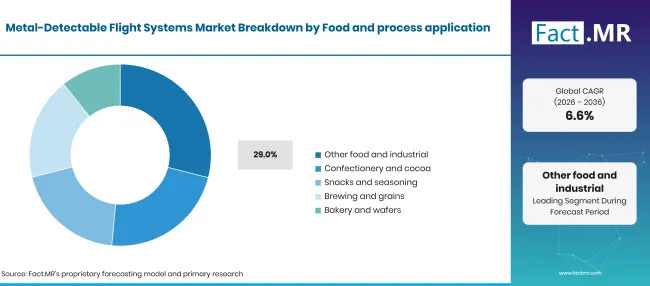
Metal Detectable Flight Systems Breakdown Food And Process Application | Source: Fact.MR
Meat, dairy, frozen food and nutraceutical processors use conveyor flights across handling and transfer stages where damaged components can introduce foreign material. Their varied processing conditions create opportunities for detectable polymer and stainless steel designs. Confectionery applications are also gaining attention as manufacturers improve inspection practices across automated production lines. BRCGS published its updated Foreign Body Control guideline in September 2025, highlighting the growing importance of suitable inspection technology across different food manufacturing environments.
Metal-Detectable Flight Systems Market-Drivers, Restraints & Trends
Driver: Greater Attention to Foreign-Material Prevention:
A damaged conveyor flight can turn a routine production issue into a costly contamination incident, particularly when plastic fragments escape detection. This risk is encouraging food processors to replace conventional conveyor components with detectable alternatives that work alongside existing inspection equipment. In 2025, FDA continued publishing food recall and safety alerts through its official enforcement reporting system, keeping foreign-material prevention firmly on manufacturers' operational agendas. Investment in detectable components is gaining relevance as processors seek to reduce contamination exposure and avoid production interruptions.
Restraint: Higher Replacement and Validation Costs:
Switching from standard plastic flights involves more than purchasing new components. Detectable grades generally carry higher material costs, while differences in stiffness, impact resistance and abrasion behaviour require testing on individual conveyor lines. Smaller processors may struggle to justify replacing functioning equipment before its normal service life ends. Additional validation, maintenance and spare-parts expenses can also delay wider adoption, particularly where existing inspection systems require sensitivity adjustments.
Trend: Wider Use of X-ray-Compatible Materials:
Food plants are increasingly looking beyond conventional metal detection as X-ray inspection becomes part of broader foreign-body control programmes. This creates room for conveyor components that remain identifiable under multiple inspection methods. BRCGS published its Foreign Body Control guideline on 22 September 2025, covering metal detectors, X-ray systems, sieves and optical sorting. This wider inspection focus opens opportunities for material innovation and better coordination between conveyor design and factory inspection systems.
Trend: Greater Focus on Hygienic Conveyor Design:
Food manufacturers are placing greater emphasis on conveyor components that are easy to inspect, clean and maintain. Open designs, fewer material-trapping gaps and accessible surfaces are becoming important considerations alongside detectability. BRCGS's 2025 Foreign Body Control guideline highlights equipment selection, installation, validation and testing. This creates future opportunities for manufacturers to develop hygienic conveyor components that combine contamination control with easier maintenance and longer operating life.
Metal-Detectable Flight Systems Market by Analysis by Key Country
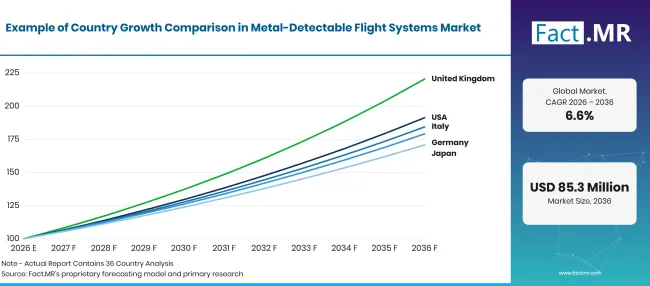
Metal Detectable Flight Systems Growth Index | Source: Fact.MR
| Country | CAGR (2026-2036) |
|---|---|
| China | 8.2% |
| United States | 6.7% |
| Italy | 6.2% |
| Germany | 6.0% |
| Japan | 5.5% |
Source: Fact.MR analysis. Updated Nov 25, 2026
Why is China the fastest-growing market for metal-detectable flight systems?
China's food processing industry is seeing stronger regulatory attention to hygiene across production, storage and transportation.
On March 19, 2025, the Chinese government announced a food safety framework covering eight regulatory areas and 21 specific measures. Greater scrutiny of food handling and processing equipment is encouraging manufacturers to consider detectable conveyor components. Expansion of automated food production facilities and stricter contamination prevention practices are likely to strengthen sales through 2036.
What is shaping metal-detectable flight system sales in the United States?
Large-scale food manufacturing and strict preventive-control requirements are creating favourable conditions for metal-detectable flight adoption.
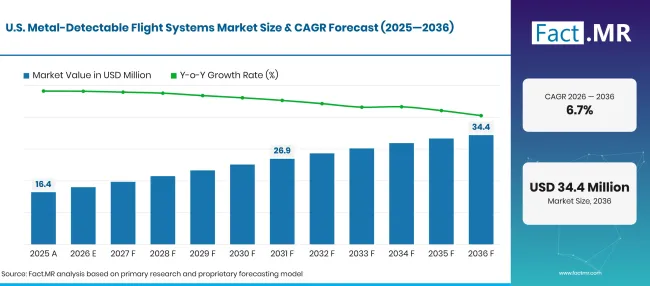
Metal Detectable Flight Systems Forecast Usa | Source: Fact.MR
The 2025 edition of 21 CFR Part 117 requires food facilities to establish written preventive controls for relevant hazards. This puts greater emphasis on identifying potential contamination from damaged processing equipment. Replacement of conventional conveyor parts and wider use of inspection systems are expected to support market growth across American food processing facilities.
What is shaping metal-detectable flight system demand in Italy?
Italy's extensive meat, dairy, bakery and packaged-food manufacturing base creates opportunities for detectable conveyor components.
The country's agricultural inspection authority, ICQRF, reported 54,913 food-chain checks and 367,039 analytical determinations in 2025, according to its July 2026 report. Such extensive oversight reinforces manufacturers' focus on product integrity and processing hygiene. Modernisation of food production equipment and export-oriented quality controls are adding further momentum to sales.
What is shaping metal-detectable flight system demand in Germany?
Germany's expanding prepared-food production is creating additional requirements for reliable conveyor equipment.
Destatis reported that domestic ready-meal production reached 1.7 million tonnes worth EUR 5.9 billion in 2024. Production value also increased by 2.8% during the first three quarters of 2025 compared with the same period in 2024. Higher processing volumes and stringent food hygiene practices are encouraging manufacturers to consider detectable conveyor components across automated production lines.
Why is metal-detectable flight system growth slower in Japan?
Japan's emphasis on HACCP-based hygiene management is keeping equipment safety and foreign-object prevention relevant across food manufacturing.
The Ministry of Agriculture, Forestry and Fisheries continued its food manufacturing production surveys throughout 2025, tracking monthly output across processed-food categories. This sustained monitoring reflects the scale and diversity of the country's processing industry. Automation upgrades, careful equipment maintenance and contamination-control practices are likely to encourage gradual adoption of metal-detectable flight systems.
Competitive Landscape for Metal-Detectable Flight Systems Market
The metal-detectable flight systems market features integrated food equipment manufacturers alongside specialised conveyor component suppliers. GEA, JBT Marel and Bühler focus on complete processing lines, while Heat and Control, Baker Perkins and tna solutions serve specific food production applications. Recent equipment launches reflect growing attention to hygienic design and production efficiency. In June 2025, GEA introduced its Bake Extruder for high-speed biscuit production, while Bühler unveiled its Nutrex 7 Series and other processing upgrades in May 2026. These developments highlight the importance of reliable operation and easier maintenance. Manufacturers offering verified detection performance, longer wear life and food-safe materials are better positioned to attract replacement orders.
Recent Developments
- On June 16, 2025, GEA launched its new Bake Extruder at IBA in Düsseldorf. The equipment was designed for high-speed biscuit production with improved flexibility, hygienic operation and precise product handling.
- On September 23, 2025, JBT Marel inaugurated a Global Production Center in Pune, India, to strengthen its manufacturing capabilities and support customers across India and the Asia-Pacific region.
- On June 2, 2025, Heat and Control acquired Fabcon Food Systems Ltd, a UK-based food processing equipment manufacturer specialising in vibratory conveyors, product handling, sorting and packaging systems.
- On May 7, 2026, Bühler introduced several food processing innovations at Interpack, including its Nutrex 7 Series extruder, Lucent cocoa roaster and upgraded biscuit production equipment.
- On October 6, 2026, Baker Perkins launched the ServoForm Flexi+ starch-free gummy manufacturing system, designed for automated production with output capacity of up to 1,000 kg per hour.
- On November 26, 2025, TNA Solutions announced its participation in ProSweets 2026, where it planned to showcase integrated confectionery production technologies, including its tna robag 3e packaging system and tna conti-oil coating system.
Key Players in Metal-Detectable Flight Systems Market
Key companies operating in the market include GEA, JBT Marel, Heat and Control, Bühler, Baker Perkins, and tna solutions.
- GEA
- JBT Marel
- Heat and Control
- Bühler
- Baker Perkins
- tna solutions
Bibliography
- BRCGS. (2025, September 22). Best practice guideline: Foreign body control.
- Destatis. (2026, January 14). Produktion von Fertiggerichten binnen fünf Jahren mengenmäßig um 25,6 % gestiegen. Statistisches Bundesamt.
- Ministero dell'Agricoltura, della Sovranità Alimentare e delle Foreste. (2026, July 16). ICQRF e CONAF insieme per l'eccellenza del Made in Italy: presentato il Report 2025.
- Ministry of Agriculture, Forestry and Fisheries. (n.d.). Food Industry Dynamics Survey. Government of Japan.
- Ministry of Health, Labour and Welfare. (n.d.). HACCP (Hazard Analysis and Critical Control Point). Government of Japan.
- State Council of the People's Republic of China. (2025, March 19). China unveils new food safety regulatory framework across full supply chain.
- U.S. Food and Drug Administration. (2015). FSMA final rule for preventive controls for human food.
- U.S. Food and Drug Administration. (2025). YoCrunch products voluntarily recalled by Danone U.S. due to potential presence of plastic pieces in dome topper.
Segmentation
Scope of Report
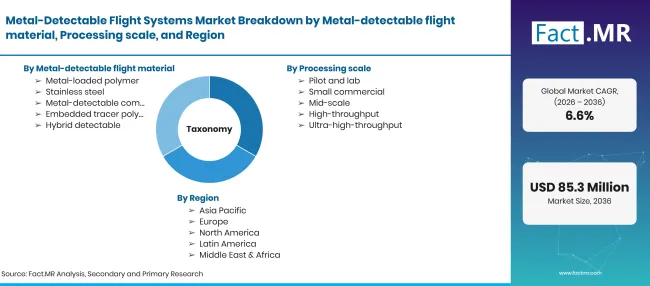
Metal Detectable Flight Systems Taxonomy | Source: Fact.MR
| Items | Values |
|---|---|
| Quantitative Units (2026) | USD 45.0 Million |
| Metal-detectable flight material | Metal-loaded polymer, Stainless steel, Metal-detectable composite, Embedded tracer polymer, Hybrid detectable |
| Processing scale | Pilot / lab, Small commercial, Mid-scale, High-throughput, Ultra-high-throughput |
| Operating configuration | Batch, Semi-continuous, Continuous, Modular skid, Integrated line |
| Food / process application | Bakery / wafers, Confectionery / cocoa, Snacks / seasoning, Brewing / grains, Other food / industrial |
| Regions Covered | North America, Latin America, Europe, East Asia, South Asia and Pacific, Middle East & Africa |
| Countries Covered | China, United States, Italy, Germany, Japan, and other countries |
| Key Companies Profiled | GEA, JBT Marel, Heat and Control, Bühler, Baker Perkins, tna solutions |
| Additional Attributes | Dollar revenue in the Metal-Detectable Flight Systems Market is segmented by metal-detectable flight material (metal-loaded polymer, stainless steel, metal-detectable composite, embedded tracer polymer, hybrid detectable); processing scale (pilot / lab, small commercial, mid-scale, high-throughput, ultra-high-throughput); operating configuration (batch, semi-continuous, continuous, modular skid, integrated line); food / process application (bakery / wafers, confectionery / cocoa, snacks / seasoning, brewing / grains, other food / industrial) and region. |
Source: Fact.MR analysis. Updated Nov 25, 2026
Metal-Detectable Flight Systems Market by Segments
-
Metal-detectable flight material
- Metal-loaded polymer
- Stainless steel
- Metal-detectable composite
- Embedded tracer polymer
- Hybrid detectable
-
Processing scale
- Pilot / lab
- Small commercial
- Mid-scale
- High-throughput
- Ultra-high-throughput
-
Operating configuration
- Batch
- Semi-continuous
- Continuous
- Modular skid
- Integrated line
-
Food / process application
- Bakery / wafers
- Confectionery / cocoa
- Snacks / seasoning
- Brewing / grains
- Other food / industrial
-
Region:
- North America
- United States
- Canada
- Mexico
- Europe
- Germany
- United Kingdom
- France
- Italy
- Spain
- Rest of Europe
- Asia Pacific
- China
- India
- Japan
- South Korea
- Australia
- Rest of Asia Pacific
- Latin America
- Brazil
- Mexico
- Argentina
- Rest of Latin America
- Middle East & Africa
- GCC Countries
- South Africa
- Rest of Middle East & Africa
- North America
Table of Contents
Key Takeaways
- Market Size and CAGR
- Top Growth Driver
- Fastest Growing Segment
- Leading Region
- Key Companies
- Emerging Opportunities

