
- Market Value (2025): USD 1.05 Bn
- Estimated Value (2026): USD 1.10 Bn
- Forecast Value (2036): USD 1.88 Bn
- CAGR (2026-2036): 5.5%
Hot Forming Press Market Forecast and Outlook 2026 to 2036
As per the Fact.MR analysis, the hot forming press market surpassed a value of USD 1.05 billion in 2025 and is projected to grow from USD 1.10 billion in 2026 to USD 1.88 billion by 2036. Demand for hot forming presses is likely to grow at a CAGR of 5.5% over the forecast period.
Demand for hot forming presses is rising as carmakers use press-hardened steel and other hot-formed parts to reduce vehicle weight while meeting crash-safety targets. Manufacturers are offering hydraulic and servo-driven presses with fast closing, controlled quenching, transfer automation and energy-saving drives for high-volume body-structure lines.
Key Takeaways from the Hot Forming Press Market
- Hot Forming Press Market Value (2025): USD 1.05 billion
- Hot Forming Press Market Value (2026): USD 1.10 billion
- Hot Forming Press Market Forecast Value (2036): USD 1.88 billion
- Hot Forming Press Market Forecast CAGR (2026-2036): 5.5%
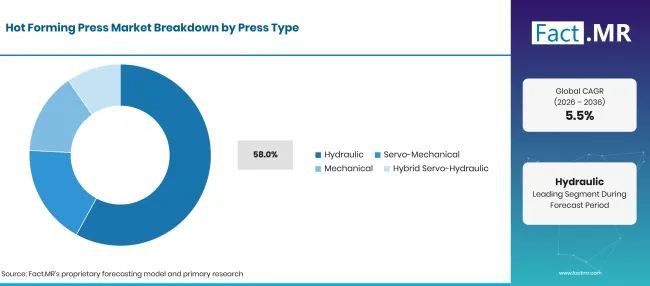
- Leading Press Type: Hydraulic (58.0%)
- Key Market Participants: Schuler, AP&T, Aida Engineering, Komatsu Industries, Dieffenbacher
- Key Growth Countries: India, Mexico, China, South Korea, United States
New vehicle platform development, increasing electric vehicle production and the adoption of lightweight structural materials are expected to strengthen demand for hot-forming and metal-forming equipment through 2036. India's Ministry of Heavy Industries reported in July 2026 that the PLI Automobile and Auto Components Scheme had attracted INR 44,326 crore in investments and generated 67,820 jobs by March 2026. Additionally, the government's Advanced Chemistry Cell battery programme targets 50 GWh of domestic battery manufacturing capacity, supported by an INR 18,100 crore allocation. As EV manufacturers expand battery production and develop lightweight vehicle structures, equipment orders are expected to benefit from demand for hot-formed steel components, aluminium battery enclosures and precision-formed structural parts. These developments also encourage manufacturers to upgrade forming lines for improved strength, dimensional accuracy and production efficiency.
Hot Forming Press Market
| Metric | Value |
|---|---|
| Estimated Value in (2026) | USD 1.10 billion |
| Forecast Value in (2036) | USD 1.88 billion |
| Forecast CAGR (2026 to 2036) | 5.5% |
Source: Fact.MR analysis.
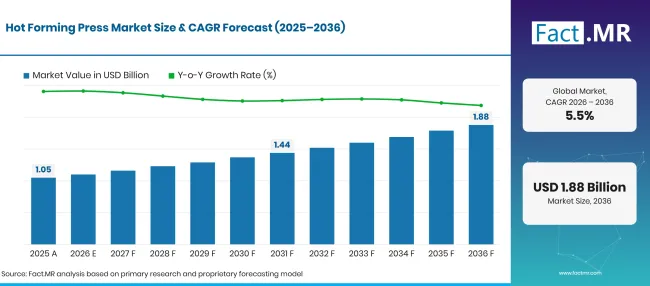
Hot Forming Press Market Forecast Global | Source: Fact.MR
Category
| Category | Segments |
|---|---|
| Press Type | Hydraulic, Servo-mechanical, Mechanical, Hybrid servo-hydraulic |
| Process | Direct hot stamping, Indirect hot stamping, Hot forming of aluminium and non-ferrous alloys, Composite and thermoplastic hot forming |
| Press Force | 800 to 1,500 tonnes, 1,500 to 3,000 tonnes, Up to 800 tonnes, Above 3,000 tonnes |
| End Use | Passenger vehicle body structures, Commercial and off-highway vehicles, Aerospace and defence, Industrial and energy equipment, Rail and heavy equipment |
| Region | India; Mexico; China; South Korea; United States |
Source: Fact.MR analysis.
Segmental Analysis
What makes hydraulic the leading press type segment in the Hot Forming Press Market?
Hot Forming Press Market Breakdown Press Type | Source: Fact.MR
Demand for hydraulic segment accounts for 58.0% of revenue in 2026, approximately USD 638.0 million, as hydraulic presses deliver high force, long dwell time and good control of die closing, all of which suit press hardening of thick, high-strength steel blanks. Plants also value their proven reliability and straightforward maintenance. India's Ministry of Statistics and Programme Implementation reported that manufacturing output increased by 7.6% year over year in September 2026, while motor vehicle manufacturing expanded by 19.0%. This industrial expansion supports investment in advanced metal-forming equipment. Hydraulic systems remain relevant for manufacturers producing high-strength steel components, including pillars, bumper beams and reinforced vehicle structures, where precise forming and controlled quenching are essential.
Which factors support direct hot stamping as the largest process segment in the Hot Forming Press Market?
Hot Forming Press Market Breakdown Process | Source: Fact.MR
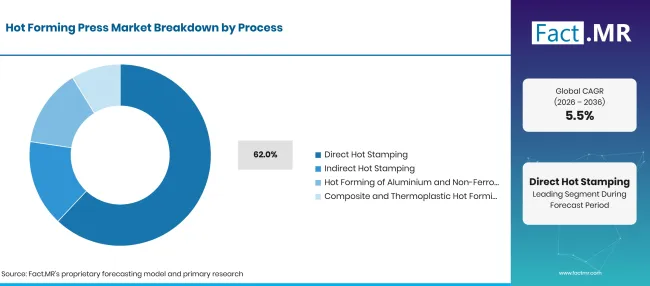
Sales of direct hot stamping segment holds 62.0% of revenue in 2026, approximately USD 682.0 million, as direct hot stamping heats the blank before forming and quenching in the die, which is the standard route for safety-critical structural parts. It gives high strength in a single press stroke. India's Ministry of Heavy Industries reported passenger vehicle production of 53.8 lakh units during January to December 2025, according to figures published in February 2026. The country's expanding vehicle manufacturing base supports demand for press-hardening processes used in safety-critical body structures. Direct hot stamping allows manufacturers to heat steel blanks before forming and quenching them in the die, producing complex components with high strength and dimensional consistency.
How are automotive component requirements influencing demand for 800 to 1,500-tonne presses?
Hot Forming Press Market Breakdown Press Force | Source: Fact.MR
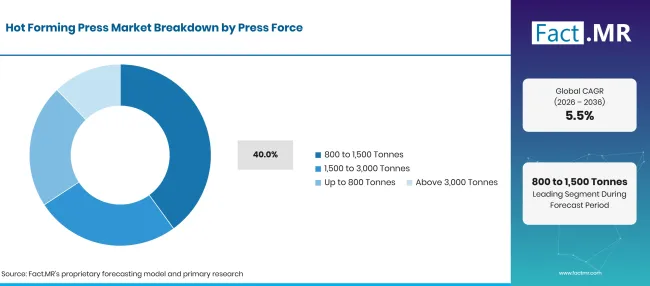
Demand for 800 to 1,500 tonnes presses to capture 40.0% of revenue in 2026, approximately USD 440.0 million, as presses in this range cover most body-in-white components such as pillars, rails and bumper beams. Buyers balance force, bed size and cycle time against floor space and energy use. India's Ministry of Statistics and Programme Implementation recorded 19.0% year-over-year growth in motor vehicle manufacturing in September 2026. Manufacturing of basic metals also increased by 3.7% during the month. These production indicators support opportunities for metal-forming equipment used by automotive OEMs and component suppliers. Buyers increasingly evaluate press capacity, forming accuracy, production speed and energy consumption when investing in new hot-stamping lines.
What is sustaining passenger vehicle body structure demand in the Hot Forming Press Market?
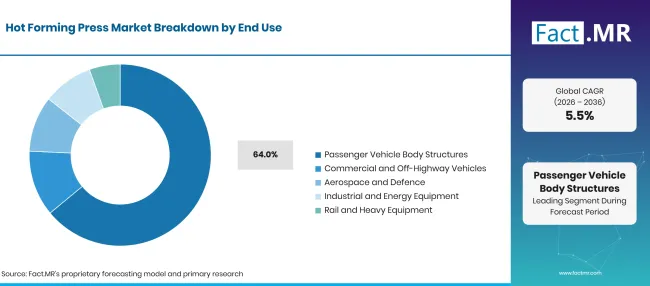
Hot Forming Press Market Breakdown End Use | Source: Fact.MR
Sales of passenger vehicle body structures segment accounts for 64.0% of revenue in 2026, approximately USD 704.0 million, as passenger-vehicle body structures use the largest number of press-hardened parts to meet crash and weight targets. Carmakers and tier-one suppliers invest in new lines with each platform change. India's Ministry of Heavy Industries reported that passenger vehicle production reached 53.8 lakh units in 2025, with sales of 44.9 lakh units. Separately, MoSPI recorded 19.0% growth in motor vehicle manufacturing in September 2026. Rising vehicle production and continuing investments in automotive manufacturing provide opportunities for hot forming press installations as manufacturers seek stronger structures, improved crash protection and reduced vehicle weight.
Hot Forming Press Market-Drivers, Restraints & Trends
Drivers:
Automotive Lightweighting and Crash-Safety Requirements-: Demand for hot forming presses is rising as carmakers specify press-hardened steel for pillars, rails and battery enclosures to reduce weight and meet crash-safety requirements. According to India's Ministry of Heavy Industries, passenger vehicle production reached 5.061 million units in FY 2024–25, compared with 4.902 million in FY 2023–24. Furthermore, the Ministry of Statistics and Programme Implementation reported that motor vehicle, trailer and semi-trailer manufacturing recorded 19.0% year-on-year growth in September 2026. These figures indicate expanding automotive production activity, supporting investment in advanced metal-forming technologies used to manufacture structural components, including press-hardened steel pillars, reinforcement rails and crash-management structures.
Restraints:
High Capital Investment and Automotive Production Cycles-: Sales is constrained by high capital cost, long investment cycles tied to vehicle platforms and cyclical automotive production, which can delay new line orders. High equipment costs and lengthy investment decisions remain important considerations for manufacturers purchasing industrial forming machinery. India's Ministry of Statistics and Programme Implementation reported that fixed capital in registered manufacturing establishments increased by 10.54% in FY 2024–25, reflecting substantial investment requirements across manufacturing operations. The Annual Survey of Industries also recorded 9.59% growth in manufacturing gross value added during the same period. These figures demonstrate the scale of capital investment taking place across the industrial sector. Large press installations still require manufacturers to evaluate equipment expenditure, production volumes, tooling requirements and expected returns before approving new production lines.
Opportunity: Servo and Hybrid Drive Systems -:
Press builders are adding servo-driven and hybrid drives that cut energy use and give finer control of motion and speed during forming. Energy-efficiency initiatives are creating opportunities for advanced servo-driven and hybrid forming equipment. India's Bureau of Energy Efficiency (BEE), under the Ministry of Power, reports that its Perform, Achieve and Trade (PAT) programme covers 1,333 energy-intensive industrial units, representing approximately 55% of total industrial energy consumption. The programme dashboard reports energy savings of 25.78 million tonnes of oil equivalent. These government figures demonstrate the importance of industrial energy management and efficiency improvements. For hot forming press manufacturers, this creates an opportunity to promote servo and hybrid drive systems that offer controlled movement, reduced idle energy consumption and improved production efficiency.
Trend: Electric-Vehicle Structures -:
Battery enclosures, crash members and integrated structures for electric vehicles are adding new hot-formed parts and larger part sizes. Electric-vehicle manufacturing is creating additional opportunities for hot-formed structural components used in battery protection, vehicle frames and crash-resistant enclosures. China's National Bureau of Statistics reported that new energy vehicle production reached 10.591 million units during January–August 2026, registering 11.3% year-on-year growth. In August alone, production reached 1.647 million units, increasing 21.9% year-on-year. This expansion demonstrates the growing scale of electric-vehicle manufacturing and the associated requirement for advanced structural components. As manufacturers develop battery enclosures, reinforced pillars and crash-management structures, demand for precision hot forming and press-hardening technologies can increase.
Hot Forming Press Market Analysis by Key Country
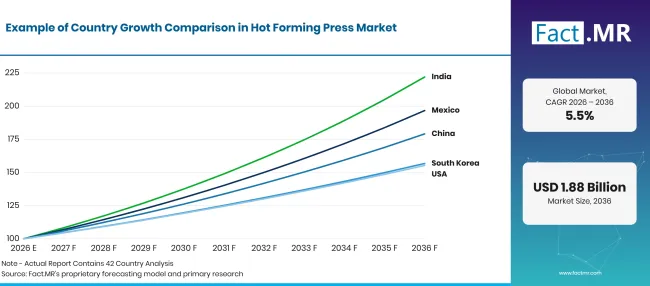
Hot Forming Press Market Growth Index | Source: Fact.MR
| Country | CAGR (2026-2036) |
|---|---|
| India | 8.3% |
| Mexico | 7.0% |
| China | 6.0% |
| South Korea | 4.6% |
| United States | 4.5% |
Source: Fact.MR analysis.
Why is India the fastest-growing market for hot forming presses?
Demand for hot forming presses in India is projected to grow at an 8.3% CAGR through 2036, the fastest among the five countries.
Expanding automotive production and the build-out of new vehicle platforms drive investment in domestic press lines and in imported equipment. India's hot forming presses market is the fastest among the five profiled countries. Expanding passenger vehicle manufacturing, investments in lightweight vehicle platforms and demand for crash-resistant structural components are encouraging automotive suppliers to upgrade stamping capabilities. According to the Ministry of Heavy Industries, India produced 50.61 lakh passenger vehicles in FY 2024–25, compared with 49.02 lakh in FY 2023–24, representing approximately 3.2% growth. Increasing vehicle production creates opportunities for press-hardening equipment used to manufacture high-strength automotive body components.
How is demand for hot forming presses developing in Mexico?
Sales of hot forming presses in Mexico is forecast to rise at a 7.0% CAGR through 2036, above the global rate of 5.5%.
Vehicle assembly serving the North American market and the expansion of automotive supply chains support orders for new stamping and hot forming lines. Mexico's hot forming presses market is exceeding the global rate of 5.5%. Its integration with North American automotive supply chains encourages manufacturers to invest in stamping capacity and advanced body-in-white production equipment. According to Mexico's National Institute of Statistics and Geography (INEGI), the country produced 3,254,062 light vehicles between January and October 2026, while exports reached 2,786,760 units. Although production declined 3.9% year over year, the substantial export-oriented manufacturing base continues to support opportunities for press-hardening and automotive metal-forming equipment suppliers.
What is driving hot forming presses demand in China?
Demand for hot forming presses in China is likely to increase at a 6.0% CAGR through 2036, above the global rate of 5.5%.
The world's largest vehicle market and an active domestic press industry support demand, with local builders competing alongside European and Japanese manufacturers. China's hot forming presses market is supported by electric vehicle manufacturing demand, lightweight body structures demand and the use of high-strength steel in automotive safety components. According to China's National Bureau of Statistics, automobile manufacturing value added increased 0.9% year over year in October 2026, while new energy vehicle production reached 2.027 million units, increasing 17.1%. The continued expansion of electric vehicle manufacturing creates opportunities for advanced hot stamping lines and precision press-hardening equipment.
What is keeping South Korea's hot forming press market competitive?
Sales of hot forming presses in South Korea is estimated to advance at a 4.6% CAGR through 2036, below the global rate of 5.5%.
A mature automotive sector with strong steel and parts suppliers supports demand for high-end presses used in structural body parts. Established automotive manufacturers and steel suppliers sustain demand for precision forming equipment used in structural components, vehicle frames and safety-critical body parts. South Korea's Ministry of Trade, Industry and Resources reported that automobile production reached 3.396 million units during January–October 2026, increasing 0.3% year over year. Eco-friendly vehicle exports also reached 884,000 units during this period, exceeding the full-year 2025 total. These developments support demand for advanced automotive stamping capabilities.
Why is growth slower for hot forming presses in United States?
Demand for hot forming presses in United States is set to expand at a 4.5% CAGR through 2036, the slowest among the five countries.
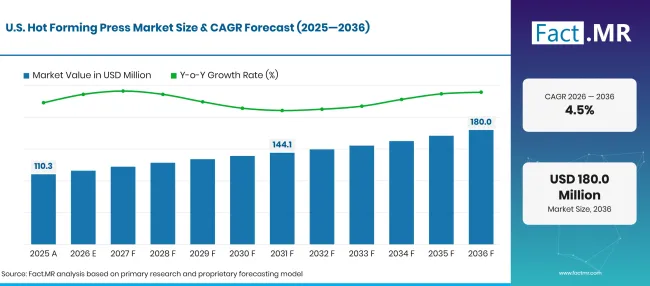
Hot Forming Press Market Forecast Usa | Source: Fact.MR
Vehicle production for domestic and export markets, plus electric-vehicle investment, sustains demand for press-hardening capacity. Established automotive manufacturing capacity, long equipment replacement cycles and high investment requirements moderate new press-line purchases. Nevertheless, electric vehicle platforms and lightweight structural components sustain opportunities for advanced press-hardening systems. According to the US Bureau of Economic Analysis, real motor vehicle output reached USD 630.1 billion at a seasonally adjusted annual rate in the second quarter of 2026, compared with USD 621.9 billion in the first quarter. This indicates continued manufacturing activity despite moderate equipment demand growth.
Competitive Landscape for Hot Forming Press Market
Competition in the hot forming press market is shaped by established European engineering groups, specialized press-hardening technology providers and regional manufacturers. Companies compete through press capacity, forming precision, automation integration, production speed and turnkey line capabilities for automotive structural components.
ANDRITZ Schuler maintains a strong position through hydraulic, mechanical and servo press technologies, integrated press lines and automation solutions. AP&T differentiates itself through complete press-hardening systems combining heating, forming, quenching and automation. Fagor Arrasate competes through customized metal forming equipment, hot stamping lines and large-scale automotive press solutions.
Indian manufacturers, including ISGEC Heavy Engineering and Hind Presses & Automation, serve opportunities in industrial and automotive press manufacturing, with capabilities in customized hydraulic presses and heavy engineering equipment. Hyundai WIA strengthens the competitive environment through automotive manufacturing machinery, machining centres and industrial automation solutions.
Competition increasingly depends on delivering energy-efficient presses, shorter production cycles, advanced process controls and integrated automation. Manufactuerers capable of providing complete hot forming lines, technical support and customized solutions for high-strength steel components are better positioned to secure automotive OEM and Tier-1 supplier contracts.
Recent Developments
- In February 2025, AP&T announced a new production line in February 2025, designed for flexible and efficient press hardening of large, complex automotive components. The development strengthens its integrated hot forming equipment portfolio and supports advanced vehicle-body manufacturing.
- In August 2026, AP&T announced that India's ALF Engineering ordered a second complete press-hardening line in August 2026, in collaboration with ISGEC. The investment expands automotive component production capacity and demonstrates growing demand for press-hardening technology in India.
- In March 2025, ANDRITZ announced that Schuler would be renamed ANDRITZ Schuler, strengthening integration across its metal-forming operations. Schuler remains the product brand, retaining its press-engineering portfolio and expanding access to integrated industrial solutions.
- In August 2026, ISGEC collaborated with AP&T to supply ALF Engineering's second complete press-hardening line in India. The project supports automotive manufacturing capacity expansion and strengthens ISGEC's involvement in advanced press-hardening equipment installations.
- In March 2026. Hyundai WIA commenced mass production at its new Slovakia facility in October 2026, establishing European manufacturing capacity for constant velocity joints and coolant modules.
Key Players in Hot Forming Press Market
Key companies operating in the market include Schuler, AP&T, Fagor Arrasate, ISGEC Heavy Engineering, Hind Presses & Automation, and Hyundai WIA.
- Schuler
- AP&T
- Fagor Arrasate
- ISGEC Heavy Engineering
- Hind Presses & Automation
- Hyundai WIA
Bibliography
- AP&T. (2026). Indian Tier 1 leader ALF Engineering doubles its capacity with second press line from AP&T.
- Ministry of Heavy Industries. (2026, February 10). Status of heavy industries sector. Press Information Bureau.
- Ministry of Statistics and Programme Implementation. (2026, October 28). Quick estimates of Index of Industrial Production and use-based index for the month of September 2026 (Base 2022–23=100). Press Information Bureau.
- Ministry of Statistics and Programme Implementation. (2026, September 30). Annual Survey of Industries 2024–25. Press Information Bureau.
- National Bureau of Statistics of China. (2026, September 17). Industrial production, August 2026.
- Press Information Bureau. (2026). Automotive manufacturing and industrial production. Government of India.
- ANDRITZ. (2025, March 13). Schuler becomes ANDRITZ Schuler.
Segmentation
Scope of Report
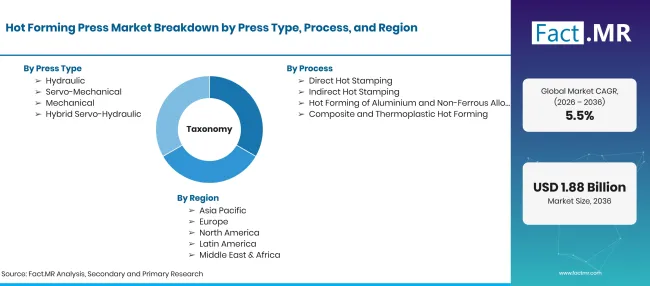
Hot Forming Press Market Taxonomy | Source: Fact.MR
| Items | Values |
|---|---|
| Quantitative Units (2026) | USD 1.10 Billion |
| Press Type | Hydraulic, Servo-mechanical, Mechanical, Hybrid servo-hydraulic |
| Process | Direct hot stamping, Indirect hot stamping, Hot forming of aluminium and non-ferrous alloys, Composite and thermoplastic hot forming |
| Press Force | 800 to 1,500 tonnes, 1,500 to 3,000 tonnes, Up to 800 tonnes, Above 3,000 tonnes |
| End Use | Passenger vehicle body structures, Commercial and off-highway vehicles, Aerospace and defence, Industrial and energy equipment, Rail and heavy equipment |
| Regions Covered | North America, Latin America, Europe, Asia Pacific, Middle East & Africa |
| Countries Covered | India, Mexico, China, South Korea, United States, and other countries |
| Key Companies Profiled | Schuler AP&T Fagor Arrasate ISGEC Heavy Engineering Hind Presses & Automation Hyundai WIA |
| Additional Attributes | Dollar revenue in the Hot Forming Press Market is segmented by press type, process, press force and end use and region. |
Source: Fact.MR analysis.
Hot Forming Press Market by Segments
-
Press Type
- Hydraulic
- Servo-mechanical
- Mechanical
- Hybrid servo-hydraulic
-
Process
- Direct hot stamping
- Indirect hot stamping
- Hot forming of aluminium and non-ferrous alloys
- Composite and thermoplastic hot forming
-
Press Force
- 800 to 1,500 tonnes
- 1,500 to 3,000 tonnes
- Up to 800 tonnes
- Above 3,000 tonnes
-
End Use
- Passenger vehicle body structures
- Commercial and off-highway vehicles
- Aerospace and defence
- Industrial and energy equipment
- Rail and heavy equipment
-
Region:
- North America
- United States
- Canada
- Mexico
- Europe
- Germany
- United Kingdom
- France
- Italy
- Spain
- Rest of Europe
- Asia Pacific
- China
- India
- Japan
- South Korea
- Australia and New Zealand
- Rest of Asia Pacific
- Latin America
- Brazil
- Argentina
- Rest of Latin America
- Middle East & Africa
- GCC Countries
- South Africa
- Rest of Middle East & Africa
- North America
Table of Contents
Key Takeaways
- Market Size and CAGR
- Top Growth Driver
- Fastest Growing Segment
- Leading Region
- Key Companies
- Emerging Opportunities

