
Float Valves Market Forecast and Outlook 2026 to 2036
According to the Fact.MR analysis, the float valve market surpassed a value of USD 1.15 billion in 2025 and is projected to grow from USD 1.20 billion in 2026 to USD 1.86 billion by 2036. Demand for float valves is likely to grow at a CAGR of 4.5% over the forecast period.
Demand for float valves is rising as water utilities, building owners, farms and industrial plants replace leaking or worn level-control valves and add automatic filling to storage tanks and cisterns to cut water waste. The key players are offering plastic and brass valves in a range of connection sizes, with quieter filling, adjustable shut-off levels and corrosion-resistant materials.
Key Takeaways from the Float Valves Market
- Float Valves Market Value (2025): USD 1.15 billion
- Float Valves Market Value (2026): USD 1.20 billion
- Float Valves Market Forecast Value (2036): USD 1.86 billion
- Float Valves Market Forecast CAGR (2026-2036): 4.5%
- Leading Type: Cistern fill valves (44.0%)
- Key Market Participants: Geberit, Fluidmaster, Watts Water Technologies, Zurn Elkay Water Solutions, Kohler
- Key Growth Countries: India, China, South Korea, United States, United Kingdom
Replacement demand across the Float Valves Market is expected to remain steady through 2036 as ageing toilets, water storage tanks and livestock troughs require periodic valve replacement to maintain reliable water levels and prevent leakage. India's Ministry of Jal Shakti reported in March 2026 that approximately 15.82 crore rural households had tap water connections, representing 81.71% of rural households. Additionally, the government reported more than 12.58 crore household connections added under the Jal Jeevan Mission. Expanding water infrastructure and sanitation coverage are creating opportunities for float valves in new installations, storage systems and maintenance applications.
Float Valves Market
| Metric | Value |
|---|---|
| Estimated Value in (2026) | USD 1.20 billion |
| Forecast Value in (2036) | USD 1.86 billion |
| Forecast CAGR (2026 to 2036) | 4.5% |
Source: Fact.MR analysis.
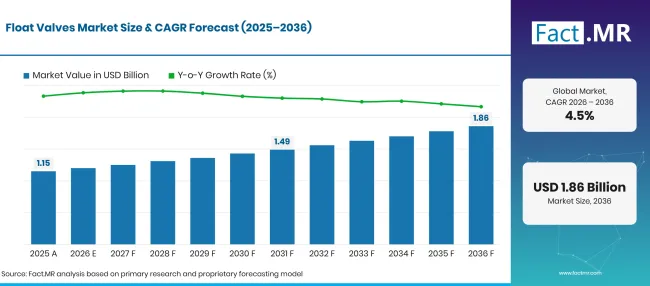
Float Valves Market Forecast Global | Source: Fact.MR
Category
| Category | Segments |
|---|---|
| Type | Cistern fill valves, Tank and trough float valves, Industrial float control valves, Hydraulically operated float valves |
| Material | Plastic, Brass and bronze, Stainless steel, Cast and ductile iron |
| Application | Toilets and sanitary systems, Water storage tanks, Agriculture and livestock, Industrial and process plants, Fire and municipal reservoirs |
| Connection Size | Up to 25 mm, 25 to 50 mm, 50 to 100 mm, Above 100 mm |
| Region | India; China; South Korea; United States; United Kingdom |
Source: Fact.MR analysis.
Segmental Analysis
What makes cistern fill valves the leading type segment in the Float Valves Market?
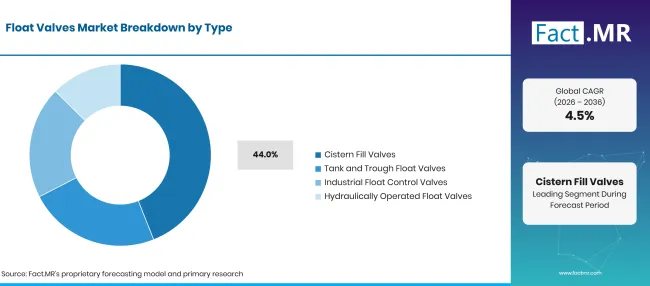
Float Valves Market Breakdown Type | Source: Fact.MR
Demand for the cistern fill valves segment accounts for 44.0% of revenue in 2026, about USD 528.0 million, as cistern fill valves are fitted in virtually every toilet cistern and are replaced regularly as seals wear. Plumbers and building managers choose them for easy fitting, quiet refill and compatibility with standard cistern designs. India's Ministry of Jal Shakti reported in February 2026 that more than 12.05 crore household toilets had been constructed under the Swachh Bharat Mission. This extensive installed base supports recurring demand for replacement fill valves, particularly as internal seals and float mechanisms wear. Manufacturers are targeting plumbers and sanitation equipment manufacturers with compact, adjustable cistern valves designed for reliable refilling and reduced water wastage.
Which factors support plastic as the largest material segment in the Float Valves Market?
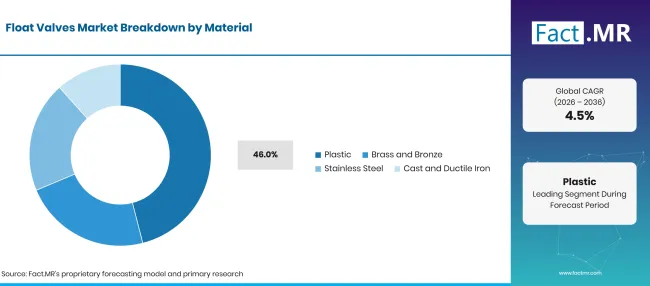
Float Valves Market Breakdown Material | Source: Fact.MR
Plastic float valves account for 46.0% of revenue in 2026, about USD 552.0 million, as plastic valves are light, resist scale and corrosion and keep unit cost low in high-volume plumbing products. Manufacturers can mold complex shapes and integrate adjustable floats at low cost. India's Ministry of Jal Shakti reported that 15.82 crore rural households had tap water connections as of March 3, 2026, representing 81.71% of rural households under the Jal Jeevan Mission. Expanding household water infrastructure creates opportunities for plastic valves in storage and water-level control applications. Their resistance to corrosion, mouldability and relatively economical production support high-volume procurement by plumbing manufacturers and sanitation equipment manufacturers.
What makes toilets and sanitary systems the leading application segment in the Float Valves Market?
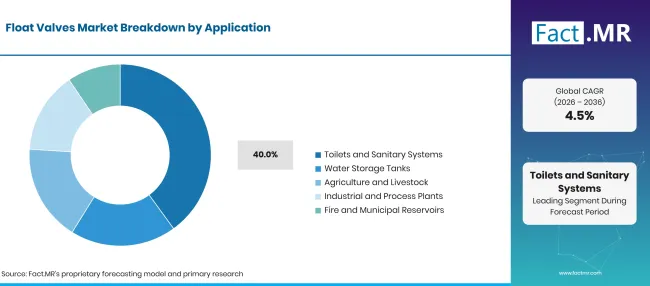
Float Valves Market Breakdown Application | Source: Fact.MR
Demand for toilets and sanitary systems segment accounts for 40.0% of revenue in 2026, about USD 480.0 million, as toilets and sanitary systems in homes, offices, hospitals and public buildings all rely on an automatic fill mechanism that shuts off reliably and limits water loss. Replacement cycles keep demand recurring. The Government of India reported in June 2026 that more than 12.14 crore household toilets had been completed under Swachh Bharat Mission-Grameen, alongside over 63 lakh household toilets constructed under the urban mission between 2014 and 2026. This substantial sanitation infrastructure supports demand for cistern fill valves, replacement components and water-control mechanisms. Suppliers are focusing on dependable shut-off performance and compatibility with widely installed toilet cistern designs.
Which factors support up to 25 mm as the largest connection size segment in the Float Valves Market?
Float Valves Market Breakdown Connection Size | Source: Fact.MR
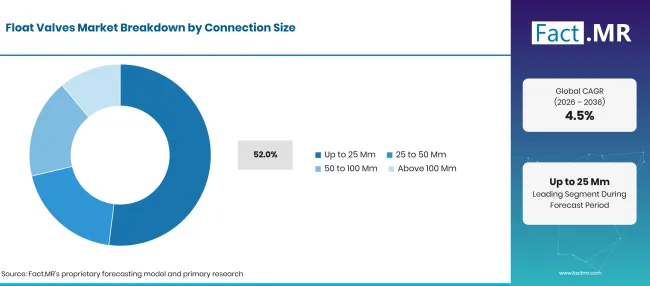
The up to 25 mm segment accounts for 52.0% of revenue in 2026, about USD 624.0 million, as small-bore valves fit domestic cisterns, tanks and troughs, which account for the bulk of units installed. Larger sizes serve industrial and municipal tanks but sell in much lower volume. India's Jal Jeevan Mission reported that approximately 15.89 crore rural households had tap water connections by July 18, 2026, equivalent to 82.09% coverage. The expansion of household water infrastructure supports installations requiring smaller water-level control components. Manufacturers are therefore targeting plumbing distributors and tank producers with compact float valves offering straightforward installation, reliable shut-off and compatibility with standard domestic water-storage connections.
Drivers: Expansion of Water Supply Infrastructure and Automatic Water-Level Control
Drivers: Expansion of Water Supply Infrastructure and Automatic Water-Level Control
India's Ministry of Jal Shakti reported on March 12, 2026, that approximately 15.82 crore rural households, representing 81.71% of the country's 19.36 crore rural households, had tap water connections under the Jal Jeevan Mission as of March 3, 2026. At the beginning of the programme in August 2019, only 3.23 crore households had tap water connections. The addition of more than 12.58 crore connections demonstrates the substantial expansion of India's rural water distribution infrastructure. This expansion supports demand for water-storage tanks, reservoirs, plumbing accessories and automatic water-level control components, including float valves used to regulate tank filling and prevent overflow.
Restraints:
Long Product Life and Competition from Alternative Water Controls -: Demand is constrained by low unit prices and long product lives, and by competition from electronic level sensors and solenoid-based controls in industrial and commercial installations. The Ministry of Jal Shakti's January 29, 2026, functionality assessment examined 2,37,608 households across 19,812 villages in 761 districts. It found that 86.5% of households had working tap connections, 80.2% received adequate water quantities and 83.6% received water regularly according to supply schedules. These findings indicate the importance of maintaining existing water infrastructure rather than relying exclusively on new installations. For float valve manufacturers, established plumbing systems, replacement cycles and competition from electronic level sensors and solenoid-operated controls can limit demand for conventional mechanical valves.
Opportunity:
Water-Saving and Quiet-Fill Designs The manufacturers are offering low-noise, dual-flush-compatible and leak-resistant fill valves that help households and building owners reduce water use. The Bureau of Indian Standards (BIS) has established water-efficiency requirements for plumbing products through IS 17650 (Part 1):2021 and IS 17650 (Part 2):2021. These standards introduce one-star, two-star and three-star water-efficiency ratings for relevant sanitaryware and sanitary fittings. The standards cover products such as flushing cisterns, flush valves, faucets and showerheads. Additionally, India's Ministry of Jal Shakti reported that 81.71% of rural households had tap water connections as of March 3, 2026. Together, these developments support the importance of water-efficient plumbing systems. Manufacturers can address this opportunity through leak-resistant float valves, controlled refill mechanisms and quieter tank-filling designs.
Trend:
Resistant Materials and Water Quality Management Buyers in agriculture, coastal and industrial settings are moving toward engineered plastics and stainless steel that resist scale, chlorine and fertilizers. India's Central Ground Water Board (CGWB), in its Dynamic Ground Water Resources Assessment 2025 published by the Ministry of Jal Shakti in August 2026, estimated annual groundwater extraction at 247 billion cubic metres. Of this amount, 215 billion cubic metres, or 87%, was used for irrigation, 28 billion cubic metres for domestic purposes and 4 billion cubic metres for industrial purposes. The scale of groundwater utilization highlights the importance of durable water-handling infrastructure across agricultural, domestic and industrial applications. Float valves used in irrigation tanks, agricultural storage systems and industrial water installations must withstand operating conditions involving mineral deposits, fertilizers and chemical exposure. This supports the relevance of stainless steel and engineered plastic valve components.
Float Valves Market Analysis by Key Country
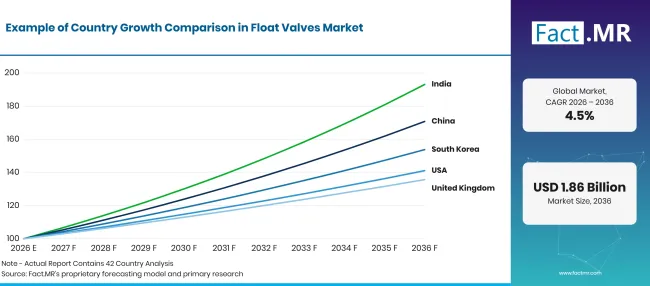
Float Valves Market Growth Index | Source: Fact.MR
| Country | CAGR (2026-2036) |
|---|---|
| India | 6.8% |
| China | 5.5% |
| South Korea | 4.4% |
| United States | 3.5% |
| United Kingdom | 3.1% |
Source: Fact.MR analysis.
Why is India the fastest-growing market for float valves?
Sales of float valves in India is estimated to advance at a 6.8% CAGR through 2036, the fastest among the five countries.
Expanding urban housing, rising water-storage needs and the large agricultural sector support demand for both plumbing and tank float valves. India's float valves market is projected to grow at a 6.8% CAGR through 2036, the fastest among the five profiled countries. Expanding household water connections, agricultural water storage and urban infrastructure are creating additional requirements for tank-level control equipment. According to the Ministry of Jal Shakti, approximately 15.82 crore rural households had tap-water connections as of March 3, 2026, representing 81.71% of rural households. Continued investment in water-supply infrastructure supports opportunities for float valves in storage tanks, overhead reservoirs and plumbing systems, particularly where automatic water-level regulation helps prevent overflow.
Which infrastructure investments are strengthening float valve sales in China?
Demand for float valves in China is set to expand at a 5.5% CAGR through 2036, above the global rate of 4.5%.
A large building stock and water-infrastructure investment sustain demand, with local manufacturers supplying cost-sensitive plastic valves in volume. Investment in water distribution, reservoirs and municipal infrastructure supports demand for mechanical level-control components used in storage and supply systems. China's Ministry of Water Resources reported that water conservancy investment reached RMB 515.1 billion during the first half of 2026, with 25 major projects newly launched. The government also outlined plans to expand the national water network during 2026–2030. These investments create opportunities for float valves across water-storage tanks, distribution facilities and agricultural infrastructure.
What is shaping float valves demand in South Korea?
Demand for float valves in South Korea is projected to grow at a 4.4% CAGR through 2036, below the global rate of 4.5%.
Demand follows apartment construction and replacement of fittings in an established housing stock, and buyers favor quiet-fill, certified plumbing products. Residential construction and replacement of water-control fittings in apartment buildings support demand for toilet cistern valves, storage tanks and plumbing installations. South Korea's Ministry of Land, Infrastructure and Transport maintains monthly statistics covering building permits, construction starts and completions. Seoul government-reported figures showed 44,371 housing permits during January–September 2026, up 33.3% from the corresponding 2025 period. This construction activity supports replacement and installation opportunities, although the mature housing market moderates overall demand growth.
How is demand for float valves developing in United States?
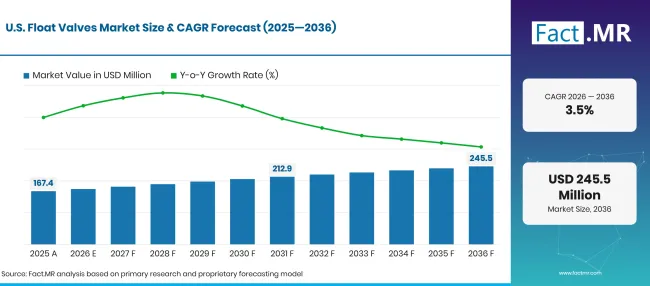
Sales of float valves in United States is forecast to rise at a 3.5% CAGR through 2036, below the global rate of 4.5%.
Float Valves Market Forecast Usa | Source: Fact.MR
Replacement of cistern and tank valves in existing homes and commercial buildings provides recurring demand, supported by plumbing standards that require approved water fittings. Replacement of ageing toilet cistern mechanisms, water-storage tank fittings and plumbing components provides recurring sales opportunities across residential and commercial properties. The US Census Bureau reported 1.221 million housing starts at a seasonally adjusted annual rate in September 2026, down 5.2% from August. Although construction activity softened, the existing housing base continues to support replacement demand. Manufacturers supplying durable, water-efficient and low-maintenance float valves can benefit from renovation and plumbing maintenance requirements.
Why is growth slower for float valves in United Kingdom?
Demand for float valves in United Kingdom is likely to increase at a 3.1% CAGR through 2036, the slowest among the five countries.
Water-efficiency programs and a large stock of older homes keep replacement demand for cistern valves steady, with a smaller industrial tank segment. Demand primarily comes from replacement of toilet cistern valves, domestic water-storage equipment and plumbing fittings in older properties. According to the UK government's November 2026 Council Taxbase statistics, England contained approximately 26.0 million dwellings as of September 9, 2026, providing a substantial installed base for plumbing replacements. Additionally, household water consumption averaged 136.9 litres per person per day during 2025–2026. Water-efficiency initiatives encourage improved water-level control and reduced wastage, supporting replacement opportunities for efficient float valves.
Competitive Landscape for Float Valves Market
The float valve market is relatively concentrated, with Geberit, Fluidmaster, Watts Water Technologies, Zurn Elkay Water Solutions and Kohler together holding about 67% of 2026 revenue, based on Fact.MR estimates. Competition centers on product reliability, plumbing approvals, breadth of cistern compatibility and distribution through wholesalers and DIY retailers. Large sanitary-ware and plumbing groups lead in cistern valves, while smaller specialists supply industrial and municipal level-control valves.
Recent Developments
- In July 2026, Zurn Elkay agreed to acquire Intellihot, expanding its portfolio into energy-efficient tankless water-heating solutions for commercial and institutional facilities, including healthcare, education and hospitality markets.
- In April 2026, Zurn Elkay introduced the Wilkins 975XL3N reduced-pressure backflow preventer for irrigation replacement applications. Its compact n-pattern design addresses restricted installation spaces and simplifies servicing across outdoor plumbing systems.
- In March 2025, Geberit improved its Type 383 cistern fill valve, reducing perceptible refill noise by 50% compared with its predecessor. The redesigned valve also uses 40% less material and incorporates recycled plastic.
Key Players in Float Valves Market
Key companies operating in the market include Geberit, Fluidmaster, Watts Water Technologies, Zurn Elkay Water Solutions, and Kohler.
- Geberit
- Fluidmaster
- Watts Water Technologies
- Zurn Elkay Water Solutions
- Kohler
Bibliography
- Bureau of Indian Standards. (2026). IS 17650 (Part 1):2021 – Water efficient plumbing products: Requirements, Part 1: Sanitaryware.
- Ministry of Jal Shakti. (2026, January 29). Dynamic groundwater resources assessment, 2025. Press Information Bureau.
- Ministry of Jal Shakti. (2026, February 9). Accessibility to sanitation facilities. Press Information Bureau.
- Ministry of Jal Shakti. (2026, March 12). Safe and regular water supply under Jal Jeevan Mission. Press Information Bureau.
- Ministry of Jal Shakti. (2026, March 30). Jal Jeevan Mission and rural drinking water supply. Press Information Bureau.
- Ministry of Jal Shakti. (2026, June). Sanitation and Swachh Bharat Mission achievements. Press Information Bureau.
- Ministry of Jal Shakti. (2026, July 27). Extension of the Jal Jeevan Mission and transfer of rural water supply schemes. Press Information Bureau.
- Ministry of Jal Shakti. (2026, August 10). Average groundwater consumption and its quality in the country. Press Information Bureau.
Segmentation
Scope of Report
Float Valves Market Taxonomy | Source: Fact.MR
| Items | Values |
|---|---|
| Quantitative Units (2026) | USD 1.20 Billion |
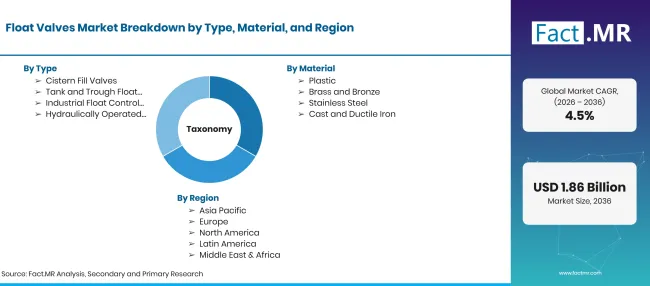
| Type | Cistern fill valves, Tank and trough float valves, Industrial float control valves, Hydraulically operated float valves |
| Material | Plastic, Brass and bronze, Stainless steel, Cast and ductile iron |
| Application | Toilets and sanitary systems, Water storage tanks, Agriculture and livestock, Industrial and process plants, Fire and municipal reservoirs |
| Connection Size | Up to 25 mm, 25 to 50 mm, 50 to 100 mm, Above 100 mm |
| Regions Covered | North America, Latin America, Europe, Asia Pacific, Middle East & Africa |
| Countries Covered | India, China, South Korea, United States, United Kingdom, and other countries |
| Key Companies Profiled | Geberit, Fluidmaster, Watts Water Technologies, Zurn Elkay Water Solutions, Kohler |
| Additional Attributes | Dollar revenue in the Float Valves Market is segmented by type, material, application and connection size and region. |
Source: Fact.MR analysis.
Float Valves Market by Segments
-
Type
- Cistern fill valves
- Tank and trough float valves
- Industrial float control valves
- Hydraulically operated float valves
-
Material
- Plastic
- Brass and bronze
- Stainless steel
- Cast and ductile iron
-
Application
- Toilets and sanitary systems
- Water storage tanks
- Agriculture and livestock
- Industrial and process plants
- Fire and municipal reservoirs
-
Connection Size
- Up to 25 mm
- 25 to 50 mm
- 50 to 100 mm
- Above 100 mm
-
Region:
- North America
- United States
- Canada
- Mexico
- Europe
- Germany
- United Kingdom
- France
- Italy
- Spain
- Rest of Europe
- Asia Pacific
- China
- India
- Japan
- South Korea
- Australia and New Zealand
- Rest of Asia Pacific
- Latin America
- Brazil
- Argentina
- Rest of Latin America
- Middle East & Africa
- GCC Countries
- South Africa
- Rest of Middle East & Africa
- North America
Table of Contents
Key Takeaways
- Market Size and CAGR
- Top Growth Driver
- Fastest Growing Segment
- Leading Region
- Key Companies
- Emerging Opportunities

