- Market Value (2025): USD 1.0 Bn
- Estimated Value (2026): USD 1.2 Bn
- Forecast Value (2036): USD 9.1 Bn
- CAGR (2026-2036): 22.0%
What is the Edge Vision Systems Market forecast to be worth by 2036?
USD 1.2 billion in 2026 to USD 9.1 billion by 2036 at a 22.0% CAGR.
- The edge vision systems market reached USD 1.0 billion in 2025.
- Demand is projected to increase from USD 1.2 billion in 2026 to USD 9.1 billion by 2036.
- The market is forecast to record 22.0% CAGR from 2026 to 2036 as manufacturers place inspection, monitoring and decision control closer to production assets.
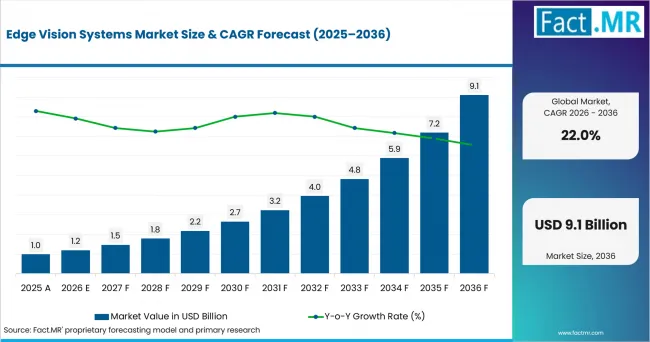
Edge Vision Systems Market Value Analysis | Source: Fact.MR
What are the defining numbers behind Edge Vision Systems Market growth?
USD 7.9 billion absolute opportunity is expected between 2026 and 2036.
- Demand Drivers in the Market
- Automotive line managers need local visual inspection because reject decisions must match robot and conveyor timing.
- Electronics manufacturers need compact optical systems for surface checks where small defects affect yield and rework cost.
- Logistics operators need cameras near conveyors so parcels, labels and barcodes can be checked before routing decisions move downstream.
- Machine-tool owners need visual condition monitoring at the cell because tool wear and alignment issues are expensive when discovered after machining.
- Factory IT teams need edge processing because large image streams can overload plant networks when every frame moves to a remote server.
- Key Segments Analyzed
- By Sensor Type: Optical is expected to hold 41.0% share in 2026 because camera-based inspection remains the core sensing layer for edge vision systems.
- By Connectivity: Industrial Ethernet is projected to account for 44.0% share in 2026 as plant teams connect vision devices with PLCs and control networks.
- By Function: Condition monitoring is anticipated to capture 38.0% share in 2026 since visual checks increasingly support equipment health and product quality together.
- By End Use: Automotive is estimated to represent 34.0% share in 2026 owing to high line speeds, repeatable part handling and strict defect traceability.
- By Installation: Inline is forecast to hold 51.0% share in 2026 because inspection decisions are most valuable before parts leave the production station.
- Analyst Opinion at Fact.MR
- Shambhu Nath Jha, Principal Consultant at Fact.MR, states, “Edge vision is drawing attention because manufacturers want inspection decisions at the point of work. Demand is expected to favor systems that combine optics, inference and plant connectivity inside a compact footprint. Suppliers with clear integration paths should pair camera performance with controller links, model maintenance and documented accuracy.”
- Strategic Implications
- Vision-system vendors should document line-speed accuracy by part type so plant teams can compare edge inspection against existing camera stations.
- Processor suppliers should show thermal and power data in production-like enclosures before asking manufacturers to approve embedded AI platforms.
- Automation integrators should package lighting, mounting and PLC communications as one tested cell to reduce deployment time.
- Plant operators should measure false rejects, pass-through defects and network load before expanding edge vision beyond pilot lines.
Germany is projected to post 27.4% CAGR through 2036, supported by machinery orders and factory inspection upgrades. Japan is anticipated to record 26.9% CAGR as machinery investment supports compact vision deployment. South Korea is forecast to advance at 26.0% CAGR with electronics and semiconductor output lifting plant-level inspection needs. The UK is estimated to reach 15.7% CAGR on the back of robotics support and selective manufacturing modernization. The USA is expected to record 15.4% CAGR as robot installations and manufacturing orders sustain edge inspection pilots.
How does the Edge Vision Systems Market break down by segment?
Optical leads Sensor Type at 41.0%; Inline leads Installation at 51.0% share.
Which Sensor Type dominates?
Optical is expected to hold 41.0% share in 2026.
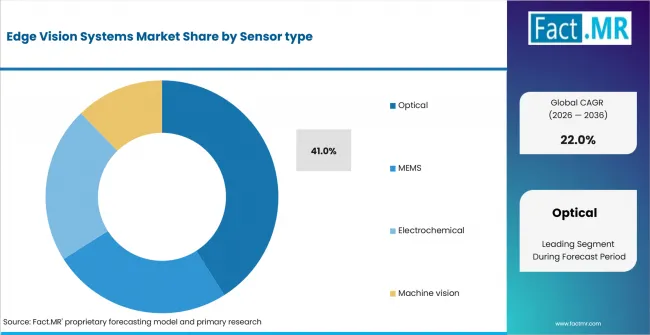
Edge Vision Systems Market Analysis By Sensor Type | Source: Fact.MR
Optical systems lead because most edge vision use cases begin with image capture. Cameras, lenses and illumination determine whether the embedded processor receives usable information. Basler introduced a GMSL vision system for NVIDIA Jetson Orin in March 2026 with sensors up to 24.4 MP and frame rates up to 170 fps.
What leads the Connectivity segment?
Industrial Ethernet is projected to account for 44.0% share in 2026.
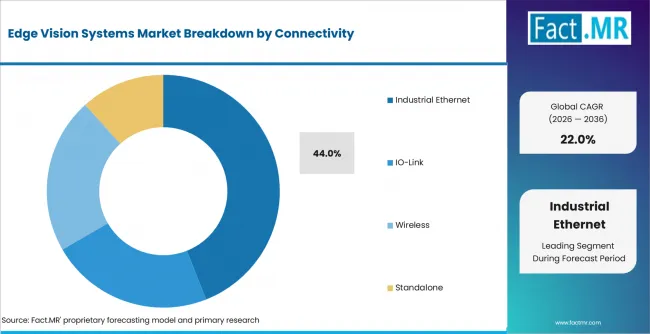
Edge Vision Systems Market Analysis By Connectivity | Source: Fact.MR
Industrial Ethernet is expected to lead because plant teams need deterministic links between cameras, controllers and supervisory systems. Edge vision devices still need to exchange triggers, status data and reject signals. Basler reported in April 2026 that its CoaXPress-over-Fiber TDI vision system supports bandwidth up to dual 100 Gbps.
How does Function shape demand?
Condition monitoring is anticipated to lead with 38.0% share in 2026.
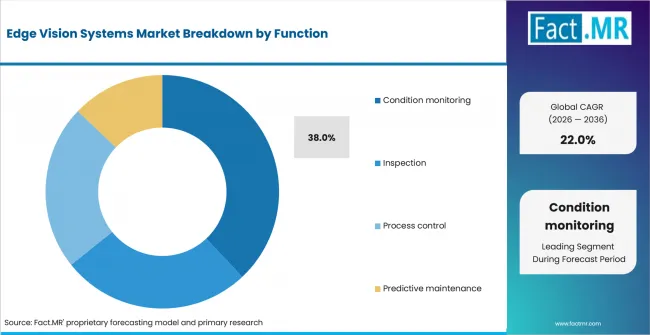
Edge Vision Systems Market Analysis By Function | Source: Fact.MR
Condition monitoring is expected to lead because edge vision can check equipment condition while inspecting output. The same camera station can identify surface defects, misalignment and tooling changes. Ambarella launched the 4nm CV7 edge AI vision SoC in January 2026 and described it as supporting simultaneous multi-stream video with on-device AI.
What supports Automotive within End Use?
Automotive is estimated to represent 34.0% share in 2026.
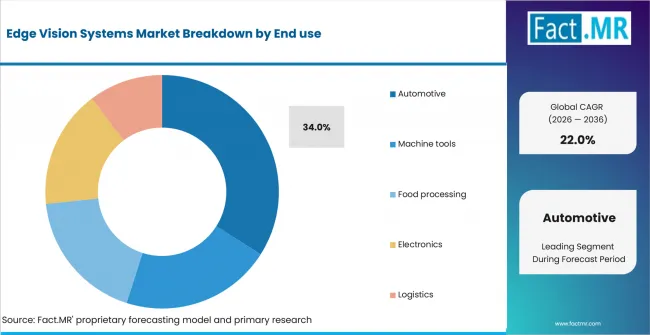
Edge Vision Systems Market Analysis By End Use | Source: Fact.MR
Automotive leads because parts move through repeatable stations where visual inspection can be standardized. Edge systems are suited to weld checks, label verification and component presence checks. The International Federation of Robotics reported in June 2026 that U.S. robot density stood at 307 industrial robots per 10,000 manufacturing employees.
What supports Inline within Installation?
Inline is forecast to hold 51.0% share in 2026.
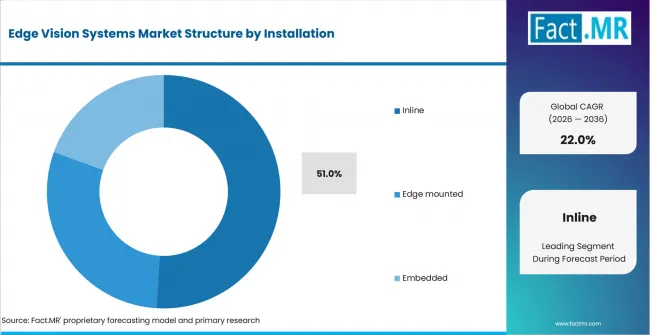
Edge Vision Systems Market Analysis By Installation | Source: Fact.MR
Inline installation leads because the cost of a missed visual error increases after the part leaves the station. Edge vision helps plant teams accept, reject or route items before extra handling occurs. Cognex said in May 2026 that the In-Sight 3900 offers image resolution up to 25 MP and runs inspections up to four times faster than previous-generation Cognex vision systems.
What is accelerating Edge Vision Systems Market adoption, and what is holding it back?
Demand is expected to rise through line-side inspection, robotics adoption and embedded AI processing. Adoption is paced by integration effort, model validation and plant-network approval.
Drivers Impact Analysis
| DRIVER | (~) % IMPACT ON CAGR | GEOGRAPHIC RELEVANCE | IMPACT TIMELINE |
|---|---|---|---|
| Inline quality inspection at production speed | +2.4% | North America, East Asia, Western Europe | Short term (<= 2 years) |
| Embedded AI processors inside compact vision devices | +1.7% | Global | Medium term (2-4 years) |
| Robotics and conveyor automation in factories | +1.5% | USA, Germany, Japan, South Korea | Medium term (2-4 years) |
| Electronics and optical-product manufacturing intensity | +1.1% | East Asia, Western Europe | Long term (>= 4 years) |
Source: Fact.MR analysis. Updated Aug 26, 2026
- Inline quality inspection at production speed: Production teams place vision systems near conveyors and robot cells so defective products can be identified before additional handling or processing.
- Robotics and conveyor automation in factories: Expanding use of industrial robots and automated material-handling systems increases demand for machine vision that supports positioning, inspection and real-time production decisions.
- Electronics and optical-product manufacturing intensity: Electronics and optical manufacturing requires precise inspection of small components, assemblies and surface defects, supporting demand for high-resolution vision systems and automated quality control.
Opportunity Impact Analysis
| OPPORTUNITY | (~) % IMPACT ON CAGR | GEOGRAPHIC RELEVANCE | IMPACT TIMELINE |
|---|---|---|---|
| Smart-camera replacement of PC-based inspection | +1.3% | Global | Short term (<= 2 years) |
| Robotics adoption programs and integrator support | +1.0% | UK, USA, Germany, Japan | Medium term (2-4 years) |
| High-bandwidth inspection for semiconductor and battery lines | +0.8% | East Asia, Western Europe | Long term (>= 4 years) |
Source: Fact.MR analysis. Updated Aug 26, 2026
- Smart-camera replacement of PC-based inspection: Compact edge AI processing allows smart cameras to handle more inspection workloads locally, reducing dependence on separate PC-based vision systems.
- Robotics adoption programs and integrator support: Expanding robotics programs and system-integrator support encourage manufacturers to deploy machine vision alongside automated production and handling systems.
- High-bandwidth inspection for semiconductor and battery lines: High-speed inspection systems help semiconductor and battery manufacturers process large image volumes while reducing computing requirements and maintaining production-line throughput.
Restraints Impact Analysis
| RESTRAINT | (~) % IMPACT ON CAGR | GEOGRAPHIC RELEVANCE | IMPACT TIMELINE |
|---|---|---|---|
| Lighting and part-presentation variation | -0.8% | Global | Short term (<= 2 years) |
| Plant-network and cybersecurity approval cycles | -0.6% | North America, Europe | Medium term (2-4 years) |
| Model validation across product variants | -0.5% | Global | Long term (>= 4 years) |
Source: Fact.MR analysis. Updated Aug 26, 2026
- Lighting and part-presentation variation: Edge vision accuracy depends on repeatable illumination, part orientation and image contrast at the station.
- Plant-network and cybersecurity approval cycles: Connected cameras and edge controllers require factory IT approval before data movement and remote support can expand.
- Model validation across product variants: Engineering teams need documented accuracy by product family before AI inspection models are scaled across several lines.
Which countries are scaling the Edge Vision Systems Market through 2036?
- The country comparison spans 12.0 percentage points between Germany and the USA across the forecast period.
- Germany remains 0.5 percentage point above Japan through machinery orders and computer, electronic and optical product activity.
- Japan remains 0.9 percentage point above South Korea as machinery orders support factory-equipment renewal.
- South Korea remains 10.3 percentage points above the UK through electronics exports and manufacturing production intensity.
- The UK remains 0.3 percentage point above the USA as robotics adoption funding supports selected factory upgrades.
- The USA closes the displayed range while robot installations create a wide installed base for edge inspection pilots.
Comparable CAGRs can create different entry conditions due to automation depth, electronics exposure, robotics readiness and plant-network maturity. Full report coverage includes North America, Latin America, Western Europe, Eastern Europe, East Asia, South Asia & Pacific, Middle East & Africa.
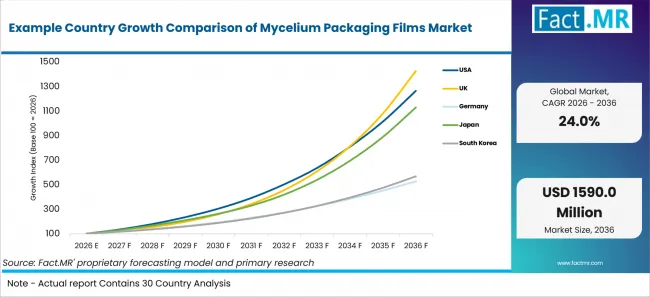
Example Country Growth Comparison Of Mycelium Packaging Films Market | Source: Fact.MR
| Country | CAGR (2026-2036) |
|---|---|
| Germany | 27.4% |
| Japan | 26.9% |
| South Korea | 26.0% |
| UK | 15.7% |
| USA | 15.4% |
Source: Fact.MR analysis. Updated Aug 26, 2026
What supports Germany adoption?
27.4% CAGR, supported by machinery orders and optical-product manufacturing activity.
German plants already use automated equipment, machine tools and quality stations. The country is projected to record 27.4% CAGR through 2036. Destatis reported in August 2026 that manufacturing new orders rose 3.1% in June 2026 from the previous month, with machinery and equipment up 12.7% and computer, electronic and optical products up 22.7%.
How is Japan scaling demand?
26.9% CAGR, driven by machinery orders and factory automation upgrades.
Japanese manufacturers evaluate compact equipment carefully before it enters production lines. The country is anticipated to post 26.9% CAGR through 2036. The Cabinet Office reported in August 2026 that total machinery orders received by 280 manufacturers increased 0.4% month over month in June 2026 on a seasonally adjusted basis and rose 11.3% in the April–June quarter compared with the previous quarter.
How is South Korea developing demand?
26.0% CAGR, supported by electronics exports and manufacturing production intensity.
South Korea links edge vision demand with semiconductor, electronics and automotive production. The country is forecast to reach 26.0% CAGR through 2036. The Ministry of Data and Statistics reported in July 2026 that the manufacturing production index rose 6.8% in June 2026 from the previous month. MOTIR and MSIT reported in July 2026 that ICT exports reached USD 253.9 billion in the first half of 2026.
What supports the United Kingdom’s growth?
15.7% CAGR, backed by robotics support and selective manufacturing upgrades.
The UK opportunity is expected to build around factories that need practical automation gains before wider line changes. The country is estimated to advance at 15.7% CAGR through 2036. The Office for National Statistics reported in August 2026 that 8 of 13 manufacturing subsectors increased during Quarter 2 2026, including a 3.0% rise in computer, electronic and optical products. UKRI also lists a GBP 52 million Robotics Adoption Programme from April 2026 to March 2030.
What supports USA adoption?
15.4% CAGR, supported by robot installations and factory modernization.
U.S. manufacturers use edge vision where automotive, food and logistics operations need local decisions at the line. The USA is expected to record 15.4% CAGR through 2036. The International Federation of Robotics reported in June 2026 that industrial robot installations in the United States rose 11% year over year to 38,000 units in 2025. The U.S. Census Bureau reported in August 2026 that new orders for manufactured goods reached USD 656.5 billion in June 2026.
Who leads the Edge Vision Systems Market?
Cognex Corporation is a leading provider of industrial machine vision systems, AI-enabled vision tools and inspection software for manufacturing and distribution applications. Its May 2026 In-Sight 3900 launch added a fully integrated embedded vision system combining high-resolution imaging, high-performance processing and AI and rule-based inspection tools for real-time operation at the edge.
KEYENCE Corporation competes through machine vision and factory-automation technologies. Its VS Series combines built-in AI with rule-based inspection tools and software designed to simplify inspection setup and defect detection across manufacturing applications.
Basler AG supports industrial and embedded vision through cameras, software and complete vision systems. Its March 2026 GMSL vision system supports NVIDIA Jetson Orin-based embedded applications, including multi-camera and AI-connected configurations, while its April 2026 CoaXPress-over-Fiber TDI system provides bandwidth up to dual 100 Gbps for high-throughput inspection applications.
Teledyne FLIR IIS is part of Teledyne Vision Solutions, which brings together FLIR IIS, Teledyne DALSA and other industrial-imaging portfolios serving machine vision and factory automation. Ambarella supplies edge-AI vision processors for cameras and industrial systems, while Hailo provides AI accelerators and camera SoCs for real-time local inference. Across these portfolios, inspection performance, ease of integration, power and thermal efficiency, and supporting software ecosystems are relevant competitive considerations for edge vision deployments.
Which companies are the key providers?
Key companies include Cognex Corporation; KEYENCE Corporation; Basler AG; Teledyne FLIR; Ambarella, Inc.; and Hailo Technologies Ltd.
- Cognex Corporation
- KEYENCE Corporation
- Basler AG
- Teledyne FLIR
- Ambarella, Inc.
- Hailo Technologies Ltd.
Bibliography
- Ambarella, Inc. (2026, January 5). Ambarella launches powerful edge AI 8K vision SoC with industry-leading AI and multi-sensor perception performance.
- Basler AG. (2026, March 24). Basler presents a complete GMSL vision system for embedded applications.
- Basler AG. (2026, April 14). Basler introduces a complete CoaXPress-over-Fiber TDI vision system.
- Cabinet Office, Economic and Social Research Institute. (2026, August 19). Machinery orders in June, 2026 and forecast for Jul.-Sep. 2026.
- Cognex Corporation. (2026, May 5). Cognex launches highest performance embedded AI vision system powered by Qualcomm.
- Federal Statistical Office. (2026, August 6). New orders in manufacturing in June 2026: +3.1% on the previous month.
- Hailo. (2025, July 22). Hailo announces general availability of Hailo-10H Edge AI Accelerator with generative AI capabilities.
- International Federation of Robotics. (2026, June 18). US robot industry returns to double digit growth.
- Ministry of Data and Statistics. (2026, July 31). Monthly Industrial Statistics, June 2026.
- Ministry of Trade, Industry and Resources, & Ministry of Science and ICT. (2026, July 14). Korea’s ICT exports reach record $253.9 billion in first half of 2026.
- Office for National Statistics. (2026, August 13). Index of Production, UK: June 2026.
- U.S. Census Bureau. (2026, August 4). Monthly Full Report on Manufacturers’ Shipments, Inventories, & Orders.
- UK Research and Innovation. (2026, August 11). Area of investment and support: Robotics adoption programme.
This Report Answers
- The report explains where edge vision systems are used across sensor type and connectivity. It also covers function, end use and installation.
- Segment analysis identifies the leading subsegments and the operational reasons plant teams prioritize them.
- Country analysis examines the listed markets and the manufacturing or policy mechanisms supporting edge vision deployment.
- Competitive analysis reviews current providers across industrial vision, embedded cameras and edge AI processors.
- Application analysis assesses how line speed, image quality and controller integration affect purchase decisions.
What does the Edge Vision Systems Market cover?
The Edge Vision Systems Market covers systems used in production cells where visual data is processed close to the asset. It is adjacent to robot vision systems where cameras guide industrial robots during handling and inspection.
The assessment includes 2D and selected 3D inspection use cases. It connects with 3D machine vision when depth data helps identify part position, shape and surface variation. Compact cameras with embedded processing are included when they perform line-side decisions. The scope overlaps with smart camera platforms where image capture and inference are built into the same device.
What is included in the scope?
The scope includes integrated edge vision cameras, embedded controllers, local inference software and production-line communication interfaces. It aligns with industrial automation control systems when vision devices connect with PLCs and factory control layers.
Video streams are included when they become machine-readable inputs for inspection, monitoring or routing decisions. The same boundary touches video as a sensor where camera feeds become operational data.
What is excluded from the scope?
The scope excludes general surveillance cameras used only for security recording. It also excludes cloud-only analytics platforms sold separately from the vision device or plant integration layer. Logistics vision is included only where cameras connect with automated material handling equipment for routing, sorting or inspection.
The scope excludes raw image sensors sold as components, standalone lighting products and general-purpose industrial PCs without a vision workload. Training-only AI software and plant dashboards are outside the boundary when they lack inspection execution at the edge.
How Was the Analysis Built?
The analysis draws on 120+ sources, 35+ company portfolios, 25+ countries, and more than 20 interviews.
- Primary Research: Primary research includes discussions with manufacturers, integrators, camera suppliers, processor developers, distributors, plant engineers and procurement teams. These conversations examine purchasing priorities, approval requirements and line performance.
- Desk Research: Desk research covers government statistics, regulatory publications, company filings, technical studies, associations, standards and public policy.
- Market Sizing and Forecasting: Market estimates combine historical performance, demand indicators, pricing trends, segment shares, company participation, country growth and adoption patterns.
- Data Validation and Update Cycle: Findings are validated by comparing interviews with public data, company activity and industry developments. Updates review product launches, partnerships, procurement trends and commercial adoption.
Segmentation
What is the report’s scope and coverage?
Mycelium Packaging Films Market Breakdown By Material, Format, And Region | Source: Fact.MR
| Attribute | Details |
|---|---|
| Quantitative Units | USD billion |
| Market Definition | Edge vision systems are camera, sensor, embedded processor, software and connectivity products that inspect or monitor production assets near the point of use. |
| Sensor Type | Optical; MEMS; Electrochemical; Machine vision |
| Connectivity | Industrial Ethernet; IO-Link; Wireless; Standalone |
| Function | Condition monitoring; Inspection; Process control; Predictive maintenance |
| End Use | Automotive; Machine tools; Food processing; Electronics; Logistics |
| Installation | Inline; Edge mounted; Embedded |
| Regions Covered | North America; Latin America; Western Europe; Eastern Europe; East Asia; South Asia & Pacific; Middle East & Africa |
| Countries Covered | United States; United Kingdom; Germany; Japan; South Korea |
| Key Companies Profiled | Cognex Corporation; KEYENCE Corporation; Basler AG; Teledyne FLIR; Ambarella, Inc.; Hailo Technologies Ltd. |
| Forecast Period | 2026 to 2036 |
| Approach | Hybrid top-down and bottom-up approach using automation indicators, plant inspection use cases, segment shares, country adoption and provider portfolio review. |
Source: Fact.MR analysis. Updated Aug 26, 2026
How is the market segmented?
-
By Sensor Type
- Optical
- MEMS
- Electrochemical
- Machine vision
-
By Connectivity
- Industrial Ethernet
- IO-Link
- Wireless
- Standalone
-
By Function
- Condition monitoring
- Inspection
- Process control
- Predictive maintenance
-
By End Use
- Automotive
- Machine tools
- Food processing
- Electronics
- Logistics
-
By Installation
- Inline
- Edge mounted
- Embedded
-
By Region
- North America
- Latin America
- Western Europe
- Eastern Europe
- East Asia
- South Asia & Pacific
- Middle East & Africa
Frequently Asked Questions
How big is the edge vision systems market in 2026?
What is the CAGR of the edge vision systems market from 2026 to 2036?
Which sensor type leads the edge vision systems market?
Which connectivity type leads the edge vision systems market?
Who are the leading companies in the edge vision systems market?
Who worked on this report


Preview the report firsthand - request a free sample
Free SampleGet the brochure for pricing and purchase details
Download PDF