- Market Value (2025): USD 1.6 Bn
- Estimated Value (2026): USD 1.8 Bn
- Forecast Value (2036): USD 5.5 Bn
- CAGR (2026-2036): 12.0%
What is the Enzymatic Biomaterial Stabilizers Market forecast to be worth by 2036?
USD 1.8 billion in 2026 to USD 5.5 billion by 2036 at a 12.0% CAGR.
- The Enzymatic Biomaterial Stabilizers Market reached USD 1.6 billion in 2025.
- Demand is projected to increase from USD 1.8 billion in 2026 to USD 5.5 billion by 2036.
- The market is forecast to record 12.0% CAGR from 2026 to 2036 as food manufacturers and biomaterial developers qualify enzyme systems for texture, binding and process stability.
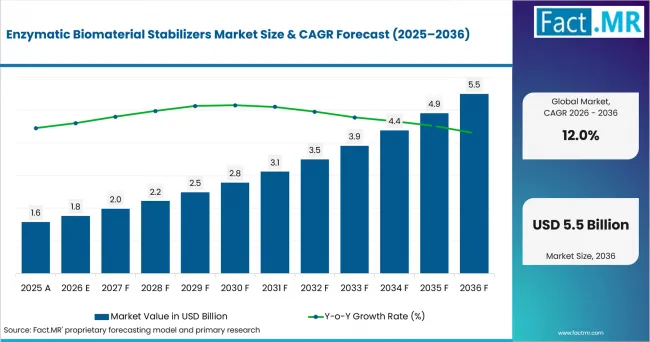
Enzymatic Biomaterial Stabilizers Market Value Analysis | Source: Fact.MR
What are the defining numbers behind Enzymatic Biomaterial Stabilizers Market growth?
USD 3.7 billion absolute opportunity by 2036, led by protein matrices, cross-linking and food texturization.
- Demand Drivers in the Market
- Food formulators need controlled protein binding because transglutaminase modifies structure without heavy additive systems in bakery and dairy lines.
- Biomaterial developers need enzyme-led stabilization for plant fibers since natural substrates vary by crop source and processing history.
- Nutraceutical manufacturers need mild process conditions owing to active ingredients that lose quality under high heat or harsh chemical treatment.
- Industrial biotechnology teams need repeatable viscosity control as polysaccharide and emulsion systems move from pilot batches into larger runs. USDA ERS reported in June 2026 that inflation-adjusted U.S. food spending reached USD 2.51 trillion in 2025, expressed in 2025 dollars.
- Key Segments Analyzed
- By Enzyme Class: Transglutaminase is expected to hold 27.00% share in 2026 supported by its direct role in protein cross-linking and network strengthening.
- By Biomaterial Substrate: Protein matrices are projected to account for 37.00% share in 2026 because food and nutrition brands use proteins as the main structure-building base.
- By Stabilization Mechanism: Cross-linking is anticipated to capture 32.00% share in 2026 due to its measurable effect on gel strength and structural cohesion.
- By Application: Food texturization is estimated to represent 43.00% share in 2026 owing to high-volume use across bakery and dairy. The same buyer need overlaps with functional food texture systems that rely on stable mouthfeel.
- Analyst Opinion at Fact.MR
- Shambhu Nath Jha, Principal Consultant at Fact.MR, states, “Enzyme choice is now tied to finished-product behavior and process reliability. Demand is projected to move toward suppliers that prove activity, substrate fit and use-level control in one qualification package. Stronger vendors should combine enzyme portfolios, application labs and safety files that help manufacturers approve a stabilizer with fewer trial loops.”
- Strategic Implications
- Enzyme producers should document activity ranges so formulation teams match each enzyme to the right texture target.
- Food manufacturers should test bite, moisture retention and yield before routine plant use.
- Biomaterial developers should align enzyme choice with fiber chemistry before scale-up.
- Application labs should pair formulation support with handling guidance to reduce adoption delays.
The USA is expected to record 13.6% CAGR through 2036, led by food processing scale. Germany is projected to post 12.8% CAGR through dairy and meat-alternative use. Denmark is anticipated to reach 12.0% CAGR due to biosolutions capacity. Japan is estimated to advance at 10.8% CAGR as exports support specialty enzymes. The UK is forecast to hold 8.9% CAGR owing to food manufacturing scale.
How does the Enzymatic Biomaterial Stabilizers Market break down by segment?
Protein matrices lead at 37.00%; Food texturization leads at 43.00%.
Which Enzyme Class dominates?
Transglutaminase holds 27.0% share in 2026.
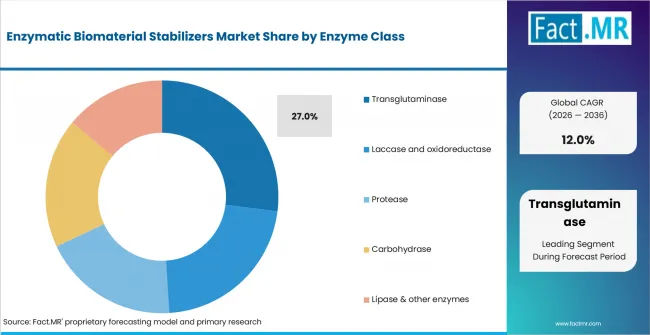
Enzymatic Biomaterial Stabilizers Market Analysis By Enzyme Class | Source: Fact.MR
Transglutaminase is expected to lead enzyme class demand supported by its ability to build protein networks. It improves cohesion in dough, dairy proteins and meat-alternative structures. Protease remains relevant where controlled hydrolysis improves solubility and mouthfeel. AB Enzymes states that VERON TG works as a protein cross-linking enzyme in bread improvers, which supports the commercial fit of enzymatic protein texturizers.
What leads the Biomaterial Substrate segment?
Protein matrices account for 37.0% share in 2026.
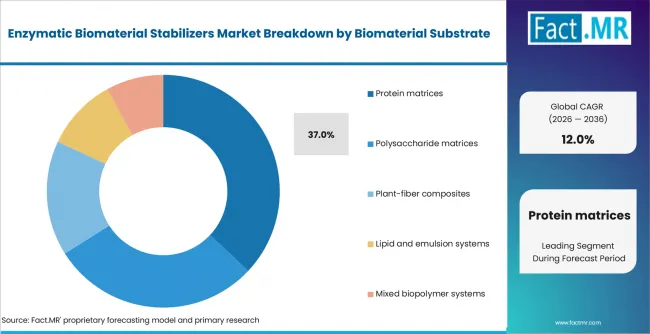
Enzymatic Biomaterial Stabilizers Market Analysis By Biomaterial Substrate | Source: Fact.MR
Protein matrices are projected to account for the main substrate share owing to their role in food texture and nutrition. Dairy, cereal and plant proteins require different enzyme control. Polysaccharide matrices follow where viscosity affects acceptance. BMEL-Statistik reported that German per-capita cheese consumption reached 26.4 kilograms in 2025, up 3.6% from the previous year, based on preliminary figures.
How does Stabilization Mechanism shape demand?
Cross-linking captures 32.0% share in 2026.
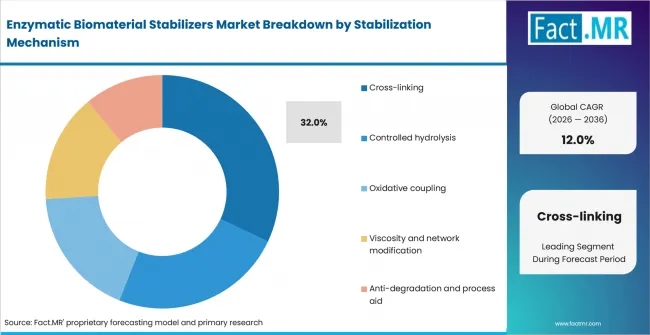
Enzymatic Biomaterial Stabilizers Market Analysis By Stabilization Mechanism | Source: Fact.MR
Cross-linking is anticipated to lead stabilization mechanisms because manufacturers test its effect through firmness and water retention. Controlled hydrolysis is used when lower viscosity is the goal. Oxidative coupling supports binding in selected plant systems. EFSA published an April 2026 assessment extending the use of triacylglycerol lipase from Aspergillus oryzae strain NZYM-FL to a total of eight food-manufacturing processes, with specified intended uses and use levels, illustrating how enzyme safety assessments remain tied to defined processing conditions.
What supports Food Texturization within Application?
Food texturization represents 43.0% share in 2026.
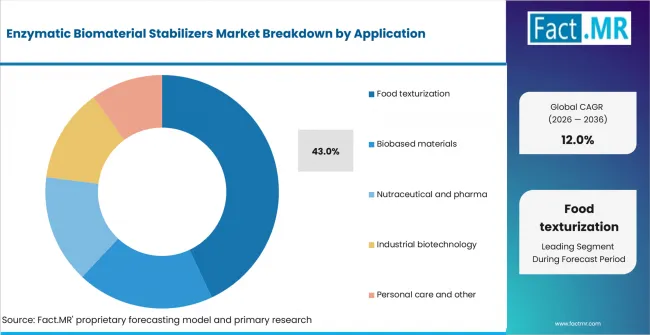
Enzymatic Biomaterial Stabilizers Market Analysis By Application | Source: Fact.MR
Food texturization is estimated to lead application demand as manufacturers use enzymes to improve bite, softness and stability. Bakery and dairy products give suppliers repeatable test environments. Biobased materials use enzymes where fibers need controlled binding. ONS reported in July 2026 that the manufacture of food represented 22.9% of total UK manufacturers' sales in 2025.
What is accelerating Enzymatic Biomaterial Stabilizers Market adoption, and what is holding it back?
Food texture control drives it; regulatory and validation work restrains it.
Drivers Impact Analysis
| DRIVER | (~) % IMPACT ON CAGR | GEOGRAPHIC RELEVANCE | IMPACT TIMELINE |
|---|---|---|---|
| Food texture and shelf-life reformulation | +1.8% | North America, Western Europe | Short term (<= 2 years) |
| Protein and plant-fiber substrate expansion | +1.4% | North America, Europe, East Asia | Medium term (2-4 years) |
| Mild processing for nutrition and pharma applications | +1.1% | Global | Medium term (2-4 years) |
| Application-specific enzyme blends | +0.8% | Europe, East Asia | Long term (>= 4 years) |
Source: Fact.MR analysis. Updated Sep 4, 2026
- Food texture and shelf-life reformulation: Enzymes help manufacturers adjust softness, bite, cohesiveness, and processing performance across food formulations. Adoption is supported where improved texture stability can reduce quality losses and support more consistent finished products.
- Protein and plant-fiber substrate expansion: Protein matrices and plant-fiber composites require effective stabilization and binding as ingredient characteristics vary by source. This trend supports industrial enzymes that perform reliably under routine manufacturing conditions.
- Mild processing for nutrition and pharma applications: Enzyme reactions can operate under moderate processing conditions, helping preserve sensitive biomaterial functions. Suppliers can strengthen adoption by combining enzyme technologies with application support that reduces formulation and scale-up risk.
- Application-specific enzyme blends: Formulators increasingly prefer enzyme systems tailored to specific substrates and processing windows. Clear use-level guidance and practical performance testing can help manufacturers qualify blends for texture, binding, stability, and yield requirements.
Opportunity Impact Analysis
| OPPORTUNITY | (~) % IMPACT ON CAGR | GEOGRAPHIC RELEVANCE | IMPACT TIMELINE |
|---|---|---|---|
| Plant-fiber composite stabilization | +1.2% | Europe, East Asia | Medium term (2-4 years) |
| Documentation-led qualification services | +0.9% | North America, Europe | Short term (<= 2 years) |
| Food-grade enzyme systems for clean labels | +0.7% | Global | Long term (>= 4 years) |
Source: Fact.MR analysis. Updated Sep 4, 2026
- Plant-fiber composite stabilization: Plant-fiber systems create opportunities where binding, hydration, and water control influence final texture. Enzyme suppliers can strengthen adoption by matching enzyme activity with specific fiber and protein sources used in plant-based foods and dairy-alternative formulations.
- Documentation-led qualification services: Food and biomaterial developers require clear safety documentation, handling guidance, and regulatory support before adopting enzyme systems. Suppliers that prepare technical dossiers early can help customers navigate qualification requirements and move formulations toward commercial use more efficiently.
- Food-grade enzyme systems for clean labels: Manufacturers increasingly favor enzyme systems that can reduce reliance on additive-heavy stabilizers while maintaining processing performance. This creates overlap with clean label enzyme systems and adjacent bio processing aids, particularly where clear labeling and application support influence repeat purchasing.
Restraints Impact Analysis
| RESTRAINT | (~) % IMPACT ON CAGR | GEOGRAPHIC RELEVANCE | IMPACT TIMELINE |
|---|---|---|---|
| Food-enzyme safety and use-level files | -0.6% | North America, Europe | Short term (<= 2 years) |
| Substrate variability in natural biomaterials | -0.4% | Global | Medium term (2-4 years) |
| Enzyme handling and process control | -0.3% | Global | Long term (>= 4 years) |
Source: Fact.MR analysis. Updated Sep 4, 2026
- Food-enzyme safety and use-level files: Enzyme applications require clear evidence covering ingredient identity, safety, intended use, and dosage. Suppliers with well-prepared technical and regulatory files can help manufacturers complete qualification more efficiently and reduce uncertainty during formulation approval.
- Substrate variability in natural biomaterials: Protein and fiber sources can vary by supplier, season, and composition. This variability requires tighter dose and process control, giving suppliers an advantage when they provide matrix-specific operating windows and application guidance.
- Enzyme handling and process control: Production teams need appropriate handling guidance to manage enzyme powders, dosing consistency, and activity retention. Smaller plants often require additional supplier support, while premixed or easier-to-dose formats can reduce handling variation and support more consistent routine use.
Which countries are scaling the Enzymatic Biomaterial Stabilizers Market through 2036?
- The country comparison spans 4.65 percentage points and forms three practical growth bands across the forecast period.
- The USA remains 0.72 percentage point above Germany through food processing scale and dairy enzyme trials.
- Germany remains 0.84 percentage point above Denmark as meat-alternative and dairy applications support enzyme-led texture work.
- Denmark remains 1.20 percentage points above Japan through biosolutions depth and fermentation know-how.
- Japan remains 1.89 percentage points above the UK as food exports support specialty enzyme use.
Comparable CAGRs create different entry conditions due to food-manufacturing scale, safety review and enzyme production depth. Full report coverage includes North America, Latin America, Western Europe, Eastern Europe, East Asia, South Asia & Pacific, and Middle East & Africa.
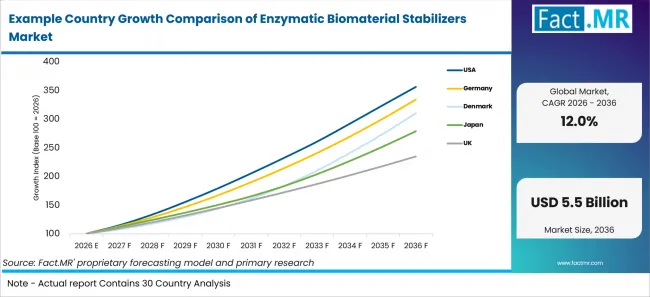
Example Country Growth Comparison Of Enzymatic Biomaterial Stabilizers Market | Source: Fact.MR
| Country | CAGR (2026-2036) |
|---|---|
| United States | 13.6% |
| Germany | 12.8% |
| Denmark | 12.0% |
| Japan | 10.8% |
| United Kingdom | 8.9% |
Source: Fact.MR analysis. Updated Sep 4, 2026
What supports United States adoption?
13.6% CAGR through 2036, driven by food processing scale and protein-matrix reformulation.
U.S. manufacturers evaluate enzyme stabilizers through yield, texture and label fit before commercial use. The USA is expected to record 13.6% CAGR through 2036. USDA NASS reported in April 2026 that U.S. milk production reached 232 billion pounds in 2025, giving dairy formulators a large protein base for enzyme-led stabilization.
How is Germany scaling demand?
12.8% CAGR through 2036, led by dairy and plant-protein processing.
Germany has a practical route through dairy and meat-alternative processors that already test texture systems. The country is projected to post 12.8% CAGR through 2036. Destatis reported in May 2026 that Germany produced 124,900 tonnes of meat-substitute products in 2025, supporting trials that use protein matrices and plant fibers.
What supports Denmark growth?
12.0% CAGR through 2036, backed by biosolutions depth and enzyme production know-how.
Denmark benefits from a deep biosolutions base and supplier familiarity with fermentation-derived enzymes. The country is anticipated to reach 12.0% CAGR through 2036. Statistics Denmark reported 2025 manufacturing sales of goods at DKK 1,156 billion, giving enzyme producers and formulation partners a strong industrial base.
How does Japan perform?
10.8% CAGR through 2036, supported by food exports and specialty enzyme formulation.
Japan links specialty enzyme use with food quality expectations and export-facing formulation work. The market is estimated to advance at 10.8% CAGR through 2036. MAFF reported in February 2026 that agriculture, forestry, fishery and food exports reached JPY 1,700.5 billion in 2025, supporting demand for consistent texture and shelf quality.
What supports United Kingdom adoption?
8.9% CAGR through 2036, driven by food manufacturing scale and regulated-product modernization.
UK formulators operate in a regulated food system where safety status and claim language shape product approval. The country is forecast to hold 8.9% CAGR through 2036. Defra reported in April 2026 that provisional UK food, feed and drink exports were GBP 25.7 billion in 2025 in current prices.
Who leads the Enzymatic Biomaterial Stabilizers Market?
Novonesis is active across food and beverage, animal/feed and industrial biosolutions. Its June 2025 acquisition of dsm-firmenich’s share of the Feed Enzyme Alliance consolidated research, development, production, sales and distribution of feed enzymes within Novonesis, with the company taking over sales and distribution activities that had previously been handled by dsm-firmenich. IFF participates through baking and food enzyme systems used to support dough stability, texture, freshness and shelf-life performance. dsm-firmenich supports dairy processing through coagulant enzymes such as Maxiren® and lactase systems under the Maxilact® portfolio.
Amano Enzyme supplies specialty enzymes across food processing, healthcare and green-chemistry applications. AB Enzymes participates through baking solutions such as VERON® TG, a transglutaminase enzyme that cross-links gluten proteins and supports dough stability and fermentation tolerance. Kerry Group adds food, beverage and biotechnology capabilities supported by enzyme application expertise and dedicated innovation facilities.
Competitive differentiation can be assessed through factors such as application testing and technical support, regulatory and compliance readiness, process performance, and suitability for specialty enzyme applications across food and industrial bioprocessing.
Which companies are profiled in the competitive landscape?
Key companies include Novonesis, IFF, Amano Enzyme, AB Enzymes, Kerry Group, and dsm-firmenich.
- Novonesis
- IFF
- Amano Enzyme
- AB Enzymes
- Kerry Group
- dsm-firmenich
Bibliography
- Department for Environment, Food & Rural Affairs. (2026, April 30). UK trade in food, feed and drink, 2025 provisional. GOV.UK.
- dsm-firmenich. (2025, March 20). dsm-firmenich launches Maxiren®EVO: A revolutionary coagulant enzyme for enhanced cheese texture, taste, yield, and functionality.
- EFSA FEZ Panel (EFSA Panel on Food Enzymes), Zorn, H., Barat Baviera, J. M., Bolognesi, C., Catania, F., Gadermaier, G., Greiner, R., Mayo, B., Mortensen, A., Roos, Y. H., Solano, M. L. M., Van Loveren, H., Vernis, L., Rosell, A. F., Cavanna, D., & Liu, Y. (2026). Safety evaluation of an extension of use of the food enzyme triacylglycerol lipase from the genetically modified Aspergillus oryzae strain NZYM-FL. EFSA Journal, 24(4), e10012.
- IFF. (2025, August 13). IFF launches POWERFRESH® ACE 2000, a bread fresh-keeping solution that ‘aces’ the shelf-life test.
- Kerry. (2025, September 24). Kerry establishes new biotechnology centre in Leipzig.
- Novonesis. (2025, June 2). Deal to acquire dsm-firmenich’s share of the Feed Enzyme Alliance is completed, supporting Novonesis’ growth strategy.
- Office for National Statistics. (2026, July 24). UK manufacturers' sales by product: 2025.
- Statistics Denmark. (2026, May 13). Sales of goods by manufacturing industries.
- Zeballos, E., & Sinclair, W. (2026, June 11). Total U.S. food spending reached $2.51 trillion in 2025. Economic Research Service, U.S. Department of Agriculture
- U.S. Department of Agriculture, National Agricultural Statistics Service. (2026, April 30). Milk production, disposition, and income 2025 summary
- U.S. Department of Health and Human Services. (2026, August 10). Fact sheet: HHS announces proposed GRAS rule.
- Statistisches Bundesamt (Destatis). (2026, May 18). Nach jahrelangem Anstieg: Fleischersatz-Produktion sinkt 2025 um 1,2 % gegenüber dem Vorjahr [After years of increase: Meat substitute production decreased by 1.2% in 2025 compared with the previous year].
This Report Answers
- The report explains enzyme stabilizer use by enzyme class and substrate.
- Segment analysis explains protein matrices and food texturization shares.
- Country analysis reviews the USA, Germany, Denmark, Japan and the United Kingdom.
- Competitive analysis reviews Novonesis, IFF, Amano Enzyme, AB Enzymes, Kerry Group and dsm-firmenich.
- Technology assessment covers transglutaminase, oxidoreductase, protease, carbohydrase and lipase systems.
- Application assessment covers food texturization, biobased materials, pharma uses and personal care.
- Primary interviews, provider checks and official source review support the forecast.
What does the Enzymatic Biomaterial Stabilizers Market cover?
The Enzymatic Biomaterial Stabilizers Market covers enzyme preparations that stabilize proteins, polysaccharides, plant fibers and emulsions during production.
The assessment is narrower than the full enzyme category. It focuses on stabilization use in foods and selected biobased materials, while unrelated catalytic uses stay outside the commercial boundary.
What is included in the scope?
The scope includes transglutaminase, laccase, protease, carbohydrase and lipase systems used to adjust structure during production. It covers protein matrices, polysaccharide matrices, plant-fiber composites, lipid and emulsion systems and mixed biopolymers. It includes food texturization where gum hydrocolloid ingredients and enzyme systems support mouthfeel. Selected texture recovery hydrocolloids are covered when enzymes drive stabilization.
Included applications cover food processing, biobased materials, nutraceutical and pharma uses, industrial biotechnology and personal care. Bio processing aids and industrial enzyme systems are covered only when structure or process durability is the main function.
What is excluded from the scope?
Commodity preservatives, non-enzymatic gums and synthetic cross-linkers are outside the scope. General food additives are treated as adjacent context unless enzyme activity is the basis for stabilization.
Cleaning enzymes, diagnostic enzymes and laboratory reagents are outside the scope when they serve no biomaterial-stabilization function. Specialty enzymes are included only when commercial use fits the defined stabilization boundary.
How Was the Analysis Built?
The analysis draws on 120+ sources, 35+ company portfolios, 25+ countries, and more than 20 industry interviews.
- Primary Research: Primary research includes discussions with manufacturers, service providers, technology developers, distributors, end users, and subject-matter experts. These conversations examine purchasing priorities, product adoption, operational challenges, approval requirements, competitive positioning, and the factors that influence wider market acceptance.
- Desk Research: Desk research covers government statistics, regulatory publications, company filings, trade data, technical studies, industry associations, standards, public policy, and other authoritative sources. Every source used in the analysis is documented in the bibliography.
- Market Sizing and Forecasting: Market estimates combine historical performance, demand indicators, pricing and volume trends, segment shares, company participation, country-level growth, adoption patterns, investment activity, and barriers to market expansion.
- Data Validation and Update Cycle: Findings are validated by comparing primary interviews with public data, company activity, regulatory changes, trade patterns, and industry developments. Regular updates review new product launches, capacity changes, partnerships, approvals, and shifts in commercial adoption.
Segmentation
What is the report’s scope and coverage?
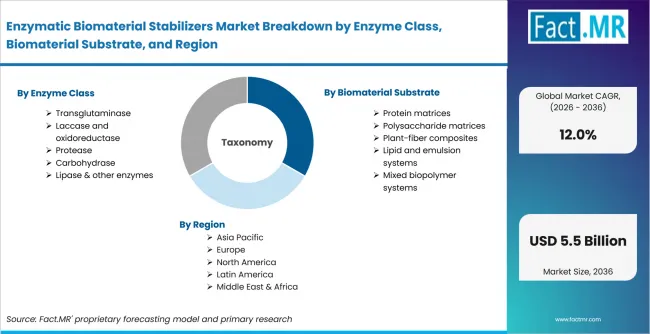
Enzymatic Biomaterial Stabilizers Market Breakdown By Enzyme Class, Biomaterial Substrate, And Region | Source: Fact.MR
| Attribute | Details |
|---|---|
| Quantitative Units | USD billion |
| Market Definition | Enzyme preparations used to stabilize biomaterial substrates by modifying protein binding, polysaccharide viscosity, plant-fiber cohesion, emulsion behavior and process durability. |
| Enzyme Class | Transglutaminase; Laccase and oxidoreductase; Protease; Carbohydrase; Lipase and other enzymes |
| Biomaterial Substrate | Protein matrices; Polysaccharide matrices; Plant-fiber composites; Lipid and emulsion systems; Mixed biopolymer systems |
| Stabilization Mechanism | Cross-linking; Controlled hydrolysis; Oxidative coupling; Viscosity and network modification; Anti-degradation and process aid |
| Application | Food texturization; Biobased materials; Nutraceutical and pharma; Industrial biotechnology; Personal care and other |
| Regions Covered | North America; Latin America; Western Europe; Eastern Europe; East Asia; South Asia & Pacific; Middle East & Africa |
| Countries Covered | United States; Germany; Denmark; Japan; United Kingdom |
| Key Companies Profiled | Novonesis; IFF; Amano Enzyme; AB Enzymes; Kerry Group; dsm-firmenich |
| Forecast Period | 2026 to 2036 |
| Approach | Hybrid top-down and bottom-up approach using enzyme class, substrate fit, stabilization mechanism, application use, country growth and provider portfolio review. |
Source: Fact.MR analysis. Updated Sep 4, 2026
How is the market segmented?
-
By Enzyme Class:
- Transglutaminase
- Laccase and oxidoreductase
- Protease
- Carbohydrase
- Lipase and other enzymes
-
By Biomaterial Substrate:
- Protein matrices
- Polysaccharide matrices
- Plant-fiber composites
- Lipid and emulsion systems
- Mixed biopolymer systems
-
By Stabilization Mechanism:
- Cross-linking
- Controlled hydrolysis
- Oxidative coupling
- Viscosity and network modification
- Anti-degradation and process aid
-
By Application:
- Food texturization
- Biobased materials
- Nutraceutical and pharma
- Industrial biotechnology
- Personal care and other
-
By Region:
- North America
- Latin America
- Western Europe
- Eastern Europe
- East Asia
- South Asia & Pacific
- Middle East & Africa
Who worked on this report


Preview the report firsthand - request a free sample
Free SampleGet the brochure for pricing and purchase details
Download PDF