- Base Value(2025): 3.3 Bn
- Estimated Value(2026): 3.5 Bn
- Forecast Value (2036): 7.2 Bn
- CAGR (2026 - 2036): 8.2%
Enzyme-Reduced Sugar Fruit Preparations Market Forecast and Outlook By FACT.MR
In 2025, the enzyme-reduced sugar fruit preparations market was valued at USD 3.3 billion. Based on Fact.MR analysis, demand for enzyme-reduced sugar fruit preparations is estimated to grow to USD 3.5 billion in 2026 and USD 7.2 billion by 2036. FACT.MR projects a CAGR of 8.2% during the forecast period.
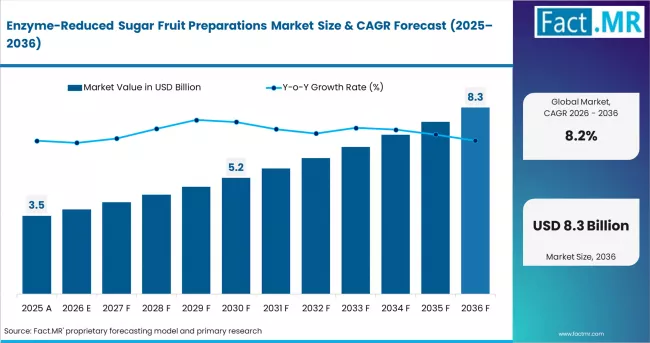
Enzyme Reduced Sugar Fruit Preparations Market Value Analysis | Source: Fact.MR
Summary Of Enzyme-Reduced Sugar Fruit Preparations Market
- Market Definition
- Covers enzyme-processed fruit preparations in pectolytic, carbohydrase, and invertase systems supplied as purees, concentrates, liquids, and powders for dairy, bakery, beverage, confectionery, and infant food applications globally.
- Demand Drivers
- India's fruit processing sector is scaling enzyme-reduced preparation output under government FSSAI sugar nutrition labelling guidelines for processed food manufacturers.
- U.S. FDA added sugar declaration rules are accelerating dairy and bakery reformulation toward enzyme-processed no-added-sugar fruit filling alternatives.
- EU sugar reduction regulatory targets are driving clean-label ingredient substitution in German and French food manufacturing procurement cycles.
- Key Segments Analyzed
- By Enzyme Type: Pectolytic enzymes lead with 42% share in 2026. Dominant due to superior cell wall breakdown efficiency across high-pectin fruit substrates.
- By Application: Dairy & Bakery Fillings lead with 35% share in 2026. Driven by active yogurt, pastry, and cake filling reformulation activity.
- By Form: Purees & Concentrates lead with 50% share in 2026. Preferred industrial format for dairy, bakery, and beverage processing lines.
- By Geography: India leads at 9.2% CAGR through 2036, driven by PLI-scheme fruit processing expansion and nutrition labelling mandates.
- Analyst Opinion at FACT.MR
- Shambhu Nath Jha, Principal Consultant at Fact.MR, opines, ‘CXOs will find that enzyme-processed fruit preparations with clean-label and no-added-sugar credentials are increasingly replacing commodity fillings in premium dairy and bakery procurement. Enzyme process documentation and natural origin certification are emerging as key pricing power levers.’
- Strategic Implications
- Invest in pectolytic enzyme processing and natural origin certification to capture premium dairy and bakery filling reformulation contracts under FDA and EU labelling mandates.
- Build fruit preparation infrastructure in India and Brazil to leverage tropical fruit volumes and serve export-oriented confectionery and dairy manufacturer demand.
- Develop enzyme-reduced beverage and infant food preparations aligned with FDA and EU nutrition rules to capture fastest-growing application segments.
- Methodology
- Market sizing is based on enzyme ingredient manufacturer revenues and fruit preparation shipment volumes. Validated using 2024-2025 company data and trade benchmarks.
- Demand and country analysis use EU sugar regulation data, FDA nutrition labelling records, India FSSAI outputs, and China GB standard reform data.
- Forecasts incorporate food industry reformulation cycles, enzyme cost trajectories, and clean-label adoption rates. Supported by expert interviews with ingredient procurement teams.
| Metric | Value |
|---|---|
| Estimated Value in 2026 | USD 3.5 billion |
| Forecast Value in 2036 | USD 7.2 billion |
| Forecast CAGR (2026 to 2036) | 8.2% |
Source: Fact.MR analysis. Updated Apr 22, 2026
Between 2026 and 2036, the market is expected to create USD 3.7 billion in new opportunity. Growth is transformational and structurally driven. Demand is expanding through food reformulation mandates, sugar tax legislation, and clean-label positioning across dairy, bakery, and beverage segments. Growth is moderated by enzyme processing cost premiums and the complexity of scaling pectolytic enzyme systems across diverse fruit substrates.
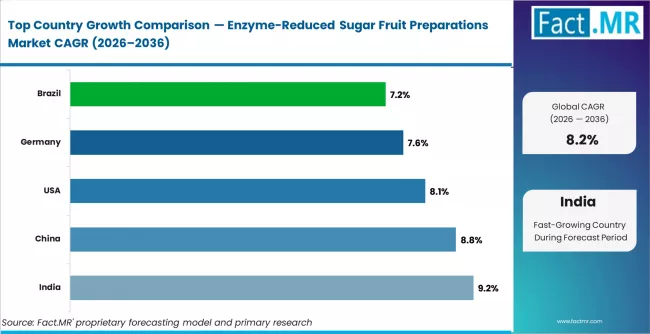
India leads country-level growth at 9.2% CAGR through 2036, driven by rapid fruit processing sector expansion and government nutrition labelling mandates. China follows at 8.8%, supported by national beverage reformulation and GB standard clean-label enforcement. The United States records 8.1%, anchored by FDA added sugar labelling pressure and low-sugar innovation in dairy and bakery. Germany records 7.6%, driven by EU sugar reduction targets and clean-label certification demand in food manufacturing. Brazil records 7.2%, underpinned by large-scale tropical fruit processing capacity and export-oriented production for global confectionery and dairy markets. Mature European markets face constraints from high enzyme processing certification costs and established formulation inertia among mid-tier food producers.
Segmental Analysis
Enzyme-Reduced Sugar Fruit Preparations Market Analysis by Enzyme Type
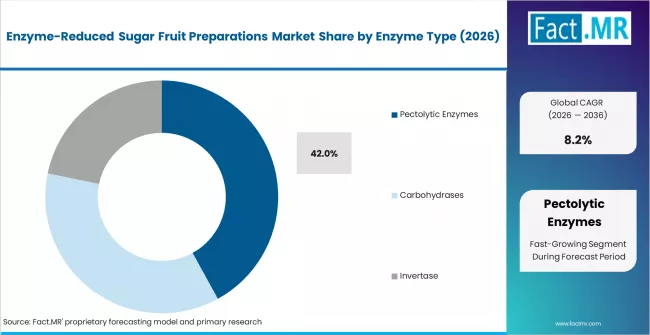
Enzyme Reduced Sugar Fruit Preparations Market Analysis By Enzyme Type | Source: Fact.MR
Based on FACT.MR's enzyme-reduced sugar fruit preparations market report, pectolytic enzymes hold 42% share in 2026. This segment leads due to superior fruit cell wall breakdown efficiency across high-pectin substrates. Pectolytic processing maximises juice yield while reducing sugar content, making it the preferred enzymatic route for dairy filling and beverage applications.
- Novozymes Investment: Novozymes expanded its fruit enzyme processing application centre in Denmark in Q2 2024. The facility focuses on pectolytic enzyme optimisation for fruit preparation manufacturers. Output supports European and export market clean-label ingredient development. [4]
- DSM-Firmenich Development: DSM-Firmenich launched an integrated carbohydrase enzyme system for sugar reduction in tropical fruit preparations in 2025. It targets mango and passion fruit substrates for dairy and confectionery applications. The system delivers measurable Brix reduction without added sweeteners. [5]
- Invertase Adoption Trend: Corbion reported accelerated invertase enzyme adoption in European confectionery fruit filling applications in 2024. Invertase-processed preparations deliver softer texture and reduced crystallisation in praline and chocolate fillings. Confectionery manufacturers are replacing sucrose-rich fillings with enzyme-converted alternatives. [6]
Enzyme-Reduced Sugar Fruit Preparations Market Analysis by Application
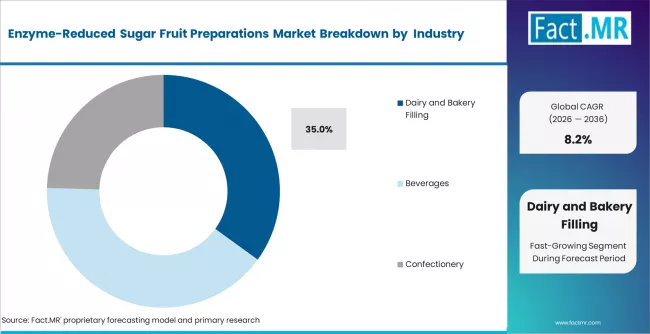
Enzyme Reduced Sugar Fruit Preparations Market Analysis By Application | Source: Fact.MR
Based on FACT.MR's enzyme-reduced sugar fruit preparations market report, dairy and bakery fillings hold 35% share in 2026. This segment leads due to active manufacturer reformulation of yogurt, fruit cake, and pastry applications under no-added-sugar and reduced-sugar label claims. Enzyme-processed preparations solve the technical challenge of maintaining flavour and texture while eliminating sugar additions.
- Kerry Group Investment: Kerry Group expanded its enzyme-processed fruit preparation manufacturing in Ireland in Q3 2024. New output targets dairy and bakery filling reformulation contracts in the UK and Continental Europe. Capacity serves branded and private label food manufacturer customers. [3]
- Ingredion Beverage Development: Ingredion launched an enzyme-reduced fruit concentrate range for reduced-sugar beverage applications in early 2025. The range targets RTD fruit juice and smoothie reformulation in North America. It delivers natural sweetness reduction with full fruit flavour retention. [2]
- Infant Food Application Trend: ESPGHAN updated infant food sugar restriction guidance in 2024. This accelerated European infant food manufacturer reformulation toward enzyme-processed low-sugar fruit purees. DSM-Firmenich reported rising demand from infant nutrition clients in 2024-2025 for enzyme-processed low-sugar purees.
Drivers, Restraints, and Opportunities
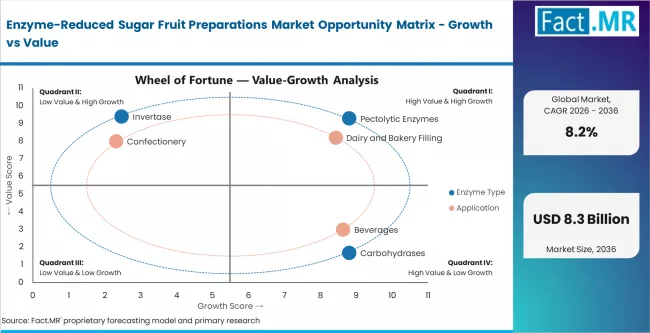
Enzyme Reduced Sugar Fruit Preparations Market Opportunity Matrix Growth Vs Value | Source: Fact.MR
Fact.MR notes growth is linked to global sugar reduction mandates. Reformulation of dairy and bakery products is a primary driver. Enzyme-processed preparations deliver natural sugar reduction without artificial sweetener labels. This ensures simultaneous compliance with nutrition labelling regulations and clean-label positioning.
Commodity sugar-added fruit preparations are losing specification share in premium food manufacturing. Enzyme-processed alternatives command 25-45% price premiums. Pectolytic enzyme systems are gaining dominance as the preferred processing route.
- EU Nutrition Labelling Regulation: EU Regulation 1169/2011 and national sugar reduction targets mandate reformulation across dairy and bakery categories. Manufacturers must reduce added sugar declarations. Chr. Hansen expanded its enzyme-processed fruit preparation range in 2025 to meet EU compliance-driven reformulation demand. [1]
- India PLI Fruit Processing: India's Ministry of Food Processing Industries expanded the PLI scheme for fruit processing in 2024. New capacity targets enzyme-processed concentrate and puree production. Ingredion invested in India ingredient manufacturing in 2024 to serve dairy and beverage reformulation pipelines.
- U.S. FDA Added Sugar Labelling: FDA's added sugar declaration requirements on Nutrition Facts labels have accelerated food manufacturer reformulation since 2024. Dairy and bakery producers are replacing conventional fruit fillings with enzyme-reduced preparations. Kerry Group expanded its enzyme-processed fruit ingredient portfolio for U.S. food manufacturers in 2024.
Regional Analysis
The enzyme-reduced sugar fruit preparations market is assessed across Asia Pacific, Europe, North America, Latin America, and Middle East and Africa, covering 40+ countries with distinct demand profiles shaped by national sugar reduction regulation, food reformulation mandates, fruit processing capacity, and clean-label ingredient adoption intensity. The full report offers market attractiveness analysis by region and country.
.webp "Top Country Growth Comparison Enzyme Reduced Sugar Fruit Preparations Market Cagr (2026 2036)")
Top Country Growth Comparison Enzyme Reduced Sugar Fruit Preparations Market Cagr (2026 2036) | Source: Fact.MR
| Country | CAGR (2026 to 2036) |
|---|---|
| India | 9.2% |
| China | 8.8% |
| United States | 8.1% |
| Germany | 7.6% |
| Brazil | 7.2% |
Source: Fact.MR analysis. Updated Apr 22, 2026
Source: Fact.MR (FACT.MR) analysis, based on proprietary forecasting model and primary research
Enzyme Reduced Sugar Fruit Preparations Market Cagr Analysis By Country | Source: Fact.MR
Asia Pacific Enzyme-Reduced Sugar Fruit Preparations Market Analysis
Asia Pacific is the fastest-growing region. Growth is supported by expanding fruit processing capacity and tightening sugar regulations. India and China define regional demand patterns. India is capacity- and export-driven, while China is regulation- and reformulation-led. Novozymes and DSM-Firmenich are strengthening supply through application centres and local distribution networks.
- India: Domestic fruit processing expansion is accelerating ingredient demand. Growth is projected at 9.2% CAGR through 2036. PLI schemes are increasing output of mango, guava, and citrus concentrates for both domestic use and exports. Ingredion expanded manufacturing capacity in 2024 to support rising procurement from dairy and beverage producers. Updated FSSAI labelling rules are forcing clearer sugar disclosure, pushing manufacturers toward enzyme-based sugar reduction. Demand is broadening across yogurt, beverages, and bakery fillings.
- China: Regulatory enforcement is reshaping product formulation strategies. Growth is projected at 8.8% CAGR through 2036. Revised GB standards and national dietary guidelines are pushing brands to reduce added sugar content. Novozymes reported increased enzyme sales in 2024, reflecting higher adoption among beverage manufacturers. Domestic producers are scaling clean-label fruit preparation production to meet both retail and foodservice demand. Growth is supported by large-scale beverage reformulation and strong domestic consumption.
Fact.MR's analysis of Asia Pacific covers India, China, Japan, South Korea, ASEAN, and ANZ. Includes fruit processing capacity data, regulatory timelines, and reformulation demand forecasts.
North America Enzyme-Reduced Sugar Fruit Preparations Market Analysis
Enzyme Reduced Sugar Fruit Preparations Market Country Value Analysis | Source: Fact.MR
North America is a mature, compliance-driven market. Demand is shaped by regulatory pressure and premium product positioning. Dairy, bakery, and beverage manufacturers are actively reformulating products. Kerry Group, Ingredion, and DSM-Firmenich dominate supply through innovation and application support.
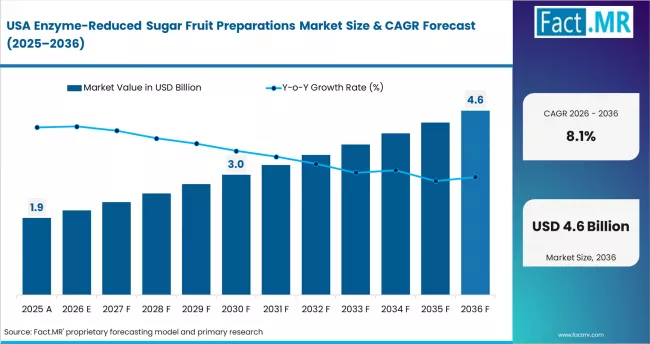
- United States: Regulatory compliance is the primary growth driver. Demand is projected at 8.1% CAGR through 2036. FDA added sugar labelling requirements have redefined ingredient selection across packaged foods. Kerry Group expanded enzyme-processed fruit solutions in 2024 targeting yogurt and bakery segments. USDA institutional procurement programmes are also increasing demand for reduced-sugar compliant ingredients. Reformulation is widespread across retail, foodservice, and institutional channels.
Fact.MR covers the United States, Canada, and Mexico. Includes FDA compliance trends, institutional demand, and reformulation activity.
Europe Enzyme-Reduced Sugar Fruit Preparations Market Analysis
Enzyme Reduced Sugar Fruit Preparations Market Europe Country Market Share Analysis, 2026 & 2036 | Source: Fact.MR
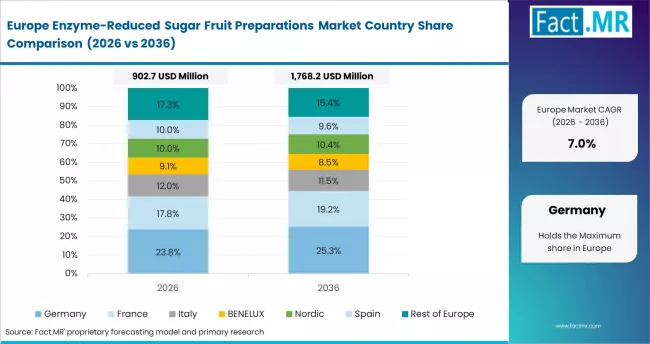
Europe remains the most regulation-driven region. Sugar taxes, labelling laws, and retailer standards define procurement behaviour. Clean-label enzyme processing is now a baseline requirement. Chr. Hansen, DSM-Firmenich, and Corbion lead supply with certified product portfolios.
- Germany: Retailer and regulatory pressure is accelerating reformulation. Growth is projected at 7.6% CAGR through 2036. EU Regulation 1169/2011 and national sugar reduction targets are driving procurement changes. Chr. Hansen expanded supply to dairy producers in 2025, focusing on yogurt and quark applications. Private label specifications increasingly require no-added-sugar fruit preparations. Demand is driven by compliance and premium positioning.
- Brazil: Labelling regulation is reshaping product development strategies. Growth is projected at 7.2% CAGR through 2036. ANVISA front-of-pack rules are pushing manufacturers to reduce sugar content in fruit-based products. Corbion expanded enzyme distribution in 2024 to support local processors. Strong tropical fruit supply supports both domestic consumption and export-oriented production. Growth is supported by raw material availability and regulatory alignment.
Fact.MR covers Germany, France, the UK, Italy, Spain, and Rest of Europe. Includes sugar regulation impact, tax policies, and clean-label procurement trends.
Competitive Aligners for Market Players
Enzyme Reduced Sugar Fruit Preparations Market Analysis By Company | Source: Fact.MR
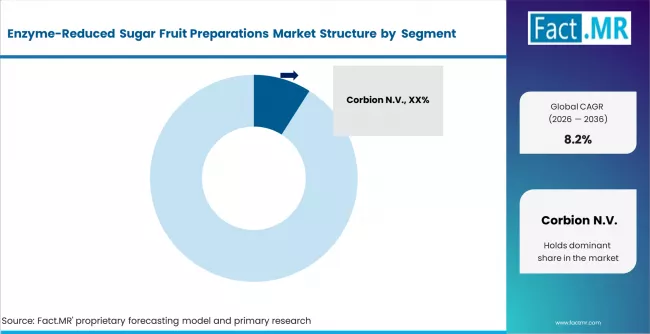
The enzyme-reduced sugar fruit preparations market is shaped by a mix of technical expertise and long-term customer relationships. Competition is not just about price. It is about how well companies can deliver consistent enzyme performance, clean-label certification, and support food manufacturers during reformulation. A few global players, including Novozymes, Chr. Hansen, DSM-Firmenich, and Kerry Group, hold strong positions. Their advantage comes from deep enzyme expertise and close partnerships with dairy and bakery producers.
Other players bring more focused strengths. Corbion is well known in bakery and confectionery applications, especially in Europe where clean-label standards are strict. Ingredion benefits from a wide distribution network and strong ties with North American food companies. Both companies use detailed process documentation and application support to help customers reformulate products, which often leads to long-term supply agreements.
From the buyer side, large food manufacturers take a cautious and structured approach. They rarely depend on a single supplier. Instead, they use dual sourcing and formal qualification processes. Before approving a new ingredient, they require proof of enzyme traceability, non-GMO status, and consistent performance in real applications. This makes switching suppliers slow and complex.
Key Players
- Corbion N.V.
- Chr. Hansen Holding A/S
- Novozymes A/S
- DSM-Firmenich AG
- Kerry Group plc
- Ingredion Incorporated
Bibliography
- [1] Chr. Hansen Holding A/S. (Early 2025). Product Range Update: Enzyme-Processed Fruit Preparation Range Expansion for EU Dairy and Bakery Manufacturer No-Added-Sugar Reformulation Under EU Regulation 1169/2011 Nutrition Labelling Compliance. January 2025. chr-hansen.com/investor-relations
- [2] Ingredion Incorporated. (2024). India Operations Update: Manufacturing Infrastructure Investment for Enzyme-Processed Fruit Concentrate and Ingredient Supply to Dairy and Beverage Reformulation Manufacturers Under India PLI Fruit Processing Scheme. 2024. ingredion.com/investor-relations
- [3] Kerry Group plc. (Q3 2024). Manufacturing Expansion: Enzyme-Processed Fruit Preparation Capacity Increase at Ireland Facility for UK and Continental European Dairy and Bakery No-Added-Sugar Filling Reformulation Contract Supply. Q3 2024. kerrygroup.com/investor-relations
- [4] Novozymes A/S. (Q2 2024). Application Centre Expansion: Pectolytic Enzyme Optimisation Facility in Denmark for Fruit Preparation Manufacturer Clean-Label Enzyme Processing Development Targeting European and Export Market Ingredient Supply. Q2 2024. novozymes.com/investor-relations
- [5] DSM-Firmenich AG. (2025). Product Launch: Integrated Carbohydrase Enzyme System for Sugar Reduction in Tropical Fruit Preparations Including Mango and Passion Fruit Substrates for Dairy and Confectionery Application Reformulation. Early 2025. dsm-firmenich.com
- [6] Corbion N.V. (2024). Market Development Report: Invertase Enzyme Adoption Growth in European Confectionery Fruit Filling Applications for Praline and Chocolate Filling Sugar Reduction Under Clean-Label Reformulation Programmes. 2024. corbion.com/investor-relations
This Report Addresses
- Strategic intelligence on enzyme-reduced sugar fruit preparation demand across dairy, bakery, beverage, confectionery, and infant food reformulation procurement globally.
- Market forecast from USD 3.5 billion in 2026 to USD 7.2 billion by 2036 at a CAGR of 8.2%.
- Growth opportunity mapping across India PLI-scheme fruit processing expansion, China GB standard-driven beverage reformulation, U.S. FDA dairy and bakery ingredient substitution, Germany EU sugar regulation compliance, and Brazil export-oriented fruit concentrate production.
- Segment analysis by enzyme type (pectolytic, carbohydrase, invertase, others), application (dairy & bakery, beverages, confectionery, infant food, spreads), and form (purees & concentrates, liquid, powdered, semi-solid).
- Regional outlook covering Asia Pacific fruit processing-led demand, North America FDA compliance-driven reformulation, and Europe EU sugar reduction regulation-led ingredient procurement shifts.
- Competitive analysis of Corbion, Chr. Hansen, Novozymes, DSM-Firmenich, Kerry Group, and Ingredion. Focus on enzyme processing certification, clean-label credentials, and reformulation contract positioning.
- Regulatory impact analysis covering EU Regulation 1169/2011, FDA added sugar declaration rules, India FSSAI nutrition labelling updates, China GB standard revisions, and Brazil ANVISA RDC 429/2020 enforcement.
- Report delivered in PDF, Excel datasets, and presentation formats. Supported by primary interviews, enzyme manufacturer revenue data, food industry reformulation pipeline benchmarks, and regulatory filing documentation.
Enzyme-Reduced Sugar Fruit Preparations Market Definition
The market includes fruit-based preparations where enzyme systems, primarily pectolytic, carbohydrase, and invertase types, reduce or convert natural fruit sugars. Products are supplied as purees, concentrates, liquids, and powders to food manufacturers.
Enzyme-Reduced Sugar Fruit Preparations Market Inclusions
Includes global and regional forecasts from 2026 to 2036 by enzyme type, application, and form. Covers pectolytic, carbohydrase, invertase, and specialty enzyme-processed preparations across dairy, bakery, beverage, confectionery, and infant food applications through industrial ingredient and direct food manufacturer supply channels.
Enzyme-Reduced Sugar Fruit Preparations Market Exclusions
Excludes conventional sugar-added fruit preparations without enzyme processing steps. Omits fruit flavourings, artificial fruit compounds, and standalone enzyme products not integrated into fruit substrates. Excludes finished consumer packaged food products. Focus remains on enzyme-processed fruit preparation intermediates supplied to food and beverage manufacturers.
Enzyme-Reduced Sugar Fruit Preparations Market Research Methodology
- Primary Research
- Interviews with fruit preparation manufacturers, enzyme suppliers, food manufacturer procurement teams, and clean-label ingredient specialists across key markets.
- Desk Research
- Analysis of Novozymes, Chr. Hansen, DSM-Firmenich, and Kerry Group company reports, EU sugar reduction regulation records, FDA nutrition labelling guidance, and enzyme-processed ingredient trade data from 2024 to 2025.
- Market-Sizing and Forecasting
- Hybrid model integrating top-down estimates from enzyme ingredient manufacturer revenues with bottom-up application-level volume forecasts by fruit preparation format and food industry end-use segment.
- Data Validation and Update Cycle
- Validated through manufacturer revenue data, food industry reformulation volumes, regulatory filing cross-checks, and expert interviews with enzyme processing and ingredient procurement specialists.
Segmentation
Scope of Report
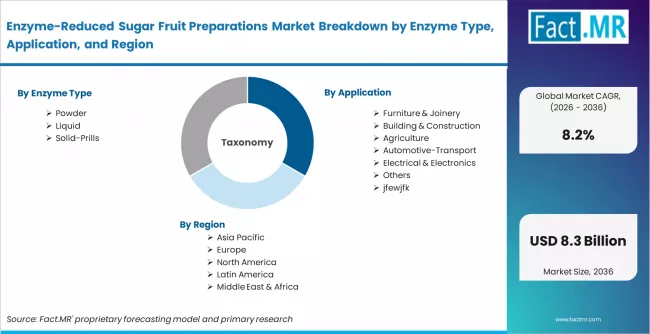
Enzyme Reduced Sugar Fruit Preparations Market Breakdown By Enzyme Type, Application, And Region | Source: Fact.MR
| Attribute | Details |
|---|---|
| Quantitative Units | USD 3.5 billion (2026) to USD 7.2 billion (2036), at a CAGR of 8.2% |
| Market Definition | Enzyme-processed fruit preparations in pectolytic, carbohydrase, invertase, and specialty enzyme systems supplied as purees, concentrates, liquids, and powders for dairy, bakery, beverage, confectionery, and infant food applications globally. |
| Enzyme Type Segmentation | Pectolytic Enzymes, Carbohydrases, Invertase, Others |
| Application Segmentation | Dairy & Bakery Fillings, Beverages, Confectionery, Infant Food & Clinical Nutrition, Sauces & Fruit Spreads |
| Form Segmentation | Purees & Concentrates, Liquid, Powdered, Semi-Solid |
| Application Coverage | Dairy yogurt and bakery filling reformulation, reduced-sugar beverage fruit concentrate supply, confectionery fruit filling enzyme processing, infant food low-sugar puree production, and fruit spread no-added-sugar preparation manufacturing. |
| Regions Covered | North America, Europe, Asia Pacific, Latin America, Middle East and Africa |
| Countries Covered | USA, Canada, Mexico, Germany, UK, France, Italy, Spain, Nordic, BENELUX, China, Japan, South Korea, India, ASEAN, Australia and New Zealand, Brazil, Argentina, Chile, Saudi Arabia, GCC, Turkey, South Africa, Rest of MEA |
| Key Companies Profiled | Corbion N.V., Chr. Hansen Holding A/S, Novozymes A/S, DSM-Firmenich AG, Kerry Group plc, Ingredion Incorporated |
| Forecast Period | 2026 to 2036 |
| Approach | Hybrid top-down and bottom-up model using enzyme ingredient manufacturer revenues, fruit preparation volume by application and form, average selling prices by enzyme system grade, food industry reformulation pipeline data, and primary interviews with ingredient procurement and food technology specialists. |
Source: Fact.MR analysis. Updated Apr 22, 2026
Enzyme-Reduced Sugar Fruit Preparations Market by Segments
-
By Enzyme Type:
- Pectolytic Enzymes
- Carbohydrases
- Invertase
- Others
-
By Application:
- Dairy & Bakery Fillings
- Beverages
- Confectionery
- Infant Food & Clinical Nutrition
- Sauces & Fruit Spreads
-
By Form:
- Purees & Concentrates
- Liquid
- Powdered
- Semi-Solid
-
By Region:
- North America
- United States
- Canada
- Mexico
- Latin America
- Brazil
- Argentina
- Chile
- Rest of Latin America
- Western Europe
- Germany
- United Kingdom
- France
- Italy
- Spain
- Nordic Countries
- BENELUX
- Rest of Western Europe
- Eastern Europe
- Russia
- Poland
- Hungary
- Balkan and Baltic
- Rest of Eastern Europe
- East Asia
- China
- Japan
- South Korea
- South Asia and Pacific
- India
- ASEAN
- Australia and New Zealand
- Rest of South Asia and Pacific
- Middle East and Africa
- Kingdom of Saudi Arabia
- Other GCC Countries
- Turkey
- South Africa
- Rest of Middle East and Africa
- North America
Frequently Asked Questions
How large is the enzyme-reduced sugar fruit preparations market in 2025?
What will the market size be by 2036?
What is the expected CAGR for the market from 2026 to 2036?
Which enzyme type segment is poised to lead the market?
Which application segment is expected to dominate?
Which country shows the fastest growth?
What is driving demand for enzyme-reduced sugar fruit preparations?
What are the major restraints?
Which form segment leads the market?
What is the main challenge in this market?
Who worked on this report


Preview the report firsthand - request a free sample
Free SampleGet the brochure for pricing and purchase details
Download PDF