- Base Value(2026): 1.66 Bn
- Forecast Value (2036): 3.18 Bn
- CAGR (2036): 7.3%
Epoxy Grouts Market Forecast and Outlook 2026 to 2036
In 2025, the global epoxy grouts market was valued at approximately USD 1.55 billion, slightly adjusted from baseline estimates. Based on Fact.MR analysis, demand for epoxy grouts is estimated to reach around USD 1.66 billion in 2026 and expand to nearly USD 3.18 billion by 2036, registering a CAGR of 7.3% during the forecast period. Market growth reflects rising demand in industrial flooring, chemical containment, and healthcare facilities where hygienic, chemical-resistant, and low-porosity joint systems are required. Increasing infrastructure refurbishment and expansion of food processing and pharmaceutical plants further support demand for high-performance grout systems over traditional cement-based alternatives.
The market is projected to add roughly USD 1.63 billion in incremental value over the forecast window, reflecting steady compounding driven by regulatory compliance and performance specification. Early-period growth is supported by commercial and hospitality renovations. Mid-period expansion aligns with industrial facility upgrades and infrastructure investments. In later years, value realization is increasingly shaped by antimicrobial, high-temperature, and specialty epoxy formulations tailored to regulated environments.
China leads growth at 9.9% CAGR, supported by infrastructure expansion and industrial construction. India follows at 9.1%, driven by commercial and manufacturing growth. Germany records 8.4%, reflecting renovation-led demand in industrial and public buildings. The United Kingdom grows at 6.9%, while the United States at 6.2% remains influenced by commercial refurbishment and industrial compliance requirements.
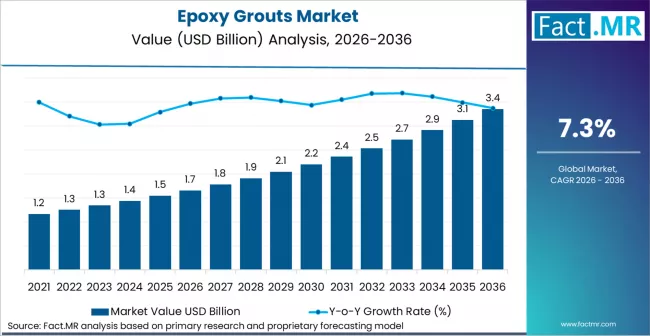
Epoxy Grouts Market Market Value Analysis | Source: Fact.MR
Epoxy Grouts Market
| Metric | Value |
|---|---|
| Market Value (2026) | USD 1.66 billion |
| Forecast Value (2036) | USD 3.18 billion |
| Forecast CAGR (2026-2036) | 7.3% |
Source: Fact.MR analysis. Updated Feb 28, 2026
Summary of Epoxy Grouts Market
- Market Definition
- The epoxy grouts market comprises resin-based grouting systems used for structural anchoring, industrial flooring, equipment baseplates, and chemical-resistant joint filling where high strength, low shrinkage, and durability are required.
- Demand Drivers
- Expansion of industrial facilities, food processing plants, and pharmaceutical units is increasing specification of chemical-resistant and hygienic grout systems.
- Infrastructure refurbishment and transportation projects are driving demand for high-load-bearing grouts in bridges, tunnels, and public buildings.
- Commercial renovations in hospitality, healthcare, and retail are supporting adoption of low-porosity, stain-resistant epoxy grout formulations.
- Key Segments Analyzed
- Type: Two-component epoxy grouts account for approximately 55% share due to predictable curing performance and strong mechanical properties.
- Application: Commercial applications hold nearly 40% share, reflecting flooring durability and hygiene requirements in public buildings.
- Geography: Asia Pacific is the fastest-growing region, led by China and India through infrastructure and industrial expansion.
- Analyst Opinion at Fact.MR
- Shambhu Nath Jha, Principal Consultant at Fact.MR, opines, ‘CXOs will find this report useful for understanding how performance specification, regulatory compliance, and industrial modernization trends are influencing long-term demand for epoxy grout systems across infrastructure and manufacturing environments.’
- Strategic Implications / Executive Takeaways
- Manufacturers should focus on specialty formulations such as antimicrobial and high-temperature resistant grades to address regulated industrial environments.
- Collaboration with infrastructure contractors and industrial engineering firms can strengthen project-based procurement visibility.
- Expansion in Asia Pacific should align with industrial corridor development and large-scale infrastructure investments.
- Methodology
- Market estimates are derived from infrastructure project volumes, industrial installation rates, and material consumption norms across key applications.
- Regulatory validation references. [1]
Epoxy Grouts Market Definition
The epoxy grouts market covers two component resin based grouting materials used to fill voids, anchor equipment, and bond structural elements where high strength and chemical resistance are required. Epoxy grouts consist of resin and hardener systems that cure through a chemical reaction, forming a rigid material with low shrinkage and strong adhesion. These products are used in industrial foundations, machinery base plates, bridge bearings, and structural repairs. Chemical safety, handling, and construction material compliance are regulated under frameworks administered by the US Environmental Protection Agency and workplace safety rules issued by the US Occupational Safety and Health Administration. [2]
Epoxy Grouts Market Inclusions
The report provides global and regional market size estimates in volume and value with a forecast from 2026 to 2036. Segmentation includes grout type by formulation, application across equipment anchoring and structural repair, and end use in industrial plants, infrastructure projects, and commercial construction. Regional demand patterns, pricing benchmarks, and trade flows for resin based grouting materials are included.
Epoxy Grouts Market Exclusions
The scope excludes cementitious non shrink grouts, polyurethane grouts, and general purpose repair mortars not based on epoxy chemistry. Finished structural assemblies, anchor bolts, and machinery foundations are not included. Raw resin production, mixing equipment, installation services, laboratory scale formulations, and custom project specific blends without commercial distribution are also outside the scope.
Epoxy Grouts Market Research Methodology
- Primary Research: Interviews were conducted with grout manufacturers, construction contractors, industrial maintenance managers, and procurement specialists.
- Desk Research: Desk research reviewed chemical substance documentation from the US Environmental Protection Agency and workplace handling guidance from the US Occupational Safety and Health Administration, along with construction activity data and company disclosures.
- Market Sizing and Forecasting: Estimates were developed using industrial installation rates, infrastructure project volumes, and material consumption norms by application.
- Data Validation and Update Cycle: Data was cross checked against trade statistics, regulatory documentation, procurement records, and manufacturer shipment disclosures before updates were finalized.
Segmental Analysis
Epoxy Grouts Market Analysis by Type
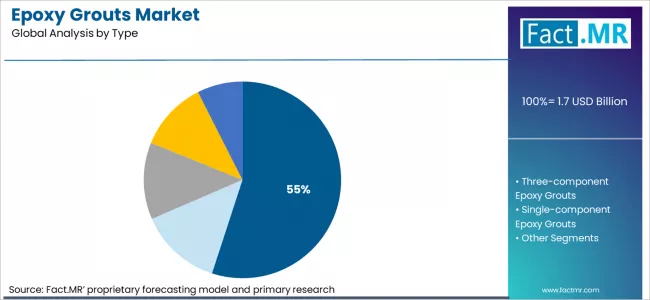
Epoxy Grouts Market Analysis By Type | Source: Fact.MR
Based on Fact.MR analysis, consumption of two-component epoxy grouts is estimated to hold 55% share of the global epoxy grouts market. Fact.MR analysts note two-component systems lead due to predictable mixing ratios, strong chemical resistance, and structural bonding strength. As per Fact.MR, this type addresses contractor requirements for high compressive performance, controlled curing, and durability in demanding environments, supporting applications in tile installation, heavy equipment anchoring, and industrial flooring systems worldwide today across commercial and infrastructure projects globally.
- Construction standards: Structural materials used in commercial projects must meet building and safety codes.[3]
- Performance demand: Fact.MR analysts note two-component grouts provide superior load-bearing strength.
- Chemical resistance: These systems perform effectively in moisture and chemical exposure settings.
Epoxy Grouts Market Analysis by Application
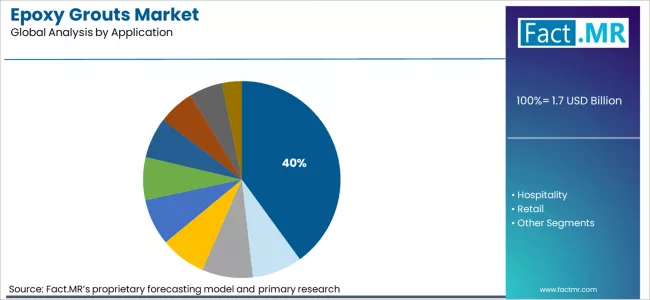
Epoxy Grouts Market Analysis By Application | Source: Fact.MR
Based on Fact.MR analysis, consumption of epoxy grouts in commercial applications is estimated to hold 40% share of the global market. Fact.MR analysts note commercial use leads due to flooring durability requirements, hygiene standards, and aesthetic considerations in public spaces. As per Fact.MR, this application addresses facility operator needs for crack resistance, stain protection, and long service life, supporting use across hospitality, retail, healthcare, and educational buildings worldwide today under regulated construction and maintenance standards globally.
- Public building codes: Commercial buildings must comply with safety and construction regulations.[4]
- Traffic exposure: Fact.MR analysts note commercial floors endure sustained foot traffic.
- Maintenance focus: Epoxy grout supports reduced repair frequency in high-use environments.
Epoxy Grouts Market Drivers, Restraints, And Opportunities
Fact.MR analysis indicates that the epoxy grouts market exists as a specialised construction chemicals segment used in heavy-duty anchoring, load-bearing grouting, structural bonding, and equipment mounting applications where high strength, chemical resistance, and minimal shrinkage are required. As per Fact.MR assessment, epoxy grout formulations are specified in industrial and commercial construction settings where performance and safety expectations are influenced by regulatory guidance and structural design codes such as the American Concrete Institute (ACI) standards for anchoring and grouting that inform best practices for epoxy resin grout use in concrete and steel assemblies. Fact.MR analysts observe that the current market size is supported by demand from infrastructure projects, power plants, bridges, and equipment installation sectors in developed and emerging economies where high-performance grouting materials are integrated into structural specifications.
Fact.MR is of the opinion that current market dynamics reflect a transition between traditional cementitious grouts and epoxy-based formulations that provide superior mechanical and environmental performance in critical applications. Based on Fact.MR assessment, conventional cementitious grouts remain widely used because of lower cost and straightforward application in non-high-performance settings, but demand for epoxy grouts grows where resistance to chemical exposure, dynamic loading, and dimensional stability under thermal cycling are specified. Epoxy grouts typically carry higher per-unit pricing due to resin chemistry, formulation controls, and quality assurance testing, meaning realised market value can grow even where shipment volumes expand at a measured pace. Fact.MR analysis suggests that this balance between premium performance adoption and moderate volume growth will shape near-term market progression.
- Performance and structural standards: Fact.MR analysts note that standards such as ACI anchoring and grouting guidelines influence how epoxy grouts are specified and applied in structural and industrial settings, affecting product development and procurement planning.
- Shift to high-performance formulations: Based on Fact.MR assessment, increasing demand for grouts with enhanced chemical resistance, load transfer capacity, and minimal shrinkage supports adoption of epoxy grouts over conventional alternatives in demanding applications.
- Asia Pacific infrastructure growth: Fact.MR opines that expanding infrastructure, industrial construction, and equipment installation activity in China, India, and Southeast Asia supports regional uptake of epoxy grout solutions across heavy-duty projects.
Regional Analysis
Based on regional assessment, the epoxy grouts sector is analyzed across North America, Europe, East Asia, South Asia, and other key construction and industrial regions, spanning more than 40 countries. Regional performance varies according to infrastructure development activity, industrial flooring demand, chemical resistance requirements, and adoption of high performance grouting materials in commercial and heavy duty applications.
Epoxy Grouts Market CAGR Analysis by Country (2026-2036)
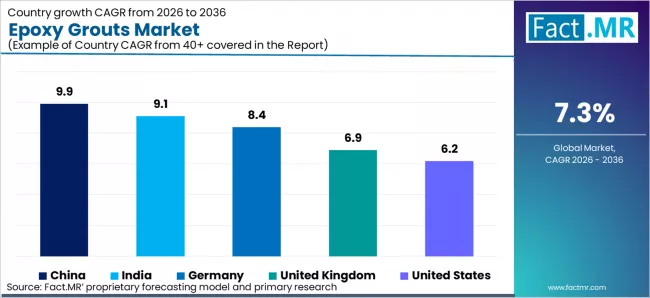
Epoxy Grouts Market Cagr Analysis By Country | Source: Fact.MR
| Country | CAGR |
|---|---|
| China | 9.9% |
| India | 9.1% |
| Germany | 8.4% |
| United Kingdom | 6.9% |
| United States | 6.2% |
Source: Fact.MR analysis. Updated Feb 28, 2026
Source: Fact.MR analysis, based on proprietary forecasting models and primary research.
Outlook On Epoxy Grouts Demand in Asia Pacific
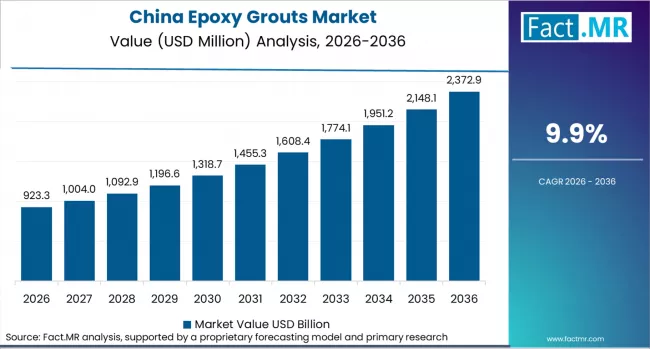
Epoxy Grouts Market Country Value Analysis | Source: Fact.MR
Asia Pacific reflects strong demand for epoxy grouts driven by industrial flooring infrastructure expansion and commercial construction growth. Adoption is shaped by need for chemical resistance high compressive strength and durability in manufacturing plants warehouses and transportation hubs. China and India anchor regional consumption through large scale industrial projects and commercial real estate development. Procurement emphasizes long service life load bearing performance and resistance to moisture and chemicals. Market growth reflects modernization of industrial facilities and expansion of organized construction supply chains regionwide.
- China: Demand for epoxy grouts in China is projected to rise at 9.9% CAGR through 2036. Growth reflects industrial facility construction and increasing use of chemical resistant flooring systems, as per Fact.MR.
- India: Demand for epoxy grouts in India is projected to rise at 9.1% CAGR through 2036. Usage reflects expansion of commercial buildings and infrastructure projects requiring durable grouting materials, according to Fact.MR.
Fact.MR’s analysis of the Epoxy Grouts Market in Asia Pacific consists of country-wise assessment that includes China and India. Readers can find infrastructure development and industrial construction insights.
Analysis On Epoxy Grouts Sales in Europe
Europe demonstrates steady epoxy grouts sales shaped by refurbishment activity infrastructure maintenance and regulated construction standards. Demand is influenced by industrial retrofitting commercial building upgrades and transportation infrastructure projects. Germany and the United Kingdom contribute through structured procurement frameworks and compliance based material specifications. Procurement emphasizes mechanical strength chemical stability and durability under heavy loads. Market growth reflects modernization of industrial plants and maintenance of public infrastructure across Western European construction and renovation sectors regionwide.
- Germany: Demand for epoxy grouts in Germany is projected to rise at 8.4% CAGR through 2036. Sales reflect industrial retrofitting and infrastructure maintenance activities, as per Fact.MR.
- United Kingdom: Demand for epoxy grouts in the United Kingdom is projected to rise at 6.9% CAGR through 2036. Adoption reflects refurbishment projects and compliance driven material selection, according to Fact.MR.
Fact.MR’s analysis of the Epoxy Grouts Market in Europe consists of country-wise assessment that includes Germany and the United Kingdom. Readers can find renovation and infrastructure insights.
Demand for Epoxy Grouts in North America
North America shows consistent demand for epoxy grouts supported by industrial flooring upgrades transportation infrastructure and commercial construction. Sales are driven by requirement for high strength grouting in heavy equipment installation and structural anchoring. The United States anchors regional volume through manufacturing facilities logistics centers and public infrastructure projects. Procurement emphasizes durability load resistance and compliance with construction codes. Market growth reflects steady refurbishment and expansion of industrial and commercial spaces nationwide.
- United States: Demand for epoxy grouts in the United States is projected to rise at 6.2% CAGR through 2036. Usage reflects industrial flooring upgrades and infrastructure related grouting applications, as per Fact.MR.
Fact.MR’s analysis of the Epoxy Grouts Market in North America consists of country-wise assessment that includes the United States. Readers can find industrial and infrastructure demand insights.
Competitive Landscape for Market Players
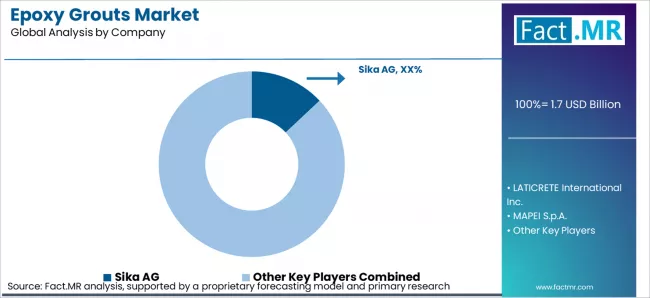
Epoxy Grouts Market Analysis By Company | Source: Fact.MR
As per Fact.MR analysis, the 2026 epoxy grouts market is defined by validated chemical performance, durability, and multi-region regulatory compliance, which determine competitive advantage. Sika AG and LATICRETE International Inc. lead with high-performance formulations that maintain bond strength and chemical resistance, which strengthens adoption in industrial, commercial, and residential construction. MAPEI S.p.A. and Five Star Products Inc. focus on verified curing consistency and shrinkage control, which improves long-term structural integrity. Euclid Chemical Company and Hexion Inc. emphasize multi-application compatibility and proven resistance to moisture and chemicals, which enhances adoption across flooring, tiling, and infrastructure projects. Atul Ltd and BASF SE provide validated large-scale production with consistent quality, which supports global supply chains. Fosroc International, GCP Applied Technologies, Saint-Gobain Weber S.A., and Bostik (Arkema) offer regionally compliant grouts with tested adhesion and wear resistance, which improves regulatory acceptance. H.B. Fuller Company, Dow Inc., RPM International, W.R. Grace & Co., Pidilite Industries, Chembond Chemicals, ALFA International, and Custom Building Products deliver validated performance for specialty and niche applications. Across the market, validated chemical durability, consistent performance, and regulatory compliance form enduring competitive moats, reducing reliance on price or isolated product claims
Recent Industry Development
- In February 2026 - Sika agreed to acquire Turkey-based Akkim, a global adhesives and sealants manufacturer with CHF 220 million in 2025 sales, strengthening its distribution network, production capacity, and growth across Eastern Europe and MENA. [5]
- In February 2025 - Saint-Gobain completed its acquisition of Fosroc, a global construction chemicals company with $487 million in 2024 revenue, strengthening its presence in India, the Middle East, and Asia-Pacific markets. [6]
Key Players in Epoxy Grouts Market
- Sika AG
- LATICRETE International Inc.
- MAPEI S.p.A.
- Five Star Products Inc.
- Euclid Chemical Company
- Hexion Inc.
- Atul Ltd
- BASF SE
- Fosroc International
- GCP Applied Technologies
- Saint-Gobain Weber S.A.
- Bostik (Arkema)
- H.B. Fuller Company
- Dow Inc.
- RPM International Inc.
- W.R. Grace & Co.
- Pidilite Industries
- Chembond Chemicals Ltd
- ALFA International Corporation
- Custom Building Products
Bibliography
- [1] U.S. Environmental Protection Agency. (2024). Chemical research and safety overview. U.S. Environmental Protection Agency.
U.S. Occupational Safety and Health Administration. (2024). Occupational safety and health standards: Construction and material handling regulations. U.S. Department of Labor. - [2] U.S. Environmental Protection Agency. (2024). Chemical substance evaluation and risk assessment framework. U.S. Environmental Protection Agency.
U.S. Occupational Safety and Health Administration. (2024). Workplace chemical handling and safety regulations. U.S. Department of Labor. - [3] U.S. Occupational Safety and Health Administration. (2024). Safety and health regulations for construction (29 CFR Part 1926). U.S. Department of Labor.
- [4] U.S. Environmental Protection Agency. (2024). Indoor air quality and building material guidance. U.S. Environmental Protection Agency.
- [5] Sika AG. (2026). Sika agrees to acquire Akkim, strengthening adhesives and sealants portfolio in Eastern Europe and MENA [Corporate announcement]. Sika AG.
- [6] Compagnie de Saint-Gobain. (2025). Saint-Gobain completes acquisition of Fosroc to expand construction chemicals footprint [Corporate announcement]. Compagnie de Saint-Gobain.
This Report Addresses
- Market intelligence to enable structured strategic decision-making across mature and emerging epoxy grout markets
- Market size estimation and 10-year revenue forecasts from 2026 to 2036, supported by construction activity indicators, industrial installation rates, and project-led consumption norms
- Growth opportunity mapping across grout types and specialty grades, with emphasis on two-component systems, antimicrobial, chemical-resistant, and high-temperature formulations
- Application and end-use outlook covering commercial, industrial, infrastructure, and regulated facilities, including chemical containment, equipment bases, and hygienic flooring systems
- Competitive strategy assessment benchmarking performance claims, curing reliability, chemical resistance, and multi-region compliance positioning among leading manufacturers
- Technology and formulation roadmap tracking including rapid-curing systems, flexible epoxies, low-porosity/hygienic grouts, and next-gen specialty chemistries for regulated environments
- Regulatory impact analysis covering chemical safety, workplace handling, and construction compliance considerations aligned with EPA and OSHA frameworks
- Market report delivery in PDF, Excel, PPT, and dashboard formats for executive planning, specification strategy, and contractor/distribution enablement
Segmentation
Scope of the Report
| Metric | Value |
|---|---|
| Quantitative Units | USD 1.66 billion (2026) to USD 3.18 billion (2036), CAGR 7.3% |
| Market Definition | The epoxy grouts market covers resin-based grouting compounds used for filling joints, anchoring equipment, and bonding structural elements where chemical resistance, mechanical strength, and dimensional stability are required. Products include two-component, three-component, single-component, water-based, and specialty epoxy grouts. Applications span commercial, residential, industrial, and infrastructure projects where high performance, low shrinkage, and durability under chemical and thermal stress are necessary. Regulatory frameworks include US EPA chemical safety and OSHA construction and handling standards. |
| Type Segmentation | Two-component Epoxy Grouts (Standard, Rapid-curing, Flexible), Three-component Epoxy Grouts, Single-component Epoxy Grouts, Water-based Epoxy Grouts, Specialty Epoxy Grouts (Fast-setting, Flexible, High-temperature Resistant, Antimicrobial, Chemical-resistant) |
| Application Segmentation | Commercial (Hospitality, Retail, Office Buildings, Healthcare, Education), Residential (Single-family, Multi-family), Industrial (Manufacturing, Warehouses, Food Processing, Pharmaceutical), Infrastructure (Transportation Hubs, Public Buildings, Bridges, Tunnels), Others |
| End Use Segmentation | Flooring, Wall Tiling, Countertops & Backsplashes, Swimming Pools & Spas, Chemical Containment Areas, Equipment Bases & Foundations, Others |
| Distribution Channel Segmentation | Distributors & Wholesalers, Direct Sales, Retail (Home Improvement Stores), Online Retail, Others |
| Regions Covered | Asia Pacific, Europe, North America, Latin America, Middle East & Africa |
| Countries Covered | China, India, Japan, South Korea, Indonesia, Australia & New Zealand, Germany, Italy, France, United Kingdom, Spain, Benelux, Nordics, Central & Eastern Europe, United States, Canada, Mexico, Brazil, Argentina, Chile, Kingdom of Saudi Arabia, United Arab Emirates, South Africa, Turkey |
| Key Companies Profiled | Sika AG, LATICRETE International Inc., MAPEI S.p.A., Five Star Products Inc., Euclid Chemical Company, Hexion Inc., Atul Ltd, BASF SE, Fosroc International, GCP Applied Technologies, Saint-Gobain Weber S.A., Bostik (Arkema), H.B. Fuller Company, Dow Inc., RPM International Inc., W.R. Grace & Co., Pidilite Industries, Chembond Chemicals Ltd, ALFA International Corporation, Custom Building Products |
| Forecast Period | 2026 to 2036 |
| Approach | Market sizing and forecasting based on industrial installation rates, infrastructure and commercial construction activity, epoxy consumption norms by application, and regulatory compliance. Data validated through interviews with manufacturers, contractors, and procurement specialists, and cross-checked against trade statistics and shipment disclosures. |
Source: Fact.MR analysis. Updated Feb 28, 2026
Epoxy Grouts Market Analysis by Segments
-
Type :
- Two-component Epoxy Grouts
- Standard Two-component
- Rapid-curing Two-component
- Flexible Two-component
- Three-component Epoxy Grouts
- Single-component Epoxy Grouts
- Water-based Epoxy Grouts
- Specialty Epoxy Grouts
- Fast-setting Epoxy Grouts
- Flexible Epoxy Grouts
- High-temperature Resistant Epoxy Grouts
- Antimicrobial Epoxy Grouts
- Chemical-resistant Epoxy Grouts
- Two-component Epoxy Grouts
-
Application :
- Commercial
- Hospitality
- Retail
- Office Buildings
- Healthcare Facilities
- Educational Institutions
- Residential
- Single-family Homes
- Multi-family Housing
- Industrial
- Manufacturing Facilities
- Warehouses
- Food Processing Plants
- Pharmaceutical Facilities
- Infrastructure
- Transportation Hubs
- Public Buildings
- Bridges and Tunnels
- Others
-
End Use :
- Flooring
- Wall Tiling
- Countertops and Backsplashes
- Swimming Pools and Spas
- Chemical Containment Areas
- Equipment Bases and Foundations
- Others
-
Distribution Channel :
- Distributors and Wholesalers
- Direct Sales
- Retail (Home Improvement Stores)
- Online Retail
- OthersTop of FormBottom of Form
-
Region :
- Asia Pacific
- India
- China
- Japan
- South Korea
- Indonesia
- Australia & New Zealand
- ASEAN
- Rest of Asia Pacific
- Europe
- Germany
- Italy
- France
- United Kingdom
- Spain
- Benelux
- Nordics
- Central & Eastern Europe
- Rest of Europe
- North America
- United States
- Canada
- Mexico
- Latin America
- Brazil
- Argentina
- Chile
- Rest of Latin America
- Middle East & Africa
- Kingdom of Saudi Arabia
- United Arab Emirates
- South Africa
- Turkey
- Rest of Middle East & Africa
- Asia Pacific
Frequently Asked Questions
How large is the epoxy grouts market in 2026?
What will the epoxy grouts market size be by 2036?
What is the expected CAGR of the epoxy grouts market during 2026–2036?
How much incremental value will the market add between 2026 and 2036?
What was the market valuation in 2025?
Which type segment holds the largest share in the market?
Why do two-component epoxy grouts lead the market?
Which application segment dominates the epoxy grouts market?
Why do commercial applications account for a significant share?
Which region is growing the fastest in the epoxy grouts market?
What is the projected growth rate for China?
How fast is the market expected to grow in India?
What is the expected growth rate in Germany?
How is the United Kingdom expected to perform during the forecast period?
What is the projected growth rate for the United States?
What factors are supporting early-period growth in the market?
What drives mid-period expansion in the forecast window?
What shapes long-term value realization in the market?
What structural factors influence demand in this market?
What core sectors are driving overall market expansion?
Who worked on this report


Preview the report firsthand - request a free sample
Free SampleGet the brochure for pricing and purchase details
Download PDF