- Base Value(2025): 1.3 Bn
- Estimated Value(2026): 1.4 Bn
- Forecast Value (2036): 3.4 Bn
- CAGR (2026 - 2036): 9.0%
High-Heat Epoxy Films Market Forecast 2026 to 2036
In 2025, the high-heat epoxy films market was valued at USD 1.3 billion. Based on Fact MR's analysis, demand for high-heat epoxy films is estimated to grow to USD 1.4 billion in 2026 and USD 3.4 billion by 2036. FMR projects a CAGR of 9.0% during the forecast period.
The absolute dollar growth from 2026 to 2036 is USD 2 billion. This significant growth is driven by the increasing demand for high-performance materials used in applications such as electronics, automotive, and aerospace, where high-temperature resistance is crucial. However, challenges such as fluctuating raw material prices and regulatory concerns in certain markets may impact the growth pace.
China leads with a CAGR of 10.2%, driven by the rapid growth of the electronics, automotive, and aerospace industries. Brazil follows with a 9.8% CAGR, supported by increasing demand for durable, high-temperature materials in various industrial sectors. The USA and the United Kingdom show growth rates of 8.7%, driven by consistent demand for high-performance materials. South Korea grows at 8.2%, supported by its strong electronics and automotive sectors. Germany and Europe show growth at 8.6% and 8.8%, respectively, due to increasing industrial applications and the demand for advanced materials. Japan experiences the slowest growth at 7.5%, influenced by a mature market and a focus on high-end, specialized applications.
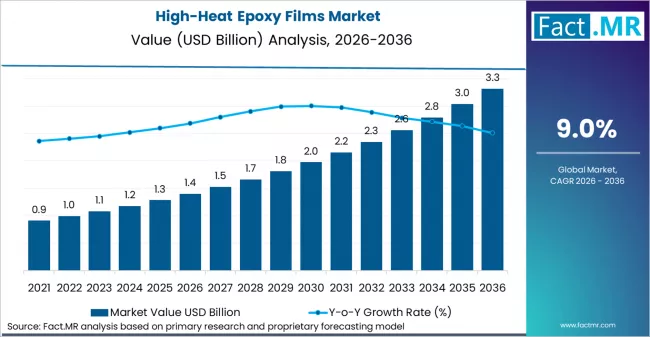
High Heat Epoxy Films Market Market Value Analysis | Source: Fact.MR
High‑Heat Epoxy Films Market Definition
The High‑Heat Epoxy Films Market refers to the production and sale of engineered polymer films made from epoxy resins that withstand elevated temperatures while maintaining mechanical strength and electrical insulation. These thin, flexible films are used as insulating layers, protective coatings, and bonding interfaces in high‑temperature environments. Their primary function is to deliver thermal stability, chemical resistance, and dielectric performance. Key end uses include electrical and electronics, automotive under‑the‑hood components, industrial equipment, and aerospace applications where thermal resilience and reliability are required.
Market Inclusions
This report covers global and regional market sizes for high‑heat epoxy films with a defined forecast period. It includes segment breakdowns by product type (standard, flame‑retardant, reinforced), application (insulation, protective films, adhesive layers), and end user (electronics, automotive, aerospace, industrial). Pricing trends, raw material supply, and trade flow data are also included to reflect comprehensive market dynamics.
Market Exclusions
The scope excludes general epoxy coatings, bulk epoxy resins used in casting or molding, and unrelated polymer films like polyethylene or PVC. Finished electrical devices, composites, and laminates that incorporate epoxy films are not covered. Niche film technologies used solely in consumer packaging or medical disposables are omitted to focus strictly on high‑temperature industrial applications.
Research Methodology
- Primary Research: Interviews were conducted with material scientists, product engineers, and procurement specialists.
- Desk Research: Data was sourced from industry reports, material suppliers, and trade statistics.
- Market‑Sizing and Forecasting: A hybrid model was used, combining top‑down industry demand estimates with bottom‑up shipment and revenue data.
- Data Validation and Update Cycle: Findings were validated through expert review and aligned with recent production and sales figures, with periodic updates.
High-Heat Epoxy Films Market Summary
- High-Heat Epoxy Films Market Definition
- The High-Heat Epoxy Films Market encompasses the production and sale of advanced polymer films made from epoxy resins, engineered to withstand elevated temperatures while maintaining their mechanical strength, electrical insulation, and performance in harsh environments. These thin, flexible films are typically used as insulating layers, protective coatings, and bonding interfaces in high-temperature conditions. Their key functionalities include providing thermal stability, chemical resistance, and dielectric performance, making them indispensable in industries like aerospace, automotive, electronics, and industrial machinery.
- Demand Drivers in the Market
- Rising Demand for High-Performance Materials: Industries such as automotive, aerospace, and electronics require materials that perform reliably in extreme environments, fueling the adoption of high-heat epoxy films.
- Electric Vehicle (EV) Growth: The rise of electric vehicles has created a demand for materials capable of withstanding higher temperatures in powertrain systems, contributing to the increased adoption of high-heat epoxy films.
- Advances in Manufacturing Processes: Enhanced manufacturing processes are improving the performance of high-heat epoxy films, making them suitable for a wider range of applications in high-temperature environments.
- Regulatory Safety Standards: Increasing regulatory standards for safety and performance, particularly in automotive and aerospace industries, have accelerated the demand for certified high-heat epoxy films.
- Key Segments Analyzed in the FMR Report
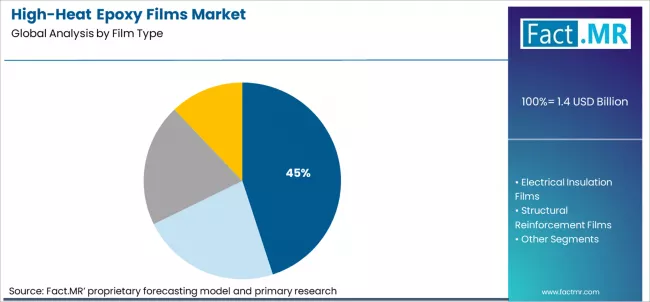
- Film Type: Adhesive Films are projected to dominate the market, accounting for 45% of the market share by 2026. These films are essential for bonding applications in industries like electronics, automotive, and aerospace, where high-temperature resistance and strong adhesion are crucial.
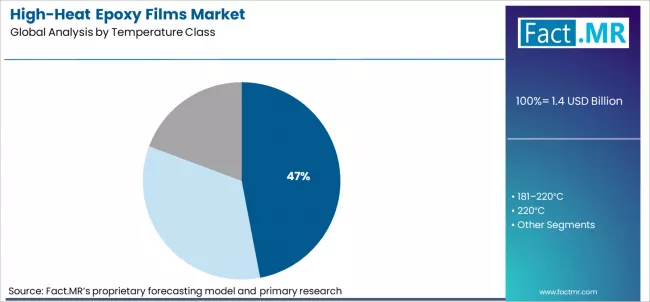
- Temperature Class: Films rated for 181-220°C are expected to hold 47% of the market share by 2026, driven by their versatility in industries requiring moderate to high-temperature performance, such as automotive and aerospace.
- Substrate: Film on Polyimide/PET is projected to be the dominant substrate type, known for its excellent thermal stability and mechanical strength in demanding applications.
- Analyst Opinion at FMR
- Fact MR analysts predict that "The high-heat epoxy films market is poised for substantial growth, driven by increasing demand for durable, heat-resistant materials across various industries, including automotive, aerospace, and electronics. The trend toward electrification and the need for higher performance standards will continue to fuel market expansion."
- Strategic Implications/Executive Takeaways
- Focus on High-Temperature Solutions: Manufacturers should focus on developing advanced high-heat epoxy films to cater to the growing demand for high-performance materials, particularly in automotive, aerospace, and electronics.
- Capitalize on Emerging Markets: Rapid industrial growth in regions like China, India, and Brazil presents significant opportunities for high-heat epoxy film manufacturers to expand their market share.
- Sustainability and Performance: Companies should explore sustainable materials in high-heat epoxy films to meet both environmental regulations and the increasing demand for eco-friendly manufacturing solutions.
- Methodology
- Primary Research: Interviews with material scientists, product engineers, and procurement specialists provided insights into the current market trends and demand drivers.
- Desk Research: Data was gathered from industry reports, material suppliers, and trade statistics to assess demand dynamics and project future growth in the high-heat epoxy films market.
- Market Sizing and Forecasting: A hybrid model combining top-down demand analysis with bottom-up revenue data was employed to forecast the market's growth and size over the forecast period.
Segmental Analysis
High-Heat Epoxy Films Market Analysis by Film Type
High Heat Epoxy Films Market Analysis By Film Type | Source: Fact.MR
- Market Overview: Adhesive films are expected to capture 45% of the high-heat epoxy films market by 2026. These films are widely used for bonding and joining applications in high-temperature environments, providing strong adhesion and maintaining their performance under heat stress. They are essential in industries such as electronics, automotive, and aerospace.
- Demand Drivers:
- High Adhesion Strength: Adhesive films are valued for their ability to provide strong, reliable bonds under high heat conditions. This is especially crucial in industries where materials are exposed to extreme temperatures, such as in electronics or automotive components.
- Versatility in Applications: These films are used in a variety of applications, from electronics to structural materials, making them versatile for different industries. Their ease of application and efficiency in bonding have driven their widespread adoption.
- Growing Demand for Heat-Resistant Solutions: As industries focus on improving the performance of their products under high-temperature conditions, the demand for high-performance adhesive films that can withstand extreme heat continues to rise.
High-Heat Epoxy Films Market Analysis by Temperature Class
High Heat Epoxy Films Market Analysis By Temperature Class | Source: Fact.MR
- Market Overview: Films rated for 181-220°C are projected to hold 47% of the market share by 2026. These films are ideal for a wide range of applications where the material needs to operate at moderately high temperatures, such as in the automotive, aerospace, and electrical industries.
- Demand Drivers:
- Broad Industrial Applications: Epoxy films in the 181-220°C temperature range are particularly suited for use in a variety of manufacturing processes, including automotive, electronics, and industrial equipment, where they are required to perform reliably at higher temperatures without degradation.
- Growing Need for Heat-Resistant Components: As industries continue to push the boundaries of high-performance materials, the demand for films capable of withstanding moderate to high temperatures while maintaining structural integrity and adhesion is growing.
- Cost-Effectiveness and Efficiency: Films that can operate in this temperature range offer a balance of performance and cost-effectiveness, making them a preferred choice for manufacturers looking for high-temperature solutions without significant cost increases.
High Heat Epoxy Films Market Drivers, Restraints, and Opportunities
FMR analysts observe that the high‑heat epoxy films market is a mature, performance‑driven segment within advanced materials for electronics and industrial applications. Historically, conventional polymer films could not meet the thermal and dielectric demands of rising power densities in automotive, aerospace, and electronic systems, creating structural demand for epoxy films capable of withstanding elevated temperatures. The 2026 valuation reflects this reality, where adoption correlates with electrification trends and stricter performance standards in power electronics, insulation systems, and high‑temperature industrial environments.
While demand for basic insulating materials persists in cost‑led segments, high‑heat epoxy films with superior thermal stability and dielectric strength are gaining share. These specialized films command higher per‑unit pricing, contributing to net market value growth even as unit volumes grow in line with electronics and electrification cycles. The market exists at its current size because end‑users increasingly require materials that maintain performance at high temperatures without failure, and regulatory safety standards reinforce the need for reliable insulation solutions.
- Thermal Performance Demand: As power electronics and EV systems operate at higher temperatures, high‑heat epoxy films are replacing conventional polymers that lack required stability.
- Regulatory Safety Standards: Standards such as UL 94 and IEC 60695 for flammability and thermal endurance push manufacturers toward certified epoxy films that meet defined safety criteria.
- Regional Industrial Growth: In North America and Asia‑Pacific, strong growth in electronics manufacturing and electrification applications accelerates uptake of high‑heat epoxy films over basic insulating materials.
Regional Analysis
The market analysis covers key global regions, including North America, East Asia, South Korea, Western Europe, Latin America, and Germany. It is segmented geographically, with specific market dynamics for each region. The full report provides a detailed market attractiveness analysis.
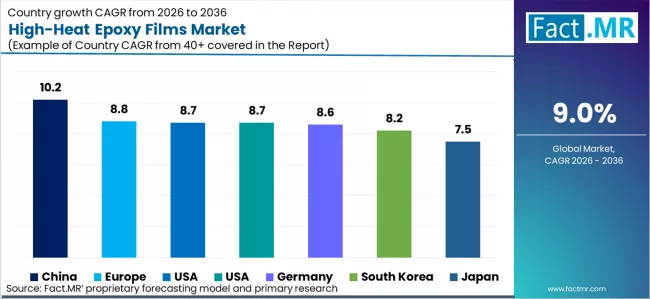
High Heat Epoxy Films Market Cagr Analysis By Country | Source: Fact.MR
| Country | CAGR (2026-2036) |
|---|---|
| USA | 8.7% |
| Japan | 7.5% |
| South Korea | 8.2% |
| Europe | 8.8% |
| Germany | 8.6% |
| China | 10.2% |
| United Kingdom | 8.7% |
| Brazil | 9.8% |
Source: Fact.MR analysis. Updated Feb 19, 2026
Source: Fact MR (FMR) analysis, based on proprietary forecasting model and primary research.
North America:
North America is a "key market for industrial applications," where demand for high-heat epoxy films is driven by their use in automotive, aerospace, and electronic industries.
- USA: Demand for high-heat epoxy films in the U.S. is projected to rise at 8.7% CAGR through 2036. Increasing demand for high-performance materials in electronics and aerospace sectors, coupled with rising industrial activities, is driving market growth.
East Asia:
East Asia is a "global manufacturing powerhouse," with high demand for high-heat epoxy films driven by rapid industrialization and strong electronic and automotive industries.
- China: Demand for high-heat epoxy films in China is projected to rise at 10.2% CAGR through 2036. China’s rapid industrial expansion and the increasing demand for advanced electronics and automotive solutions support market growth.
- Japan: Demand for high-heat epoxy films in Japan is projected to rise at 7.5% CAGR through 2036. Japan’s advanced technology sector and strong industrial base continue to drive demand for high-performance materials like epoxy films.
South Korea:
South Korea is a "leading player in electronic manufacturing," with growing demand for high-heat epoxy films in the production of electronics, automotive, and other high-tech industries.
- South Korea: Demand for high-heat epoxy films in South Korea is projected to rise at 8.2% CAGR through 2036. South Korea's electronics and automotive sectors drive the need for advanced materials like high-heat epoxy films.
Europe:
Europe remains a "mature market" for high-heat epoxy films, with strong demand driven by the region’s automotive and electronics industries and stringent manufacturing standards.
- Germany: Demand for high-heat epoxy films in Germany is projected to rise at 8.6% CAGR through 2036. Germany’s leading automotive industry and demand for high-performance electronic materials contribute to continued growth in the market.
- United Kingdom: Demand for high-heat epoxy films in the UK is projected to rise at 8.7% CAGR through 2036. The growing demand for high-quality materials in the electronics sector and sustainability-driven innovations in manufacturing contribute to the market's expansion.
Latin America:
In Latin America, Brazil stands out due to its expanding industrial sector and increasing demand for high-performance materials across multiple industries.
- Brazil: Demand for high-heat epoxy films in Brazil is projected to rise at 9.8% CAGR through 2036. Brazil’s growing electronics and automotive sectors and the increasing adoption of advanced materials support significant market growth.
Fact MR's analysis of the High-Heat Epoxy Films Market in North America, East Asia, South Korea, Europe, Latin America, and Germany consists of country-wise assessments that include the USA, Japan, South Korea, Germany, China, the United Kingdom, and Brazil. Readers can find detailed trends, regulatory updates, and company-specific investments shaping the market’s growth in these countries.
How Are Key Players Competing in the High-Heat Epoxy Films Market?
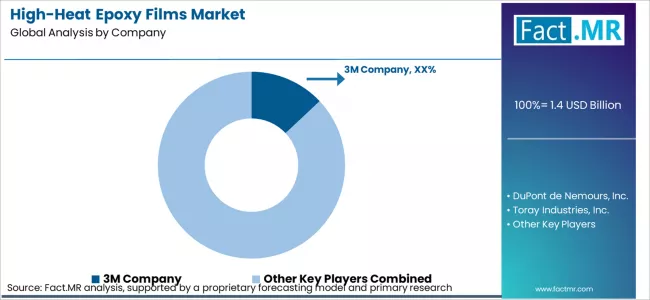
High Heat Epoxy Films Market Analysis By Company | Source: Fact.MR
The high-heat epoxy films market is highly competitive, with global leaders like 3M Company, DuPont de Nemours, Inc., and Toray Industries, Inc. driving innovation in advanced film technologies designed to withstand extreme temperatures. Henkel AG & Co. KGaA and Avery Dennison Corporation are focusing on improving the performance of their epoxy films for applications in electronics, automotive, and aerospace, where heat resistance is crucial. Saint-Gobain Performance Plastics and Nitto Denko Corporation are capitalizing on their material science expertise to develop films that offer superior thermal stability and reliability in demanding conditions. Sumitomo Bakelite Co., Ltd. and Ahlstrom Corporation are investing in manufacturing techniques that enhance the durability and performance of their products. Von Roll Holding AG is positioning itself by offering specialized solutions for high-temperature applications, ensuring it captures demand from industries requiring robust and reliable film materials. Leading players are focused on providing high-performance, heat-resistant solutions tailored to the evolving needs of high-tech industries.
Recent Industry Developments
- Product launch-Park Aerospace Aeroadhere™ FAE-350-1 structural epoxy film adhesive (May 9, 2023): Park Aerospace introduced Aeroadhere™ FAE-350-1, a 350°F-curing epoxy film adhesive for high-temperature structural bonding across composite/metal and honeycomb assemblies in aerospace OEM and MRO uses.
- Patent-Toughened adhesive layer using a fibrous veil with dissolvable binder (Published Dec 13, 2023): Cytec Industries’ EP application describes a toughened structural adhesive layer (including epoxy systems) that embeds a binder-carrying fibrous veil to improve strength/toughness tradeoffs for demanding bonded structures.
- Patent-Epoxy-based thermosetting composition for “high-performance adhesive film” up to 350°F service range (Published Nov 20, 2025): Cytec Industries’ WO publication discloses an epoxy thermosetting composition intended to form a high-performance adhesive film with high bond strength and fracture toughness across temperatures up to 350°F (177°C).
Key Players of the High‑Heat Epoxy Films Market
- 3M Company
- DuPont de Nemours, Inc.
- Toray Industries, Inc.
- Henkel AG & Co. KGaA
- Avery Dennison Corporation
- Saint-Gobain Performance Plastics
- Nitto Denko Corporation
- Sumitomo Bakelite Co., Ltd.
- Ahlstrom Corporation
- Von Roll Holding AG
Report Scope
| Metric | Value |
|---|---|
| Quantitative Units | USD 1.4 billion (2026) to USD 3.4 billion (2036), at a CAGR of 9.0% |
| Market Definition | The High-Heat Epoxy Films Market includes epoxy-based films designed for high-temperature applications, used in industries such as aerospace, electronics, and electric vehicles (EVs). |
| By Film Type | Adhesive Films, Electrical Insulation Films, Structural Reinforcement Films, Other Epoxy Films |
| By End Use | Aerospace & Defense, EV & E-Mobility, Industrial & Electrical, Electronics & Other |
| By Temperature Class | Up to 180°C, 181-220°C, >220°C |
| By Substrate | Film on Polyimide / PET, Film on Metal Foils, Self-Supporting Films, Other Substrates |
| Regions Covered | North America, Latin America, Europe, East Asia, South Asia, Oceania, Middle East and Africa |
| Countries Covered | United States, Canada, Mexico, Brazil, Argentina, Germany, France, United Kingdom, Italy, Spain, China, India, Japan, South Korea, Indonesia, Australia, and 40+ countries |
| Key Companies Profiled | 3M Company, DuPont de Nemours, Inc., Toray Industries, Inc., Henkel AG & Co. KGaA, Avery Dennison Corporation, Saint-Gobain Performance Plastics, Nitto Denko Corporation, Sumitomo Bakelite Co., Ltd., Ahlstrom Corporation, Von Roll Holding AG |
| Forecast Period | 2026 to 2036 |
| Approach | Hybrid top-down and bottom-up market modeling validated through primary interviews with manufacturers and supported by trade data benchmarking and market research. |
Source: Fact.MR analysis. Updated Feb 19, 2026
Bibliographies
- Product Launch-Park Aerospace Aeroadhere™ FAE-350-1 Structural Epoxy Film Adhesive: Park Aerospace Corp. (2023, May 9). Park Aerospace introduces Aeroadhere™ FAE-350-1 structural epoxy film adhesive. Park Aerospace Corp. [1]
- Patent-Toughened Adhesive Layer Using a Fibrous Veil with Dissolvable Binder: Cytec Industries. (2023, December 13). Toughened adhesive layer using a fibrous veil with dissolvable binder. European Publication Server. [2]
- Patent-Epoxy-Based Thermosetting Composition for “High-Performance Adhesive Film” Up to 350°F Service Range: Cytec Industries. (2025, November 20). Epoxy-based thermosetting composition for high-performance adhesive film. Google Patents. [3]
Segmentation
High Heat Epoxy Films Market Key Segments
-
By Film Type
- Adhesive Films
- Electrical Insulation Films
- Structural Reinforcement Films
- Other Epoxy Films
-
By End Use
- Aerospace & Defense
- EV & E-Mobility
- Industrial & Electrical
- Electronics & Other
-
By Temperature Class
- Up to 180°C
- 181-220°C
- 220°C
-
By Substrate
- Film on Polyimide / PET
- Film on Metal Foils
- Self-Supporting Films
- Other Substrates
-
Region
- North America
- USA
- Canada
- Mexico
- Europe
- Germany
- UK
- France
- Italy
- Spain
- Nordic Countries
- BENELUX
- Rest of Europe
- Asia Pacific
- China
- Japan
- South Korea
- India
- Australia
- Rest of Asia Pacific
- Latin America
- Brazil
- Argentina
- Rest of Latin America
- Middle East and Africa
- Kingdom of Saudi Arabia
- United Arab Emirates
- South Africa
- Rest of Middle East and Africa
- Other Regions
- Oceania
- Central Asia
- Other Markets
- North America
Frequently Asked Questions
How large is the demand for High-Heat Epoxy Films in the global market in 2026?
What will be the market size of High-Heat Epoxy Films in the global market by 2036?
What is the expected demand growth for High-Heat Epoxy Films in the global market between 2026 and 2036?
Which film type is expected to dominate the market?
Which region is expected to show the highest growth rate for High-Heat Epoxy Films?
How significant is the growth outlook for Brazil in this market?
What is the growth outlook for the United States in this report?
What is the growth forecast for Japan in the High-Heat Epoxy Films market?
What is the growth forecast for South Korea in this market?
Which European market is highlighted in this analysis?
Which company is identified as a leading player in the High-Heat Epoxy Films market?
What are High-Heat Epoxy Films used for?
What does the High-Heat Epoxy Films market include in this report?
How is the market forecast developed in this report?
What is meant by the High-Heat Epoxy Films market in this report?
Who worked on this report


Preview the report firsthand - request a free sample
Free SampleGet the brochure for pricing and purchase details
Download PDF