- Market Value (2025): USD 1.04 Bn
- Estimated Value (2026): USD 1.09 Bn
- Forecast Value (2036): USD 1.75 Bn
- CAGR (2026-2036): 4.8%
What is the Ertapenem Market forecast to be worth by 2036?
USD 1.1 billion in 2026 to USD 1.8 billion by 2036 at a 4.8% CAGR.
- The valuation of the ertapenem market was USD 1.04 billion in 2025, with hospital treatment of complicated intra-abdominal and urinary tract infections accounting for most dispensed vials.
- Revenue will expand from USD 1.09 billion in 2026 to USD 1.75 billion by 2036 as resistant Gram-negative infections keep carbapenems on hospital formularies and generic vials reach more health systems.
- A 4.8% CAGR reflects a mature molecule whose value grows through steady institutional use, not through new indications.
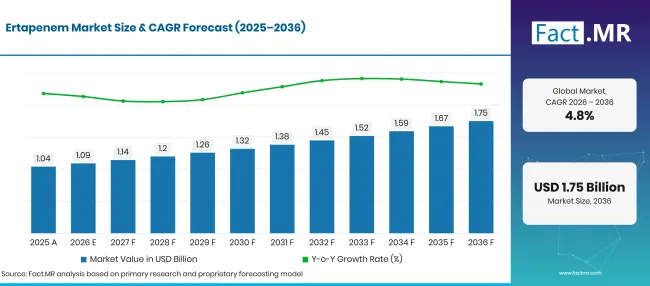
Ertapenem Market Forecast Global | Source: Fact.MR
| Year | Basis | Market Value (USD billion) |
|---|---|---|
| 2025 | Actual | 1.04 |
| 2026 | Estimate | 1.09 |
| 2036 | Forecast | 1.75 |
| CAGR 2026 to 2036 | Forecast period | 4.8% |
Source: Fact.MR analysis. Updated Nov 2, 2026
What are the defining numbers behind Ertapenem Market growth?
The 2026 to 2036 period adds USD 0.7 billion in new value, concentrated in hospital injectables and high-purity API supply.
- Demand Drivers in the Market
- Resistance to first-choice antibiotics keeps carbapenems in daily hospital use. WHO reported in October 2025 that over 40% of E. coli and over 55% of K. pneumoniae isolates worldwide resist third-generation cephalosporins, the usual first-line option for these infections [1].
- Once-daily dosing gives ertapenem a practical edge on busy wards and in outpatient parenteral therapy. The February 2026 INVANZ prescribing information sets an adult dose of 1 g once daily, infused over 30 minutes, with a 500 mg daily dose for severe renal impairment [2].
- Treatment guidance continues to name ertapenem for resistant infections. The IDSA 2026 guidance lists it among preferred agents for ESBL-producing Enterobacterales outside the urinary tract, while favouring imipenem or meropenem for critically ill or hypoalbuminemic patients [3].
- Generic registrations keep adding supply to hospital channels. DailyMed shows an Apotex ertapenem sodium injection label updated on October 1, 2026, one of several abbreviated new drug application products now marketed in the United States [4].
- Key Segments Analyzed
- By Purity: Above 99% Purity will command 79.8% of 2026 value, since sterile injectable makers need tight impurity limits to pass regulatory review.
- By Dosage Form: Powder for Injection will account for 66.9% of 2026 revenue, given that ertapenem degrades in solution and is shipped as lyophilized powder for reconstitution.
- Analyst Opinion at Fact.MR
- Shambhu Nath Jha, Principal Consultant at Fact.MR, states, “Ertapenem holds a clear place in hospital care because a single daily dose covers many ESBL infections that older cephalosporins no longer treat reliably. Over the next ten years, lyophilized vials will remain the main commercial format, and growth will favour suppliers that pair high-purity API with dependable sterile fill-finish capacity. Stewardship programmes will cap volume, so hospitals will reward consistent supply and quality records over the lowest bid.”
- Strategic Implications
- API producers should invest in impurity profiling and keep drug master files current, since high-purity material now carries most of the value and buyers audit suppliers before awarding contracts.
- Finished-dose manufacturers should secure dedicated penem fill lines and stable lyophilization capacity, because supply gaps in sterile antibiotics push hospitals toward rival vials quickly.
- Hospital pharmacies and purchasing groups should weigh supplier quality history alongside unit price, and align ertapenem stocking with stewardship rules that reserve carbapenems for confirmed resistant infections.
- Investors should look at sterile injectable platforms with carbapenem experience, where regulatory approvals and inspection records form a barrier that new entrants take years to clear.
Germany will lead the five-country view at 6.0%, helped by a dense hospital network and national surveillance that tracks antibiotic use closely. Brazil follows at 5.5% as stewardship programmes spread across public and private hospitals and generic access widens. The United States will grow at 4.9%; its large generic vial base supports volume, though price competition tempers value. The United Kingdom, at 4.4%, reflects NHS purchasing discipline and steady secondary care demand. Japan closes the group at 3.9%, where injectable carbapenem use has fallen since 2020 under a national action plan.
How does the Ertapenem Market break down by segment?
Above 99% Purity will lead Purity at 79.8%; Powder for Injection will head Dosage Form at 66.9% in 2026.
Which Purity grade leads?
Above 99% Purity holds 79.8% of 2026 sales.
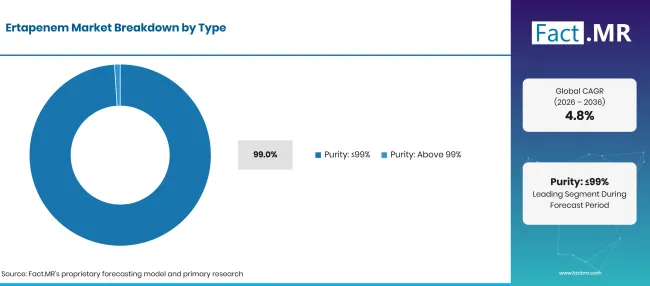
Ertapenem Market Breakdown Type | Source: Fact.MR
| Purity | Share (2026) |
|---|---|
| Above 99% Purity (Leading segment) | 79.8% |
| Other segments combined | 20.2%* |
| Total | 100.0% |
Source: Fact.MR analysis. Updated Nov 2, 2026
Regulators judge sterile antibiotic dossiers on impurity control, and ertapenem is prone to degradation products that must stay within tight limits. API buyers therefore specify material above 99% purity for finished vials sold into regulated markets. FDA’s drug master file list, current as of October 2026, shows how API makers file confidential manufacturing data that buyers reference in their applications, although FDA notes that a DMF is not itself an approval [5]. Material at or below 99% purity serves less demanding uses, such as intermediate processing, research work and some markets with lighter dossier requirements. Its share of value is smaller because finished-dose makers selling to hospitals in the United States, Europe and Japan rarely accept it. Producers of carbapenem-based antibiotics face the same purity pressure across the class.
What supports Powder for Injection within Dosage Form?
Powder for Injection takes 66.9% of 2026 revenue.
| Dosage Form | Share (2026) |
|---|---|
| Powder for Injection (Leading segment) | 66.9% |
| Other segments combined | 33.1%* |
| Total | 100.0% |
Source: Fact.MR analysis. Updated Nov 2, 2026
Ertapenem is unstable once dissolved, so the originator and most generic makers supply it as a sterile lyophilized powder in a 1 g single-dose vial. The EMA product page for Invanz, updated in November 2025, describes a vial of powder that is dissolved before use to make a solution for infusion [6]. Hospital pharmacies reconstitute the vial for intravenous or intramuscular use, which keeps preparation inside controlled settings. Other formulations cover ready-to-use and premixed presentations sold into selected hospital and home care channels. These formats appeal to home infusion therapy services that want less preparation time, but shelf-life limits keep them a minor part of sales. Patients stepping down from intravenous care usually move to extended oral antibiotics instead of oral ertapenem, which is not marketed.
What is accelerating Ertapenem Market adoption, and what is holding it back?
Rising ESBL resistance and convenient once-daily dosing keep ertapenem on hospital formularies, and new generic vials widen access. Stewardship policy pulls the other way. WHO’s September 2025 operational guidance asks countries to plan registration, use and monitoring of Watch and Reserve antibiotics carefully [7], and hospitals apply the same caution to carbapenems. Tender pricing on off-patent vials also limits value growth.
Drivers Impact Analysis
| DRIVER | (~) % IMPACT ON CAGR | GEOGRAPHIC RELEVANCE | IMPACT TIMELINE |
|---|---|---|---|
| Hospital reliance on carbapenems as cephalosporin resistance spreads in E. coli and Klebsiella | +1.7% | Global | Short term (<=2 years) |
| Once-daily dosing that saves nursing time and suits home infusion after discharge | +1.1% | North America, Western Europe, East Asia | Medium term (2-4 years) |
| New generic API and vial capacity from sterile injectable manufacturers | +0.7% | South Asia & Pacific, North America | Medium term (2-4 years) |
| Standing hospital and group purchasing contracts for broad-spectrum antibiotics | +0.5% | Global | Short term (<=2 years) |
Source: Fact.MR analysis. Updated Nov 2, 2026
Opportunity Impact Analysis
| OPPORTUNITY | (~) % IMPACT ON CAGR | GEOGRAPHIC RELEVANCE | IMPACT TIMELINE |
|---|---|---|---|
| Dedicated penem and carbapenem lines at injectable plants in India and China | +0.7% | South Asia & Pacific, East Asia | Medium term (2-4 years) |
| Consistent generic vial quality that secures repeat hospital tenders | +0.4% | Global | Medium term (2-4 years) |
| Clean inspection records that open regulated markets to more API makers | +0.3% | Global | Long term (>=4 years) |
| Public tenders that widen access to essential antibiotics | +0.3% | Latin America, South Asia & Pacific | Medium term (2-4 years) |
Source: Fact.MR analysis. Updated Nov 2, 2026
Restraints Impact Analysis
| RESTRAINT | (~) % IMPACT ON CAGR | GEOGRAPHIC RELEVANCE | IMPACT TIMELINE |
|---|---|---|---|
| Stewardship rules that reserve carbapenems for confirmed resistant infections | -0.4% | Global | Short term (<=2 years) |
| Substitution with meropenem, imipenem and newer agents in critically ill patients | -0.2% | Global | Medium term (2-4 years) |
| Cost and audit burden of sterile fill-finish facilities | -0.2% | Global | Medium term (2-4 years) |
| Falling tender prices for off-patent injectable medicines | -0.1% | North America, Western Europe, East Asia | Short term (<=2 years) |
Source: Fact.MR analysis. Updated Nov 2, 2026
Which countries are scaling the Ertapenem Market through 2036?
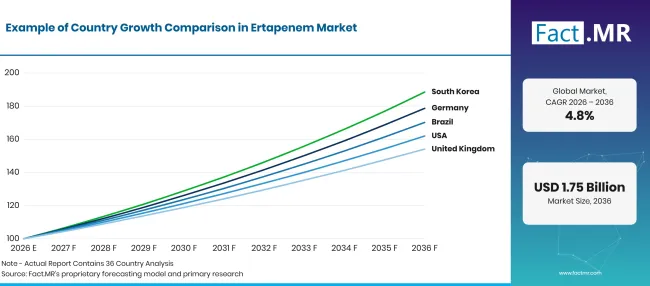
Ertapenem Market Growth Index | Source: Fact.MR
| Country | CAGR (2026 to 2036) |
|---|---|
| Germany | 6.0% |
| Brazil | 5.5% |
| United States | 4.9% |
| United Kingdom | 4.4% |
| Japan | 3.9% |
Source: Fact.MR analysis. Updated Nov 2, 2026
What supports Germany’s adoption?
6.0% CAGR, supported by a dense hospital network and close national tracking of antibiotic use.
German hospitals treat a high volume of surgical and urinary infections, and they report antibiotic use to the Robert Koch Institute in large numbers. In September 2026, the institute reported that 593 hospitals contributed consumption data and 126 laboratories contributed resistance data for 2025 [8]. The same release found hospital antibiotic use in 2025 broadly unchanged from 2024, which keeps carbapenem demand steady while stewardship targets push for careful selection of agents.
How is Brazil developing demand?
5.5% CAGR, as stewardship programmes and generic access spread across hospitals.
Brazil’s regulator is building a national picture of how hospitals manage antimicrobials, which shapes when ertapenem is chosen. In October 2026, ANVISA opened its 2026 national assessment of hospital antimicrobial stewardship programmes to public, private, philanthropic and military hospitals [9]. In the 2024 round, 1,453 hospitals took part and just over half reported a programme in place, leaving room for more structured carbapenem use as programmes mature.
What is supporting the United States’ adoption?
4.9% CAGR, backed by a deep generic vial supply and hospital use data reporting.
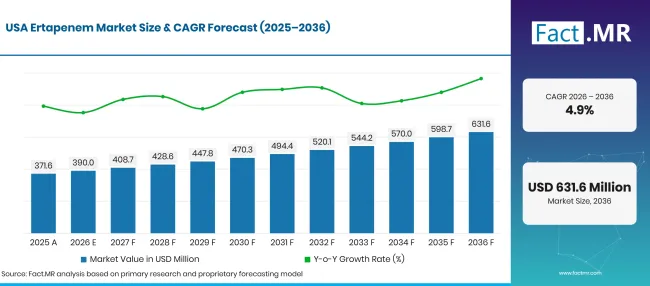
Ertapenem Market Forecast Usa | Source: Fact.MR
The United States has the widest choice of generic ertapenem vials, and hospitals monitor their use closely. CDC reported in February 2026 that 4,362 acute care hospitals had submitted at least one month of data to the National Healthcare Safety Network antimicrobial use option by January 1, 2025 [10]. This reporting lets hospitals benchmark carbapenem use, so growth comes from appropriate treatment and outpatient therapy, while generic pricing holds back value per vial.
How is the United Kingdom scaling demand?
4.4% CAGR, reflecting steady NHS secondary care use under firm purchasing control.
NHS trusts buy injectable antibiotics through national frameworks that favour reliable generic supply. UKHSA data updated in May 2026 put secondary care antibiotic consumption at 4.4 defined daily doses per 1,000 inhabitants per day for the month ending December 2025 [11]. That steady hospital base supports ertapenem use in surgical and urinary infections, while stewardship teams limit carbapenems to cases with documented resistance.
How does Japan perform?
3.9% CAGR, owing to a national plan that has cut injectable carbapenem use.
Japan tracks antimicrobial use through its One Health surveillance committee. At the committee’s December 2025 meeting, the Ministry of Health, Labour and Welfare reported that injectable carbapenem use in 2024 was 14.3% lower than in 2020, while total antimicrobial use was 27.3% higher [12]. This shift toward narrower agents explains the slower pace, although an ageing population keeps demand for hospital treatment of complicated infections in place.
Who leads the Ertapenem Market?
Competition falls into three groups. Merck & Co., the originator, still anchors the brand with INVANZ, and its February 2026 prescribing update keeps the label aligned with current dosing and indications [2].
A second group of generic injectable specialists, including Fresenius Kabi, Hikma Pharmaceuticals and Apotex, competes on hospital contracts, supply reliability and broad anti-infective portfolios. Hikma announced a USD 1 billion US investment plan in June 2025 that includes added sterile injectable capacity [13], and Apotex’s ertapenem label was refreshed on DailyMed in October 2026 [4]. A third group of Asian manufacturers, such as Gland Pharma, Qilu Antibiotics Pharmaceutical and Savior Lifetec, combines API or vial production with export filings, giving them a cost base that pressures tender prices. Through 2036, winning suppliers will be those that hold clean inspection records, keep lyophilization capacity free for penems and can prove impurity control batch after batch.
Which companies are the key providers?
Key companies in the Ertapenem Market include Merck & Co., Fresenius Kabi, Hikma Pharmaceuticals, Apotex, Gland Pharma, Qilu Antibiotics Pharmaceutical and Savior Lifetec.
- Merck & Co.
- Fresenius Kabi
- Hikma Pharmaceuticals
- Apotex
- Gland Pharma
- Qilu Antibiotics Pharmaceutical
- Savior Lifetec
Bibliography
- [1] World Health Organization. (2025, October 13). WHO warns of widespread resistance to common antibiotics worldwide.
- [2] Merck Sharp & Dohme LLC. (2026, February). INVANZ (ertapenem for injection): Prescribing information.
- [3] Infectious Diseases Society of America. (2026, July 30). IDSA 2026 Guidance on the Treatment of Antimicrobial Resistant Gram-Negative Infections.
- [4] U.S. National Library of Medicine, DailyMed. (2026, October 1). ERTAPENEM (ertapenem sodium) injection: Apotex Corp.
- [5] U.S. Food and Drug Administration. (2026, October 13). List of Drug Master Files (DMFs).
- [6] European Medicines Agency. (2025, November 21). Invanz.
- [7] World Health Organization. (2025, September 17). Country preparedness for the introduction and appropriate use of antibiotics: operational guidance.
- [8] Robert Koch Institute. (2026, September 9). Neue RKI-Daten zu Antibiotikaresistenzen und -verbrauch.
- [9] Agência Nacional de Vigilância Sanitária. (2026, October 23). Anvisa disponibiliza a Avaliação Nacional dos Programas de Gerenciamento de Antimicrobianos em Hospitais 2026.
- [10] Centers for Disease Control and Prevention. (2026, February 9). Antibiotic Use and Stewardship in the United States, 2025 Update: Progress and Opportunities.
- [11] UK Health Security Agency. (2026, May 28). Antibiotic consumption: Secondary care.
- [12] Ministry of Health, Labour and Welfare. (2025, December 4). 第13回薬剤耐性ワンヘルス動向調査検討会 議事録 (13th AMR One Health Surveillance Committee: Minutes).
- [13] Hikma Pharmaceuticals. (2025, June 28). Hikma Pharmaceuticals USA announces $1 Billion of new US investment to further expand its domestic manufacturing and development of essential generic medicines.
This Report Answers
- How is ertapenem value split between high-purity and standard API grades, and why do buyers pay for purity?
- Why does lyophilized powder for injection carry most dosage form revenue?
- In what ways do stewardship programmes and treatment guidance shape carbapenem selection in hospitals?
- Which originator, generic and API suppliers compete for hospital contracts?
- What explains the growth gap between Germany, Brazil, the United States, the United Kingdom and Japan?
- Where do sterile manufacturing capacity and inspection records decide supplier access?
What does the Ertapenem Market cover?
This study values ertapenem active pharmaceutical ingredient and finished ertapenem medicines sold to hospitals, clinics and home infusion providers. Ertapenem belongs to the carbapenem group of beta-lactam antibacterials and is approved for complicated intra-abdominal, skin, urinary and pelvic infections, community-acquired pneumonia and surgical prophylaxis after colorectal surgery.
Value is measured at manufacturer selling prices in USD billion across two purity grades and two dosage form groups. Country estimates cover Germany, Brazil, the United States, the United Kingdom and Japan, with regional totals for seven world regions.
What is included in the scope?
Ertapenem sodium API sold to finished-dose makers, at both purity grades.
Branded and generic ertapenem powder for injection in single-dose vials, used by intravenous or intramuscular route.
Ready-to-use and other ertapenem presentations sold to hospitals and urinary tract infection treatment programmes.
Sales through hospital pharmacies, group purchasing contracts, public tenders and home infusion channels.
What is excluded from the scope?
Other carbapenems such as meropenem, imipenem and doripenem, which fall within the wider antibiotics category.
Hospital service fees, nursing time and infusion equipment.
Diagnostic and susceptibility testing services.
Antibiotic classes outside the beta-lactams, including macrolide antibiotics and fluoroquinolones.
How Was the Analysis Built?
The analysis draws on 120+ sources, 35+ company portfolios, 25+ countries, and more than 20 industry interviews.
- Primary Research: Primary research includes discussions with manufacturers, service providers, technology developers, distributors, end users, and subject-matter experts. These conversations examine purchasing priorities, product adoption, operational challenges, approval requirements, competitive positioning, and the factors that influence wider market acceptance.
- Desk Research: Desk research covers government statistics, regulatory publications, company filings, trade data, technical studies, industry associations, standards, public policy, and other authoritative sources. Every source used in the analysis is documented in the bibliography.
- Market Sizing and Forecasting: Market estimates combine historical performance, demand indicators, pricing and volume trends, segment shares, company participation, country-level growth, adoption patterns, investment activity, and barriers to market expansion.
- Data Validation and Update Cycle: Findings are validated by comparing primary interviews with public data, company activity, regulatory changes, trade patterns, and industry developments. Regular updates review new product launches, capacity changes, partnerships, approvals, and shifts in commercial adoption.
Segmentation
What is the report’s scope and coverage?
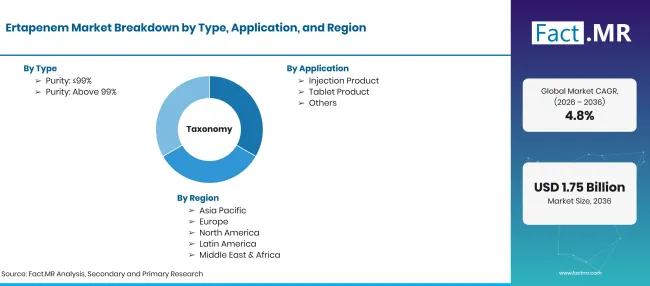
Ertapenem Market Taxonomy | Source: Fact.MR
| Attribute | Details |
|---|---|
| Quantitative Units | USD billion in 2026 to USD billion by 2036 at CAGR |
| Market Definition | Ertapenem active pharmaceutical ingredient and finished ertapenem medicines, mainly lyophilized powder for injection, used to treat susceptible bacterial infections. |
| Purity | Above 99% Purity; 99% Purity and Below |
| Dosage Form | Powder for Injection; Other Formulations |
| Regions Covered | North America; Latin America; Western Europe; Eastern Europe; East Asia; South Asia & Pacific; Middle East & Africa |
| Countries Covered | Germany; Brazil; United States; United Kingdom; Japan |
| Companies Profiled | Merck & Co.; Fresenius Kabi; Hikma Pharmaceuticals; Apotex; Gland Pharma; Qilu Antibiotics Pharmaceutical; Savior Lifetec |
| Forecast Period | 2026 to 2036 |
| Approach | Hybrid top-down and bottom-up model built from hospital carbapenem use, generic vial registrations, API purity mix and country stewardship data. |
Source: Fact.MR analysis. Updated Nov 2, 2026
How is the market segmented?
-
By Purity
- Above 99% Purity
- 99% Purity and Below
-
By Dosage Form
- Powder for Injection
- Other Formulations
-
By Region
- North America
- Latin America
- Western Europe
- Eastern Europe
- East Asia
- South Asia & Pacific
- Middle East & Africa
Frequently Asked Questions
How large is the ertapenem market in 2026?
What growth rate will the ertapenem market record?
Which purity grade leads?
Which dosage form leads?
Which country will grow quickest?
Who are the main companies?
What holds the market back?
Who worked on this report


Preview the report firsthand - request a free sample
Free SampleGet the brochure for pricing and purchase details
Download PDF