- Market Value (2025): USD 5.7 Bn
- Estimated Value (2026): USD 6.4 Bn
- Forecast Value (2036): USD 18.8 Bn
- CAGR (2026-2036): 11.4%
What is the Healthcare AI Consulting Services Market forecast to be worth by 2036?
USD 6.4 billion in 2026 to USD 18.8 billion by 2036 at 11.4% CAGR.
- The Healthcare AI Consulting Services market reached USD 5.7 billion in 2025 as providers and payers moved AI work from pilots into governed programs.
- Demand is projected to increase from USD 6.4 billion in 2026 to USD 18.8 billion by 2036.
- The market is forecast to record 11.4% CAGR from 2026 to 2036 owing to workflow pressure and stronger governance needs.
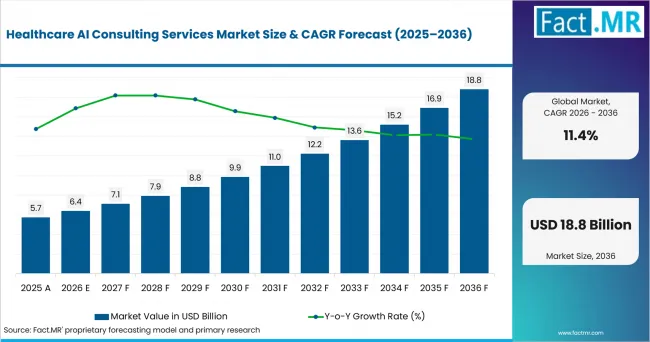
Healthcare Ai Consulting Services Market Value Analysis | Source: Fact.MR
What are the defining numbers behind Healthcare AI Consulting Services Market growth?
USD 12.4 billion absolute opportunity by 2036.
- Demand Drivers in the Market
- Healthcare buyers require AI roadmaps that convert clinical priorities and data readiness into sequenced projects.
- Hospitals place high value on workflow redesign because AI tools must fit physician documentation and care coordination.
- Payers and providers need governance support so model selection and privacy review are agreed before deployment.
- Consulting demand is anticipated to benefit from generative AI use cases that need safe testing and staff training.
- Key Segments Analyzed
- By Service Offering: Artificial Intelligence Strategy Consulting is expected to hold 42.0% share in 2026 because buyers need strategy before AI deployment.
- By Application: Clinical Workflow Optimization is projected to account for 39.0% share in 2026 as hospitals target care-team efficiency.
- By End User: Hospitals are anticipated to capture 41.0% share in 2026 since they manage the widest range of AI-ready workflows.
- By Engagement Model: Project-based Consulting is estimated to represent 47.0% share in 2026 due to pilot-led procurement and staged rollouts.
- By Artificial Intelligence Capability: Generative Artificial Intelligence is forecast to hold 45.0% share in 2026 as documentation and engagement use cases expand.
- Analyst Opinion at Fact.MR
- Shambhu Nath Jha, Senior Consultant at Fact.MR, states, “Healthcare AI consulting is shifting from broad digital strategy toward accountable deployment. Buyers want partners that can align model selection with clinical risk and workflow evidence. They need data readiness and operating governance. Vendors that move AI from proof of concept into safe hospital and payer workflows are expected to gain the clearest advantage.”
- Strategic Implications
- Consulting teams should build AI governance playbooks before recommending platforms or models.
- Providers need workflow-specific implementation plans that protect clinician time and patient-safety review.
- Payers and hospitals should connect AI roadmaps with data quality and system access.
- Vendors should prove integration depth across electronic health records and revenue-cycle systems.
- Investors should separate healthcare AI consulting exposure from generic IT services.
The USA leads at 12.3% CAGR through payer-provider AI budgets and strict governance needs. Germany follows at 11.9% as hospital IT programs require structured implementation support. UK reaches 11.5% through NHS digital programs. Canada records 11.1% through universal-care modernization. France posts 10.6%. Japan reaches 10.2% and Australia reaches 9.8% through healthcare digitization and provider demand.
How does the Healthcare AI Consulting Services Market break down by segment?
Artificial Intelligence Strategy Consulting is expected to lead Service Offering at 42.0% share in 2026. Clinical Workflow Optimization is projected to lead Application at 39.0% share in 2026.
Why does Artificial Intelligence Strategy Consulting lead Service Offering?
By Service Offering, Artificial Intelligence Strategy Consulting is projected to account for 42.0% share in 2026.
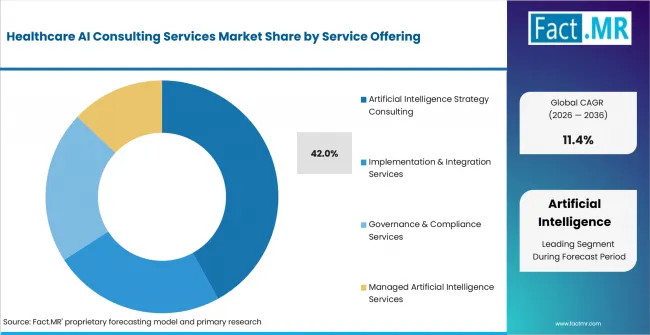
Healthcare Ai Consulting Services Market Analysis By Service Offering | Source: Fact.MR
This service line leads because healthcare buyers need decision frameworks before they choose platforms or models. Strategy work connects board priorities with privacy rules and proof-of-value milestones.
Why does Clinical Workflow Optimization lead Application?
Clinical Workflow Optimization is expected to hold 39.0% share in 2026.
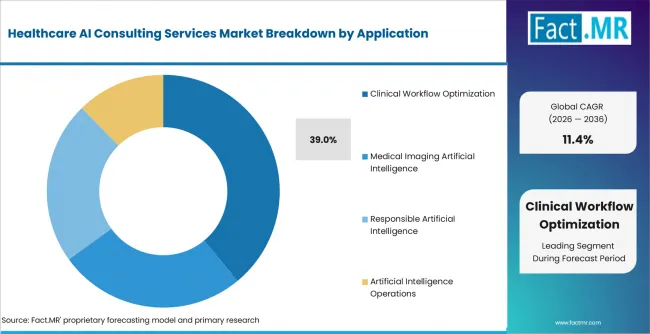
Healthcare Ai Consulting Services Market Analysis By Application | Source: Fact.MR
Hospitals want AI to reduce friction inside everyday care delivery. Consulting work maps handoffs and documentation. It covers alerting, triage, and lab workflow design before algorithms enter clinical routines.
The UK Department of Health and Social Care reported in April 2025 that an NHS England-funded ambient voice technology evaluation covered more than 7,000 patients across adult outpatients, primary care, pediatrics, mental health, community care, A&E, and the London Ambulance Service.
Why do Hospitals lead End User?
A 41.0% share is anticipated for Hospitals in 2026.
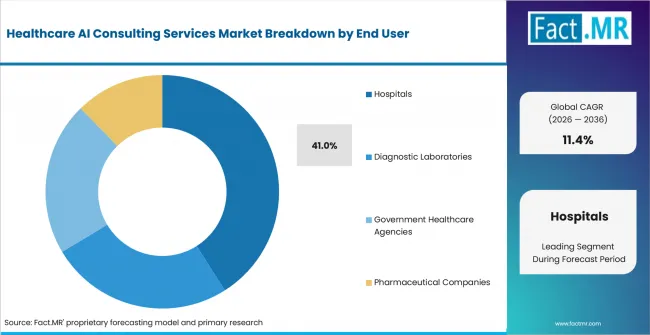
Healthcare Ai Consulting Services Market Analysis By End User | Source: Fact.MR
Hospitals lead because they manage clinical risk while following strict procurement rules. Their broad operational needs create strong demand for AI consulting. These services help connect patient care systems with administrative workflows and support better coordination across complex healthcare environments.
Why does Project-based Consulting lead Engagement Model?
With 47.0% share in 2026, Project-based Consulting is estimated to lead Engagement Model.
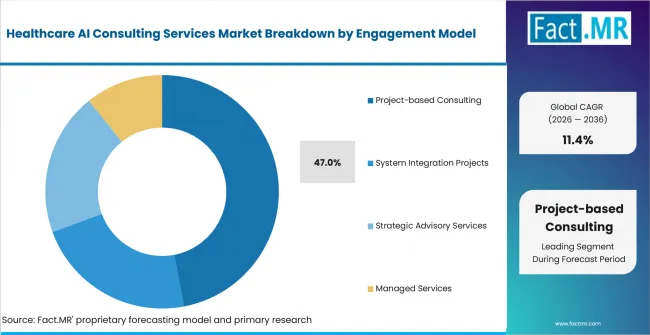
Healthcare Ai Consulting Services Market Analysis By Engagement Model | Source: Fact.MR
This model fits healthcare procurement because buyers often start with defined use cases and short evaluation cycles. Project work lets hospitals test value and refine governance before wider contracts.
The Assistant Secretary for Technology Policy/Office of the National Coordinator for Health IT reported in September 2025 that predictive AI use for billing simplification rose by 25 percentage points and scheduling facilitation rose by 16 percentage points among U.S. non-federal acute care hospitals from 2023 to 2024, supporting scoped consulting projects before wider rollouts.
Why does Generative Artificial Intelligence lead Artificial Intelligence Capability?
Generative Artificial Intelligence is forecast to hold 45.0% share in 2026.
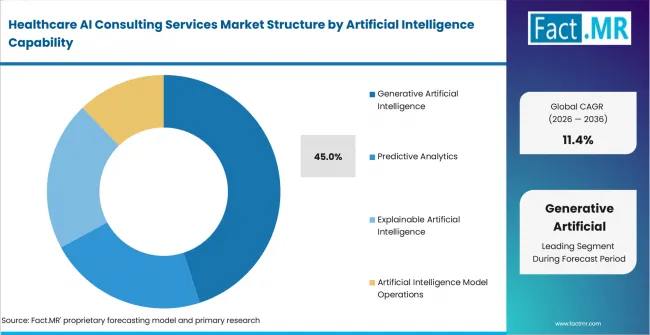
Healthcare Ai Consulting Services Market Analysis By Artificial Intelligence Capability | Source: Fact.MR
Generative AI leads because it supports documentation and clinical summarization. It also improves patient communication and research review. Consulting demand is expected to focus on prompt design and governance. Adoption is also rising across dental practices and other care settings.
What is accelerating Healthcare AI Consulting Services Market adoption, and what is holding it back?
Demand is expected to rise as healthcare organizations move AI from trials into governed workflows. Growth is likely to be limited by budget pressure and fragmented data. Vendor complexity and staff capability gaps are expected to slow rollout.
Drivers Impact Analysis
| DRIVER | (~) % IMPACT ON CAGR | GEOGRAPHIC RELEVANCE | IMPACT TIMELINE |
|---|---|---|---|
| Technology Innovation & R&D | High | Global | 2026-2036 |
| Regulatory & Policy Drivers | Medium-High | North America, Europe | 2026-2032 |
| End-User Industry Expansion | High | Asia Pacific, MEA | 2026-2036 |
| Operational & Cost Efficiency | Medium | Global | 2026-2036 |
Source: Fact.MR analysis. Updated Aug 10, 2026
- Technology Innovation & R&D: AI strategy and model testing are expected to raise consulting intensity across care settings. Data architecture and integration advisory add service depth.
- Regulatory & Policy Drivers: Governance work is expected to expand because clinical oversight and model-risk controls must be documented.
- End-User Industry Expansion: Hospitals and payers are expected to scale AI use cases across care and operations. Life sciences companies and health-tech providers widen the buyer base.
Opportunity Impact Analysis
| OPPORTUNITY | (~) % IMPACT ON CAGR | GEOGRAPHIC RELEVANCE | IMPACT TIMELINE |
|---|---|---|---|
| Generative AI workflow deployment | Medium-High | North America, Europe | 2026-2032 |
| EHR and data interoperability advisory | Medium | Global | 2026-2036 |
| Payer automation and revenue-cycle redesign | Medium | USA, Canada, UK | 2026-2036 |
| AI governance and model-risk services | Medium-High | Regulated healthcare markets | 2026-2036 |
Source: Fact.MR analysis. Updated Aug 10, 2026
- Generative AI workflow deployment: Consulting firms can build demand where organizations need safe rollout plans for documentation and communication workflows.
- EHR and data interoperability advisory: Providers are expected to need support connecting AI projects with data quality and system access.
- AI governance and model-risk services: Buyers are expected to seek neutral advisory support when they select vendors and assign clinical accountability.
Restraints Impact Analysis
| RESTRAINT | (~) % IMPACT ON CAGR | GEOGRAPHIC RELEVANCE | IMPACT TIMELINE |
|---|---|---|---|
| Capital Intensity & Investment | Medium | Developing Markets | 2026-2030 |
| Supply Chain & Raw Material | Medium | Global | 2026-2028 |
| Workforce & Capability Gaps | Low-Medium | Africa, Latin America | 2026-2036 |
Source: Fact.MR analysis. Updated Aug 10, 2026
- Capital Intensity & Investment: Budget limits can delay AI consulting work when hospitals must fund platform changes and staff training together.
- Supply Chain & Raw Material: Vendor complexity and software-stack dependence are expected to slow deployment when buyers cannot align data ownership.
- Workforce & Capability Gaps: Shortages of AI-literate clinical and technical staff are expected to lengthen implementation cycles in resource-limited markets.
Which countries are scaling the Healthcare AI Consulting Services Market fastest?
- The displayed country comparison spans 2.5 percentage points and forms three practical growth bands across the forecast period.
- The USA remains 0.4 percentage points above Germany through provider-scale AI programs and advanced compliance expectations.
- Germany remains 0.4 percentage points above UK as enterprise health IT buyers require structured implementation support.
- UK remains 0.4 percentage points above Canada through national digital health programs and NHS workflow modernization.
- Canada remains 0.5 percentage points above France as health-system modernization creates demand for AI governance and data integration.
- France remains 0.4 percentage points above Japan through hospital digitization and payer-provider coordination.
- Japan remains 0.4 percentage points above Australia as healthcare technology adoption intersects with aging-care workflows.
Comparable CAGRs can create different entry conditions due to procurement rules and integration barriers. Full report coverage includes North America, Europe, Asia Pacific, Latin America, Middle East and Africa.
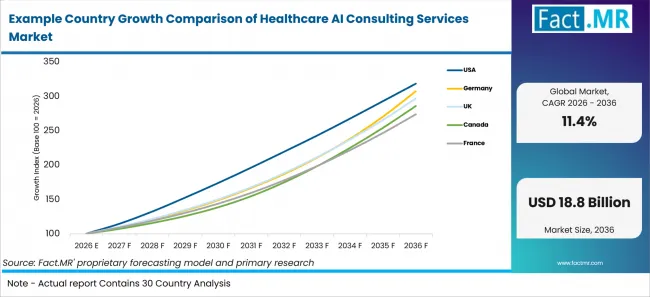
Example Country Growth Comparison Of Healthcare Ai Consulting Services Market | Source: Fact.MR
| Country | CAGR (2026-2036) |
|---|---|
| USA | 12.3% |
| Germany | 11.9% |
| UK | 11.5% |
| Canada | 11.1% |
| France | 10.6% |
| Japan | 10.2% |
| Australia | 9.8% |
Source: Fact.MR analysis. Updated Aug 10, 2026
What supports USA adoption?
12.3% CAGR, supported by large payer-provider technology budgets and advanced regulatory expectations.
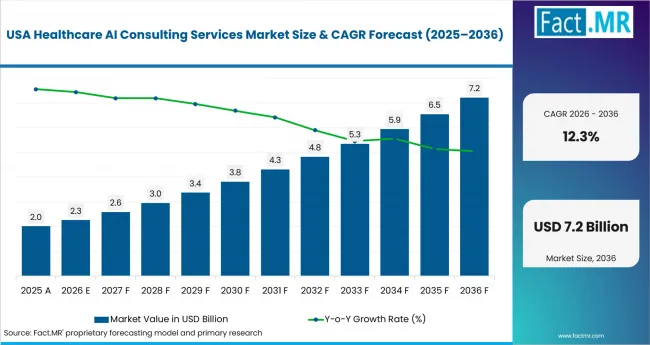
Healthcare Ai Consulting Services Market Country Value Analysis | Source: Fact.MR
In the USA, consulting work is expected to center on governance and workflow evidence. Hospitals need support for documentation automation and revenue-cycle redesign before AI programs expand across clinical teams.
ASTP/ONC reported in February 2026 that approximately 9 in 10 U.S. hospitals enabled patient access to health information through an API in 2024, while 71% used standards-based APIs for patient access.
What is driving Germany’s growth from 2026 to 2036?
11.9% CAGR, supported by a regulated healthcare system and hospital IT modernization.
German providers are expected to move carefully from AI planning into implementation. Consulting demand should remain tied to privacy review and interoperability checks. Clinical safety controls are expected to shape regulated procurement.
How is UK demand developing?
11.5% CAGR, backed by NHS workflow pressure and clinical research infrastructure.
UK demand is shaped by national health service modernization and pressure on care teams. Advisory work is expected to focus on use-case selection and change management across digital programs.
The UK Department of Health and Social Care and NHS England reported in October 2025 that a Microsoft 365 Copilot trial covered more than 30,000 NHS workers across 90 NHS organizations and saved an average of 43 minutes per staff member per day, with a full rollout estimated to save up to 400,000 staff hours per month.
What supports Canada’s expansion?
11.1% CAGR, supported by universal-care modernization and provider data programs.
Canada’s provider market is expected to require practical AI roadmaps for governance and data mapping. This creates room for consulting teams that can test workflows before wider rollout.
How does France perform?
10.6% CAGR, led by digital hospital programs and structured healthcare procurement.
In France, buyers are expected to favor controlled adoption over broad experimentation. Healthcare AI consulting should help hospitals compare vendors and set oversight rules before deployment.
How is Japan scaling demand?
10.2% CAGR, supported by aging-care needs and advanced technology adoption.
Japan is expected to use AI consulting where automation must protect clinical quality and older-patient care. Implementation support should concentrate on workflow design and staff training.
What supports Australia’s growth?
9.8% CAGR, backed by healthcare digitization and clinical-service modernization.
Australian health systems are expected to favor practical AI programs that improve access and documentation. Buyers should need roadmaps that connect analytics with everyday care operations.
Who leads the Healthcare AI Consulting Services Market?
Accenture plc, Deloitte, IBM Corporation, and Cognizant Technology Solutions Corporation have broad relevance across consulting and managed transformation services. Infosys Limited, Capgemini SE, PwC, KPMG, EY, and Tata Consultancy Services Limited extend the provider field through implementation and governance capabilities.
Recent official activity confirms direct relevance for selected providers. IBM expanded AI consulting capabilities in May 2026. Infosys announced a Sentara collaboration in June 2026. Cognizant launched TriZetto AI Gateway in August 2025. Capgemini introduced agentic AI services with NVIDIA in March 2025. Tata Consultancy Services was selected by NHS Supply Chain in November 2025.
Which companies are the key providers?
Key companies include Accenture plc, Deloitte, IBM Corporation, Cognizant Technology Solutions Corporation, Infosys Limited, Capgemini SE, PwC, KPMG, EY, and Tata Consultancy Services Limited.
- Accenture plc
- Deloitte
- IBM Corporation
- Cognizant Technology Solutions Corporation
- Infosys Limited
- Capgemini SE
- PwC
- KPMG
- EY
- Tata Consultancy Services Limited
Bibliography
- American Medical Association. (2026, March 12). AMA: AI usage among doctors doubles as confidence in technology grows.
- Capgemini. (2025, March 19). Capgemini accelerates enterprise adoption of agentic AI for industries with NVIDIA.
- Cognizant. (2025, August 6). Cognizant debuts TriZetto® AI Gateway to power the next generation of AI in healthcare.
- IBM. (2026, May 6). IBM Consulting expands AI capabilities to accelerate enterprise transformation.
- Infosys. (2026, June 24). Infosys collaborates with Sentara to unlock AI value and scale enterprise AI adoption in healthcare services.
- Tata Consultancy Services. (2025, November 18). NHS Supply Chain selects TCS to transform healthcare delivery using AI & cloud in a 5 year deal.
- Chang, W., Owusu-Mensah, P., Everson, J., & Richwine, C. (2025, September). Hospital trends in the use, evaluation, and governance of predictive AI, 2023–2024 (Data Brief No. 80). Office of the Assistant Secretary for Technology Policy.
- Strawley, C., & Barker, W. (2026, February). Hospital use of APIs to enable data sharing between EHRs and third-party technology (Data Brief No. 81). Office of the Assistant Secretary for Technology Policy.
- Department of Health and Social Care. (2025, April 27). AI doctors’ assistant to speed up appointments a ‘gamechanger’.
- Department of Health and Social Care. (2025, October 21). Major NHS AI trial delivers unprecedented time and cost savings.
- Canadian Institute for Health Information. (2026, March). Health providers who perceive digital health services as useful for patient care. Retrieved August 7, 2026.
- Accenture. (2025, October 14). Accenture acquires Decho to further scale Palantir and Gen AI capabilities across health and public service clients.
- PwC. (2025, November 25). PwC collaborates with AWS to transform healthcare revenue cycle management through AI and cloud innovation.
This Report Answers
- The report provides strategic intelligence on Healthcare AI Consulting Services across Service Offering and Application choices that shape enterprise AI programs.
- Segment analysis covers Artificial Intelligence Strategy Consulting and Clinical Workflow Optimization as the share leaders within the 2026 market.
- Country outlook evaluates the USA and Germany alongside UK and Canada. France and Japan complete the comparison with Australia.
- Competitive analysis profiles Accenture plc and Deloitte alongside IBM Corporation and Cognizant Technology Solutions Corporation.
- Capability assessment covers Generative Artificial Intelligence and natural language processing. Machine learning and predictive analytics complete the capability view with computer vision.
What does the Healthcare AI Consulting Services Market cover?
Healthcare AI consulting services are used to plan AI programs where governance and workflow fit decide whether pilots can move into operating use.
The Healthcare AI Consulting Services Market covers advisory work for hospitals and payers. Coverage extends to AI-enabled wound analysis and patient engagement where consulting defines safe workflows. It includes generative AI, machine learning, predictive analytics, computer vision, and adaptive AI when service support is required.
What is included in the scope?
The scope includes Service Offering and Application alongside End User, Engagement Model, Artificial Intelligence Capability, and Region. It covers strategy consulting and implementation advisory.
Data and integration advisory, governance support, and training complete the service view. Clinical workflow optimization and administrative automation are included. Revenue-cycle operations and patient engagement complete the use-case view with clinical decision support.
What is excluded from the scope?
General IT services and unrelated software resale remain outside the scope of this market.
The scope excludes standalone AI products when no advisory or implementation service is attached. It excludes generic cloud migration, hardware resale, routine managed services, and software licensing without healthcare AI planning. Company revenue without a clear service connection to healthcare AI consulting remains excluded.
How Was the Analysis Built?
The analysis draws on 120+ sources, 35+ company portfolios, 25+ countries, and more than 20 industry interviews.
- Primary Research: Interviews with consulting firms, providers, payers, technology developers, and procurement teams examine buying priorities and implementation barriers.
- Desk Research: Desk research covers government statistics, regulatory publications, company filings, company announcements, associations, standards, and public policy. Sources used are documented in the bibliography.
- Market Sizing and Forecasting: Estimates combine historical performance, service mix, segment shares, company participation, country growth, adoption patterns, investment activity, and barriers.
- Data Validation and Update Cycle: Findings are validated against public data, company activity, regulatory changes, procurement trends, and industry developments. Updates review service launches, partnerships, platform changes, approvals, and adoption shifts.
Segmentation
What is the report's scope and coverage?
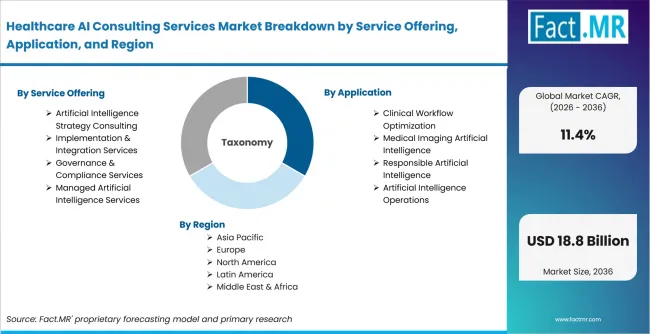
Healthcare Ai Consulting Services Market Breakdown By Service Offering, Application, And Region | Source: Fact.MR
| Attribute | Details |
|---|---|
| Quantitative Units | USD billion in 2026 to USD billion by 2036 at CAGR |
| Market Definition | Advisory and implementation services that help healthcare organizations plan, govern, deploy, and scale artificial intelligence across clinical, administrative, revenue-cycle, and data workflows |
| Service Offering | Artificial Intelligence Strategy Consulting, Implementation Advisory, Data and Integration Advisory, AI Governance Support, Training and Change Management |
| Application | Clinical Workflow Optimization, Administrative Automation, Revenue-cycle Operations, Patient Engagement, Clinical Decision Support |
| End User | Hospitals, Payers, Physician Groups, Life Sciences Companies, Health-tech Providers |
| Engagement Model | Project-based Consulting, Retained Advisory, Managed Transformation Support, Implementation Support, Training Programs |
| Artificial Intelligence Capability | Generative Artificial Intelligence, Machine Learning, Natural Language Processing, Predictive Analytics, Computer Vision |
| Regions Covered | North America, Europe, Asia Pacific, Latin America, Middle East and Africa |
| Countries Covered | USA, Germany, UK, Canada, France, Japan, Australia |
| Key Companies Profiled | Accenture plc, Deloitte, IBM Corporation, Cognizant Technology Solutions Corporation, Infosys Limited, Capgemini SE, PwC, KPMG, EY, Tata Consultancy Services Limited |
| Forecast Period | 2026 to 2036 |
| Approach | Hybrid top-down and bottom-up approach using healthcare AI consulting demand, service-offering shares, application use cases, hospital and payer adoption, engagement model patterns, AI capability mix, country CAGR comparison, company portfolio review, source verification, and Fact.MR interlink review |
Source: Fact.MR analysis. Updated Aug 10, 2026
How is the market segmented?
-
By Service Offering
- Artificial Intelligence Strategy Consulting
- Digital Transformation Strategy
- Artificial Intelligence Readiness Assessment
- Implementation & Integration Services
- Artificial Intelligence System Integration
- Healthcare Data Integration
- Governance & Compliance Services
- Regulatory Compliance Advisory
- Ethical Artificial Intelligence Assessment
- Managed Artificial Intelligence Services
- Model Monitoring Services
- Artificial Intelligence Performance Management
- Artificial Intelligence Strategy Consulting
-
By Application
- Clinical Workflow Optimization
- Clinical Decision Support Implementation
- Enterprise Artificial Intelligence Planning
- Medical Imaging Artificial Intelligence
- Radiology Workflow Automation
- Electronic Health Record Optimization
- Responsible Artificial Intelligence
- Healthcare Data Governance
- Model Risk Management
- Artificial Intelligence Operations
- Continuous Model Optimization
- Production Artificial Intelligence Support
- Clinical Workflow Optimization
-
By End User
- Hospitals
- Integrated Health Systems
- Academic Medical Centers
- Diagnostic Laboratories
- Imaging Centers
- Telehealth Providers
- Government Healthcare Agencies
- Public Health Organizations
- Health Insurance Providers
- Pharmaceutical Companies
- Biotechnology Companies
- Contract Research Organizations
- Hospitals
-
By Engagement Model
- Project-based Consulting
- Long-term Advisory Engagements
- Retainer-based Consulting
- System Integration Projects
- Hybrid Delivery Model
- Dedicated Consulting Teams
- Strategic Advisory Services
- Compliance Consulting
- Risk Advisory Services
- Managed Services
- Cloud-managed Delivery
- Remote Consulting Services
- Project-based Consulting
-
By Artificial Intelligence Capability
- Generative Artificial Intelligence
- Large Language Models
- Machine Learning Models
- Predictive Analytics
- Computer Vision
- Natural Language Processing
- Explainable Artificial Intelligence
- Artificial Intelligence Governance Frameworks
- Bias Detection & Monitoring
- Artificial Intelligence Model Operations
- Automated Model Lifecycle Management
- Agentic Artificial Intelligence Orchestration
- Generative Artificial Intelligence
-
By Region
- North America
- Latin America
- Western Europe
- Eastern Europe
- East Asia
- South Asia and Pacific
- Middle East & Africa
Frequently Asked Questions
How big is the healthcare AI consulting services market in 2026?
What is the CAGR of the healthcare AI consulting services market from 2026 to 2036?
Which service offering leads the healthcare AI consulting services market?
Which application leads the healthcare AI consulting services market?
Who are the leading companies in the healthcare AI consulting services market?
Who worked on this report


Preview the report firsthand - request a free sample
Free SampleGet the brochure for pricing and purchase details
Download PDF