- Market Value (2025): USD 1.6 Bn
- Estimated Value (2026): USD 1.8 Bn
- Forecast Value (2036): USD 5.6 Bn
- CAGR (2026-2036): 12.0%
What is the ESD Conductive Additive Ranges Market forecast to be worth by 2036?
USD 1.8 billion in 2026 to USD 5.6 billion by 2036 at a 12.0% CAGR.
- The ESD Conductive Additive Ranges Market was valued at USD 1.6 billion in 2025.
- Demand is projected to increase from USD 1.8 billion in 2026 to USD 5.6 billion by 2036.
- The market is forecast to grow at a 12.0% CAGR through 2036.
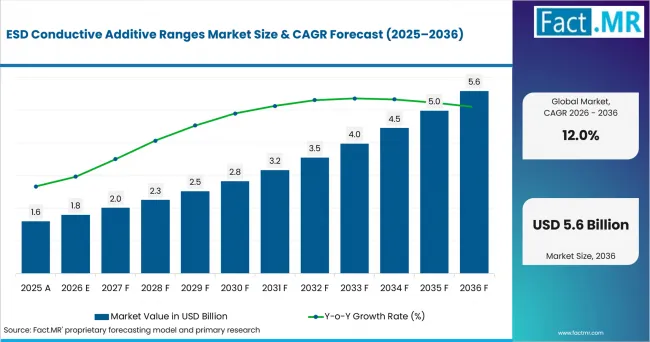
Esd Conductive Additive Ranges Market Value Analysis | Source: Fact.MR
What are the defining numbers behind ESD Conductive Additive Ranges Market growth?
USD 3.8 billion absolute opportunity by 2036, led by carbon black, 10^3-10^5 Ω/sq, epoxy, and flooring.
- Demand Drivers in the Market
- Electronics makers need reliable static control during assembly and handling. Anti-static agents help manage charge on nearby materials. This reduces the chance of a damaging discharge near sensitive parts.
- Flooring teams need conductive paths that stay stable under traffic. Those paths must also survive repeated cleaning. ESD results depend on steady behavior across the full floor. A sound ground link is part of the same system.
- Polymer teams need additives that reach the target resistance at practical loading levels. Conductive plastic compounds extend this need to trays, housings, and handling parts. The blend must still run well during normal processing.
- Coating and adhesive teams need conductive fillers that mix evenly. Common base systems include epoxy, polyurethane, acrylic, and thermoplastics. Each blend must reach its electrical target. It must also keep normal use and cure behavior.
- Key Segments Analyzed
- By Additive Family: Carbon black is expected to hold 37.0% share in 2026.
- By Surface Resistivity Target: 10^3-10^5 Ω/sq is projected to hold 36.0% share in 2026.
- By Host Matrix: Epoxy is anticipated to capture 34.0% share in 2026.
- By Use: Flooring is estimated to represent 30.0% share in 2026.
- Analyst Opinion at Fact.MR
- Shambhu Nath Jha, Principal Consultant at Fact.MR, states, “Commercial results depend on more than conductivity. Teams must reach the required resistance range. The base material must remain easy to process. The final surface must also remain dependable.”
- Strategic Implications
- Additive makers should publish resistance-versus-loading guidance for each base material. Conductive carbon black results depend on filler structure and process conditions. These factors shape the electrical path inside the finished part.
- Flooring teams should test the full installed system from primer to ground layer and topcoat. Industrial floor coatings also face wear and chemical exposure. These needs sit alongside the electrical target.
- Electronics packaging teams should match surface resistance to handling risk. Grounding practice must also fit the selected range. Trays and containers need safe charge flow. Films and reusable handling parts need the same control.
- Compounders should compare carbon black, CNT, graphene, conductive polymer, and metal-hybrid options. Each use can favor a different material. Teams should check mixing quality and strength. They should also review color and process repeatability.
Japan is forecast to record a 12.0% CAGR through 2036. Electronic-parts and electrical-machinery output supports demand. The USA is projected at 11.7% as investment expands static-sensitive production. Germany is forecast at 11.4% as electrical-equipment activity supports material use. France is estimated at 11.1% with an active electronics base. The UK is expected to post 8.7% as technology output supports static-control uses.
How does the ESD Conductive Additive Ranges Market break down by segment?
Carbon black leads Additive Family at 37.0%; 10^3-10^5 Ω/sq leads Surface Resistivity Target at 36.0%.
Which Additive Family dominates?
Carbon black holds 37.0% share in 2026.
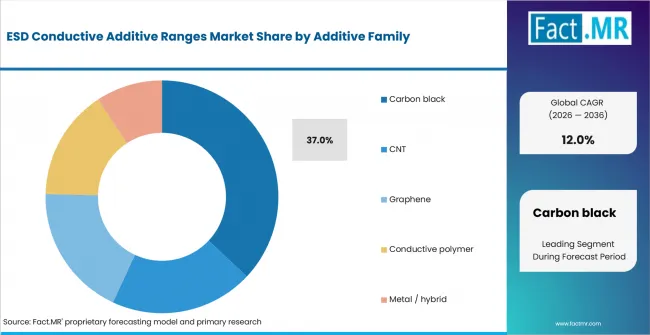
Esd Conductive Additive Ranges Market Analysis By Additive Family | Source: Fact.MR
Carbon black is expected to lead because it can form conductive paths at practical cost. CNT grades can work at lower loading when mixing stays even. Graphene offers another carbon route for conductivity. Polymer nanocomposites combine small fillers with polymer bases. Conductive polymers and metal-hybrid systems serve other resistance ranges. Cabot also markets specialty carbons for static-control use in plastics and coatings.
What leads the Surface Resistivity Target segment?
10^3-10^5 Ω/sq accounts for 36.0% share in 2026.
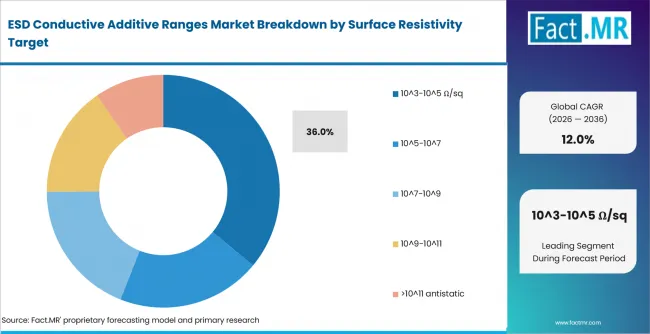
Esd Conductive Additive Ranges Market Analysis By Surface Resistivity Target | Source: Fact.MR
The 10^3-10^5 Ω/sq range is projected to hold 36.0% share. Conductive floors need fast charge movement. Ground layers can need the same result. The 10^5-10^7 range supports more controlled discharge. Higher bands suit surfaces that need less conductivity.
How does Host Matrix shape demand?
Epoxy leads with 34.0% share in 2026.
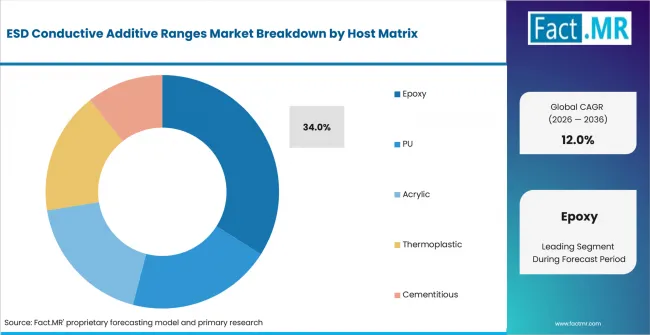
Esd Conductive Additive Ranges Market Analysis By Host Matrix | Source: Fact.MR
Epoxy is anticipated to hold 34.0% share because strong bonding and chemical resistance support conductive filler use. The wider epoxy resin category spans coatings and electrical uses. Polyurethane suits more flexible systems where wear matters. Acrylic and thermoplastic bases offer other routes for coatings and molded parts. Cement-based systems extend ESD control into floor toppings.
What supports Flooring within Use?
Flooring represents 30.0% share in 2026.
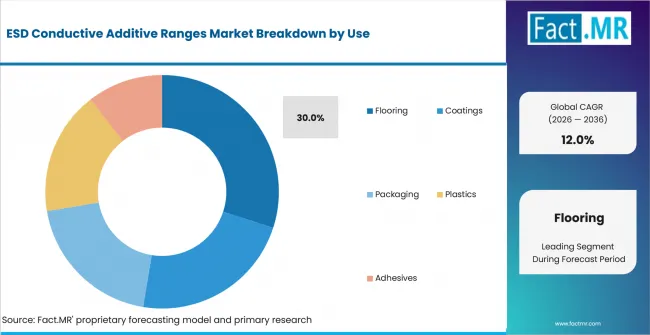
Esd Conductive Additive Ranges Market Analysis By Use | Source: Fact.MR
Flooring is estimated to represent 30.0% share in 2026. Static control must cover walking and equipment areas. Coatings can add charge-control layers to many surfaces. Packaging needs set resistance around sensitive parts. Plastics use conductive fillers in molded handling parts. Adhesives use conductive particles when bonds must also carry current.
What is accelerating ESD Conductive Additive Ranges Market adoption, and what is holding it back?
Electronics handling and static-control needs drive demand. Mixing limits can slow adoption. Filler cost can also affect use. Material trade-offs remain another design concern.
Drivers Impact Analysis
| DRIVER | (~) CAGR IMPACT | REGION | TIMING |
|---|---|---|---|
| Electronics and chip handling needs | +2.0% | Global | Short term (<= 2 years) |
| More ESD floors and coated work areas | +1.5% | North America, Europe, East Asia | Medium term (2-4 years) |
| Conductive plastics for housings and packs | +1.2% | Global | Medium term (2-4 years) |
| Low-load CNT and graphene blends | +0.9% | North America, Europe, East Asia | Long term (>= 4 years) |
| Wider testing of conductive adhesive systems | +0.7% | Global | Long term (>= 4 years) |
Source: Fact.MR analysis. Updated Sep 24, 2026
Opportunity Impact Analysis
| OPPORTUNITY | (~) CAGR IMPACT | REGION | TIMING |
|---|---|---|---|
| Additive masterbatches for set uses | +1.1% | Global | Short term (<= 2 years) |
| Low-load carbon nano systems | +0.9% | North America, Europe, East Asia | Medium term (2-4 years) |
| ESD coatings for electronics sites | +0.8% | North America, Europe | Medium term (2-4 years) |
| Conductive packs and reusable handling systems | +0.6% | Global | Long term (>= 4 years) |
Source: Fact.MR analysis. Updated Sep 24, 2026
Restraints Impact Analysis
| RESTRAINT | (~) CAGR IMPACT | REGION | TIMING |
|---|---|---|---|
| Mixing sensitivity and clumping risk | -0.9% | Global | Short term (<= 2 years) |
| Strength loss at high filler load | -0.7% | Global | Medium term (2-4 years) |
| Cost of CNT, graphene, and metal systems | -0.6% | North America, Europe, East Asia | Medium term (2-4 years) |
| Testing and resistance drift in use | -0.4% | Global | Long term (>= 4 years) |
Source: Fact.MR analysis. Updated Sep 24, 2026
Which countries are scaling ESD Conductive Additive Ranges Market through 2036?
- The displayed country range spans 3.3 percentage points. It runs from Japan to the UK. The comparison covers 2026 through 2036.
- Japan remains 0.3 percentage point above the USA. Electronic-parts output supports this position. Electrical-machinery production adds another source of demand.
- The USA remains 0.3 percentage point above Germany. Electronics investment supports new static-controlled sites. Chip production also creates handling needs.
- Germany stays 0.3 percentage point above France. Electrical-equipment orders support material demand. Key uses include floors, coatings, and handling systems.
- France remains 2.4 percentage points above the UK. Electronics output supports a broad industrial base. Electrical-equipment production adds demand for conductive materials.
Similar CAGRs can still lead to different market conditions. Electronics output varies by country. Site spending and material testing also differ. Full report coverage spans seven major world regions.
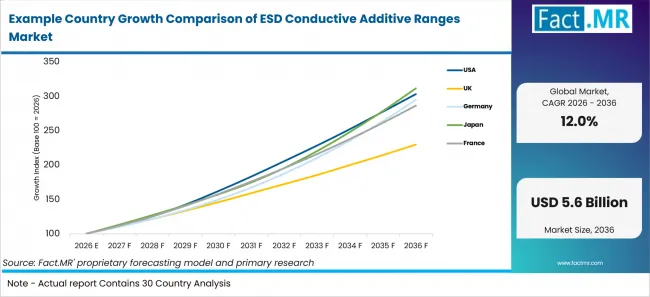
Example Country Growth Comparison Of Esd Conductive Additive Ranges Market | Source: Fact.MR
| Country | CAGR (2026-2036) |
|---|---|
| Japan | 12.0% |
| United States | 11.7% |
| Germany | 11.4% |
| France | 11.1% |
| United Kingdom | 8.7% |
Source: Fact.MR analysis. Updated Sep 24, 2026
What supports USA adoption?
11.7% CAGR, supported by electronics investment and expanding static-sensitive production.
U.S. electronics production creates demand for static-control materials across floors, conductive plastics, packaging, and bonded parts. In June 2026, the U.S. Bureau of Economic Analysis reported USD 2.0 billion in 2025 greenfield spending for computer and electronic products production. New production space can widen the installed base for controlled-resistance materials used on floors and handling equipment.
How is the United Kingdom scaling demand?
8.7% CAGR, led by electronics output and industrial static-control needs.
The United Kingdom has electronics output and a broad industrial base that uses static-control floors, coatings, and handling materials. In February 2026, the Office for National Statistics reported a 3.3% rise in computer, electronic and optical product output during the fourth quarter of 2025. Continued activity can support controlled-resistance materials used across production and test areas.
What supports Germany’s adoption?
11.4% CAGR, backed by electrical-equipment output and electronics production.
Germany combines electrical-equipment production with automotive electronics and plant-control systems that require stable ESD performance. In May 2025, Destatis reported a 14.5% month-on-month rise in new electrical-equipment orders for March 2025. This manufacturing base can support conductive materials used in floors, coatings, molded parts, and handling products.
How does Japan perform?
12.0% CAGR, driven by electronic parts, electrical machinery, and precision production.
Japan has a large electronics base where process consistency and material control are important. In July 2025, the Ministry of Economy, Trade and Industry forecast a 1.8% rise in industrial production for July and ranked electronic parts and devices as the first contributing industry. This production mix supports conductive materials used in handling, flooring, packaging, and equipment surfaces.
What is supporting France’s adoption?
11.1% CAGR, shaped by electronics production and electrical-equipment output.
France combines electronics, electrical equipment, aerospace, and other advanced manufacturing activities that can use controlled-resistance materials. In March 2026, INSEE reported that output in the manufacture of electrical equipment was 4.4% higher over November 2025–January 2026 than during the same three-month period a year earlier. This manufacturing base can support conductive coatings, floor systems, packaging, and polymer parts designed to control static charge.
Who leads the ESD Conductive Additive Ranges Market?
Avient Corporation, Birla Carbon, OCSiAl, NanoXplore Inc., Orion S.A., and Cabot Corporation form the profiled competitive set. Their relevance sits within conductive additives and blends used for static-control applications across coatings, plastics, flooring, packaging, and adhesive systems.
The competitive landscape spans carbon black, carbon nanotubes, graphene, conductive polymers, and metal or hybrid technologies. These material routes give formulators different ways to reach conductive, static-dissipative, or antistatic behavior while maintaining compatibility with epoxy, polyurethane, acrylic, thermoplastic, and cementitious matrices.
Cabot Corporation has a direct position through specialty carbon products used for static control in plastics and coatings. More broadly, the market also evaluates carbon black, CNT, graphene, conductive polymer, and hybrid approaches according to loading behavior, dispersion quality, resistance control, and compatibility with the host material.
Which companies are the key providers?
Avient Corporation, Birla Carbon, OCSiAl, NanoXplore Inc., Orion S.A., and Cabot Corporation are profiled in the market.
- Avient Corporation
- Birla Carbon
- OCSiAl
- NanoXplore Inc.
- Orion S.A.
- Cabot Corporation
Bibliography
- U.S. Bureau of Economic Analysis. (2026, June 10). New foreign direct investment in the United States, 2025.
- Office for National Statistics. (2026, February 12). Index of Production, UK: December 2025.
- Federal Statistical Office (Destatis). (2025, May 7). New orders in manufacturing in March 2025: +3.6% on the previous month.
- Ministry of Economy, Trade and Industry. (2025, July 31). Indices of industrial production: Preliminary report for June 2025.
- Institut national de la statistique et des études économiques. (2026, March 5). In January 2026, manufacturing output rebounded (+0.6%).
- Cabot Corporation. (2025, July 29). Cabot Corporation launches new LITX® 95F conductive carbon engineered for energy storage systems.
This Report Answers
- The report explains how conductive additives help materials reach set resistance ranges. It covers coatings and floors. It also covers plastics, packaging, and adhesive systems.
- Segment analysis identifies the 2026 share leaders. It explains why carbon black leads Additive Family. It also covers low resistance, epoxy, and flooring leadership.
- Country analysis compares the USA, UK, Germany, Japan, and France. It uses the stated CAGRs. Current electronics and electrical-equipment activity supports the country discussion.
- Competitive analysis reviews six companies in the market. It covers conductive additives and ESD coatings. Conductive adhesives and related material systems are also included.
What does the ESD Conductive Additive Ranges Market cover?
The market covers additives and conductive blends used for static control. These materials create a set electrical resistance. The scope includes carbon black, CNT, graphene, conductive polymers, and metal or hybrid packages. Base materials include epoxy, polyurethane, acrylic, thermoplastics, and cement-based systems. Related markets provide extra context for the same material needs.
Uses include floors, coatings, packaging, plastics, and adhesives. These systems can control static charge. Some also provide a direct conductive path. Surface resistance bands keep conductive, dissipative, and antistatic systems separate.
What is included in the scope?
The scope includes grades sold for conductive or static-dissipative use. It also covers downstream blends with a clear conductivity need. Carbon fillers and conductive polymers are included. Metal-hybrid packages are included when they create a set resistance range. Floor and coating systems enter the scope when conductive layers provide ESD control.
What is excluded from the scope?
Coverage focuses on fillers and blends used for electrical flow or static control. Standalone ground hardware sits outside the material scope. Wrist straps, footwear, ionizers, and test meters are also excluded. Chip devices are outside the scope as well. Battery additives are included only when the same chemistry fits wider conductive-material uses.
How Was the Analysis Built?
The analysis draws on 120+ sources, 35+ company portfolios, 25+ countries, and more than 20 industry interviews.
- Primary Research: Primary research includes discussions with manufacturers, service providers, technology developers, distributors, end users, and subject-matter experts. These conversations examine purchasing priorities, product adoption, operational challenges, approval requirements, competitive positioning, and the factors that influence wider market acceptance.
- Desk Research: Desk research covers government statistics, regulatory publications, company filings, trade data, technical studies, industry associations, standards, public policy, and other authoritative sources. Every source used in the analysis is documented in the bibliography.
- Market Sizing and Forecasting: Market estimates combine historical performance, demand indicators, pricing and volume trends, segment shares, company participation, country-level growth, adoption patterns, investment activity, and barriers to market expansion.
- Data Validation and Update Cycle: Findings are validated by comparing primary interviews with public data, company activity, regulatory changes, trade patterns, and industry developments. Regular updates review new product launches, capacity changes, partnerships, approvals, and shifts in commercial adoption.
Segmentation
What is the report’s scope and coverage?
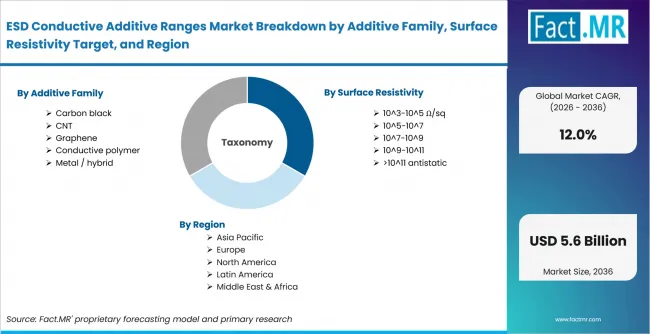
Esd Conductive Additive Ranges Market Breakdown By Additive Family, Surface Resistivity Target, And Region | Source: Fact.MR
| Attribute | Details |
|---|---|
| Units | USD billion |
| Market Scope | Conductive additives and blends used to control surface or volume resistance. Uses include coatings, plastics, floors, packs, and adhesives. |
| Additive Type | Carbon black; CNT; Graphene; Conductive polymer; Metal / hybrid |
| Resistance Target | 10^3-10^5 Ω/sq; 10^5-10^7; 10^7-10^9; 10^9-10^11; >10^11 antistatic |
| Base Material | Epoxy; PU; Acrylic; Thermoplastic; Cementitious |
| Use | Flooring; Coatings; Packaging; Plastics; Adhesives |
| Regions | North America; Latin America; Western Europe; Eastern Europe; East Asia; South Asia & Pacific; Middle East & Africa |
| Countries | United States; United Kingdom; Germany; Japan; France |
| Key Companies | Avient Corporation; Birla Carbon; OCSiAl; NanoXplore Inc.; Orion S.A.; Cabot Corporation |
| Forecast | 2026 to 2036 |
| Approach | Top-down and bottom-up review using electronics output, ESD use, material loading, base-material use, country demand, and provider checks. |
Source: Fact.MR analysis. Updated Sep 24, 2026
How is the market segmented?
-
By Additive Family:
- Carbon black
- CNT
- Graphene
- Conductive polymer
- Metal / hybrid
-
By Surface Resistivity Target:
- 10^3-10^5 Ω/sq
- 10^5-10^7
- 10^7-10^9
- 10^9-10^11
- >10^11 antistatic
-
By Host Matrix:
- Epoxy
- PU
- Acrylic
- Thermoplastic
- Cementitious
-
By Use:
- Flooring
- Coatings
- Packaging
- Plastics
- Adhesives
-
By Region:
- North America
- Latin America
- Western Europe
- Eastern Europe
- East Asia
- South Asia & Pacific
- Middle East & Africa
Frequently Asked Questions
How big is the ESD Conductive Additive Ranges Market in 2026?
What is the CAGR of the ESD Conductive Additive Ranges Market from 2026 to 2036?
Which additive family leads the ESD Conductive Additive Ranges Market?
Which surface resistivity target leads the ESD Conductive Additive Ranges Market?
Which companies are profiled in the ESD Conductive Additive Ranges Market?
Who worked on this report


Preview the report firsthand - request a free sample
Free SampleGet the brochure for pricing and purchase details
Download PDF