- Base Value(2025): 151.2 Mn
- Estimated Value(2026): 157.7 Mn
- Forecast Value (2036): 252.0 Mn
- CAGR (2026 - 2036): 4.8%
Europe Bio-Waste Shredder Market Size, Market Forecast and Outlook by Fact.MR
- The Europe bio-waste shredder market crossed a valuation of USD 151.2 million in 2025.
- Demand is estimated to reach USD 157.7 million in 2026. The market is anticipated to record 4.8% CAGR from 2026 to 2036.
- Separate organic waste collection, composting upgrades, and biogas feedstock preparation are forecast to lift the market to USD 252.0 million by 2036.
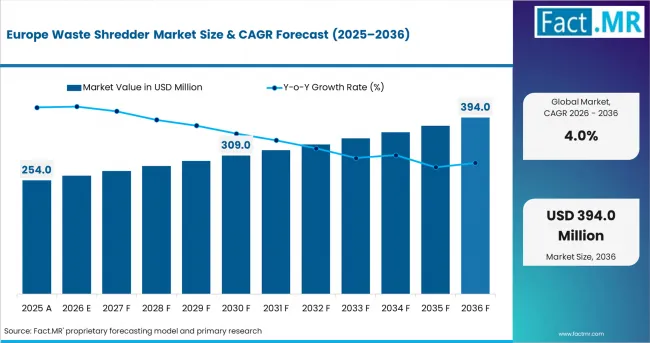
Europe Waste Shredder Market Value Analysis | Source: Fact.MR
| Metric | Details |
|---|---|
| Industry Size (2026) | USD 157.7 million |
| Industry Value (2036) | USD 252.0 million |
| CAGR (2026 to 2036) | 4.8% |
Summary of Europe Bio-Waste Shredder Market
- Demand Drivers in the Market
- Source Separation: Municipal waste agencies need shredders that can prepare separated food and garden waste for composting or digestion. France made source sorting of bio-waste a public service requirement from January 2024. [3]
- Composting Quality: Composting operators need smaller and uniform organic input. Germany’s environment ministry states that separately collected organic waste can be composted into fertilizer and soil improver.
- Biogas Feedstock: Biogas plant operators need organic material that can move through fermentation systems. ANDRITZ states that its ADuro QZ prepares pre-packaged food and organic waste for fermentation in biogas plants. [8]
- Key Segments Analyzed
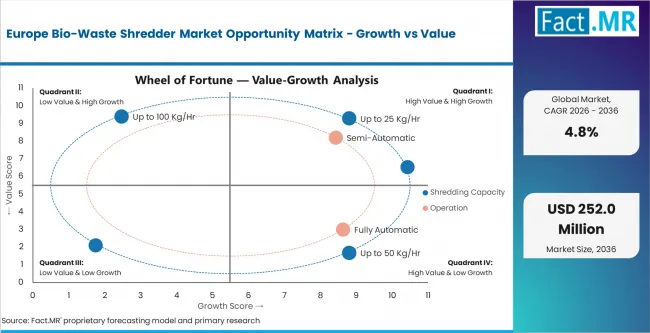
- By Shredding Capacity: Up to 25 Kg/Hr shredders are projected to account for 47.0% share in 2026 because small sites need affordable machines for food and garden waste preparation.
- By Operation: Semi-Automatic systems are forecast to represent 64.0% share in 2026 as municipal and commercial sites prefer lower purchase cost and easier maintenance.
- By End Use: Municipal Composting leads with 38.0% share in 2026 because local authorities need equipment that supports source-separated bio-waste recovery.
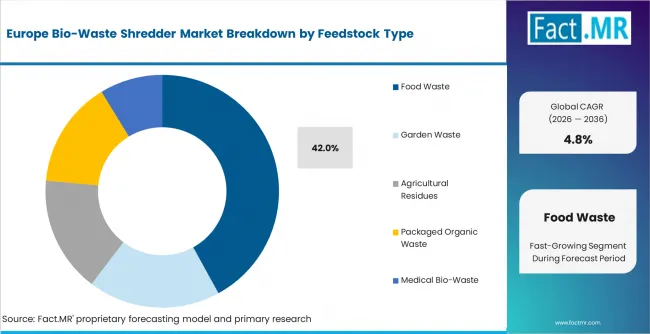
- By Feedstock Type: Food Waste leads because workplace and household separation rules are increasing clean organic streams, with the subsegment projected to hold 42.0% share in 2026.
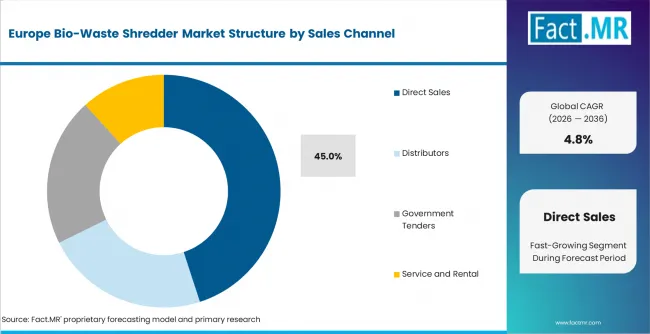
- By Sales Channel: Direct Sales are forecast to represent 45.0% share in 2026 because waste treatment sites need machine specification support and installation guidance.
- By Geography: France is projected to grow at 5.0% CAGR from 2026 to 2036 as source sorting duties increase equipment need.
- Analyst Opinion at Fact.MR
- Shambhu Nath Jha, Senior Analyst at Fact.MR, notes, “Europe bio-waste shredder demand should be read through the quality of separated organic waste. Waste operators need machines that can handle wet material, contaminants, and uneven feedstock. Suppliers that reduce downtime and prepare cleaner substrate will protect repeat orders.”
- Strategic Implications
- Contamination Control: Shredder suppliers must design machines for mixed organic input and foreign materials because composting sites often receive plastics and grit with food waste. Improved screening support and durable cutting systems help operators reduce stoppages during daily processing.
- Site-Level Capacity: Municipal agencies should match shredder capacity to collection routes and local composting plans. Oversized equipment can raise idle cost if bio-waste volume is uneven across districts. Right-sized machines support steadier loading and improved energy use.
- Service Support: Equipment producers need wider maintenance coverage in Europe because wet bio-waste can increase blade wear and downtime risk. Quick service response helps composting plants protect daily throughput during high-volume collection periods.
Bio waste shredders are becoming a processing tool for cleaner organic streams. The European Commission states that the EU generates around 2.5 billion tonnes of waste per year and that the Waste Framework Directive sets the waste hierarchy with recovery and recycling principles. [1] This supports equipment demand for food waste and garden waste preparation.
Separate collection rules create stronger demand for small and mid-capacity shredders. England’s workplace recycling rules changed on 31 March 2025 and require businesses, charities, and public sector sites to separate food waste. [2] The rules raise the need for equipment that can process wet organic material near the point of generation.
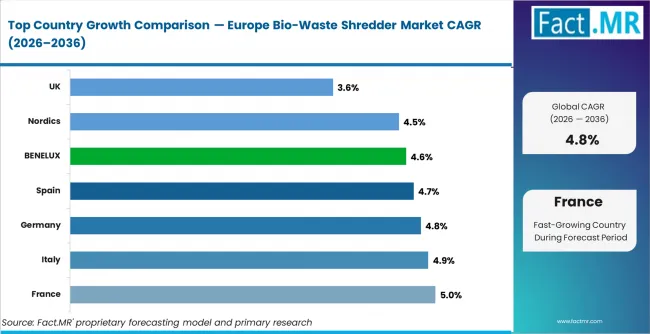
France is projected to grow at 5.0% CAGR from 2026 to 2036 as source sorting expands. Italy records 4.9% CAGR as composting and food waste recovery improve. Germany follows at 4.8% CAGR because mature separate collection and composting systems create replacement demand. Spain is expected to post 4.7% CAGR through city-level organic waste recovery. BENELUX tracks 4.6% CAGR through dense municipal collection networks. Nordics record 4.5% CAGR because recovery systems are already advanced. United Kingdom demand is likely to rise at 3.6% CAGR by 2036 as workplace food waste rules support steady adoption.
Segmental Analysis
Europe Bio-Waste Shredder Market Analysis by Shredding Capacity
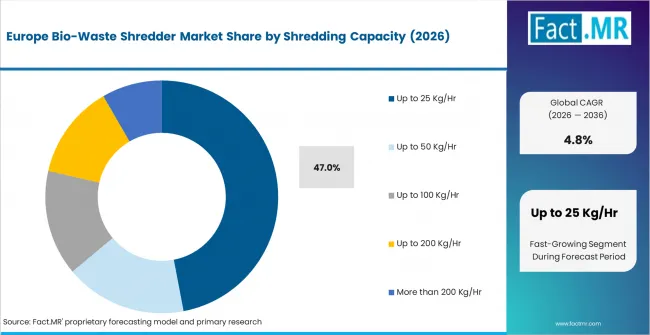
Europe Bio Waste Shredder Market Analysis By Shredding Capacity | Source: Fact.MR
Up to 25 Kg/Hr shredders are projected to account for 47.0% share in 2026 because small sites need compact machines that can process food waste and garden residues with manageable equipment cost. These machines suit commercial kitchens and community-level waste programs. The subsegment leads because local organic waste preparation needs affordable throughput.
- Small-Site Use: Up to 25 Kg/Hr shredders suit local composting and kitchen waste handling. Facility managers can control waste before collection.
- Cost Control: Compact shredders reduce upfront spending. Smaller municipal sites can start bio-waste processing without high-capacity equipment.
- Wet Waste Fit: Low-capacity machines can handle daily food scraps. Operators need simple equipment for frequent organic waste streams.
Europe Bio-Waste Shredder Market Analysis by Operation
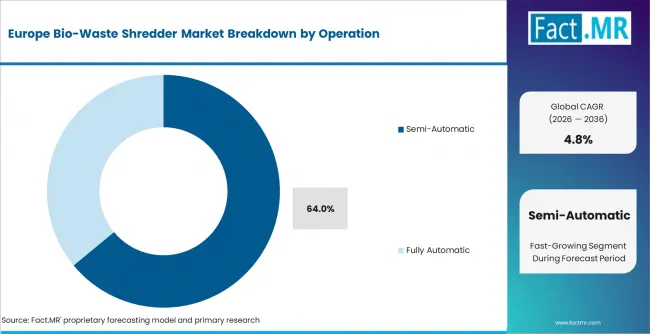
Europe Bio Waste Shredder Market Analysis By Operation | Source: Fact.MR
Semi-Automatic systems lead because waste operators often prioritize purchase cost and repair simplicity over full automation. The segment is forecast to represent 64.0% share in 2026 as municipal composting sites and commercial facilities need reliable machines with manageable maintenance. Fact.MR identifies semi-automatic bio-waste shredders as the leading operation type in its public base. The format suits early compliance needs because staff can operate and maintain the system with limited automation dependence.
- Cost Position: Semi-Automatic systems suit smaller operators. Lower purchase cost helps sites begin bio-waste processing.
- Maintenance Access: Simpler controls reduce service pressure. Waste sites need machines that staff can maintain quickly.
- Custom Handling: Semi-Automatic machines can be adjusted for different organic streams. This supports food waste and garden residue processing.
Europe Bio-Waste Shredder Market Analysis by End Use
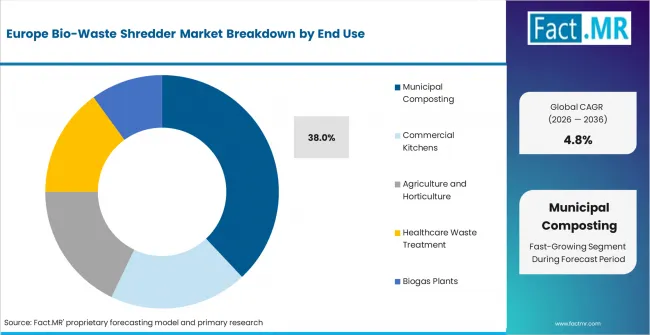
Europe Bio Waste Shredder Market Analysis By End Use | Source: Fact.MR
Municipal Composting leads because local authorities are responsible for converting separated bio-waste into useful compost or digestion feedstock. The end use is projected to hold 38.0% share in 2026 because source-separated collection expands treatment needs at public composting sites.
- Compost Feed: Municipal composting sites need uniform organic input. Shredding improves handling before active treatment.
- Public Recovery: Local authorities need equipment that supports source-separated collection. Better preparation improves compost quality.
- Treatment Readiness: Composting sites need reliable pre-processing. Smaller particle size helps operators manage wet organic streams.
Europe Bio-Waste Shredder Market Analysis by Feedstock Type
Europe Bio Waste Shredder Market Analysis By Feedstock Type | Source: Fact.MR
Food Waste leads because workplace and household separation rules are creating cleaner organic streams. The subsegment is projected to hold 42.0% share in 2026 as kitchens and public facilities separate food waste before collection. Food Waste leads because it is generated daily and needs fast odor-controlled handling before composting or digestion.
- Kitchen Residue: Food Waste needs quick volume reduction. Commercial kitchens need safer storage before collection.
- Daily Stream: Food scraps are generated every day. Shredders help operators manage odor and storage pressure.
- Recovery Quality: Cleaner food waste improves composting and digestion feedstock. Separation rules make this stream more practical to process.
Europe Bio-Waste Shredder Market Analysis by Sales Channel
Europe Bio Waste Shredder Market Analysis By Sales Channel | Source: Fact.MR
Direct Sales lead because bio-waste shredders require site assessment and service planning before installation. Waste treatment facilities need suppliers that can match feedstock type with cutting system and discharge design. Direct Sales are projected to hold 45.0% share in 2026 because municipal composting and biogas sites need technical guidance before equipment selection. Direct relationships help operators reduce commissioning risk and improve maintenance planning.
- Specification Support: Direct Sales help waste sites match equipment with feedstock. Technical checks reduce commissioning risk.
- Service Planning: Direct supplier contact improves blade and shaft maintenance support. Wet organic streams increase wear risk.
- Site Fit: Machine sizing depends on daily input and treatment route. Direct engagement reduces selection errors.
Europe Bio-Waste Shredder Market Drivers, Restraints, and Opportunities
Europe Bio Waste Shredder Market Opportunity Matrix Growth Vs Value | Source: Fact.MR
Source separation policy is the main driver for bio waste shredders in Europe. Waste hierarchy rules and recovery targets require municipalities and commercial sites to separate organic waste with better discipline. Wider bio waste sorting requirements increase demand for machines that prepare food and green waste for composting or anaerobic digestion.
High equipment and maintenance cost is the main restraint. Wet bio waste can include bones and other contaminants. Cutting systems and seals need improved protection under mixed organic loads. Local municipalities and foodservice sites may delay investment if collection contracts do not require on site processing.
Opportunities in the Europe Bio-Waste Shredder Market
- Decentralized Composting: Local authorities can use compact shredders to support neighborhood composting and site-level bio-waste preparation. Compact machines help councils process food scraps closer to collection points and reduce transport pressure. These systems suit community composting sites that need controlled particle size before aerobic treatment or transfer to larger facilities.
- Biogas Feedstock: Biogas operators can use shredding to improve substrate consistency before anaerobic digestion. ANDRITZ states that ADuro QZ creates a homogeneous substrate for biogas facilities. [8] Uniform feedstock helps operators manage digestion stability and reduce process disruption when mixed organic waste enters the plant.
- Packaged Food Waste: Food manufacturers and retailers can use specialized shredders for expired products that still contain packaging. Separation of food from packaging can improve recovery quality and reduce contamination in downstream composting or biogas routes. Equipment that handles sealed packs can help operators recover organic material from rejected stock.
Regional Analysis
Based on country analysis, the Europe bio-waste shredder market is segmented into Germany, France, United Kingdom, BENELUX, Nordics, Italy, Spain, and Rest of Europe.
.webp "Top Country Growth Comparison Europe Bio Waste Shredder Market Cagr (2026 2036)")
Top Country Growth Comparison Europe Bio Waste Shredder Market Cagr (2026 2036) | Source: Fact.MR
| Country, Region | CAGR (2026 to 2036) |
|---|---|
| France | 5.0% |
| Italy | 4.9% |
| Germany | 4.8% |
| Spain | 4.7% |
| BENELUX | 4.6% |
| Nordics | 4.5% |
| United Kingdom | 3.6% |
Source: Fact.MR adjusted forecast model based on revised 2026 to 2036 assumptions.
Europe Bio Waste Shredder Market Cagr Analysis By Country | Source: Fact.MR
Europe Bio-Waste Shredder Market Analysis
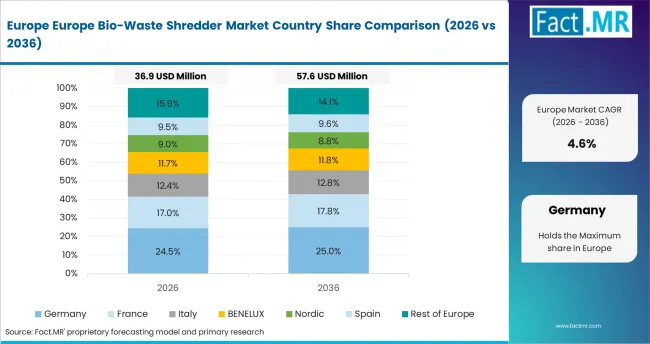
Europe Bio Waste Shredder Market Europe Country Market Share Analysis, 2026 & 2036 | Source: Fact.MR
Europe is a policy led bio waste shredder market as municipalities expand source separated organic waste treatment. Composting sites and biogas operators need machines that reduce volume before recovery. Commercial food sites use shredders to prepare wet organic waste for collection and processing.
- Germany: Germany is projected to grow at 4.8% CAGR from 2026 to 2036 as an established separate collection and composting systems create replacement demand. Separately collected organic waste can be fermented in biogas plants or composted into fertilizer and soil improver. Shredders are important for feedstock preparation. Demand comes from composting sites and biogas operators that need separated organic input with consistent particle size.
- France: France has the strongest country growth profile in this report. Local and regional authorities must provide source-based segregation of bio-waste as part of the public waste management service. The country is projected to reach 5.0% CAGR by 2036 because source sorting raises equipment need across municipal and commercial sites. Shredder demand will come from local composting sites and service contractors that need to prepare separated organic waste for recovery.
- United Kingdom: United Kingdom demand is predicted to rise at 3.6% CAGR over the study period as workplace food waste separation expands equipment need. GOV. Growth is slower than mainland Europe because collection contracts and local authority investment cycles can delay equipment purchases. Commercial kitchens and campuses need food waste reduction. Supermarkets and public sites add demand for compact shredders with service support.
- BENELUX: BENELUX has dense municipal and industrial networks that support centralized treatment assets. The region is expected to grow at 4.6% CAGR during the assessment period as replacement demand improves across composting and biogas sites. Belgium, the Netherlands, and Luxembourg have compact service areas that can support efficient collection and treatment. Food processors and urban waste contractors need shredders that can handle wet material and contamination. Growth will be steady because waste systems are already structured. Suppliers can improve position through fast service and machines that reduce stoppage risk.
- Nordics: Nordics demand is supported by advanced recovery systems and strong environmental policy culture. Sweden, Denmark, Norway, and Finland often prioritize composting, biogas, and low-waste municipal systems. Demand is projected to register 4.5% CAGR from 2026 to 2036 because growth comes mainly from replacement and feedstock-quality upgrades. Bio waste shredders are used to prepare wet food waste and garden residues for digestion or composting. Agricultural streams add selective demand. Suppliers need durable machines that can manage seasonal garden waste peaks and remote service needs.
- Italy: Italy is projected to record 4.9% CAGR from 2026 to 2036 as city-level organic waste collection and composting programs expand. Food waste separation is common in several municipalities and composting operators need uniform input to improve treatment quality. Agricultural residues support shredder use in rural regions and biogas-linked applications. Southern regions offer longer-term opportunity as collection systems improve. Equipment demand will favor mid-capacity machines that can handle food waste and green waste together. Italy’s growth is supported by composting demand and the need to improve feedstock quality.
- Spain: Spain has rising organic waste recovery needs across large urban and tourism-heavy regions. The country is expected to post 4.7% CAGR through 2036 as municipalities expand food waste and garden waste recovery. Restaurants and municipal collection points generate wet organic streams that need size reduction. Composting and digestion sites need shredders that can process kitchen waste and green residues with low odor risk. Regional differences in collection maturity will shape purchase timing. Equipment demand will be strongest where local authorities connect collection with treatment capacity.
Competitive Aligners for Market Players
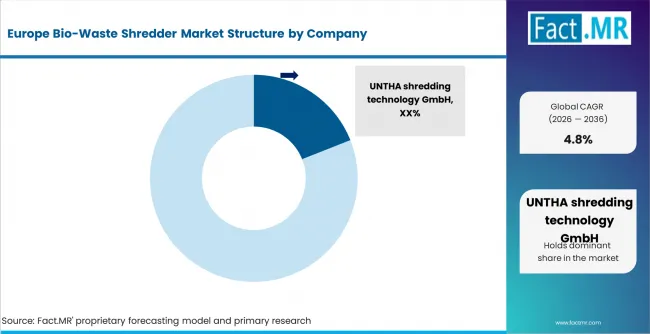
Europe Bio Waste Shredder Market Analysis By Company | Source: Fact.MR
The Europe bio-waste shredder market includes specialized shredder manufacturers, waste treatment equipment suppliers, composting machine producers, and medical waste system providers. This supports its position in organic waste preparation across municipal and commercial uses.
Competitive strength comes from application-specific design. Doppstadt’s AK-Series brochure states that its mobile fine shredders serve compost processors, disposal companies, and biogas plant operators. [4] Suppliers with machines that manage contamination and wet organic material will be better placed.
Service support will shape replacement demand through 2036. Bio-waste shredders work with acidic, wet, and irregular input streams. Operators need fast blade service, sealing protection, and downtime control. Manufacturers that combine robust cutting systems with local maintenance coverage can protect municipal and composting accounts.
Key Players in Europe Bio-Waste Shredder Market
- UNTHA shredding technology GmbH
- Filamaker
- Shredding Systems, Inc.
- Gient Heating Industry Co., Ltd.
- ANDRITZ
- Doppstadt Group
- VERTISA CORPORATION
- Sulzer Ltd.
- DONASONIC
- Menart
Bibliography
- [1]. European Commission. (2026). Waste Framework Directive. Directorate-General for Environment.
- [2]. Department for Environment, Food & Rural Affairs. (2025, October 3). Simpler recycling: Workplace recycling in England.
- [3]. Federal Ministry for the Environment, Nature Conservation, Nuclear Safety and Consumer Protection. (2025). Organic waste. BMUV.
- [4]. Doppstadt Group. (2026). AK-Series Grinder Line brochure. Doppstadt.
- [5] Favoino, E., & Giavini, M. (2024). Bio-waste generation in the EU: Current capture levels and future potential (2nd ed.). Bio-based Industries Consortium & Zero Waste Europe.
This Report Addresses
- Strategic intelligence on Europe bio-waste shredder demand across municipal composting and biogas feedstock preparation.
- Adjusted 2026 to 2036 forecast based on the Fact.MR public baseline.
- Segment analysis by shredding capacity, operation, end use, feedstock type, and sales channel.
- Country outlook across Germany, France, United Kingdom, BENELUX, Nordics, Italy, and Spain.
- Competitive analysis of UNTHA, ANDRITZ, Doppstadt Group, Gient, DONASONIC, and Menart.
- Product assessment covering compact units, semi-automatic systems, and treatment-site shredders.
- Source-backed review of bio-waste separation rules and organic waste treatment needs.
- Primary interviews, supplier checks, municipal waste review, and composting operator validation support the forecast.
Europe Bio-Waste Shredder Market Definition
The Europe bio-waste shredder market covers machines used to reduce and homogenize food wast, and selected medical bio-waste before composting. The market differs from general waste shredders because machine design must manage wet organic matter and downstream recovery needs.
Europe Bio-Waste Shredder Market Inclusions
The scope includes semi-automatic and fully automatic bio-waste shredders used by municipal sites and food manufacturers. It includes small-capacity machines for site-level waste handling and larger shredders for centralized treatment plants.
Europe Bio-Waste Shredder Market Exclusions
The scope excludes plastic shredders, and construction waste crushers. Compost bins and sterilizers are excluded unless shredding is supplied as an integrated machine function. Waste collection vehicles and sorting bins are outside scope because they collect bio-waste rather than process it.
Europe Bio-Waste Shredder Market Research Methodology
- Primary Research
- Primary research includes interviews with municipal waste managers and composting plant operators. Biogas plant engineers and commercial kitchen facility heads are covered separately. Supplier feedback supports capacity and operation-type checks.
- Desk Research
- Desk research reviews bio-waste collection rules, equipment manufacturer brochures and waste treatment guidance. Application data is compared with composting and foodservice waste handling.
- Market-Sizing and Forecasting
- Forecasting uses shredding capacity demand and sales channel checks. Up to 25 Kg/Hr and semi-automatic demand are linked to smaller sites and cost-controlled waste handling.
- Data Validation and Update Cycle
- Forecasts are validated through supplier checks and waste facility interviews. Country assumptions are reviewed with separate collection rules and biogas feedstock preparation trends.
Scope of the Report
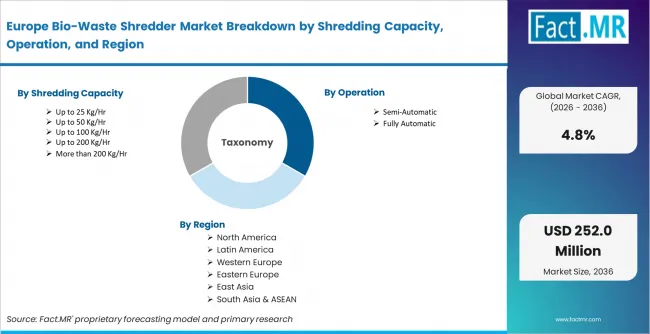
Europe Bio Waste Shredder Market Breakdown By Shredding Capacity, Operation, And Region | Source: Fact.MR
| Attribute | Details |
| Quantitative Units | USD 157.7 million in 2026 to USD 252.0 million by 2036 at 4.8% CAGR |
| Market Definition | Shredders used to reduce and homogenize biological waste before composting, fermentation, sterilization, or disposal. |
| Shredding Capacity | Up to 25 Kg/Hr, Up to 50 Kg/Hr, Up to 100 Kg/Hr, Up to 200 Kg/Hr, More than 200 Kg/Hr |
| Operation | Fully Automatic, Semi-Automatic |
| End Use | Municipal Composting, Commercial Kitchens, Agriculture and Horticulture, Healthcare Waste Treatment, Biogas Plants |
| Feedstock Type | Food Waste, Garden Waste, Agricultural Residues, Packaged Organic Waste, Medical Bio-Waste |
| Sales Channel | Direct Sales, Distributors, Government Tenders, Service and Rental |
| Countries Covered | Germany, France, United Kingdom, BENELUX, Nordics, Italy, Spain, Rest of Europe |
| Key Companies Profiled | UNTHA shredding technology GmbH, Filamaker, Shredding Systems, Inc., Gient Heating Industry Co., Ltd., ANDRITZ, Doppstadt Group |
| Forecast Period | 2026 to 2036 |
| Approach | Adjusted top-down and bottom-up model using capacity demand, operation type, end-use checks, feedstock type, sales route, and country validation. |
Europe Bio-Waste Shredder Market Analysis by Segments
-
By Shredding Capacity:
- Up to 25 Kg/Hr
- Up to 50 Kg/Hr
- Up to 100 Kg/Hr
- Up to 200 Kg/Hr
- More than 200 Kg/Hr
-
By Operation:
- Fully Automatic
- Semi-Automatic
-
By End Use:
- Municipal Composting
- Commercial Kitchens
- Agriculture and Horticulture
- Healthcare Waste Treatment
- Biogas Plants
-
By Feedstock Type:
- Food Waste
- Garden Waste
- Agricultural Residues
- Packaged Organic Waste
- Medical Bio-Waste
-
By Sales Channel:
- Direct Sales
- Distributors
- Government Tenders
- Service and Rental
-
By Country:
- Germany
- France
- United Kingdom
- BENELUX
- Nordics
- Italy
- Spain
- Rest of Europe
- Germany