- Base Value(2025): 259.9 Mn
- Estimated Value(2026): 273.9 Mn
- Forecast Value (2036): 463.5 Mn
- CAGR (2026 - 2036): 5.4%
Europium Market Forecast 2026 to 2036
In 2025, the europium market was valued at USD 259.9 million. Based on Fact MR’s analysis, demand for europium is estimated to grow to USD 273.9 million in 2026 and USD 463.5 million by 2036. FMR projects a CAGR of 5.4% during the forecast period.
The absolute dollar growth from 2026 to 2036 is USD 189.6 million. This growth is driven by increasing applications of europium in phosphors for lighting, display technologies, and other electronics. The rising demand for high-performance display devices, including TVs, smartphones, and LED lighting, is supporting market expansion. However, supply constraints, high raw material costs, and geopolitical factors may limit growth in certain regions.
China leads with a CAGR of 6.4%, driven by its dominance in rare earth mining and high demand for electronics manufacturing. South Korea follows with 5.4%, supported by strong demand in consumer electronics and display technologies. Japan grows at 5.3%, reflecting its role in advanced electronics and lighting industries. India shows a CAGR of 5.2%, fueled by emerging electronics manufacturing and technology adoption. The USA grows at 5.1%, driven by steady demand for high-performance display and LED applications.
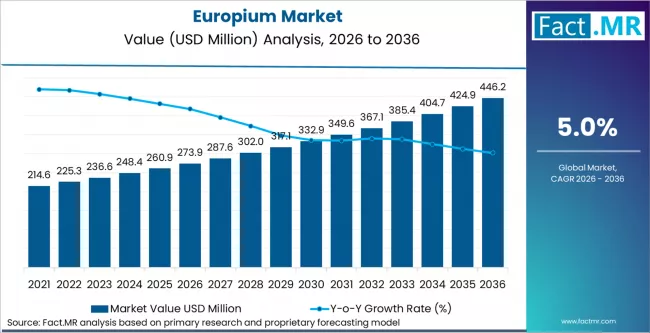
Europium Market Market Value Analysis | Source: Fact.MR
Europium Market
| Metric | Value |
|---|---|
| Estimated Value in (2026E) | USD 273.9 million |
| Forecast Value in (2036F) | USD 463.5 million |
| Forecast CAGR (2026 to 2036) | 5.4% |
Source: Fact.MR analysis. Updated Mar 9, 2026
Europium Market Definition
The Europium Market involves the production and sale of europium, a rare earth element used primarily in phosphors, alloys, and specialized optical, electronic, and lighting applications that require specific luminescent and magnetic properties.
Market Inclusions
This report covers global and regional market sizes for europium over a defined forecast period, including product forms (oxides, metals, phosphors), application segments (LEDs, fluorescent lamps, magnets, display technologies), and end‑use industries.
Market Exclusions
The scope excludes other rare earth elements not classified as europium and finished consumer products that contain europium where the element’s market data is not separately quantified.
Research Methodology
- Primary Research: Interviews were conducted with rare earth producers, material formulators, and industry analysts.
- Desk Research: Data was sourced from industry reports, mineral statistics, and trade association publications.
- Market‑Sizing and Forecasting: A hybrid model combining top‑down rare earth demand forecasts with bottom‑up shipment and revenue data was used.
- Data Validation and Update Cycle: Findings were validated through expert review and aligned with recent production, adoption, and trade figures.
Summary of the Europium Market
- Market Definition
- The Europium Market includes global production and trade of europium, a rare earth element used in phosphors, catalysts, and specialty glass/ceramics for electronics, lighting, and automotive applications. The market supports high-performance display technologies, LED lighting, and specialized industrial uses requiring specific luminescent and magnetic properties.
- Demand Drivers
- Expansion of Consumer Electronics: Rising demand for TVs, smartphones, and high-definition display devices increases the need for europium-based phosphors.
- LED and Display Technology Growth: Adoption of LED, LCD, and OLED backlit displays drives the use of europium for high-quality color rendering.
- Energy Efficiency Requirements: Europium phosphors are critical for energy-efficient lighting solutions, meeting global regulations and environmental standards.
- Advanced Lighting Applications: Growth in solid-state lighting and high-performance illumination continues to support europium consumption.
- High-Quality Visual Performance: Regulatory and industry standards for color accuracy and brightness in displays necessitate europium-based phosphors.
- Key Segments Analyzed
- End-Use Industry: Consumer Electronics (34.4%), Lighting, Automotive, Others.
- Application: Phosphors (39.7%), Catalysts, Glass/Ceramics, Others.
- Geography: China leads with 6.4% CAGR, followed by South Korea (5.4%), Japan (5.3%), India (5.2%), and USA (5.1%).
- Analyst Opinion at Fact MR
- Shambhu Nath Jha, Principal Consultant at Fact MR, stated, "The europium market remains critical to high-performance display and LED technologies. Growth is supported by electronics manufacturing in Asia Pacific and the rising adoption of energy-efficient, high-brightness phosphors in global lighting and display sectors."
- Strategic Implications / Executive Takeaways
- Target Electronics & LED Manufacturers: Focus on partnerships with high-volume display panel and LED lighting producers.
- Invest in High-Purity Europium Production: Ensure consistent quality and supply to meet stringent color rendering and brightness standards.
- Leverage Asia Pacific Growth: Capitalize on high demand from China, South Korea, and Japan, which dominate electronics manufacturing and phosphor production.
- Promote Energy-Efficient Applications: Market europium for energy-efficient LED and display solutions to align with regulatory and sustainability trends.
- Strengthen Supply Chain Security: Secure upstream mining and refining capabilities to manage material scarcity and price volatility.
- Methodology
- Primary Research: Interviews with rare earth producers, material formulators, and industry analysts.
- Desk Research: Data sourced from mineral statistics, trade associations, and industry reports.
- Market Sizing & Forecasting: Hybrid top-down and bottom-up approach combining historical adoption, shipment data, and revenue trends.
Segmental Analysis
Europium Market Analysis by End Use
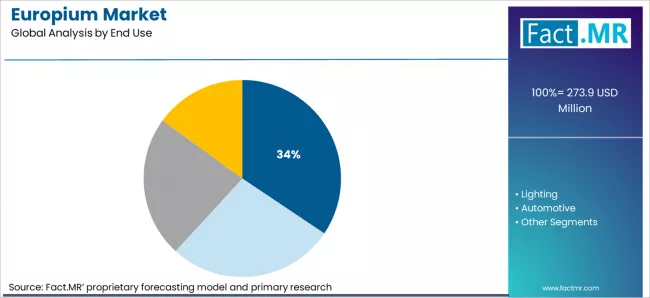
Europium Market Analysis By End Use | Source: Fact.MR
- Market Overview: Consumer electronics are expected to capture 34.4% of the europium market share by 2026. Europium is widely used in the production of red and blue phosphors for display panels, televisions, smartphones, and other electronic devices, providing high-quality color rendering and brightness.
- Demand Drivers:
- Growing Consumer Electronics Market: The rising demand for televisions, smartphones, and other display devices drives the need for europium-based phosphors in electronic screens.
- High-Quality Display Requirements: Europium enhances the brightness and color accuracy of displays, meeting consumer expectations for advanced visual experiences.
- Technological Advancements: Increasing adoption of high-definition and energy-efficient display technologies, such as LED and OLED, boosts the demand for europium in consumer electronics.
Europium Market Analysis by Application
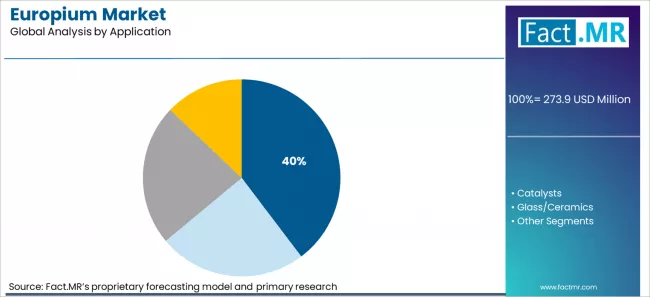
Europium Market Analysis By Application | Source: Fact.MR
- Market Overview: Phosphors are projected to hold 39.7% of the market share by 2026. Europium-based phosphors are critical for producing red and blue light in fluorescent lamps, LEDs, and display technologies, ensuring high brightness and precise color reproduction.
- Demand Drivers:
- Expansion of LED and Display Technologies: The growth of LED lighting and high-definition display panels is driving demand for europium phosphors.
- Enhanced Color Quality: Europium phosphors improve color rendering and brightness, making them essential for consumer electronics and lighting applications.
- Rising Energy Efficiency Requirements: Europium phosphors are used in energy-efficient lighting solutions that meet global regulations, supporting sustainable and high-performance lighting and display systems.
Europium Market Drivers, Restraints, and Opportunities
FMR analysts observe that the europium market is a growth‑aligned, technology‑critical segment rooted in its unique role as a dopant for phosphors in lighting and display applications. Historically, europium was essential in cathode‑ray tube (CRT) screens and fluorescent lamps; structural demand persisted as the transition to modern displays (LED, LCD, and OLED backlighting) continued to rely on europium‑activated phosphors for color accuracy and brightness. The 2026 valuation reflects this shifting but sustained demand, tied not to mature legacy uses but to ongoing adoption in high‑performance visualization and specialized lighting where alternatives struggle to match performance.
While legacy CRT and fluorescent uses have declined, high‑purity europium compounds remain indispensable in next‑generation display and solid‑state lighting technologies, which command higher pricing and support net market value growth even as overall material volumes remain constrained by supply and substitution pressure. The market exists at its current size because few materials deliver the same optical performance, and regulatory color‑rendering standards in lighting and display industries continue to favor europium‑doped phosphors.
- Advanced Display Demand: High‑performance TVs, monitors, and backlit displays use europium‑activated phosphors to achieve precise red emission and vibrant color profiles that replace less accurate materials.
- Regulatory & Performance Standards: Color rendering and efficiency standards in lighting and consumer electronics push manufacturers toward certified phosphor systems that often require europium, supporting premium pricing.
- Regional Technology Dynamics: In Asia‑Pacific and North America, strong electronics production and display manufacturing bases drive greater uptake of europium materials compared with regions with smaller high‑tech manufacturing sectors.
Regional Analysis
The market analysis covers key global regions, including East Asia, South Asia, and North America. It is segmented geographically, with specific market dynamics for each region. The full report provides a detailed market attractiveness analysis.
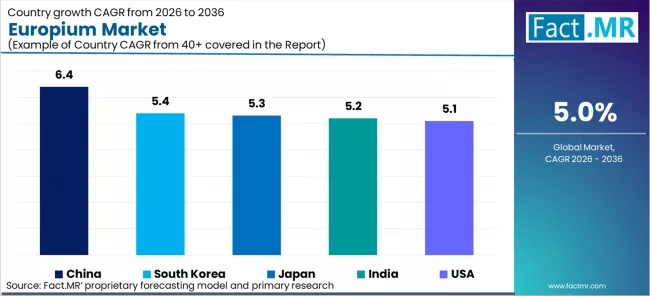
Europium Market Cagr Analysis By Country | Source: Fact.MR
| Country | CAGR (2026-2036) |
|---|---|
| China | 6.4% |
| South Korea | 5.4% |
| Japan | 5.3% |
| India | 5.2% |
| USA | 5.1% |
Source: Fact.MR analysis. Updated Mar 9, 2026
Source: Fact MR (FMR) analysis, based on proprietary forecasting model and primary research
East Asia:
China, South Korea, and Japan are the leading markets, driven by demand for high-performance magnets, electronics, and LED technologies. Key regional players include China Northern Rare Earth Group, LG Chem, and Sumitomo Metal Mining.
- China: Demand for europium in China is projected to rise at 6.4% CAGR through 2036. Growth is supported by expansion in electronics manufacturing (03-2025) and China Northern Rare Earth Group’s production capacity increase (08-2025).
- South Korea: Demand for europium in South Korea is projected to rise at 5.4% CAGR through 2036. Growth is influenced by LED technology adoption (02-2025) and LG Chem’s regional supply chain expansion (07-2025).
- Japan: Demand for europium in Japan is projected to rise at 5.3% CAGR through 2036. Growth is supported by high-tech electronics demand (04-2025) and Sumitomo Metal Mining’s facility upgrades (09-2025).
South Asia:
India is an emerging market, supported by increasing electronics and renewable energy applications.
- India: Demand for europium in India is projected to rise at 5.2% CAGR through 2036. Growth is driven by rising production of LED and display technologies (05-2025) and domestic investment in rare earth processing facilities (10-2025).
North America:
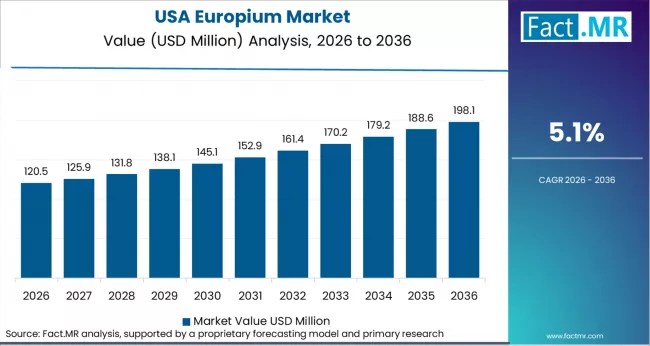
Europium Market Country Value Analysis | Source: Fact.MR
The USA is a stable market, driven by electronics manufacturing and defense sector applications.
- USA: Demand for europium in the U.S. is projected to rise at 5.1% CAGR through 2036. Growth is supported by defense industry procurement (06-2025) and expansions by domestic suppliers of rare earth materials (09-2025).
Fact MR's analysis of the europium market in East Asia, South Asia, and North America consists of country-wise assessments that include China, South Korea, Japan, India, and the USA. Readers can find detailed trends, regulatory updates, and company-specific investments shaping market growth in these countries.
What is the Competitive Structure and Buyer Behavior in the Europium Market?
The europium market is moderately concentrated, with key rare earth producers such as China Northern Rare Earth Group High‑Tech Co., Ltd., China Minmetals Rare Earth Co., Ltd., Lynas Rare Earths Limited, and MP Materials Corp. commanding a substantial share alongside other established suppliers including Iluka Resources Limited, Solvay S.A., Shin‑Etsu Chemical Co., Ltd., JL MAG Rare‑Earth Co., Ltd., Cyclic Materials Inc., and Noveon Magnetics Inc. The primary competitive variables are product purity, supply stability, traceability, and cost efficiency for critical applications in phosphors, lighting, electronics, and high‑performance magnets. Companies with integrated mining, separation, and refining capabilities hold structural advantages because they can secure upstream feedstock, ensure consistent quality, and buffer against rare earth price volatility. Established global supply networks and long‑term customer relationships also strengthen position by providing reliable delivery into specialized manufacturing value chains. Large industrial and electronics buyers exert significant leverage by qualifying multiple suppliers, negotiating long‑term supply agreements tied to volume and quality specifications, and often maintaining preferred vendor lists to manage risk. To mitigate supplier dependency, these buyers diversify sourcing and emphasize certified quality and delivery performance, which limits individual suppliers’ pricing power. As a result, competition centers on supply assurance, consistent material performance, and technical support rather than on price alone.
Recent Industry Developments
- U.S. Price Support & Profitability: In February 2026, MP Materials (owner of the Mountain Pass mine) reported a return to profitability for Q4 2025. This was significantly aided by a U.S. government price floor agreement set at $110/kg for rare earth materials, which helped stabilize domestic operations against global price volatility.
- Strategic European Rare Earth Expansion: Lynas Rare Earths is projected to achieve a 53% production growth in 2026 as it ramps up its heavy rare earth separation circuits in Malaysia. This expansion is critical for reducing global reliance on China's Bayan Obo complex, which currently controls roughly 70-90% of europium processing capacity.
- Europium 155 Niche Growth: The market for the radioisotope Europium-155 is seeing a steady 8.2% CAGR in early 2026. This isotope is increasingly vital for nuclear physics research and as a calibration source in the growing medical imaging sector.
Key Players of the Europium Market
- China Northern Rare Earth Group High-Tech Co., Ltd.
- China Minmetals Rare Earth Co., Ltd.
- Lynas Rare Earths Limited
- MP Materials Corp.
- Iluka Resources Limited
- Solvay S.A.
- Shin-Etsu Chemical Co., Ltd.
- JL MAG Rare-Earth Co., Ltd.
- Cyclic Materials Inc.
- Noveon Magnetics Inc.
Report Scope
| Metric | Value |
|---|---|
| Quantitative Units | USD 273.9 million (2026) to USD 463.5 million (2036), at a CAGR of 5.4% |
| Market Definition | The Europium Market includes global production and trade of europium, a rare earth element used in phosphors, catalysts, and specialty glass/ceramics for electronics, lighting, and automotive applications. |
| End Use | Consumer Electronics, Lighting, Automotive, Others |
| Application | Phosphors, Catalysts, Glass/Ceramics, Others |
| Regions Covered | North America, Latin America, Europe, East Asia, South Asia, Oceania, Middle East and Africa |
| Countries Covered | United States, Canada, Mexico, Brazil, Argentina, Germany, France, United Kingdom, Italy, Spain, China, India, Japan, South Korea, Indonesia, Australia, and 40+ countries |
| Key Companies Profiled | China Northern Rare Earth Group High-Tech Co., Ltd., China Minmetals Rare Earth Co., Ltd., Lynas Rare Earths Limited, MP Materials Corp., Iluka Resources Limited, Solvay S.A., Shin-Etsu Chemical Co., Ltd., JL MAG Rare-Earth Co., Ltd., Cyclic Materials Inc., Noveon Magnetics Inc. |
| Forecast Period | 2026 to 2036 |
| Approach | Hybrid top-down and bottom-up market modeling validated through primary interviews with rare earth producers, supported by trade data benchmarking and plant-level capacity verification. |
Source: Fact.MR analysis. Updated Mar 9, 2026
Bibliographies
- U.S. Geological Survey. (2024). Mineral commodity summaries: Rare earth elements. U.S. Geological Survey.
- International Energy Agency. (2023). The role of critical minerals in clean energy transitions. International Energy Agency.
- European Commission. (2023). Critical raw materials resilience: Rare earth supply chains and strategic materials. European Commission.
- International Renewable Energy Agency. (2023). Critical materials for the energy transition: Rare earth supply outlook. International Renewable Energy Agency.
- Mining.com. (2026, February 26). MP Materials swings to Q4 profit on U.S. government price support. Mining.com.
- Rare Earth Exchanges. (2026). Rare earth and magnet industry updates. Rare Earth Exchanges.
- Lynas Rare Earths Ltd. (2024). Annual report: Rare earth production and downstream applications. Lynas Rare Earths Ltd.
This report addresses:
- Market intelligence enabling comprehensive assessment of leading countries and product segments across the Europium Market globally.
- Market volume (sales units and revenue) estimates and 10-year revenue forecasts from 2026 to 2036, validated through producer shipment data, downstream buyer surveys, and country-level demand modeling.
- Growth opportunity mapping across end-use industries (Consumer Electronics, Lighting, Automotive, Others) and applications (Phosphors, Catalysts, Glass/Ceramics, Others).
- Segment and regional revenue forecasts by end-use industry, application, and geography across 40+ countries.
- Competition strategy analysis covering product purity, supply stability, traceability, cost efficiency, and technical support, including major players like China Northern Rare Earth Group High-Tech Co., Ltd., China Minmetals Rare Earth Co., Ltd., Lynas Rare Earths Limited, and MP Materials Corp.
- Product and regulatory compliance tracking aligned with rare earth material standards, electronics and lighting performance certifications, and environmental and safety regulations.
- Regulatory impact analysis addressing lighting, electronics, and industrial manufacturing standards, rare earth import/export restrictions, and quality certification requirements across key markets.
- Report delivery in PDF, Excel, PowerPoint, and interactive dashboard formats for executive, procurement, and operational planning use.
Segmentation
Europium Market Key Segments
-
End-Use Industry :
- Consumer Electronics
- Lighting
- Automotive
- Others
-
Application :
- Phosphors
- Catalysts
- Glass/Ceramics
- Others
-
Region :
- North America
- USA
- Canada
- Mexico
- Europe
- Germany
- UK
- France
- Italy
- Spain
- Nordic Countries
- BENELUX
- Rest of Europe
- Asia Pacific
- China
- Japan
- South Korea
- India
- Australia
- Rest of Asia Pacific
- Latin America
- Brazil
- Argentina
- Rest of Latin America
- Middle East and Africa
- Kingdom of Saudi Arabia
- United Arab Emirates
- South Africa
- Rest of Middle East and Africa
- Other Regions
- Oceania
- Central Asia
- Other Markets
- North America
Frequently Asked Questions
How large is the demand for Europium in the global market in 2026?
What will be the market size of Europium in the global market by 2036?
What is the expected demand growth for Europium in the global market between 2026 and 2036?
Which application is expected to dominate the market?
Which region is expected to show the highest growth rate for Europium?
How significant is the growth outlook for South Korea in this market?
What is the growth outlook for Japan in the Europium market?
What is the growth forecast for India in the Europium market?
What is the growth forecast for the United States in the Europium market?
Which company is identified as a leading player in the Europium market?
What is Europium used for?
What does the Europium market include in this report?
How is the market forecast developed in this report?
What is meant by the Europium market in this report?
Who worked on this report


Preview the report firsthand - request a free sample
Free SampleGet the brochure for pricing and purchase details
Download PDF