Fluorobenzonitrile Market Size, Share, Growth and Forecast (2026 - 2036)

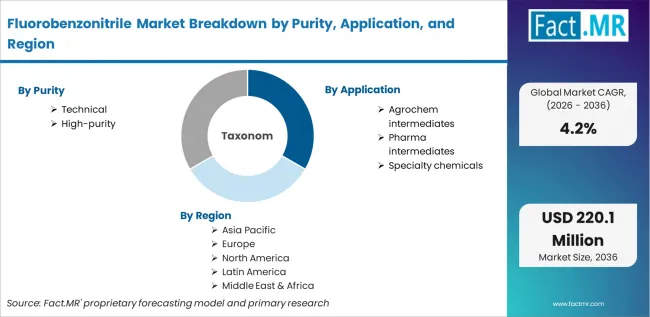
The Fluorobenzonitrile Market is segmented by Purity (Technical and High-Purity), Isomer Type (2-Fluorobenzonitrile, 3-Fluorobenzonitrile, 4-Fluorobenzonitrile), Application (Agrochem Intermediates, Pharma Intermediates, Specialty Chemicals), Form (Liquid and Solid), End User (Agrochemical Producers, Pharmaceutical Manufacturers, Specialty Chemical Producers), Sales Channel (Direct Supply, Distributor Supply, Contract Manufacturing, Online Supply), and Region. Forecast for 2026 to 2036.

Fact.MR states that fluorobenzonitrile demand is moving toward controlled intermediate supply for pesticide chemistry and pharmaceutical synthesis. Fine chemical suppliers need stable purity files and repeatable batches for regulated synthesis work.

Fluorobenzonitrile Market Size, Market Forecast and Outlook by Fact.MR

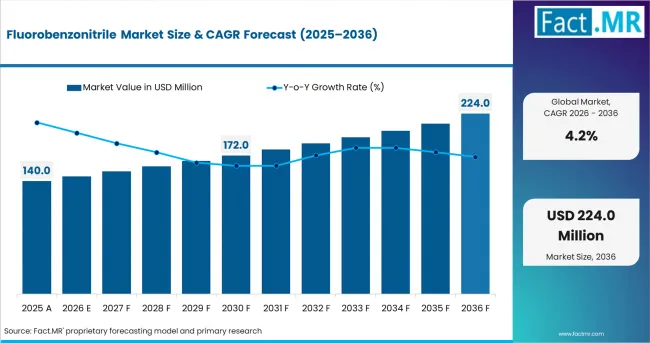
  • The fluorobenzonitrile market was valued at USD 140.0 million in 2025. Demand will reach USD 145.9 million in 2026.
  • Fact.MR projects 4.2% CAGR from 2026 to 2036.
  • Agrochemical synthesis and pharmaceutical intermediate use will lift the market to USD 224.0 million by 2036.
Fluorobenzonitrile Market Value Analysis

Metric Details
Industry Size (2026) USD 145.9 million
Industry Value (2036) USD 224.0 million
CAGR (Forecast Period) 4.2%

Summary of Fluorobenzonitrile Market

  • Demand Drivers in the Market
    • Agrochemical Synthesis: Crop protection producers need fluorobenzonitrile for active ingredient chemistry. Fluorobenzonitrile supports fluorinated aromatic building blocks used in regulated pesticide synthesis. Suppliers with stable technical grade output support repeat production needs across agrochemical programs.
    • Drug Intermediate Use: Pharmaceutical manufacturers use fluorobenzonitrile in small molecule synthesis. High purity lots reduce impurity risk during regulated production. Suppliers with clear quality files build repeat orders from drug intermediate manufacturers.
    • Batch Documentation: Regulated chemical manufacturers need traceable grade files before approving suppliers. Purity records and impurity data reduce qualification delays. Fine chemical suppliers with repeatable batches serve agrochemical producers and pharmaceutical manufacturers with reliable supply.
  • Key Segments Analyzed
    • By Purity: Technical grade is projected to hold 68.0% share in 2026 as large-volume synthesis users need usable purity at controlled cost.
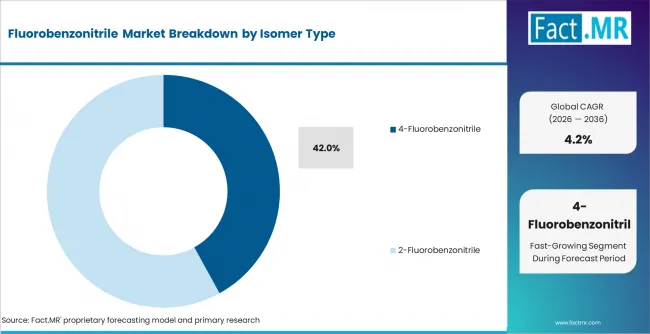
    • By Isomer Type: 4-Fluorobenzonitrile is forecast to hold 42.0% share in 2026 because para substitution supports common agrochemical and pharmaceutical synthesis routes.
    • By Application: Agrochem intermediates are projected to hold 46.0% share in 2026 since pesticide synthesis uses fluorinated aromatic building blocks.
    • By Form: Liquid form is forecast to hold 83.0% share in 2026 due to bulk users prefer pumpable material for controlled synthesis batches.
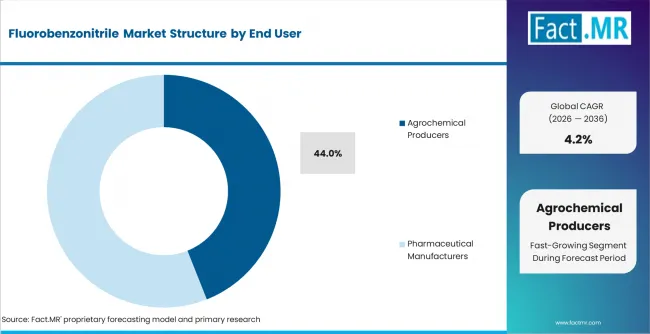
    • By End User: Agrochemical producers are expected to represent 44.0% share in 2026 as crop protection chemistry remains the main outlet.
    • By Sales Channel: Direct supply is forecast to hold 58.0% share in 2026 because large chemical accounts need shipment planning and technical files.
    • By Geography: United States fluorobenzonitrile demand is forecast to grow at 5.0% CAGR by 2036 as drug development supports small molecule synthesis needs.
  • Analyst Opinion at Fact.MR
    • Shambhu Nath Jha of Fact.MR says, 'Fluorobenzonitrile competition is shifting from basic catalog access to proof of batch control. Suppliers that support technical grade volume and high-purity files can serve agrochemical programs and pharma intermediate users with stronger repeat demand.'
  • Strategic Implications
    • Grade Control: Suppliers should separate technical and high purity lines so agrochemical producers get cost efficient material and pharmaceutical manufacturers get detailed impurity records.
    • Isomer Focus: Producers prioritize 4-fluorobenzonitrile capacity as para chemistry serves common synthesis pathways and supports stable catalog demand.
    • Channel Planning: Distributors should build regional stock for small laboratories as direct supply remains the main route for bulk manufacturers with repeat batch needs.

Fluorobenzonitrile use comes from pesticide chemistry and small molecule pharmaceutical synthesis. Fact.MR identifies liquid form as the leading format by revenue. Liquid supply supports bulk synthesis plants because chemical manufacturers can meter material into reactors with reduced handling steps.

Technical grade is the main purity route as large volume synthesis manufacturers balance purity and delivered cost. Agrochemical producers need fluorinated aromatic building blocks for active ingredient programs. Pharmaceutical manufacturers need high purity lots and clear impurity records. Supplier service influences repeat demand because batch documentation and isomer availability affect approval continuity.

United States fluorobenzonitrile demand is forecast to grow at 5.0% CAGR by 2036 as drug development supports small molecule synthesis needs. Mexico is projected to expand at 4.7% CAGR as pharmaceutical manufacturing investment supports controlled input chemicals. Germany is expected to record 4.4% CAGR as chemical and pharmaceutical production needs high quality intermediates. France is projected to advance at 4.1% CAGR as medicine funding sustains controlled intermediate use. South Korea is forecast at 3.8% CAGR as fine chemical exporters serve drug and crop chemistry users. United Kingdom demand is projected at 3.6% CAGR as specialty chemical trade supports import channels. Japan is expected to grow at 3.5% CAGR as strict quality systems favor proven suppliers.

Segmental Analysis

Fluorobenzonitrile Market Analysis by Purity

Fluorobenzonitrile Market Analysis By Purity

Technical grade is projected to account for 68.0% share in 2026 as large synthesis manufacturers balance purity with delivered cost. High purity material serves pharmaceutical manufacturers and research laboratories that need detailed impurity checks. Technical grade leads because routine agrochemical and fine chemical routes can accept practical purity with stable lot records.

  • Technical Use: Technical grade supports agrochemical batches and standard fine chemical work. Routine reaction routes need usable purity at controlled cost.
  • High Purity Demand: High purity material serves pharmaceutical intermediate work. Small volumes command premium pricing when impurity records are detailed.
  • Quality Files: Supplier approval improves with certificates and impurity data. Catalog and bulk suppliers protect repeat orders through documented lots.

Fluorobenzonitrile Market Analysis by Isomer Type
Fluorobenzonitrile Market Analysis By Isomer Type

4-Fluorobenzonitrile is forecast to hold 42.0% share in 2026 because para substitution supports multiple synthesis designs. The isomer serves common pharmaceutical and crop chemistry routes. It leads because synthesis chemists often prefer predictable reaction planning and stable commercial availability.

  • Para Preference: 4-Fluorobenzonitrile supports pharmaceutical and crop chemical routes. Synthesis chemists use this isomer for predictable route planning.
  • Meta Route: 3-Fluorobenzonitrile serves specialty synthesis needs. Demand is limited and steady in research and fine chemical projects.
  • Ortho Route: 2-Fluorobenzonitrile serves selected intermediate pathways. Molecule design and supplier purity consistency guide usage.

Fluorobenzonitrile Market Analysis by Application

Fluorobenzonitrile Market Analysis By Application

Agrochem intermediates are projected to hold 46.0% share in 2026 as pesticide synthesis is the main application outlet. Crop chemistry uses fluorinated nitrile intermediates for active ingredient routes. FAO reported agricultural pesticide active ingredient use in 2023. [2] Agrochemical intermediates lead because crop protection programs need tested inputs for repeat synthesis.

  • Agrochemical Pull: Agrochemical synthesis uses fluorinated nitrile intermediates for active ingredient routes. Repeat input needs support this application base.
  • Pharmaceutical Route: Pharmaceutical intermediate manufacturers need high purity lots and documented impurity controls. Supplier approval often takes extended time compared with standard sourcing.
  • Specialty Work: Specialty chemical producers need small batches for research and formulation support. Quick delivery and technical service guide supplier choice.

Fluorobenzonitrile Market Analysis by Form

Fluorobenzonitrile Market Analysis By Form

Liquid form is forecast to hold 83.0% share in 2026 due to bulk synthesis plants meter liquid intermediates with existing systems. Liquid supply reduces preparation before reactor charging. The form leads because large synthesis plants prefer reduced handling steps during controlled synthesis batches.

  • Liquid Handling: Liquid material supports tank storage and batch feeding. Large synthesis plants prefer reduced handling steps before synthesis.
  • Solid Use: Solid form serves lab packaging and selected specialty needs. Research laboratories choose it for small batch control and storage preference.
  • Bulk Supply: Bulk liquid supply favors direct contracts and repeat shipments. Safe packaging allows suppliers to serve regional plants with reduced delays.

Fluorobenzonitrile Market Analysis by End User
Fluorobenzonitrile Market Analysis By End User

Agrochemical producers are expected to represent 44.0% share in 2026 as crop protection synthesis uses the material as an intermediate. Pharmaceutical manufacturers follow through small molecule synthesis. Agrochemical producers lead because active ingredient programs need fluorinated building blocks with repeatable input quality.

  • Crop Chemistry: Agrochemical producers need stable intermediate quality. Active ingredient programs use fluorinated building blocks in repeat synthesis routes.
  • Drug Makers: Pharmaceutical manufacturers need detailed impurity checks and supply records. Controlled lots reduce extra testing during scale up work.
  • Specialty Producers: Specialty chemical producers use fluorobenzonitrile for limited volume synthesis. Supplier support influences qualification speed.

Fluorobenzonitrile Market Analysis by Sales Channel
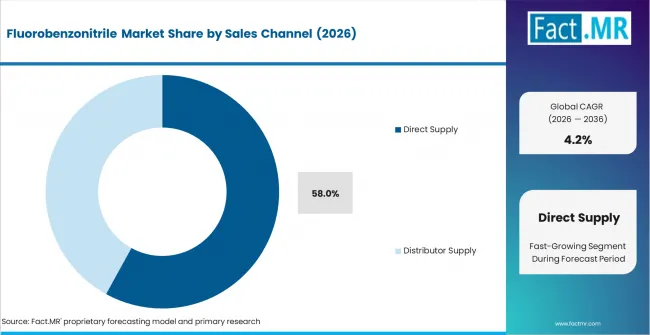
Fluorobenzonitrile Market Analysis By Sales Channel

Direct supply is forecast to hold 58.0% share in 2026 since large manufacturers need supply planning and lot documentation. Distributors serve laboratories and small chemical plants. Direct supply leads because repeat synthesis manufacturers prefer supplier contact over small order channels.

  • Direct Supply: Direct contracts support bulk orders and planned delivery. Direct contracts reduce order gaps for manufacturers with repeat production schedules.
  • Distributor Supply: Distributor sales serve laboratories and small chemical plants. Local stock improves access for urgent and limited volume orders.
  • Contract Manufacturing: Contract manufacturing supports custom purity or isomer needs. Dedicated production slots serve chemical manufacturers with specific synthesis requirements.

Fluorobenzonitrile Market Drivers, Restraints and Opportunities
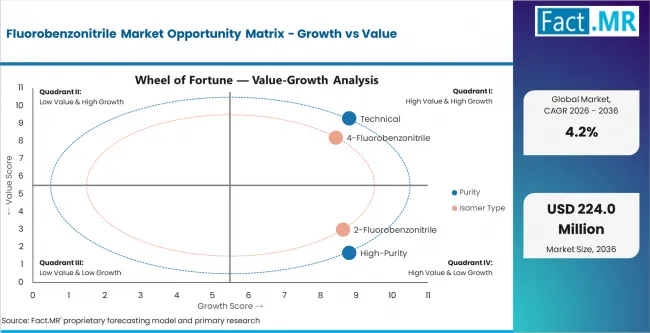
Fluorobenzonitrile Market Opportunity Matrix Growth Vs Value

Drug and crop chemistry form the main demand drivers for fluorobenzonitrile. FDA reported 46 novel drug approvals in 2025. [1] This approval activity signals steady small molecule development that uses controlled fine chemical intermediates.

The main restraint is supplier qualification time. Pharmaceutical manufacturers and agrochemical producers need purity evidence and impurity history before accepting repeat shipments. WHO states that the 2024 Joint FAO/WHO pesticide residue review met in September 2024. [3] Active residue review keeps quality expectations strict for crop chemistry suppliers.

Opportunities in the Fluorobenzonitrile Market

• High Purity Supply: Pharmaceutical intermediate manufacturers pay for detailed impurity records and stable batch history. Suppliers raise value by separating high purity lots from standard technical shipments.
• Pesticide Chemistry: Crop protection synthesis needs tested intermediate inputs for active ingredient programs. Producers with stable technical grade output serve repeat agrochemical batches.
• Regional Stocking: Distributors build share by holding liquid and packaged grades near chemical clusters. Quick delivery improves approval chances for small and medium volume chemical manufacturers.

Regional Analysis

Based on regional analysis, the fluorobenzonitrile market is segmented into North America, Latin America, Europe, East Asia, South Asia and Pacific, and Middle East and Africa.

Top Country Growth Comparison Fluorobenzonitrile Market Cagr (2026 2036)

Country CAGR
United States 5.0%
Mexico 4.7%
Germany 4.4%
France 4.1%
South Korea 3.8%
United Kingdom 3.6%
Japan 3.5%

Source: Fact.MR analysis, based on adjusted forecast model and primary research.
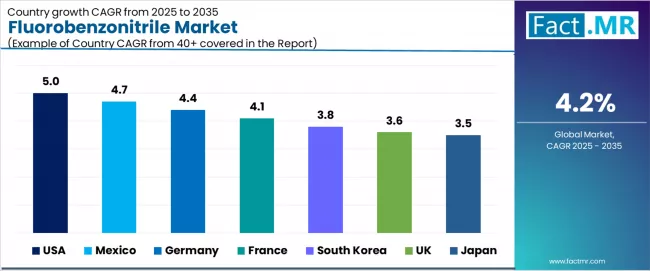
Fluorobenzonitrile Market Cagr Analysis By Country

North America Fluorobenzonitrile Market Analysis
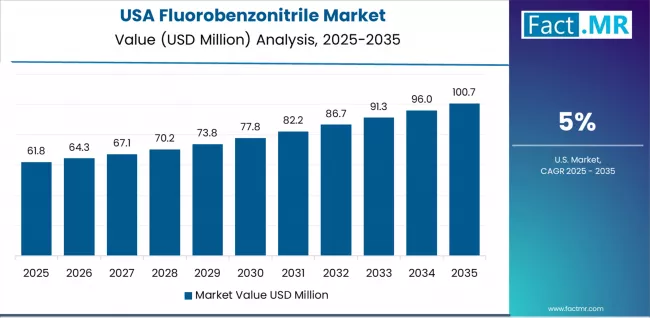
Fluorobenzonitrile Market Country Value Analysis

North America demand benefits from pharmaceutical approvals and specialty chemical capacity. The United States leads because local drug development supports intermediate sourcing. Mexico adds demand through pharmaceutical manufacturing investment and regional chemical supply channels.

  • United States: United States fluorobenzonitrile demand is forecast to grow at 5.0% CAGR by 2036 as drug development supports small molecule synthesis needs. The FDA approval pipeline keeps fine chemical suppliers focused on tested intermediate quality. Pharmaceutical manufacturers need high purity lots and clear impurity records before repeat sourcing. Agrochemical producers need stable technical grade material for active ingredient chemistry.
  • Mexico: Mexico fluorobenzonitrile demand is projected to grow at 4.7% CAGR by 2036 as pharma manufacturing attracts investment. Data México reported US$784 million in pharmaceutical manufacturing foreign direct investment for January to September 2024. [4] Pharmaceutical investment supports local interest in controlled input chemicals. Regional distributors build share by holding packaged grades near chemical clusters.

Europe Fluorobenzonitrile Market Analysis
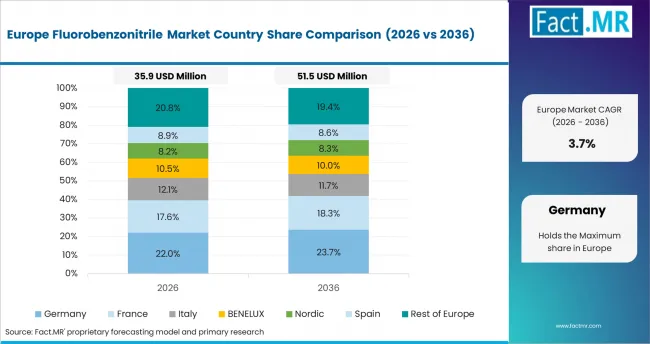
Fluorobenzonitrile Market Europe Country Market Share Analysis, 2026 & 2036

Europe demand comes from established chemical production and regulated pharmaceutical use. Germany and France lead regional activity as medicine funding supports controlled chemical inputs. The United Kingdom adds demand through specialty chemical trade and access to imported intermediates.

  • Germany: Germany fluorobenzonitrile demand is expected to record 4.4% CAGR by 2036 as chemical and pharmaceutical production needs high quality intermediates. Pharmaceutical spending supports supplier focus on documented pharmaceutical inputs. Chemical producers need stable technical grade and high purity options for different synthesis routes.
  • France: France fluorobenzonitrile demand is projected to advance at 4.1% CAGR by 2036 as medicine funding sustains controlled intermediate use. Pharmaceutical manufacturers need reliable aromatic nitrile building blocks for small molecule synthesis. Agrochemical producers support demand through pesticide active ingredient chemistry.
  • United Kingdom: United Kingdom demand is forecast at 3.6% CAGR by 2036 as specialty chemical trade supports steady use. The UK reported GBP 937.3 billion in exports during the 12 months to February 2026. [5] Trade capacity supports access to imported and distributed intermediates. Distributors serve small laboratories and specialty chemical producers with local stock.

East Asia Fluorobenzonitrile Market Analysis

East Asia demand comes from high quality synthesis work and export oriented chemical supply. South Korea grows above Japan as fine chemical exporters serve pharmaceutical and crop chemistry manufacturers.

  • South Korea: South Korea fluorobenzonitrile demand is forecast to record 3.8% CAGR by 2036 as drug and fine chemical producers need reliable intermediates. MFDS published its 2024 Drug Approval Report on July 1, 2025. [6] The release supports supplier attention to drug approval and quality systems. Fine chemical exporters need repeatable batches for pharmaceutical and crop chemistry manufacturers.
  • Japan: Japan fluorobenzonitrile demand is projected at 3.5% CAGR by 2036 as strict quality expectations favor proven lots. Pharmacopoeia updates reinforce careful supplier qualification for pharmaceutical inputs. Japanese chemical manufacturers often prefer stable suppliers over low cost spot sourcing.

Competitive Aligners for Market Players
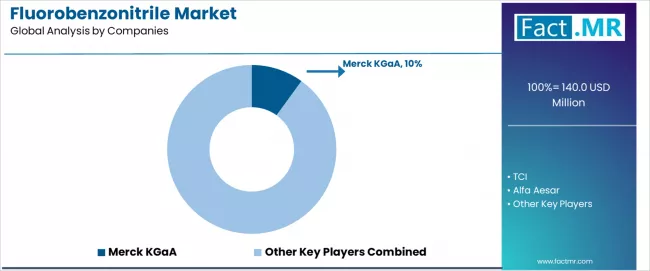
Fluorobenzonitrile Market Analysis By Company

The fluorobenzonitrile market includes catalog suppliers and fine chemical producers. Integrated fluorochemical companies add upstream control through fluoropolymers and adjacent fluorochemical chains. Merck KGaA and Tokyo Chemical Industry Co., Ltd. supply laboratory or specialty grades for research laboratories and synthesis service providers.

Competition centers on usable purity at repeatable cost instead of product list breadth. Chemical manufacturers assess isomer availability before approving a supplier. Certificate quality and lot variation shape repeat order confidence.

Upstream access affects delivered cost and supply continuity. Producers with access to fluorspar and calcium fluoride manage input pressure with greater control than small traders. This reduces exposure for chemical manufacturers using technical grade material.

Supplier position depends on safety handling and technical documentation. Agrochemical producers need technical grade material at repeatable cost. Pharmaceutical intermediate manufacturers need high purity records and clear impurity files.

Key Players in Fluorobenzonitrile Market

  • Merck KGaA
  • Tokyo Chemical Industry Co., Ltd.
  • Thermo Fisher Scientific Inc.
  • Eastman Chemical Company
  • Solvay S.A.
  • Arkema S.A.
  • Hunan Tianzha Chemical Co., Ltd.
  • Zhejiang Medicine Co., Ltd.
  • LANXESS AG

Fluorobenzonitrile Market Analysis by Segments

  • By Purity:

    • Technical
    • High-Purity
  • By Isomer Type:

    • 2-Fluorobenzonitrile
    • 3-Fluorobenzonitrile
    • 4-Fluorobenzonitrile
  • By Application:

    • Agrochem Intermediates
    • Pharma Intermediates
    • Specialty Chemicals
  • By Form:

    • Liquid
    • Solid
  • By End User:

    • Agrochemical Producers
    • Pharmaceutical Manufacturers
    • Specialty Chemical Producers
  • By Sales Channel:

    • Direct Supply
    • Distributor Supply
    • Contract Manufacturing
    • Online Supply
  • Region:

    • North America
      • United States
      • Canada
    • Europe
      • Germany
      • United Kingdom
      • France
      • Italy
      • Spain
    • Asia Pacific
      • China
      • Japan
      • South Korea
      • Taiwan
      • Singapore
    • Latin America
      • Brazil
      • Mexico
      • Argentina
    • Middle East & Africa
      • GCC Countries
      • South Africa
      • Israel

Bibliography

  • [1]. U.S. Food and Drug Administration. (2026). Novel drug approvals for 2025.
  • [2]. Food and Agriculture Organization of the United Nations. (2025). Pesticides use and trade: 1990-2023.
  • [3]. World Health Organization. (2025). Pesticide residues in food: Report 2024: Joint FAO/WHO Meeting on Pesticide Residues.
  • [4]. Data México. (2025). Fabricación de productos farmacéuticos.
  • [5]. Department for Business and Trade. (2026). Trade and investment core statistics book.
  • [6]. Ministry of Food and Drug Safety. (2025). 2024 Drug Approval Report.

This Report Addresses

  • Strategic intelligence on fluorobenzonitrile demand across agrochemical synthesis, pharmaceutical intermediates and specialty chemicals.
  • Growth opportunity mapping across the United States, Mexico, Germany, France, South Korea, the United Kingdom, and Japan.
  • Segment analysis by purity, isomer type, application, form, end user, and sales channel.
  • Regional outlook covering drug synthesis, pesticide chemistry and specialty chemical supply routes.
  • Competitive analysis of Merck KGaA, Tokyo Chemical Industry, Thermo Fisher Scientific, Solvay S.A., and Arkema S.A.
  • Product assessment covering technical grade, high-purity grade, liquid form, and key fluorobenzonitrile isomers.
  • Report delivered through PDF, Excel datasets and presentation formats.
  • Primary interviews, supplier checks and official demand indicators support validation.

Fluorobenzonitrile Market Definition

The fluorobenzonitrile market covers fluorinated aromatic nitrile intermediates used in pharmaceutical synthesis and pesticide active ingredient chemistry. It includes ortho, meta and para isomers sold in technical and high-purity grades.

Fluorobenzonitrile Market Inclusions

The scope includes fluorobenzonitrile grades supplied for agrochemical synthesis and pharma intermediate work. Bulk liquid supply, packaged laboratory grades and contract-made material are covered under the same product scope.

Fluorobenzonitrile Market Exclusions

The scope excludes finished pesticide products and finished active pharmaceutical ingredients. It excludes unrelated fluorinated solvents and downstream drug products that do not sell fluorobenzonitrile as a separate intermediate.

Fluorobenzonitrile Market Research Methodology

  • Primary Research
    • Primary research includes interviews with fine chemical producers and synthesis service providers. Agrochemical formulation managers and pharmaceutical quality managers were included to assess purity and documentation requirements.
  • Desk Research
    • Desk research reviews chemical trade signals, pesticide use data and official drug approval releases. Company product pages support supplier presence checks but do not drive market sizing.
  • Market-Sizing and Forecasting
    • Forecasting uses the supplied 2025 value and applies a one-year forward adjustment for the study window. Segment shares were assigned through product form use and synthesis channel evidence.
  • Data Validation and Update Cycle
    • Forecasts are validated through supplier availability checks and end-use demand signals. Regional assumptions are reviewed against official pharmaceutical and crop protection indicators after each update cycle.

Scope of the Report

Fluorobenzonitrile Market Breakdown By Purity, Application, And Region

Attribute Details
Quantitative Units USD million and CAGR
Market Definition Fluorinated aromatic nitrile intermediates used in agrochemical, pharmaceutical and specialty chemical synthesis
Purity Segments Technical and High-Purity
Isomer Segments 2-Fluorobenzonitrile, 3-Fluorobenzonitrile and 4-Fluorobenzonitrile
Application Segments Agrochem Intermediates, Pharma Intermediates and Specialty Chemicals
Form Segments Liquid and Solid
End User Segments Agrochemical Producers, Pharmaceutical Manufacturers and Specialty Chemical Producers
Sales Channel Segments Direct Supply, Distributor Supply, Contract Manufacturing and Online Supply
Regions Covered North America, Latin America, Europe, East Asia, South Asia and Pacific, and Middle East and Africa
Countries Covered United States, Mexico, Germany, France, South Korea, United Kingdom and Japan
Key Companies Profiled Merck KGaA, Tokyo Chemical Industry Co., Ltd., Thermo Fisher Scientific Inc., Eastman Chemical Company, Solvay S.A., Arkema S.A., Hunan Tianzha Chemical Co., Ltd., Zhejiang Medicine Co., Ltd. and LANXESS AG
Forecast Period 2026 to 2036
Approach Hybrid top-down and bottom-up model using purity demand, isomer type adoption, application use, product form preference, end-user sourcing, sales channel checks and supplier validation.

- Frequently Asked Questions -

How large is the fluorobenzonitrile market in 2026?

The fluorobenzonitrile market is estimated at USD 145.9 million in 2026 after the one-year forward adjustment.

What is the forecast value of the fluorobenzonitrile market by 2036?

The fluorobenzonitrile market is projected to reach USD 224.0 million by 2036 under the adjusted forecast path.

What CAGR is projected for the fluorobenzonitrile market?

The fluorobenzonitrile market is projected to expand at 4.2% CAGR during the forecast period.

Which purity segment leads the fluorobenzonitrile market?

Technical grade leads the fluorobenzonitrile market as routine synthesis users need usable purity at controlled delivered cost.

Which form segment leads the fluorobenzonitrile market?

Liquid form leads the fluorobenzonitrile market as bulk users can meter material into reactors with fewer preparation steps.

Which application leads the fluorobenzonitrile market?

Agrochem intermediates lead the fluorobenzonitrile market as pesticide synthesis uses fluorinated aromatic building blocks for active ingredient routes

What restrains fluorobenzonitrile market growth?

Supplier qualification restrains fluorobenzonitrile market growth as regulated users need purity records before approving repeat supply.

Table of Content

  1. Executive Summary
    • Global Market Outlook
    • Demand to side Trends
    • Supply to side Trends
    • Technology Roadmap Analysis
    • Analysis and Recommendations
  2. Market Overview
    • Market Coverage / Taxonomy
    • Market Definition / Scope / Limitations
  3. Research Methodology
    • Chapter Orientation
    • Analytical Lens and Working Hypotheses
      • Market Structure, Signals, and Trend Drivers
      • Benchmarking and Cross-market Comparability
      • Market Sizing, Forecasting, and Opportunity Mapping
    • Research Design and Evidence Framework
      • Desk Research Programme (Secondary Evidence)
        • Company Annual and Sustainability Reports
        • Peer-reviewed Journals and Academic Literature
        • Corporate Websites, Product Literature, and Technical Notes
        • Earnings Decks and Investor Briefings
        • Statutory Filings and Regulatory Disclosures
        • Technical White Papers and Standards Notes
        • Trade Journals, Industry Magazines, and Analyst Briefs
        • Conference Proceedings, Webinars, and Seminar Materials
        • Government Statistics Portals and Public Data Releases
        • Press Releases and Reputable Media Coverage
        • Specialist Newsletters and Curated Briefings
        • Sector Databases and Reference Repositories
        • Fact.MR Internal Proprietary Databases and Historical Market Datasets
        • Subscription Datasets and Paid Sources
        • Social Channels, Communities, and Digital Listening Inputs
        • Additional Desk Sources
      • Expert Input and Fieldwork (Primary Evidence)
        • Primary Modes
          • Qualitative Interviews and Expert Elicitation
          • Quantitative Surveys and Structured Data Capture
          • Blended Approach
        • Why Primary Evidence is Used
        • Field Techniques
          • Interviews
          • Surveys
          • Focus Groups
          • Observational and In-context Research
          • Social and Community Interactions
        • Stakeholder Universe Engaged
          • C-suite Leaders
          • Board Members
          • Presidents and Vice Presidents
          • R&D and Innovation Heads
          • Technical Specialists
          • Domain Subject-matter Experts
          • Scientists
          • Physicians and Other Healthcare Professionals
        • Governance, Ethics, and Data Stewardship
          • Research Ethics
          • Data Integrity and Handling
      • Tooling, Models, and Reference Databases
    • Data Engineering and Model Build
      • Data Acquisition and Ingestion
      • Cleaning, Normalisation, and Verification
      • Synthesis, Triangulation, and Analysis
    • Quality Assurance and Audit Trail
  4. Market Background
    • Market Dynamics
      • Drivers
      • Restraints
      • Opportunity
      • Trends
    • Scenario Forecast
      • Demand in Optimistic Scenario
      • Demand in Likely Scenario
      • Demand in Conservative Scenario
    • Opportunity Map Analysis
    • Product Life Cycle Analysis
    • Supply Chain Analysis
    • Investment Feasibility Matrix
    • Value Chain Analysis
    • PESTLE and Porter’s Analysis
    • Regulatory Landscape
    • Regional Parent Market Outlook
    • Production and Consumption Statistics
    • Import and Export Statistics
  5. Global Market Analysis 2021 to 2025 and Forecast, 2026 to 2036
    • Historical Market Size Value (USD Million) Analysis, 2021 to 2025
    • Current and Future Market Size Value (USD Million) Projections, 2026 to 2036
      • Y to o to Y Growth Trend Analysis
      • Absolute $ Opportunity Analysis
  6. Global Market Pricing Analysis 2021 to 2025 and Forecast 2026 to 2036
  7. Global Market Analysis 2021 to 2025 and Forecast 2026 to 2036, By Purity
    • Introduction / Key Findings
    • Historical Market Size Value (USD Million) Analysis By Purity , 2021 to 2025
    • Current and Future Market Size Value (USD Million) Analysis and Forecast By Purity , 2026 to 2036
      • Technical
      • High-Purity
    • Y to o to Y Growth Trend Analysis By Purity , 2021 to 2025
    • Absolute $ Opportunity Analysis By Purity , 2026 to 2036
  8. Global Market Analysis 2021 to 2025 and Forecast 2026 to 2036, By Isomer Type
    • Introduction / Key Findings
    • Historical Market Size Value (USD Million) Analysis By Isomer Type, 2021 to 2025
    • Current and Future Market Size Value (USD Million) Analysis and Forecast By Isomer Type, 2026 to 2036
      • 4-Fluorobenzonitrile
      • 2-Fluorobenzonitrile
      • 3-Fluorobenzonitrile
    • Y to o to Y Growth Trend Analysis By Isomer Type, 2021 to 2025
    • Absolute $ Opportunity Analysis By Isomer Type, 2026 to 2036
  9. Global Market Analysis 2021 to 2025 and Forecast 2026 to 2036, By Application
    • Introduction / Key Findings
    • Historical Market Size Value (USD Million) Analysis By Application, 2021 to 2025
    • Current and Future Market Size Value (USD Million) Analysis and Forecast By Application, 2026 to 2036
      • Agrochem Intermediates
      • Pharma Intermediates
      • Specialty Chemicals
    • Y to o to Y Growth Trend Analysis By Application, 2021 to 2025
    • Absolute $ Opportunity Analysis By Application, 2026 to 2036
  10. Global Market Analysis 2021 to 2025 and Forecast 2026 to 2036, By Form
    • Introduction / Key Findings
    • Historical Market Size Value (USD Million) Analysis By Form, 2021 to 2025
    • Current and Future Market Size Value (USD Million) Analysis and Forecast By Form, 2026 to 2036
      • Liquid
      • Solid
    • Y to o to Y Growth Trend Analysis By Form, 2021 to 2025
    • Absolute $ Opportunity Analysis By Form, 2026 to 2036
  11. Global Market Analysis 2021 to 2025 and Forecast 2026 to 2036, By End User
    • Introduction / Key Findings
    • Historical Market Size Value (USD Million) Analysis By End User, 2021 to 2025
    • Current and Future Market Size Value (USD Million) Analysis and Forecast By End User, 2026 to 2036
      • Agrochemical Producers
      • Pharmaceutical Manufacturers
      • Specialty Chemical Producers
    • Y to o to Y Growth Trend Analysis By End User, 2021 to 2025
    • Absolute $ Opportunity Analysis By End User, 2026 to 2036
  12. Global Market Analysis 2021 to 2025 and Forecast 2026 to 2036, By Sales Channel
    • Introduction / Key Findings
    • Historical Market Size Value (USD Million) Analysis By Sales Channel, 2021 to 2025
    • Current and Future Market Size Value (USD Million) Analysis and Forecast By Sales Channel, 2026 to 2036
      • Direct Supply
      • Distributor Supply
      • Contract Manufacturing
    • Y to o to Y Growth Trend Analysis By Sales Channel, 2021 to 2025
    • Absolute $ Opportunity Analysis By Sales Channel, 2026 to 2036
  13. Global Market Analysis 2021 to 2025 and Forecast 2026 to 2036, By Region
    • Introduction
    • Historical Market Size Value (USD Million) Analysis By Region, 2021 to 2025
    • Current Market Size Value (USD Million) Analysis and Forecast By Region, 2026 to 2036
      • North America
      • Latin America
      • Western Europe
      • Eastern Europe
      • East Asia
      • South Asia and Pacific
      • Middle East & Africa
    • Market Attractiveness Analysis By Region
  14. North America Market Analysis 2021 to 2025 and Forecast 2026 to 2036, By Country
    • Historical Market Size Value (USD Million) Trend Analysis By Market Taxonomy, 2021 to 2025
    • Market Size Value (USD Million) Forecast By Market Taxonomy, 2026 to 2036
      • By Country
        • USA
        • Canada
        • Mexico
      • By Purity
      • By Isomer Type
      • By Application
      • By Form
      • By End User
      • By Sales Channel
    • Market Attractiveness Analysis
      • By Country
      • By Purity
      • By Isomer Type
      • By Application
      • By Form
      • By End User
      • By Sales Channel
    • Key Takeaways
  15. Latin America Market Analysis 2021 to 2025 and Forecast 2026 to 2036, By Country
    • Historical Market Size Value (USD Million) Trend Analysis By Market Taxonomy, 2021 to 2025
    • Market Size Value (USD Million) Forecast By Market Taxonomy, 2026 to 2036
      • By Country
        • Brazil
        • Chile
        • Rest of Latin America
      • By Purity
      • By Isomer Type
      • By Application
      • By Form
      • By End User
      • By Sales Channel
    • Market Attractiveness Analysis
      • By Country
      • By Purity
      • By Isomer Type
      • By Application
      • By Form
      • By End User
      • By Sales Channel
    • Key Takeaways
  16. Western Europe Market Analysis 2021 to 2025 and Forecast 2026 to 2036, By Country
    • Historical Market Size Value (USD Million) Trend Analysis By Market Taxonomy, 2021 to 2025
    • Market Size Value (USD Million) Forecast By Market Taxonomy, 2026 to 2036
      • By Country
        • Germany
        • UK
        • Italy
        • Spain
        • France
        • Nordic
        • BENELUX
        • Rest of Western Europe
      • By Purity
      • By Isomer Type
      • By Application
      • By Form
      • By End User
      • By Sales Channel
    • Market Attractiveness Analysis
      • By Country
      • By Purity
      • By Isomer Type
      • By Application
      • By Form
      • By End User
      • By Sales Channel
    • Key Takeaways
  17. Eastern Europe Market Analysis 2021 to 2025 and Forecast 2026 to 2036, By Country
    • Historical Market Size Value (USD Million) Trend Analysis By Market Taxonomy, 2021 to 2025
    • Market Size Value (USD Million) Forecast By Market Taxonomy, 2026 to 2036
      • By Country
        • Russia
        • Poland
        • Hungary
        • Balkan & Baltic
        • Rest of Eastern Europe
      • By Purity
      • By Isomer Type
      • By Application
      • By Form
      • By End User
      • By Sales Channel
    • Market Attractiveness Analysis
      • By Country
      • By Purity
      • By Isomer Type
      • By Application
      • By Form
      • By End User
      • By Sales Channel
    • Key Takeaways
  18. East Asia Market Analysis 2021 to 2025 and Forecast 2026 to 2036, By Country
    • Historical Market Size Value (USD Million) Trend Analysis By Market Taxonomy, 2021 to 2025
    • Market Size Value (USD Million) Forecast By Market Taxonomy, 2026 to 2036
      • By Country
        • China
        • Japan
        • South Korea
      • By Purity
      • By Isomer Type
      • By Application
      • By Form
      • By End User
      • By Sales Channel
    • Market Attractiveness Analysis
      • By Country
      • By Purity
      • By Isomer Type
      • By Application
      • By Form
      • By End User
      • By Sales Channel
    • Key Takeaways
  19. South Asia and Pacific Market Analysis 2021 to 2025 and Forecast 2026 to 2036, By Country
    • Historical Market Size Value (USD Million) Trend Analysis By Market Taxonomy, 2021 to 2025
    • Market Size Value (USD Million) Forecast By Market Taxonomy, 2026 to 2036
      • By Country
        • India
        • ASEAN
        • Australia & New Zealand
        • Rest of South Asia and Pacific
      • By Purity
      • By Isomer Type
      • By Application
      • By Form
      • By End User
      • By Sales Channel
    • Market Attractiveness Analysis
      • By Country
      • By Purity
      • By Isomer Type
      • By Application
      • By Form
      • By End User
      • By Sales Channel
    • Key Takeaways
  20. Middle East & Africa Market Analysis 2021 to 2025 and Forecast 2026 to 2036, By Country
    • Historical Market Size Value (USD Million) Trend Analysis By Market Taxonomy, 2021 to 2025
    • Market Size Value (USD Million) Forecast By Market Taxonomy, 2026 to 2036
      • By Country
        • Kingdom of Saudi Arabia
        • Other GCC Countries
        • Turkiye
        • South Africa
        • Other African Union
        • Rest of Middle East & Africa
      • By Purity
      • By Isomer Type
      • By Application
      • By Form
      • By End User
      • By Sales Channel
    • Market Attractiveness Analysis
      • By Country
      • By Purity
      • By Isomer Type
      • By Application
      • By Form
      • By End User
      • By Sales Channel
    • Key Takeaways
  21. Key Countries Market Analysis
    • USA
      • Pricing Analysis
      • Market Share Analysis, 2025
        • By Purity
        • By Isomer Type
        • By Application
        • By Form
        • By End User
        • By Sales Channel
    • Canada
      • Pricing Analysis
      • Market Share Analysis, 2025
        • By Purity
        • By Isomer Type
        • By Application
        • By Form
        • By End User
        • By Sales Channel
    • Mexico
      • Pricing Analysis
      • Market Share Analysis, 2025
        • By Purity
        • By Isomer Type
        • By Application
        • By Form
        • By End User
        • By Sales Channel
    • Brazil
      • Pricing Analysis
      • Market Share Analysis, 2025
        • By Purity
        • By Isomer Type
        • By Application
        • By Form
        • By End User
        • By Sales Channel
    • Chile
      • Pricing Analysis
      • Market Share Analysis, 2025
        • By Purity
        • By Isomer Type
        • By Application
        • By Form
        • By End User
        • By Sales Channel
    • Germany
      • Pricing Analysis
      • Market Share Analysis, 2025
        • By Purity
        • By Isomer Type
        • By Application
        • By Form
        • By End User
        • By Sales Channel
    • UK
      • Pricing Analysis
      • Market Share Analysis, 2025
        • By Purity
        • By Isomer Type
        • By Application
        • By Form
        • By End User
        • By Sales Channel
    • Italy
      • Pricing Analysis
      • Market Share Analysis, 2025
        • By Purity
        • By Isomer Type
        • By Application
        • By Form
        • By End User
        • By Sales Channel
    • Spain
      • Pricing Analysis
      • Market Share Analysis, 2025
        • By Purity
        • By Isomer Type
        • By Application
        • By Form
        • By End User
        • By Sales Channel
    • France
      • Pricing Analysis
      • Market Share Analysis, 2025
        • By Purity
        • By Isomer Type
        • By Application
        • By Form
        • By End User
        • By Sales Channel
    • India
      • Pricing Analysis
      • Market Share Analysis, 2025
        • By Purity
        • By Isomer Type
        • By Application
        • By Form
        • By End User
        • By Sales Channel
    • ASEAN
      • Pricing Analysis
      • Market Share Analysis, 2025
        • By Purity
        • By Isomer Type
        • By Application
        • By Form
        • By End User
        • By Sales Channel
    • Australia & New Zealand
      • Pricing Analysis
      • Market Share Analysis, 2025
        • By Purity
        • By Isomer Type
        • By Application
        • By Form
        • By End User
        • By Sales Channel
    • China
      • Pricing Analysis
      • Market Share Analysis, 2025
        • By Purity
        • By Isomer Type
        • By Application
        • By Form
        • By End User
        • By Sales Channel
    • Japan
      • Pricing Analysis
      • Market Share Analysis, 2025
        • By Purity
        • By Isomer Type
        • By Application
        • By Form
        • By End User
        • By Sales Channel
    • South Korea
      • Pricing Analysis
      • Market Share Analysis, 2025
        • By Purity
        • By Isomer Type
        • By Application
        • By Form
        • By End User
        • By Sales Channel
    • Russia
      • Pricing Analysis
      • Market Share Analysis, 2025
        • By Purity
        • By Isomer Type
        • By Application
        • By Form
        • By End User
        • By Sales Channel
    • Poland
      • Pricing Analysis
      • Market Share Analysis, 2025
        • By Purity
        • By Isomer Type
        • By Application
        • By Form
        • By End User
        • By Sales Channel
    • Hungary
      • Pricing Analysis
      • Market Share Analysis, 2025
        • By Purity
        • By Isomer Type
        • By Application
        • By Form
        • By End User
        • By Sales Channel
    • Kingdom of Saudi Arabia
      • Pricing Analysis
      • Market Share Analysis, 2025
        • By Purity
        • By Isomer Type
        • By Application
        • By Form
        • By End User
        • By Sales Channel
    • Turkiye
      • Pricing Analysis
      • Market Share Analysis, 2025
        • By Purity
        • By Isomer Type
        • By Application
        • By Form
        • By End User
        • By Sales Channel
    • South Africa
      • Pricing Analysis
      • Market Share Analysis, 2025
        • By Purity
        • By Isomer Type
        • By Application
        • By Form
        • By End User
        • By Sales Channel
  22. Market Structure Analysis
    • Competition Dashboard
    • Competition Benchmarking
    • Market Share Analysis of Top Players
      • By Regional
      • By Purity
      • By Isomer Type
      • By Application
      • By Form
      • By End User
      • By Sales Channel
  23. Competition Analysis
    • Competition Deep Dive
      • Merck KGaA
        • Overview
        • Product Portfolio
        • Profitability by Market Segments (Product/Age /Sales Channel/Region)
        • Sales Footprint
        • Strategy Overview
          • Marketing Strategy
          • Product Strategy
          • Channel Strategy
      • Tokyo Chemical Industry Co., Ltd.
      • Thermo Fisher Scientific Inc.
      • Eastman Chemical Company
      • Solvay S.A.
      • Arkema S.A.
  24. Assumptions & Acronyms Used

List Of Table

  • Table 1: Global Market Value (USD Million) Forecast by Region, 2021 to 2036
  • Table 2: Global Market Value (USD Million) Forecast by Purity, 2021 to 2036
  • Table 3: Global Market Value (USD Million) Forecast by Isomer Type, 2021 to 2036
  • Table 4: Global Market Value (USD Million) Forecast by Application, 2021 to 2036
  • Table 5: Global Market Value (USD Million) Forecast by Form, 2021 to 2036
  • Table 6: Global Market Value (USD Million) Forecast by End User, 2021 to 2036
  • Table 7: Global Market Value (USD Million) Forecast by Sales Channel, 2021 to 2036
  • Table 8: North America Market Value (USD Million) Forecast by Country, 2021 to 2036
  • Table 9: North America Market Value (USD Million) Forecast by Purity, 2021 to 2036
  • Table 10: North America Market Value (USD Million) Forecast by Isomer Type, 2021 to 2036
  • Table 11: North America Market Value (USD Million) Forecast by Application, 2021 to 2036
  • Table 12: North America Market Value (USD Million) Forecast by Form, 2021 to 2036
  • Table 13: North America Market Value (USD Million) Forecast by End User, 2021 to 2036
  • Table 14: North America Market Value (USD Million) Forecast by Sales Channel, 2021 to 2036
  • Table 15: Latin America Market Value (USD Million) Forecast by Country, 2021 to 2036
  • Table 16: Latin America Market Value (USD Million) Forecast by Purity, 2021 to 2036
  • Table 17: Latin America Market Value (USD Million) Forecast by Isomer Type, 2021 to 2036
  • Table 18: Latin America Market Value (USD Million) Forecast by Application, 2021 to 2036
  • Table 19: Latin America Market Value (USD Million) Forecast by Form, 2021 to 2036
  • Table 20: Latin America Market Value (USD Million) Forecast by End User, 2021 to 2036
  • Table 21: Latin America Market Value (USD Million) Forecast by Sales Channel, 2021 to 2036
  • Table 22: Western Europe Market Value (USD Million) Forecast by Country, 2021 to 2036
  • Table 23: Western Europe Market Value (USD Million) Forecast by Purity, 2021 to 2036
  • Table 24: Western Europe Market Value (USD Million) Forecast by Isomer Type, 2021 to 2036
  • Table 25: Western Europe Market Value (USD Million) Forecast by Application, 2021 to 2036
  • Table 26: Western Europe Market Value (USD Million) Forecast by Form, 2021 to 2036
  • Table 27: Western Europe Market Value (USD Million) Forecast by End User, 2021 to 2036
  • Table 28: Western Europe Market Value (USD Million) Forecast by Sales Channel, 2021 to 2036
  • Table 29: Eastern Europe Market Value (USD Million) Forecast by Country, 2021 to 2036
  • Table 30: Eastern Europe Market Value (USD Million) Forecast by Purity, 2021 to 2036
  • Table 31: Eastern Europe Market Value (USD Million) Forecast by Isomer Type, 2021 to 2036
  • Table 32: Eastern Europe Market Value (USD Million) Forecast by Application, 2021 to 2036
  • Table 33: Eastern Europe Market Value (USD Million) Forecast by Form, 2021 to 2036
  • Table 34: Eastern Europe Market Value (USD Million) Forecast by End User, 2021 to 2036
  • Table 35: Eastern Europe Market Value (USD Million) Forecast by Sales Channel, 2021 to 2036
  • Table 36: East Asia Market Value (USD Million) Forecast by Country, 2021 to 2036
  • Table 37: East Asia Market Value (USD Million) Forecast by Purity, 2021 to 2036
  • Table 38: East Asia Market Value (USD Million) Forecast by Isomer Type, 2021 to 2036
  • Table 39: East Asia Market Value (USD Million) Forecast by Application, 2021 to 2036
  • Table 40: East Asia Market Value (USD Million) Forecast by Form, 2021 to 2036
  • Table 41: East Asia Market Value (USD Million) Forecast by End User, 2021 to 2036
  • Table 42: East Asia Market Value (USD Million) Forecast by Sales Channel, 2021 to 2036
  • Table 43: South Asia and Pacific Market Value (USD Million) Forecast by Country, 2021 to 2036
  • Table 44: South Asia and Pacific Market Value (USD Million) Forecast by Purity, 2021 to 2036
  • Table 45: South Asia and Pacific Market Value (USD Million) Forecast by Isomer Type, 2021 to 2036
  • Table 46: South Asia and Pacific Market Value (USD Million) Forecast by Application, 2021 to 2036
  • Table 47: South Asia and Pacific Market Value (USD Million) Forecast by Form, 2021 to 2036
  • Table 48: South Asia and Pacific Market Value (USD Million) Forecast by End User, 2021 to 2036
  • Table 49: South Asia and Pacific Market Value (USD Million) Forecast by Sales Channel, 2021 to 2036
  • Table 50: Middle East & Africa Market Value (USD Million) Forecast by Country, 2021 to 2036
  • Table 51: Middle East & Africa Market Value (USD Million) Forecast by Purity, 2021 to 2036
  • Table 52: Middle East & Africa Market Value (USD Million) Forecast by Isomer Type, 2021 to 2036
  • Table 53: Middle East & Africa Market Value (USD Million) Forecast by Application, 2021 to 2036
  • Table 54: Middle East & Africa Market Value (USD Million) Forecast by Form, 2021 to 2036
  • Table 55: Middle East & Africa Market Value (USD Million) Forecast by End User, 2021 to 2036
  • Table 56: Middle East & Africa Market Value (USD Million) Forecast by Sales Channel, 2021 to 2036

List Of Figures

  • Figure 1: Global Market Pricing Analysis
  • Figure 2: Global Market Value (USD Million) Forecast 2021-2036
  • Figure 3: Global Market Value Share and BPS Analysis by Purity, 2026 and 2036
  • Figure 4: Global Market Y-o-Y Growth Comparison by Purity, 2026 to 2036
  • Figure 5: Global Market Attractiveness Analysis by Purity
  • Figure 6: Global Market Value Share and BPS Analysis by Isomer Type, 2026 and 2036
  • Figure 7: Global Market Y-o-Y Growth Comparison by Isomer Type, 2026 to 2036
  • Figure 8: Global Market Attractiveness Analysis by Isomer Type
  • Figure 9: Global Market Value Share and BPS Analysis by Application, 2026 and 2036
  • Figure 10: Global Market Y-o-Y Growth Comparison by Application, 2026 to 2036
  • Figure 11: Global Market Attractiveness Analysis by Application
  • Figure 12: Global Market Value Share and BPS Analysis by Form, 2026 and 2036
  • Figure 13: Global Market Y-o-Y Growth Comparison by Form, 2026 to 2036
  • Figure 14: Global Market Attractiveness Analysis by Form
  • Figure 15: Global Market Value Share and BPS Analysis by End User, 2026 and 2036
  • Figure 16: Global Market Y-o-Y Growth Comparison by End User, 2026 to 2036
  • Figure 17: Global Market Attractiveness Analysis by End User
  • Figure 18: Global Market Value Share and BPS Analysis by Sales Channel, 2026 and 2036
  • Figure 19: Global Market Y-o-Y Growth Comparison by Sales Channel, 2026 to 2036
  • Figure 20: Global Market Attractiveness Analysis by Sales Channel
  • Figure 21: Global Market Value (USD Million) Share and BPS Analysis by Region, 2026 and 2036
  • Figure 22: Global Market Y-o-Y Growth Comparison by Region, 2026 to 2036
  • Figure 23: Global Market Attractiveness Analysis by Region
  • Figure 24: North America Market Incremental Dollar Opportunity, 2026 to 2036
  • Figure 25: Latin America Market Incremental Dollar Opportunity, 2026 to 2036
  • Figure 26: Western Europe Market Incremental Dollar Opportunity, 2026 to 2036
  • Figure 27: Eastern Europe Market Incremental Dollar Opportunity, 2026 to 2036
  • Figure 28: East Asia Market Incremental Dollar Opportunity, 2026 to 2036
  • Figure 29: South Asia and Pacific Market Incremental Dollar Opportunity, 2026 to 2036
  • Figure 30: Middle East & Africa Market Incremental Dollar Opportunity, 2026 to 2036
  • Figure 31: North America Market Value Share and BPS Analysis by Country, 2026 and 2036
  • Figure 32: North America Market Value Share and BPS Analysis by Purity, 2026 and 2036
  • Figure 33: North America Market Y-o-Y Growth Comparison by Purity, 2026 to 2036
  • Figure 34: North America Market Attractiveness Analysis by Purity
  • Figure 35: North America Market Value Share and BPS Analysis by Isomer Type, 2026 and 2036
  • Figure 36: North America Market Y-o-Y Growth Comparison by Isomer Type, 2026 to 2036
  • Figure 37: North America Market Attractiveness Analysis by Isomer Type
  • Figure 38: North America Market Value Share and BPS Analysis by Application, 2026 and 2036
  • Figure 39: North America Market Y-o-Y Growth Comparison by Application, 2026 to 2036
  • Figure 40: North America Market Attractiveness Analysis by Application
  • Figure 41: North America Market Value Share and BPS Analysis by Form, 2026 and 2036
  • Figure 42: North America Market Y-o-Y Growth Comparison by Form, 2026 to 2036
  • Figure 43: North America Market Attractiveness Analysis by Form
  • Figure 44: North America Market Value Share and BPS Analysis by End User, 2026 and 2036
  • Figure 45: North America Market Y-o-Y Growth Comparison by End User, 2026 to 2036
  • Figure 46: North America Market Attractiveness Analysis by End User
  • Figure 47: North America Market Value Share and BPS Analysis by Sales Channel, 2026 and 2036
  • Figure 48: North America Market Y-o-Y Growth Comparison by Sales Channel, 2026 to 2036
  • Figure 49: North America Market Attractiveness Analysis by Sales Channel
  • Figure 50: Latin America Market Value Share and BPS Analysis by Country, 2026 and 2036
  • Figure 51: Latin America Market Value Share and BPS Analysis by Purity, 2026 and 2036
  • Figure 52: Latin America Market Y-o-Y Growth Comparison by Purity, 2026 to 2036
  • Figure 53: Latin America Market Attractiveness Analysis by Purity
  • Figure 54: Latin America Market Value Share and BPS Analysis by Isomer Type, 2026 and 2036
  • Figure 55: Latin America Market Y-o-Y Growth Comparison by Isomer Type, 2026 to 2036
  • Figure 56: Latin America Market Attractiveness Analysis by Isomer Type
  • Figure 57: Latin America Market Value Share and BPS Analysis by Application, 2026 and 2036
  • Figure 58: Latin America Market Y-o-Y Growth Comparison by Application, 2026 to 2036
  • Figure 59: Latin America Market Attractiveness Analysis by Application
  • Figure 60: Latin America Market Value Share and BPS Analysis by Form, 2026 and 2036
  • Figure 61: Latin America Market Y-o-Y Growth Comparison by Form, 2026 to 2036
  • Figure 62: Latin America Market Attractiveness Analysis by Form
  • Figure 63: Latin America Market Value Share and BPS Analysis by End User, 2026 and 2036
  • Figure 64: Latin America Market Y-o-Y Growth Comparison by End User, 2026 to 2036
  • Figure 65: Latin America Market Attractiveness Analysis by End User
  • Figure 66: Latin America Market Value Share and BPS Analysis by Sales Channel, 2026 and 2036
  • Figure 67: Latin America Market Y-o-Y Growth Comparison by Sales Channel, 2026 to 2036
  • Figure 68: Latin America Market Attractiveness Analysis by Sales Channel
  • Figure 69: Western Europe Market Value Share and BPS Analysis by Country, 2026 and 2036
  • Figure 70: Western Europe Market Value Share and BPS Analysis by Purity, 2026 and 2036
  • Figure 71: Western Europe Market Y-o-Y Growth Comparison by Purity, 2026 to 2036
  • Figure 72: Western Europe Market Attractiveness Analysis by Purity
  • Figure 73: Western Europe Market Value Share and BPS Analysis by Isomer Type, 2026 and 2036
  • Figure 74: Western Europe Market Y-o-Y Growth Comparison by Isomer Type, 2026 to 2036
  • Figure 75: Western Europe Market Attractiveness Analysis by Isomer Type
  • Figure 76: Western Europe Market Value Share and BPS Analysis by Application, 2026 and 2036
  • Figure 77: Western Europe Market Y-o-Y Growth Comparison by Application, 2026 to 2036
  • Figure 78: Western Europe Market Attractiveness Analysis by Application
  • Figure 79: Western Europe Market Value Share and BPS Analysis by Form, 2026 and 2036
  • Figure 80: Western Europe Market Y-o-Y Growth Comparison by Form, 2026 to 2036
  • Figure 81: Western Europe Market Attractiveness Analysis by Form
  • Figure 82: Western Europe Market Value Share and BPS Analysis by End User, 2026 and 2036
  • Figure 83: Western Europe Market Y-o-Y Growth Comparison by End User, 2026 to 2036
  • Figure 84: Western Europe Market Attractiveness Analysis by End User
  • Figure 85: Western Europe Market Value Share and BPS Analysis by Sales Channel, 2026 and 2036
  • Figure 86: Western Europe Market Y-o-Y Growth Comparison by Sales Channel, 2026 to 2036
  • Figure 87: Western Europe Market Attractiveness Analysis by Sales Channel
  • Figure 88: Eastern Europe Market Value Share and BPS Analysis by Country, 2026 and 2036
  • Figure 89: Eastern Europe Market Value Share and BPS Analysis by Purity, 2026 and 2036
  • Figure 90: Eastern Europe Market Y-o-Y Growth Comparison by Purity, 2026 to 2036
  • Figure 91: Eastern Europe Market Attractiveness Analysis by Purity
  • Figure 92: Eastern Europe Market Value Share and BPS Analysis by Isomer Type, 2026 and 2036
  • Figure 93: Eastern Europe Market Y-o-Y Growth Comparison by Isomer Type, 2026 to 2036
  • Figure 94: Eastern Europe Market Attractiveness Analysis by Isomer Type
  • Figure 95: Eastern Europe Market Value Share and BPS Analysis by Application, 2026 and 2036
  • Figure 96: Eastern Europe Market Y-o-Y Growth Comparison by Application, 2026 to 2036
  • Figure 97: Eastern Europe Market Attractiveness Analysis by Application
  • Figure 98: Eastern Europe Market Value Share and BPS Analysis by Form, 2026 and 2036
  • Figure 99: Eastern Europe Market Y-o-Y Growth Comparison by Form, 2026 to 2036
  • Figure 100: Eastern Europe Market Attractiveness Analysis by Form
  • Figure 101: Eastern Europe Market Value Share and BPS Analysis by End User, 2026 and 2036
  • Figure 102: Eastern Europe Market Y-o-Y Growth Comparison by End User, 2026 to 2036
  • Figure 103: Eastern Europe Market Attractiveness Analysis by End User
  • Figure 104: Eastern Europe Market Value Share and BPS Analysis by Sales Channel, 2026 and 2036
  • Figure 105: Eastern Europe Market Y-o-Y Growth Comparison by Sales Channel, 2026 to 2036
  • Figure 106: Eastern Europe Market Attractiveness Analysis by Sales Channel
  • Figure 107: East Asia Market Value Share and BPS Analysis by Country, 2026 and 2036
  • Figure 108: East Asia Market Value Share and BPS Analysis by Purity, 2026 and 2036
  • Figure 109: East Asia Market Y-o-Y Growth Comparison by Purity, 2026 to 2036
  • Figure 110: East Asia Market Attractiveness Analysis by Purity
  • Figure 111: East Asia Market Value Share and BPS Analysis by Isomer Type, 2026 and 2036
  • Figure 112: East Asia Market Y-o-Y Growth Comparison by Isomer Type, 2026 to 2036
  • Figure 113: East Asia Market Attractiveness Analysis by Isomer Type
  • Figure 114: East Asia Market Value Share and BPS Analysis by Application, 2026 and 2036
  • Figure 115: East Asia Market Y-o-Y Growth Comparison by Application, 2026 to 2036
  • Figure 116: East Asia Market Attractiveness Analysis by Application
  • Figure 117: East Asia Market Value Share and BPS Analysis by Form, 2026 and 2036
  • Figure 118: East Asia Market Y-o-Y Growth Comparison by Form, 2026 to 2036
  • Figure 119: East Asia Market Attractiveness Analysis by Form
  • Figure 120: East Asia Market Value Share and BPS Analysis by End User, 2026 and 2036
  • Figure 121: East Asia Market Y-o-Y Growth Comparison by End User, 2026 to 2036
  • Figure 122: East Asia Market Attractiveness Analysis by End User
  • Figure 123: East Asia Market Value Share and BPS Analysis by Sales Channel, 2026 and 2036
  • Figure 124: East Asia Market Y-o-Y Growth Comparison by Sales Channel, 2026 to 2036
  • Figure 125: East Asia Market Attractiveness Analysis by Sales Channel
  • Figure 126: South Asia and Pacific Market Value Share and BPS Analysis by Country, 2026 and 2036
  • Figure 127: South Asia and Pacific Market Value Share and BPS Analysis by Purity, 2026 and 2036
  • Figure 128: South Asia and Pacific Market Y-o-Y Growth Comparison by Purity, 2026 to 2036
  • Figure 129: South Asia and Pacific Market Attractiveness Analysis by Purity
  • Figure 130: South Asia and Pacific Market Value Share and BPS Analysis by Isomer Type, 2026 and 2036
  • Figure 131: South Asia and Pacific Market Y-o-Y Growth Comparison by Isomer Type, 2026 to 2036
  • Figure 132: South Asia and Pacific Market Attractiveness Analysis by Isomer Type
  • Figure 133: South Asia and Pacific Market Value Share and BPS Analysis by Application, 2026 and 2036
  • Figure 134: South Asia and Pacific Market Y-o-Y Growth Comparison by Application, 2026 to 2036
  • Figure 135: South Asia and Pacific Market Attractiveness Analysis by Application
  • Figure 136: South Asia and Pacific Market Value Share and BPS Analysis by Form, 2026 and 2036
  • Figure 137: South Asia and Pacific Market Y-o-Y Growth Comparison by Form, 2026 to 2036
  • Figure 138: South Asia and Pacific Market Attractiveness Analysis by Form
  • Figure 139: South Asia and Pacific Market Value Share and BPS Analysis by End User, 2026 and 2036
  • Figure 140: South Asia and Pacific Market Y-o-Y Growth Comparison by End User, 2026 to 2036
  • Figure 141: South Asia and Pacific Market Attractiveness Analysis by End User
  • Figure 142: South Asia and Pacific Market Value Share and BPS Analysis by Sales Channel, 2026 and 2036
  • Figure 143: South Asia and Pacific Market Y-o-Y Growth Comparison by Sales Channel, 2026 to 2036
  • Figure 144: South Asia and Pacific Market Attractiveness Analysis by Sales Channel
  • Figure 145: Middle East & Africa Market Value Share and BPS Analysis by Country, 2026 and 2036
  • Figure 146: Middle East & Africa Market Value Share and BPS Analysis by Purity, 2026 and 2036
  • Figure 147: Middle East & Africa Market Y-o-Y Growth Comparison by Purity, 2026 to 2036
  • Figure 148: Middle East & Africa Market Attractiveness Analysis by Purity
  • Figure 149: Middle East & Africa Market Value Share and BPS Analysis by Isomer Type, 2026 and 2036
  • Figure 150: Middle East & Africa Market Y-o-Y Growth Comparison by Isomer Type, 2026 to 2036
  • Figure 151: Middle East & Africa Market Attractiveness Analysis by Isomer Type
  • Figure 152: Middle East & Africa Market Value Share and BPS Analysis by Application, 2026 and 2036
  • Figure 153: Middle East & Africa Market Y-o-Y Growth Comparison by Application, 2026 to 2036
  • Figure 154: Middle East & Africa Market Attractiveness Analysis by Application
  • Figure 155: Middle East & Africa Market Value Share and BPS Analysis by Form, 2026 and 2036
  • Figure 156: Middle East & Africa Market Y-o-Y Growth Comparison by Form, 2026 to 2036
  • Figure 157: Middle East & Africa Market Attractiveness Analysis by Form
  • Figure 158: Middle East & Africa Market Value Share and BPS Analysis by End User, 2026 and 2036
  • Figure 159: Middle East & Africa Market Y-o-Y Growth Comparison by End User, 2026 to 2036
  • Figure 160: Middle East & Africa Market Attractiveness Analysis by End User
  • Figure 161: Middle East & Africa Market Value Share and BPS Analysis by Sales Channel, 2026 and 2036
  • Figure 162: Middle East & Africa Market Y-o-Y Growth Comparison by Sales Channel, 2026 to 2036
  • Figure 163: Middle East & Africa Market Attractiveness Analysis by Sales Channel
  • Figure 164: Global Market - Tier Structure Analysis
  • Figure 165: Global Market - Company Share Analysis

Fluorobenzonitrile Market