Air Suspension System Components Market (2026 - 2036)

Air Suspension System Components Market Size and Share Forecast Outlook 2026 to 2036

Core Findings

    Air Suspension System Components Market Forecast Outlook 2026 to 2036

    The air suspension system components market is projected to reach USD 7.8 billion in 2026 and USD 13.2 billion by 2036, growing at a compound annual growth rate (CAGR) of 5.4%. Regional demand concentration will be a key factor shaping this market's evolution, with significant variations in adoption rates across different geographies.

    Key Takeaways from Air Suspension System Components Market

    • Air Suspension System Components Market Value (2026): USD 7.8 billion
    • Air Suspension System Components Market Forecast Value (2036): USD 13.2 billion
    • Air Suspension System Components Market Forecast CAGR 2026 to 2036: 5.4%
    • Leading Segment in Air Suspension System Components Market: First Fit (OEM) Sales Channel (76%)
    • Key Growth Region in Air Suspension System Components Market: Asia Pacific
    • Key Players in Air Suspension System Components Market: Continental AG, WABCO, Hitachi Astemo Ltd., BWI Company Ltd., RAPA Automotive Parts & Components GmbH & Co. KG, Firestone Industrial Products Company, LLC, Dunlop Systems, Mando Corporation, thyssenkrupp AG, Haldex AB
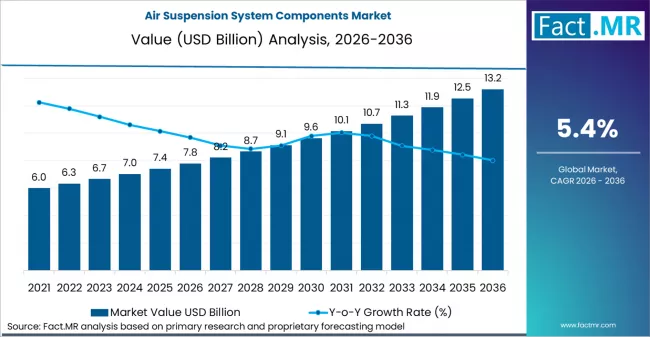
    Air Suspension System Components Market Market Value Analysis

    North America and Europe will continue to dominate due to high vehicle production volumes and regulatory-driven demand for improved ride quality and safety standards. However, emerging markets in Asia-Pacific are showing growing interest, driven by increasing vehicle production and rising consumer preferences for comfort. Geographic cost advantages will also play a role, as manufacturers in regions with lower labor costs may see improved margins, influencing global supply chain strategies. The pace and extent of adoption will vary, with some regions prioritizing air suspension systems for commercial vehicles, while others focus on passenger vehicles, creating a fragmented but interconnected global market.

    Air Suspension System Components Market

    Metric Value
    Estimated Value in (2026E) USD 7.8 billion
    Forecast Value in (2036F) USD 13.2 billion
    Forecast CAGR (2026 to 2036) 5.4%

    Category

    Category Segments
    Sales Channel First Fit (OEM); Aftermarket
    Component Air Springs; Compressors; Valve Blocks; Reservoir or Lines; ECU or Sensors
    Vehicle Type Passenger Cars; SUV or Pickup; Commercial Vehicles
    System Type Full Air Suspension; Air-assisted or Partial
    Voltage 12V; 48V
    Region North America; Europe; Asia Pacific; Latin America; Middle East & Africa

    Strategic Intelligence Brief: Air Suspension System Components Market

    How is the First Fit (OEM) Segment Shaping the Air Suspension System Components Market?
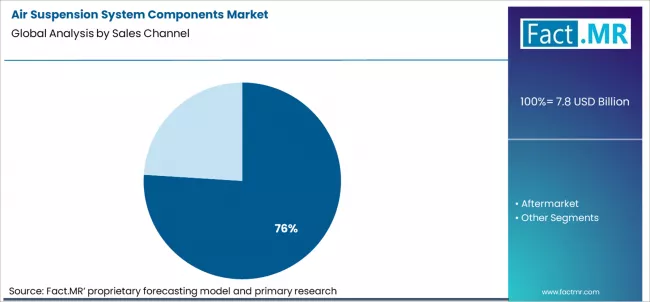
    Air Suspension System Components Market Analysis By Sales Channel

    The First Fit (OEM) segment holds a dominant 76% market share in 2026, driven by the structural integration of air suspension systems into premium vehicle platforms and heavy-duty commercial trucks during primary assembly. OEMs are increasingly standardizing air suspension in luxury SUVs and electric vehicles (EVs) to manage battery weight and optimize aerodynamics, particularly with high-speed "lowering" modes. ZF Friedrichshafen AG and Continental AG are key OEM partners, with ZF’s "Smart Air" modules-integrating the compressor, valve block, and ECU-being deployed in major 2026 European and North American SUV programs to streamline assembly. Over 80% of new heavy-duty trucks from Volvo and Daimler in Europe are factory-fitted with heavy duty air suspension to meet 2026 stability and cargo safety mandates.

    What is Driving the Dominance of the 12V Voltage Architecture in the Air Suspension System Market?
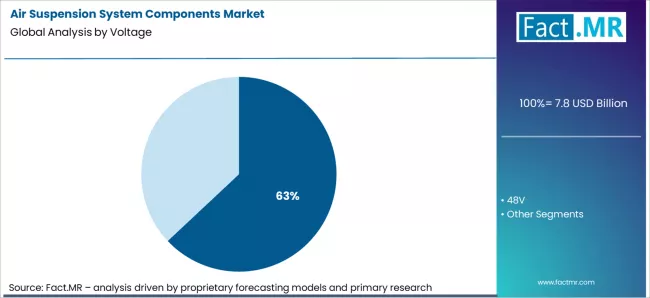
    Air Suspension System Components Market Analysis By Voltage

    The 12V voltage architecture continues to dominate the air suspension system market, holding 63% of the market share in 2026. This dominance is fueled by the high volume of ICE and hybrid vehicles that rely on traditional auxiliary power for compressors and solenoid valves. The 12V standard remains the cost-effective choice for most light commercial vehicles (LCVs) and mass-premium passenger cars. However, 48V systems are gaining traction, especially in "Fully Active" suspensions. These systems power high-current electric compressors, allowing vehicle height adjustments in less than 1 second, significantly outperforming traditional 12V systems that take 5-10 seconds. Dual-compatible micro-motors from companies like Buhler Motor and Nidec enable OEMs to use a single component across various powertrain architectures, advancing the market’s technological convergence.

    Air Suspension System Components Market - Drivers, Restraints & Trends

    Country Drivers Restraints Trends
    USA High demand for luxury and SUV segments increases air suspension uptake. Higher system cost limits penetration in entry vehicles. Integration with adaptive ride and safety systems.
    China Growth in premium and EV segments supports adoption of air suspension components. Cost sensitivity in mass market models. Localized production and feature bundling with ADAS.
    India Rising premium vehicle sales boost interest in comfort oriented suspension systems. Price constraints lower adoption outside premium segment. Aftermarket demand and retrofit upgrades.
    Germany Premium automotive engineering and performance expectations drive strong adoption. Electrification and lightweight design priorities may shift suspension approaches. Advanced damping and predictive control integration.
    Japan OEM focus on ride comfort and stability supports adoption in premium models. Slower growth in large luxury segments limits overall volume. Lightweight, energy efficient air suspension designs.

    Analysis of the Air Suspension System Components Market by Key Country
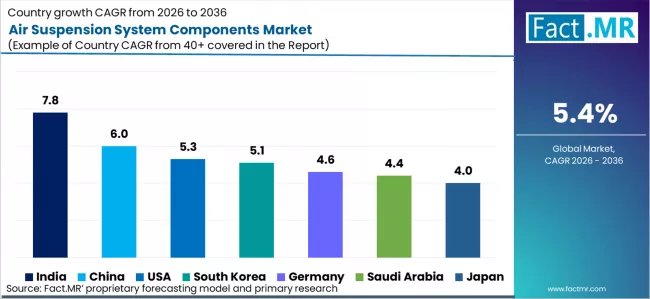
    Air Suspension System Components Market Cagr Analysis By Country

    Country CAGR (Forecast Period)
    USA 5.3%
    China 6.0%
    India 7.8%
    Germany 4.6%
    Japan 4.0%
    South Korea 5.1%
    Saudi Arabia 4.4%

    What Drives the 5.3% Growth in the USA Air Suspension Market?

    The USA air suspension market is growing at 5.3% due to several factors, notably the rising adoption of air suspension in electric pickup trucks and luxury SUVs. Under the NHTSA’s 2026 CAFE standards, automakers are deploying "Aero-Lowering" air suspension systems to meet the target of 49 mpg fleet average. Vehicles like the Rivian R1T and Tesla Cybertruck are using high-output air compressors and composite air reservoirs to enable variable ground clearance for off-road use while maintaining highway efficiency. Additionally, the market is seeing increased adoption of air suspension in "Last-Mile" delivery vans to protect sensitive cargo and improve driver ergonomics during frequent loading cycles.

    Why is the China Air Suspension Market Projected to Expand at a 6.0% Rate?

    The China air suspension market is projected to expand at 6.0% due to the MIIT’s push for Intelligent New Energy Vehicles. Air suspension technology has transitioned from the high-end luxury market into the mid-market, with domestic brands like Li Auto and NIO integrating air systems as standard features. This "scale effect" has allowed local suppliers such as Ningbo Tuopu and Shanghai Baolong to capture nearly 70% of the domestic market share, reducing the cost of air springs and ECUs. Moreover, the government's focus on autonomous driving and smart vehicles further increases demand for air suspension to enhance passenger comfort and stability in future EVs.

    How Does the 7.8% Growth Reflect the India Air Suspension Market Expansion?

    India is leading the growth with a 7.8% rate, driven by the Premiumization of the country’s automotive market and the PLI Scheme for advanced components. The Ministry of Road Transport and Highways (MoRTH) is pushing for the adoption of air suspension in the "Intercity Luxury Coach" segment, which improves passenger safety and reduces road damage. Additionally, the rapid growth of the e-commerce sector and increasing demand for high-capacity trucks that traverse India’s diverse road network is contributing to demand for air suspension. Tier-1 suppliers like Wheels India are expanding local production, aligning with government efforts to increase domestic value addition in automotive components.

    What Supports the 4.6% Growth for the Germany Air Suspension Market?

    The Germany air suspension market is growing at 4.6%, driven by the upcoming Euro 7 regulations that emphasize reducing non-exhaust emissions, including tire and brake dust. Adaptive air suspension helps optimize tire-to-road contact, reducing uneven tire wear and minimizing particulate emissions. German luxury brands such as Mercedes-Benz, BMW, and Porsche are at the forefront of introducing Sustainable Air Springs made from thermoplastic polyurethane (TPU) and recycled fiber-reinforced composites. The demand for air suspension is also increasing with the rise of Level 3 Autonomous Driving, where air suspension ensures a smooth "lounge" experience for passengers, making it a crucial component for autonomous vehicles.

    How Does Japan Achieve Growth in the Air Suspension Market?

    Japan’s 4.0% growth is influenced by the METI Green Transformation (GX) 2040 Vision, which encourages energy-efficient automotive technologies. Japanese suppliers like Hitachi Astemo are developing Energy-Harvesting Air Suspension components that capture the kinetic energy of air compression to power system sensors. The market is also experiencing a shift towards "Kneeling" air suspension in public transport and personal SUVs, making it easier for elderly passengers to enter and exit vehicles. This inclusive mobility focus ensures continued demand for air suspension components, particularly in urban public transport and the hybrid segment.

    Why Does South Korea Exhibit 5.1% Growth in Air Suspension Systems?

    The South Korea air suspension market is growing at 5.1%, bolstered by the K-Mobility Strategy, which emphasizes Integrated Chassis Systems. South Korea is leading the development of "Preview Air Suspension" systems that use front cameras and navigation data to identify road imperfections up to 500 meters ahead, adjusting air pressure accordingly. The government's focus on Cyber-Secure ECUs for air suspension further enhances safety and performance, making South Korean components highly attractive for global EV manufacturers. This technological advancement ensures South Korea remains competitive in the premium automotive market.

    How is the Saudi Arabia Air Suspension Market Maintaining a 4.4% Rate?

    The Saudi Arabia air suspension market is growing at 4.4%, driven by Vision 2030 and the country’s harsh desert terrain. The Saudi Industrial Development Fund (SIDF) is supporting the local assembly of air suspension components, especially for the Ceer and Lucid EV manufacturing plants. In this market, air suspension is valued for its ability to adjust for sand clearance and provide extreme cooling for suspension components in high temperatures. The aftermarket also plays a significant role, as the extreme 50°C summer heat accelerates the wear of rubber air bellows, driving a high demand for heat-resistant components.

    How Are Participants Competing in the Air Suspension Components Market?
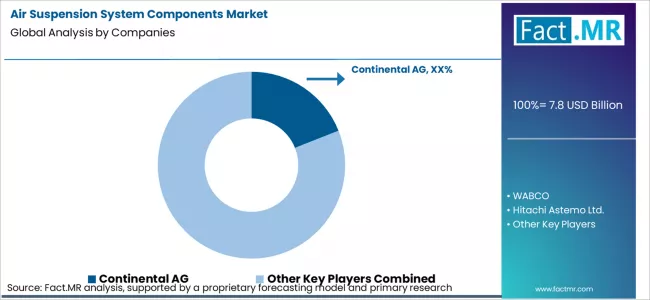
    Air Suspension System Components Market Analysis By Company

    The air suspension components market is undergoing a major transformation as it shifts from traditional luxury comfort systems to more efficiency-driven electrification and integrated smart pneumatics. Leading companies such as Continental, ZF/WABCO, BWI, and RAPA are focusing on weight reduction and aerodynamic optimization to extend the range of electric vehicles (EVs). Notably, Continental launched a dedicated air suspension system for EVs in 2025, while ZF introduced a Smart Pneumatic Actuator for Hyundai, integrating solenoid valves and pressure sensors into one compact unit. As the market moves forward, AI-based predictive suspension and active aero-leveling systems will dominate, improving vehicle efficiency and durability. Companies are also embracing sustainability by using lightweight materials and reducing embedded carbon. In the future, the air suspension system will evolve from a comfort feature to an energy-saving tool, with the potential to optimize aerodynamic drag through AI-driven adjustments. Firms that fail to incorporate these smart and sustainable systems into the central energy management of the vehicle will be left behind as leaders capture range extension contracts for electric vehicles.

    Recent Industry Developments

    • Patent - Integrated Air Supply Unit for Air Suspension (Mar 26, 2025): A new integrated air supply and control unit for an air suspension system was published, combining compressor, valves, manifold, and desiccator into a unified module to improve packaging and control efficiency of system components (air springs, valves, reservoirs). ???? Patent - Integrated air supply unit for vehicle air suspension (EP4166785NWB1): https://data.epo.org/publication-server/rest/v1.2/publication-dates/2025-03-26/patents/EP4166785NWB1/document.pdf (European Publication Server)
    • Patent - Air Suspension System with Fast Down Leveling Valves (Published/Active 2024): An air suspension system including an air supply block with multiple integrated valves and fast down leveling valves was granted, highlighting component innovations in air spring valve blocks and integrated pneumatic control systems. ???? Patent - Air suspension system with integrated air supply and fast down leveling valves (US11590819B2): https://patents.google.com/patent/US11590819B2/en (Google Patents)

    Key Players of the Air Suspension Components Market

    • Continental AG
    • WABCO
    • Hitachi Astemo Ltd.
    • BWI Company Ltd.
    • RAPA Automotive Parts & Components GmbH & Co. KG
    • Firestone Industrial Products Company, LLC
    • Dunlop Systems
    • Mando Corporation
    • thyssenkrupp AG
    • Haldex AB

    Scope of the Report

    Items Values
    Quantitative Units (2026) USD Billion
    Sales Channel First Fit (OEM), Aftermarket
    Component Air Springs, Compressors, Valve Blocks, Reservoir or Lines, ECU or Sensors
    Vehicle Type Passenger Cars, SUV or Pickup, Commercial Vehicles
    System Type Full Air Suspension, Air-assisted or Partial
    Voltage 12V, 48V
    Regions Covered North America, Europe, Asia Pacific, Latin America, Middle East & Africa
    Countries Covered United States, Canada, Mexico, Germany, United Kingdom, France, Japan, South Korea, China, India, Brazil, and other countries
    Key Companies Profiled Continental AG, WABCO, Hitachi Astemo Ltd., BWI Company Ltd., RAPA Automotive Parts & Components GmbH & Co. KG, Firestone Industrial Products Company, LLC, Dunlop Systems, Mando Corporation, thyssenkrupp AG, Haldex AB
    Additional Attributes Dollar revenue by sales channel, component, vehicle type, system type, voltage, and region; regional demand trends, competitive landscape, technological advancements in air suspension system components, operational performance optimization initiatives, and product development strategies

    Air Suspension System Components Market Key Segments

    • Sales Channel :

      • First Fit (OEM)
      • Aftermarket
    • Component :

      • Air Springs
      • Compressors
      • Valve Blocks
      • Reservoir or Lines
      • ECU or Sensors
    • Vehicle Type :

      • Passenger Cars
      • SUV or Pickup
      • Commercial Vehicles
    • System Type :

      • Full Air Suspension
      • Air-assisted or Partial
    • Voltage :

      • 12V
      • 48V
    • Region :

      • North America
        • USA
        • Canada
        • Mexico
      • Europe
        • Germany
        • UK
        • France
        • Italy
        • Spain
        • Nordic Countries
        • BENELUX
        • Rest of Europe
      • Asia Pacific
        • China
        • Japan
        • South Korea
        • India
        • Australia
        • Rest of Asia Pacific
      • Latin America
        • Brazil
        • Argentina
        • Rest of Latin America
      • Middle East and Africa
        • Kingdom of Saudi Arabia
        • United Arab Emirates
        • South Africa
        • Rest of Middle East and Africa
      • Other Regions
        • Oceania
        • Central Asia
        • Other Markets

    Bibliographies

    • Society of Automotive Engineers (SAE). (2023). Air spring design and pneumatic control strategies for vehicle load leveling and ride comfort. SAE Technical Paper Series.
    • International Organization for Standardization. (2023). ISO 4414: Pneumatic fluid power - General rules and safety requirements for systems and their components. ISO.
    • United Nations Economic Commission for Europe (UNECE). (2024). Vehicle stability and suspension performance under UN Regulation No. 13 and No. 140. UNECE Transport Division.
    • National Highway Traffic Safety Administration (NHTSA). (2023). Suspension system performance, vehicle stability, and load compensation in passenger and commercial vehicles. U.S. Department of Transportation.
    • Institute of Electrical and Electronics Engineers (IEEE). (2024). Electro-pneumatic control architectures for adaptive air suspension systems. IEEE Xplore Digital Library.

    Table of Content

    1. Executive Summary
      • Global Market Outlook
      • Demand to side Trends
      • Supply to side Trends
      • Technology Roadmap Analysis
      • Analysis and Recommendations
    2. Market Overview
      • Market Coverage / Taxonomy
      • Market Definition / Scope / Limitations
    3. Research Methodology
      • Chapter Orientation
      • Analytical Lens and Working Hypotheses
        • Market Structure, Signals, and Trend Drivers
        • Benchmarking and Cross-market Comparability
        • Market Sizing, Forecasting, and Opportunity Mapping
      • Research Design and Evidence Framework
        • Desk Research Programme (Secondary Evidence)
          • Company Annual and Sustainability Reports
          • Peer-reviewed Journals and Academic Literature
          • Corporate Websites, Product Literature, and Technical Notes
          • Earnings Decks and Investor Briefings
          • Statutory Filings and Regulatory Disclosures
          • Technical White Papers and Standards Notes
          • Trade Journals, Industry Magazines, and Analyst Briefs
          • Conference Proceedings, Webinars, and Seminar Materials
          • Government Statistics Portals and Public Data Releases
          • Press Releases and Reputable Media Coverage
          • Specialist Newsletters and Curated Briefings
          • Sector Databases and Reference Repositories
          • FMR Internal Proprietary Databases and Historical Market Datasets
          • Subscription Datasets and Paid Sources
          • Social Channels, Communities, and Digital Listening Inputs
          • Additional Desk Sources
        • Expert Input and Fieldwork (Primary Evidence)
          • Primary Modes
            • Qualitative Interviews and Expert Elicitation
            • Quantitative Surveys and Structured Data Capture
            • Blended Approach
          • Why Primary Evidence is Used
          • Field Techniques
            • Interviews
            • Surveys
            • Focus Groups
            • Observational and In-context Research
            • Social and Community Interactions
          • Stakeholder Universe Engaged
            • C-suite Leaders
            • Board Members
            • Presidents and Vice Presidents
            • R&D and Innovation Heads
            • Technical Specialists
            • Domain Subject-matter Experts
            • Scientists
            • Physicians and Other Healthcare Professionals
          • Governance, Ethics, and Data Stewardship
            • Research Ethics
            • Data Integrity and Handling
        • Tooling, Models, and Reference Databases
      • Data Engineering and Model Build
        • Data Acquisition and Ingestion
        • Cleaning, Normalisation, and Verification
        • Synthesis, Triangulation, and Analysis
      • Quality Assurance and Audit Trail
    4. Market Background
      • Market Dynamics
        • Drivers
        • Restraints
        • Opportunity
        • Trends
      • Scenario Forecast
        • Demand in Optimistic Scenario
        • Demand in Likely Scenario
        • Demand in Conservative Scenario
      • Opportunity Map Analysis
      • Product Life Cycle Analysis
      • Supply Chain Analysis
      • Investment Feasibility Matrix
      • Value Chain Analysis
      • PESTLE and Porter’s Analysis
      • Regulatory Landscape
      • Regional Parent Market Outlook
      • Production and Consumption Statistics
      • Import and Export Statistics
    5. Global Market Analysis 2021 to 2025 and Forecast, 2026 to 2036
      • Historical Market Size Value (USD Million) Analysis, 2021 to 2025
      • Current and Future Market Size Value (USD Million) Projections, 2026 to 2036
        • Y to o to Y Growth Trend Analysis
        • Absolute $ Opportunity Analysis
    6. Global Market Pricing Analysis 2021 to 2025 and Forecast 2026 to 2036
    7. Global Market Analysis 2021 to 2025 and Forecast 2026 to 2036, By Sales Channel
      • Introduction / Key Findings
      • Historical Market Size Value (USD Million) Analysis By Sales Channel, 2021 to 2025
      • Current and Future Market Size Value (USD Million) Analysis and Forecast By Sales Channel, 2026 to 2036
        • First Fit (OEM)
        • Aftermarket
      • Y to o to Y Growth Trend Analysis By Sales Channel, 2021 to 2025
      • Absolute $ Opportunity Analysis By Sales Channel, 2026 to 2036
    8. Global Market Analysis 2021 to 2025 and Forecast 2026 to 2036, By Component
      • Introduction / Key Findings
      • Historical Market Size Value (USD Million) Analysis By Component, 2021 to 2025
      • Current and Future Market Size Value (USD Million) Analysis and Forecast By Component, 2026 to 2036
        • Air Springs
        • Compressors
        • Valve Blocks
        • Reservoir or Lines
        • ECU or Sensors
      • Y to o to Y Growth Trend Analysis By Component, 2021 to 2025
      • Absolute $ Opportunity Analysis By Component, 2026 to 2036
    9. Global Market Analysis 2021 to 2025 and Forecast 2026 to 2036, By Vehicle Type
      • Introduction / Key Findings
      • Historical Market Size Value (USD Million) Analysis By Vehicle Type, 2021 to 2025
      • Current and Future Market Size Value (USD Million) Analysis and Forecast By Vehicle Type, 2026 to 2036
        • Passenger Cars
        • SUV or Pickup
        • Commercial Vehicles
      • Y to o to Y Growth Trend Analysis By Vehicle Type, 2021 to 2025
      • Absolute $ Opportunity Analysis By Vehicle Type, 2026 to 2036
    10. Global Market Analysis 2021 to 2025 and Forecast 2026 to 2036, By System Type
      • Introduction / Key Findings
      • Historical Market Size Value (USD Million) Analysis By System Type, 2021 to 2025
      • Current and Future Market Size Value (USD Million) Analysis and Forecast By System Type, 2026 to 2036
        • Full Air Suspension
        • Air-assisted or Partial
      • Y to o to Y Growth Trend Analysis By System Type, 2021 to 2025
      • Absolute $ Opportunity Analysis By System Type, 2026 to 2036
    11. Global Market Analysis 2021 to 2025 and Forecast 2026 to 2036, By Voltage
      • Introduction / Key Findings
      • Historical Market Size Value (USD Million) Analysis By Voltage, 2021 to 2025
      • Current and Future Market Size Value (USD Million) Analysis and Forecast By Voltage, 2026 to 2036
        • 12V
        • 48V
      • Y to o to Y Growth Trend Analysis By Voltage, 2021 to 2025
      • Absolute $ Opportunity Analysis By Voltage, 2026 to 2036
    12. Global Market Analysis 2021 to 2025 and Forecast 2026 to 2036, By Region
      • Introduction
      • Historical Market Size Value (USD Million) Analysis By Region, 2021 to 2025
      • Current Market Size Value (USD Million) Analysis and Forecast By Region, 2026 to 2036
        • North America
        • Latin America
        • Western Europe
        • Eastern Europe
        • East Asia
        • South Asia and Pacific
        • Middle East & Africa
      • Market Attractiveness Analysis By Region
    13. North America Market Analysis 2021 to 2025 and Forecast 2026 to 2036, By Country
      • Historical Market Size Value (USD Million) Trend Analysis By Market Taxonomy, 2021 to 2025
      • Market Size Value (USD Million) Forecast By Market Taxonomy, 2026 to 2036
        • By Country
          • USA
          • Canada
          • Mexico
        • By Sales Channel
        • By Component
        • By Vehicle Type
        • By System Type
        • By Voltage
      • Market Attractiveness Analysis
        • By Country
        • By Sales Channel
        • By Component
        • By Vehicle Type
        • By System Type
        • By Voltage
      • Key Takeaways
    14. Latin America Market Analysis 2021 to 2025 and Forecast 2026 to 2036, By Country
      • Historical Market Size Value (USD Million) Trend Analysis By Market Taxonomy, 2021 to 2025
      • Market Size Value (USD Million) Forecast By Market Taxonomy, 2026 to 2036
        • By Country
          • Brazil
          • Chile
          • Rest of Latin America
        • By Sales Channel
        • By Component
        • By Vehicle Type
        • By System Type
        • By Voltage
      • Market Attractiveness Analysis
        • By Country
        • By Sales Channel
        • By Component
        • By Vehicle Type
        • By System Type
        • By Voltage
      • Key Takeaways
    15. Western Europe Market Analysis 2021 to 2025 and Forecast 2026 to 2036, By Country
      • Historical Market Size Value (USD Million) Trend Analysis By Market Taxonomy, 2021 to 2025
      • Market Size Value (USD Million) Forecast By Market Taxonomy, 2026 to 2036
        • By Country
          • Germany
          • UK
          • Italy
          • Spain
          • France
          • Nordic
          • BENELUX
          • Rest of Western Europe
        • By Sales Channel
        • By Component
        • By Vehicle Type
        • By System Type
        • By Voltage
      • Market Attractiveness Analysis
        • By Country
        • By Sales Channel
        • By Component
        • By Vehicle Type
        • By System Type
        • By Voltage
      • Key Takeaways
    16. Eastern Europe Market Analysis 2021 to 2025 and Forecast 2026 to 2036, By Country
      • Historical Market Size Value (USD Million) Trend Analysis By Market Taxonomy, 2021 to 2025
      • Market Size Value (USD Million) Forecast By Market Taxonomy, 2026 to 2036
        • By Country
          • Russia
          • Poland
          • Hungary
          • Balkan & Baltic
          • Rest of Eastern Europe
        • By Sales Channel
        • By Component
        • By Vehicle Type
        • By System Type
        • By Voltage
      • Market Attractiveness Analysis
        • By Country
        • By Sales Channel
        • By Component
        • By Vehicle Type
        • By System Type
        • By Voltage
      • Key Takeaways
    17. East Asia Market Analysis 2021 to 2025 and Forecast 2026 to 2036, By Country
      • Historical Market Size Value (USD Million) Trend Analysis By Market Taxonomy, 2021 to 2025
      • Market Size Value (USD Million) Forecast By Market Taxonomy, 2026 to 2036
        • By Country
          • China
          • Japan
          • South Korea
        • By Sales Channel
        • By Component
        • By Vehicle Type
        • By System Type
        • By Voltage
      • Market Attractiveness Analysis
        • By Country
        • By Sales Channel
        • By Component
        • By Vehicle Type
        • By System Type
        • By Voltage
      • Key Takeaways
    18. South Asia and Pacific Market Analysis 2021 to 2025 and Forecast 2026 to 2036, By Country
      • Historical Market Size Value (USD Million) Trend Analysis By Market Taxonomy, 2021 to 2025
      • Market Size Value (USD Million) Forecast By Market Taxonomy, 2026 to 2036
        • By Country
          • India
          • ASEAN
          • Australia & New Zealand
          • Rest of South Asia and Pacific
        • By Sales Channel
        • By Component
        • By Vehicle Type
        • By System Type
        • By Voltage
      • Market Attractiveness Analysis
        • By Country
        • By Sales Channel
        • By Component
        • By Vehicle Type
        • By System Type
        • By Voltage
      • Key Takeaways
    19. Middle East & Africa Market Analysis 2021 to 2025 and Forecast 2026 to 2036, By Country
      • Historical Market Size Value (USD Million) Trend Analysis By Market Taxonomy, 2021 to 2025
      • Market Size Value (USD Million) Forecast By Market Taxonomy, 2026 to 2036
        • By Country
          • Kingdom of Saudi Arabia
          • Other GCC Countries
          • Turkiye
          • South Africa
          • Other African Union
          • Rest of Middle East & Africa
        • By Sales Channel
        • By Component
        • By Vehicle Type
        • By System Type
        • By Voltage
      • Market Attractiveness Analysis
        • By Country
        • By Sales Channel
        • By Component
        • By Vehicle Type
        • By System Type
        • By Voltage
      • Key Takeaways
    20. Key Countries Market Analysis
      • USA
        • Pricing Analysis
        • Market Share Analysis, 2025
          • By Sales Channel
          • By Component
          • By Vehicle Type
          • By System Type
          • By Voltage
      • Canada
        • Pricing Analysis
        • Market Share Analysis, 2025
          • By Sales Channel
          • By Component
          • By Vehicle Type
          • By System Type
          • By Voltage
      • Mexico
        • Pricing Analysis
        • Market Share Analysis, 2025
          • By Sales Channel
          • By Component
          • By Vehicle Type
          • By System Type
          • By Voltage
      • Brazil
        • Pricing Analysis
        • Market Share Analysis, 2025
          • By Sales Channel
          • By Component
          • By Vehicle Type
          • By System Type
          • By Voltage
      • Chile
        • Pricing Analysis
        • Market Share Analysis, 2025
          • By Sales Channel
          • By Component
          • By Vehicle Type
          • By System Type
          • By Voltage
      • Germany
        • Pricing Analysis
        • Market Share Analysis, 2025
          • By Sales Channel
          • By Component
          • By Vehicle Type
          • By System Type
          • By Voltage
      • UK
        • Pricing Analysis
        • Market Share Analysis, 2025
          • By Sales Channel
          • By Component
          • By Vehicle Type
          • By System Type
          • By Voltage
      • Italy
        • Pricing Analysis
        • Market Share Analysis, 2025
          • By Sales Channel
          • By Component
          • By Vehicle Type
          • By System Type
          • By Voltage
      • Spain
        • Pricing Analysis
        • Market Share Analysis, 2025
          • By Sales Channel
          • By Component
          • By Vehicle Type
          • By System Type
          • By Voltage
      • France
        • Pricing Analysis
        • Market Share Analysis, 2025
          • By Sales Channel
          • By Component
          • By Vehicle Type
          • By System Type
          • By Voltage
      • India
        • Pricing Analysis
        • Market Share Analysis, 2025
          • By Sales Channel
          • By Component
          • By Vehicle Type
          • By System Type
          • By Voltage
      • ASEAN
        • Pricing Analysis
        • Market Share Analysis, 2025
          • By Sales Channel
          • By Component
          • By Vehicle Type
          • By System Type
          • By Voltage
      • Australia & New Zealand
        • Pricing Analysis
        • Market Share Analysis, 2025
          • By Sales Channel
          • By Component
          • By Vehicle Type
          • By System Type
          • By Voltage
      • China
        • Pricing Analysis
        • Market Share Analysis, 2025
          • By Sales Channel
          • By Component
          • By Vehicle Type
          • By System Type
          • By Voltage
      • Japan
        • Pricing Analysis
        • Market Share Analysis, 2025
          • By Sales Channel
          • By Component
          • By Vehicle Type
          • By System Type
          • By Voltage
      • South Korea
        • Pricing Analysis
        • Market Share Analysis, 2025
          • By Sales Channel
          • By Component
          • By Vehicle Type
          • By System Type
          • By Voltage
      • Russia
        • Pricing Analysis
        • Market Share Analysis, 2025
          • By Sales Channel
          • By Component
          • By Vehicle Type
          • By System Type
          • By Voltage
      • Poland
        • Pricing Analysis
        • Market Share Analysis, 2025
          • By Sales Channel
          • By Component
          • By Vehicle Type
          • By System Type
          • By Voltage
      • Hungary
        • Pricing Analysis
        • Market Share Analysis, 2025
          • By Sales Channel
          • By Component
          • By Vehicle Type
          • By System Type
          • By Voltage
      • Kingdom of Saudi Arabia
        • Pricing Analysis
        • Market Share Analysis, 2025
          • By Sales Channel
          • By Component
          • By Vehicle Type
          • By System Type
          • By Voltage
      • Turkiye
        • Pricing Analysis
        • Market Share Analysis, 2025
          • By Sales Channel
          • By Component
          • By Vehicle Type
          • By System Type
          • By Voltage
      • South Africa
        • Pricing Analysis
        • Market Share Analysis, 2025
          • By Sales Channel
          • By Component
          • By Vehicle Type
          • By System Type
          • By Voltage
    21. Market Structure Analysis
      • Competition Dashboard
      • Competition Benchmarking
      • Market Share Analysis of Top Players
        • By Regional
        • By Sales Channel
        • By Component
        • By Vehicle Type
        • By System Type
        • By Voltage
    22. Competition Analysis
      • Competition Deep Dive
        • Continental AG
          • Overview
          • Product Portfolio
          • Profitability by Market Segments (Product/Age /Sales Channel/Region)
          • Sales Footprint
          • Strategy Overview
            • Marketing Strategy
            • Product Strategy
            • Channel Strategy
        • WABCO
        • Hitachi Astemo Ltd.
        • BWI Company Ltd.
        • RAPA Automotive Parts & Components GmbH & Co. KG
        • Firestone Industrial Products Company, LLC
        • Dunlop Systems
        • Mando Corporation
        • thyssenkrupp AG
        • Haldex AB
    23. Assumptions & Acronyms Used

    List Of Table

    • Table 1: Global Market Value (USD Million) Forecast by Region, 2021 to 2036
    • Table 2: Global Market Value (USD Million) Forecast by Sales Channel, 2021 to 2036
    • Table 3: Global Market Value (USD Million) Forecast by Component, 2021 to 2036
    • Table 4: Global Market Value (USD Million) Forecast by Vehicle Type, 2021 to 2036
    • Table 5: Global Market Value (USD Million) Forecast by System Type, 2021 to 2036
    • Table 6: Global Market Value (USD Million) Forecast by Voltage, 2021 to 2036
    • Table 7: North America Market Value (USD Million) Forecast by Country, 2021 to 2036
    • Table 8: North America Market Value (USD Million) Forecast by Sales Channel, 2021 to 2036
    • Table 9: North America Market Value (USD Million) Forecast by Component, 2021 to 2036
    • Table 10: North America Market Value (USD Million) Forecast by Vehicle Type, 2021 to 2036
    • Table 11: North America Market Value (USD Million) Forecast by System Type, 2021 to 2036
    • Table 12: North America Market Value (USD Million) Forecast by Voltage, 2021 to 2036
    • Table 13: Latin America Market Value (USD Million) Forecast by Country, 2021 to 2036
    • Table 14: Latin America Market Value (USD Million) Forecast by Sales Channel, 2021 to 2036
    • Table 15: Latin America Market Value (USD Million) Forecast by Component, 2021 to 2036
    • Table 16: Latin America Market Value (USD Million) Forecast by Vehicle Type, 2021 to 2036
    • Table 17: Latin America Market Value (USD Million) Forecast by System Type, 2021 to 2036
    • Table 18: Latin America Market Value (USD Million) Forecast by Voltage, 2021 to 2036
    • Table 19: Western Europe Market Value (USD Million) Forecast by Country, 2021 to 2036
    • Table 20: Western Europe Market Value (USD Million) Forecast by Sales Channel, 2021 to 2036
    • Table 21: Western Europe Market Value (USD Million) Forecast by Component, 2021 to 2036
    • Table 22: Western Europe Market Value (USD Million) Forecast by Vehicle Type, 2021 to 2036
    • Table 23: Western Europe Market Value (USD Million) Forecast by System Type, 2021 to 2036
    • Table 24: Western Europe Market Value (USD Million) Forecast by Voltage, 2021 to 2036
    • Table 25: Eastern Europe Market Value (USD Million) Forecast by Country, 2021 to 2036
    • Table 26: Eastern Europe Market Value (USD Million) Forecast by Sales Channel, 2021 to 2036
    • Table 27: Eastern Europe Market Value (USD Million) Forecast by Component, 2021 to 2036
    • Table 28: Eastern Europe Market Value (USD Million) Forecast by Vehicle Type, 2021 to 2036
    • Table 29: Eastern Europe Market Value (USD Million) Forecast by System Type, 2021 to 2036
    • Table 30: Eastern Europe Market Value (USD Million) Forecast by Voltage, 2021 to 2036
    • Table 31: East Asia Market Value (USD Million) Forecast by Country, 2021 to 2036
    • Table 32: East Asia Market Value (USD Million) Forecast by Sales Channel, 2021 to 2036
    • Table 33: East Asia Market Value (USD Million) Forecast by Component, 2021 to 2036
    • Table 34: East Asia Market Value (USD Million) Forecast by Vehicle Type, 2021 to 2036
    • Table 35: East Asia Market Value (USD Million) Forecast by System Type, 2021 to 2036
    • Table 36: East Asia Market Value (USD Million) Forecast by Voltage, 2021 to 2036
    • Table 37: South Asia and Pacific Market Value (USD Million) Forecast by Country, 2021 to 2036
    • Table 38: South Asia and Pacific Market Value (USD Million) Forecast by Sales Channel, 2021 to 2036
    • Table 39: South Asia and Pacific Market Value (USD Million) Forecast by Component, 2021 to 2036
    • Table 40: South Asia and Pacific Market Value (USD Million) Forecast by Vehicle Type, 2021 to 2036
    • Table 41: South Asia and Pacific Market Value (USD Million) Forecast by System Type, 2021 to 2036
    • Table 42: South Asia and Pacific Market Value (USD Million) Forecast by Voltage, 2021 to 2036
    • Table 43: Middle East & Africa Market Value (USD Million) Forecast by Country, 2021 to 2036
    • Table 44: Middle East & Africa Market Value (USD Million) Forecast by Sales Channel, 2021 to 2036
    • Table 45: Middle East & Africa Market Value (USD Million) Forecast by Component, 2021 to 2036
    • Table 46: Middle East & Africa Market Value (USD Million) Forecast by Vehicle Type, 2021 to 2036
    • Table 47: Middle East & Africa Market Value (USD Million) Forecast by System Type, 2021 to 2036
    • Table 48: Middle East & Africa Market Value (USD Million) Forecast by Voltage, 2021 to 2036

    List Of Figures

    • Figure 1: Global Market Pricing Analysis
    • Figure 2: Global Market Value (USD Million) Forecast 2021 to 2036
    • Figure 3: Global Market Value Share and BPS Analysis by Sales Channel, 2026 and 2036
    • Figure 4: Global Market Y to o to Y Growth Comparison by Sales Channel, 2026 to 2036
    • Figure 5: Global Market Attractiveness Analysis by Sales Channel
    • Figure 6: Global Market Value Share and BPS Analysis by Component, 2026 and 2036
    • Figure 7: Global Market Y to o to Y Growth Comparison by Component, 2026 to 2036
    • Figure 8: Global Market Attractiveness Analysis by Component
    • Figure 9: Global Market Value Share and BPS Analysis by Vehicle Type, 2026 and 2036
    • Figure 10: Global Market Y to o to Y Growth Comparison by Vehicle Type, 2026 to 2036
    • Figure 11: Global Market Attractiveness Analysis by Vehicle Type
    • Figure 12: Global Market Value Share and BPS Analysis by System Type, 2026 and 2036
    • Figure 13: Global Market Y to o to Y Growth Comparison by System Type, 2026 to 2036
    • Figure 14: Global Market Attractiveness Analysis by System Type
    • Figure 15: Global Market Value Share and BPS Analysis by Voltage, 2026 and 2036
    • Figure 16: Global Market Y to o to Y Growth Comparison by Voltage, 2026 to 2036
    • Figure 17: Global Market Attractiveness Analysis by Voltage
    • Figure 18: Global Market Value (USD Million) Share and BPS Analysis by Region, 2026 and 2036
    • Figure 19: Global Market Y to o to Y Growth Comparison by Region, 2026 to 2036
    • Figure 20: Global Market Attractiveness Analysis by Region
    • Figure 21: North America Market Incremental Dollar Opportunity, 2026 to 2036
    • Figure 22: Latin America Market Incremental Dollar Opportunity, 2026 to 2036
    • Figure 23: Western Europe Market Incremental Dollar Opportunity, 2026 to 2036
    • Figure 24: Eastern Europe Market Incremental Dollar Opportunity, 2026 to 2036
    • Figure 25: East Asia Market Incremental Dollar Opportunity, 2026 to 2036
    • Figure 26: South Asia and Pacific Market Incremental Dollar Opportunity, 2026 to 2036
    • Figure 27: Middle East & Africa Market Incremental Dollar Opportunity, 2026 to 2036
    • Figure 28: North America Market Value Share and BPS Analysis by Country, 2026 and 2036
    • Figure 29: North America Market Value Share and BPS Analysis by Sales Channel, 2026 and 2036
    • Figure 30: North America Market Y to o to Y Growth Comparison by Sales Channel, 2026 to 2036
    • Figure 31: North America Market Attractiveness Analysis by Sales Channel
    • Figure 32: North America Market Value Share and BPS Analysis by Component, 2026 and 2036
    • Figure 33: North America Market Y to o to Y Growth Comparison by Component, 2026 to 2036
    • Figure 34: North America Market Attractiveness Analysis by Component
    • Figure 35: North America Market Value Share and BPS Analysis by Vehicle Type, 2026 and 2036
    • Figure 36: North America Market Y to o to Y Growth Comparison by Vehicle Type, 2026 to 2036
    • Figure 37: North America Market Attractiveness Analysis by Vehicle Type
    • Figure 38: North America Market Value Share and BPS Analysis by System Type, 2026 and 2036
    • Figure 39: North America Market Y to o to Y Growth Comparison by System Type, 2026 to 2036
    • Figure 40: North America Market Attractiveness Analysis by System Type
    • Figure 41: North America Market Value Share and BPS Analysis by Voltage, 2026 and 2036
    • Figure 42: North America Market Y to o to Y Growth Comparison by Voltage, 2026 to 2036
    • Figure 43: North America Market Attractiveness Analysis by Voltage
    • Figure 44: Latin America Market Value Share and BPS Analysis by Country, 2026 and 2036
    • Figure 45: Latin America Market Value Share and BPS Analysis by Sales Channel, 2026 and 2036
    • Figure 46: Latin America Market Y to o to Y Growth Comparison by Sales Channel, 2026 to 2036
    • Figure 47: Latin America Market Attractiveness Analysis by Sales Channel
    • Figure 48: Latin America Market Value Share and BPS Analysis by Component, 2026 and 2036
    • Figure 49: Latin America Market Y to o to Y Growth Comparison by Component, 2026 to 2036
    • Figure 50: Latin America Market Attractiveness Analysis by Component
    • Figure 51: Latin America Market Value Share and BPS Analysis by Vehicle Type, 2026 and 2036
    • Figure 52: Latin America Market Y to o to Y Growth Comparison by Vehicle Type, 2026 to 2036
    • Figure 53: Latin America Market Attractiveness Analysis by Vehicle Type
    • Figure 54: Latin America Market Value Share and BPS Analysis by System Type, 2026 and 2036
    • Figure 55: Latin America Market Y to o to Y Growth Comparison by System Type, 2026 to 2036
    • Figure 56: Latin America Market Attractiveness Analysis by System Type
    • Figure 57: Latin America Market Value Share and BPS Analysis by Voltage, 2026 and 2036
    • Figure 58: Latin America Market Y to o to Y Growth Comparison by Voltage, 2026 to 2036
    • Figure 59: Latin America Market Attractiveness Analysis by Voltage
    • Figure 60: Western Europe Market Value Share and BPS Analysis by Country, 2026 and 2036
    • Figure 61: Western Europe Market Value Share and BPS Analysis by Sales Channel, 2026 and 2036
    • Figure 62: Western Europe Market Y to o to Y Growth Comparison by Sales Channel, 2026 to 2036
    • Figure 63: Western Europe Market Attractiveness Analysis by Sales Channel
    • Figure 64: Western Europe Market Value Share and BPS Analysis by Component, 2026 and 2036
    • Figure 65: Western Europe Market Y to o to Y Growth Comparison by Component, 2026 to 2036
    • Figure 66: Western Europe Market Attractiveness Analysis by Component
    • Figure 67: Western Europe Market Value Share and BPS Analysis by Vehicle Type, 2026 and 2036
    • Figure 68: Western Europe Market Y to o to Y Growth Comparison by Vehicle Type, 2026 to 2036
    • Figure 69: Western Europe Market Attractiveness Analysis by Vehicle Type
    • Figure 70: Western Europe Market Value Share and BPS Analysis by System Type, 2026 and 2036
    • Figure 71: Western Europe Market Y to o to Y Growth Comparison by System Type, 2026 to 2036
    • Figure 72: Western Europe Market Attractiveness Analysis by System Type
    • Figure 73: Western Europe Market Value Share and BPS Analysis by Voltage, 2026 and 2036
    • Figure 74: Western Europe Market Y to o to Y Growth Comparison by Voltage, 2026 to 2036
    • Figure 75: Western Europe Market Attractiveness Analysis by Voltage
    • Figure 76: Eastern Europe Market Value Share and BPS Analysis by Country, 2026 and 2036
    • Figure 77: Eastern Europe Market Value Share and BPS Analysis by Sales Channel, 2026 and 2036
    • Figure 78: Eastern Europe Market Y to o to Y Growth Comparison by Sales Channel, 2026 to 2036
    • Figure 79: Eastern Europe Market Attractiveness Analysis by Sales Channel
    • Figure 80: Eastern Europe Market Value Share and BPS Analysis by Component, 2026 and 2036
    • Figure 81: Eastern Europe Market Y to o to Y Growth Comparison by Component, 2026 to 2036
    • Figure 82: Eastern Europe Market Attractiveness Analysis by Component
    • Figure 83: Eastern Europe Market Value Share and BPS Analysis by Vehicle Type, 2026 and 2036
    • Figure 84: Eastern Europe Market Y to o to Y Growth Comparison by Vehicle Type, 2026 to 2036
    • Figure 85: Eastern Europe Market Attractiveness Analysis by Vehicle Type
    • Figure 86: Eastern Europe Market Value Share and BPS Analysis by System Type, 2026 and 2036
    • Figure 87: Eastern Europe Market Y to o to Y Growth Comparison by System Type, 2026 to 2036
    • Figure 88: Eastern Europe Market Attractiveness Analysis by System Type
    • Figure 89: Eastern Europe Market Value Share and BPS Analysis by Voltage, 2026 and 2036
    • Figure 90: Eastern Europe Market Y to o to Y Growth Comparison by Voltage, 2026 to 2036
    • Figure 91: Eastern Europe Market Attractiveness Analysis by Voltage
    • Figure 92: East Asia Market Value Share and BPS Analysis by Country, 2026 and 2036
    • Figure 93: East Asia Market Value Share and BPS Analysis by Sales Channel, 2026 and 2036
    • Figure 94: East Asia Market Y to o to Y Growth Comparison by Sales Channel, 2026 to 2036
    • Figure 95: East Asia Market Attractiveness Analysis by Sales Channel
    • Figure 96: East Asia Market Value Share and BPS Analysis by Component, 2026 and 2036
    • Figure 97: East Asia Market Y to o to Y Growth Comparison by Component, 2026 to 2036
    • Figure 98: East Asia Market Attractiveness Analysis by Component
    • Figure 99: East Asia Market Value Share and BPS Analysis by Vehicle Type, 2026 and 2036
    • Figure 100: East Asia Market Y to o to Y Growth Comparison by Vehicle Type, 2026 to 2036
    • Figure 101: East Asia Market Attractiveness Analysis by Vehicle Type
    • Figure 102: East Asia Market Value Share and BPS Analysis by System Type, 2026 and 2036
    • Figure 103: East Asia Market Y to o to Y Growth Comparison by System Type, 2026 to 2036
    • Figure 104: East Asia Market Attractiveness Analysis by System Type
    • Figure 105: East Asia Market Value Share and BPS Analysis by Voltage, 2026 and 2036
    • Figure 106: East Asia Market Y to o to Y Growth Comparison by Voltage, 2026 to 2036
    • Figure 107: East Asia Market Attractiveness Analysis by Voltage
    • Figure 108: South Asia and Pacific Market Value Share and BPS Analysis by Country, 2026 and 2036
    • Figure 109: South Asia and Pacific Market Value Share and BPS Analysis by Sales Channel, 2026 and 2036
    • Figure 110: South Asia and Pacific Market Y to o to Y Growth Comparison by Sales Channel, 2026 to 2036
    • Figure 111: South Asia and Pacific Market Attractiveness Analysis by Sales Channel
    • Figure 112: South Asia and Pacific Market Value Share and BPS Analysis by Component, 2026 and 2036
    • Figure 113: South Asia and Pacific Market Y to o to Y Growth Comparison by Component, 2026 to 2036
    • Figure 114: South Asia and Pacific Market Attractiveness Analysis by Component
    • Figure 115: South Asia and Pacific Market Value Share and BPS Analysis by Vehicle Type, 2026 and 2036
    • Figure 116: South Asia and Pacific Market Y to o to Y Growth Comparison by Vehicle Type, 2026 to 2036
    • Figure 117: South Asia and Pacific Market Attractiveness Analysis by Vehicle Type
    • Figure 118: South Asia and Pacific Market Value Share and BPS Analysis by System Type, 2026 and 2036
    • Figure 119: South Asia and Pacific Market Y to o to Y Growth Comparison by System Type, 2026 to 2036
    • Figure 120: South Asia and Pacific Market Attractiveness Analysis by System Type
    • Figure 121: South Asia and Pacific Market Value Share and BPS Analysis by Voltage, 2026 and 2036
    • Figure 122: South Asia and Pacific Market Y to o to Y Growth Comparison by Voltage, 2026 to 2036
    • Figure 123: South Asia and Pacific Market Attractiveness Analysis by Voltage
    • Figure 124: Middle East & Africa Market Value Share and BPS Analysis by Country, 2026 and 2036
    • Figure 125: Middle East & Africa Market Value Share and BPS Analysis by Sales Channel, 2026 and 2036
    • Figure 126: Middle East & Africa Market Y to o to Y Growth Comparison by Sales Channel, 2026 to 2036
    • Figure 127: Middle East & Africa Market Attractiveness Analysis by Sales Channel
    • Figure 128: Middle East & Africa Market Value Share and BPS Analysis by Component, 2026 and 2036
    • Figure 129: Middle East & Africa Market Y to o to Y Growth Comparison by Component, 2026 to 2036
    • Figure 130: Middle East & Africa Market Attractiveness Analysis by Component
    • Figure 131: Middle East & Africa Market Value Share and BPS Analysis by Vehicle Type, 2026 and 2036
    • Figure 132: Middle East & Africa Market Y to o to Y Growth Comparison by Vehicle Type, 2026 to 2036
    • Figure 133: Middle East & Africa Market Attractiveness Analysis by Vehicle Type
    • Figure 134: Middle East & Africa Market Value Share and BPS Analysis by System Type, 2026 and 2036
    • Figure 135: Middle East & Africa Market Y to o to Y Growth Comparison by System Type, 2026 to 2036
    • Figure 136: Middle East & Africa Market Attractiveness Analysis by System Type
    • Figure 137: Middle East & Africa Market Value Share and BPS Analysis by Voltage, 2026 and 2036
    • Figure 138: Middle East & Africa Market Y to o to Y Growth Comparison by Voltage, 2026 to 2036
    • Figure 139: Middle East & Africa Market Attractiveness Analysis by Voltage
    • Figure 140: Global Market - Tier Structure Analysis
    • Figure 141: Global Market - Company Share Analysis

    - FAQs -

    How big is the air suspension system components market in 2026?

    The global air suspension system components market is estimated to be valued at USD 7.8 billion in 2026.

    What will be the size of air suspension system components market in 2036?

    The market size for the air suspension system components market is projected to reach USD 13.2 billion by 2036.

    How much will be the air suspension system components market growth between 2026 and 2036?

    The air suspension system components market is expected to grow at a 5.4?GR between 2026 and 2036.

    What are the key product types in the air suspension system components market?

    The key product types in air suspension system components market are first fit (oem) and aftermarket.

    Which component segment to contribute significant share in the air suspension system components market in 2026?

    In terms of component, air springs segment to command 30.0% share in the air suspension system components market in 2026.

    Air Suspension System Components Market