- Base Value(2025): 2.8 Bn
- Estimated Value(2026): 3.0 Bn
- Forecast Value (2036): 4.9 Bn
- CAGR (2026 - 2036): 5.3%
Export-Tolerance Ready Multi-MRL Pesticide Program Market Forecast and Outlook By FACT.MR
In 2025, the export-tolerance ready multi-MRL pesticide program market was valued at USD 2.8 billion. Based on Fact.MR analysis, demand for multi-MRL pesticide compliance programs is estimated to grow to USD 3.0 billion in 2026 and USD 4.9 billion by 2036. FACT.MR projects a CAGR of 5.3% during the forecast period.
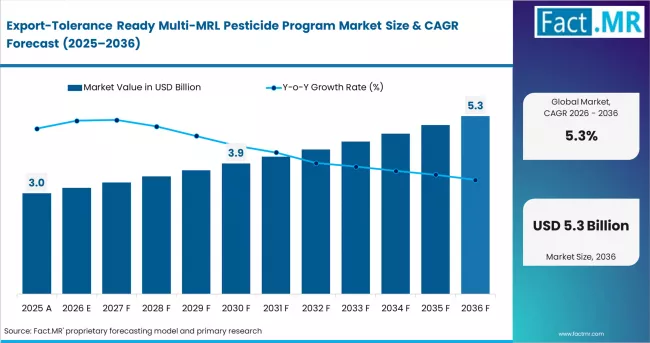
Export Tolerance Ready Multi Mrl Pesticide Program Market Value Analysis | Source: Fact.MR
Summary of Export-Tolerance Ready Multi-MRL Pesticide Program Market
- Market Definition
- The market includes structured pesticide use and residue management programs designed for simultaneous compliance with MRLs of multiple agricultural importing countries.
- Demand Drivers
- Rising EU and UK import rejection incidents are compelling agri-exporters in India and Brazil to adopt pre-programmed, multi-MRL compliant pesticide sequences.
- Codex Alimentarius harmonisation gaps between importing countries are increasing demand for country-specific tolerance mapping embedded in export programs.
- Retailer and supermarket chain residue audit requirements in Europe are driving farm-level adoption of certified multi-MRL compliance programs beyond regulatory minimums.
- Key Segments Analyzed
- By Program Type: Export-tolerance customized programs lead with approximately 48% share in 2026, required for multi-country export compliance by agri-exporters.
- By Crop Type: Fruits and vegetables lead with approximately 52% share in 2026, driven by highest export rejection sensitivity due to tight MRL thresholds.
- By Formulation Type: Synthetic low-residue pesticides hold approximately 45% share in 2026, balancing crop protection efficacy with residue compliance requirements.
- Analyst Opinion at FACT.MR
- Shambhu Nath Jha, Principal Consultant at Fact.MR, opines, 'CXOs will find that growth in this market is not driven by pesticide volume but by compliance architecture; companies that can integrate MRL stacks across export destinations into a single program layer will define the next competitive frontier.'
- Strategic Implications
- Invest in export-tolerance customized programs for India and Brazil to capture agri-exporter demand driven by EU and UK rejection risk.
- Develop integrated residue management offerings combining biopesticides and synthetics for plantation crop exporters targeting Japan and Gulf markets.
- Build multi-country MRL mapping capabilities and digital residue tracking tools as a value-added layer to commodity pesticide sales.
- Methodology
- Market sizing uses agri-export volume data, MRL violation incident logs, and compliance program adoption benchmarks by crop category.
- Analysis incorporates CODEX, EU Pesticides Database, USDA FAS, and national phytosanitary authority disclosures.
- Forecasts account for regulatory divergence across importing countries, biopesticide substitution trends, and export rejection cost modelling.
| Metric | Value |
|---|---|
| Estimated Value in 2026 | USD 3.0 billion |
| Forecast Value in 2036 | USD 4.9 billion |
| Forecast CAGR (2026 to 2036) | 5.3% |
Source: Fact.MR analysis. Updated Apr 24, 2026
The market is projected to generate USD 1.9 billion in absolute opportunity between 2026 and 2036. Growth reflects rising export rejection incidents and regulatory tightening rather than volume-led expansion. Structural growth is constrained by the cost of multi-country compliance stack management and the fragmented adoption of MRL frameworks across importing nations.
India leads with a projected CAGR of 7.6% through 2036, driven by export rejection risk across fruits and vegetables and government-backed MRL compliance initiatives. China follows at 7.2%, as domestic agrochemical companies scale export-ready formulations. Brazil grows at 7.0%, anchored by EU-driven MRL compliance requirements on soy and tropical fruit exports. The United States records 6.2%, with established compliance infrastructure aligning exporters to multi-destination MRL stacks. Spain grows at 6.5%, supported by its role as an EU export hub for fruits and vegetables and strict residue monitoring obligations.
Segmental Analysis
Export-Tolerance Ready Multi-MRL Pesticide Program Market Analysis by Program Type
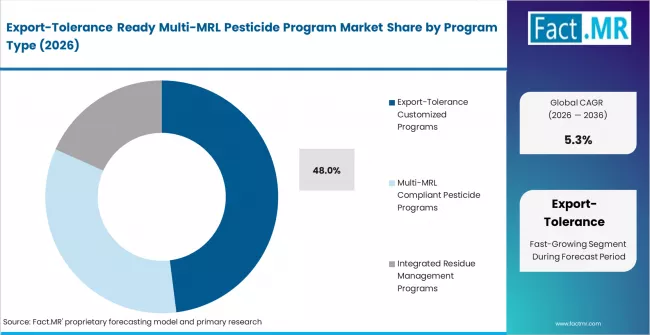
Export Tolerance Ready Multi Mrl Pesticide Program Market Analysis By Program Type | Source: Fact.MR
Based on FACT.MR's report, export-tolerance customised programs hold 48% share in 2026. These programs dominate due to targeted compliance. They align with specific import market requirements. This reduces multi-destination rejection risk.
- Syngenta Program Launch: Syngenta launched Crop Export Assurance in Q2 2024. The program covers EU, UK, and Japan compliance. It includes actives mapping and PHI scheduling. Documentation supports traceability. [4]
- Corteva Technology Tool: Corteva launched a digital MRL tool in Q3 2024. It is integrated into farm management systems. Farmers can map pesticide use across 40+ markets. Compliance reports are generated in real time. [5]
- Integrated Program Trend: FMC Corporation reported increased adoption in 2025. Growth is strong among Asian exporters. Japan and South Korea tightened MRL enforcement. Integrated programs are gaining share in export portfolios. [6]
Export-Tolerance Ready Multi-MRL Pesticide Program Market Analysis by Crop Type
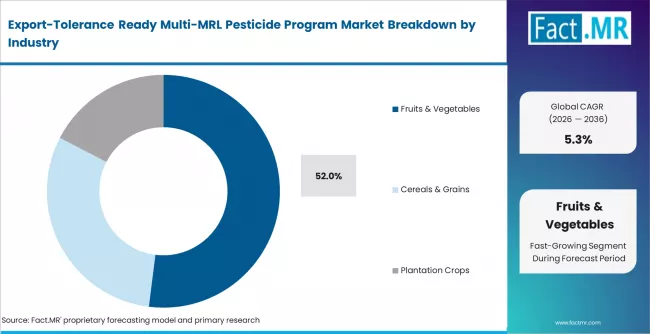
Export Tolerance Ready Multi Mrl Pesticide Program Market Analysis By Crop Type | Source: Fact.MR
Based on FACT.MR's report, fruits and vegetables hold 52% share in 2026. This segment leads due to high rejection risk. Perishable produce cannot be remediated post-harvest. Residue violations result in full shipment loss.
- BASF Portfolio Expansion: BASF expanded export-compliant solutions in Q1 2024. Focus is on grapes and citrus. Products are aligned with EU and UK MRL limits. PHI protocols support multi-destination exports. [7]
- Bayer Program Development: Bayer launched residue advisory in 2025. Target crops include mango and pepper. Programs align with EU Regulation EC 396/2005. Includes testing and compliance support. [8]
- Plantation Crop Trend: ADAMA reported increased adoption in 2024. Tea and spice exporters are key users. Demand is driven by EU and Gulf market enforcement. Residue advisory services are expanding. [9]
Drivers, Restraints, and Opportunities
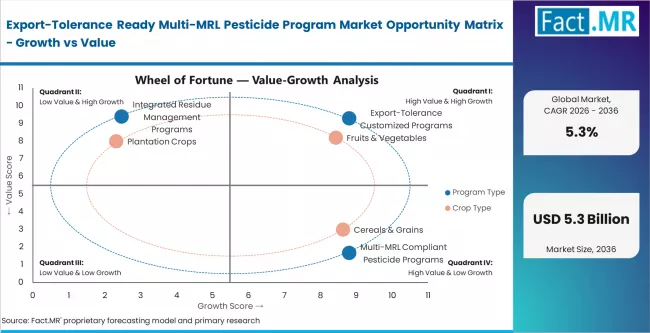
Export Tolerance Ready Multi Mrl Pesticide Program Market Opportunity Matrix Growth Vs Value | Source: Fact.MR
FACT.MR analysts observe that the export-tolerance ready multi-MRL pesticide program market is in active transition. Growth is concentrated in export-oriented agricultural economies. Demand is driven by divergence in MRL frameworks across importing countries. Producers in India, Brazil, China, and Spain are increasing export exposure.
The market exists because export rejection costs have risen significantly. Structured compliance programs are now more economical than reactive remediation. Residue management is shifting to pre-season planning. Commodity pesticide volumes are losing relevance in export supply chains.
- MRL Divergence Driver: EU Regulation EC 396/2005 and Japan’s Positive List System maintain strict thresholds. These differ from Codex and U.S. EPA standards. Exporters must manage conflicting compliance layers. Syngenta and BASF launched compliance advisory services in 2024. [1]
- Rejection Cost Escalation: EU border inspections increased MRL violation cases in 2024. Losses were reported from South Asia and Latin America. India’s APEDA mandated farm-level MRL audits from January 2025. Export losses in grapes and mangoes triggered this shift. [2]
- Retailer Standard Pressure: Retailers like Tesco and REWE enforce stricter residue standards. These exceed regulatory MRL limits. UPL Limited and Corteva expanded compliance partnerships in 2025. Programs target European retail supply chains. [3]
Regional Analysis
The export-tolerance ready multi-MRL pesticide program market is assessed across Asia Pacific, North America, Europe, Latin America, and Middle East and Africa, covering 40+ countries with demand shaped by export rejection incident rates, MRL regulatory frameworks of importing nations, and agri-export policy infrastructure. The full report provides market attractiveness analysis by region and country.
.webp "Top Country Growth Comparison Export Tolerance Ready Multi Mrl Pesticide Program Market Cagr (2026 2036)")
Top Country Growth Comparison Export Tolerance Ready Multi Mrl Pesticide Program Market Cagr (2026 2036) | Source: Fact.MR
| Country | CAGR (2026 to 2036) |
|---|---|
| India | 7.6% |
| China | 7.2% |
| Brazil | 7.0% |
| Spain | 6.5% |
| United States | 6.2% |
Source: Fact.MR analysis. Updated Apr 24, 2026
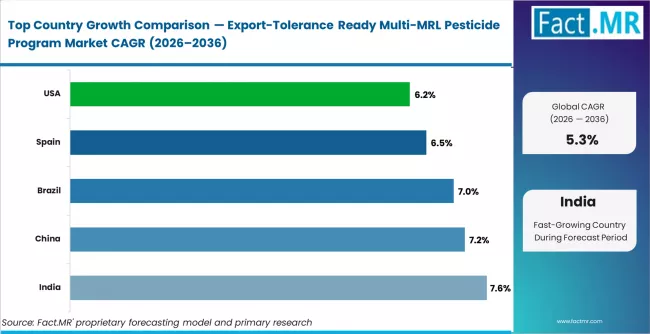
Export Tolerance Ready Multi Mrl Pesticide Program Market Cagr Analysis By Country | Source: Fact.MR
Source: Fact.MR (FACT.MR) analysis, based on proprietary forecasting model and primary research
Asia Pacific Export-Tolerance Ready Multi-MRL Pesticide Program Market Analysis
Asia Pacific is the primary demand-growth region for export-compliance pesticide programs. Growth is driven by high agri-export volumes. MRL violation records at EU and Japanese borders remain high. India and China account for most incremental adoption. UPL Limited, Bayer, and Syngenta are key program providers in the region.
- India: Enforcement-led adoption defines market growth. Demand is projected at 7.6% CAGR through 2036. APEDA mandated MRL audits for exporters from January 2025. This embeds multi-MRL programs into supply chains. UPL Limited expanded residue programs in Maharashtra in 2024. Focus is on grapes and pomegranates. Programs align with EU MRL thresholds. Distribution is organised through certified export clusters. This ensures consistency across seasons.
- China: State-led compliance scaling shapes adoption. Demand is projected at 7.2% CAGR through 2036. Exporters faced higher rejection rates in EU markets in 2024. Tea and frozen vegetables were most affected. Syngenta updated export programs in Shandong in Q3 2024. Programs align with EU and UK MRL requirements. Adoption is driven by state-linked certification bodies. Open-market advisory demand remains limited.
Fact.MR's analysis of Asia Pacific covers India, China, Japan, ASEAN, and Australia. Includes MRL rejection data, adoption trends, and regulatory alignment assessments.
Europe Export-Tolerance Ready Multi-MRL Pesticide Program Market Analysis
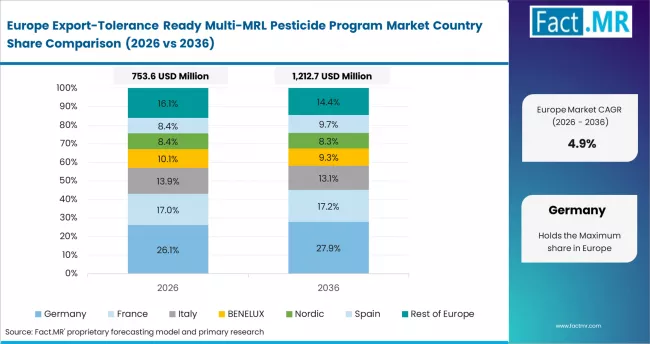
Export Tolerance Ready Multi Mrl Pesticide Program Market Europe Country Market Share Analysis, 2026 & 2036 | Source: Fact.MR
Europe acts as both an import regulator and export hub. MRL compliance drives program demand. Spain and Italy lead export-driven adoption. Germany anchors compliance infrastructure. BASF and Bayer lead program development.
- Spain: Export-driven compliance shapes adoption. Demand is projected at 6.5% CAGR through 2036. Spain is the EU’s largest fruit and vegetable exporter. Multi-market compliance is mandatory. BASF updated citrus and stone fruit programs in Q2 2024. Programs align with EU, UK, and Swiss MRL limits. Adoption is coordinated through cooperatives. This ensures scale across growing regions.
Fact.MR's analysis covers Germany, France, the UK, Italy, Spain, and Rest of Europe. Includes MRL enforcement trends, retailer standards, and market sizing.
North America Export-Tolerance Ready Multi-MRL Pesticide Program Market Analysis
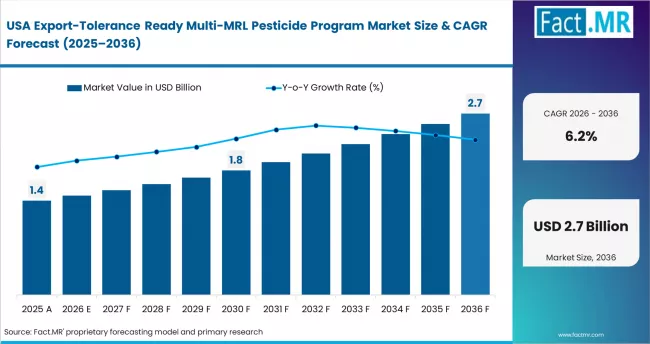
Export Tolerance Ready Multi Mrl Pesticide Program Market Country Value Analysis | Source: Fact.MR
North America is a compliance-mature region. Regulatory frameworks are well established. Exporters align with multiple global MRL systems. Corteva and FMC Corporation lead program offerings.
- United States: Infrastructure-led compliance supports steady growth. Demand is projected at 6.2% CAGR through 2036. Exporters rely on pre-configured compliance programs. Digital farm tools are widely used. Corteva expanded its Granular platform in Q3 2024. Coverage now includes 40+ markets. Exporters can generate compliance documentation easily. This reduces advisory dependency.
Fact.MR's analysis covers the United States, Canada, and Mexico. Includes adoption rates, regulatory alignment, and digital tool penetration.
Latin America Export-Tolerance Ready Multi-MRL Pesticide Program Market Analysis
Latin America is the fastest-scaling adoption region. Growth is driven by export exposure. Brazil leads regional dynamics. EU MRL compliance is the primary trigger. Corteva, Bayer, and ADAMA are key providers.
- Brazil: Compliance pressure is reshaping pesticide planning. Demand is projected at 7.0% CAGR through 2036. EU Regulation EC 396/2005 drives enforcement. Violations increased in 2024. Bayer expanded EU-compliant programs in Q1 2025. Focus is on mango and papaya exporters. Programs include PHI scheduling and residue testing. Adoption is driven through MAPA advisory networks.
Fact.MR's analysis covers Brazil, Argentina, Chile, and Rest of Latin America. Includes compliance trends, rejection data, and competitive positioning.
Competitive Aligners for Market Players
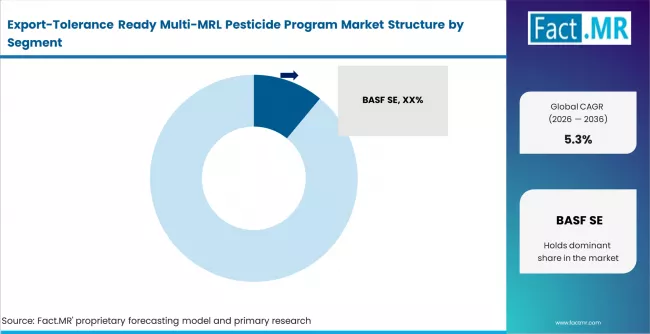
Export Tolerance Ready Multi Mrl Pesticide Program Market Analysis By Company | Source: Fact.MR
The export-tolerance ready multi-MRL pesticide program market is shaped by regulatory complexity rather than sheer product volume. Competition centers on the ability to design compliance-ready programs that align with multiple international residue standards simultaneously. Leading players such as BASF, Bayer, Syngenta, and Corteva hold strong positions due to their global regulatory expertise, established active ingredient portfolios, and integrated advisory capabilities.
Their advantage lies in combining chemistry with compliance services. These companies are not just selling crop protection products. They are offering structured spray programs, residue forecasting tools, and documentation support aligned with EU, UK, and Japanese MRL frameworks. This creates a high barrier for smaller players, who often lack the regulatory depth and global data infrastructure required to support export-oriented farmers. Market dynamics are also influenced by the growing role of digital agriculture platforms. Tools that map pesticide applications against multiple MRL databases are becoming critical. Companies that embed compliance into farm-level decision systems are gaining stronger engagement with exporters. This shifts competition from product-based to solution-based offerings.
Buyer behavior reflects risk management priorities. Exporters prefer suppliers that can guarantee compliance across multiple destinations. Once a program is validated and linked to export certification, switching becomes operationally complex. However, large exporters are increasingly working with multiple program providers to reduce dependency on a single active ingredient or regulatory pathway. Thus, the market is evolving toward integrated compliance ecosystems, where regulatory credibility, data support, and advisory capability define competitive positioning.
Key Players
- BASF SE
- Bayer AG
- Syngenta AG
- Corteva Agriscience
- UPL Limited
- FMC Corporation
- ADAMA Agricultural Solutions Ltd.
- Nufarm Limited
- Sumitomo Chemical Co., Ltd.
Bibliography
- [1] Syngenta AG. (2024). Crop Protection Advisory Services Update: Export Compliance Program Launch for EU, UK, and Japan MRL Alignment Across Fruit and Vegetable Exporters in India and Turkey. Q2 2024. syngenta.com/investor-relations
- [2] Agricultural and Processed Food Products Export Development Authority (APEDA), Government of India. (January 2025). Mandatory MRL Compliance Audit Guidelines for Registered Agri-Exporters: Grapes, Mangoes, and Vegetables Targeted at EU and UK Markets. January 2025. apeda.gov.in
- [3] UPL Limited. (2025). Annual Report 2025: Residue Management Program Expansion for Grape and Pomegranate Exporters in Maharashtra Aligned with EU Regulation EC 396/2005 MRL Thresholds. 2025. upl-ltd.com/investor-relations
- [4] Syngenta AG. (Q2 2024). Program Launch Announcement: Crop Export Assurance Program Covering Pesticide Sequencing, Pre-Harvest Intervals, and Market-of-Destination Traceability Documentation. Q2 2024. syngenta.com
- [5] Corteva Agriscience. (Q3 2024). Platform Update: Granular Farm Management MRL Compliance Module Covering 40+ Import Markets with Real-Time Documentation Generation for Export-Oriented Producers. Q3 2024. corteva.com/investor-relations
- [6] FMC Corporation. (2025). APAC Operational Update 2025: Integrated Residue Management Program Adoption Growth Among South Asian Rice and Vegetable Exporters Targeting Japan and South Korea. 2025. fmc.com/investor-relations
- [7] BASF SE. (Q1 2024). Crop Protection Product Update: Export-Compliant Fungicide and Insecticide Combinations for Table Grape and Citrus Exporters in Spain and South Africa Pre-Cleared Against EU and UK MRL Thresholds. Q1 2024. basf.com/investor-relations
- [8] Bayer AG. (2025). Crop Science Division Update: Residue Reduction Advisory Program Launch for Mango and Pepper Exporters in India Aligned with EU MRL Requirements Under Regulation EC 396/2005. 2025. bayer.com/investor-relations
- [9] ADAMA Agricultural Solutions Ltd. (2024). Operational Update 2024: Export Residue Advisory Service Adoption Growth for Tea and Spice Exporters in Southeast Asia Targeting EU and Gulf Cooperation Council Markets. 2024. adama.com
This Report Addresses
- Strategic intelligence on export-tolerance ready multi-MRL pesticide program demand across agri-export supply chains, compliance advisory services, and formulation-level residue management globally.
- Market forecast from USD 3.0 billion in 2026 to USD 4.9 billion by 2036 at a CAGR of 5.3%.
- Growth opportunity mapping across India MRL rejection-driven adoption, Brazil EU-compliance program uptake, Spain export-hub residue monitoring, and China regulatory-tightening-led formulation scaling.
- Segment analysis by program type (multi-MRL compliant, export-tolerance customized, integrated residue management), crop type (fruits and vegetables, cereals and grains, plantation crops), and formulation type (synthetic low-residue, biopesticides, integrated programs).
- Regional outlook covering Asia Pacific export compliance program scaling, Europe dual-role market dynamics as importer and exporter, and Latin America EU-driven adoption acceleration.
- Competitive analysis of BASF, Bayer, Syngenta, Corteva, UPL Limited, FMC Corporation, and ADAMA. Focus on MRL database integration depth, digital compliance tool differentiation, and export cluster partnership strategies.
- Regulatory impact analysis covering EU Regulation EC 396/2005 MRL enforcement, Japan Positive List System updates, India APEDA mandatory compliance audit requirements, and Codex Alimentarius harmonisation dynamics.
- Report delivered in PDF, Excel datasets, and presentation formats. Supported by primary interviews, agri-export rejection incident data, USDA FAS trade statistics, EU Pesticides Database, and Codex MRL benchmarks.
Export-Tolerance Ready Multi-MRL Pesticide Program Market Definition
The market covers structured pesticide use programs designed to achieve simultaneous compliance with maximum residue limits (MRLs) set by multiple importing countries. These programs bundle formulation selection, application timing, pre-harvest intervals, and documentation protocols.
Export-Tolerance Ready Multi-MRL Pesticide Program Market Inclusions
Covers global and regional market forecasts from 2026 to 2036. Includes multi-MRL compliant programs, export-tolerance customized programs, and integrated residue management programs across fruits and vegetables, cereals and grains, and plantation crops through agri-input supplier and consultancy channels.
Export-Tolerance Ready Multi-MRL Pesticide Program Market Exclusions
Excludes single-country MRL compliance programs and domestic-market-only pesticide applications. Omits finished agrochemical products sold without residue management advisory. Focus remains on structured, multi-destination export compliance programs and their service and formulation components.
Export-Tolerance Ready Multi-MRL Pesticide Program Market Research Methodology
- Primary Research
- Interviews with pesticide formulators, export-compliance agronomists, agri-export certification bodies, and farm management consultants across India, Brazil, Spain, and China.
- Desk Research
- Uses CODEX Alimentarius MRL database, EU Pesticides Database (Regulation EC 396/2005), USDA FAS export data, and company disclosures from BASF, Bayer, Syngenta, Corteva, and UPL Limited (2024–2025).
- Market-Sizing and Forecasting
- Hybrid model using agricultural export volume data, MRL violation incident records, pesticide compliance program adoption rates, and crop-specific export revenue benchmarks from FAO and national trade bodies.
- Data Validation and Update Cycle
- Validated using trade rejection databases, phytosanitary authority disclosures, and compliance program enrollment data. Updated annually.
Segmentation
Scope of Report
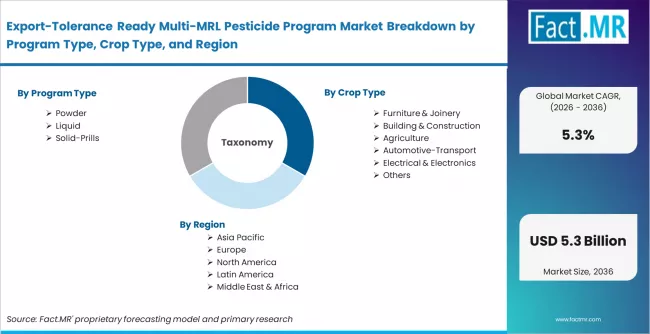
Export Tolerance Ready Multi Mrl Pesticide Program Market Breakdown By Program Type Crop Type And Region | Source: Fact.MR
| Attribute | Details |
|---|---|
| Quantitative Units | USD 2.95 billion (2026) to USD 4.93 billion (2036), at a CAGR of 5.3% |
| Market Definition | Market covers export-tolerance ready, multi-MRL compliant pesticide programs designed for pre-season and in-season crop protection planning. These programs align pesticide application schedules with varying maximum residue limits across EU, UK, Japan, U.S. EPA, and Codex frameworks. |
| Product Type Segmentation | Export-Tolerance Customized Programs, Multi-MRL Compliant Standard Programs, Integrated Residue Management Program |
| Application Segmentation | Fruits and Vegetables, Cereals and Grains, Plantation Crops |
| End Use Segmentation | Export-Oriented Farms, Agri-Export Cooperatives, Contract Farming Networks, Agronomy Advisory Platforms |
| Application Coverage | Pre-season pesticide program design, residue compliance mapping across multiple import markets, spray scheduling and PHI optimization, export certification documentation support, digital MRL compliance tracking, and integration with farm management systems for export-oriented crop production. |
| Regions Covered | North America, Europe, Asia Pacific, Latin America, Middle East and Africa |
| Countries Covered | USA, Canada, Mexico, Germany, UK, France, Italy, Spain, Nordic, BENELUX, China, Japan, South Korea, India, ASEAN, Australia and New Zealand, Brazil, Argentina, Chile, Saudi Arabia, UAE, Turkey, South Africa, Rest of MEA |
| Key Companies Profiled | BASF SE, Bayer AG, Syngenta AG, Corteva Agriscience, UPL Limited, FMC Corporation, ADAMA Ltd. |
| Forecast Period | 2026 to 2036 |
| Approach | Hybrid top-down and bottom-up model using program-level revenues, crop-wise adoption rates, export-oriented farm participation data, average pricing by compliance complexity, regulatory alignment benchmarks across EU, Japan, and U.S. markets, and primary interviews with agronomy advisors, exporters, and pesticide compliance specialists. |
Source: Fact.MR analysis. Updated Apr 24, 2026
Export-Tolerance Ready Multi-MRL Pesticide Program Market by Segment
-
By Program Type
- Multi-MRL Compliant Pesticide Programs
- Export-Tolerance Customized Programs
- Integrated Residue Management Programs
-
By Crop Type
- Fruits & Vegetables
- Cereals & Grains
- Plantation Crops
-
By Formulation Type
- Synthetic Low-Residue Pesticides
- Biopesticides
- Integrated Programs (Chemical + Biological)
-
By Region
- North America
- United States
- Canada
- Mexico
- Latin America
- Brazil
- Argentina
- Chile
- Rest of Latin America
- Western Europe
- Germany
- France
- United Kingdom
- Italy
- Spain
- Nordic Countries
- BENELUX
- Rest of Western Europe
- Eastern Europe
- Russia
- Poland
- Hungary
- Balkan and Baltic
- Rest of Eastern Europe
- East Asia
- China
- Japan
- South Korea
- South Asia and Pacific
- India
- ASEAN
- Australia and New Zealand
- Rest of South Asia and Pacific
- Middle East and Africa
- Kingdom of Saudi Arabia
- Other GCC Countries
- Turkey
- South Africa
- Rest of Middle East and Africa
- North America
Frequently Asked Questions
How large is the global export-tolerance ready multi-MRL pesticide program market in 2025?
What will the market size be in 2026?
What is the projected market size by 2036?
What is the expected CAGR from 2026 to 2036?
Which program type segment is poised to lead the market?
Which crop type segment holds the largest share?
Which country shows the fastest growth?
What is driving demand for these programs?
What is the key challenge in this market?
Who worked on this report


Preview the report firsthand - request a free sample
Free SampleGet the brochure for pricing and purchase details
Download PDF