- Base Value(2025): 4.8 Bn
- Estimated Value(2026): 6.3 Bn
- Forecast Value (2036): 96.0 Bn
- CAGR (2026 - 2036): 31.3%
Net Zero-as-a-Service Market Overview, Growth Outlook, and Forecast by Fact.MR
In 2025, the Net Zero-as-a-Service (NZaaS) market was valued at USD 4.8 billion. Demand for Net Zero-as-a-Service solutions is projected to grow to USD 6.3 billion in 2026 and reach USD 96.0 billion by 2036. The market is expected to expand at a CAGR of 31.3% during the forecast period.
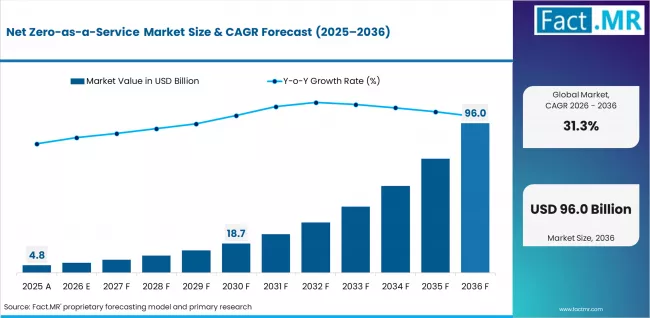
Net Zero As A Service Market Value Analysis | Source: Fact.MR
The NZaaS market is projected to create an absolute dollar opportunity of USD 89.7 billion between 2026 and 2036. This reflects a transformative growth trajectory rather than incremental expansion, driven by increasing enterprise net-zero commitments, growing ESG disclosure requirements, rising demand for Scope 1–3 emissions management, accelerating decarbonization initiatives, and increasing adoption of AI-enabled carbon intelligence and sustainability platforms. The growth momentum is expected to continue due to expanding investments in climate technologies, renewable energy transition programs, carbon management solutions, and supply-chain sustainability initiatives. However, potential constraints may include Scope 3 data reliability challenges, integration complexity across enterprise systems, regulatory uncertainties, and high implementation and operational costs.
Summary of the Net Zero-as-a-Service (NzaaS) Market
- Market Snapshot
- Global Net Zero-as-a-Service (NZaaS) market revenue stood at USD 6.3 billion in 2026 and is forecast to reach USD 96.0 billion by 2036.
- At a 31.3% CAGR from 2026 to 2036, the market is expected to expand by nearly 15.2x in value, creating an absolute dollar opportunity of USD 89.7 billion.
- The growth is being fueled by growing enterprise net-zero commitments, increasing ESG disclosure requirements, expanding Scope 1–3 emissions management, and accelerating corporate decarbonization activities.
- Increasing enterprise demand for sustainability transformation at scale and operational carbon reduction is contributing to an acceleration of NZaaS around the world.
- The convergence of AI-powered carbon intelligence, predictive sustainability analytics, IoT monitoring solutions, ERP-integrated climate platforms and automated emissions management solutions is revolutionizing enterprise sustainable operations.
- Demand and Growth Drivers
- Rising enterprise focus on delivering on net-zero targets
- Growing global ESG disclosure and climate reporting obligations
- Heightened visibility on Scope 3 emissions and supply-chain sustainability
- Growing enterprise commitments to sustainability technologies and climate intelligence solutions
- Need for solutions providing:
- Real-time carbon footprint monitoring
- Enterprise-wide emissions visibility
- Automated sustainability reporting
- Decarbonization planning and execution
- Product and Segment View
- Carbon Accounting & GHG Measurement holds 22.9% of service offering share in 2026, emerging as the leading segment due to increasing demand for enterprise emissions measurement and reporting capabilities.
- Managed Services account for 34.5% of delivery model share in 2026, positioning them as the dominant delivery model due to increasing demand for outsourced sustainability management.
- Full-Scope (Scope 1, 2 & 3) represents 37.0% of emission scope coverage share in 2026, supported by rising enterprise demand for integrated emissions visibility.
- Manufacturing accounts for 21.5% of end-use industry share in 2026, driven by high-emission operations and increasing industrial decarbonization initiatives.
- Regulatory Compliance accounts for 24.2% of primary use case share in 2026, reflecting growing enterprise focus on climate-related reporting obligations.
- Geography and Competitive Outlook
- Strong growth opportunities exist across North America, Western Europe, and Asia Pacific due to increasing enterprise sustainability investments and rising climate-related regulations.
- Major high-growth countries within the Net Zero-as-a-Service market include India (36.8% CAGR), Japan (35.8% CAGR), China (35.4% CAGR), Canada (31.7% CAGR), United States (29.6% CAGR), United Kingdom (28.5% CAGR), and Germany (27.9% CAGR), supported by increasing sustainability investments, expanding climate regulations, and accelerating enterprise net-zero initiatives.
- Growth opportunities for the market depend on:
- Increasing enterprise sustainability spending
- Expansion of carbon accounting and climate intelligence platforms
- Rising adoption of AI-powered emissions analytics
- Increasing renewable energy transition initiatives
- Growing demand for supply-chain sustainability solutions
- Expansion of enterprise-wide decarbonization programs
- Key companies active in the NZaaS market include Accenture, Deloitte, EY, KPMG, McKinsey & Company, Boston Consulting Group (BCG), Tata Consultancy Services (TCS), and other regional and specialized sustainability solution providers.
- Analyst Opinion
- Shambhu Nath Jha, Principal Consultant at Fact.MR, opines, “CXOare increasingly expected to recognize that the future competitive advantage in the Net Zero-as-a-Service (NZaaS) market will depend on translating carbon visibility into measurable operational outcomes through integrated decarbonization execution, AI-enabled climate intelligence, and enterprise-wide sustainability transformation rather than relying solely on emissions reporting and compliance-driven initiatives.
Net Zero-as-a-Service Market — At a Glance
| Attribute | Details |
|---|---|
| Market Value 2025 | USD 4.8 Billion |
| Market Value 2026 | USD 6.3 Billion |
| Market Value 2036 | USD 96.0 Billion |
| Absolute Dollar Opportunity | USD 89.7 Billion |
| Total Growth | 1423.8% |
| CAGR | 31.3% |
| Growth Multiple | 15.2x |
| Key Demand Theme | Increasing enterprise net-zero commitments, ESG disclosure requirements, Scope 1–3 emissions management demand, corporate decarbonization initiatives, AI-enabled carbon intelligence adoption, sustainability transformation, and renewable energy transition programs |
| Leading Service Offering | Carbon Accounting & GHG Measurement |
| Service Offering Share | 22.9% |
| Leading Delivery Model | Managed Services |
| Delivery Model Share | 34.5% |
| Leading Emission Scope Coverage | Full-Scope (Scope 1, 2 & 3) |
| Emission Scope Coverage Share | 37.0% |
| Leading End-Use Industry | Manufacturing |
| End-Use Industry Share | 21.5% |
| Leading Primary Use Case | Regulatory Compliance |
| Primary Use Case Share | 24.2% |
| Key Growth Regions | East Asia, South Asia & Pacific, North America |
| Key Companies | Accenture, Deloitte, EY, KPMG, McKinsey & Company, Boston Consulting Group (BCG), Tata Consultancy Services (TCS), Schneider Electric, Siemens, Honeywell |
| Segmentation by Service Offering | Carbon Accounting & GHG Measurement, Net-Zero Strategy & Transition Planning, ESG & Sustainability Reporting, Renewable Energy Procurement & Management, Carbon Offset & Removal Management, Supply Chain Emissions Management, Energy Efficiency & Optimization Services, Climate Risk & Regulatory Compliance Services |
| Segmentation by Delivery Model | Software Platform, Managed Services, Consulting & Advisory, Integrated End-to-End Services |
| Segmentation by Emission Scope Coverage | Scope 1 Emissions, Scope 2 Emissions, Scope 3 Emissions, Full-Scope (Scope 1, 2 & 3) |
| Segmentation by End-Use Industry | Manufacturing, Energy & Utilities, Oil & Gas, Transportation & Logistics, Retail & Consumer Goods, BFSI, IT & Telecom, Construction & Real Estate, Healthcare & Pharmaceuticals, Food & Beverage, Chemicals & Materials, Government & Public Sector, Others |
| Segmentation by Primary Use Case | Regulatory Compliance, ESG Disclosure & Reporting, Corporate Decarbonization, Supply Chain Sustainability, Renewable Energy Transition, Carbon Neutrality / Net-Zero Achievement |
| Segmentation by Region | North America, Latin America, East Asia, South Asia & Pacific, Western Europe, Eastern Europe, Middle East & Africa |
Source: Fact.MR analysis. Updated May 15, 2026
Why is the Net Zero-as-a-Service (NZaaS) market shifting from carbon reporting toward operational decarbonization execution, and what are the strategic implications for enterprises?
As far as market and enterprise transformation go, the NZaaS market will be undergoing structural change from "emissions visibility" to "emissions execution." In its early stages, enterprise sustainability programs were mostly about carbon accounting and compliance. These improvements brought better emissions visibility but no direct emissions reductions. Now, however, companies are beginning to realize that just reporting emissions does not guarantee any reduction in emissions.
Accordingly, the market will move towards execution platforms that incorporate sustainability intelligence into everyday operational workflows. Emissions originate from production plants, supply chains, transportation logistics, and industrial assets, thus, for emissions reductions, sustainable operations should be part of everyday processes rather than just another duty for corporate ESG departments.
Indeed, leading players in the market offer platforms that include IoT sensors for monitoring of emissions and waste; smart recommendations for emissions reductions based on AI technologies and predictive analytics; modeling of processes and digital twins, and platforms for automation of emissions reduction processes. These new platforms automatically recognize inefficiencies and opportunities, optimize energy consumption, activate reduction workflows, and enable plant-level action.
Data Reliability Crisis: Why Supplier Data Is Emerging as the Largest Barrier to Net-Zero Execution
The rising significance of managing Scope 3 emissions is emerging as one of the largest challenges within the Net Zero-as-a-Service (NZaaS) domain. Although there has been better visibility for organizations in terms of carbon accounting and reporting on emissions, a significant portion of Scope 3 information is derived from industry averages, supplier assumptions, and proxy data sets as opposed to validated operational data. And because Scope 3 emissions often account for 70–90% of a company’s total emissions, errors in supplier data can have an immediate impact on corporate sustainability planning, investment decisions, regulatory compliance, and strategies for cutting emissions. Sectors with complicated and multi-tier supply chains such as automotive, electronics, FMCG and retail are anticipated to have the most significant implementation challenges owing to poor supplier transparency and disjointed reporting mechanisms. Market differentiation in the future is likely to rest increasingly on supplier intelligence, data validation capabilities, and real-time supply-chain visibility.
| Key Scope 3 Challenge | Current Market Situation | Enterprise Impact | Future Market Direction |
|---|---|---|---|
| Supplier-estimated emissions | Heavy dependence on assumptions and averages | Lower reporting accuracy | Shift toward primary measured data |
| AI-generated emissions assumptions | Growing use of modeled datasets | Hidden calculation and model risks | AI-assisted validation systems |
| Multi-tier supplier visibility | Visibility concentrated at Tier-1 level | Hidden upstream emissions exposure | End-to-end supplier intelligence networks |
| Supplier onboarding complexity | High reporting burden and participation challenges | Delayed emissions reporting | Automated supplier collaboration ecosystems |
| Upstream and downstream verification | Limited standardization and data consistency | Reduced decision confidence | Digital product passports and blockchain verification |
| Scope 3 reporting reliability | Data quality varies significantly across industries | Increased execution and compliance risk | Real-time sustainability intelligence platforms |
Source: Fact.MR analysis. Updated May 15, 2026
How is carbon accounting evolving from standalone sustainability platforms into embedded ERP intelligence within enterprise systems?
The emergence of carbon accounting solutions is moving from sustainability-specific software to ERP-based intelligence due to companies increasingly needing carbon data as part of their core business operations rather than having carbon data reporting as an extra function. Previous carbon platforms were mainly used for measurement purposes to generate sustainability reports and relied on manual data gathering and disconnected systems. Yet, companies need to have carbon data visible in real-time together with operations like procurement, finances, supply chain management, production process, and HR. Integration with the enterprise system becomes necessary for that reason.
For instance, the integration can be provided with ERP systems such as SAP, Oracle, Microsoft Dynamics, and Workday. Buyer responsibilities related to carbon accounting have also changed from the sustainability department or Chief Sustainability Officer to the chief technology officer, chief financial officer, procurement specialists, and supply chain managers. In terms of vendor strategy, partnership becomes the focus, and API connectivity and ecosystems play an increasing role, with standalone software offerings losing popularity. Also, the pricing model is increasingly based on bundled enterprise subscription and usage models compared to previous pay-as-you-go models of standalone software. ERP-integrated climate intelligence allows having better data quality, auditability, real-time monitoring, and in-system decision making compared to traditional solutions. In the future, carbon will be viewed as a metric similar to cost and revenue.
Decarbonization Procurement Marketplaces in the NZaaS Market
| Component | Precise Analysis |
|---|---|
| Enterprise Shift | Enterprises are moving from measuring emissions to sourcing decarbonization assets because achieving net-zero requires actual emissions reduction through renewable energy, carbon removals, SAF, green hydrogen, and low-carbon materials. |
| Key Buyer Requirements | Cost efficiency, scalability, supply reliability, verification accuracy, contract flexibility, regulatory compliance, and geographic compatibility. |
| Procurement Workflow Evolution | Emissions Assessment → Demand Forecasting → Marketplace Matching → Supplier Evaluation → Contract Negotiation → MRV Integration → Portfolio Management. |
| Marketplace Business Models | Transaction marketplaces, Procurement-as-a-Service, carbon asset exchanges, integrated NZaaS platforms, and demand aggregation platforms. |
| Pricing Mechanisms | PPAs use fixed contracts; carbon removals use cost per tCO₂; SAF uses fuel premium pricing; green hydrogen uses cost/kg; low-carbon materials use embedded carbon premiums. |
| Asset Availability Challenge | Demand growth exceeds current supply for SAF, DAC, green hydrogen, and premium low-carbon materials. |
| Verification Challenge | Lack of standardized methodologies and inconsistent reporting frameworks increase uncertainty regarding asset quality. |
| Contract Structure Challenge | Long-term agreements involve delivery obligations, price uncertainty, and changing policy requirements. |
| Market Fragmentation Challenge | Multiple registries, standards, suppliers, and disconnected platforms reduce market efficiency. |
| Industrial Company Implications | Requires long-term renewable energy and hydrogen sourcing to reduce process emissions. |
| Logistics Provider Implications | Increasing dependence on SAF and low-carbon transportation assets for operational decarbonization. |
| Long-Term Strategic Outlook | NZaaS platforms are expected to evolve into integrated carbon and decarbonization asset management ecosystems with procurement, analytics, and risk management capabilities. |
Source: Fact.MR analysis. Updated May 15, 2026
Carbon Removal Portfolio Management in the Net Zero-as-a-Service (NZaaS) Market Key Strategic Drivers and Market Evolution
- Shift Beyond Traditional Offsets
- Businesses are progressively abandoning traditional carbon offsets amid questions of legitimacy, durability, and visibility. Companies are under pressure from stakeholders to implement solutions that can actually show that atmospheric carbon was removed, not just offsets emissions. This change is being driven by increasing regulatory requirements, investor expectations, and the need to enhance climate commitments.
- Risks of Single-Source Carbon Removal Strategies
- Relying on one type of carbon removal method leaves organizations exposed to concentration risks. The effectiveness of individual solutions may be subject to limitations of technology, interruptions to supply, events of the environment, the variation of costs and uncertainties of policies. An undiversified portfolio may diminish portfolio resilience and increase operational and reputational risk.
- Importance of Portfolio Diversification
- Enterprises are diversifying carbon removal portfolios to mitigate risk and enhance returns over time. By blending nature-based and technology-driven solutions, companies can maximize cost-effectiveness, scalability, permanence and reliability. Diversification also provides more flexibility in the event of changing market conditions.
- Development of Carbon Asset Management Frameworks
- Carbon removals are increasingly being treated as strategic assets rather than isolated transactions. Enterprises are implementing frameworks that support planning, allocation, performance evaluation, and risk management. This approach aligns carbon decisions with broader business and investment objectives.
- Growing Need for Robust MRV Systems
- High-Quality Monitoring, Reporting, and Verification (MRV) systems are increasingly important to guarantee the quality of carbon credits and market confidence. Robust verification systems have greater transparency, accountability, and lessen uncertainties for carbon markets.
Key Growth Drivers, Constraints, and Opportunities
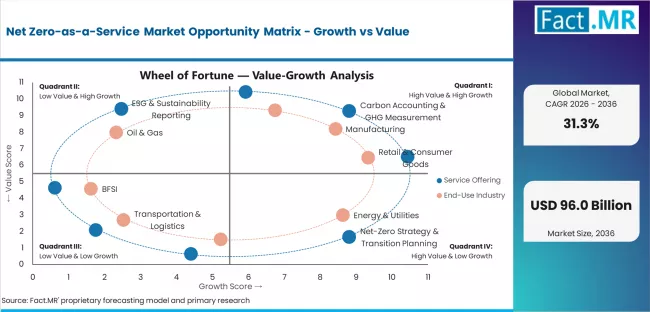
Net Zero As A Service Market Opportunity Matrix Growth Vs Value | Source: Fact.MR
Key Factors Driving Growth
- The prevalence of mandatory climate disclosure regulation (CSRD, SEC climate reporting requirements, ISSB frameworks) is leading enterprises to move towards integrated Net Zero-as-a-Service platforms instead of isolated sustainability solutions.
- Escalating pressure to address Scope 3 emissions, which can constitute 70-90% of the overall enterprise emissions, is fueling the need for supplier emissions intelligence and supply-chain sustainability solutions.
- Growing demand for ERP-integrated carbon accounting, AI-enabled emissions tracking and real-time sustainability dashboards is rapidly driving enterprise adoption in manufacturing, utilities, logistics and industrial verticals.
| Growth Driver | Demand Impact | Time Horizon | Key Impact Area | Fact.MR Insight |
|---|---|---|---|---|
| Increasing implementation of mandatory ESG disclosure regulations and climate reporting frameworks | High | Short–Mid Term | Regulatory compliance & sustainability reporting | Increasing enterprise focus on compliance with climate disclosure requirements and sustainability reporting standards is accelerating adoption of integrated Net Zero-as-a-Service platforms globally. |
| Rising enterprise focus on Scope 3 emissions visibility and supply-chain sustainability | High | Short–Mid Term | Supply-chain emissions management & carbon intelligence | Growing need to manage upstream and downstream emissions across supplier networks is increasing demand for Scope 3 management and supplier emissions platforms. |
| Expansion of AI-enabled carbon accounting and real-time emissions intelligence platforms | Medium-High | Mid–Long Term | Carbon monitoring & enterprise sustainability analytics | Enterprises are increasingly adopting AI-based sustainability analytics and real-time carbon monitoring tools to improve emissions visibility and operational decision-making. |
| Increasing investments in renewable energy transition and enterprise decarbonization programs | Medium-High | Mid–Long Term | Renewable energy management & operational decarbonization | Rising investments in renewable energy procurement, energy optimization, and emissions reduction initiatives are driving demand for integrated NZaaS solutions. |
| Growing integration of carbon intelligence within ERP and enterprise systems | Medium-High | Mid–Long Term | Enterprise workflow integration & sustainability automation | Increasing integration of sustainability platforms with ERP systems and operational infrastructure is enabling embedded climate intelligence and enterprise-wide sustainability management. |
Source: Fact.MR analysis. Updated May 15, 2026
Key Market Constraints
- Dependence on estimated supplier emissions data rather than verified primary emissions data creates reporting inconsistencies and reduces confidence in Scope 3 calculations.
- Integration of sustainability platforms with SAP, Oracle, Microsoft Dynamics, IoT systems, procurement platforms, and legacy operational infrastructure creates implementation complexity and increases deployment timelines.
- Enterprises continue to face challenges in converting carbon visibility into measurable emissions reduction actions, creating a gap between reporting capability and operational execution.
Key Opportunity Areas
- The growth of decarbonization sourcing markets for renewable PPAs, sustainable aviation fuel (SAF), green hydrogen, low-carbon materials, and carbon removal sourcing is driving new revenue streams.
- Developing demand for carbon removal portfolio management, encompassing Direct Air Capture (DAC), biochar, MRV (Monitoring, Reporting, Verification) platforms, is establishing a new service category within NZaaS ecosystems.
- Growing corporate adoption of carbon intelligence integrated directly within ERP systems is opening the door for platform providers to transcend reporting systems and become operational decision systems.
Segment-wise Analysis of the Net Zero-as-a-Service Market
- Carbon Accounting & GHG Measurement accounts for 22.9% share of the service offering segment in 2026, driven by increasing enterprise focus on emissions measurement, carbon footprint tracking, ESG reporting requirements, and growing regulatory compliance initiatives.
- Managed Services hold 34.5% share of the delivery model segment in 2026, supported by increasing demand for outsourced sustainability expertise, continuous emissions monitoring, and enterprise-wide net-zero management capabilities.
- Full-Scope (Scope 1, 2 & 3) represents 37.0% share of the emission scope coverage segment in 2026, owing to growing demand for comprehensive emissions visibility and integrated carbon management across enterprise operations and supply chains.
- Manufacturing accounts for 21.5% share of the end-use industry segment in 2026, driven by high emissions intensity, complex supply-chain networks, and increasing industrial decarbonization initiatives.
The Net Zero-as-a-Service Market is segmented by service offering, delivery model, emission scope coverage, end-use industry, primary use case, and region.
Which Service Offering Segment Topped the Net Zero-as-a-Service Market?
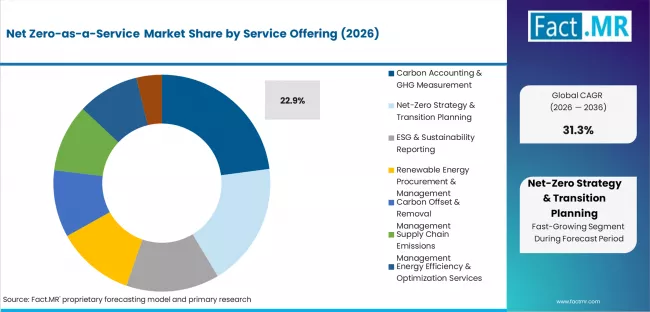
Net Zero As A Service Market Analysis By Service Offering | Source: Fact.MR
Carbon Accounting & GHG Measurement is expected to dominate in the Net Zero-as-a-Service Market with a significant market share of 22.9%. The key reason behind this growth includes increasing demands from businesses in terms of carbon footprints measurements, emission tracking, and ESG disclosure compliance requirements. Businesses across industries are focusing more on emissions visibility to make their first step towards sustainability.
Which Delivery Model Segment Accounts for the Highest Share in the Market?
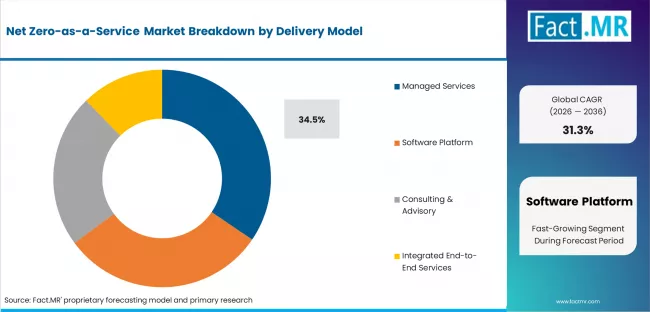
Net Zero As A Service Market Analysis By Delivery Model | Source: Fact.MR
With an estimated market share of 34.5%, the Managed Services segment is forecasted to capture the highest share in the Delivery Model category by 2026. This will be enabled by a rising trend towards outsourcing of sustainability knowledge, ongoing monitoring of carbon footprint, and comprehensive emissions management solutions.
Which Emission Scope Coverage Segment Leads the Market?
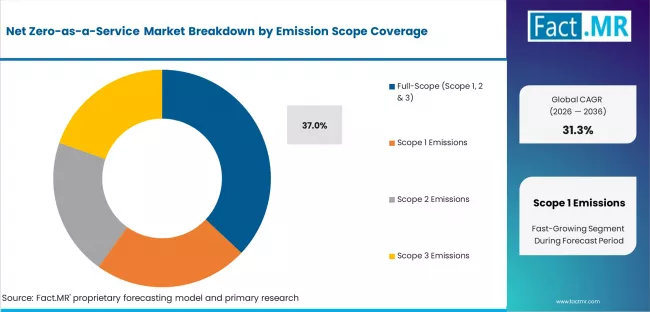
Net Zero As A Service Market Analysis By Emission Scope Coverage | Source: Fact.MR
Full-Scope (Scope 1, 2 & 3) is expected to capture the largest market share of 37.0% in 2026, owing to increasing enterprise focus on comprehensive emissions visibility and integrated carbon management strategies. Businesses are increasingly shifting toward full lifecycle emissions monitoring to improve sustainability reporting and support enterprise-wide decarbonization initiatives.
Which End-Use Industry Segment Holds the Largest Share in the Market?
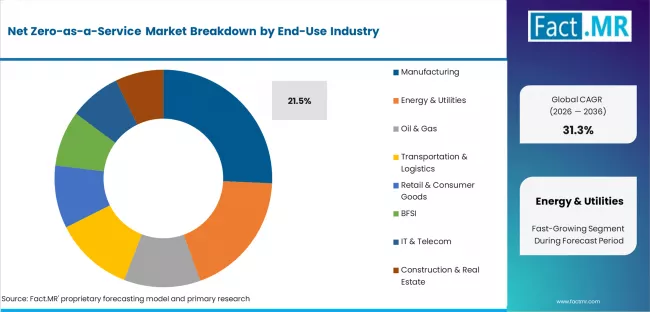
Net Zero As A Service Market Analysis By End Use Industry | Source: Fact.MR
Manufacturing is expected to emerge as the leading end-use industry segment, accounting for 21.5% share in 2026. This growth is supported by increasing industrial decarbonization efforts, complex supply-chain emissions management requirements, and rising investments in sustainability technologies and energy optimization initiatives across manufacturing ecosystems.
Which Primary Use Case Segment Holds the Largest Share in the Market?
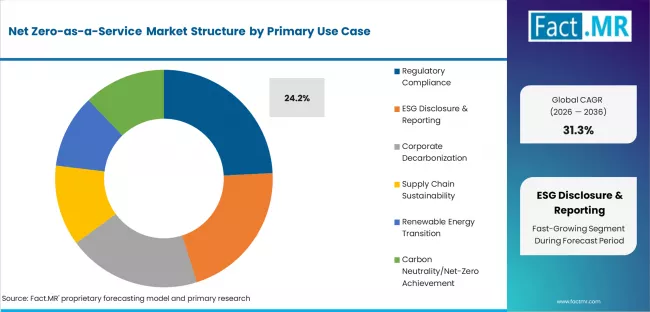
Net Zero As A Service Market Analysis By Primary Use Case | Source: Fact.MR
Regulatory Compliance is expected to account for the highest market share of 24.2% in 2026, supported by expanding climate disclosure requirements, increasing ESG reporting obligations, and growing regulatory pressure on enterprises to improve emissions transparency and sustainability performance.
Regional Outlook Across Key Markets
The geographies covered in this study include North America, Latin America, Western Europe, Eastern Europe, East Asia, South Asia & Pacific, and Middle East & Africa. Regional analysis covers the assessment of enterprise sustainability adoption, net-zero commitments, ESG disclosure requirements, climate regulations, Scope 1–3 emissions management trends, renewable energy transition initiatives, carbon management technology adoption, and industry-specific opportunities influencing Net Zero-as-a-Service deployment across key sectors.
.webp "Top Country Growth Comparison Net Zero As A Service Market Cagr (2026 2036)")
Top Country Growth Comparison Net Zero As A Service Market Cagr (2026 2036) | Source: Fact.MR
CAGR Table
| Country | CAGR (%) |
|---|---|
| India | 36.8% |
| Japan | 35.8% |
| China | 35.4% |
| Canada | 31.7% |
| United States | 29.6% |
| United Kingdom | 28.5% |
| Germany | 27.9% |
Source: Fact.MR analysis. Updated May 15, 2026
Source: Fact.MR (FMR) analysis, based on proprietary forecasting model and primary research.
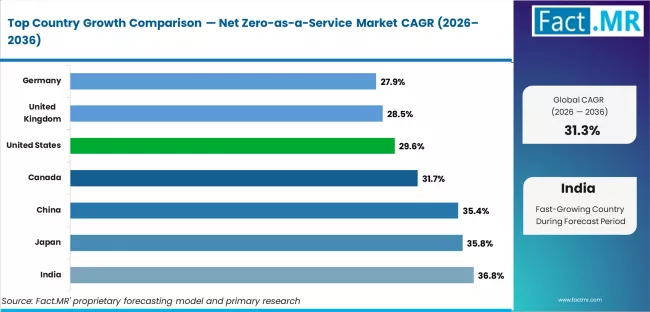
Net Zero As A Service Market Cagr Analysis By Country | Source: Fact.MR
North America Net Zero-as-a-Service Market
The North American region serves as the “enterprise sustainability transformation hub” for the NZaaS market, as a result of stringent ESG disclosure requirements, high enterprise sustainability expenditure, mature digital infrastructure, and growing climate technology investments. Prominent players such as Accenture, Deloitte, Schneider Electric and an IBM-led sustainability ecosystem, are further pushing market adoption in this space with AI-enabled carbon intelligence and integrated decarbonization solutions.
- U.S.: Demand for Net Zero-as-a-Service solutions in the U.S. is projected to grow at 29.6% CAGR through 2036, driven by increasing enterprise investments in carbon management platforms, climate reporting solutions, Scope 1–3 emissions management, and sustainability transformation initiatives across manufacturing, energy, logistics, and technology industries.
- Canada: Market growth in Canada is expected at 31.7% CAGR through 2036, supported by increasing renewable energy investments, climate policy initiatives, and enterprise focus on emissions monitoring and sustainability programs.
Western Europe Net Zero-as-a-Service Market
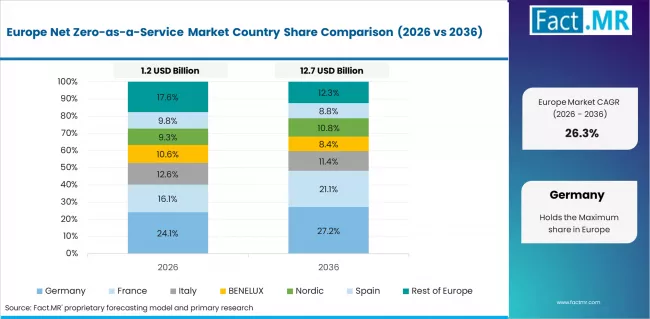
Net Zero As A Service Market Europe Country Market Share Analysis, 2026 & 2036 | Source: Fact.MR
Western Europe acts as the “Innovation Hub for Regulation and Sustainability” within the NZaaS market, wherein it is supported by robust climate legislations, net-zero pledges, and mature sustainability ecosystems. Companies are also increasingly leveraging integrated carbon management and decarbonization solutions to comply with growing ESG reporting requirements.
- Germany: Demand for Net Zero-as-a-Service solutions in Germany is projected to rise at 27.9% CAGR through 2036, supported by industrial decarbonization initiatives, sustainability regulations, and enterprise investments in carbon intelligence platforms.
- U.K.: Net Zero-as-a-Service demand in the U.K. is expected to expand at 28.5% CAGR through 2036, driven by increasing ESG reporting requirements and growing adoption of enterprise sustainability technologies.
- France: Market growth in France is supported by increasing investments in renewable energy transition programs and sustainability transformation initiatives.
East Asia Net Zero-as-a-Service Market
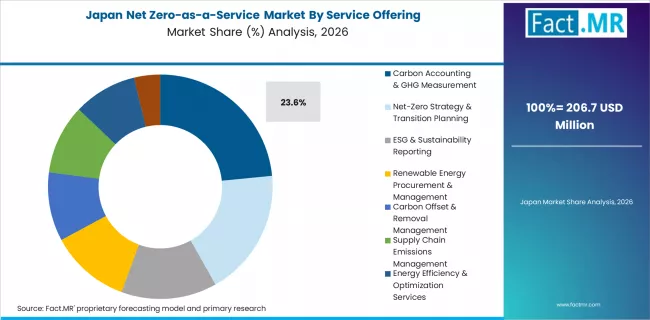
Net Zero As A Service Market Japan Market Share Analysis By Service Offering | Source: Fact.MR
East Asia is the “centre for the acceleration of global industrial decarbonization” in the NZaaS market, with active manufacturing, climate investments, and corporate sustainability programs. Extensive industrial systems and growing investments in climate technologies are further facilitating regional market growth.
- China: Demand for Net Zero-as-a-Service solutions in China is projected to grow at 35.4% CAGR through 2036, driven by large-scale industrial decarbonization efforts, renewable energy deployment, and increasing carbon management investments.
- Japan: Net Zero-as-a-Service demand in Japan is expected to rise at 35.8% CAGR through 2036, supported by increasing enterprise focus on energy efficiency, emissions optimization, and sustainability technologies.
- South Korea: Market growth in South Korea is supported by increasing smart manufacturing initiatives and enterprise sustainability investments.
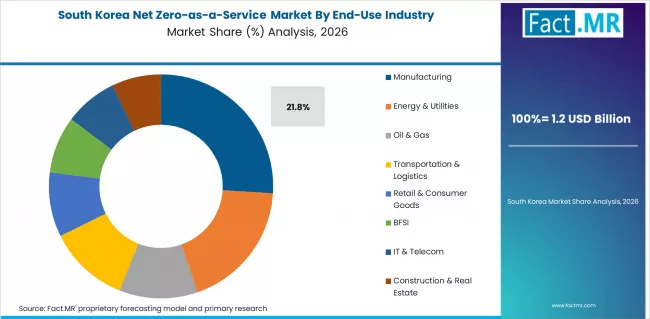
Net Zero As A Service Market South Korea Market Share Analysis By End Use Industry | Source: Fact.MR
South Asia & Pacific Net Zero-as-a-Service Market
South Asia & Pacific is emerging as the “high-growth climate technology adoption region” due to rising sustainability investments, increasing corporate net-zero commitments, and accelerating industrial digital transformation.
- India: Demand for Net Zero-as-a-Service solutions in India is projected to increase at 36.8% CAGR through 2036, driven by expanding renewable energy deployment, increasing ESG investments, and growing enterprise adoption of carbon intelligence and decarbonization platforms.
Fact.MR-style analysis of the Net Zero-as-a-Service market consists of country-level assessment across North America, Latin America, Western Europe, Eastern Europe, East Asia, South Asia & Pacific, and Middle East & Africa, covering enterprise sustainability adoption, climate regulations, carbon management technologies, competitive benchmarking, and long-term market opportunities.
Competitive Benchmarking and Company Positioning
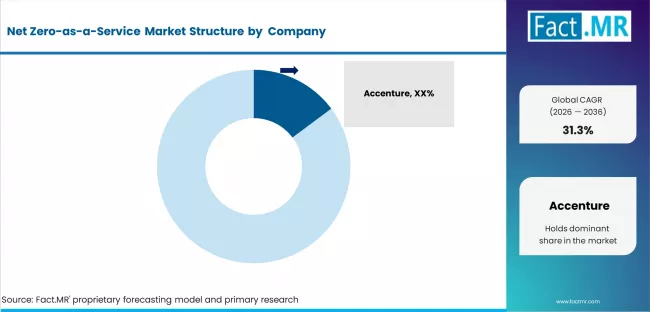
Net Zero As A Service Market Analysis By Company | Source: Fact.MR
Leading Companies Shaping the Net Zero-as-a-Service Market
The NZaaS market is somewhat fragmented, with some of the key firms operating in the industry being Accenture, Deloitte, EY, KPMG, McKinsey & Company, Boston Consulting Group (BCG), Tata Consultancy Services (TCS), Schneider Electric, Siemens, and Honeywell. The companies operate on the basis of carbon accounting features, Scope 1 to 3 emissions visibility, sustainability intelligence powered by artificial intelligence (AI), decarbonization implementation capabilities, and enterprise integration know-how. Existing companies benefit from their competitive edge due to their solid sustainability consultancy services, enterprise-level partnerships, digitization capabilities, and climate-related solutions in the manufacturing, energy, transportation, healthcare, and other industries.
Recent Industry Developments
- Boomitra – Soil Carbon Credit Collaboration with Deloitte (November 2025)
- Boomitra collaborated with Deloitte North & South Europe to support procurement of high-integrity soil carbon credits, strengthening carbon removal initiatives and supporting enterprise net-zero strategies. The initiative enhances carbon sequestration efforts and expands opportunities for measurable emissions reduction and carbon portfolio diversification within sustainability ecosystems.
- Accenture – Accenture Siemens Business Group Launch (March 2025)
- Accenture and Siemens announced the Accenture Siemens Business Group to accelerate digital engineering, industrial AI, and sustainability transformation capabilities. The initiative aims to improve operational efficiency, industrial decarbonization, and integrated enterprise sustainability execution across manufacturing ecosystems.
- Schneider Electric – Zeigo™ Hub Launch (July 2025)
- Schneider Electric launched Zeigo™ Hub, a supplier engagement and decarbonization platform designed to improve Scope 3 emissions visibility, supplier collaboration, and sustainability management capabilities. The platform supports enterprises in accelerating supply-chain decarbonization and operational sustainability initiatives.
- Siemens – Altair Acquisition for AI-Powered Industrial Software Portfolio (March 2025)
- Siemens completed the acquisition of Altair Engineering to strengthen its industrial software portfolio with enhanced simulation, AI, and digital engineering capabilities. The acquisition expands Siemens' sustainability and industrial intelligence ecosystem while supporting enterprise decarbonization initiatives and digital transformation strategies.
- ClimeCo – SBTi Updated Net-Zero Standard V2 Insights (March 2025)
- ClimeCo published analysis on SBTi’s Updated Net-Zero Standard V2, highlighting evolving requirements around target validation, Scope 3 emissions management, and carbon reduction pathways. The updated framework is expected to influence enterprise sustainability planning and increase demand for integrated Net Zero-as-a-Service solutions.
Leading Companies Shaping the Net Zero-as-a-Service Market
- Accenture
- Deloitte
- EY
- KPMG
- McKinsey & Company
- Boston Consulting Group
- Tata Consultancy Services
- Schneider Electric
- Siemens
- Honeywell
Sources and Research References
- [1] Boomitra, “Deloitte NSE Purchases Soil Carbon Credits from Boomitra”, November 2025
- [2] Accenture, “New Accenture Siemens Business Group to Reinvent Engineering and Manufacturing for Clients”, March 2025
- [3] Schneider Electric, “Schneider Electric Launches Zeigo™ Hub”, July 2025
- [4] Siemens, “Siemens Acquires Altair to Create Most Complete AI-Powered Portfolio of Industrial Software”, March 2025
- [5] ClimeCo, “SBTi’s Updated Net-Zero Standard V2: What Companies Need to Know”, March 2025
Net Zero-as-a-Service Market Definition
The NZaaS market offers technology-based sustainable and decarbonization solutions that enable enterprises to meet net-zero emission targets for carbon accounting, emissions monitoring, ESG reporting, renewable energy management, supply-chain emissions tracking, and climate risk assessment. These platforms leverage AI analytics, IoT monitoring, and enterprise systems to provide carbon intelligence and operational sustainability results in real time. NZaaS is relied upon by a wide range of sectors, i.e. manufacturing, energy, transportation, healthcare, BFSI, IT, and others, assisting them in driving enterprise-wide sustainable transformations and emission reduction strategies.
Net Zero-as-a-Service Market Inclusions
The market evaluation report includes the size of the global and regional NZaaS market in the period 2021 to 2036. This study provides an in-depth analysis of service offering, delivery model, emission scope coverage, vertical, and main use case segments, along with global and regional adoption trends, competitive landscape, business strategies, and sustainable technological integration furthermore. The report also analyzes developments in enterprise net-zero pledges, ESG disclosure requirements, scope 1-3 emissions monitoring, AI-enhanced carbon intelligence, renewable energy transition, supply chain sustainability, carbon removal programs, and cross-industry and regional investment prospects.
Net Zero-as-a-Service Market Exclusions
Conventional sustainability consulting services and environmental management solutions without technology-enabled carbon management, AI-led analytics, emissions intelligence, or integrated sustainability platforms are not included in the definition. The report does not include standalone environmental consulting or manual processes for carbon assessment, traditional energy management solutions and simple ESG reporting tools without analytics capabilities, turning carbon offsets without integrated sustainability solutions which comprise continual emissions surveillance, enterprise workflow integration, or options for operational decarbonization.
Net Zero-as-a-Service Market Research Methodology
- Primary Research
- Fact.MR conducted a rigorous primary research approach was conducted involving interviews with sustainability consultants, carbon management platform providers, climate technology companies, ESG specialists, enterprise technology vendors, industrial sustainability experts, energy solution providers, and end users across manufacturing, energy & utilities, transportation, BFSI, healthcare, and other industries to validate market findings, demand trends, and adoption patterns.
- Desk Research
- The study utilizes company annual reports, sustainability reports, ESG disclosures, climate policy publications, regulatory frameworks, industry white papers, trade journals, carbon market studies, enterprise sustainability spending data, and decarbonization research reports.
- Market-Sizing and Forecasting
- A hybrid demand-side and top-down market modeling approach was adopted, combining revenue analysis of NZaaS providers with enterprise sustainability spending, ESG investments, and regional adoption trends across industries.
- Data Validation and Update Cycle
- Market estimates were validated through primary interviews, company financials, regulatory trends, historical market performance, and enterprise sustainability investment patterns, with forecasts updated periodically to reflect changing market dynamics.
Segmentation
Scope of Analysis
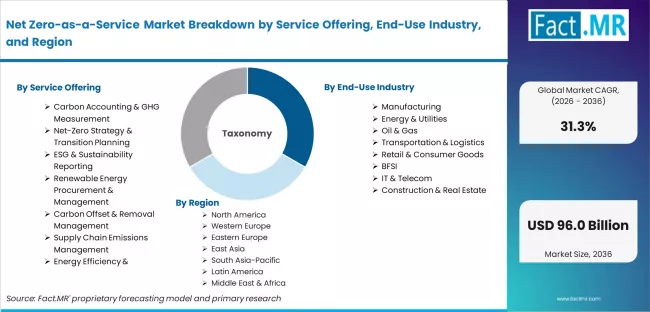
Net Zero As A Service Market Breakdown By Service Offering, End Use Industry, And Region | Source: Fact.MR
Parameter |
Details |
|---|---|
| Quantitative Units | USD 4.8 Billion (2025) to USD 96.0 Billion (2036), at a CAGR of 31.3% |
| Market Definition | The Net Zero-as-a-Service (NZaaS) Market offers software, managed services, and AI/IoT-enabled solutions for carbon management, sustainability reporting, and renewable energy optimization. It helps enterprises achieve net-zero emissions by integrating decarbonization planning and carbon removal management across all three emission scopes. |
| Regions Covered | North America, Latin America, East Asia, South Asia & Pacific, Western Europe, Eastern Europe, Middle East & Africa |
| Countries Covered | USA, Canada, UK, Germany, China, Japan, India, South Korea, Australia, France, Brazil, Saudi Arabia, UAE, Singapore and 20+ countries |
| Key Companies | Accenture, Deloitte, EY, KPMG, McKinsey & Company, Boston Consulting Group (BCG), Tata Consultancy Services (TCS), Schneider Electric, Siemens, Honeywell |
| Forecast Period | 2026 to 2036 |
| Approach | Hybrid demand-side and top-down methodology based on enterprise sustainability adoption, net-zero commitments, ESG disclosure requirements, corporate decarbonization initiatives, Scope 1–3 emissions management demand, climate technology investments, and increasing integration of AI-enabled sustainability platforms, validated through primary interviews with sustainability consultants, carbon management platform providers, enterprise technology vendors, industrial companies, energy solution providers, ESG specialists, and climate technology experts across key regions. |
Source: Fact.MR analysis. Updated May 15, 2026
Analysis by Service Offering, Delivery Model, Emission Scope Coverage, End-Use Industry, Primary Use Case, and Region
-
Net Zero-as-a-Service Market by Service Offering
- Carbon Accounting & GHG Measurement
- Net-Zero Strategy & Transition Planning
- ESG & Sustainability Reporting
- Renewable Energy Procurement & Management
- Carbon Offset & Removal Management
- Supply Chain Emissions Management
- Energy Efficiency & Optimization Services
- Climate Risk & Regulatory Compliance Services
-
Net Zero-as-a-Service Market by Delivery Model
- Software Platform
- Managed Services
- Consulting & Advisory
- Integrated End-to-End Services
-
Net Zero-as-a-Service Market by Emission Scope Coverage
- Scope 1 Emissions
- Scope 2 Emissions
- Scope 3 Emissions
- Full-Scope (Scope 1, 2 & 3)
-
Net Zero-as-a-Service Market by End-Use Industry
- Manufacturing
- Energy & Utilities
- Oil & Gas
- Transportation & Logistics
- Retail & Consumer Goods
- BFSI
- IT & Telecom
- Construction & Real Estate
- Healthcare & Pharmaceuticals
- Food & Beverage
- Chemicals & Materials
- Government & Public Sector
- Others
-
Net Zero-as-a-Service Market by Primary Use Case
- Regulatory Compliance
- ESG Disclosure & Reporting
- Corporate Decarbonization
- Supply Chain Sustainability
- Renewable Energy Transition
- Carbon Neutrality / Net-Zero Achievement
-
Net Zero-as-a-Service Market by Region
- North America
- USA
- Canada
- Mexico
- Latin America
- Brazil
- Chile
- Rest of LATAM
- East Asia
- China
- Japan
- South Korea
- Taiwan
- South Asia & Pacific
- India
- Singapore
- Australia
- ASEAN
- Western Europe
- Germany
- France
- U.K.
- Italy
- Spain
- BENELUX
- Nordic
- Rest of Western Europe
- Eastern Europe
- Poland
- Hungary
- Czech Republic
- Balkan & Baltics
- Rest of Eastern Europe
- Middle East and Africa
- Kingdom of Saudi Arabia
- United Arab Emirates
- South Africa
- Rest of Middle East and Africa
- North America
Frequently Asked Questions
How large is the demand for Net Zero-as-a-Service in the global market in 2025?
What will be the market size of the Net Zero-as-a-Service Market by 2036?
What is the expected demand growth for the Net Zero-as-a-Service Market between 2026 and 2036?
Which service offering segment is expected to dominate the market?
Which delivery model segment is expected to hold the highest market share?
How significant is the growth outlook for India in this market?
Which company is identified as a leading player in the Net Zero-as-a-Service Market?
Who worked on this report


Preview the report firsthand - request a free sample
Free SampleGet the brochure for pricing and purchase details
Download PDF