- Base Value(2025): 1.2 Bn
- Estimated Value(2026): 1.5 Bn
- Forecast Value (2036): 20.0 Bn
- CAGR (2026 - 2036): 29.6%
Age Verification & Online Safety Compliance Services Market Size, Market Forecast and Outlook by Fact.MR
- The age verification and online safety compliance services market was valued at USD 1.2 billion in 2025.
- Demand is expected to increase from USD 1.5 billion in 2026 to USD 20.0 billion by 2036.
- The market is forecast to record 29.6% CAGR during 2026 to 2036 as platforms and social apps adopt age assurance under online safety rules.
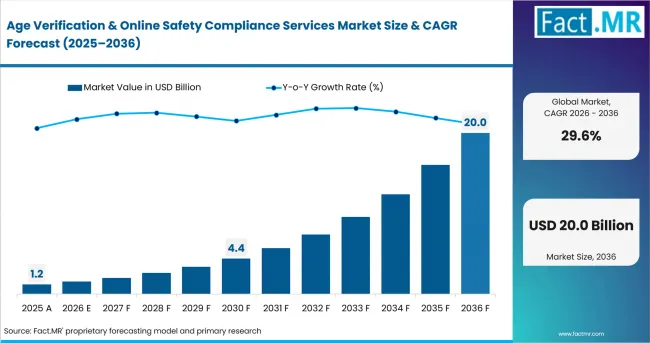
Age Verification & Online Safety Compliance Services Market Value Analysis | Source: Fact.MR
Summary of Age Verification & Online Safety Compliance Services Market
- Demand Drivers in the Market
- Platforms need age checks because online safety rules now require stronger minor protection.
- Adult content operators need compliant access controls before enforcement actions begin.
- Gaming platforms need age-based experiences that match child safety expectations.
- E-commerce operators need privacy-aware checks for restricted products and services.
- Key Segments Analyzed
- By Service Type: Age assurance integration is expected to hold 36.0% share in 2026 because platforms need deployment support before compliance deadlines.
- By Verification Method: Facial age estimation leads because it reduces friction for high-volume platforms. The segment is projected to capture 32.0% share in 2026.
- By Customer Type: Adult Content Platforms are likely to account for 35.0% share in 2026 because Ofcom enforcement creates urgent compliance demand.
- By Delivery Model: API-based verification is projected to hold 43.0% share in 2026 because platforms need checks inside existing user flows.
- By End Use: Adult content access control is expected to hold 37.0% share in 2026 because the earliest mandatory age-check use is concentrated there.
- By Geography: The United Kingdom is projected to record 33.4% CAGR through 2036 as Online Safety Act enforcement creates the strongest early demand.
- Analyst Opinion at Fact.MR
- Shambhu Nath Jha, Senior Analyst at Fact.MR, states, “Age assurance is becoming a compliance layer for digital platforms. We see platforms asking how to prove age without collecting more identity data than needed. Providers that combine verification accuracy with privacy protection will gain stronger access to regulated digital services.”
- Strategic Implications
- Adult content platforms need strong age checks before enforcement exposure rises.
- Social platforms should prepare minor risk assessments before age assurance reviews.
- Gaming operators need age-based flows that support safe access without harming user experience.
- Age assurance vendors need privacy controls that reduce data collection concerns.
| Metric | Details |
|---|---|
| Industry Size 2026 | USD 1.5 billion |
| Industry Value 2036 | USD 20.0 billion |
| CAGR 2026 to 2036 | 29.6% |
Source: Fact.MR analysis. Updated Jun 18, 2026
Privacy-preserving age assurance and online safety compliance services form the core of this market. These services include facial age estimation and platform compliance support. Ofcom stated that from 25 July 2025, sites and apps allowing pornography must have strong age checks in place. [1] This makes age assurance a direct compliance need for high-risk digital services such as adult sites and social apps.
The United Kingdom is projected to record 33.4% CAGR by 2036 as Online Safety Act enforcement creates the strongest early demand. The United States is likely to post 31.8% CAGR as state age-verification laws push platforms toward compliance services. Germany is expected to register 30.4% CAGR through 2036 because EU minor-protection rules support platform review. France is forecast to advance at 29.7% CAGR as DSA-linked child safety obligations expand. South Korea is set to record 28.5% CAGR as mobile gaming and social platforms adopt stronger minor protection controls.
Segmental Analysis
Age Verification & Online Safety Compliance Services Market Analysis by Service Type
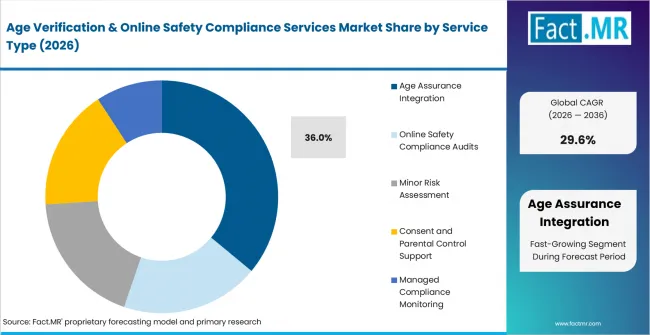
Age Verification & Online Safety Compliance Services Market Analysis By Service Type | Source: Fact.MR
Age Assurance Integration is expected to hold 36.0% share in 2026 because platforms need deployment support before compliance deadlines. The work includes age-gate design, method selection and integration with user access flows. Demand is strongest where services need working controls rather than policy documentation alone.
Age Verification & Online Safety Compliance Services Market Analysis by Verification Method
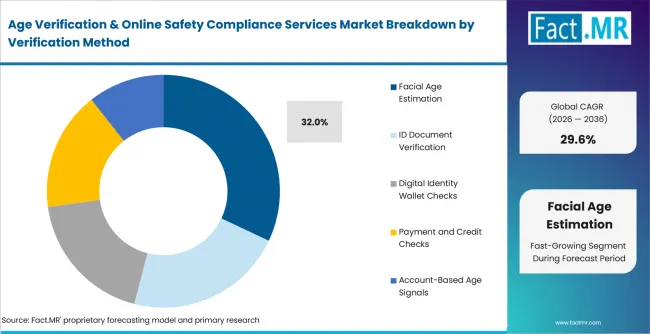
Age Verification & Online Safety Compliance Services Market Analysis By Verification Method | Source: Fact.MR
Facial Age Estimation leads because high-volume platforms need a lower-friction route before requesting document checks. NIST’s FATE Age Estimation and Verification work supports technical evaluation of age-estimation systems. [2] The segment is projected to capture 32.0% share in 2026 as platforms seek checks that can work at scale. ID document verification is used when confidence needs to be higher or risk is greater.
Age Verification & Online Safety Compliance Services Market Analysis by Customer Type
.webp "Age Verification & Online Safety Compliance Services Market Analysis By Customer Type (1)")
Age Verification & Online Safety Compliance Services Market Analysis By Customer Type (1) | Source: Fact.MR
Adult Content Platforms are likely to account for 35.0% share in 2026 because enforcement pressure is immediate. Operators need proof that minors are blocked before access is granted. This creates demand for verification workflows, compliance evidence and vendor support during regulator review.
Age Verification & Online Safety Compliance Services Market Analysis by Delivery Model
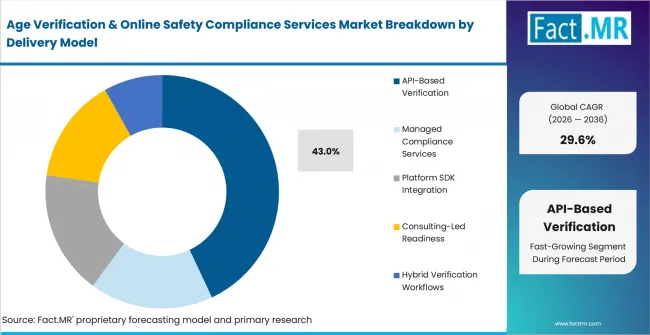
Age Verification & Online Safety Compliance Services Market Analysis By Delivery Model | Source: Fact.MR
API-Based Verification leads because platforms need age checks inside existing account and access journeys. The delivery model is projected to hold 43.0% share in 2026 as operators avoid building age assurance systems from scratch. APIs also help platforms switch between facial estimation and alternative methods. This flexibility matters because user risk and content sensitivity differ across services.
Age Verification & Online Safety Compliance Services Market Analysis by End Use
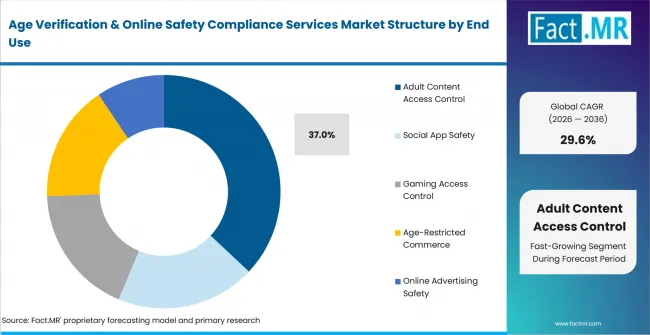
Age Verification & Online Safety Compliance Services Market Analysis By End Use | Source: Fact.MR
Adult Content Access Control is expected to hold 37.0% share in 2026 because adult-content access is the clearest early enforcement point. Operators need to block minors before restricted content is shown. Compliance teams also need records that prove age assurance methods were applied. The use case leads because online safety laws create direct service demand and short implementation timelines.
Age Verification & Online Safety Compliance Services Market Drivers, Restraints, and Opportunities
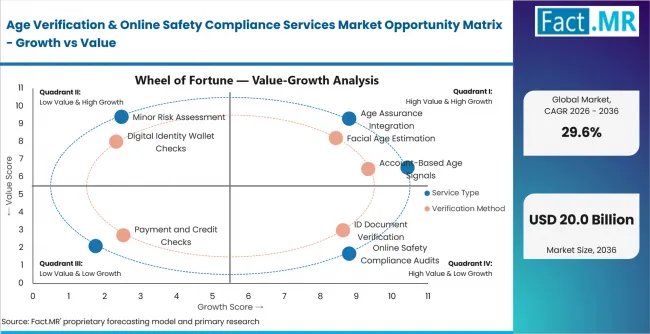
Age Verification & Online Safety Compliance Services Market Opportunity Matrix Growth Vs Value | Source: Fact.MR
The primary driver is regulation-led enforcement. The DSA minor-protection guidelines increase pressure on platforms to make online services safer for children.
The United States adds momentum through state-level age-verification laws. The Supreme Court’s 2025 Paxton decision supports state authority to require age verification for adult content. [3] This expands demand from adult platforms into broader compliance planning.
The main restraint is privacy concern. Age checks can create user distrust if platforms collect too much identity data. Facial estimation also needs fairness testing and clear fallback routes. Services that reduce data retention and support selective disclosure will be better placed.
Opportunities in the Age Verification & Online Safety Compliance Services Market
- Adult Platform Compliance: Providers can support age checks for services facing immediate enforcement.
- Gaming Safety Flows: Gaming platforms can add age-based experiences and parental controls.
- Privacy-Preserving Verification: Vendors can offer checks that confirm age without storing full identity data.
Regional Analysis
Based on regional analysis, the age verification and online safety compliance services market is segmented into Western Europe, North America, Western Europe, East Asia, South Asia and Pacific, Latin America, and Middle East and Africa.
.webp "Top Country Growth Comparison Age Verification & Online Safety Compliance Services Market Cagr (2026 2036)")
Top Country Growth Comparison Age Verification & Online Safety Compliance Services Market Cagr (2026 2036) | Source: Fact.MR
| Country | CAGR |
|---|---|
| United Kingdom | 33.4% |
| United States | 31.8% |
| Germany | 30.4% |
| France | 29.7% |
| South Korea | 28.5% |
Source: Fact.MR analysis. Updated Jun 18, 2026
Source: Fact.MR analysis, based on proprietary forecasting model and primary research. Age Verification & Online Safety Compliance Services Market Cagr Analysis By Country | Source: Fact.MR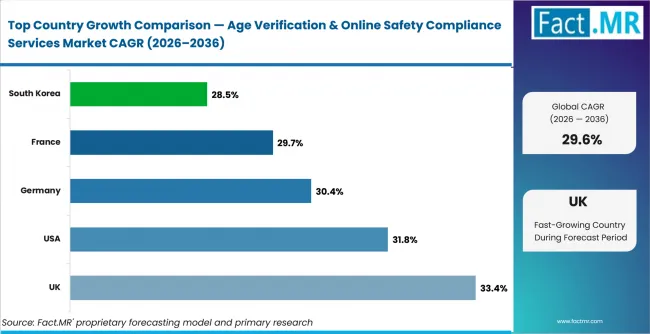
Western Europe Age Verification & Online Safety Compliance Services Market Analysis
Western Europe demand is led by the United Kingdom and EU markets. UK enforcement creates immediate age-check demand while EU DSA guidance supports wider minor-protection compliance.
- United Kingdom: The United Kingdom is projected to record 33.4% CAGR through 2036 as Online Safety Act enforcement creates the strongest early demand. Adult content platforms need highly effective age checks before access is granted. Ofcom states that all user-to-user and search services must complete a children’s access assessment and should only conclude that children cannot access a service if highly effective age assurance is used [4]. Social and gaming services must assess child access risk and apply suitable protections.
North America Age Verification & Online Safety Compliance Services Market Analysis
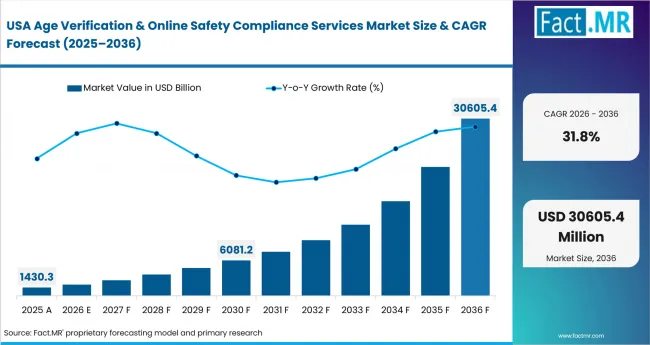
Age Verification & Online Safety Compliance Services Market Country Value Analysis | Source: Fact.MR
North America demand is led by the United States because state-level age-verification rules are changing compliance planning for adult platforms and social apps.
- United States: State age-verification laws are pushing U.S. platforms toward stronger compliance services. Adult content operators face immediate pressure while social apps review age-based access and safety controls. The country is likely to post 31.8% CAGR through 2036 as legal exposure expands across states. Vendors can gain by offering flexible workflows that work across state rules.
Western Europe Age Verification & Online Safety Compliance Services Market Analysis
Germany and France show steady demand because EU minor-protection rules require stronger platform risk controls. Digital service providers need age assurance that fits privacy expectations.
- Germany: Germany is expected to register 30.4% CAGR through 2036 because EU minor-protection rules support platform review. Adult sites, gaming firms and media platforms need clearer age assurance before regulators question access design. German services will prefer privacy-first methods because identity data collection faces higher scrutiny. DSA guidance strengthens the need for age-appropriate design and risk control.
- France: French platforms and digital media services are reviewing minor-protection duties under EU online safety rules. The country is forecast to advance at 29.7% CAGR through 2036 as DSA-linked child safety obligations expand. Gaming, streaming and social apps need age assurance that fits user-experience expectations. Adult content operators need stronger access control.
East Asia Age Verification & Online Safety Compliance Services Market Analysis
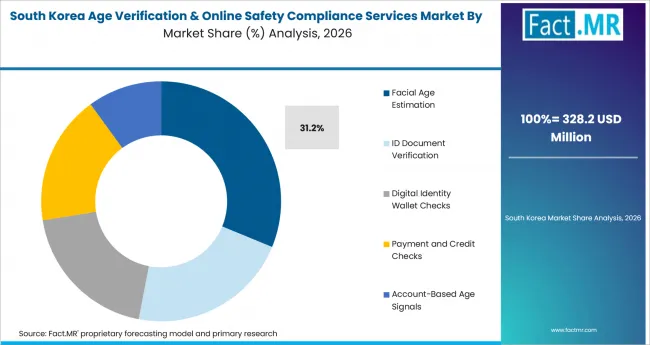
Age Verification & Online Safety Compliance Services Market South Korea Market Share Analysis By Verification Method | Source: Fact.MR
East Asia demand is supported by mobile gaming, social platforms and public concern around minor protection. South Korea shows earlier service opportunity because digital service use is highly mobile.
- South Korea: South Korea is set to record 28.5% CAGR through 2036 as mobile gaming and social platforms adopt stronger minor protection controls. Digital entertainment companies need age-based access and parental control support without adding too much friction. Platform teams will prefer API-based checks that can be embedded inside mobile user flows. Compliance services can also support gaming operators that need age-appropriate access rules.
Competitive Aligners for Market Suppliers
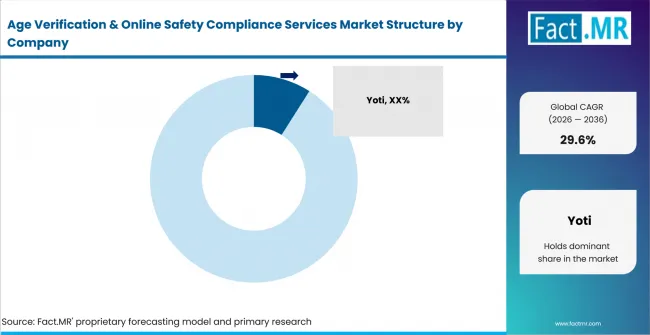
Age Verification & Online Safety Compliance Services Market Analysis By Company | Source: Fact.MR
Age verification and online safety compliance services are used where platforms must keep minors away from restricted content and harmful experiences. Yoti supports facial age estimation and age verification for online users. k-ID supports youth compliance and age-appropriate digital experiences. VerifyMy provides age assurance services for regulated content access.
Persona offers identity verification workflows that can support age checks. Incode provides age verification solutions for safety and compliance. Entrust expanded its identity verification position through its acquisition of Onfido in 2024.
Competition through 2036 will depend on accuracy, privacy controls and integration depth. Platforms will prefer vendors that offer multiple methods because one verification route will not fit every user. Providers that support evidence records and regulator-ready reporting will be better placed.
Key Companies in Age Verification & Online Safety Compliance Services Market
- Yoti
- k-ID
- VerifyMy
- Persona
- Incode
- Entrust (Onfido)
Bibliography
- [1] Ofcom. (2025, July 24). Online age checks now in force.
- [2] Hanaoka, K., Ngan, M., Yang, J., Quinn, G. W., Hom, A., & Grother, P. (2024, May). Face Analysis Technology Evaluation: Age Estimation and Verification (NIST IR 8525). National Institute of Standards and Technology.
- [3] European Commission. (2025, July 14). Commission publishes guidelines on the protection of minors. Shaping Europe’s Digital Future.
- [4] Ofcom. (2025, January 16). Children’s access assessment duties under the Online Safety Act.
This Report Addresses
- Strategic intelligence on age verification and online safety compliance services across service type, verification method, customer type, delivery model and end use.
- Forecast mapping from USD 1.5 billion in 2026 to USD 20.0 billion by 2036.
- Segment analysis covering Age Assurance Integration, Facial Age Estimation, Adult Content Platforms, API-Based Verification and Adult Content Access Control.
- Regional outlook covering the United Kingdom, United States, Germany, France and South Korea.
- Competitive analysis of Yoti, k-ID, VerifyMy, Persona, Incode and Entrust (Onfido).
- Service assessment covering age assurance integration, minor risk assessment and managed compliance monitoring.
- Verification assessment covering facial age estimation, ID checks, digital identity wallet checks and account-based signals.
- Primary interviews, provider checks, official source review and online safety compliance validation support the forecast.
Age Verification & Online Safety Compliance Services Market Definition
The age verification and online safety compliance services market covers services that help digital platforms confirm or estimate user age and meet minor-protection rules. It includes facial age estimation and online safety compliance support. The market differs from broad identity verification because the main purpose is age assurance and child safety compliance.
Age Verification & Online Safety Compliance Services Market Inclusions
The scope includes privacy-preserving age assurance and online safety audits. It covers facial age estimation and digital identity wallet checks. It includes API-based verification for platforms and managed compliance support for adult content services. It also covers minor risk assessment for social media and gaming apps.
Age Verification & Online Safety Compliance Services Market Exclusions
The scope excludes general KYC services with no age assurance use. It excludes content moderation tools unless they support age-based access control. It excludes parental control apps that do not verify user age for platform compliance. General cybersecurity services are outside scope unless they support online safety compliance.
Age Verification & Online Safety Compliance Services Market Research Methodology
- Primary Research:
- Primary research includes interviews with trust and safety heads and platform compliance managers. It includes input from age assurance vendors and online safety legal teams.
- Desk Research:
- Desk research reviews Online Safety Act rules and DSA minor-protection guidance. It covers official provider pages and age-estimation testing sources.
- Market-Sizing and Forecasting:
- Forecasting uses platform compliance intensity and age-check transaction demand. Adult content access control and social app risk assessment support the market assessment.
- Data Validation and Update Cycle:
- Forecasts are validated through provider checks and regulator activity. Age assurance technology trials and platform adoption signals help confirm market direction.
Segmentation
Scope of the Report
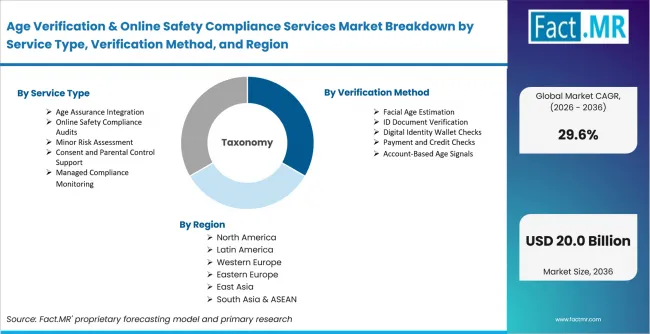
Age Verification & Online Safety Compliance Services Market Breakdown By Service Type, Verification Method, And Region | Source: Fact.MR
| Attribute | Details |
|---|---|
| Quantitative Units | USD 1.5 billion in 2026 to USD 20.0 billion by 2036 at 29.6% CAGR |
| Market Definition | Privacy-preserving age assurance and online safety compliance services for platforms, gaming, adult and social apps |
| Service Type | Age Assurance Integration, Online Safety Compliance Audits, Minor Risk Assessment, Consent and Parental Control Support, Managed Compliance Monitoring |
| Verification Method | Facial Age Estimation, ID Document Verification, Digital Identity Wallet Checks, Payment and Credit Checks, Account-Based Age Signals |
| Customer Type | Social Platforms, Gaming Platforms, Adult Content Platforms, E-Commerce Operators, Streaming and Media Apps |
| Delivery Model | API-Based Verification, Managed Compliance Services, Platform SDK Integration, Consulting-Led Readiness, Hybrid Verification Workflows |
| End Use | Adult Content Access Control, Social App Safety, Gaming Access Control, Age-Restricted Commerce, Online Advertising Safety |
| Regions Covered | Western Europe, North America, East Asia, South Asia and Pacific, Latin America, Middle East and Africa |
| Countries Covered | United Kingdom, United States, Germany, France, South Korea |
| Key Companies Profiled | Yoti, k-ID, VerifyMy, Persona, Incode and Entrust (Onfido) |
| Forecast Period | 2026 to 2036 |
| Approach | Hybrid top-down and bottom-up approach using platform counts, regulatory deadlines, verification transaction demand, provider activity and online safety compliance intensity |
Source: Fact.MR analysis. Updated Jun 18, 2026
Age Verification & Online Safety Compliance Services Market Analysis by Segments
-
By Service Type:
- Age Assurance Integration
- Online Safety Compliance Audits
- Minor Risk Assessment
- Consent and Parental Control Support
- Managed Compliance Monitoring
-
By Verification Method:
- Facial Age Estimation
- ID Document Verification
- Digital Identity Wallet Checks
- Payment and Credit Checks
- Account-Based Age Signals
-
By Customer Type:
- Social Platforms
- Gaming Platforms
- Adult Content Platforms
- E-Commerce Operators
- Streaming and Media Apps
-
By Delivery Model:
- API-Based Verification
- Managed Compliance Services
- Platform SDK Integration
- Consulting-Led Readiness
- Hybrid Verification Workflows
-
By End Use:
- Adult Content Access Control
- Social App Safety
- Gaming Access Control
- Age-Restricted Commerce
- Online Advertising Safety
-
By Region:
- North America
- United States
- Canada
- Europe
- Germany
- United Kingdom
- France
- Italy
- Spain
- Asia Pacific
- China
- Japan
- South Korea
- Taiwan
- Singapore
- Latin America
- Brazil
- Mexico
- Argentina
- Middle East & Africa
- GCC Countries
- South Africa
- Israel
- North America
Frequently Asked Questions
What is the Age Verification & Online Safety Compliance Services Market size in 2026?
What will the Age Verification & Online Safety Compliance Services Market be worth by 2036?
What CAGR is projected for the Age Verification & Online Safety Compliance Services Market?
Which service type leads the Age Verification & Online Safety Compliance Services Market?
Which country expands faster in the Age Verification & Online Safety Compliance Services Market?
How does the United States perform in the Age Verification & Online Safety Compliance Services Market?
How does Germany perform in the Age Verification & Online Safety Compliance Services Market?
How does France perform in the Age Verification & Online Safety Compliance Services Market?
How does South Korea perform in the Age Verification & Online Safety Compliance Services Market?
What is the primary driver in the Age Verification & Online Safety Compliance Services Market?
What is the main restraint in the Age Verification & Online Safety Compliance Services Market?
Why is facial age estimation important in this market?
Who worked on this report


Preview the report firsthand - request a free sample
Free SampleGet the brochure for pricing and purchase details
Download PDF