- Market Value (2025): USD 1.72 Bn
- Estimated Value (2026): USD 1.83 Bn
- Forecast Value (2036): USD 3.45 Bn
- CAGR (2026-2036): 6.9%
What is the Extract-based Biostimulants Market forecast to be worth by 2036?
USD 1.8 billion in 2026 to USD 3.5 billion by 2036 at an approximately 6.9% CAGR based on displayed market values
- As per the Fact.MR analysis, the market was valued at USD 1.72 billion in 2025.
- Demand is projected to increase from USD 1.83 billion in 2026 to USD 3.45 billion by 2036.
- The displayed endpoints imply an approximately 6.9% CAGR from 2026 to 2036 as growers seek natural, extract-based solutions to improve crop growth and resilience to environmental stress.
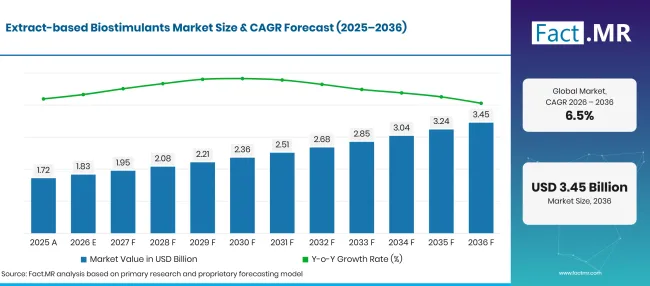
Extract Based Biostimulants Market Forecast Global | Source: Fact.MR
| Year | Basis | Market Value (USD billion) |
|---|---|---|
| 2025 | Actual | 1.6 |
| 2026 | Estimate | 1.8 |
| 2036 | Forecast | 3.45 |
| CAGR 2026 to 2036 | Forecast period | 6.9% |
Source: Fact.MR analysis. Updated Oct 28, 2026
What are the defining numbers behind Extract-based Biostimulants Market growth?
USD 1.7 billion in absolute opportunity between 2026 and 2036
- Demand Drivers in the Market
- Demand for extract-based biostimulants is driven by the need to improve crop productivity and nutrient-use efficiency while supporting plant growth and strengthening resilience to environmental stress.
- Large agricultural production bases support demand for extract-based biostimulants as farmers seek to improve crop performance and maintain yields across extensive cultivation areas. Brazil's National Supply Company (Conab) estimated grain production of 361.7 million tonnes for the 2025/26 season in its September 15, 2026, report, with planted area reaching 83.5 million hectares. [1]
- The extract-based biostimulants demand has increased due to crop-specific formulation needs, as different crops require tailored solutions to support growth, nutrient uptake and tolerance to environmental stress. Seaweed extracts, plant extracts, and humic substances offer different formulation characteristics.
- Key Segments Analyzed
- By Source Type: Seaweed Extracts lead with a stated 38.6% share in 2026, followed by Plant Extracts at 28.4% and Humic Substances at 24.8%.
- By Application: Foliar Treatment holds 45.2% in 2026.
- By Crop Type: Cereals & Grains account for 38.2% in 2026.
- By Form: Liquid formulations lead with 62.4% due to their ease of dilution and compatibility with foliar spraying and fertigation systems, allowing growers to apply extract-based biostimulants uniformly across crops.
- Analyst Opinion at Fact.MR
- Shambhu Nath Jha, Principal Consultant at Fact.MR, states, “Extract-based biostimulants are positioned to benefit from agricultural input programs that prioritize crop performance and nutrient-use efficiency. Commercial success will depend on whether suppliers can demonstrate repeatable results under relevant crop and field conditions. Seaweed-derived ingredients and liquid formulations offer clear product-development opportunities, but pricing, consistency of raw materials, and the quality of field evidence will influence adoption.”
- Strategic Implications
- Manufacturers must substantiate crop-specific claims through replicated field trials and clearly defined application protocols.
- Distributors need to explain how extract-based biostimulants fit into existing fertilizer and crop-protection programs without implying that they replace essential nutrients.
- Agronomists can compare treated and untreated plots and document crop, soil, weather, dosage and yield outcomes.
- Farm operators should assess treatment costs against measurable changes in crop quality, stress tolerance and marketable yield.
Germany is projected to record an 8.3% CAGR through 2036. Brazil is set to post 7.6%, followed by the USA at 6.8%. The UK is estimated to advance at 6.1%, while Japan is forecast to grow at 5.4%.
How does the Extract-based Biostimulants Market break down by segment?
Fact.MR's segmentation identifies Seaweed Extracts as the leading source category, Foliar Treatment as the leading application, Cereals & Grains as the largest crop category, and Liquid as the leading form.
Which Source Type dominates?
Seaweed Extracts are set to hold 38.6% share in 2026.
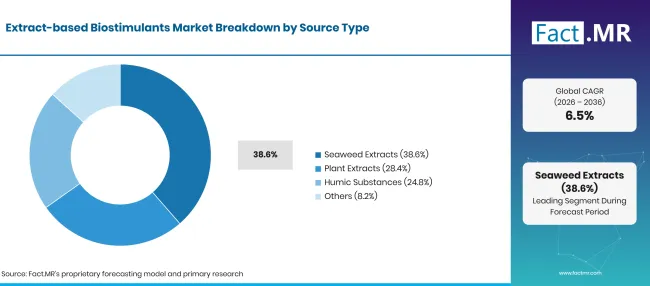
Extract Based Biostimulants Market Breakdown Source Type | Source: Fact.MR
| Source Type | Share (2026) |
|---|---|
| Seaweed Extracts (Leading segment) | 38.6% |
| Other segments combined | 61.4%* |
| Total | 100.0% |
Source: Fact.MR analysis. Updated Oct 28, 2026
Seaweed extracts contain naturally occurring compounds used in agricultural formulations. Their commercial positioning depends on extraction methods, composition, consistency, and evidence supporting crop-specific claims. Plant extracts offer another route to developing formulations for crop growth and stress management. Humic substances occupy a separate category in the segmentation and should be assessed according to their defined product composition.
How does Application shape demand?
Foliar Treatment is set to account for 45.2% share in 2026.
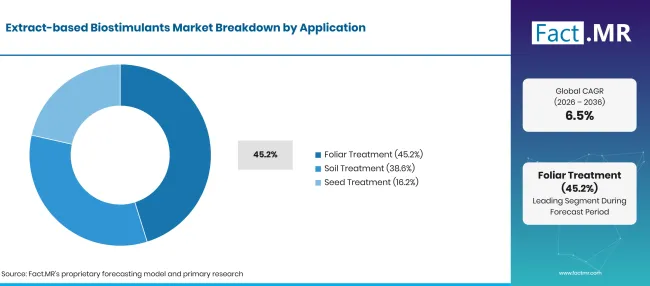
Extract Based Biostimulants Market Breakdown Application | Source: Fact.MR
| Application | Share (2026) |
|---|---|
| Foliar Treatment (Leading segment) | 45.2% |
| Other segments combined | 54.8%* |
| Total | 100.0% |
Source: Fact.MR analysis. Updated Oct 28, 2026
Foliar treatment allows products to be applied directly to plant leaves, making application timing and spray compatibility important. Soil treatment targets the root-zone environment and may suit specific nutrient-management programs. Seed treatment provides an early-stage delivery route, although formulation compatibility and crop-specific evidence determine its suitability.
Which Crop Type dominates?
Cereals & Grains holds 38.2% share in 2026.
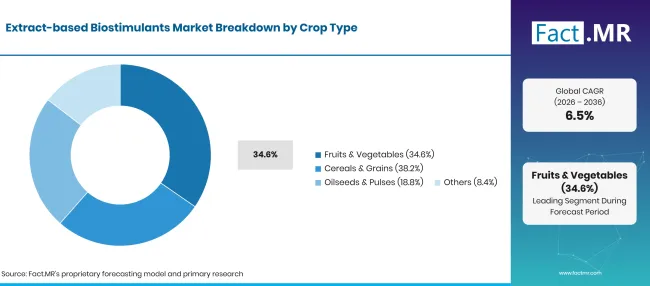
Extract Based Biostimulants Market Breakdown Crop Type | Source: Fact.MR
| Crop Type | Share (2026) |
|---|---|
| Cereals & Grains | 38.2% |
| Other segments combined | 61.8%* |
| Total | 100.0% |
Source: Fact.MR analysis. Updated Oct 28, 2026
Cereals and grains offer a broad potential application base because of their extensive cultivated area. Fruits and vegetables provide opportunities where growers closely monitor marketable quality, fruit development, and crop stress. Oilseeds and pulses represent another demand category, with product choice shaped by crop physiology, local growing conditions, and the economics of treatment.
What is driving demand by Form?
Liquid formulations are set to represent 62.4% share in 2026.
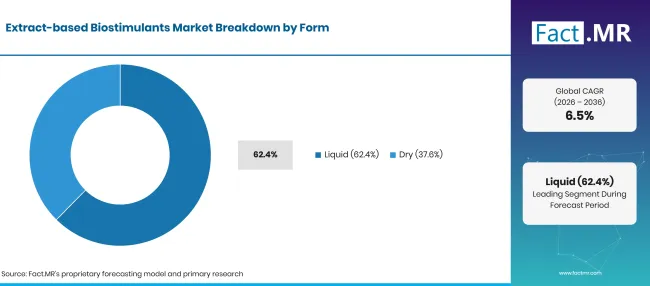
Extract Based Biostimulants Market Breakdown Form | Source: Fact.MR
| Form | Share (2026) |
|---|---|
| Liquid (Leading segment) | 62.4% |
| Other segments combined | 37.6%* |
| Total | 100.0% |
Source: Fact.MR analysis. Updated Oct 28, 2026
Liquid products can be convenient for foliar spraying and selected soil-treatment systems. Their commercial performance depends on storage stability, concentration, mixing compatibility, and ease of application. Dry products may provide handling or transportation advantages in some distribution settings. Manufacturers must ensure that the selected formulation preserves the relevant extract characteristics throughout its stated shelf life.
What is accelerating Extract-based Biostimulants Market adoption, and what is holding it back?
Greater attention to crop stress management and nutrient-use efficiency supports demand, while inconsistent field results, product differentiation, and price sensitivity constrain adoption.
Drivers Impact Analysis
| Driver | Approximate impact on CAGR | Geographic relevance | Impact timeline |
| Crop stress management | +1.0% | Global | Medium term (2–4 years) |
| Interest in nutrient-use efficiency | +0.9% | Europe, Americas | Medium term (2–4 years) |
| Demand for higher-quality horticultural crops | +0.7% | Global | Short term (≤2 years) |
| Expanded distributor and agronomy support | +0.5% | Global | Short term (≤2 years) |
| Formulation development and application flexibility | +0.4% | Global | Long term (≥4 years) |
Source: Fact.MR analysis. Updated Oct 28, 2026
Opportunity Impact Analysis
| Opportunity | Approximate impact on CAGR | Geographic relevance | Impact timeline |
| Replicated crop-specific field trials | +0.8% | Global | Medium term (2–4 years) |
| Seaweed extraction and formulation improvements | +0.6% | Europe, Asia-Pacific | Medium term (2–4 years) |
| Crop-specific foliar formulations | +0.5% | Americas, Asia-Pacific | Long term (≥4 years) |
| Better product traceability and quality control | +0.4% | Global | Short term (≤2 years) |
Source: Fact.MR analysis. Updated Oct 28, 2026
Restraints Impact Analysis
| Restraint | Approximate impact on CAGR | Geographic relevance | Impact timeline |
| High cost per treated hectare | -0.8% | Global | Short term (≤2 years) |
| Inconsistent results across field conditions | -0.6% | Global | Medium term (2–4 years) |
| Limited farmer awareness and technical support | -0.5% | Emerging markets | Medium term (2–4 years) |
| Raw-material variability and shelf-life concerns | -0.4% | Global | Long term (≥4 years) |
Source: Fact.MR analysis. Updated Oct 28, 2026
Which countries are scaling the Extract-based Biostimulants Market through 2036?
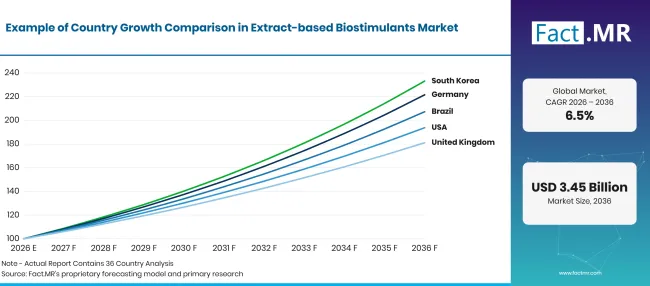
Extract Based Biostimulants Market Growth Index | Source: Fact.MR
| Country | CAGR (2026–2036) |
|---|---|
| Germany | 8.3% |
| Brazil | 7.6% |
| USA | 6.8% |
| UK | 6.1% |
| Japan | 5.4% |
Source: Fact.MR analysis. Updated Oct 28, 2026
What supports Germany adoption?
8.3% CAGR, supported by extensive cereal production and an established agricultural input market.
Germany's agricultural base provides a potential market for crop-specific biostimulant products. According to the German Federal Statistical Office, the country harvested approximately 45.3 million tonnes of grain in 2025, based on its detailed time-series statistics updated in September 2026 [2]. Manufacturers may find opportunities in cereal production and horticulture where trials establish useful product effects.
How is Brazil developing extract-based biostimulant adoption?
7.6% CAGR, driven by a large agricultural production base and multiple crop seasons.
Brazil’s extensive soybean, maize and cotton cultivation supports demand for extract-based biostimulants that help improve nutrient-use efficiency and plant tolerance to abiotic stress. Seaweed extracts and other plant-derived formulations may support root development and physiological processes under water-limited or high-temperature conditions. Commercial adoption depends on crop-specific field-trial results, application timing, formulation compatibility and demonstrated benefits under Brazil’s diverse soil and climatic conditions.
What supports United States adoption?
6.8% CAGR, led by extensive field-crop acreage and commercial interest in crop performance.
The US Department of Agriculture's National Agricultural Statistics Service estimated that 95.3 million acres of corn and 85.4 million acres of soybeans were planted in 2026 [3]. The scale of corn and soybean cultivation establishes a potential application base for extract-based biostimulants, while these planting statistics do not directly measure biostimulant adoption. Adoption depends on demonstrated crop response, compatibility with established farm programs, and the economics of treatment.[3]
How is the United Kingdom building adoption?
6.1% CAGR, shaped by arable farming and the need to manage crop performance under variable conditions.
The UK Department for Environment, Food & Rural Affairs reported a final 2025 wheat harvest of 12 million tonnes [4]. Extract-based products may appeal to growers seeking additional tools for crop stress management and quality. Commercial uptake will depend on field evidence, product suitability, farm economics, and compliance with applicable product requirements.
What supports Japan adoption?
5.4% CAGR, backed by managed rice cultivation and high-value horticultural production.
Japan's Ministry of Agriculture, Forestry and Fisheries reported a 2025 food-rice harvest estimate of approximately 7.181 million tonnes, based on the applicable sieve-width measurement standard [5]. Rice and horticultural production provide potential applications for biostimulants where local trials establish suitable timing and rates. The market's growth will depend on evidence of benefits under Japanese cultivation conditions and the economics of adoption.
Who leads the Extract-based Biostimulants Market?
The company set includes Syngenta Crop Protection AG (Syngenta Biologicals), J.M. Huber Corporation (Biolchim), REKA Group B.V. (biostimulant portfolio; Koppert retains distribution), BASF SE, Gowan Company, L.L.C., UPL Limited. Their relevance differs according to product portfolio, ownership, distribution arrangements, and whether products fall within the extract-based market definition.
Syngenta offers plant-derived biostimulants such as MEGAFOL, which contains selected vegetal extracts. [6]. Koppert transferred management of its biostimulant and fertilizer portfolio to REKA Group in 2025, making it important to distinguish its historical portfolio from current ownership and management arrangements [7]. BASF maintains a dedicated biostimulant portfolio and has announced distribution agreements covering seaweed-based products [8]. Gowan offers Siapton, a natural-origin plant bio-activator based on free amino acids and short-chain peptides. UPL’s NPP Biosolutions portfolio includes biostimulants and other agricultural biologicals [9]; [10].
Which companies are the key providers?
Key companies in the Extract-based Biostimulants Market include Syngenta Crop Protection AG (Syngenta Biologicals); J.M. Huber Corporation (Biolchim); REKA Group B.V. (biostimulant portfolio; Koppert retains distribution); BASF SE; Gowan Company, L.L.C.; UPL Limited.
- Syngenta Crop Protection AG (Syngenta Biologicals)
- J.M. Huber Corporation (Biolchim)
- REKA Group B.V. (biostimulant portfolio; Koppert retains distribution)
- BASF SE
- Gowan Company, L.L.C.
- UPL Limited
Bibliography
- [1] Companhia Nacional de Abastecimento. (2026, September 15). Conab estima produção de 361,7 milhões de toneladas de grãos na safra 2025/26. Conab source
- [2] Statistisches Bundesamt (Destatis). (2026, September 2). Anbauflächen, Hektarerträge und Erntemengen ausgewählter Anbaukulturen im Zeitvergleich. Destatis source
- [3] U.S. Department of Agriculture, National Agricultural Statistics Service. (2026, June 30). Corn planted acreage down 3% from 2025, soybean acreage up 5% from last year. USDA NASS source
- [4] Department for Environment, Food & Rural Affairs. (2026, October 8). Cereal and oilseed production in the United Kingdom 2025. GOV.UK. DEFRA source
- [5] Ministry of Agriculture, Forestry and Fisheries. (2025, December 23). [Rice newsletter, issue 142]. MAFF source
- [6] Syngenta. (n.d.). Biologicals blockbuster products. Syngenta source
- [7] Koppert. (2025, March 19). Koppert transfers its biostimulant and fertilizer portfolio to REKA. Koppert source
- [8] BASF. (n.d.). Biostimulants. BASF Agricultural Solutions. BASF source
- [9] Gowan Company. (n.d.). Siapton®. Gowan source
- [10] UPL Limited. (n.d.). NPP Biosolutions. UPL source
This Report Answers
- The report describes how extract-based biostimulants are used across the listed agricultural crop categories.
- Segment analysis compares seaweed extracts, plant extracts, humic substances, application methods, crop types, and formulation forms.
- Country analysis discusses Germany, Brazil, the USA, the UK, and Japan alongside official agricultural indicators.
- The competitive overview examines seven companies with relevant agricultural biologicals or biostimulant portfolios.
- Application analysis distinguishes foliar treatment, soil treatment, and seed treatment.
What does the Extract-based Biostimulants Market cover?
The market covers agricultural biostimulant products based on seaweed extracts, plant extracts, and humic substances within the segmentation. These products are used in crop production programs intended to support plant physiological processes, nutrient-use efficiency, stress tolerance, and crop quality. The report distinguishes products by source, application route, crop category, and formulation.
What is included in the scope?
Included products are extract-based agricultural biostimulants marketed for use in crop production and falling within the defined source categories.
The scope covers foliar, soil, and seed treatment applications and the specified crop categories. Product inclusion should be based on the formulation and its intended agricultural function.
What is excluded from the scope?
The analysis excludes products used solely for industrial, cosmetic, pharmaceutical, or human-nutrition purposes.
Conventional fertilizers without a qualifying extract-based biostimulant component are excluded from this defined market. Microbial inoculants and biological crop-protection products are excluded unless they also meet the report's extract-based product definition. Agricultural application equipment and unrelated farm machinery are outside the market boundary.
How Was the Analysis Built?
The analysis draws on 120+ sources, 35+ company portfolios, 25+ countries, and more than 20 industry interviews.
- Primary Research: Primary research includes discussions with manufacturers, service providers, technology developers, distributors, end users, and subject-matter experts. These conversations examine purchasing priorities, product adoption, operational challenges, approval requirements, competitive positioning, and the factors that influence wider market acceptance.
- Desk Research: Desk research covers government statistics, regulatory publications, company filings, trade data, technical studies, industry associations, standards, public policy, and other authoritative sources. Every source used in the analysis is documented in the bibliography.
- Market Sizing and Forecasting: Market estimates combine historical performance, demand indicators, pricing and volume trends, segment shares, company participation, country-level growth, adoption patterns, investment activity, and barriers to market expansion.
- Data Validation and Update Cycle: Findings are validated by comparing primary interviews with public data, company activity, regulatory changes, trade patterns, and industry developments. Regular updates review new product launches, capacity changes, partnerships, approvals, and shifts in commercial adoption.
Segmentation
What is the report's scope and coverage?
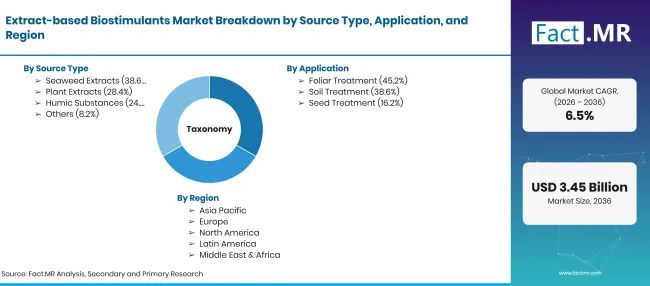
Extract Based Biostimulants Market Taxonomy | Source: Fact.MR
| Attribute | Details |
|---|---|
| Quantitative Units | USD billion |
| Market Definition | The extract-based biostimulants market comprises products derived from seaweed, plants and other biological sources that are applied to seeds, plants or growing media to support natural plant processes, improve nutrient-use efficiency and enhance tolerance to abiotic stress. |
| Source Type | Seaweed Extracts; Plant Extracts; Humic Substances; Others |
| Application | Foliar Treatment; Soil Treatment; Seed Treatment |
| Crop Type | Cereals & Grains; Fruits & Vegetables; Oilseeds & Pulses; Others |
| Form | Liquid; Dry |
| Regions Covered | North America; Latin America; Europe; East Asia; South Asia & Pacific; Middle East & Africa |
| Countries Covered | Germany; Brazil; USA; UK; Japan |
| Companies Profiled | Syngenta Crop Protection AG (Syngenta Biologicals); J.M. Huber Corporation (Biolchim); REKA Group B.V. (biostimulant portfolio; Koppert retains distribution); BASF SE; Gowan Company, L.L.C.; UPL Limited. |
| Forecast Period | 2026 to 2036 |
| Approach | Segment analysis and scenario-based forecasting supported by official agricultural statistics, regulatory publications, and company portfolios |
Source: Fact.MR analysis. Updated Oct 28, 2026
How is the market segmented?
-
By Source Type
- Seaweed Extracts
- Plant Extracts
- Humic Substances
- Others
-
By Application
- Foliar Treatment
- Soil Treatment
- Seed Treatment
-
By Crop Type
- Cereals & Grains
- Fruits & Vegetables
- Oilseeds & Pulses
- Others
-
By Form
- Liquid
- Dry
-
By Region
- North America
- Latin America
- Europe
- East Asia
- South Asia & Pacific
- Middle East & Africa
Frequently Asked Questions
How big is the Extract-based Biostimulants Market in 2026?
What is the CAGR from 2026 to 2036?
Which source type has the largest share?
Which application leads?
Which crop type has the largest share?
Which countries are covered?
Which companies are covered?
Who worked on this report


Preview the report firsthand - request a free sample
Free SampleGet the brochure for pricing and purchase details
Download PDF