- Market Value (2025): USD 38.3 Mn
- Estimated Value (2026): USD 40.0 Mn
- Forecast Value (2036): USD 62.0 Mn
- CAGR (2026-2036): 4.5%
What is the Faceting Handpieces Market forecast to be worth by 2036?
USD 40 million in 2026 to USD 62 million by 2036, at 4.5% CAGR.
- The market reached approximately USD 38.3 million in 2025, reflecting a specialized base of professional cutters, hobbyists, training schools, custom jewelers, and replacement buyers.
- Revenue is projected to increase from USD 40 million in 2026 to USD 62 million in 2036 as cutting activity, skills training, machine refurbishment, and precision upgrades sustain purchases.
- The forecast CAGR of 4.5% from 2026 to 2036 is supported by demand for stable indexing, repeatable angle control, compatible replacements, and better operator ergonomics.
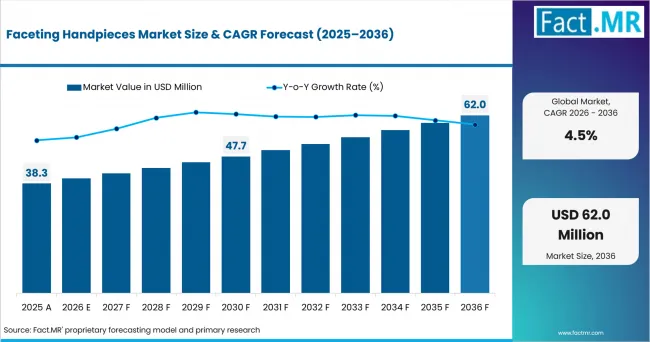
Faceting Handpieces Market Value Analysis | Source: Fact.MR
What are the defining numbers behind Faceting Handpieces Market growth?
USD 22 million absolute opportunity by 2036, led by Precision indexed handpieces and 64-index within their respective segments.
- Demand Drivers in the Market
- Professional cutters need a handpiece that returns reliably to a chosen angle and index position across repeated facets.
- Machine owners often replace or upgrade the head assembly while retaining a sound base, lap, motor, and workbench setup.
- Gem-cutting schools create demand for durable, teachable controls that help students connect index selection with facet symmetry.
- Hobbyists support a broad aftermarket for index gears, dops, transfer fixtures, adapters, and compatible handpiece assemblies.
- Key Segments Analyzed
- By Control Mechanism: Cutting forty or more facets to a common set of meet points requires a mechanism that returns to the identical angle setting every time it is re-engaged; precision indexed handpieces deliver that through a fixed mast-and-index lock, which is why they lead Control Mechanism at 37.0% of demand.
- By Index Gear Type: 64-index leads Index Gear Type at 32.0% of demand. Its 64 teeth divide a full rotation into 5.625-degree steps, a number that splits evenly into the 2-, 4-, 8-, 16- and 32-fold symmetry used by step cuts, checkerboards, and round brilliants alike, covering most commercial-volume cutting patterns with fewer index positions to track than a 96-tooth gear. That simpler math keeps indexing fast on repetitive step-cut and calibrated-stone runs, which is where commercial faceting volume sits.
- By Compatibility: Dedicated faceting machines lead at 44.0% of demand. Cabbing shapes a smooth curved surface with no angle control involved, while faceting fixes every cut to a specific angle and azimuth, work that only the rigid mast, quill, and index-gear lock of a purpose-built faceting frame hold to the tolerance a facet diagram requires.
- By User Type: Professional cutters lead User Type at 36.0% of demand. A hobbyist can finish a single stone well on an entry-level machine, but wholesale and bench-jeweler resale work means repeating the same facet sequence across many rough parcels with identical meet-point placement each time, and that repetition is what pushes professional lapidaries toward precision-indexed equipment.
- By Material: Machined aluminum leads at 34.0% of demand. The alloy runs roughly a third of the weight of brass, holds tolerances to about plus or minus 0.02 millimeters on precision CNC passes, and cuts at 600 to 1,200 surface feet per minute against 150 to 400 SFM for carbon steel, so a handpiece body machines faster and lighter without giving up accuracy. Anodizing further hardens the aluminum's natural oxide layer, which resists the corrosion that water-based cutting slurry causes on unprotected steel over years of bench use.
- Analyst Opinion at Fact.MR
- Shambhu Nath Jha, Senior Analyst at Fact.MR, states, "The handpiece is a tactile precision component, so a specification sheet cannot fully substitute for control feel and repeatability at the lap. Vendors that maintain compatibility, spare parts, clear manuals, and dependable alignment can build unusually durable customer relationships in this market."
- Strategic Implications
- Professional workshops should assess runout, angle repeatability, index engagement, and dop interchange before standardizing on a handpiece.
- Training programs need controls that are sturdy enough for repeated student use and clear enough to demonstrate good cutting habits.
- Machine makers can retain installed-base customers through upgrade paths that do not force replacement of the entire faceting system.
- Distributors should stock the index gears, dops, adapters, bearings, and service parts that keep a precision handpiece productive.
Ultra Tec's V5 platform and published operating guidance show how suppliers are treating the faceting head as a serviceable precision system rather than an isolated accessory. Sachi's handpiece-type machine also demonstrates continuing demand for a control style that differs from the conventional mast-mounted approach.
The United States is projected to expand at a 4.8% CAGR from 2026 to 2036 because professional cutters, custom jewelers, guilds, schools, and committed hobbyists sustain several equipment tiers. Germany follows at 4.6% around Idar-Oberstein's cutting and equipment tradition, and the United Kingdom at 4.5% on a club-organized amateur scene that steadily upgrades. Thailand is forecast at a 4.9% CAGR, where colored-stone trading concentrates experienced commercial users, while Sri Lanka is anticipated to advance at 4.4% through its skilled cutting community.
How does the Faceting Handpieces Market break down by segment?
The leading shares are Precision indexed handpieces at 37.0% by Control Mechanism and 64-index at 32.0% by Index Gear Type.
Why do precision indexed handpieces lead the control-mechanism segment?
At 37.0% share in 2026, the leading position goes to Precision indexed handpieces because defined index positions support symmetry and repeatable facet placement.
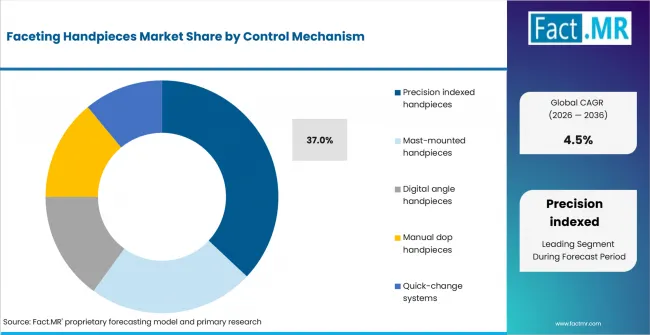
Faceting Handpieces Market Analysis By Control Mechanism | Source: Fact.MR
Precision indexed handpieces hold 37.0% of demand and form the core choice for cutters seeking consistent facet relationships. Mast-mounted handpieces account for 23.0%, anchoring angle and height control to the machine structure. Digital angle handpieces at 15.0%, manual dop handpieces at 14.0%, and quick-change systems at 11.0% emphasize readout, hand-guided technique, or faster workpiece exchange.
What makes the 64-index gear the largest index category?
The 2026 leader is 64-index at 32.0% share because it supports many familiar cutting patterns with a practical number of evenly spaced positions.
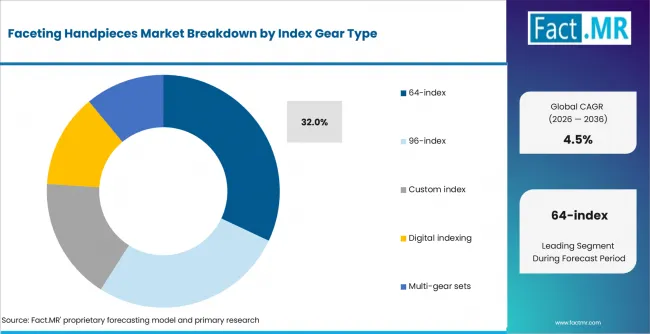
Faceting Handpieces Market Analysis By Index Gear Type | Source: Fact.MR
The 64-index format represents 32.0% of demand and remains widely used for standard designs and teaching. The 96-index gear follows at 27.0%, giving cutters a denser set of divisions for patterns designed around that geometry. Custom index at 17.0%, digital indexing at 13.0%, and multi-gear sets at 11.0% serve cutters who prioritize specialized patterns, electronic guidance, or flexibility.
Why are dedicated faceting-machine handpieces the leading compatibility class?
A 44.0% share puts Dedicated faceting machines first in 2026 because a matched assembly reduces alignment uncertainty and preserves the machine maker's intended geometry.
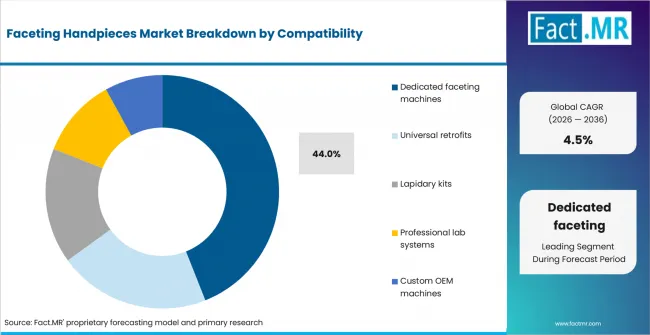
Faceting Handpieces Market Analysis By Compatibility | Source: Fact.MR
Dedicated faceting machines account for 44.0% of compatibility demand, reflecting the importance of a known mechanical fit. Universal retrofits hold 21.0% and appeal to owners extending the life or capability of an existing base. Lapidary kits at 16.0%, professional laboratory systems at 11.0%, and custom OEM machines at 8.0% require different balances of affordability, documentation, and engineered integration.
Why do professional cutters form the largest user segment?
For User Type, the top 2026 position is Professional cutters at 36.0% share because handpiece accuracy and uptime directly affect saleable output and rework.
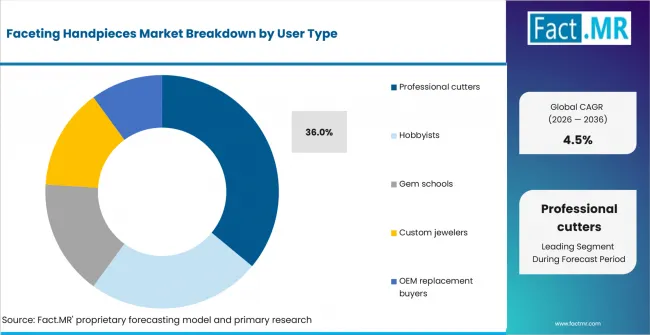
Faceting Handpieces Market Analysis By User Type | Source: Fact.MR
Professional cutters generate 36.0% of demand and place the highest value on repeatability, repair access, and dependable daily operation. Hobbyists account for 24.0%, sustaining varied price points and a strong accessories market. Gem schools at 16.0%, custom jewelers at 14.0%, and OEM replacement buyers at 10.0% differ in fleet durability, occasional-use flexibility, and fit requirements.
Why does machined aluminum lead handpiece material demand?
The leading 2026 share is 34.0% for Machined aluminum because it combines precise machining, manageable weight, corrosion resistance, and practical production cost.
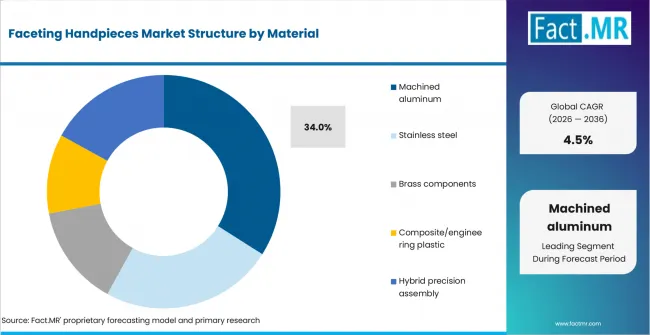
Faceting Handpieces Market Analysis By Material | Source: Fact.MR
Machined aluminum holds 34.0% of the market and suits assemblies where rigidity must be balanced against operator handling. Stainless steel accounts for 24.0%, adding wear resistance and mass in critical components. Hybrid precision assemblies represent 17.0%, brass components 14.0%, and composite or engineering plastic 11.0%, allowing makers to place each material where feel, friction, weight, or cost matters most.
What is accelerating Faceting Handpieces Market adoption, and what is holding it back?
The main accelerator is the need for repeatable facet placement without replacing an entire working machine. The principal restraint is compatibility: even a well-made handpiece has limited value if its geometry, spindle, dops, or mounting arrangement cannot be aligned to the user's system.
Drivers Impact Analysis
| DRIVER | (~) % IMPACT ON CAGR | GEOGRAPHIC RELEVANCE | IMPACT TIMELINE |
|---|---|---|---|
| Precision cutting output | +0.7% | Thailand and Sri Lanka | Medium term (2-4 years) |
| Installed-machine upgrades | +0.6% | United States and established lapidary markets | Short term (<= 2 years) |
| Faceting education | +0.5% | United States and gem-cutting hubs | Medium term (2-4 years) |
| Custom jewelry work | +0.4% | Global artisan clusters | Long term (>= 4 years) |
| Parts and service continuity | +0.3% | Global | Short term (<= 2 years) |
Source: Fact.MR analysis. Updated Jul 17, 2026
- Precision cutting output: Commercial cutters depend on consistent angles and index positions to reduce corrective work. Reliable handpieces therefore contribute to both finish quality and bench productivity.
- Installed-machine upgrades: Many users own bases and motors that remain serviceable after the original head shows wear or feels dated. A compatible upgrade can improve control while preserving the rest of the investment.
- Faceting education: Schools and guilds introduce new cutters to particular control styles and index systems. Equipment used during training can influence later personal or workshop purchases.
Opportunity Impact Analysis
| OPPORTUNITY | (~) % IMPACT ON CAGR | GEOGRAPHIC RELEVANCE | IMPACT TIMELINE |
|---|---|---|---|
| Digital angle retrofits | +0.4% | Professional and advanced hobby markets | Medium term (2-4 years) |
| Quick-change dop systems | +0.3% | Commercial cutting workshops | Short term (<= 2 years) |
| Modular index families | +0.3% | Hobbyist and training channels | Medium term (2-4 years) |
| Regional service partners | +0.2% | Thailand, Sri Lanka, and other gem-cutting centers | Long term (>= 4 years) |
Source: Fact.MR analysis. Updated Jul 17, 2026
- Digital angle retrofits: Digital feedback can help users return to target angles and monitor small adjustments. Retrofit designs have an advantage when they preserve the tactile workflow and fit established machines.
- Quick-change dop systems: Faster, repeatable dop changes can reduce non-cutting time across batches and repairs. The opportunity depends on maintaining alignment after each exchange.
- Modular index families: Interchangeable gears let one handpiece support a wider library of designs. Clear compatibility tables and pattern guidance can turn index options into a meaningful ecosystem.
Restraints Impact Analysis
| RESTRAINT | (~) % IMPACT ON CAGR | GEOGRAPHIC RELEVANCE | IMPACT TIMELINE |
|---|---|---|---|
| Platform incompatibility | -0.3% | Global aftermarket | Short term (<= 2 years) |
| Small specialist customer base | -0.2% | Markets without cutting clusters | Long term (>= 4 years) |
| Used-equipment availability | -0.2% | United States and hobbyist channels | Medium term (2-4 years) |
| Calibration and learning curve | -0.2% | New user markets | Short term (<= 2 years) |
Source: Fact.MR analysis. Updated Jul 17, 2026
- Platform incompatibility: Mounting dimensions, spindle design, dop sizes, index gears, and machine geometry vary across platforms. A nominally universal head may still require skilled adaptation and recalibration.
- Small specialist customer base: Faceting handpieces serve a narrower audience than general jewelry tools. Low local volumes can limit distributor inventory and lengthen parts lead times.
- Used-equipment availability: Durable machines and heads circulate through clubs and resale markets. Refurbished equipment can postpone a new purchase when buyers have access to knowledgeable repair support.
Where is demand for faceting handpieces developing?
United States 4.8% CAGR. Germany 4.6%. United Kingdom 4.5%. Thailand 4.9%. Sri Lanka 4.4%.
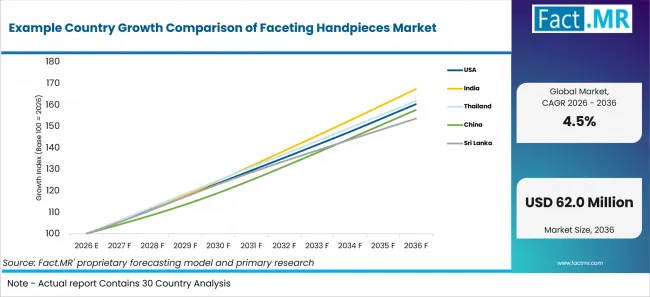
Example Country Growth Comparison Of Faceting Handpieces Market | Source: Fact.MR
Regional analysis addresses North America, Europe, and Asia Pacific, with country sections on the United States, Germany, the United Kingdom, Thailand, and Sri Lanka. More than 30 countries are covered in the complete report.
| COUNTRY | CAGR |
|---|---|
| United States | 4.8% |
| Germany | 4.6% |
| United Kingdom | 4.5% |
| Thailand | 4.9% |
| Sri Lanka | 4.4% |
Source: Fact.MR analysis. Updated Jul 17, 2026
Why does the US market combine handpiece manufacturing with hobbyist demand?
The United States sits on both sides of the faceting handpiece trade.
Ultra Tec runs its own machine shop in Santa Ana, California, cutting parts on computer-controlled equipment rather than importing them, and Graves, Facetron, and Polymetric are likewise American-built brands with decades of production history between them. Replacement index gears, dop arms, and cutting heads for domestic cutters largely move through US supply chains rather than overseas ones. Demand is also spread across a wide amateur base rather than concentrated in a few large cutting houses. Seven regional federations under the American Federation of Mineralogical Societies coordinate several hundred rock and lapidary clubs nationwide, and the annual Tucson Gem and Mineral Show pulls in international rough dealers every February. That mix of domestic manufacturing and dispersed hobbyist purchasing supports the market's 4.8% CAGR from 2026 to 2036.
How did Idar-Oberstein's shift away from mass cutting reshape German demand?
Idar-Oberstein built its reputation over centuries on local agate deposits and later on rough imported from Brazil, developing hundreds of cutting houses at its peak.
Bulk agate cutting has reportedly shifted toward China in recent decades, with quartz cutting now concentrated in Jaipur, leaving Idar-Oberstein's remaining workshops, among them Gebrueder Meelis and Manfred Schwinn, focused on smaller runs of higher-value and unusual material rather than volume output. Some of the town's cutting expertise has moved into adjacent fields entirely. Klein & Becker, founded in Idar-Oberstein in 1934, now machines precision sapphire and ruby components for optical and medical-device manufacturers rather than gem dealers. That shift toward specialized, technically demanding work lines up with a German market growing at 4.6% CAGR from 2026 to 2036.
Why does UK demand stay concentrated in small clubs and training bodies rather than a production hub?
UK lapidary activity is scattered across small membership organizations rather than built around a national cutting center.
The Scottish Mineral and Lapidary Club in Edinburgh is the country's oldest such group, the Kingston Lapidary Society was the first founded in England, and the Sidcup Lapidary and Mineral Society has run for 40 years. Skills exchange and mentoring inside these clubs, more than factory-scale output, account for much of the country's cutting activity. Commercial cutting persists in small workshops, including Birmingham Stone Cutting in Birmingham's Jewellery Quarter, alongside London-based Gem-A, the Gemmological Association of Great Britain, whose gemmology course traces to a proposal made by Peterborough jeweller Samuel Barnett in 1908. The Diploma is now taught in person at Accredited Teaching Centres in 19 countries, alongside online study, sustaining a working base of UK-trained cutters and supporting the market's 4.5% CAGR from 2026 to 2036.
Why does Thailand post the highest CAGR of the five countries at 4.9%?
Chanthaburi has functioned as Thailand's principal cutting and treatment center for more than a century, sourcing rough after domestic mines were exhausted: rubies mainly from Mozambique, Madagascar, and Myanmar, sapphires from Sri Lanka and Madagascar.
The Gem and Jewelry Institute of Thailand, the government's national gemstone-testing authority established in 1989, estimates that more than 80% of gemstones traded internationally, particularly rubies and sapphires, have undergone enhancement in Chanthaburi. That volume, combined with furnace-based heat treatment run at 1,600 to 1,800 degrees Celsius to improve corundum color, calls for cutting equipment built for continuous commercial use rather than occasional hobbyist sessions. The scale of Chanthaburi's processing is the clearest reason Thailand carries the highest CAGR among the five countries, at 4.9% from 2026 to 2036.
How does Sri Lanka's restriction on rough gem exports shape equipment demand?
Ratnapura, whose name translates to "city of gems," anchors Sri Lanka's mine-to-market trade, with streets of cutters and polishers working alongside rough dealers.
Many still use the hanaporuwa, a bow-driven lap wheel worked by hand, though formal instruction, started at the Ratnapura Gem Bureau in the early 1970s under Badra Marapana, combined traditional Sri Lankan methods with Japanese and European technique to train later generations of cutters. Sri Lanka restricts the export of rough gemstones as a matter of policy: exporters need an Official Gem Dealers License from the National Gem and Jewellery Authority, and government sector strategy documents describe measures to limit rough export in order to capture more value from in-country cutting. Gem and jewelry exports were valued at roughly $381.9 million in 2024. That policy-driven demand floor is consistent with the country's 4.4% CAGR from 2026 to 2036.
Who leads the Faceting Handpieces Market?
Sachi, Graves, Ultra Tec, Polymetric, and Facetron compete through control style, precision, installed-base loyalty, accessories, and long-term service.
Sachi leads the source-company set with a 16.0% share, followed by Graves at 11.0% and Ultra Tec at 9.0%. Their positions reflect different regional traditions and platform preferences, including handpiece-type and mast-based approaches.
Polymetric holds 7.0% and Facetron accounts for 5.0%. In this specialist category, the surrounding ecosystem of dops, index gears, manuals, repairs, upgrades, and experienced user communities can protect a supplier long after the original equipment sale.
Which companies are the key providers?
The company set includes Sachi, Graves, Ultra Tec, Polymetric, and Facetron.
- Sachi
- Graves
- Ultra Tec
- Polymetric
- Facetron
The named makers anchor the comparison, while the complete report reviews more than 30 companies across faceting machines, handpieces, and lapidary accessories.
Bibliography
- Sachi. (n.d.). Handpiece Type Faceting Machine.
- Ultra Tec. (n.d.). Frequently Asked Questions.
- Ultra Tec. (n.d.). V5 Faceting Machine Manual.
- Ultra Tec. (n.d.). V5 Analog Faceting Machine.
- Facetron. (n.d.). The Facetron.
- Polymetric. (n.d.). Faceting Equipment.
- United States Faceters Guild. (n.d.). Faceting Machines.
This Report Addresses
- The report establishes a 2025 baseline and forecasts faceting handpiece revenue through 2036.
- It compares the United States, Germany, the United Kingdom, Thailand, and Sri Lanka, drawing on country coverage of more than 30 markets.
- It examines the competitive positions of Sachi, Graves, Ultra Tec, Polymetric, and Facetron.
- It evaluates indexed, mast-mounted, digital, manual, and quick-change control mechanisms.
- It separates professional, hobby, school, custom-jewelry, and OEM replacement demand.
- It validates growth against cutting activity, training, compatibility, upgrades, service, and equipment longevity.
What does the Faceting Handpieces Market cover?
The study isolates the precision handpiece and head assembly within the wider gemstone faceting equipment system.
Revenue covers complete handpieces, quills, indexed heads, and bundled mechanical or electronic controls sold as new, replacement, or retrofit assemblies. Dedicated and universal products are modeled separately to account for compatibility and price differences.
Demand is segmented by control mechanism, index gear, compatibility, user, and material. Country estimates reflect cutting clusters, lapidary participation, jewelry production, training access, distribution, and the installed machine base.
What is included in the scope?
Included assemblies must control dop position, angle, or indexing during gemstone faceting.
Precision indexed heads, mast-mounted units, hand-held dop controls, digital-angle assemblies, and quick-change systems are included. Machined aluminum, stainless steel, brass, composite, and hybrid constructions remain within scope.
Bundled index gears, dops, cheater or fine-adjustment mechanisms, adapters, and electronic readouts are counted in the delivered handpiece value. Replacement units sold by an OEM or independent supplier are both included.
What is excluded from the scope?
The broader faceting machine and consumables market is not counted as handpiece revenue.
Motors, laps, splash pans, bases, water systems, polishing compounds, cutting media, transfer fixtures sold alone, trim saws, and unrelated lapidary tools are excluded. Used handpieces and stand-alone repair services do not enter the new-product model.
How was the analysis built?
Equipment catalogs, workshop interviews, lapidary-channel evidence, and forecast cross-checks spanning 30+ countries.
- Primary Research: Primary research covers professional gemstone cutters, lapidary hobbyists, instructors, custom jewelers, machine manufacturers, repair technicians, and specialist distributors. Interviews examine control feel, repeatability, index preferences, compatibility, wear, downtime, upgrade motives, and price.
- Desk Research: Desk work reviews official machine manuals, manufacturer product pages, compatibility information, guild resources, and service guidance. Product-specific statements are used only where the named supplier or an official industry body documents them.
- Market-Sizing and Forecasting: The model estimates handpiece shipments and realized prices across dedicated heads, universal retrofits, educational kits, laboratory systems, and custom OEM assemblies. It reconciles these streams to USD 40 million in 2026 and USD 62 million in 2036.
- Data Validation and Update Cycle: Validation compares control-mechanism, index, user, and country splits with practitioner and channel feedback. Updates track platform launches, retrofit availability, parts continuity, training activity, gem-cutting output, and resale substitution.
Segmentation
What is the report's scope and coverage?
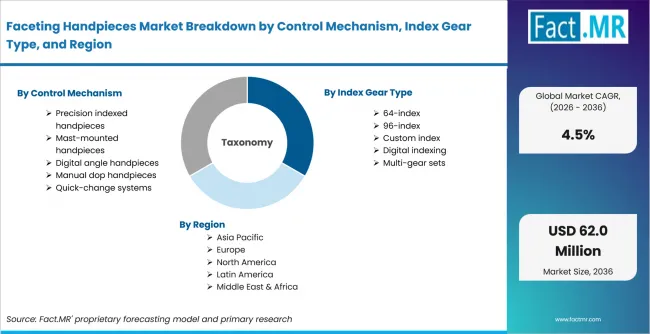
Faceting Handpieces Market Breakdown By Control Mechanism Index Gear Type And Region | Source: Fact.MR
| ATTRIBUTE | DETAILS |
|---|---|
| Quantitative Units | USD million in 2026 to USD million by 2036 |
| Market Definition | The market covers faceting handpieces, quills, indexed head assemblies, and replacement or upgrade control units used to hold and position a dop against a gemstone faceting lap. |
| Control Mechanism | Precision indexed handpieces; Mast-mounted handpieces; Digital angle handpieces; Manual dop handpieces; Quick-change systems |
| Index Gear Type | 64-index; 96-index; Custom index; Digital indexing; Multi-gear sets |
| Compatibility | Dedicated faceting machines; Universal retrofits; Lapidary kits; Professional lab systems; Custom OEM machines |
| User Type | Professional cutters; Hobbyists; Gem schools; Custom jewelers; OEM replacement buyers |
| Material | Machined aluminum; Stainless steel; Brass components; Composite/engineering plastic; Hybrid precision assembly |
| Regions Covered | North America; Europe; Asia Pacific |
| Countries Covered | United States; Germany; United Kingdom; Thailand; Sri Lanka (full report analyzes 30+ countries) |
| Key Companies Profiled | Sachi; Graves; Ultra Tec; Polymetric; Facetron |
| Forecast Period | 2026 to 2036 |
| Approach | Sizing combines new handpiece and head shipments, allocated assembly value in covered machine sales, retrofit demand, realized prices, user growth, and installed-base replacement. |
Source: Fact.MR analysis. Updated Jul 17, 2026
How is the market segmented?
-
By Control Mechanism
- Precision indexed handpieces
- Mast-mounted handpieces
- Digital angle handpieces
- Manual dop handpieces
- Quick-change systems
-
By Index Gear Type
- 64-index
- 96-index
- Custom index
- Digital indexing
- Multi-gear sets
-
By Compatibility
- Dedicated faceting machines
- Universal retrofits
- Lapidary kits
- Professional lab systems
- Custom OEM machines
-
By User Type
- Professional cutters
- Hobbyists
- Gem schools
- Custom jewelers
- OEM replacement buyers
-
By Material
- Machined aluminum
- Stainless steel
- Brass components
- Composite/engineering plastic
- Hybrid precision assembly
-
By Region
- North America
- United States
- Europe
- Germany
- United Kingdom
- Asia Pacific
- Thailand
- Sri Lanka
Frequently Asked Questions
How large is the faceting handpieces market in 2026?
What is the forecast value for 2036?
What CAGR is projected?
Which control mechanism leads?
Which index gear type has the largest share?
What compatibility class dominates?
Who is the largest user group?
Which material leads?
Who worked on this report


Preview the report firsthand - request a free sample
Free SampleGet the brochure for pricing and purchase details
Download PDF