- Market Value (2025): USD 15.1 Bn
- Estimated Value (2026): USD 17.6 Bn
- Forecast Value (2036): USD 81.1 Bn
- CAGR (2026-2036): 16.5%
What is the Artificial Intelligence in Life Sciences Market forecast to be worth by 2036?
USD 17.6 billion in 2026 to USD 81.1 billion by 2036 at 16.5% CAGR.
- The artificial intelligence in life sciences market surpassed a value of USD 15.1 billion in 2025.
- Demand is projected to increase from USD 17.6 billion in 2026 to USD 81.1 billion by 2036.
- The market is forecast to record 16.5% CAGR from 2026 to 2036 as life sciences teams move artificial intelligence into repeated work.
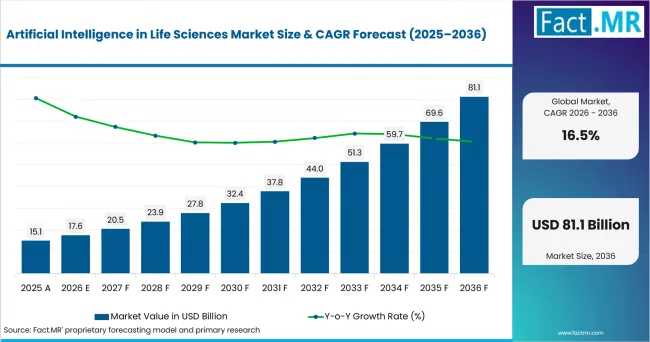
Artificial Intelligence In Life Sciences Market Value Analysis | Source: Fact.MR
What are the defining numbers behind Artificial Intelligence in Life Sciences Market growth?
USD 63.7 billion absolute opportunity by 2036.
- Demand Drivers in the Market
- Pharmaceutical research teams need faster target and compound ranking because laboratory time remains limited.
- Clinical development teams need current site and patient data before protocol choices move forward.
- Precision medicine programs need traceable genomic evidence so patient subgroups remain reviewable.
- Key Segments Analyzed
- By AI Solution: Drug Discovery Platforms are expected to hold 40% share in 2026 as target identification and lead optimization remain the clearest early uses.
- By Life Sciences Function: Drug Discovery & Development is projected to account for 39% share in 2026 since model outputs can guide experiments.
- By Application Area: Pharmaceutical Research is anticipated to capture 42% share in 2026 as drug programs use artificial intelligence for evidence review.
- By End User: Pharmaceutical Companies are estimated to represent 44% share in 2026 owing to research budgets and proprietary data.
- By Artificial Intelligence Technology: Machine Learning is forecast to account for 39% share in 2026 through use in molecular data and clinical records.
- Analyst Opinion at Fact.MR
- Shambhu Nath Jha, Principal Consultant at Fact.MR, states, “Life sciences buyers are not buying artificial intelligence as a stand-alone model. They are funding systems that turn scientific questions into traceable evidence. Clear validation and accountable human decisions remain central.”
- Strategic Implications
- Pharmaceutical companies gain clearer control by defining the decision and evidence standard before models enter regulated work.
- Clinical teams can evaluate predictions against real site capacity before applying them to protocol planning.
- Precision medicine teams benefit from preserving data history so genomic and biomarker findings remain reviewable.
The USA leads at 17.9% CAGR through pharmaceutical R&D scale and governed artificial intelligence adoption. The UK follows at 17.2% through clinical research depth. Germany reaches 16.6% and Switzerland records 16.0%. Japan posts 15.5% as Singapore reaches 14.9%. Canada advances at 14.3% through 2036, completing the profiled range.
How does the Artificial Intelligence in Life Sciences Market break down by segment?
Drug Discovery Platforms are expected to lead AI Solution at 40% share in 2026. Drug Discovery & Development is projected to lead Life Sciences Function at 39% share in 2026.
Which AI Solution dominates?
Drug Discovery Platforms hold 40% share in 2026.
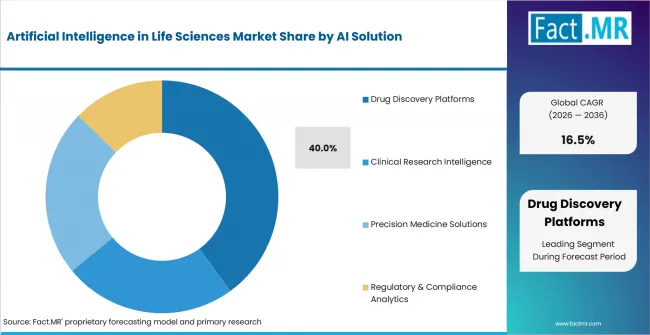
Artificial Intelligence In Life Sciences Market Analysis By Ai Solution | Source: Fact.MR
Drug Discovery Platforms lead the AI Solution segment by placing output near target selection. Research teams use these platforms before they commit scarce laboratory time.
What leads the Life Sciences Function segment?
Drug Discovery & Development holds 39% share in 2026.
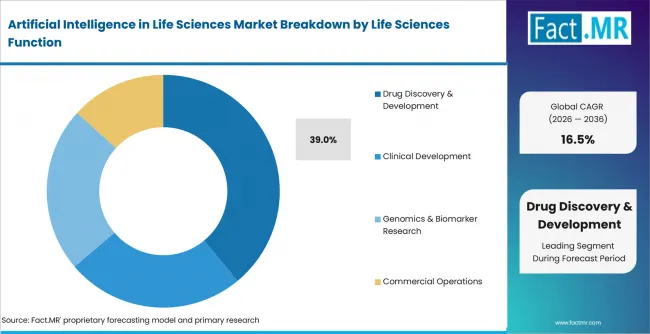
Artificial Intelligence In Life Sciences Market Analysis By Life Sciences Function | Source: Fact.MR
Drug Discovery & Development leads where researchers can compare system output with experiments. That makes the function easier to own and test.
Which Application Area leads?
Pharmaceutical Research holds 42% share in 2026.
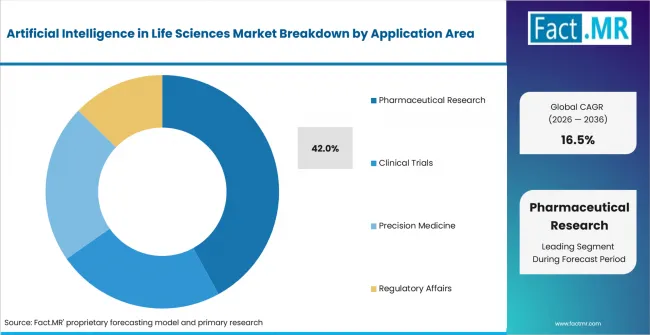
Artificial Intelligence In Life Sciences Market Analysis By Application Area | Source: Fact.MR
Pharmaceutical Research leads because drug and biologics programs compare targets many times. Assay evidence and portfolio priority guide these choices.
Why do Pharmaceutical Companies lead End User demand?
Pharmaceutical Companies hold 44% share in 2026.
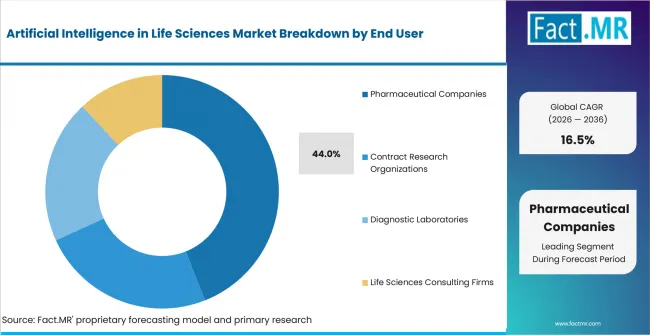
Artificial Intelligence In Life Sciences Market Analysis By End User | Source: Fact.MR
Pharmaceutical Companies lead End User demand because they control research budgets and proprietary data. Their laboratories create a clear need for governance.
Which Artificial Intelligence Technology leads?
Machine Learning holds 39% share in 2026.
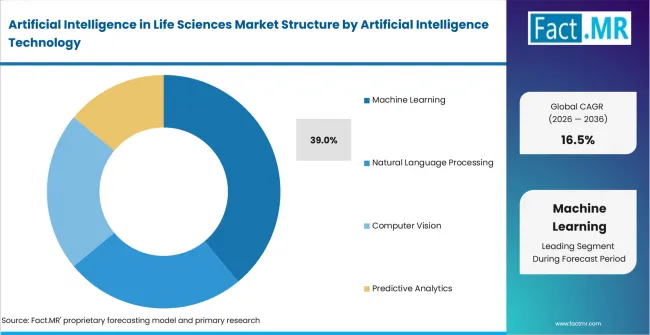
Artificial Intelligence In Life Sciences Market Analysis By Artificial Intelligence Technology | Source: Fact.MR
Machine Learning leads because supervised learning and deep learning are familiar to scientific teams. These methods can rank molecules and classify images.
What is accelerating Artificial Intelligence in Life Sciences Market adoption, and what is holding it back?
Governed biomedical data and workflow integration are anticipated to support adoption. Validation burden and fragmented data are expected to slow wider use.
Drivers Impact Analysis
| DRIVER | COMMERCIAL EFFECT | GEOGRAPHIC RELEVANCE | IMPACT TIMELINE |
|---|---|---|---|
| AI-ready biomedical and clinical data programs | Supports adoption | North America and Europe | Medium term (2-4 years) |
| Drug discovery and preclinical workflow integration | Supports adoption | USA, UK, Germany, and Switzerland | Medium term (2-4 years) |
| Clinical trial optimization and patient matching | Supports adoption | USA, UK, and Japan | Short to medium term |
| Precision medicine and multi-omics analysis | Supports adoption | USA, Switzerland, and Canada | Long term (>= 4 years) |
| Regulatory guidance for defined AI contexts of use | Supports adoption | USA, Europe, and UK | Short term (<= 2 years) |
Source: Fact.MR analysis. Updated Aug 5, 2026
- AI-ready data infrastructure: Life sciences systems need usable metadata and data history.
- Defined regulatory expectations: Sponsors are expected to separate exploratory tools from systems used for regulated decisions.
- Discovery workflow integration: Platforms become useful when outputs guide assay design and preclinical review.
Opportunity Impact Analysis
| OPPORTUNITY | COMMERCIAL EFFECT | GEOGRAPHIC RELEVANCE | IMPACT TIMELINE |
|---|---|---|---|
| Integrated discovery-to-development platforms | Expands addressable workflows | Global pharmaceutical R&D hubs | Medium term (2-4 years) |
| Trial intelligence for protocol, site, and recruitment decisions | Expands operational use | USA, UK, Japan, and Canada | Medium term (2-4 years) |
| Multi-modal precision medicine systems | Expands research use | Switzerland, USA, and Canada | Long term (>= 4 years) |
| Regulatory and safety document automation | Expands recurring enterprise use | Europe and North America | Short to medium term |
Source: Fact.MR analysis. Updated Aug 5, 2026
- Workflow breadth: Providers that cover discovery and clinical tasks are expected to create repeated use across teams.
- Evidence management: Buyers are expected to prefer platforms that retain decision history from target review into study design and regulatory documents.
Restraints Impact Analysis
| RESTRAINT | COMMERCIAL EFFECT | GEOGRAPHIC RELEVANCE | IMPACT TIMELINE |
|---|---|---|---|
| Model credibility and context-of-use validation | Slows approval | Global regulated life sciences | Short to medium term |
| Fragmented and non-interoperable biomedical data | Raises integration cost | Global | Medium term (2-4 years) |
| Privacy, consent, and cross-border data controls | Limits data reuse | Europe, Switzerland, and Canada | Medium term (2-4 years) |
| Limited reproducibility and model-change governance | Delays scale-up | Global research and regulatory teams | Long term (>= 4 years) |
Source: Fact.MR analysis. Updated Aug 5, 2026
- Validation burden: A system that performs well during development can fail when data or patient groups change.
- Data fragmentation: Biomedical and clinical information often remains spread across laboratory and trial systems.
- Lifecycle governance: Model changes need documentation and monitoring before buyers use outputs in regulated workflows.
Which countries are scaling Artificial Intelligence in Life Sciences Market fastest?
- The country comparison spans 3.6 percentage points across the forecast period.
- The USA remains 0.7 percentage point above the UK through pharmaceutical R&D scale and governed adoption pathways.
- The UK remains 0.6 percentage point above Germany as medicines-regulation experimentation supports clinical research intelligence.
- Germany remains 0.6 percentage point above Switzerland with pharmaceutical research and disciplined validation practices.
- Switzerland remains 0.5 percentage point above Japan due to pharmaceutical concentration and precision medicine use.
- Japan remains 0.6 percentage point above Singapore through coordinated medical research and translational science programs.
- Singapore remains 0.6 percentage point above Canada with compact translational infrastructure and regional partnerships.
Comparable CAGRs can create different entry conditions because each country has a different mix of research scale and data governance. Full report coverage includes North America and Latin America. Europe and East Asia are covered. South Asia and Pacific appear with Middle East and Africa.
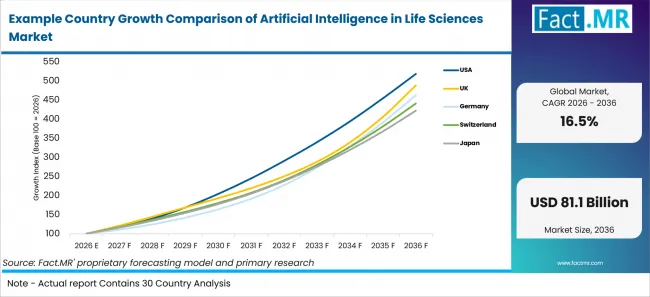
Example Country Growth Comparison Of Artificial Intelligence In Life Sciences Market | Source: Fact.MR
| Country | CAGR (2026-2036) |
|---|---|
| USA | 17.9% |
| UK | 17.2% |
| Germany | 16.6% |
| Switzerland | 16.0% |
| Japan | 15.5% |
| Singapore | 14.9% |
| Canada | 14.3% |
Source: Fact.MR analysis. Updated Aug 5, 2026
What supports USA adoption?
17.9% CAGR, supported by pharmaceutical R&D scale and evolving artificial intelligence governance.
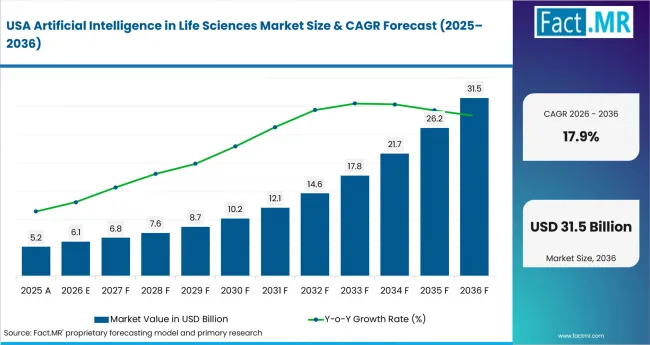
Artificial Intelligence In Life Sciences Market Country Value Analysis | Source: Fact.MR
The USA reflects a market in which buyers ask for traceable outputs before using artificial intelligence in discovery and regulatory work. Platform providers gain when they can prove performance within a clear use case.
How is the UK scaling demand?
17.2% CAGR, led by clinical research depth and medicines-regulation experimentation.
The UK builds demand through research institutions and medicines development programs. Vendors need clear evidence packages before research pilots become recurring purchases.
What supports Germany's outlook?
16.6% CAGR, shaped by pharmaceutical research and disciplined validation practices.
Germany benefits from pharmaceutical manufacturing and biotechnology depth. Buyers are expected to demand clear system boundaries before enterprise expansion.
How is Switzerland developing demand?
16.0% CAGR, attributable to pharmaceutical concentration and precision medicine infrastructure.
Switzerland combines global pharmaceutical headquarters with universities and hospitals. Adoption is expected to favor tools that protect sensitive data and preserve reviewable evidence.
What underpins Japan's growth?
15.5% CAGR, supported by coordinated medical research and pharmaceutical development.
Japan has a large pharmaceutical base and a research system that works closely with medical institutions. Providers with clear documentation are better placed to support Japanese programs.
What supports Singapore's growth?
14.9% CAGR, backed by translational infrastructure and a compact innovation ecosystem.
Singapore brings research institutes close to hospitals and biopharmaceutical manufacturing. Providers are expected to benefit when they support secure data exchange.
How does Canada perform?
14.3% CAGR, driven by artificial intelligence research and genomics capability.
Canada combines machine learning research with genomics and biomedical science. Adoption is expected to depend on privacy requirements and multi-institution proof.
Who leads the Artificial Intelligence in Life Sciences Market?
IQVIA Holdings Inc. has direct relevance through clinical research services and healthcare data. Microsoft and Oracle support wider life sciences workflows through cloud tools. IBM and NVIDIA add computing support.
Schrödinger and Tempus AI extend the competitive field through specialist scientific workflows. Insilico Medicine and BenevolentAI add discovery depth.
Which companies are the key providers?
Key companies include IQVIA Holdings Inc., Microsoft Corporation, Oracle Corporation, International Business Machines Corporation, NVIDIA Corporation, Schrödinger, Inc., Tempus AI, Inc., Recursion Pharmaceuticals, Inc., Insilico Medicine, BenevolentAI.
- IQVIA Holdings Inc.
- Microsoft Corporation
- Oracle Corporation
- International Business Machines Corporation
- NVIDIA Corporation
- Schrödinger, Inc.
- Tempus AI, Inc.
- Recursion Pharmaceuticals, Inc.
- Insilico Medicine
- BenevolentAI
Bibliography
- European Medicines Agency. (2024, September 9). Reflection paper on the use of Artificial Intelligence in the medicinal product lifecycle.
- IQVIA. (2025, June 11). IQVIA launches new AI agents for life sciences and healthcare.
- Medicines and Healthcare products Regulatory Agency. (2026, June 9). MHRA launches AI sandbox to accelerate medicines development and improve safety.
- Recursion Pharmaceuticals, Inc. (2024, November 20). Recursion and Exscientia, two leaders in the AI drug discovery space, have officially combined to advance the industrialization of drug discovery.
- U.S. Food and Drug Administration. (2025, January 6). FDA Proposes Framework to Advance Credibility of AI Models Used for Drug and Biological Product Submissions.
This Report Answers
- The report provides strategic intelligence on Artificial Intelligence in Life Sciences across AI Solution and Life Sciences Function choices.
- Segment analysis covers Drug Discovery Platforms and Drug Discovery & Development as the share leaders within the 2026 market structure.
- Country outlook evaluates the USA and UK alongside Germany and Switzerland. Japan and Singapore appear next. Canada completes the growth comparison.
- Competitive analysis profiles IQVIA Holdings Inc. alongside Microsoft Corporation and Oracle Corporation. The review includes specialist discovery and data companies.
- Technology assessment covers Machine Learning and Natural Language Processing alongside Computer Vision and Predictive Analytics.
What does the Artificial Intelligence in Life Sciences Market cover?
Artificial intelligence used for discovery and clinical research. Precision medicine and regulatory workflows are included. Safety and commercial workflows are included where the use case is defined.
The market covers software and cloud tools used to support defined life sciences decisions. Coverage extends to target work and clinical research intelligence.
What is included in the scope?
Artificial intelligence tools used across discovery and development. Precision medicine and regulatory workflows are included. Safety and commercial workflows are included where the use case is defined.
The scope includes Drug Discovery Platforms and Clinical Research Intelligence. Precision Medicine Solutions and Regulatory & Compliance Analytics are included when they support a defined life sciences function.
What is excluded from the scope?
General-purpose artificial intelligence without a defined life sciences workflow remains outside the scope.
The scope excludes pharmaceutical products and therapeutic candidates. General cloud infrastructure is excluded when it is not packaged for a life sciences use case.
How Was the Analysis Built?
The analysis draws on 120+ sources, 35+ company portfolios, 25+ countries, and more than 20 industry interviews.
- Primary Research: Primary research includes discussions with manufacturers, service providers, technology developers, distributors, end users, procurement teams, and subject-matter experts. These conversations examine purchasing priorities, product adoption, operational challenges, approval requirements, competitive positioning, and the factors that influence wider market acceptance.
- Desk Research: Desk research covers government statistics, regulatory publications, company filings, trade data, technical studies, industry associations, standards, public policy, and other authoritative sources. Every source used in the analysis is documented in the bibliography.
- Market Sizing and Forecasting: Market estimates combine historical performance, demand indicators, pricing and volume trends, segment shares, company participation, country-level growth, adoption patterns, investment activity, and barriers to market expansion.
- Data Validation and Update Cycle: Findings are validated by comparing primary interviews with public data, company activity, regulatory changes, trade patterns, and industry developments. Regular updates review new product launches, capacity changes, partnerships, approvals, procurement trends, and shifts in commercial adoption.
Segmentation
What is the report’s scope and coverage?
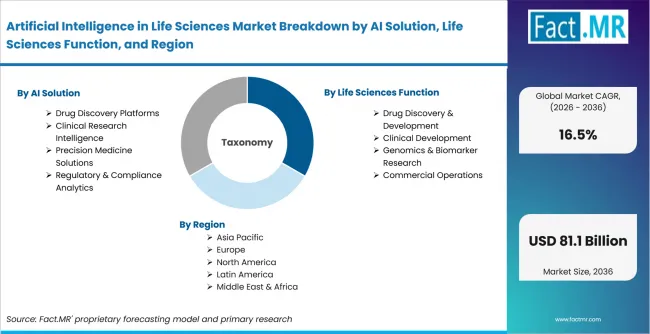
Artificial Intelligence In Life Sciences Market Breakdown By Ai Solution, Life Sciences Function, And Region | Source: Fact.MR
| Attribute | Details |
|---|---|
| Quantitative Units | USD Billion in 2026 to USD Billion by 2036 at CAGR |
| Market Definition | Artificial intelligence software and related services used to support defined scientific, clinical, regulatory, safety, and commercial workflows across life sciences organizations |
| AI Solution | Drug Discovery Platforms; Clinical Research Intelligence; Precision Medicine Solutions; Regulatory & Compliance Analytics |
| Life Sciences Function | Drug Discovery & Development; Clinical Development; Genomics & Biomarker Research; Commercial Operations |
| Application Area | Pharmaceutical Research; Clinical Trials; Precision Medicine; Regulatory Affairs |
| End User | Pharmaceutical Companies; Contract Research Organizations; Diagnostic Laboratories; Life Sciences Consulting Firms |
| Artificial Intelligence Technology | Machine Learning; Natural Language Processing; Computer Vision; Predictive Analytics |
| Regions Covered | North America; Latin America; Europe; East Asia; South Asia and Pacific; Middle East and Africa |
| Countries Covered | USA; UK; Germany; Switzerland; Japan; Singapore; Canada |
| Key Companies Profiled | IQVIA Holdings Inc.; Microsoft Corporation; Oracle Corporation; International Business Machines Corporation; NVIDIA Corporation; Schrödinger, Inc.; Tempus AI, Inc.; Recursion Pharmaceuticals, Inc.; Insilico Medicine; BenevolentAI |
| Forecast Period | 2026 to 2036 |
| Approach | Hybrid top-down and bottom-up approach using life sciences research activity; AI workflow adoption; end-user procurement; validation needs; country growth rates and company portfolio review |
Source: Fact.MR analysis. Updated Aug 5, 2026
How is the market segmented?
-
By AI Solution
- Drug Discovery Platforms
- Clinical Research Intelligence
- Precision Medicine Solutions
- Regulatory & Compliance Analytics
-
By Life Sciences Function
- Drug Discovery & Development
- Clinical Development
- Genomics & Biomarker Research
- Commercial Operations
-
By Application Area
- Pharmaceutical Research
- Clinical Trials
- Precision Medicine
- Regulatory Affairs
-
By End User
- Pharmaceutical Companies
- Contract Research Organizations
- Diagnostic Laboratories
- Life Sciences Consulting Firms
-
By Artificial Intelligence Technology
- Machine Learning
- Natural Language Processing
- Computer Vision
- Predictive Analytics
- Explainable Artificial Intelligence
-
By Region
- North America
- Latin America
- Europe
- East Asia
- South Asia and Pacific
- Middle East and Africa
Frequently Asked Questions
How big is the artificial intelligence in life sciences market in 2026?
What is the CAGR of the artificial intelligence in life sciences market from 2026 to 2036?
Which AI solution leads the artificial intelligence in life sciences market?
Which end-user segment leads the artificial intelligence in life sciences market?
Who are the leading companies in the artificial intelligence in life sciences market?
Who worked on this report


Preview the report firsthand - request a free sample
Free SampleGet the brochure for pricing and purchase details
Download PDF